
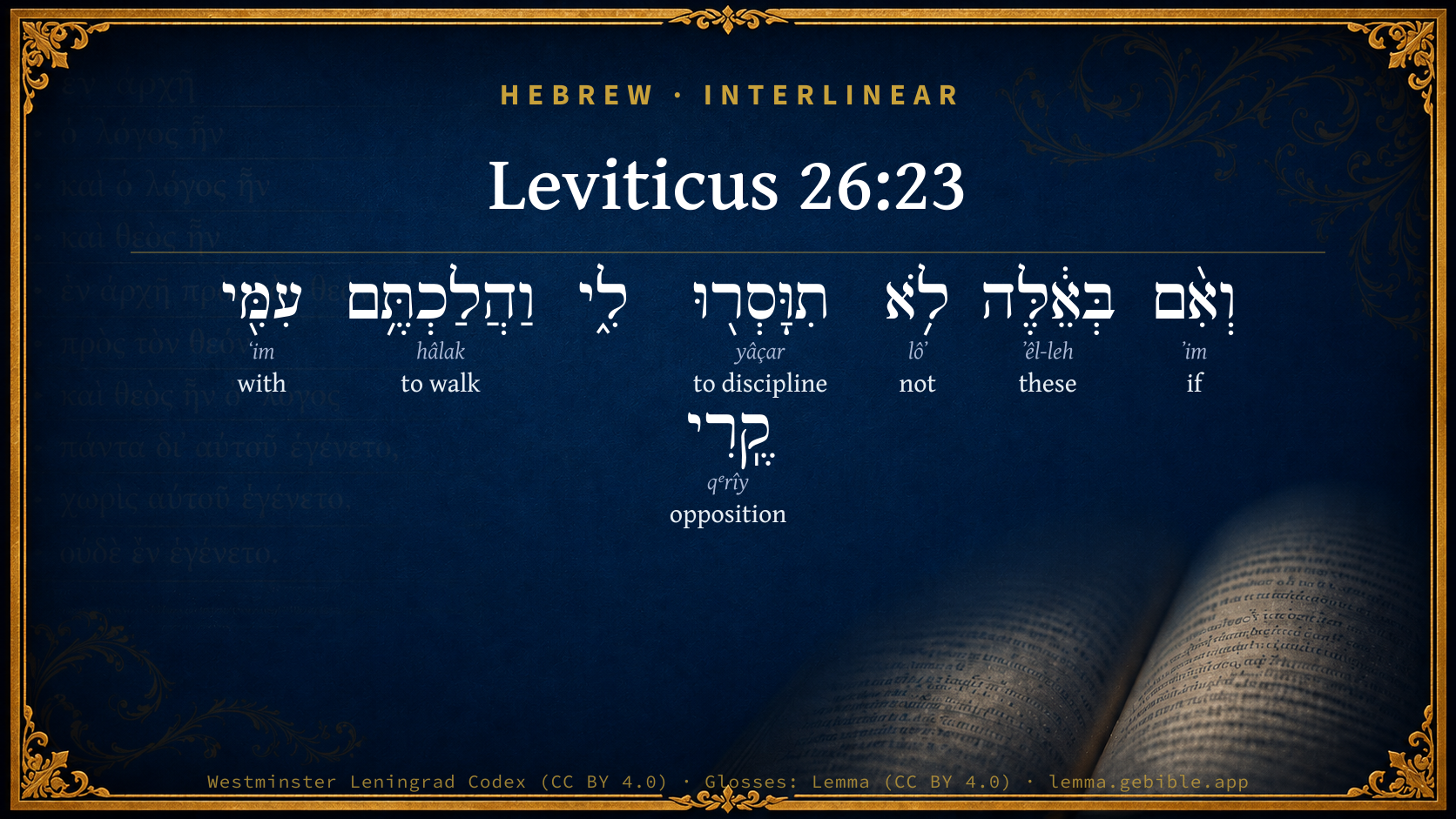
Leviticus 26:23

Hebrew (Westminster Leningrad Codex) Leviticus 26:23 appears in the Hebrew Old Testament. The text above is from the Westminster Leningrad Codex. Each word links to its Strong’s number, a concise gloss, and parsing drawn from the Open Scriptures Hebrew Bible morphology. Click any word for its full Brown-Driver-Briggs (BDB) entry.
Download image
Cite this verse

Leviticus 26:23 (World English Bible). Public Domain. Lemma interlinear Bible study tool, https://lemma.gebible.app/v/leviticus/26/23.

Show BibTeX & RIS
BibTeX
RIS
English Translation
"'If by these things you won't be reformed to me, but will walk contrary to me;
World English Bible · Public Domain
Download a study sheet

One document with this verse’s original text, its word-by-word gloss line, the meaning frame, cross-references with their text, attributed commentary, and full source and license credits — printable, and it pastes into notes with its structure intact.

This verse Autodidact and up

Study sheet (.html) Plain text (.txt)

A passage Seminary Student

Up to 50 verses in one chapter. A passage sheet keeps up to 6 commentary sources and 12 cross-references per verse, in the order this page ranks them, and says so on the sheet whenever that leaves anything out. Ask for a single verse and you get the Autodidact verse sheet above.

Everything on this page stays free to read, with no account — the sheet is a download of what is already on screen, not access to it.

Want to remove ads? Support Godless Engineer
Compare translations 3

The same verse in 3 English versions, stacked beneath the original-language interlinear above. Click any original word for its lexicon entry.

Each is an independent rendering of the whole verse — the interlinear is not word-aligned to these translations.

Highlighted words mark where these versions differ — a whole-verse word diff, not a word-by-word alignment.

  • World English Bible Public Domain
    "'If by these things you won't be reformed to me, but will walk contrary to me;
  • King James Version Public Domain
    And if ye will not be reformed by me by these things, but will walk contrary unto me;
  • unfoldingWord Literal Text CC BY-SA 4.0
    And if by these you will not accept my discipline but walk with me hostility,

unfoldingWord Literal Text — © unfoldingWord, licensed CC BY-SA 4.0. Word-aligned USFM3 via Door43 (git.door43.org/unfoldingWord/en_ult).

Versions to compare (up to 4)

3 of 4 selected

Show all 18 translations

Every available English version of this verse, each an independent rendering of the whole verse.

  • World English Bible Public Domain
    "'If by these things you won't be reformed to me, but will walk contrary to me;
  • Berean Standard Bible Public Domain
    And if in spite of these things you do not accept My discipline, but continue to walk in hostility toward Me,
  • Majority Standard Bible Public Domain
    And if in spite of these things you do not accept My discipline, but continue to walk in hostility toward Me,
  • King James Version Public Domain
    And if ye will not be reformed by me by these things, but will walk contrary unto me;
  • American Standard Version (1901) Public Domain
    And if by these things ye will not be reformed unto me, but will walk contrary unto me;
  • Revised Version (1885) Public Domain
    And if by these things ye will not be reformed unto me, but will walk contrary unto me;
  • Geneva Bible (1599) Public Domain
    Yet if by these ye will not be reformed by me, but walke stubburnly against me,
  • Douay-Rheims (1899) Public Domain
    And if even so you will not amend, but will walk contrary to me:
  • Young's Literal Translation Public Domain
    `And if by these ye are not instructed by Me, and have walked with Me `in' opposition,
  • Literal Standard Version CC BY-SA 4.0
    And if by these you are not instructed by Me, and have walked with Me [in] opposition,
  • Unlocked Literal Bible CC BY-SA 4.0
    If in spite of these things you still do not accept my correction and you continue to walk in opposition to me,
  • unfoldingWord Literal Text CC BY-SA 4.0
    And if by these you will not accept my discipline but walk with me hostility,
  • Darby Bible Public Domain
    And if ye will not be disciplined by me through these, but walk contrary unto me,
  • World Messianic Bible Public Domain
    “‘If by these things you won’t be turned back to me, but will walk contrary to me,
  • Webster's Bible Public Domain
    And if ye will not be reformed by me by these things, but will walk contrary to me;
  • Free Bible Version CC BY-SA 4.0
    However, if in spite of all this correction you still don't change but go on opposing me,
  • Bible in Basic English Public Domain
    And if by these things you will not be turned to me, but still go against me;
  • JPS Tanakh (1917) Public Domain
    And if in spite of these things ye will not be corrected unto Me, but will walk contrary unto Me;

Literal Standard Version (2020), Covenant Press — licensed CC BY-SA 4.0. Text via the HelloAO Bible API (eBible.org). Unlocked Literal Bible (unfoldingWord) — licensed CC BY-SA 4.0. Text via the HelloAO Bible API (eBible.org). unfoldingWord Literal Text — © unfoldingWord, licensed CC BY-SA 4.0. Word-aligned USFM3 via Door43 (git.door43.org/unfoldingWord/en_ult). Free Bible Version, Dr. Jonathan Gallagher — licensed CC BY-SA 4.0. Text via the HelloAO Bible API (eBible.org).

Word by word

More ways to search: Search by grammar → Find every occurrence → Compare this word →

Practice this passage: Drill this verse → Learn its vocabulary →

About this verse

These counts appear in no published source. They are computed here, from the morphology-tagged text and Lemma’s own curated glosses. What Lemma adds →

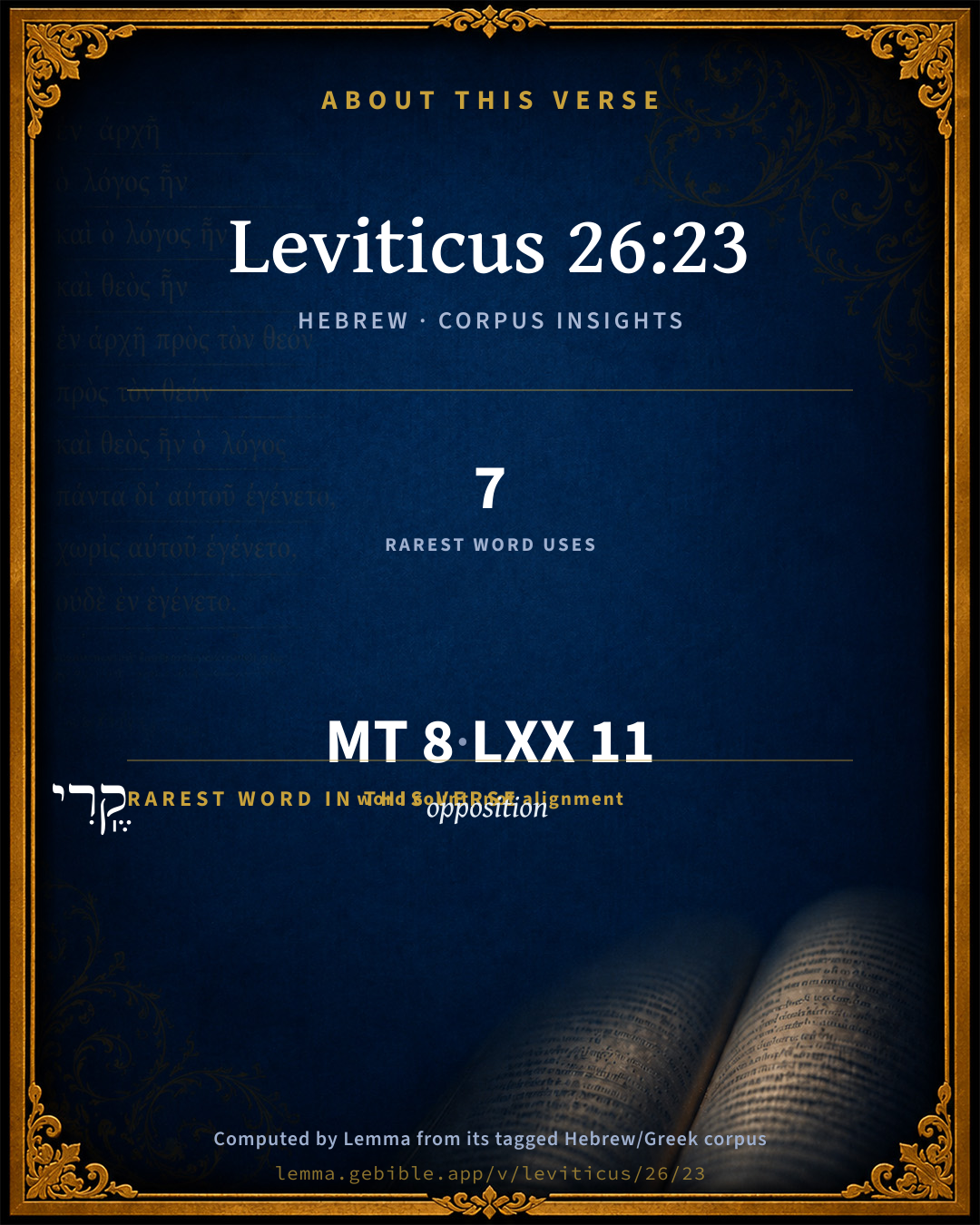
8
words
7
distinct lemmas
Pentateuch
section

Notable vocabulary

The rarest word here is קֶֽרִי opposition H7147 — appearing just 7 times in the whole Hebrew Bible.

Shared distinctive vocabulary

קֶֽרִי opposition H7147 occurs in 7 verses of the Hebrew Bible. Also found in:

Grammatical profile

  • 2 verbs
  • 1 noun
  • 1 pronoun
  • 2 prepositions
  • 1 conjunction
  • 1 particle

Verb forms

  • תִוָּסְר֖וּ Niphal · Imperfect
  • וַהֲלַכְתֶּ֥ם Qal · Sequential Perfect

Hebrew & Septuagint length

In English translation the verse runs 16 words from the Hebrew and 12 from the Septuagint (LXX English) — closely comparable.

A rough comparison of the two English renderings, which tokenize alike — not a word-level alignment.

Word counts can differ between the Hebrew and the Greek without any difference in meaning — e.g. the Hebrew direct-object marker אֵת has no separate Greek word, and Greek often adds the article ὁ.

In the original languages it is 8 Hebrew tokens and 11 Greek tokens — but the two are counted differently (Hebrew bundles its prefixes and suffixes into one token; the Greek is in lemma form), so that isn’t a like-for-like length.

Cross-references

6

Topical passages linked to Leviticus 26:23 in the Treasury of Scripture Knowledge — connected by theme and wording, ordered by reader-vote popularity; previews shown in the World English Bible.

  • Jeremiah 5:3 O Yahweh, don't your eyes look on truth? you have stricken them, but they were not grieved; you have consumed them, but they have refused to receive correction: they have made their faces harder than a rock; they have refused to return.
  • Jeremiah 2:30 In vain have I struck your children; they received no correction: your own sword has devoured your prophets, like a destroying lion.
  • Amos 4:6–12 "I also have given you cleanness of teeth in all your cities, And lack of bread in every town; Yet you haven't returned to me," says Yahweh.
  • Leviticus 26:21 "'If you walk contrary to me, and won't listen to me, then I will bring seven times more plagues on you according to your sins.
  • Isaiah 1:16–20 Wash yourselves, make yourself clean. Put away the evil of your doings from before my eyes; Cease to do evil.
  • Ezekiel 24:13–14 In your filthiness is lewdness: because I have cleansed you and you weren't cleansed, you shall not be cleansed from your filthiness any more, until I have caused my wrath toward you to rest.

Cross-references courtesy of OpenBible.info (CC BY 4.0).

Hebrew and Greek witnesses Masoretic Hebrew ↔ Greek Septuagint

The same verse in the two great witnesses to the Old Testament, shown verse-for-verse.

These are two independent witnesses, not word-aligned to each other, and the Septuagint is shown in lemma (dictionary) form.

Hebrew Leviticus 26:23 Masoretic · Westminster Leningrad Codex

וְאִ֨ם בְּאֵ֔לֶּה לֹ֥א תִוָּסְר֖וּ לִ֑י וַהֲלַכְתֶּ֥ם עִמִּ֖י קֶֽרִי

"'If by these things you won't be reformed to me, but will walk contrary to me;

World English Bible · Public Domain

Greek LXX Leviticus 26:23 Septuagint · lemma form

καί ἐπί οὗτος ἐάν μή παιδεύω ἀλλά πορεύομαι πρός ἐγώ πλάγιος

And if hereupon you⌃ are not corrected, but walk perversely towards me,

LXX2012 (modern English Septuagint) · Public Domain

Hebrew: Westminster Leningrad Codex (CC BY 4.0). Greek: Septuagint (public domain); English from LXX2012 (modern English Septuagint) (Public Domain). How the Septuagint differs from the Hebrew →

Targum (Aramaic paraphrase)

2

The Targum is the ancient Jewish Aramaic paraphrase of the Hebrew Scriptures — an interpretive translation, not the Hebrew text itself. Onkelos (literal) and Pseudo-Jonathan (expansive) render the Torah, and Jonathan the Prophets. Coverage is partial: where no permissively-licensed English translation exists for a verse, only the Aramaic is shown. This is verse-level text, not a word-by-word alignment to the Hebrew.

  1. Targum Onkelos Torah (Genesis–Deuteronomy)
    וְאִם בְּאִלֵין לָא תִתְרְדוּן לְמֵימְרִי וּתְהָכוּן קֳדָמַי בְּקַשְׁיוּ

    (no public-domain English translation for this verse)

    Targum Onkelos — Aramaic: “Onkelos Genesis” (public domain); “Onkelos Exodus” (public domain); “Onkelos Leviticus” (public domain); “Onkelos Numbers” (public domain); “Onkelos Deuteronomy” (public domain). English: “Sefaria Community Translation” (CC0 1.0 (public-domain dedication)); “J.W. Etheridge. The Targums of Onkelos and Jonathan Ben Uzziel on the Pentateuch. London: Longmans, Green, 1862” (public domain). Text via Sefaria.

  2. Targum Pseudo-Jonathan Torah (Genesis–Deuteronomy)
    וְאִין בְּאִילֵין מַרְדְוָותָא לָא תִתְרְדוּן קֳדָמַי וְתַהֲכוּן קֳדָמַי בְּעַרְאֵי

    And if by these chastisements ye will not be corrected before Me, but will walk before Me perversely,

    Targum Pseudo-Jonathan — Aramaic: “Targum Jonathan on Genesis” (public domain); “Targum Jonathan on Exodus” (public domain); “Targum Jonathan on Leviticus” (public domain); “Targum Jonathan on Numbers” (public domain); “Targum Jonathan on Deuteronomy” (public domain). English: “The Targum of Jonathan ben Uzziel, trans. J. W. Etheridge, London, 1862” (public domain). Text via Sefaria.

Commentary

Notes on Leviticus 26:23 from classic Christian and Jewish commentators (each source and its license shown beneath its notes). The classic Christian expositions comment on the surrounding passage and are grouped to its opening verse, so a note may address several verses; the Jewish commentaries on the Tanakh (Rashi and others) are per-verse, so they appear only where the commentator wrote on this verse.

Lemma curates 59 commentaries, every one of them public domain or Creative Commons licensed, each selected and text-cleaned for this edition rather than reprinted as found. About our sources →

Ellicott's Commentary for English Readers

(23) And if ye will not be reformed.—The fourth warning (Lev_26:23-26) threatens the rebellious Israelites with a more intensified form of the punishment partially mentioned in the first warning. (See Lev_26:17.)

A Bible Commentary for English Readers, edited by Charles John Ellicott (1878–1897) — public domain. Text from a community e-Sword module.

Trapp's Complete Commentary

John Trapp

Lev 26:23 And if ye will not be reformed by me by these things, but will walk contrary unto me;

Ver. 23. Ye. will not be reformed.] Or chastised. God will master us; but the wicked refuse to receive corrections: like naughty boys they prove more stubborn or more stupid: they stout it out, and will not stoop. When God’s "hand is lifted up they will not see; but they shall see and be ashamed." {Isa 26:11}

John Trapp, A Commentary or Exposition upon All the Books of the Old and New Testament (1647–1656) — public domain. Text from a community e-Sword module.

The Cambridge Bible for Schools and Colleges

gen. ed. J. J. S. Perowne

23. be reformed unto] rather, be disciplined by. See mg.

The Cambridge Bible for Schools and Colleges (gen. ed. J. J. S. Perowne; Cambridge University Press, 1878–1918) — public domain. Text from a community e-Sword module.

John Gill's Exposition

Then I will also walk contrary unto you,.... Opposing himself unto them as their enemy, fighting against them in his providence, whetting his sword, bending his bow, and causing the arrows of his wrath and vengeance to fall upon them; or behaving towards them in a careless and indifferent manner, not regarding what befell them, showing no peculiar concern for them, or as exercising any particular providence over them; but as if everything came by chance to them, which was the language of their actions, if not of their lips:

and will punish you yet seven times for your sins; add fresh corrections, and these greater than before, and more numerous in proportion to their aggravated transgressions.

John Gill's Exposition of the Whole Bible (1746–1763) — public domain (CC PDM 1.0). Text via the HelloAO Bible API.

Whedon's Commentary on the Bible

Daniel D. Whedon

23. If ye will not be reformed — The natural evil, or suffering, entailed in this world by moral evil, or sin, is corrective and not strictly penal. In this life it is of the nature of a purgative in its design; in the life to come it is a punishment, not for the amendment of the convict but for the conservation of the moral order of the universe, and hence a blessing when thus broadly viewed.

Daniel D. Whedon (gen. ed.), Commentary on the Old and New Testaments (1874–1909) — public domain. Text from a community e-Sword module.

The Pulpit Commentary

Vers. 23-26. Punishment in its fourth degree. I will bring a sword upon yon, that shall avenge the quarrel of my covenant:... I will send the pestilence among you; and ye shall be delivered into the hand of the enemy that is, ye shall go into captivity... and ye shall eat, and not be satisfied. Cf. Eze_5:12, "A third part of thee shall die with pestilence, and with famine shall they be consumed in the midst of thee: and a third part shall fall by the sword round about thee; and I will scatter a third part into all the winds, and I will draw out a sword after them." The famine that is to come upon them is described as making ten women bake bread in one oven, whereas in ordinary times one oven was only sufficient for one woman"s baking and they shall deliver you your bread again by weight; that is, the quantity baked will have to be weighed out in rations, before any one is allowed to take it. See 2Ki_6:25 Isa_3:1 Jer_14:18; and as illustrative of the last point, Eze_4:16, "Behold, I will break the staff of bread in Jerusalem: and they shall eat bread by weight, and with care; and they shall drink water by measure, and with astonishment.

Vers. 23, 24. Our God and ourselves.

The text suggests the question, How far does God"s treatment of us depend on our attitude towards him? And the answer must be somewhat complex.

I IN LARGE MEASURE, GOD"S TREATMENT OF US IS QUITE IRRESPECTIVE OF OUR CONDUCT TOWARD HIM. He has done much for us from the promptings of his own generous and beneficent nature. As the sun gives light because it is light, regardless of the objects on which it shines, so our God, who is a Sun, (Psa_84:11) is sending forth beams of truth, love, beauty, happiness, because in him is all fullness, and from that abundance there must flow blessing and bounty on every hand. (see Psa_103:10, 11 Mat_5:45)

II IN LARGE MEASURE, GOD"S TREATMENT OF US DEPENDS ON OUR ATTITUDE TOWARD HIM.

1. Right feeling on our part is reciprocated with kind feeling on his. If we love him, he will love us and come to us. (Joh_14:23)

2. Rebellious conduct on our part brings down adverse action on his part. If we" will walk contrary to him, he will walk contrary to us, and punish us for our sins." The greater part of this chapter (verses 14-39) is a terrible admonition that, if we provoke God by our willful disobedience, we must expect to find his hand against us in all the paths of life, our growing iniquity meeting with his multiplying wrath and darkening retribution.

3. Repentant action on our part is met by returning favour on his. (Jer_3:22Jo Jer_2:12-14 Isa_44:22 Isa_55:7) Let the prodigal son arise to return, and, "while yet a great way off," the heavenly Father will run to meet and to welcome him. (Lu 15)

III GOD"S GOODNESS TO US WILL SEEM TO US TO VARY ACCORDING TO THE RECTITUDE OF OUR SOULS TOWARD HIM. As men seem to us to be just or unjust, kind or unkind, according to the position we occupy toward them, so also does the Father of spirits. "All the paths of the Lord are" (and are seen to be) "mercy and truth unto such as keep his covenant and his testimonies". (Psa_25:10) But the ways of the Lord will seem "contrary" to the rebellious. With the merciful man God shows himself merciful; with the froward he shows himself froward. (Psa_18:26) The guilty will exclaim against the inequality of God"s dealings. (Eze_33:17) He will seem unjust because they are unholy, because their spirit is false and wrong. (Mat_20:15) Those who fear God and love his Son their Saviour, join in the psalm of the Church on earth, "The Lord is righteous in all his ways,... his tender mercies are over all his works"; (Ps 145) they anticipate the strain of the Church in heaven, "Just and true are thy ways, thou King of saints". C. (Rev_15:3)

The Pulpit Commentary (1880–1919), ed. H.D.M. Spence-Jones & Joseph S. Exell — public domain. Text from a community e-Sword module.

Keil & Delitzsch

C. F. Keil & F. Delitzsch

The third stage. - But if they would not be chastened by these punishments, and still rose up in hostility to the Lord, He would also engage in a hostile encounter with them, and punish them sevenfold with war, plague, and hunger.

Keil & Delitzsch — Biblical Commentary on the Old Testament (1861–1891) — public domain (CC PDM 1.0). Text via the HelloAO Bible API. (Old Testament only.)

unfoldingWord translationNotes

Door43 World Missions Community

If in spite of these things

"If when I punish you like this" or "If I discipline you like this and"

you still do not accept my correction

Accepting his correction represents responding rightly to it. In this case responding rightly to it is choosing to obey him. AT: "you still do not listen to my correction" or "you still do not obey me" (See: Metaphor)

walk in opposition to me

Walking represents behavior. Walking in opposition to him means opposing him or fighting against him. AT: "oppose me" or "fight against me" (See: Metaphor)

I will also walk in opposition to you

Walking represents behavior. Walking in opposition to them means opposing them or fighting against them. AT: "I also will oppose you" or "I also will fight against you" (See: Metaphor)

I myself will punish you seven times

The number 7 represents completeness. AT: "I will personally punish you many times" or "I myself will punish you most severely"

because of your sins

The noun "sins" can be expressed with the verb "sin." AT: "because you continue to sin against me" (See: Abstract Nouns)

translationWords

walk

unfoldingWord translationNotes — © Distant Shores Media and the Door43 World Missions Community, licensed CC BY-SA 4.0. Source: git.door43.org/Door43/en_tn.

Rashi

Rabbi Shlomo Yitzchaki (Rashi)

‎‏ לא תוסרו לי‏AND IF YOU WILL NOT BE CHASTISED — so that you should return unto Me.

Rashi on the Tanakh — English translations: “The Judaica Press complete Tanach with Rashi, translated by A. J. Rosenberg” (CC BY 4.0); “Pentateuch with Rashi's commentary by M. Rosenbaum and A.M. Silbermann, 1929-1934” (public domain); “The Metsudah Tanach series, Lakewood, N.J” (CC BY 4.0); and “The Book of Joshua, Metsudah Publications, 1997” (CC BY 4.0). Text via Sefaria.

Lesson kit

Teaching starters — assembled from the data on this page, not authored interpretation. Every prompt links to the verse data it draws on. Edit before teaching.

Leviticus, in the Pentateuch, opens this verse with 8 words (7 distinct Hebrew lemmas). Its most distinctive word is qᵉrîy (“opposition”). A historical commentator’s framing appears above. Read the whole chapter for the surrounding context.

Discussion questions

  1. What does “opposition” (qᵉrîy) contribute to the verse as a whole?
  2. How does Leviticus 26:21, which shares the word «opposition», read alongside this verse?
  3. These translations render this verse differently. What is at stake in choosing one wording over another?
  4. «תִוָּסְר֖וּ» is a Niphal Imperfect verb. How does that grammatical form shape the action described?
  5. Compare how Ellicott's Commentary for English Readers and Trapp's Complete Commentary read this verse. Where do they agree or differ?

Things to notice

Reading settings

Reading text

Shown beneath each verse's original-language words.

Old Testament
Old Testament edition

Read the OT as the Masoretic Hebrew (MT) or the Greek Septuagint (LXX).

English shown for the Greek Septuagint (in the Hebrew ↔ Greek comparison).

Comparing translations? Open the Compare panel on any verse page to stack up to four side by side.