
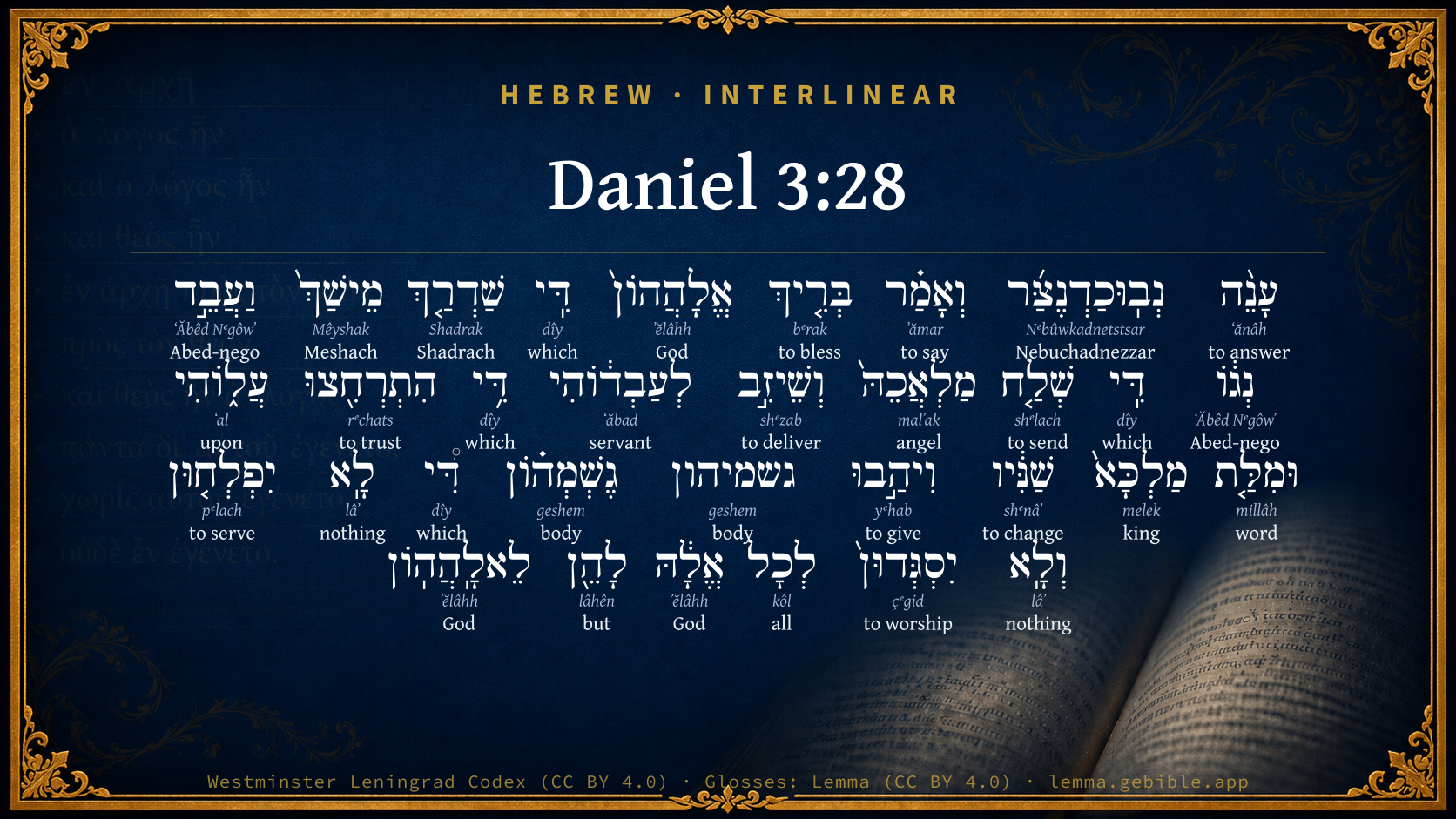
Daniel 3:28

Hebrew (Westminster Leningrad Codex) Daniel 3:28 appears in the Hebrew Old Testament. The text above is from the Westminster Leningrad Codex. Each word links to its Strong’s number, a concise gloss, and parsing drawn from the Open Scriptures Hebrew Bible morphology. Click any word for its full Brown-Driver-Briggs (BDB) entry.
Download image
Cite this verse

Daniel 3:28 (World English Bible). Public Domain. Lemma interlinear Bible study tool, https://lemma.gebible.app/v/daniel/3/28.

Show BibTeX & RIS
BibTeX
RIS
English Translation
Nebuchadnezzar spoke and said, Blessed be the God of Shadrach, Meshach, and Abednego, who has sent his angel, and delivered his servants who trusted in him, and have changed the king's word, and have yielded their bodies, that they might not serve nor worship any god, except their own God.
World English Bible · Public Domain
Highlights
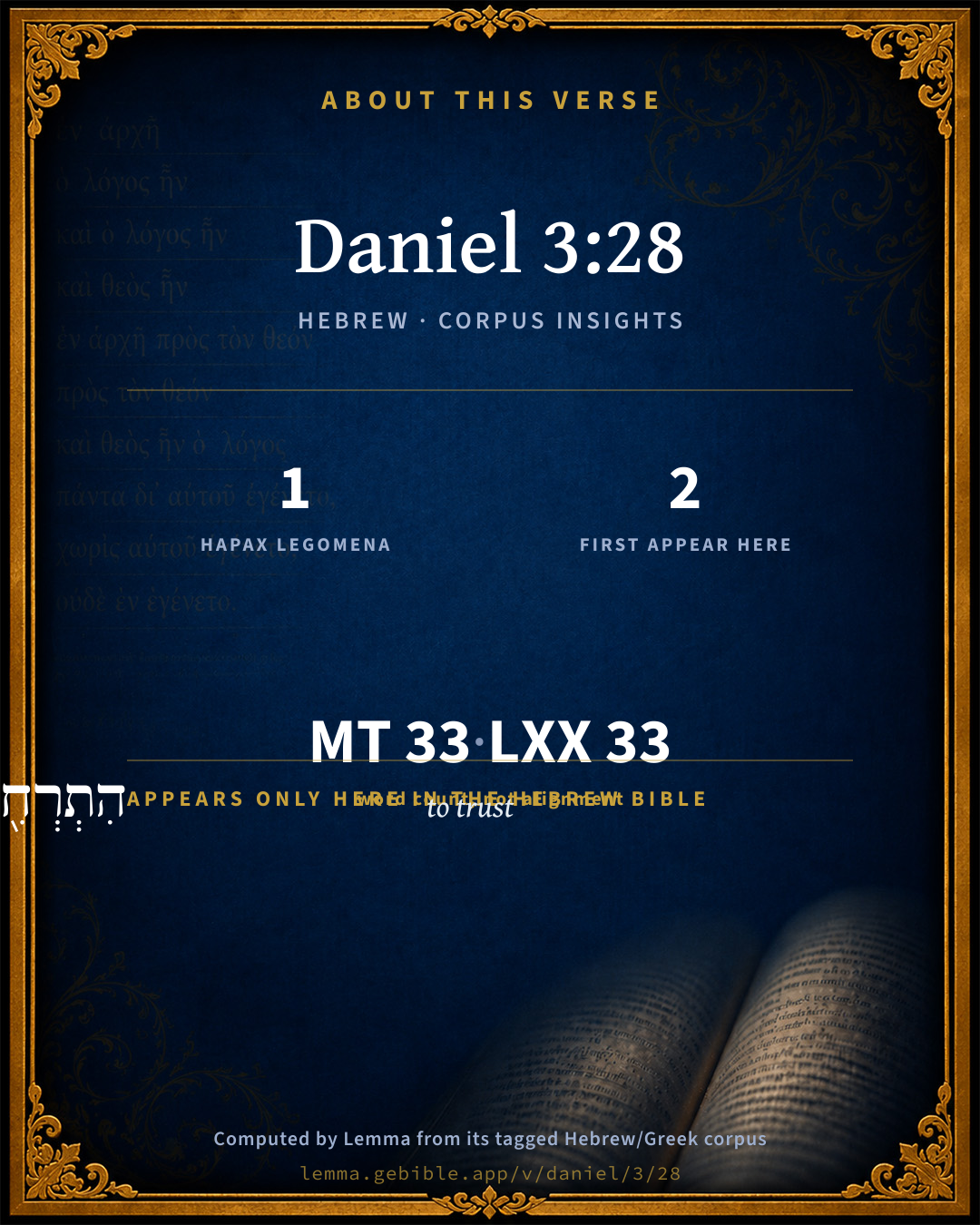
  • 1 hapax legomenon — only here in the Hebrew Bible
  • 2 first appearances in the Hebrew Bible
Full analysis ↓
Download a study sheet

One document with this verse’s original text, its word-by-word gloss line, the meaning frame, cross-references with their text, attributed commentary, and full source and license credits — printable, and it pastes into notes with its structure intact.

This verse Autodidact and up

Study sheet (.html) Plain text (.txt)

A passage Seminary Student

Up to 50 verses in one chapter. A passage sheet keeps up to 6 commentary sources and 12 cross-references per verse, in the order this page ranks them, and says so on the sheet whenever that leaves anything out. Ask for a single verse and you get the Autodidact verse sheet above.

Everything on this page stays free to read, with no account — the sheet is a download of what is already on screen, not access to it.

Want to remove ads? Support Godless Engineer
Compare translations 3

The same verse in 3 English versions, stacked beneath the original-language interlinear above. Click any original word for its lexicon entry.

Each is an independent rendering of the whole verse — the interlinear is not word-aligned to these translations.

Highlighted words mark where these versions differ — a whole-verse word diff, not a word-by-word alignment.

  • World English Bible Public Domain
    Nebuchadnezzar spoke and said, Blessed be the God of Shadrach, Meshach, and Abednego, who has sent his angel, and delivered his servants who trusted in him, and have changed the king's word, and have yielded their bodies, that they might not serve nor worship any god, except their own God.
  • King James Version Public Domain
    Then Nebuchadnezzar spake, and said, Blessed be the God of Shadrach, Meshach, and Abednego, who hath sent his angel, and delivered his servants that trusted in him, and have changed the king's word, and yielded their bodies, that they might not serve nor worship any god, except their own God.
  • unfoldingWord Literal Text CC BY-SA 4.0
    Nebuchadnezzar answered and said, “Blessed be the God of Shadrach, Meshach, and Abednego, who has sent his angel and rescued his servants, who trusted in him, and set aside the command of the king, and gave up their bodies rather than serve or worship any god except their God.

unfoldingWord Literal Text — © unfoldingWord, licensed CC BY-SA 4.0. Word-aligned USFM3 via Door43 (git.door43.org/unfoldingWord/en_ult).

Versions to compare (up to 4)

3 of 4 selected

Show all 18 translations

Every available English version of this verse, each an independent rendering of the whole verse.

  • World English Bible Public Domain
    Nebuchadnezzar spoke and said, Blessed be the God of Shadrach, Meshach, and Abednego, who has sent his angel, and delivered his servants who trusted in him, and have changed the king's word, and have yielded their bodies, that they might not serve nor worship any god, except their own God.
  • Berean Standard Bible Public Domain
    Nebuchadnezzar declared, “Blessed be the God of Shadrach, Meshach, and Abednego, who has sent His angel and delivered His servants who trusted in Him. They violated the king’s command and risked their lives rather than serve or worship any god except their own God.
  • Majority Standard Bible Public Domain
    Nebuchadnezzar declared, “Blessed be the God of Shadrach, Meshach, and Abednego, who has sent His angel and delivered His servants who trusted in Him. They violated the king’s command and risked their lives rather than serve or worship any god except their own God.
  • King James Version Public Domain
    Then Nebuchadnezzar spake, and said, Blessed be the God of Shadrach, Meshach, and Abednego, who hath sent his angel, and delivered his servants that trusted in him, and have changed the king's word, and yielded their bodies, that they might not serve nor worship any god, except their own God.
  • American Standard Version (1901) Public Domain
    Nebuchadnezzar spake and said, Blessed be the God of Shadrach, Meshach, and Abed-nego, who hath sent his angel, and delivered his servants that trusted in him, and have changed the king's word, and have yielded their bodies, that they might not serve nor worship any god, except their own God.
  • Revised Version (1885) Public Domain
    Nebuchadnezzar spake and said, Blessed be the God of Shadrach, Meshach, and Abed-nego, who hath sent his angel, and delivered his servants that trusted in him, and have changed the king’s word, and have yielded their bodies, that they might not serve nor worship any god, except their own God.
  • Geneva Bible (1599) Public Domain
    Wherefore Nebuchad-nezzar spake and said, Blessed be the God of Shadrach, Meshach and Abednego, who hath sent his Angel, and deliuered his seruants, that put their trust in him, and haue changed the Kings commandement, and yeelded their bodies rather then they would serue or worship any god, saue their owne God.
  • Douay-Rheims (1899) Public Domain
    Then Nabuchodonosor breaking forth, said: Blessed be the God of them, to wit, of Sidrach, Misach, and Abdenago, who hath sent his angel, and delivered his servants that believed in him: and they changed the king's word, and delivered up their bodies that they might not serve, nor adore any god, except their own God.
  • Young's Literal Translation Public Domain
    Nebuchadnezzar hath answered and hath said, `Blessed `is' the God of Shadrach, Meshach, and Abed-Nego, who hath sent His messenger, and hath delivered His servants who trusted on Him, and the word of the king changed, and gave up their bodies that they might not serve nor do obeisance to any god except to their own God.
  • Literal Standard Version CC BY-SA 4.0
    Nebuchadnezzar has answered and has said, “Blessed [is] the God of Shadrach, Meshach, and Abed-Nego, who has sent His messenger, and has delivered His servants who trusted on Him.” And the word of the king changed, and gave up their bodies that they might not serve nor pay respect to any god except to their own God.
  • Unlocked Literal Bible CC BY-SA 4.0
    Nebuchadnezzar said, “Let us praise the God of Shadrach, Meshach, and Abednego, who has sent his messenger and given his message to his servants. They trusted in him when they set aside my command, and they gave up their bodies rather than worship or prostrate themselves to any god except their God.
  • unfoldingWord Literal Text CC BY-SA 4.0
    Nebuchadnezzar answered and said, “Blessed be the God of Shadrach, Meshach, and Abednego, who has sent his angel and rescued his servants, who trusted in him, and set aside the command of the king, and gave up their bodies rather than serve or worship any god except their God.
  • Darby Bible Public Domain
    Nebuchadnezzar spoke and said, Blessed be the God of Shadrach, Meshach, and Abed-nego, who hath sent his angel, and delivered his servants who trusted in him, and who changed the king's word, and yielded their bodies, that they might not serve nor worship any god, except their own God!
  • World Messianic Bible Public Domain
    Nebuchadnezzar spoke and said, “Blessed be the God of Shadrach, Meshach, and Abednego, who has sent his angel and delivered his servants who trusted in him, and have changed the king’s word, and have yielded their bodies, that they might not serve nor worship any god except their own God.
  • Webster's Bible Public Domain
    Then Nebuchadnezzar spoke, and said, Blessed be the God of Shadrach, Meshach, and Abed-nego, who hath sent his angel, and delivered his servants that trusted in him, and have changed the king's word, and yielded their bodies, that they might not serve nor worship any god, except their own God.
  • Free Bible Version CC BY-SA 4.0
    Then Nebuchadnezzar said, “Praise the God of Shadrach, Meshach, and Abednego! He sent his angel and he rescued his servants who trusted in him! They disobeyed my royal command, putting their lives on the line, and refused to worship any other gods except their God.
  • Bible in Basic English Public Domain
    Nebuchadnezzar made answer and said, Praise be to the God of Shadrach, Meshach, and Abed-nego, who has sent his angel and kept his servants safe who had faith in him, and who put the king's word on one side and gave up their bodies to the fire, so that they might not be servants or worshippers of any other god but their God.
  • JPS Tanakh (1917) Public Domain
    Nebuchadnezzar spoke and said: 'Blessed be the God of Shadrach, Meshach, and Abed-nego, who hath sent His angel, and delivered His servants that trusted in Him, and have changed the king's word, and have yielded their bodies, that they might not serve nor worship any god, except their own God.

Literal Standard Version (2020), Covenant Press — licensed CC BY-SA 4.0. Text via the HelloAO Bible API (eBible.org). Unlocked Literal Bible (unfoldingWord) — licensed CC BY-SA 4.0. Text via the HelloAO Bible API (eBible.org). unfoldingWord Literal Text — © unfoldingWord, licensed CC BY-SA 4.0. Word-aligned USFM3 via Door43 (git.door43.org/unfoldingWord/en_ult). Free Bible Version, Dr. Jonathan Gallagher — licensed CC BY-SA 4.0. Text via the HelloAO Bible API (eBible.org).

Word by word

More ways to search: Search by grammar → Find every occurrence → Compare this word →

Practice this passage: Drill this verse → Learn its vocabulary →

הִתְרְחִ֖צוּ
rᵉchats
H7365
“to trust”
Adjective, V, Plural
Part of Speech
Adjective
Number
Plural
Full BDB Definition

Origin: corresponding to H7364 [probably through the accessory idea of ministering as a servant at the bath]

TWOT: 2996

to trust - (Hithpeil) to set one's trust on
  1. עָנֵ֨ה ʻănâh H6032 “answering” Adjective, V
  2. נְבֽוּכַדְנֶצַּ֜ר Nᵉbûwkadnetstsar H5020 “Nebuchadnezzar” Adjective, N
  3. וְאָמַ֗ר ʼămar H560 “and · saying” Adjective, C + Verb, Qal, Participle Active, Masculine, Singular, Absolute
  4. בְּרִ֤יךְ bᵉrak H1289 “blessed” Adjective, V, Singular
  5. אֱלָהֲהוֹן֙ ʼĕlâhh H426 “God · their” Adjective, N, Common + Suffix, Personal, 3rd Person, Masculine, Plural
  6. דִּֽי dîy H1768 “which” Adjective, T
  7. שַׁדְרַ֤ךְ Shadrak H7715 “Shadrach” Adjective, N
  8. מֵישַׁךְ֙ Mêyshak H4336 “Meshach” Adjective, N
  9. וַעֲבֵ֣ד ʻĂbêd Nᵉgôwʼ H5665 “and · Abed-nego” Adjective, C + Noun, Proper
  10. נְג֔וֹ ʻĂbêd Nᵉgôwʼ H5665 “Abed-nego” Adjective, N
  11. דִּֽי dîy H1768 “which” Adjective, C
  12. שְׁלַ֤ח shᵉlach H7972 “to send” Adjective, V, Plural
  13. מַלְאֲכֵהּ֙ malʼak H4398 “angel · his” Adjective, N, Common + Suffix, Personal, 3rd Person, Masculine, Singular
  14. וְשֵׁיזִ֣ב shᵉzab H7804 “and · to deliver” Adjective, C + Verb, e, Perfect, 3rd Person, Masculine, Singular
  15. לְעַבְד֔וֹהִי ʻăbad H5649 “to/for · servants · his” Adjective, T + Noun, Common, Masculine, Plural, Construct + Suffix, Personal, 3rd Person, Masculine, Singular
  16. דִּ֥י dîy H1768 “which” Adjective, T
  17. עֲל֑וֹהִי ʻal H5922 “upon · him” Adjective, R + Suffix, Personal, 3rd Person, Masculine, Singular
  18. וּמִלַּ֤ת millâh H4406 “and · word of” Adjective, C + Noun, Common, Feminine, Singular, Construct
  19. מַלְכָּא֙ melek H4430 “king · the” Adjective, N, Common + Particle, Definite Article
  20. שַׁנִּ֔יו shᵉnâʼ H8133 “to change” Adjective, V, Plural
  21. וִיהַ֣בוּ yᵉhab H3052 “and · to give” Adjective, C + Verb, Qal, Perfect, 3rd Person, Masculine, Plural
  22. גשמיהון geshem H1655 “bodies · their” Adjective, N, Common + Suffix, Personal, 3rd Person, Masculine, Plural
  23. גֶשְׁמְה֗וֹן geshem H1655 “body · their” Adjective, N, Common + Suffix, Personal, 3rd Person, Masculine, Plural
  24. דִּ֠י dîy H1768 “which” Adjective, C
  25. לָֽא lâʼ H3809 “nothing” Adjective, T
  26. יִפְלְח֤וּן pᵉlach H6399 “to serve” Adjective, V
  27. וְלָֽא lâʼ H3809 “and · nothing” Adjective, C + Particle, Negative
  28. יִסְגְּדוּן֙ çᵉgid H5457 “to worship” Adjective, V
  29. לְכָל kôl H3606 “to/for · all of” Adjective, T + Noun, Common, Masculine, Singular, Construct
  30. אֱלָ֔הּ ʼĕlâhh H426 “God” Adjective, N, Common
  31. לָהֵ֖ן lâhên H3861 “but” Adjective, C
  32. לֵאלָֽהֲהֽוֹן ʼĕlâhh H426 “to/for · God · their” Adjective, T + Noun, Common, Masculine, Singular, Construct + Suffix, Personal, 3rd Person, Masculine, Plural

About this verse

These counts appear in no published source. They are computed here, from the morphology-tagged text and Lemma’s own curated glosses. What Lemma adds →

33
words
25
distinct lemmas
Prophets
section

Notable vocabulary

1 hapax legomenon — a word that appears only here in the entire Hebrew Bible:

  • הִתְרְחִ֖צוּ to trust H7365

First appearance in Scripture

These words make their first canonical appearance in the Hebrew Bible here:

  • מַלְאֲכֵהּ֙ angel H4398
  • הִתְרְחִ֖צוּ to trust H7365

Shared distinctive vocabulary

מַלְאֲכֵהּ֙ angel H4398 occurs in 2 verses of the Hebrew Bible. Also found in:

Grammatical profile

  • 3 verbs
  • 5 nouns
  • 23 adjectives
  • 2 particles

Verb forms

  • וְאָמַ֗ר Qal · Participle Active
  • וְשֵׁיזִ֣ב Perfect
  • וִיהַ֣בוּ Qal · Perfect

Repetition

Words recur within this verse — often emphatic in Hebrew:

  • אֱלָהֲהוֹן֙ God H426 ×3
  • וַעֲבֵ֣ד Abed-nego H5665 ×2
  • גשמיהון body H1655 ×2
  • לָֽא nothing H3809 ×2
  • דִּֽי which H1768 ×4

Hebrew & Septuagint length

In English translation the verse runs 50 words from the Hebrew and 56 from the Septuagint (LXX English) — closely comparable.

A rough comparison of the two English renderings, which tokenize alike — not a word-level alignment.

Word counts can differ between the Hebrew and the Greek without any difference in meaning — e.g. the Hebrew direct-object marker אֵת has no separate Greek word, and Greek often adds the article ὁ.

In the original languages it is 33 Hebrew tokens and 33 Greek tokens — but the two are counted differently (Hebrew bundles its prefixes and suffixes into one token; the Greek is in lemma form), so that isn’t a like-for-like length.

Cross-references

41

Topical passages linked to Daniel 3:28 in the Treasury of Scripture Knowledge — connected by theme and wording, ordered by reader-vote popularity; previews shown in the World English Bible.

  • Romans 14:7–8 For none of us lives to himself, and none dies to himself.
  • Psalms 34:7–8 The angel of Yahweh encamps round about those who fear him, And delivers them.
  • Psalms 84:11–12 For Yahweh God is a sun and a shield. Yahweh will give grace and glory. He withholds no good thing from those who walk blamelessly.
  • Exodus 20:5 you shall not bow yourself down to them, nor serve them, for I, Yahweh your God, am a jealous God, visiting the iniquity of the fathers on the children, on the third and on the fourth generation of those who hate me,
  • Revelation 12:11 They overcame him because of the Lamb's blood, and because of the word of their testimony. They didn't love their life, even to death.
  • Psalms 22:4–5 Our fathers trusted in you. They trusted, and you delivered them.
  • Psalms 147:11 Yahweh takes pleasure in those who fear him, In those who hope in his loving kindness.
  • Romans 12:1 Therefore I urge you, brothers, by the mercies of God, to present your bodies a living sacrifice, holy, acceptable to God, which is your spiritual service.
  • Daniel 3:25 He answered, Look, I see four men loose, walking in the midst of the fire, and they have no hurt; and the aspect of the fourth is like a son of the gods.
  • Matthew 4:10 Then Jesus said to him, "Get behind me, Satan! For it is written, 'You shall worship the Lord your God, and him only shall you serve.'"
  • Acts 5:19 But an angel of the Lord opened the prison doors by night, and brought them out, and said,
  • Isaiah 26:3–4 You will keep [him] in perfect peace, [whose] mind [is] stayed [on you]; because he trusts in you.
  • Daniel 2:47 The king answered to Daniel, and said, Of a truth your God is the God of gods, and the Lord of kings, and a revealer of secrets, seeing you have been able to reveal this secret.
  • Daniel 6:22–23 My God has sent his angel, and has shut the lions' mouths, and they have not hurt me; because as before him innocence was found in me; and also before you, O king, have I done no hurt.
  • 1 Chronicles 5:20 They were helped against them, and the Hagrites were delivered into their hand, and all who were with them; for they cried to God in the battle, and he was entreated of them, because they put their trust in him.
  • 2 Chronicles 20:20 They rose early in the morning, and went forth into the wilderness of Tekoa: and as they went forth, Jehoshaphat stood and said, Hear me, Judah, and you inhabitants of Jerusalem: believe in Yahweh your God, so shall you be established; believe his prophets, so shall you prosper.
  • 2 Chronicles 32:21 Yahweh sent an angel, who cut off all the mighty men of valor, and the leaders and captains, in the camp of the king of Assyria. So he returned with shame of face to his own land. When he was come into the house of his god, those who came forth from his own bowels killed him there with the sword.
  • Psalms 62:8 Trust in him at all times, you people. Pour out your heart before him. God is a refuge for us. Selah.
  • Isaiah 37:36 The angel of Yahweh went forth, and struck in the camp of the Assyrians one hundred and eighty-five thousand; and when men arose early in the morning, behold, these were all dead bodies.
  • Jeremiah 17:7–8 Blessed is the man who trusts in Yahweh, and whose trust Yahweh is.
  • Philippians 1:20 according to my earnest expectation and hope, that I will in no way be disappointed, but with all boldness, as always, now also Christ will be magnified in my body, whether by life, or by death.
  • Genesis 9:26 He said, "Blessed be Yahweh, the God of Shem; Let Canaan be his servant.
  • Genesis 19:15–16 When the morning arose, then the angels hurried Lot, saying, "Arise, take your wife, and your two daughters who are here, lest you be consumed in the iniquity of the city."
  • Ezra 1:3 Whoever there is among you of all his people, his God be with him, and let him go up to Jerusalem, which is in Judah, and build the house of Yahweh, the God of Israel (he is God), which is in Jerusalem.
  • Ezra 6:11 Also I have made a decree, that whoever shall alter this word, let a beam be pulled out from his house, and let him be lifted up and fastened thereon; and let his house be made a dunghill for this:
  • Ezra 7:23–28 Whatever is commanded by the God of heaven, let it be done exactly for the house of the God of heaven; for why should there be wrath against the realm of the king and his sons?
  • Psalms 33:18 Behold, Yahweh's eye is on those who fear him, On those who hope in his loving kindness;
  • Psalms 33:21 For our heart rejoices in him, Because we have trusted in his holy name.
  • Psalms 34:22 Yahweh redeems the soul of his servants. None of those who take refuge in him shall be condemned.
  • Psalms 146:5–6 Happy is he who has the God of Jacob for his help, Whose hope is in Yahweh, his God:
  • Daniel 3:15–18 Now if you are ready whenever you hear the sound of the horn, flute, zither, lyre, harp, pipe, and all kinds of music to you fall down and worship the image which I have made, [well]: but if you don't worship, you shall be cast the same hour into the midst of a burning fiery furnace; and who is that god that shall deliver you out of my hands?
  • Daniel 4:34 At the end of the days I, Nebuchadnezzar, lifted up my eyes to heaven, and my understanding returned to me, and I blessed the Most High, and I praised and honored him who lives forever; for his dominion is an everlasting dominion, and his kingdom from generation to generation.
  • Daniel 6:26 I make a decree, that in all the dominion of my kingdom men tremble and fear before the God of Daniel; for he is the living God, and steadfast forever, His kingdom that which shall not be destroyed; and his dominion shall be even to the end.
  • Acts 4:19 But Peter and John answered them, "Whether it is right in the sight of God to listen to you rather than to God, judge for yourselves,
  • Acts 12:7–11 And behold, an angel of the Lord stood by him, and a light shone in the cell. He struck Peter on the side, and woke him up, saying, "Stand up quickly!" His chains fell off from his hands.
  • 2 Corinthians 1:9–10 Yes, we ourselves have had the sentence of death within ourselves, that we should not trust in ourselves, but in God who raises the dead,
  • Ephesians 1:12–13 to the end that we should be to the praise of his glory, we who had before hoped in Christ:
  • Hebrews 1:14 Aren't they all ministering spirits, sent out to do service for the sake of those who will inherit salvation?
  • Hebrews 11:37 They were stoned. They were sawn apart. They were tempted. They were slain with the sword. They went around in sheep skins and in goat skins; being destitute, afflicted, ill-treated
  • 1 Peter 1:21 who through him are believers in God, who raised him from the dead, and gave him glory; so that your faith and hope might be in God.
  • Psalms 103:20 Praise Yahweh, you angels of his, Who are mighty in strength, who fulfill his word, Obeying the voice of his word.

Cross-references courtesy of OpenBible.info (CC BY 4.0).

Hebrew and Greek witnesses Masoretic Hebrew ↔ Greek Septuagint

The same verse in the two great witnesses to the Old Testament, shown verse-for-verse.

These are two independent witnesses, not word-aligned to each other, and the Septuagint is shown in lemma (dictionary) form.

Hebrew Daniel 3:28 Masoretic · Westminster Leningrad Codex

עָנֵ֨ה נְבֽוּכַדְנֶצַּ֜ר וְאָמַ֗ר בְּרִ֤יךְ אֱלָהֲהוֹן֙ דִּֽי שַׁדְרַ֤ךְ מֵישַׁךְ֙ וַעֲבֵ֣ד נְג֔וֹ דִּֽי שְׁלַ֤ח מַלְאֲכֵהּ֙ וְשֵׁיזִ֣ב לְעַבְד֔וֹהִי דִּ֥י הִתְרְחִ֖צוּ עֲל֑וֹהִי וּמִלַּ֤ת מַלְכָּא֙ שַׁנִּ֔יו וִיהַ֣בוּ גשמיהון גֶשְׁמְה֗וֹן דִּ֠י לָֽא יִפְלְח֤וּן וְלָֽא יִסְגְּדוּן֙ לְכָל אֱלָ֔הּ לָהֵ֖ן לֵאלָֽהֲהֽוֹן

Nebuchadnezzar spoke and said, Blessed be the God of Shadrach, Meshach, and Abednego, who has sent his angel, and delivered his servants who trusted in him, and have changed the king's word, and have yielded their bodies, that they might not serve nor worship any god, except their own God.

World English Bible · Public Domain

Greek LXX Daniel 3:28 Septuagint · lemma form

καί κρίμα ἀλήθεια ποιέω κατά πᾶς ὅς ἐπιἄγω ἐγώ καί ἐπί ὁ πόλις σύ ὁ ἅγιος ὁ ὁ πατήρ ἐγώ ἰερουσαλήμ διότι ἐν ἀλήθεια καί κρίσις ποιέω πᾶς οὗτος διά ὁ ἁμαρτία ἐγώ

And king Nabuchodonosor answered and said, Blessed be the God of Sedrach, Misach, and Abdenago, who has sent his angel, and delivered his servants, because they trusted in him; and they have changed the king's word, and delivered their bodies to be burnt, that they might not serve nor worship any god, except their own God.

LXX2012 (modern English Septuagint) · Public Domain

On this verse, Keil & Delitzsch discusses the Septuagint’s reading. Read the note in Commentary ↓

Hebrew: Westminster Leningrad Codex (CC BY 4.0). Greek: Septuagint (public domain); English from LXX2012 (modern English Septuagint) (Public Domain). How the Septuagint differs from the Hebrew →

Commentary

Notes on Daniel 3:28 from classic Christian and Jewish commentators (each source and its license shown beneath its notes). The classic Christian expositions comment on the surrounding passage and are grouped to its opening verse, so a note may address several verses; the Jewish commentaries on the Tanakh (Rashi and others) are per-verse, so they appear only where the commentator wrote on this verse.

Lemma curates 59 commentaries, every one of them public domain or Creative Commons licensed, each selected and text-cleaned for this edition rather than reprinted as found. About our sources →

Matthew Henry's Commentary

The strict observations that were made, super visum corporis - on inspecting their bodies, by the princes and governors, and all the great men who were present upon this public occasion, and who could not be supposed partial in favour of the confessors, contributed much to the clearing of this miracle and the magnifying of the power and grace of God in it. That indeed a notable miracle has been done is manifest, and we cannot deny it, Act 4:16. Let us now see what effect it had upon Nebuchadnezzar.

I. He gives glory to the God of Israel as a God able and ready to protect his worshippers (Dan 3:28): "Blessed be the God of Shadrach, Meshach, and Abednego. Let him have the honour both of the faithful allegiance which his subjects bear to him and the powerful protection he grants to them, neither of which can be paralleled by any other nation and their gods." The king does himself acknowledge and adore him, and thinks it is fit that he should be acknowledged and adored by all. Blessed be thee God of Shadrach. Note, God can extort confessions of his blessedness even from those that have been ready to curse him to his face. 1. He gives him the glory of his power, that he was able to protect his worshippers against the most mighty and malignant enemies: There is no other God that can deliver after this sort (Dan 3:29), no, not this golden image which he had set up. For this reason there was no other god that obliged his worshippers to cleave to him only, and to suffer death rather than worship any other, as the God of Israel did, for they could not engage to bear them out in so doing, as he could. If God can work such deliverance as no other can, he may demand such obedience as no other may. 2. He gives him the glory of his goodness, that he was ready to do it (Dan 3:28): He has sent his angel and delivered his servants. Bel could not save his worshippers from being burnt at the mouth of the furnace, but the God of Israel saved his from being burnt when they were cast into the midst of the furnace because they refused to worship any other god. By this Nebuchadnezzar was plainly given to understand that all the great success which he had had, and should yet have, against the people of Israel, which he gloried in, as he had therein overpowered the God of Israel, was owing purely to their sin: if the body of that nation had faithfully adhered to their own God and the worship of him only, as these three men did, they would all have been delivered out of his hand as these three men were. And this was a necessary instruction for him at this time.

II. He applauds the constancy of these three men in their religion, and describes it to their honour, Dan 3:28. Though he is not himself persuaded to own their God for his and to worship him, because, if he do so, he knows he must worship him only and renounce all others, and he calls him the God of Shadrach, not my God, yet he commends them for cleaving to him, and not serving nor worshipping any other God but their own. Note, There are many who are not religious themselves, and yet will own that those are clearly in the right that are religious and are stedfast in their religion. Though they are not themselves persuaded to close with it, they will commend those who, having closed with it, cleave to it. If men have given up their names to that God who will alone be served, let them keep to their principles, and serve him only, whatever it cost them. Such a constancy in the true religion will turn to men's praise, even among those that are without, when unsteadiness, treachery, and double dealing, are what all men will cry shame on. He commends them that they did this, 1. With a generous contempt of their lives, which they valued not, in comparison with the favour of God and the testimony of a good conscience. The yielded their own bodies to be cast into the fiery furnace rather than they would not only not forsake their God, but not affront him, by once paying that homage to any other which is due to him alone. Note, Those shall have their praise, if not of men, yet of God, who prefer their souls before their bodies, and will rather lose their lives than forsake their God. Those know not the worth and value of religion who do not think it worth suffering for. 2. They did it with a glorious contradiction to their prince: They changed the king's word, that is, they were contrary to it, and thereby put contempt upon both his precepts and threatenings, and made him repent and revoke both. Note, Even kings themselves must own that, when their commands are contrary to the commands of God, he is to be obeyed and not they. (3.) They did it with a gracious confidence in their God. They trusted in him that he would stand by them in what they did, that he would either bring them out of the fiery furnace back to their place on earth or lead them through the fiery furnace forward to their place in heaven; and in this confidence they became fearless of the king's wrath and regardless of their own lives. Note, A stedfast faith in God will produce a stedfast faithfulness to God. Now this honourable testimony, thus publicly borne by the king himself to these servants of God, we may well think, would have a good influence upon the rest of the Jews that were, or should be, captives in Babylon. Their neighbours could not with any confidence urge them to do that, nor could they for shame do that, which their brethren were so highly applauded by the king himself for not doing. Nay, and what God did for these his servants would help not only to keep the Jews close to their religion while they were in captivity, but to cure them of their inclination to idolatry, for which end they were sent into captivity; and, when it had had that blessed effect upon them, they might be assured that God would deliver them out of that furnace, as now he delivered their brethren out of this.

III. He issues a royal edict, strictly forbidding any to speak evil of the God of Israel, Dan 3:29. We have reason to think that both the sins and the troubles of Israel had given great occasion, though no just occasion, to the Chaldeans to blaspheme the God of Israel, and, it is likely, Nebuchadnezzar himself had encouraged it; but now, though he is no true convert, nor is wrought upon to worship him, yet he resolves never to speak ill of him again, nor to suffer others to do so: "Whoever shall speak any thing amiss, any error (so some), or rather any reproach or blasphemy, whoever shall speak with contempt of the God of Shadrach, Meshach, and Abednego, they shall be counted the worst of malefactors, and dealt with accordingly, they shall be cut in pieces, as Agag was by the sword of Samuel, and their houses shall be demolished and made a dunghill." The miracle now wrought by the power of this God in defence of his worshippers, publicly in the sight of the thousands of Babylon, was a sufficient justification of this edict. And it would contribute much to the ease of the Jews in their captivity to be by this law screened from the fiery darts of reproach and blasphemy, with which otherwise they would have been continually annoyed. Note, It is a great mercy to the church, and a good point gained, when its enemies though they have not their hearts turned, yet have their mouths stopped and their tongues tied. If a heathen prince laid such a restraint upon the proud lips of blasphemers, much more should Christian princes do it; nay, in this thing, one would think that men should be a law to themselves, and that those who have so little love to God that they care not to speak well of him, yet could never find in their hearts, for we are sure they could never find cause, to speak any thing amiss of him.

IV. He not only reverses the attainder of these three men, but restores them to their places in the government (makes them to prosper, so the word is), and prefers them to greater and more advantageous trusts than they had been in before: He promoted them in the province of Babylon, which was much to their honour and the comfort of their brethren in captivity there. Note, It is the wisdom of princes to prefer and employ men of stedfastness in religion; for those are most likely to be faithful to them who are faithful to God, and it is likely to be well with them when God's favourites are made theirs.

Matthew Henry's Commentary on the Whole Bible (1708–1710) — public domain (CC PDM 1.0). Text via the HelloAO Bible API.

Trapp's Complete Commentary

John Trapp

Dan 3:28 [Then] Nebuchadnezzar spake, and said, Blessed [be] the God of Shadrach, Meshach, and Abednego, who hath sent his angel, and delivered his servants that trusted in him, and have changed the king’s word, and yielded their bodies, that they might not serve nor worship any god, except their own God.

Ver. 28. Then Nebuchadnezzar spake.] Being convinced, but not converted, as appeareth by the next chapter, whatever Augustine and others charitably thought to the contrary. A wicked man may pray and praise God extemporally. {Job 27:10}

And have changed the king’s word.] Chald., Secundo loco habuerunt. They have preferred God’s word before it.

John Trapp, A Commentary or Exposition upon All the Books of the Old and New Testament (1647–1656) — public domain. Text from a community e-Sword module.

The Biblical Illustrator

Joseph S. Exell

Dan_3:28

Then Nebuchadnezzar spake, and said, Blessed be the God of Shadrach, Meshach, and Abed-nego, who hath sent His angel and delivered His servants.

The Persecuting Spirit

The occasion of these words must be too well known to be repeated in all its circumstances.

I. THE PARTICULAR CAUSE OF THE GREAT DANGER WHICH THESE MEN WERE BROUGHT INTO. They would not serve or worship any god except their own God. There is no one who has any conception of God but must allow Him to be infinite in all His attributes. But infinity implies unity; and if this being is One, Divine worship must be due to Him alone. This made God forbid the Jews the serving any of the gods of the neighbouring nations, under such severe penalties. As God showed his approbation of those Jews refusal to worship the image by the miracle He wrought in their deliverance, so, I doubt not, but He has showed so many wonders in delivering this nation so often for its constancy in the same refusal, though, in all other respects, most unworthy of the least of His mercies.

II. EXAMINE THE PRETENCES OF RELIGIOUS CRUELTY. They are, either to promote Gods glory or our neighbours good. Cruelty is not proper for either of these purposes. By Gods glory is probably meant the improving that notion of God which men have by the light of nature; or making His revealed will to be more readily embraced by them. With mankind in a state of nature, fear forced the acknowledgment of a superior being, so their worship was cruel and their manners were barbarous. When they began to settle into societies, and when they reflected upon the first cause of the benefits they enjoyed, and discovered the goodness of God, then love grew as the principle of their glad obedience, and their worship was bloodless and cheerful, and their manners innocent and endearing. The improvement of human nature consists in the notions of goodness in the Divine. But if, when men had got thus far by the light of nature, anyone should have started up and pretended to have offered violence to his neighbour, by a particular commission from God and for His glory, then love must at once have given place to fear, and human nature turned savage and wild again. Take the other pretence, that violence is intended to promote the Gospel. How contradictory and absurd is this! This is to recommend love by hatred, mercy by cruelty, and forgiveness by destruction. That which distinguishes the Gospel is its being so admirably disposed to beget love and peace, justice and charity, among all men. Here forgiveness is improved into beneficence, and humanity exalted into charity. Here injuries are returned with prayers, and curses with blessings. The Pharisees taught that it was lawful to hate enemies. The Cynics renounced all humanity. The Stoics reckoned compassion an infirmity. All other sects were deficient in this particular. But Christianity improved human nature into the likeness of the Divine. Our Lords disciples were to be distinguished from the whole world by their loving one another. And what examples did the great Master leave us? Shall men, then, dare to imprison, impoverish, and murder their brethren in the name of this Jesus? Another pretence of religious cruelty is that it may promote the good of our neighbour. This is generally disguised under the specious pretence of zeal. But true zeal ought first to be employed upon ourselves. Zeal is as necessary to the life of devotion as the natural heat is to that of the body. Religion must be a free consent of the soul; it can be acceptable to God only as it is voluntary. How can full conviction be wrought but by gentle usage, calm reasoning, and good example. The will can never be forced to give a sincere assent, after all the violence that can be offered. Beside, all error, considering the vanity of mankind, is of a nice and tender nature; it requires a great deal of management and address to make people own that they are in the wrong, especially in matters of religion. The utmost we can expect from force is an outward compliance. Violence may extort confession from the mouth, but will not hinder curses, at the same time, in the heart. It may fright people into counterfeiting, but not persuade them into believing. One particular reason against the rashness of zealous cruelty is because the good should not suffer with the evil. The true causes of religious cruelty are:

1. The pride and haughtiness of power.

2. The endeavouring to recommend ourselves to man rather than to God.

3. The opinion that such violence is meritorious for the expiation of former sins.

III. COMPARE THE DELIVERANCE MENTIONED IN THE TEXT WITH OUR OWN. These men trusted in God. (J. Adams.)

The Fiery Trial

First, the idolatry is costly. The chapter tells us of an high statue and idol of gold erected by the King of Babylon. Superstition and idolatry will be no niggard, it will spare no cost; but be expensive and sumptuous to maintain an invented and superstitious worship.

1. Nebuchadnezzar must have no petty diminutive god; six cubits in breadth, sixty cubits in height. Whats this to the infinite immensity of our God, that fills Heaven and earth?

2. It must be of metal, too, lasting and durable. A mock imitation of the true Gods eternity.

3. It must be rich and costly, all of beaten gold. Their idols, saith David, are silver and gold. It may shame us Christians, that are so basely penurious in maintaining and beautifying the worship of our God. Secondly, the erecting of this idol is done with the greatest authority. Thirdly, it is done with great pomp and solemnity. Fourthly, it is done with great content and universality. All the governors and princes of the provinces are gathered together, all engaged in this idolatrous worship. This sin of idolatry, it hath been an over-spreading evil. Fifthly, it is imposed with all strictness and severity; nay, it is pressed upon the people with cruelty and tyranny. Blood and fire and persecution, they are the great promoters of idolatry. Cruelty, tis the brand of the malignant church. Such are the enforcements of idolatry; far from the temper of true Christianity. Sixthly, notwithstanding all this violence in pressing, and this great generality of submitting to this idolatrous injunction, yet, here a few, three men, that deny their conformity, and refuse to engage themselves in this public impiety. In the greatest universality and prevailing of impiety, yet God hath some that withstand superstition and give testimony to His truth. St. Paul speaks it to another purpose, but it is true in this case also, God leaves not Himself without witness. Seventhly, upon these the penalty of the law is inflicted in all extremity.

1. Though but three.

2. They, men of great place and employment, set by the king over the affairs of the province of Babylon, useful to the State.

3. Peaceable, no raisers of sedition and tumult.

4. No blasphemers of this new-made god, but only bare refusers, and that for conscience sake.

Here is the rage of idolatry. Well, what is the success? that is extraordinary and miraculous. God gives way to these men of blood, lets them do their utmost; He saves not these three holy men by rescue, or prevention; He keeps them not from the fire, but preserves them in it. They are, like Moses his bush, burning, but not consumed, The voice of the Lord divides the flames of fire. And this deliverance, it is not secret, but conspicuous in the eye and observation of Nebuchadnezzar. So, then, this passage of Scripture reports to us a solemn testimony given by Nebuchadnezzar to this miraculous deliverance of these three holy men. And this, his testimony, will appear in three evidences and manifestations of it. First, it appears in a thankful benediction of Almighty God for this gracious deliverance (v. 28), Blessed be the God of Shadrach, Meshach, and Abed-nego. Secondly, it appears in a strict injunction and provision for His glory, prohibiting all men, upon severe penalty, to blaspheme or say anything amiss against the God of these holy men (v. 29). Thirdly, it appears in an honourable promotion and advancement of these three worthies to places of dignity and authority in the province of Babylon (v. 30). And here we have: First, The action of blessing,. together with the agent, Nebuchadnezzar. Secondly, the Object or Person to whom he ascribes this blessedness, that is, the God of Shadrach, Meshach, and Abed-nego, Thirdly, the benefit for which he blesses Him, that is, the sending of His angel to work this deliverance. And, fourthly, The motives acknowledged for which God delivered them, They are four:

I. Quia servi. They were His servants.

II. Quia confidentes. Because they trusted in Him.

III. Quia constantes. They were resolute and constant in holy profession. They changed the kings word.

IV. Quia martyres. They chose to suffer death for their God and their religion; they would rather die than dishonour Him. They yielded their bodies that they might not serve nor worship any god except their own God. They loved not their lives to death that they might be true to Him. Come we to the First, Nebuchadnezzars act of benediction and blessing, the thankful acknowledgment he makes of this great deliverance. It is much to hear praises and benedictions of God out of such a mans mouth. Well, this blessing of Nebuchadnezzar hath some sparks of humanity in it. To be glad and well pleased for the saving of mens lives, for the sparing of bloodshed, such thanksgivings are comely. To take a more particular notice of this benediction and blessing of Nebuchadnezzars, let us consider it in a double notion.

I. Let us see what was good and commendable in it.

(1) That is one thing commendable. He goes not on obstinately, nor renews his persecution; a miracle stops him, and forthwith he desisteth. He is not, as some other persecuting tyrants have been, the more enraged at this strange deliverance. That was Pharaohs impiety.

(2) He blesses God for this deliverance; he quarrels not at the miracle, as wrought by some false deity or by means of delusion. We know Pharaoh and his servants, Jannes and Jambres, withstood the miracles that Moses did work; they counted them but juggling tricks and enchantments, and would not yield to them as Divine operations. Thus did the Pharisees with our Saviours miracles; He casts out devils by Beelzebub the prince of devil. It is the usual practice of infidels to question and vilify the wonderful works of God. But this king here is more ingenuous; he speaks rightly and reverently of them.

(3) He takes notice of the miracle; doth not labour to conceal it; gives no commandment that no man should speak of it; but is forward to give an honourable testimony of it. Malice loves and labours to darken and obscure such evidences of Gods power when they make against them. Of such a spirit were the obstinate Jews. How did they set themselves to smother the glory of Christs resurrection? Say, He was stolen away while we slept, His disciples removed His body out of the grave; it was no such matter as a resurrection,

We have seen what is commendable in this benediction; but yet it hath its defects; something is wanting here in Nebuchadnezzar, more would have been expected from him.

(1) He is well pleased with their deliverance; but yet here is no sign of sorrow or remorse for his cruelty towards them, no confession of his fault. Miraculous evidences of Gods power should beget other effects in us besides wonder and admiration; they should make us reflect upon ourselves and our sins. As it was with St. Peter when Christ wrought a miracle in his ship at the great draught of fishes; what said Peter? Lord, depart from me, for I am a sinful man (Luk_5:8).

(2) He blesses God and applauds the miracle, and there he stops; but is not drawn by it to a religious conversion, to believe in that God which had wrought such great things for the deliverance of His servants. A man may be much affected with the glory of Gods works, and praise and magnify them; but if it have no other work upon us it is lost and spilt. Christ charges this defect upon the Jews. He upbraided the cities, wherein most of His mighty works were done, because they repented not. They wrought admiration, but not conversion.

(3) He blesses God in the behalf of these men, but not in his own behalf; He blesses not God that had miraculously prevented his wicked design in destroying these holy men. It is a great mercy of God to keep us from suffering evil, but it is a greater mercy of God to keep us from doing evil, that our wicked intendments do not take place. St. Paul makes his acknowledgment of both these mercies, both in delivering him from suffering evil and in preserving him from doing evil (2Ti_4:17). We have done with the benediction. Come we now, secondly, to the Person to whom it is ascribed, the Author of this deliverance; that is, the God of Shadrach, Meshach, and Abed-nego. See here, he ascribes this great work to the right Author, to the true God; doth not impute it to any false deity. It is He that sends deliverance to His people. It is He that works salvation in the midst of the earth. But yet, why doth he make this acknowledgment of God under this expression, the God of Shadrach, Meshach, and Abednego? This speech Of Nebuchadnezzars:

I. Implies three errors in him.

II. Implies three truths in itself.

(1) Conceive it as the speech of an ignorant man, of one that had no knowledge of the true God but upon this present evidence and manifestation of Him. God had other more ancient titles by which He was known. He was the God of Heaven, the Lord of the whole earth, the God of Abraham, and of Isaac, and of Jacob; that was His name for ever, this is His memorial unto all generations (Exo_3:15).

(2) This speech, proceeding from this king, it is the language of idolatry. Nebuchadnezzar hath his gods, old and new, and he supposes these men have another God by themselves, and he likes well of it.

(3) This speech, it is the language of one persisting still in his infidelity. He calls this great wonder-working God the God of Shadrach, Meshach, and Abed-nego; he doth not call him his god, for all this great evidence of His Divine majesty. He doth not abandon and cast off his former false gods. These are the errors in this speech of Nebuchadnezzars.

But look upon this speech in itself, and so it carries with it an intimation of three truths.

(1) It shows us the near relation which religion gives us to our God, it appropriates God unto His servants, makes Him to be their God in a special manner. Piety makes God to be our God, and us to be His people.

(2) This name and appellation that He is called the God of these three men; it is the honour and dignity of this their noble confession, in sticking to His service, though they die for it. They had honoured His name, and now God honours their names, puts them amongst His titles of honour. They that honour Him shall be honoured by Him. Whereas flinchers and renegades shall be forgotten, their name cast out as vile. Such worthies as these, their names shall not be blotted out of the Book of Life. He will confess their names before His father and His holy angels.

(3) This title, the God of Shadrach, Meshach, and Abed-nego, implies a new claim that God lays to these three men for working their deliverance; they are become His servants, He is become their God, by right of rescue and deliverance. New deliverances multiply and strengthen Gods title to us, as David confesses (Psa_116:16), Lord, truly I am thy servant, I am thy servant, and the son of thine hand-maiden, thou hast loosed my bonds. Come we, thirdly, to the next particular, the working of this deliverance by sending of an angel.

I. What is the mercy?--deliverance.

II. What is the minister and instrument? how is it wrought 7--by the dispatch of an angel.

I. The great work here is deliverance, and riddance of these men from a mischief and destruction. Indeed, deliverance is the work that God delights in, by which He will make Himself known to be the true God. Samuel makes it the proof of a false god, That they cannot profit or deliver 1Sa_12:21). And the prophet upbraids Amaziah for choosing those gods that could not deliver their own people out of his hands (2Ch_25:15). And this deliverance, it is the more admirable

(1) because from a present destruction. It is not by way of prevention; He keeps them not from the danger, but rescues them cut of it.

(2) Because it was a deliverance from a dreadful destruction, from a most cruel tormenting death, from the burning furnace. As is the danger, such is the deliverance.

(3) Because it was a total deliverance; not the least hurt done, not an hair of their heads perished.

II. For the instrument, it was the sending and dispatch of an angel.

(1) Admire and glorify our Gods great Majesty, who hath His glorious angels always attending, speedily dispatching His will and commands. Nebuchadnezzar hath his princes and governors, and captains and counsellors, all in attendance on him with great pomp and magnificence. Alas, what is this to the God of Shadrach, Meshach, and Abed-nego? He hath His legions of angels.

(2) See here the churchs security. The holy angels are ready to rescue and deliver them.

(3) Let the churchs persecutors see against whom they fight, against a people that can be rescued by force of angels. It should strike terror into the most potent persecutors. Fourthly, the fourth thing remarkable in this acknowledgment of Nebuchadnezzars is the motives which he alleges why God wrought this deliverance for these three men. They are four:

I. See now he speaks honourably of these men, accounts them the servants of the Most High God. Before, he esteemed them factious, refractory, turbulent men, such as will be wiser, forsooth! And this consideration, that they are His servants; it is a well-alleged motive why they are delivered, His faithful service; it is a safe protection.

1. To His servants God promises protection.

2. His servants, upon this title, they plead for protection.

II. Because they trusted in Him, therefore He delivered them. And faith hath this prevailing power with God:

(1) Because it ascribes to Him the glory of His notice and special care over us.

(2) Because it ascribes the glory of His porter to Him, that He is abundantly able to save us. These three men said confidently, Our God is able to deliver us (v. 17). Faith lays hold on Gods strength; when all help fails, then faith rolls itself upon God. This trusting in God is thus prevalent

(3) because it keeps us only to use such means for deliverance as God allows us. Infidelity will make us shift for ourselves in unlawful ways.

(4) Because it teaches us to rely on Him without limitation, neither prescribing time or way, how or when He should deliver us; but leaves all to Him in a holy submission. The third motive why God delivered them is:

III. Because they were constant in their religion. That is expressed in these words, They have changed the kings word. They would not be overborne by the kings command and so sin against God. There is greater duty and greater safety to obey God rather than man. We come to the last motive that graciously inclined God to work this deliverance; that is:

IV. They yielded their bodies that they might not serve nor worship any other god but only their own God. And the goodness of this, their pious adhering to God, will appear in two things: First, in their absolute refusal of this idolatrous command. Secondly, in their ready yielding to the penalty of it upon their refusal. First, see the fulness of their refusal.

(1) They were not enjoined any denial or renouncing of their own God , a giving-over of their religion; but only there was required of them a joint acknowledgment of another god with Him.

(2) Their piety appears in that they would not perform so much as one act of unlawful and superstitious worship, not yield to the king in doing of one idolatrous action.

(3) They refuse to do any outward bodily adoration, to honour this idol with an outward gesture by bowing or bending to it.

(4) They are not moved with the general example and concurrence of all others, can be content to be accounted singular, and bear the scorn and reproach of a dissenting multitude. No; the torrent and stream of the common practice shall not carry them to idolatry.

(5) They will not yield, though to avoid and escape an imminent and a deadly danger. So, then, will not these men join the worship of an idol together with the worship of their own God, and that not in the least degree, nor yet to avoid the greatest torment? First, this truth was typified in the Levitical law (Lev_19:1-37), where all blending and mixture of divers religions are typically forbidden. Secondly, this was represented in that destruction that God brought upon Dagon, the idol of the Philistines.

Thirdly, this mixture in religion, to serve the Lord, and yet, withal, to conform to the worship of any other god; it is contrary

(1) to the unity of God.

(2) It is contrary to His sovereignty. He is the only Ruler, the only Potentate (1Ti_6:15).

(3) This worship of any other god but only of the true God, it is contrary to the all-sufficiency of God.

(4) This joining other gods with the true God, it is opposite and contrary to the nature of religion, that leads us to the worship of one only God. God commanded His people to use one altar in sign and testimony of one God to be worshipped.

Hence it is that

(1) religion puts a bond upon us, ties us strictly to the adhering to one God alone.

(2) Religion, it is a covenant, and indenting our service, our strength, our devotion only to our God. We cannot serve God and Mammon. We have seen the refusal of these men to worship any other god but only their own God; yet one thing remains, that is their ready yielding themselves to undergo the penalty and to suffer martyrdom. They yielded their bodies, would undergo death, rather than commit idolatry.

And this, their yielding, hath four things observable in it:

(1) It is passive; they yield themselves to be put to death; they did not rush upon death by their own procurement.

(2) Their yielding their bodies, it is submissive; they yielded themselves, did not stubbornly oppose and struggle against it.

(3) Their yielding was plenary, and full. They yielded their bodies; they were not content to undergo some less sufferings, the loss of their places, which were great in the province; but they engage their lives for the honour of their God.

(4) Their suffering, it is voluntary. Yielding betokens a willing parting with and resigning up their lives. They were passive in the incurring of death, but active in the acceptance. (G. Stradling.)

The Biblical Illustrator, edited by Joseph S. Exell (c. 1880s–1900s) — public domain. Text from a community e-Sword module.

Joseph Benson's Commentary

Dan 3:28. Then Nebuchadnezzar spake, and said, Blessed be the God of Shadrach, &c. — So Darius offers up his acknowledgments to the God of Dan 6:26, looking upon him as superior to other gods, but not as the only true God. Who hath sent his angel — Thus Daniel ascribes his deliverance from the lions to an angel, Dan 6:22; and delivered his servants that trusted in him — That confided in his power, love, and faithfulness, that he would stand by and support them in their time of trial, and either bring them out of the fiery furnace back to their place on earth, or lead them through it forward to their place in heaven; and in this confidence became fearless of the king’s wrath, and regardless of their own lives. And have changed the king’s word — Have rendered his command of none effect, God having himself suspended the execution of it; and yielded their bodies — To expected torture and death; that they might not serve, &c. — That is, rather than they would consent to serve any god, except their own God — Or, any false god: all gods, but Jehovah, being false pretenders to divinity. By this miracle Nebuchadnezzar was plainly given to understand, that all the great success which he had had, and should yet have against the Jews, and in which he gloried, as if he had therein overpowered their God, was purely owing to their sin; that if the body of that nation had faithfully adhered to their own God, and the worship of him only, as these three men did, they would all have been delivered out of his hands, as these three men were. And this was a necessary instruction for him at this time.

Joseph Benson's Commentary on the Old and New Testaments (1811–1818) — public domain. Text from a community e-Sword module.

Keil & Delitzsch

C. F. Keil & F. Delitzsch

The impression made by this event on Nebuchadnezzar.

The marvellous deliverance of the three from the flames of the furnace produced such an impression on Nebuchadnezzar, that he changed his earlier and humbler judgment (Dan 3:15) regarding the God of the Jews, and spoke now in praise of the might of this God. For at the same time he not only openly announced that He had saved (Dan 3:28) His servants, but also by an edict, issued to all the peoples of his kingdom, he forbade on pain of death the doing of any dishonour to the God of the Jews (Dan 3:29). Nebuchadnezzar, however, did not turn to the true God. He neither acknowledged Jehovah as the only, or the alone true God, nor did he command Him to be worshipped. He only declared Him to be a God who is able to save His servants as no other could, and merely forbade the despising and reviling of this God. Whoever speaks שׁלה, that which is erroneous or unjust, against the God of Shadrach, etc., shall be put to death. שׁלה, from שׁלה, to err, to commit a fault, is changed in the Keri into שׁלוּ, which occurs in Dan 6:5 and Ezr 4:22, and in the Targg.; but without sufficient ground, since with other words both forms are found together, e.g., ארמלא, vidua, with ארמלוּ, viduitas. According to this, שׁלוּ in abstr. means the error; שׁלה in concr., the erroneous. Hitz. finds the command partly too narrow, partly quite unsuitable, because an error, a simple oversight, should find pardon as soon as possible. But the distinction between a fault arising from mistake and one arising from a bad intention does not accord with the edict of an Oriental despot, which must be in decided terms, so that there may be no room in cases of transgression for an appeal to a mere oversight. Still less importance is to be attached to the objection that the carrying out of the command may have had its difficulties. but by such difficulties the historical character of the narrative is not brought under suspicion. As the Chaldeans in this case had watched the Jews and accused them of disobedience, so also could the Jews scattered throughout the kingdom bring before the tribunal the heathen who blasphemed their God.

Dan 3:29-30

Regarding the collocation of the words עם אמּה ו, see under Dan 3:4; and regarding the Nymid@fha and the threatened punishment, see under Dan 2:5. כּדּנה we regard, with the lxx, Theodot., Vulg., and old interpreters, as a fem. adverbial: οὕτως, ita, as it occurs in Dan 2:10; Ezr 5:7, and Jer 10:11. The interpreting it as masculine, as this God, does not correspond with the heathen consciousness of God, to which a God perceptible by sight was more appropriate than a God invisible (Kran.). The history concludes (Dan 3:30) with the remark that Nebuchadnezzar now regarded the three men with the greatest favour. In what way he manifested his regard for them is not stated, inasmuch as this is not necessary to the object of the narrative. הצלח with ל, to give to any one happiness, prosperity, to cause him to be fortunate.

If we attentively consider the import of this narrative in its bearing on the history of the kingdom of God, we learn how the true worshippers of the Lord under the dominion of the world-power could and would come into difficulties, imperilling life, between the demands of the lords of this world and the duties they owe to God. But we also learn, that if in these circumstances they remain faithful to their God, they will in a wonderful manner be protected by Him; while He will reveal His omnipotence so gloriously, that even the heathen world-rulers will be constrained to recognise their God and to give Him glory.

Keil & Delitzsch — Biblical Commentary on the Old Testament (1861–1891) — public domain (CC PDM 1.0). Text via the HelloAO Bible API. (Old Testament only.)

Tyndale Open Study Notes

Tyndale Open Resources

3:28 The king was surprised that God could rescue his people, but the three Hebrew men knew that their God could deliver them (3:17).

Tyndale Open Study Notes — © Tyndale Open Resources, licensed CC BY-SA 4.0. Text via the HelloAO Bible API.

Ibn Ezra

Rabbi Abraham ibn Ezra

[Daniel 3:28] Nebuchadnezzar spoke up (עָנֵה - ʿAne)... who sent His angel (דִּֽי־שְׁלַח מַלְאֲכֵהּ - di shelach malakheh): This [angel] is the fourth [figure seen in the furnace, Daniel 3:25]. Like [these examples of God sending angels to protect]: “The angel of the LORD encamps around those who fear Him” [Psalms 34:8]; And likewise: “and He sent an angel and brought us out of Egypt” [Numbers 20:16]; “And the angel of His presence saved them” [Isaiah 63:9]; “The angel who has redeemed me” [Genesis 48:16]; “Then the angel of God... moved” [Exodus 14:19]. And I will yet explain this to you very well / explain this thoroughly (be'er heitev). [See Ibn Ezra on Daniel 10:21.]

Ibn Ezra on the Tanakh — English translations: “Sefaria Community Translation” (CC0 1.0 (public-domain dedication)); “Yalkut, Sifsei Chachomim Chumash, Metsudah Publications, 2009” (CC BY 4.0); and “Commentary of Ibn Ezra on Isaiah - trans. by M. Friedlander, 1873” (public domain). Text via Sefaria.

Geneva Bible (1599)

Geneva Bible translators

He was moved by the greatness of the miracle to praise God, but his heart was not touched. And here we see that miracles are not sufficient to convert men to God, but that doctrine most chiefly be adjoined, without the which there can be no faith.

Geneva Bible (1599) marginal notes — public domain. Text via Bolls.life.

Jamieson, Fausset & Brown

Robert Jamieson, A. R. Fausset & David Brown

In giving some better traits in Nebuchadnezzar's character, Daniel agrees with Jer 39:11; Jer 42:12.

changed the king's word--have made the king's attempt to coerce into obedience vain. Have set aside his word (so "alter . . . word," Ezr 6:11) from regard to God. Nebuchadnezzar now admits that God's law should be obeyed, rather than his (Act 5:29).

yielded . . . bodies--namely, to the fire.

not serve--by sacrificing.

nor worship--by prostration of the body. Decision for God at last gains the respect even of the worldly (Pro 16:7).

Jamieson, Fausset & Brown — Commentary Critical and Explanatory on the Whole Bible (1871) — public domain (CC PDM 1.0). Text via the HelloAO Bible API.

Adam Clarke's Commentary

Verse 28. Blessed be the God of Shadrach, &c.] Here is a noble testimony from a heathen. And what produced it? The intrepidly pious conduct of these three noble Jews. Had they been time-servers, the name of the true God had not been known in Babylon. What honour does the Lord put on them that are steadfast in the faith!

Adam Clarke's Commentary on the Bible (1810–1826) — public domain. Text from a community e-Sword/MySword module.

John Calvin's Commentaries

This, indeed, is no common confession, but the event proved how suddenly King Nebuchadnezzar was acted on by impulse, without having, the living root of the fear of God in his heart. And I repeat this again, to shew that repentance does not consist in one or two works, but in perseverance, as Paul says, —

“If ye live in the Spirit, walk also in the Spirit.” (Galatians 5:25.)

Here he requires constancy in the faithful, by which they may shew themselves to be truly born again of God’s Spirit. Nebuchadnezzar celebrated the God of Israel as if inspired by an enthusiasm, but at the same time he mingled his idols with the true God, so that there was no sincerity in him. So when the impious feel God’s power, they do not dare to proceed with obstinacy against him, but wish to appease him by a false repentance, without putting off their natural disposition. Thus we readily conclude Nebuchadnazzar to be always the same, although God extracted from him this confession, — Blessed, says he, be the God of Shadrach, Meshach, and Abed-nego! Why does he not rather speak of him as his own God? This may be excused, had he really devoted himself to the God of Israel, and abjured his former superstitions. As he does not act thus, his confession is worthless; not because he wished to obtain men’s favor or good opinion by what he said, but he deceived himself after the manner of hypocrites. He pronounces the God of Shadrach, Meshach, and Abed-nego to be blessed if he really felt this, he must at the same time curse his idols, for the glory of the one true God cannot be extolled without all idols being reduced to nothing. For how can God’s praise exist without his being solely conspicuous? If any other deity is opposed to him, his majesty is already buried in complete obscurity. Hence we may collect that Nebuchadnezzar was not touched with true repentance when he blessed the God of Israel. He adds, Who sent his angel, and delivered his servants. Here Daniel shews more clearly the absence of conversion in Nebuchadnezzar, and his failure to embrace the God of Israel, and worship him with sound and complete surrender of his affections. Why so? Because piety is always founded upon the knowledge of the true God, and this requires instruction. Nebuchadnezzar knew the God of Israel to be majestic from the display of his power, for he had such a spectacle presented to him as he could not despise, if he wished. Here he confesses that Israel’s God was mighty, since he was taught it by a miracle; but this, as I have reminded you, is not sufficient for solid piety, unless instruction is added, and occupies the first place. I allow, indeed, that miracles prepare men to believe, but if miracles only occurred without the knowledge of God being added from his Word, faith will vanish away — as the example sufficiently remarkable here sets before us. We term the faith of Nebuchadnezzar to be but momentary, because while his senses were fixed upon the miracle, he was content with the spectacle, without inquiring into the character of the God of Israel, and the bearing of his law. He was not anxious about a Mediator; hence he neglected the chief point of piety, and rashly seized upon one part of it only. We clearly observe this in many profane men, for God often humbles them, to induce them suppliantly to fly to him for safety; but meanwhile, they remain perplexed by their own senses; they do not deny their own superstitions, nor regard the true worship of God. To prove our obedience to God, we must, uphold this principle — nothing pleases him which does not spring from faith. (Romans 14:23.) But faith cannot be acquired by any miracle, or any perception of the Divine power; it requires instruction also. The miracles avail only to the preparation for piety or for its confirmation; they cannot by themselves bring men to worship the true God. This is surprising indeed, when a profane king says the angel was sent by God

It is sufficiently evident from heathen writings that something was always known about angels. This was, as it were, a kind of anticipation and previous persuasion, since all people are persuaded that angels exist, so that they had some idea of angels, although but a partial one. For, when a short time ago Daniel said the fourth appearance in the furnace was called by the king of Babylon “a son of a god,” then, as I have explained it, Nebuchadnezzar professed some belief in angels. He now says more expressly, God sent his angel As angels afford supplies to the elect and the faithful, I treat the subject here but shortly, since I am not in the habit of dwelling upon ordinary passages. It is enough for the present passage to shew how the impious, who have learnt nothing from either God himself or from piety at large, were yet imbued with these principles, since God is accustomed to use the assistance of angels to preserve his people. For this reason Nebuchadnezzar now says; the angel was sent by God to deliver his servants He next adds, who trusted in him; and this is worthy of notice, since it is added as a reason why these three men were so wonderfully preserved, through reposing all their hopes on God. Although Nebuchadnezzar was very like a log or a stone with relation to the doctrine of faith, yet God wished by means of this stone and log to instruct us, to inspire us with shame, and to reprove us of incredulity, since we are unable to conform our lives to his will, and to approach all dangers boldly, whenever it becomes necessary. For if we are thoroughly persuaded that God is the guardian of our life, surely no threats, nor terrors, nor death itself, should hinder us from persevering in our duty. But distrust is the cause of slothfulness, and wherever we deflect from a straightforward course, we deprive God of his honor, by becoming backsliders, while some want of faith betrays itself and is palpably apparent. Hence let us learn, if we wish our life to be protected by God’s hand, to commit ourselves entirely to him, since he will never disappoint us when we confide in him. We saw how doubtful about the event Shadrach, Meshach, and Abed-nego were; but their doubt did not diminish their hope and confidence. They were placed in this alternative — either God will take us from rite furnace, or, if we must die, he will preserve us for some better state, and gather us into his kingdom. Although they dared not persuade themselves that he would notice them yet they reposed their lives in the hand and care of God. Hence they are deservedly complimented by Nebuchadnezzar, when he said, — They trusted in their God, and afterwards, they changed the king’s edict, that is, reduced it to nothing, and abrogated it, because they were endued with greater power. For whoever rests in God, easily despises all mankind, and whatever is lofty and magnificent in the world. And this context is worthy of observation, since faith ought to be put as a foundation, and then fortitude and constancy must be added, with which Shadrach, Meshach, and Abed-nego were endowed; because any one who reposes upon God can never be moved aside from the discharge of his duty; and however numerous the impediments which may occur, he will be borne aloft on the wings of his confidence. He who knows God to be on his side, will be superior to the whole world, and will neither wonder at the scepter and diadems of kings, nor dread their power, but rather surpass all the majesty of the earth which may oppose him, and never to turn aside from this course.

He afterwards adds, they delivered up their bodies instead of worshipping or adoring any god except their own God. That very thing which the king is compelled to praise in these three men, at this day many who boast themselves to be Christians wish to escape. For they fancy their faith to be buried in their hearths, and bring forth no fruit of their profession. There is no doubt God wished these things to be related by his Prophet, to shew the detestable cunning of those who wish to defraud God of his lawful honor, and at the same time shelter themselves from his gaze, lest he should notice their insult. Such as these are unworthy of being convinced by the word of God, but Nebuchadnezzar is here appointed their master, censor, and judge. And we must diligently remark this, — Nebuchadnezzar praises these three, because they refused to worship any other god except their own. Why then did he mingle together a great multitude of deities? For he did not depart from his own errors and give himself up entirely to the God of Israel, and embrace his worship in its purity. Why then does he praise in others what he does not imitate? But this is far too common; for we see virtue praised and yet frozen to death, as in this instance, for many are willing to offer him lip-service. (Juvenal, Sat. 1.) Although Nebuchadnezzar seemed here to speak seriously, yet he did not consider himself; but he took away all pretext for excuse, since he could not afterwards pretend ignorance and error, after asserting with his own mouth that no other god ought to be worshipped. Hence he may cause those who now wish to be called Christians to be ashamed, unless they depart far away from all superstitions, and consecrate themselves entirely to God, and retain his worship in its sincerity. We must remember then how King Nebuchadnezzar does not simply praise the constancy of these three men, because he does not acknowledge any god, for he does reckon the God of Israel to be a true deity. Hence it follows, that all others were fictitious and utterly vain. But he spoke to no purpose, because God did not thereby touch his heart, as he usually works in his elect when he regenerates them. It follows, —

John Calvin's Commentaries (1540-1563) — public domain. Text from the Calvin Translation Society English edition (1840s-50s) via the Christian Classics Ethereal Library (ccel.org). Calvin's coverage is partial (roughly two-thirds of the Bible); uncommented books and verses are honest gaps, never fabricated. The 19th-century editor's footnotes and remarks are omitted so the notes are faithfully Calvin's own voice.

Ellicott's Commentary for English Readers

(28) Have changed.—Literally, have transgressed.

A Bible Commentary for English Readers, edited by Charles John Ellicott (1878–1897) — public domain. Text from a community e-Sword module.

The Cambridge Bible for Schools and Colleges

gen. ed. J. J. S. Perowne

28. spake] answered.

Blessed, &c.] cf. the confessions in 1Ki_10:9; 2Ch_2:12.

sent his angel] cf. Gen_24:7; Gen_24:40; Exo_33:2; Num_20:16.

changed] i.e. frustrated: cf. Ezr_6:11-12 (‘alter’); and Psa_89:39 in the Targ., ‘thou hast altered the covenant.’

28–29. Nebuchadnezzar’s doxology, and edict of toleration.

The Cambridge Bible for Schools and Colleges (gen. ed. J. J. S. Perowne; Cambridge University Press, 1878–1918) — public domain. Text from a community e-Sword module.

John Gill's Exposition

Therefore I make a decree,.... Or, a "decree is made by me" (w); which is as follows:

that every people, nation, and language, which speak anything amiss against the God of Shadrach, Meshach, and Abednego; anything indecent, blasphemous, or by way of contempt: he does not give orders that their God should be worshipped or signify that he would worship him himself, and quit his false deities; no, only that he should not be spoken against, as very probably before this time he was, to the great grief of these good men; and to whom, therefore such an edict would be grateful, though no more could be obtained; by which it was enacted, that any such person, so blaspheming and reproaching,

shall be cut to pieces, and their houses shall be made a dunghill; See Gill on Dan 2:5;

because there is no other god that can deliver after this manner; no, not even Bel himself, as was plain; for he could not deliver the men at the mouth of the furnace, that cast in these three, for they were destroyed by the force of the flame and smoke that came out; but the true God delivered the three men cast in, even in the midst of it; this was beyond all contradiction, and therefore he could not but own it.

(w) "a me proponitur edictum", Junius & Tremellius, Piscator, Broughtonus; "a me positum decretum", Montanus, Cocceius, Michaelis.

John Gill's Exposition of the Whole Bible (1746–1763) — public domain (CC PDM 1.0). Text via the HelloAO Bible API.

Albert Barnes' Notes on the Bible

Then Nebuchadnezzar spake, and said, Blessed be the God of Shadrach ... - On the characteristic of mind thus evinced by this monarch, see the notes and practical remarks at Dan 2:46-47.

Who hath sent his angel - This proves that the king regarded this mysterious fourth personage as an angel, and that he used the phrase Dan 3:25 “is like the son of God” only in that sense. That an angel should be employed on an embassage of this kind, we have seen, is in accordance with the current statements of the Scriptures. Compare “Excursus I.” to Prof. Stuart “on the Apocalypse.” See also Luk 1:11-20, Luk 1:26-38; Mat 1:20-21; Mat 2:13, Mat 2:19-20; Mat 4:11; Mat 18:10; Act 12:7-15; Gen 32:1-2; 2Ki 6:17; Exo 14:19; Exo 23:20; Exo 33:2; Num 20:16; Jos 5:13; Isa 63:9; Dan 10:5-13, Dan 10:20-21; Dan 12:1.

And have changed the king’s word - That is, his purpose or command. Their conduct, and the Divine protection in consequence of their conduct, had had the effect wholly to change his purpose toward them. He had resolved to destroy them; he now resolved to honor them. This is referred to by the monarch himself as a remarkable result, as indeed it was - that an Eastern despot, who had resolved on the signal punishment of any of his subjects, should be so entirety changed in his purposes toward them.

And yielded their bodies - The Greek adds here εἰς πῦρ eis pur - “to the fire.” So the Arabic. This is doubtless the sense of the passage. The meaning is, that rather than bow clown to worship gods which they regarded as no gods; rather than violate their consciences, and do wrong, they had preferred to be cast into the flames, committing themselves to the protection of God. It is implied here that they had done this voluntarily, and that they might easily have avoided it if they had chosen to obey the king. He had given them time to deliberate on the subject Dan 3:14-15, and he knew that they had resolved to pursue the course which they did from principle, no matter what might be the results Dan 3:16-18. This strength of principle - this obedience to the dictates of conscience - this determination not to do wrong at any hazard - he could not but respect; and this is a remarkable instance to show that a firm and steady course in doing what is right will command the respect of even wicked men. This monarch, with all his pride, and haughtiness, and tyranny, had not a few generous qualities, and some of the finest illustrations of human nature were furnished by him.

That they might not serve nor worship any god, except their own God - They gave up their bodies to the flame rather than do this.

Albert Barnes' Notes on the Bible (1834–1885) — public domain. Text from a community e-Sword/MySword module.

Matthew Poole's English Annotations

Thus out of the mouths of blasphemers and contemners of God can the Lord ordain praise: yet all this did not draw off this king from his idolatry, for he saith,

the God of Shadrach, & c., not his God. Wonders will not work conversion till God work upon the heart, Deu 29:24. He blesseth God for four things.

1. For sending his angel to deliver his servants that trusted in him.

2. That they changed the king’s commandment, i.e. frustrated it, and make it void, and convinced the king, and brought him to a better mind.

3. Therefore yielded their bodies to the fire, and to his fury, by passive obedience, rather than not obey God actively, by worshipping any false god,

4. But only the true, whom they chose to be their own God. Observe also here the power of faith, it quencheth the violence of fire, Heb 11:34; and the presence of God with his people, even in the fire, and in fiery trials, Isa 43:2; 1Pe 1:7; 4:12.

Matthew Poole's English Annotations on the Holy Bible (1683–1685) — public domain. Text from a community e-Sword/MySword module.

Whedon's Commentary on the Bible

Daniel D. Whedon

28, 29. This sounds like the speech of a Hebrew, not a Babylonian, and the decree (Dan_3:29; compare Dan_6:25-28) is very unlike those uncovered at Babylon; but see note Dan_3:26; Dan_4:1-3. Nebuchadnezzar’s anger now blazes as hot as his furnace against the accusers of the Hebrews (Dan_3:12) — who had, as the king now thinks, so nearly made this mighty God an enemy of the empire — and therefore those who shall hereafter say “anything amiss” (“any slander,” Kautzsch) against this God shall themselves perish. The doom pronounced here is not unnatural. Assurbanipal says, “I threw them into the pit, I cut off their limbs and caused them to be eaten by dogs, bears, eagles, vultures, birds of heaven and fishes of the deep.” (See also Dan_2:5.)

Daniel D. Whedon (gen. ed.), Commentary on the Old and New Testaments (1874–1909) — public domain. Text from a community e-Sword module.

The Pulpit Commentary

Then Nebuchadnezzar spake, and said, Blessed be the God of Shadrach, Meshach, and Abed-nego, who hath sent his angel, and delivered his servants that trusted in him, and have changed the king"s word, and yielded their bodies, that they might not serve nor worship any god, except their own God. The Septuagint and Peshitta, instead of "changed the king"s word," have "despised the king"s word," reading, fWv, "to despise," instead of anv, "to change." Theodotion agrees with the Massoretic, as otherwise do the other two versions. We may regard this as the beginning of the royal decree revoking practically that previously promulgated, omitting only the statement of the titles of the monarch. The wording is somewhat peculiar, "Blessed be their God of Shadrach, Meshach, and Abednego." It may indicate that some words in the immediate context have been omitted; in other words, that the editor, in quoting the decree, has endeavoured, as far as possible, to condense without changing the words of the document. Bertholdt is mistaken in maintaining that this declaration is that the God of the three Hebrews is worthy of being blessed. All that Nebuchadnezzar acknowledges in this verse is that Jehovah really exists that he is powerful, and the Hebrews did right to continue in the worship of their national God. We find that the bar-eloheen of ver. 25 is now regarded by Nebuchadnezzar as an angel, or, as we ought rather to translate it, "messenger." We have no need to import Hebrew ideas into the declaration of the Babylonian monarch. It was quite in accordance with his mythological notions that a great God like the God of the Hebrews might have a messenger, who was his instrument in the deliverance of his servants. The reading of the Massoretes, "changed," is to be preferred to "despised." To one like Nebuchadnezzar, stiff to obstinacy in his opinions, for anything to compel him to change not only his opinions, but more, to alter a decree, was a strange thing, and a thing that he would think worthy of chronicling. At the same time, he might feel it needed a justification. On the other hand, such a one as Nebuchadnezzar would not advertise the fact that any one had "despised" his "word." It is to be observed that Nebuchadnezzar recognizes not only the deliverance as an evidence of the truth of Jehovah"s Divinity, but also the willingness with which his servants were ready to offer their bodies to be burnt. The evidence that compelled Nebuchadnezzar to acknowledge the might of Jehovah was the same in essence as that which converted the Roman Empire. Still, we must again repeat Nebuchadnezzar recognized in Jehovah only the God of the Jews, and in the fatthfulness of the three Hebrews only a species of religious patriotism, which he could at once understand and respect without having the slightest belief in monotheism, or even comprehension of such a "notion.

Vers. 28-30.

Salvations demonstrate the Saviour.

is no other God that can deliver after this sort" (ver. 29). Explain the king"s real state of mind. He did not own Jehovah as the only God, nor command him to be worshipped. He only declared him to be able to save his servants as none other could, and commanded that there should be no reviling of his Name. Curious commingling of tolerance and intolerance. So slowly do men learn the principles of religions and ecclesiastical freedom. (Matthew Henry is full and good on this section.) But the text may be used as the starting-point for a good missionary sermon. Illustrations will be abundant in proportion to our acquaintance with the best missionary literature not merely that which appears in so fragmentary a form in magazines but with full and exhaustive treatises, of which there are now many. The following outline is merely suggestive. and would have to be taken up selectively; for the whole would be far too much for one discourse.

I EVILS FROM WHICH MAN CRIES FOR DELIVERANCE.

1. Internal.

(1) Darkness of intellect in moral questions.

(2) Dwarfed, misplaced, perverted emotion.

(3) Torpidity of conscience (e.g. the extraordinary Pharisaism of the Chinese apart from the gospel, contrasted with his fear and pain when led by the convincing Spirit to a sense of sin).

(4) Terror of the awakened conscience, which nothing but the gospel can assuage.

(5) Paralysis of the will; i.e. sheer inability (i.e. moral) to do the thing we would. "I approve the good, but the evil I pursue". (Ro 7)

2. External.

(1) Individual. Perhaps most of the sorrows and discouragements of life wilt fall under this classification.

(a) Limitation. Nearly all forms of pain fall under this head; e.g. the feebleness of youth, weakness, sickness, deprivations, bereavements, discouragements, debility of age, etc.

(b) Strain. Battle of life. Work of life.

(c) Impending death.

(d) Imperfection of character; i.e. of the external manifestation of the good within.

(2) Social. There are evils that fall to us in our relations to our fellow-men. These arise from the extreme difficulty of carrying ourselves morally, rightly, in relation to our associates (see "Righteousness a Personal Relation," in Wace"s "Christianity and Morality," p. 37, most suggestive). Hence many sorrows. Hence, too, many sins; wrongs in the family; unjust subjection of women; slavery; cruelty; neglect of ministration to suffering; breaches of the fifth, sixth, seventh, eighth, ninth, and tenth commandments; war, etc. Hence, too, all political tyrannies and religious persecution. No liberty, equality, humanity, unity, or true independence.

II DELIVERERS PROVED INCOMPETENT. All religions which have declined from the purity of the primaeval revelation, and in proportion to the extent of their departure. It may be necessary here to contrast the easy and flippant assumption that each religion is an evolution from the genius of each race, and con.genial with it, and conducive to its moral elevation.

E.g. the contrast between the comparatively pure idea, which the New Guinea people have, of a Great Spirit and the horrors of their cannibal life. Surely these may not be left to such religion as they have evolved. In showing incompetence to deliver from evil, the religious of the world must be classified, and then the incompetence of each demonstrated in relation to evils enumerated above. The following classification is suggested:

1. Indifferentism; i.e. any negative system that ignores the religious nature of man.

2. Polytheism.

3. Pantheism.

4. Mere theism; e.g. the Brahmo-Samaj movement in India. Its failure to meet the sin and sorrows of men is abundantly proved (see its own literary organs in India).

5. Atheism in all its modern forms; e.g. agnosticism, positivism.

6. Impure forms of Christianity. Note that even in Russia so deep is the void left by the Greek Church, that there are fifteen millions of Dissenters, whom Imperialism tries to crush. It would not be difficult to show that the Roman perversion of Christianity has proved incompetent, and just in proportion to its decline from primitive truth.

III THE SAVIOUR ALMIGHTY. The whole history of Christ"s kingdom, the facts of modern missions, our own experience, demonstrate the competence of Christ to fill the void of man"s necessity, and to lift the burden from his surcharged heart; e.g. to enlighten the mind; to direct, purify, and elevate the emotions; to rouse and then soothe the conscience; to justify the will. And so with the other forms of evil marshalled above. Exhibit all this in detail, and demonstrate that "there is no other God that can deliver after this sort. R.

Vers. 28-30.

Total reversal of Fortune"s wheel.

During this momentous crisis, no change had passed over the convictions, resolves, or characters of these godly men except such advancement in strength and courage as was always in progress. But upon their outward condition a great change was impending. A quiet revolution was proceeding outside them.

I A CHANGE IN THE PLACE ACCORDED TO GOD. This was the central aim of the young Hebrews" resistance, that Jehovah might be recognized as supreme. This quiet endurance for God had completely annulled the effect of the gigantic idol, its imposing ritual, and its pompous music. Truth is advanced in more quiet ways. This royal endowment of idolatry had been public contumacy of Jehovah; but three modest youths, sustained by Divine grace, were more than a match for all the stately ceremonial appointed by the king. At the head of the nation, Nebuchadnezzar publicly recants his religious belief. Awhile his language was, "Who is that God that shall deliver you out of my hands?" Now his language is, "Blessed be the God of the Hebrews, who hath.., delivered his servants that trusted in him!

II A CHANGE IN THE MARTYRS" REPUTATION. Nebuchadnezzar had treated as weak and worthless the men who were accused of contumacy. He had regarded their convictions as contemptible scruples. Now his opinions have suddenly undergone a complete change. He appreciates their nobleness; he applauds their loyal constancy to God. He perceives a glorious beauty in their character, to which he was blind before. He confesses that their quiet firmness was more mighty, and more majestic, than his tyrannic rage. Their patient fortitude has captivated him. He places them upon the pedestal of royal regard, and does homage to their superior virtue. Well saith the proverb, "Them that honour me, I will honour." The martyrs are canonized and worshipped as saints.

III A CHANGE IS THE ROYAL EDICT. But just now the royal decree had been, "Let the worshippers of Jehovah be degraded be cast out as dogs!" Now a new edict issues, "That every people, nation, and language, which speak any thing amiss against the God of the Jews shall be cut in pieces, and their houses shall be made a dunghill." The tone and language of the king had undergone a complete change. This amounted almost to a miracle. To repeal the king"s decree was deemed an impossibility. The kings of the East prided themselves on the observance of their word, let the cost be what it might. But there is a conspicuous abatement of pride in Nebuchadnezzar, and this new law will be a protection for all the Jews against the blasphemies of their foreign masters.

IV A CHANGE IN THE OUTWARD CONDITION OF THE SUFFERERS. Their attainder is removed. They are not only restored to their former place, but are promoted to higher office yet. Just as a swelling wave, rolling on the sea-beach, recedes for a moment, but only to gather fresh force, and then rises higher on the shore than any point it has yet reached; so this transient degradation was but the mystic step to higher honour From the fiery jaws of death they suddenly rose to the dignity of princely life. The pathway to immortal renown is through the vale of suffering. "It is through much tribulation we must enter the kingdom." The cross was the Saviour"s road to his mediatorial throne; and if we suffer with him, "we shall also be glorified together." The fire of suffering does not destroy the Christian; it refines and purifies. He comes forth from the furnace as gold well burnished, Real merit, sooner or later, finds its true level. D.

The Pulpit Commentary (1880–1919), ed. H.D.M. Spence-Jones & Joseph S. Exell — public domain. Text from a community e-Sword module.

Scofield Reference Notes

C. I. Scofield

angel

(See Scofield "Heb 1:4")

The Scofield Reference Bible (1917 edition), notes by C. I. Scofield — public domain. Text from a community e-Sword module.

unfoldingWord translationNotes

Door43 World Missions Community

they set aside my command

Not obeying the king's command is spoken of as if they had physically moved it away from them. AT: "they ignored my command" (See: Metaphor)

they gave up their bodies

This phrase refers to the three men's willingness to die for what they believed. AT: "they were willing to die" (See: Idiom)

prostrate themselves to

People would do this to worship their gods. AT: "stretch themselves out on the ground face down in honor of" (See: Symbolic Action)

any god except their God

"any other god except their God"

translationWords

Nebuchadnezzar

praise

God

messenger

servant

trust

command

worship

false god

unfoldingWord translationNotes — © Distant Shores Media and the Door43 World Missions Community, licensed CC BY-SA 4.0. Source: git.door43.org/Door43/en_tn.

Rashi

Rabbi Shlomo Yitzchaki (Rashi)

Nebuchadnezzar cried out [as translated,] Nebuchadnezzar cried out.

who trusted him [as translated,] who trusted him.

deviated from the command of the king They deviated from the king’s command by not fulfilling it.

and risked their lives lit. delivered their bodies.

except to their God [as translated,] except to their God.

Rashi on the Tanakh — English translations: “The Judaica Press complete Tanach with Rashi, translated by A. J. Rosenberg” (CC BY 4.0); “Pentateuch with Rashi's commentary by M. Rosenbaum and A.M. Silbermann, 1929-1934” (public domain); “The Metsudah Tanach series, Lakewood, N.J” (CC BY 4.0); and “The Book of Joshua, Metsudah Publications, 1997” (CC BY 4.0). Text via Sefaria.

Lesson kit

Teaching starters — assembled from the data on this page, not authored interpretation. Every prompt links to the verse data it draws on. Edit before teaching.

Daniel, in the Prophets, opens this verse with 33 words (25 distinct Hebrew lemmas). Its most distinctive word is rᵉchats (“to trust”). A historical commentator’s framing appears above. Read the whole chapter for the surrounding context.

Discussion questions

  1. What does “to trust” (rᵉchats) contribute to the verse as a whole?
  2. This verse holds 1 word here found nowhere else in the Hebrew Bible. What might the rare word draw attention to?
  3. 2 words here appear for the first time in Scripture. What is being introduced at this debut?
  4. Daniel 6:22 shares the word «angel» with this verse. How do the two illuminate each other?
  5. “God” occurs 3× in this one verse. What is the effect of the repetition?
  6. These translations render this verse differently. What is at stake in choosing one wording over another?
  7. The verb «וְאָמַ֗ר» is Qal Participle Active. How does its form color the action?
  8. Reading how Matthew Henry's Commentary and Trapp's Complete Commentary read this verse, where do the two commentators agree and where do they part?

Things to notice

  • 1 word in this verse appears nowhere else in the Hebrew Bible.
  • 2 words make their first canonical appearance in Scripture here.
  • This verse counts 33 Hebrew ↔ 33 Greek words.
  • These translations choose different wording for 20 words in this verse.
  • “God” occurs 3× in this single verse.

Reading settings

Reading text

Shown beneath each verse's original-language words.

Old Testament
Old Testament edition

Read the OT as the Masoretic Hebrew (MT) or the Greek Septuagint (LXX).

English shown for the Greek Septuagint (in the Hebrew ↔ Greek comparison).

Comparing translations? Open the Compare panel on any verse page to stack up to four side by side.