Numbers 26:42

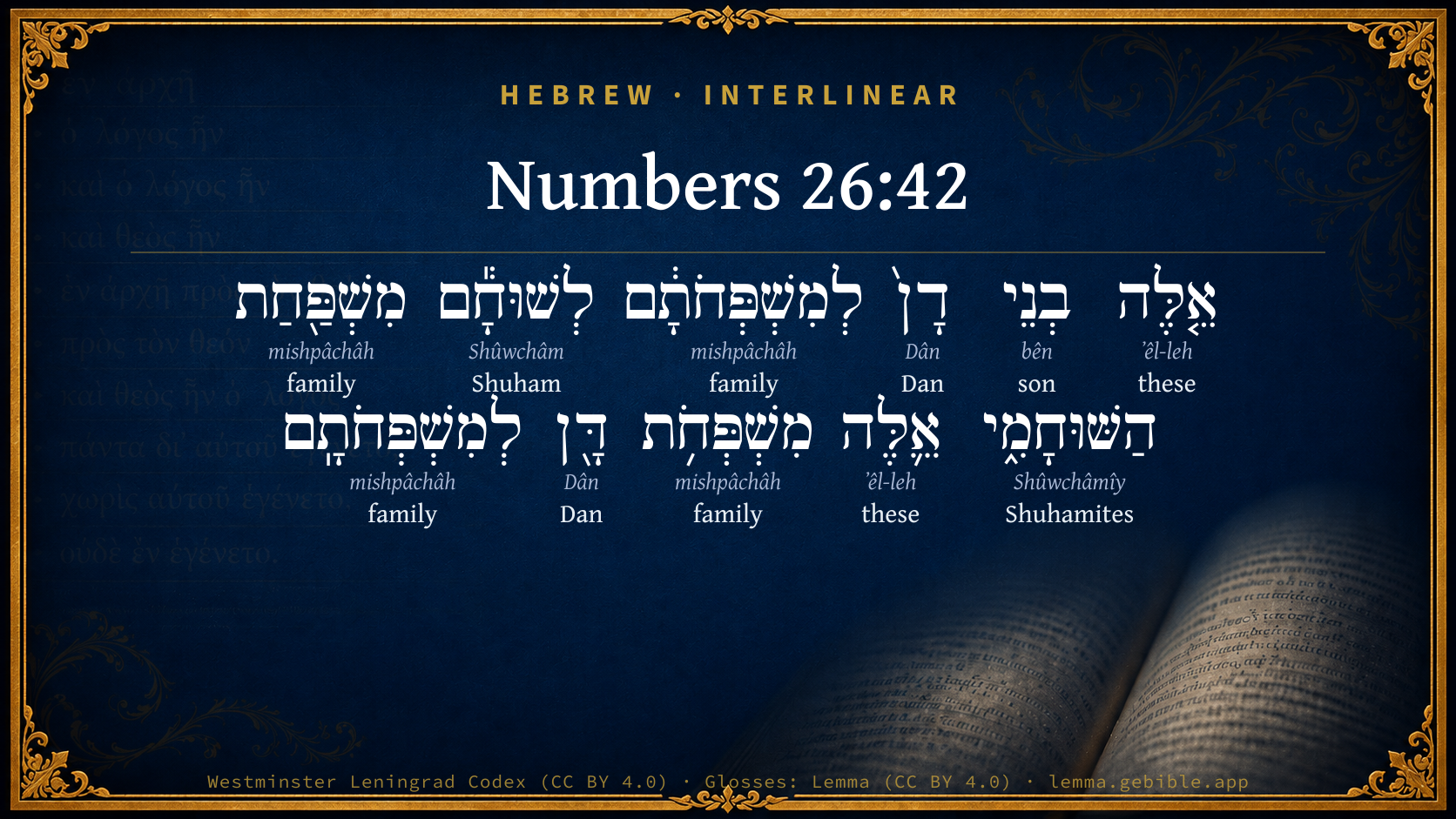
Hebrew (Westminster Leningrad Codex) Numbers 26:42 appears in the Hebrew Old Testament. The text above is from the Westminster Leningrad Codex. Each word links to its Strong’s number, a concise gloss, and parsing drawn from the Open Scriptures Hebrew Bible morphology. Click any word for its full Brown-Driver-Briggs (BDB) entry.
Download image
Cite this verse

Numbers 26:42 (World English Bible). Public Domain. Lemma interlinear Bible study tool, https://lemma.gebible.app/v/numbers/26/42.

Show BibTeX & RIS
BibTeX
RIS
English Translation
These are the sons of Dan after their families: of Shuham, the family of the Shuhamites. These are the families of Dan after their families.
World English Bible · Public Domain
Highlights
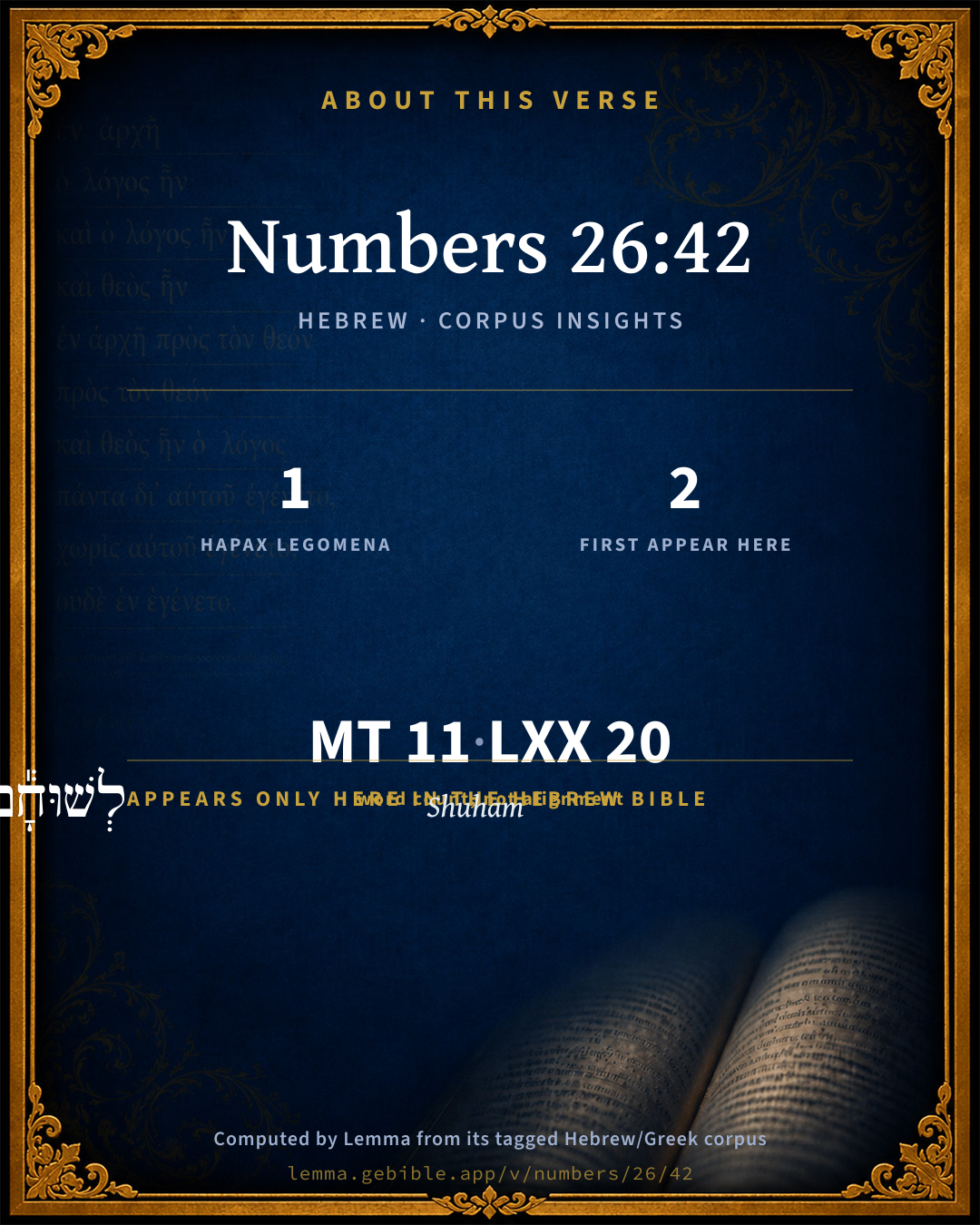
  • 1 hapax legomenon — only here in the Hebrew Bible
  • 2 first appearances in the Hebrew Bible
Full analysis ↓
Download a study sheet

One document with this verse’s original text, its word-by-word gloss line, the meaning frame, cross-references with their text, attributed commentary, and full source and license credits — printable, and it pastes into notes with its structure intact.

This verse Autodidact and up

Study sheet (.html) Plain text (.txt)

A passage Seminary Student

Up to 50 verses in one chapter. A passage sheet keeps up to 6 commentary sources and 12 cross-references per verse, in the order this page ranks them, and says so on the sheet whenever that leaves anything out. Ask for a single verse and you get the Autodidact verse sheet above.

Everything on this page stays free to read, with no account — the sheet is a download of what is already on screen, not access to it.

Want to remove ads? Support Godless Engineer
Compare translations 3

The same verse in 3 English versions, stacked beneath the original-language interlinear above. Click any original word for its lexicon entry.

Each is an independent rendering of the whole verse — the interlinear is not word-aligned to these translations.

Highlighted words mark where these versions differ — a whole-verse word diff, not a word-by-word alignment.

  • World English Bible Public Domain
    These are the sons of Dan after their families: of Shuham, the family of the Shuhamites. These are the families of Dan after their families.
  • King James Version Public Domain
    These are the sons of Dan after their families: of Shuham, the family of the Shuhamites. These are the families of Dan after their families.
  • unfoldingWord Literal Text CC BY-SA 4.0
    These were the sons of Dan according to their clans: of Shuham, the clan of the Shuhamite. These were the clans of Dan according to their clans.

unfoldingWord Literal Text — © unfoldingWord, licensed CC BY-SA 4.0. Word-aligned USFM3 via Door43 (git.door43.org/unfoldingWord/en_ult).

Versions to compare (up to 4)

3 of 4 selected

Show all 18 translations

Every available English version of this verse, each an independent rendering of the whole verse.

  • World English Bible Public Domain
    These are the sons of Dan after their families: of Shuham, the family of the Shuhamites. These are the families of Dan after their families.
  • Berean Standard Bible Public Domain
    These were the descendants of Dan by their clans: The Shuhamite clan from Shuham. These were the clans of Dan.
  • Majority Standard Bible Public Domain
    These were the descendants of Dan by their clans: The Shuhamite clan from Shuham. These were the clans of Dan.
  • King James Version Public Domain
    These are the sons of Dan after their families: of Shuham, the family of the Shuhamites. These are the families of Dan after their families.
  • American Standard Version (1901) Public Domain
    These are the sons of Dan after their families: of Shuham, the family of the Shuhamites. These are the families of Dan after their families.
  • Revised Version (1885) Public Domain
    These are the sons of Dan after their families: of Shuham, the family of the Shuhamites. These are the families of Dan after their families.
  • Geneva Bible (1599) Public Domain
    These are the sonnes of Dan after their families: of Shuham came the familie of the Shuhamites: these are the families of Dan after their housholdes.
  • Douay-Rheims (1899) Public Domain
    The sons of Dan by their kindreds: Suham, of whom is the family of the Suhamites: These are the kindreds of Dan by their families.
  • Young's Literal Translation Public Domain
    These `are' sons of Dan by their families: of Shuham `is' the family of the Shuhamite; these `are' families of Dan by their families;
  • Literal Standard Version CC BY-SA 4.0
    These [are] sons of Dan by their families: of Shuham [is] the family of the Shuhamite; these [are] families of Dan by their families;
  • Unlocked Literal Bible CC BY-SA 4.0
    The clans of Dan's descendants were, by Shuham, the clans of the Shuhamites. These were the clans of Dan's descendants.
  • unfoldingWord Literal Text CC BY-SA 4.0
    These were the sons of Dan according to their clans: of Shuham, the clan of the Shuhamite. These were the clans of Dan according to their clans.
  • Darby Bible Public Domain
    These are the sons of Dan, after their families: of Shuham, the family of the Shuhamites. These are the families of Dan after their families.
  • World Messianic Bible Public Domain
    These are the sons of Dan after their families: of Shuham, the family of the Shuhamites. These are the families of Dan after their families.
  • Webster's Bible Public Domain
    These are the sons of Dan after their families: of Shuham, the family of the Shuhamites. These are the families of Dan after their families.
  • Free Bible Version CC BY-SA 4.0
    These were the descendants of Dan by family: Shuham, ancestor of the Shuhamite families.
  • Bible in Basic English Public Domain
    These are the sons of Dan by their families: of Shuham, the family of the Shuhamites. These are the families of Dan by their families.
  • JPS Tanakh (1917) Public Domain
    These are the sons of Dan after their families: of Shuham, the family of the Shuhamites. These are the families of Dan after their families.

Literal Standard Version (2020), Covenant Press — licensed CC BY-SA 4.0. Text via the HelloAO Bible API (eBible.org). Unlocked Literal Bible (unfoldingWord) — licensed CC BY-SA 4.0. Text via the HelloAO Bible API (eBible.org). unfoldingWord Literal Text — © unfoldingWord, licensed CC BY-SA 4.0. Word-aligned USFM3 via Door43 (git.door43.org/unfoldingWord/en_ult). Free Bible Version, Dr. Jonathan Gallagher — licensed CC BY-SA 4.0. Text via the HelloAO Bible API (eBible.org).

Word by word

More ways to search: Search by grammar → Find every occurrence → Compare this word →

Practice this passage: Drill this verse → Learn its vocabulary →

לְשׁוּחָ֕ם
Shûwchâm
H7748
“to/for · Shuham”
Preposition + Noun, Proper
Part of Speech
Preposition + Noun
Type
Proper
Full BDB Definition

Origin: from H7743

TWOT: None

Shuham = "pit-digger" - son of Dan and progenitor of the family of Shuhamites
  1. אֵ֤לֶּה ʼêl-leh H428 “these” Pronoun, Demonstrative, Common, Plural
  2. בְנֵי bên H1121 “sons of” Noun, Common, Masculine, Plural, Construct
  3. דָן֙ Dân H1835 “Dan” Noun, Proper
  4. לְמִשְׁפְּחֹתָ֔ם mishpâchâh H4940 “to/for · families · their” Preposition + Noun, Common, Feminine, Plural, Construct + Suffix, Personal, 3rd Person, Masculine, Plural
  5. מִשְׁפַּ֖חַת mishpâchâh H4940 “family of” Noun, Common, Feminine, Singular, Construct
  6. הַשּׁוּחָמִ֑י Shûwchâmîy H7749 “the · Shuhamites” Particle, Definite Article + Noun, Gentilic, Masculine, Singular, Absolute
  7. אֵ֛לֶּה ʼêl-leh H428 “these” Pronoun, Demonstrative, Common, Plural
  8. מִשְׁפְּחֹ֥ת mishpâchâh H4940 “families of” Noun, Common, Feminine, Plural, Construct
  9. דָּ֖ן Dân H1835 “Dan” Noun, Proper
  10. לְמִשְׁפְּחֹתָֽם mishpâchâh H4940 “to/for · families · their” Preposition + Noun, Common, Feminine, Plural, Construct + Suffix, Personal, 3rd Person, Masculine, Plural

About this verse

These counts appear in no published source. They are computed here, from the morphology-tagged text and Lemma’s own curated glosses. What Lemma adds →

11
words
6
distinct lemmas
Pentateuch
section

Notable vocabulary

1 hapax legomenon — a word that appears only here in the entire Hebrew Bible:

  • לְשׁוּחָ֕ם Shuham H7748

First appearance in Scripture

These words make their first canonical appearance in the Hebrew Bible here:

  • לְשׁוּחָ֕ם Shuham H7748
  • הַשּׁוּחָמִ֑י Shuhamites H7749

Shared distinctive vocabulary

הַשּׁוּחָמִ֑י Shuhamites H7749 occurs in 2 verses of the Hebrew Bible. Also found in:

Grammatical profile

  • 9 nouns
  • 2 pronouns

Repetition

Words recur within this verse — often emphatic in Hebrew:

  • לְמִשְׁפְּחֹתָ֔ם family H4940 ×4
  • דָן֙ Dan H1835 ×2
  • אֵ֤לֶּה these H428 ×2

Hebrew & Septuagint length

In English translation the verse runs 25 words from the Hebrew and 29 from the Septuagint (LXX English) — closely comparable.

A rough comparison of the two English renderings, which tokenize alike — not a word-level alignment.

Word counts can differ between the Hebrew and the Greek without any difference in meaning — e.g. the Hebrew direct-object marker אֵת has no separate Greek word, and Greek often adds the article ὁ.

In the original languages it is 11 Hebrew tokens and 20 Greek tokens — but the two are counted differently (Hebrew bundles its prefixes and suffixes into one token; the Greek is in lemma form), so that isn’t a like-for-like length.

Cross-references

1

Topical passages linked to Numbers 26:42 in the Treasury of Scripture Knowledge — connected by theme and wording, ordered by reader-vote popularity; previews shown in the World English Bible.

Cross-references courtesy of OpenBible.info (CC BY 4.0).

Hebrew and Greek witnesses Masoretic Hebrew ↔ Greek Septuagint

The same verse in the two great witnesses to the Old Testament, shown verse-for-verse.

These are two independent witnesses, not word-aligned to each other, and the Septuagint is shown in lemma (dictionary) form.

Hebrew Numbers 26:42 Masoretic · Westminster Leningrad Codex

אֵ֤לֶּה בְנֵי דָן֙ לְמִשְׁפְּחֹתָ֔ם לְשׁוּחָ֕ם מִשְׁפַּ֖חַת הַשּׁוּחָמִ֑י אֵ֛לֶּה מִשְׁפְּחֹ֥ת דָּ֖ן לְמִשְׁפְּחֹתָֽם

These are the sons of Dan after their families: of Shuham, the family of the Shuhamites. These are the families of Dan after their families.

World English Bible · Public Domain

Greek LXX Numbers 26:42 Septuagint · lemma form

υἱός βενιαμίν κατά δῆμος αὐτός ὁ βαλε δῆμος ὁ βαλεϊ ὁ ασυβηρ δῆμος ὁ ασυβηρι ὁ ιαχιραν δῆμος ὁ ιαχιρανι

The sons of Benjamin according to their families; to Bale, the family of the Balites; to Asyber, the family of the Asyberites; to Jachiran, the family of the Jachiranites.

LXX2012 (modern English Septuagint) · Public Domain

Hebrew: Westminster Leningrad Codex (CC BY 4.0). Greek: Septuagint (public domain); English from LXX2012 (modern English Septuagint) (Public Domain). How the Septuagint differs from the Hebrew →

Targum (Aramaic paraphrase)

2

The Targum is the ancient Jewish Aramaic paraphrase of the Hebrew Scriptures — an interpretive translation, not the Hebrew text itself. Onkelos (literal) and Pseudo-Jonathan (expansive) render the Torah, and Jonathan the Prophets. Coverage is partial: where no permissively-licensed English translation exists for a verse, only the Aramaic is shown. This is verse-level text, not a word-by-word alignment to the Hebrew.

  1. Targum Onkelos Torah (Genesis–Deuteronomy)
    אִלֵין בְּנֵי דָן לְזַרְעֲיַתְהוֹן לְשׁוּחָם זַרְעִית שׁוּחָם אִלֵין זַרְעֲיַת דָן לְזַרְעֲיַתְהוֹן

    (no public-domain English translation for this verse)

    Targum Onkelos — Aramaic: “Onkelos Genesis” (public domain); “Onkelos Exodus” (public domain); “Onkelos Leviticus” (public domain); “Onkelos Numbers” (public domain); “Onkelos Deuteronomy” (public domain). English: “Sefaria Community Translation” (CC0 1.0 (public-domain dedication)); “J.W. Etheridge. The Targums of Onkelos and Jonathan Ben Uzziel on the Pentateuch. London: Longmans, Green, 1862” (public domain). Text via Sefaria.

  2. Targum Pseudo-Jonathan Torah (Genesis–Deuteronomy)
    אִלֵין בְּנֵי דְדָן לִגְנִיסַתְהוֹן לְשׁוּחָם גְנִיסַת שׁוּחָם אִלֵין גְנִיסַת דָן לִגְנִיסַתְהוֹן

    The Beni Dan, with their families, of Shuham, the family of Shuham; These are the families of Beni Dan.

    Targum Pseudo-Jonathan — Aramaic: “Targum Jonathan on Genesis” (public domain); “Targum Jonathan on Exodus” (public domain); “Targum Jonathan on Leviticus” (public domain); “Targum Jonathan on Numbers” (public domain); “Targum Jonathan on Deuteronomy” (public domain). English: “The Targum of Jonathan ben Uzziel, trans. J. W. Etheridge, London, 1862” (public domain). Text via Sefaria.

Commentary

Notes on Numbers 26:42 from classic Christian and Jewish commentators (each source and its license shown beneath its notes). The classic Christian expositions comment on the surrounding passage and are grouped to its opening verse, so a note may address several verses; the Jewish commentaries on the Tanakh (Rashi and others) are per-verse, so they appear only where the commentator wrote on this verse.

Lemma curates 59 commentaries, every one of them public domain or Creative Commons licensed, each selected and text-cleaned for this edition rather than reprinted as found. About our sources →

Joseph Benson's Commentary

Num 26:42. The sons of Dan — Under the name of sons his descendants are included, he having but one immediate son. But from him this tribe multiplied into very great divisions and subdivisions of families, and was now increased since the last poll seventeen hundred.

Joseph Benson's Commentary on the Old and New Testaments (1811–1818) — public domain. Text from a community e-Sword module.

John Gill's Exposition

Notwithstanding, the land shall be divided by lot,.... That the division might appear to be according to the determination and will of God, and not left to the judgment and discretion of the chief magistrate, though bound by the above rule:

according to the names of the tribes of their fathers they shall inherit; that is, according as to whatsoever name of a tribe such a part or portion of the land comes up by lot, that shall their inheritance be: Jarchi says, the names of the twelve tribes were written on twelve scrolls of parchment, and twelve borders or limits of land on twelve others, and they were mixed together in an urn, and the prince put his hand into it and took two scrolls; a scroll came up with the name of a tribe, and a scroll with a border or limit expressed on it; and the lot, he says, was by the Holy Ghost, for Eleazar, at the same time, was clothed with Urim and Thummim (s); so that the people were certain that the disposition and division of the land was of God; but there were but nine tribes and a half, among whom the land of Canaan was divided, two tribes and a half settled on the other side Jordan, namely, the tribes of Reuben and Gad, and half the tribe of Manasseh.

(s) Maimon. & Bartenora in Misn. Biccurim, c. 1. sect. 5.

John Gill's Exposition of the Whole Bible (1746–1763) — public domain (CC PDM 1.0). Text via the HelloAO Bible API.

Matthew Poole's English Annotations

Shuham, called, by transposition, Hushim, Gen 46:23.

After their families; the greater families subdivided into lesser families.

Matthew Poole's English Annotations on the Holy Bible (1683–1685) — public domain. Text from a community e-Sword/MySword module.

Whedon's Commentary on the Bible

Daniel D. Whedon

42. Shuham is Hushim in Gen_46:23.

Daniel D. Whedon (gen. ed.), Commentary on the Old and New Testaments (1874–1909) — public domain. Text from a community e-Sword module.

The Pulpit Commentary

The sons of Dan. These all formed but one family, named alter Shuham (elsewhere Hushim), the only son of Dan that is mentioned. It is possible that Dan had other children, whose descendants were incorporated with the Shuhamites.

The Pulpit Commentary (1880–1919), ed. H.D.M. Spence-Jones & Joseph S. Exell — public domain. Text from a community e-Sword module.

unfoldingWord translationNotes

Door43 World Missions Community

General Information:

The leaders of Israel are counting the men, 20 years old and older, according to their tribes and families. (See: How to Translate Names and Numbers)

64,400 men

"sixty-four thousand four hundred men" (See: Numbers)

translationWords

Dan

unfoldingWord translationNotes — © Distant Shores Media and the Door43 World Missions Community, licensed CC BY-SA 4.0. Source: git.door43.org/Door43/en_tn.

Rashi

Rabbi Shlomo Yitzchaki (Rashi)

לשוחם OF SHUHAM — he is identical with Hushim (Genesis 46:23).

Rashi on the Tanakh — English translations: “The Judaica Press complete Tanach with Rashi, translated by A. J. Rosenberg” (CC BY 4.0); “Pentateuch with Rashi's commentary by M. Rosenbaum and A.M. Silbermann, 1929-1934” (public domain); “The Metsudah Tanach series, Lakewood, N.J” (CC BY 4.0); and “The Book of Joshua, Metsudah Publications, 1997” (CC BY 4.0). Text via Sefaria.

Ramban (Nachmanides)

Rabbi Moshe ben Nachman (Ramban / Nachmanides)

THESE ARE THE SONS OF DAN AFTER THEIR FAMILIES: [OF SHUHAM, THE FAMILY OF THE SHUHAMITES. THESE ARE THE FAMILIES OF DAN AFTER THEIR FAMILIES]. The meaning of this. is that Shuham had children who formed families which were called by the name of the [respective] fathers of the family, but they all traced back their lineage to Shuham the head [of them all], and [therefore] they were called by his name, so that one would say [for example]: “Of Daniel, the family of Daniel the Shuhamite; of Ezekiel, the family of Ezekiel the Shuhamite.” Thus [the sons of Shuham] consisted of many families, but [all identified themselves] as the one Shuhamite family, and therefore they are all ascribed to him. And according to those who say that the people traced their lineage [only] to those who went down to Egypt [with Jacob, we must say that] there were many families [descended from Dan] who were called by the name of their ancestor, and who were born in Egypt, and here Scripture described them [i.e., all the families of Dan’s descendants] as Shuhamites, because he [Shuham] alone [as the only son of Dan] went down to Egypt.

Ramban (Nachmanides) on the Tanakh — English translation: “Commentary on the Torah by Ramban (Nachmanides). Translated and annotated by Charles B. Chavel. New York, Shilo Pub. House, 1971-1976” (CC BY 4.0). Text via Sefaria.

Lesson kit

Teaching starters — assembled from the data on this page, not authored interpretation. Every prompt links to the verse data it draws on. Edit before teaching.

Numbers, in the Pentateuch, opens this verse with 11 words (6 distinct Hebrew lemmas). Its most distinctive word is Shûwchâm (“Shuham”). A historical commentator’s framing appears above. Read the whole chapter for the surrounding context.

Discussion questions

  1. The word Shûwchâm carries the sense “Shuham.” How does it shape the verse?
  2. This verse holds 1 word here found nowhere else in the Hebrew Bible. What might the rare word draw attention to?
  3. 2 words here appear for the first time in Scripture. What is being introduced at this debut?
  4. Numbers 26:43 shares the word «Shuhamites» with this verse. How do the two illuminate each other?
  5. “family” occurs 4× in this one verse. What is the effect of the repetition?
  6. These translations render this verse differently; the difference is in the English rendering, not the original. What questions does that raise?
  7. Reading how Joseph Benson's Commentary and John Gill's Exposition read this verse, where do the two commentators agree and where do they part?

Things to notice

  • 1 word in this verse appears nowhere else in the Hebrew Bible.
  • 2 words make their first canonical appearance in Scripture here.
  • This verse counts 11 Hebrew ↔ 20 Greek words.
  • These translations choose different wording for 8 words in this verse.
  • “family” occurs 4× in this single verse.

Reading settings

Reading text

Shown beneath each verse's original-language words.

Old Testament
Old Testament edition

Read the OT as the Masoretic Hebrew (MT) or the Greek Septuagint (LXX).

English shown for the Greek Septuagint (in the Hebrew ↔ Greek comparison).

Comparing translations? Open the Compare panel on any verse page to stack up to four side by side.