
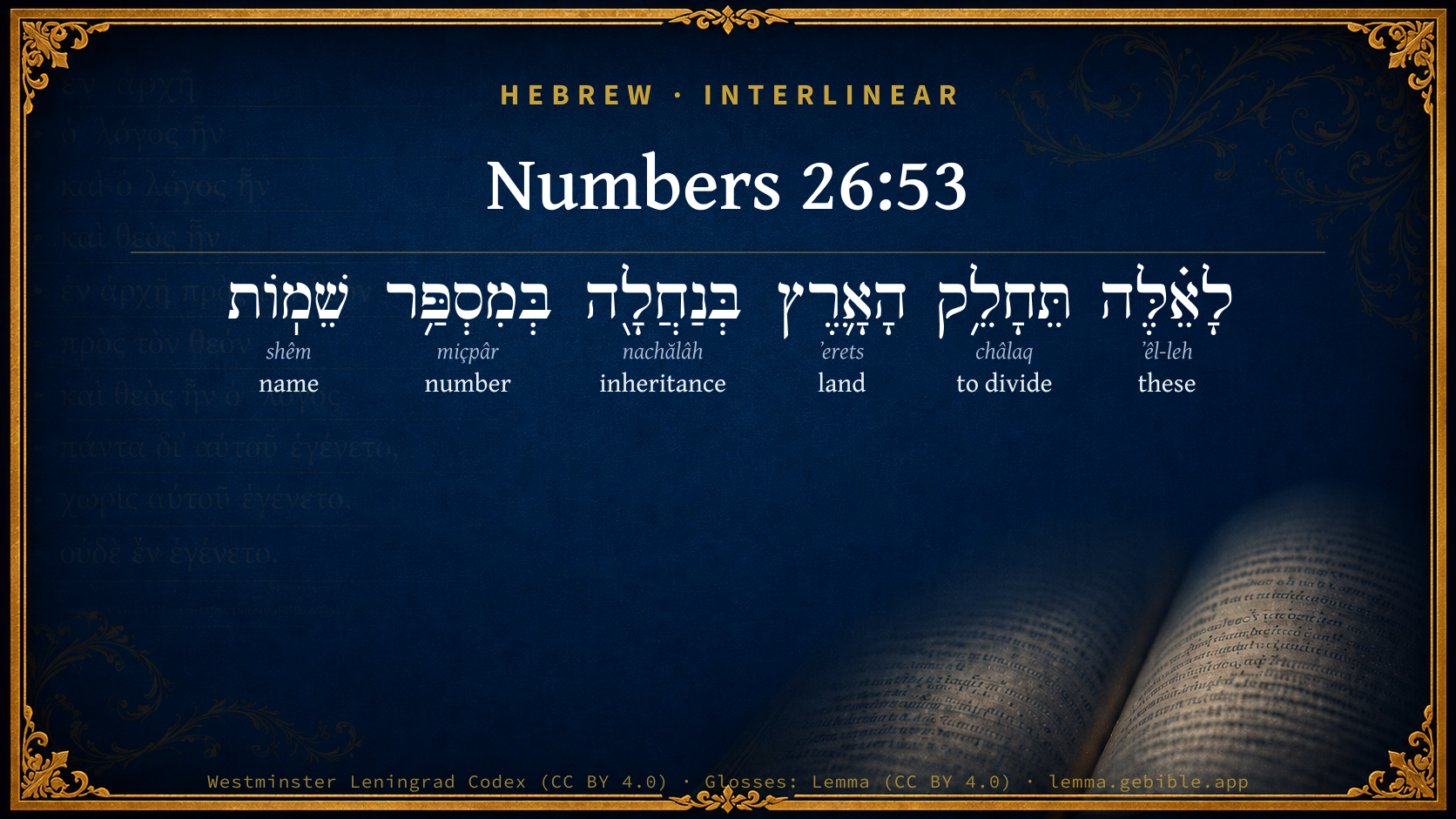
Numbers 26:53

Hebrew (Westminster Leningrad Codex) Numbers 26:53 appears in the Hebrew Old Testament. The text above is from the Westminster Leningrad Codex. Each word links to its Strong’s number, a concise gloss, and parsing drawn from the Open Scriptures Hebrew Bible morphology. Click any word for its full Brown-Driver-Briggs (BDB) entry.
Download image
Cite this verse

Numbers 26:53 (World English Bible). Public Domain. Lemma interlinear Bible study tool, https://lemma.gebible.app/v/numbers/26/53.

Show BibTeX & RIS
BibTeX
RIS
English Translation
To these the land shall be divided for an inheritance according to the number of names.
World English Bible · Public Domain
Download a study sheet

One document with this verse’s original text, its word-by-word gloss line, the meaning frame, cross-references with their text, attributed commentary, and full source and license credits — printable, and it pastes into notes with its structure intact.

This verse Autodidact and up

Study sheet (.html) Plain text (.txt)

A passage Seminary Student

Up to 50 verses in one chapter. A passage sheet keeps up to 6 commentary sources and 12 cross-references per verse, in the order this page ranks them, and says so on the sheet whenever that leaves anything out. Ask for a single verse and you get the Autodidact verse sheet above.

Everything on this page stays free to read, with no account — the sheet is a download of what is already on screen, not access to it.

Want to remove ads? Support Godless Engineer
Compare translations 3

The same verse in 3 English versions, stacked beneath the original-language interlinear above. Click any original word for its lexicon entry.

Each is an independent rendering of the whole verse — the interlinear is not word-aligned to these translations.

Highlighted words mark where these versions differ — a whole-verse word diff, not a word-by-word alignment.

  • World English Bible Public Domain
    To these the land shall be divided for an inheritance according to the number of names.
  • King James Version Public Domain
    Unto these the land shall be divided for an inheritance according to the number of names.
  • unfoldingWord Literal Text CC BY-SA 4.0
    “The land shall be apportioned to these ones as an inheritance by the number of the names.

unfoldingWord Literal Text — © unfoldingWord, licensed CC BY-SA 4.0. Word-aligned USFM3 via Door43 (git.door43.org/unfoldingWord/en_ult).

Versions to compare (up to 4)

3 of 4 selected

Show all 18 translations

Every available English version of this verse, each an independent rendering of the whole verse.

  • World English Bible Public Domain
    To these the land shall be divided for an inheritance according to the number of names.
  • Berean Standard Bible Public Domain
    “The land is to be divided among the tribes as an inheritance, according to the number of names.
  • Majority Standard Bible Public Domain
    “The land is to be divided among the tribes as an inheritance, according to the number of names.
  • King James Version Public Domain
    Unto these the land shall be divided for an inheritance according to the number of names.
  • American Standard Version (1901) Public Domain
    Unto these the land shall be divided for an inheritance according to the number of names.
  • Revised Version (1885) Public Domain
    Unto these the land shall be divided for an inheritance according to the number of names.
  • Geneva Bible (1599) Public Domain
    Vnto these the land shalbe deuided for an inheritance, according to the nomber of names.
  • Douay-Rheims (1899) Public Domain
    To these shall the land be divided for their possessions according to the number of names.
  • Young's Literal Translation Public Domain
    `To these is the land apportioned by inheritance, by the number of names;
  • Literal Standard Version CC BY-SA 4.0
    “The land is apportioned to these by inheritance, by the number of names;
  • Unlocked Literal Bible CC BY-SA 4.0
    “The land must be divided among these men as an inheritance according to the number of their names.
  • unfoldingWord Literal Text CC BY-SA 4.0
    “The land shall be apportioned to these ones as an inheritance by the number of the names.
  • Darby Bible Public Domain
    Unto these shall the land be divided for an inheritance according to the number of the names;
  • World Messianic Bible Public Domain
    “To these the land shall be divided for an inheritance according to the number of names.
  • Webster's Bible Public Domain
    To these the land shall be divided for an inheritance, according to the number of names.
  • Free Bible Version CC BY-SA 4.0
    “Divide the land that is to be owned based on the number of those censused.
  • Bible in Basic English Public Domain
    Let there be a division of the land among these, for their heritage, in relation to the number of names.
  • JPS Tanakh (1917) Public Domain
    'Unto these the land shall be divided for an inheritance according to the number of names.

Literal Standard Version (2020), Covenant Press — licensed CC BY-SA 4.0. Text via the HelloAO Bible API (eBible.org). Unlocked Literal Bible (unfoldingWord) — licensed CC BY-SA 4.0. Text via the HelloAO Bible API (eBible.org). unfoldingWord Literal Text — © unfoldingWord, licensed CC BY-SA 4.0. Word-aligned USFM3 via Door43 (git.door43.org/unfoldingWord/en_ult). Free Bible Version, Dr. Jonathan Gallagher — licensed CC BY-SA 4.0. Text via the HelloAO Bible API (eBible.org).

Word by word

More ways to search: Search by grammar → Find every occurrence → Compare this word →

Practice this passage: Drill this verse → Learn its vocabulary →

תֵּחָלֵ֥ק
châlaq
H2505
“to divide”
Verb, Niphal, Imperfect, 3rd Person, Feminine, Singular
Part of Speech
Verb
Stem
Niphal
Form
Imperfect
Person
3rd Person
Gender
Feminine
Number
Singular
Full BDB Definition

Origin: a primitive root

TWOT: 669

to divide, share, plunder, allot, apportion, assign - (Qal) - to divide, apportion - to assign, distribute - to assign, impart - to share - to divide up, plunder - (Niphal) - to divide oneself - to be divided - to assign, distribute - (Piel) - to divide, apportion - to assign, distribute - to scatter - (Pual) to be divided - (Hiphil) to receive a portion or part - (Hithpael) to divide among themselves - to be smooth, slippery, deceitful - (Qal) to be smooth, slippery - (Hiphil) - to be smooth - to flatter
  1. לָאֵ֗לֶּה ʼêl-leh H428 “to/for · these” Preposition + Pronoun, Demonstrative, Common, Plural
  2. הָאָ֛רֶץ ʼerets H776 “the · land” Particle, Definite Article + Noun, Common, Both, Singular, Absolute
  3. בְּנַחֲלָ֖ה nachălâh H5159 “in/at · inheritance” Preposition + Noun, Common, Feminine, Singular, Absolute
  4. בְּמִסְפַּ֥ר miçpâr H4557 “in/at · number of” Preposition + Noun, Common, Masculine, Singular, Construct
  5. שֵׁמֽוֹת shêm H8034 “names” Noun, Common, Masculine, Plural, Absolute

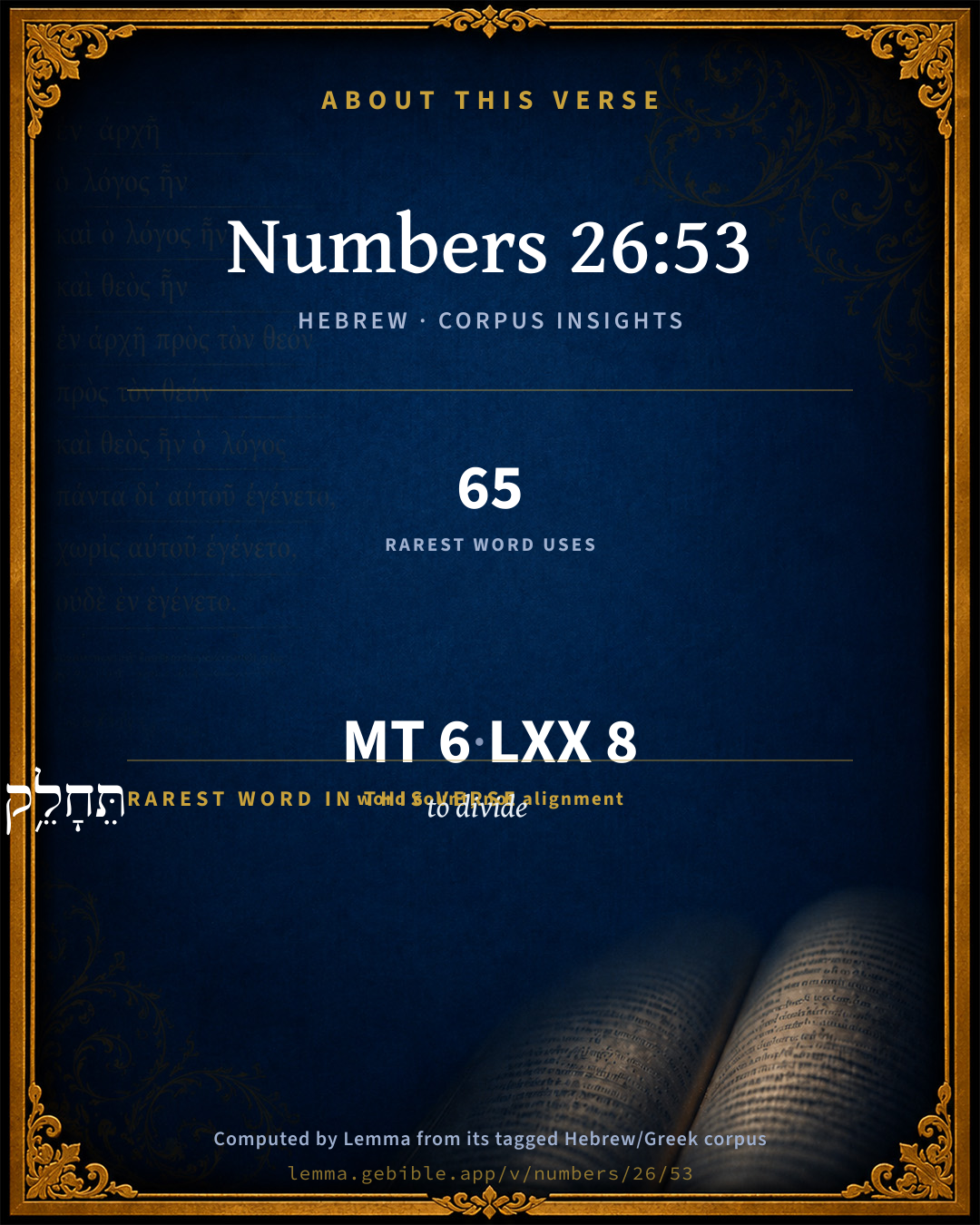
About this verse

These counts appear in no published source. They are computed here, from the morphology-tagged text and Lemma’s own curated glosses. What Lemma adds →

6
words
6
distinct lemmas
Pentateuch
section

Grammatical profile

  • 1 verb
  • 4 nouns
  • 1 pronoun

Verb forms

  • תֵּחָלֵ֥ק Niphal · Imperfect

Hebrew & Septuagint length

In English translation the verse runs 16 words from the Hebrew and 19 from the Septuagint (LXX English) — closely comparable.

A rough comparison of the two English renderings, which tokenize alike — not a word-level alignment.

Word counts can differ between the Hebrew and the Greek without any difference in meaning — e.g. the Hebrew direct-object marker אֵת has no separate Greek word, and Greek often adds the article ὁ.

In the original languages it is 6 Hebrew tokens and 8 Greek tokens — but the two are counted differently (Hebrew bundles its prefixes and suffixes into one token; the Greek is in lemma form), so that isn’t a like-for-like length.

Cross-references

11

Topical passages linked to Numbers 26:53 in the Treasury of Scripture Knowledge — connected by theme and wording, ordered by reader-vote popularity; previews shown in the World English Bible.

  • Joshua 11:23 So Joshua took the whole land, according to all that Yahweh spoke to Moses; and Joshua gave it for an inheritance to Israel according to their divisions by their tribes. The land had rest from war.
  • Joshua 14:1 These are the inheritances which the children of Israel took in the land of Canaan, which Eleazar the priest, and Joshua the son of Nun, and the heads of the fathers' [houses] of the tribes of the children of Israel, distributed to them,
  • Psalms 105:44 He gave them the lands of the nations. They took the labor of the peoples in possession,
  • Genesis 12:2 I will make of you a great nation. I will bless you, and make your name great. You will be a blessing.
  • Genesis 12:7 Yahweh appeared to Abram, and said, "I will give this land to your seed." He built an altar there to Yahweh, who appeared to him.
  • Psalms 49:14 They are appointed as a flock for Sheol. Death shall be their shepherd. The upright shall have dominion over them in the morning. Their beauty shall decay in Sheol, Far from their mansion.
  • Ezekiel 47:22 It shall happen, that you shall divide it by lot for an inheritance to you and to the strangers who sojourn among you, who shall father children among you; and they shall be to you as the home-born among the children of Israel; they shall have inheritance with you among the tribes of Israel.
  • Daniel 7:27 The kingdom and the dominion, and the greatness of the kingdoms under the whole the sky, shall be given to the people of the saints of the Most High: his kingdom is an everlasting kingdom, and all dominions shall serve and obey him.
  • Matthew 5:5 Blessed are the gentle, For they shall inherit the earth.
  • Revelation 5:10 And made them kings and priests to our God, And they reign on earth."
  • Revelation 21:27 There will in no way enter into it anything profane, or one who causes an abomination or a lie, but only those who are written in the Lamb's book of life.

Cross-references courtesy of OpenBible.info (CC BY 4.0).

Hebrew and Greek witnesses Masoretic Hebrew ↔ Greek Septuagint

The same verse in the two great witnesses to the Old Testament, shown verse-for-verse.

These are two independent witnesses, not word-aligned to each other, and the Septuagint is shown in lemma (dictionary) form.

Hebrew Numbers 26:53 Masoretic · Westminster Leningrad Codex

לָאֵ֗לֶּה תֵּחָלֵ֥ק הָאָ֛רֶץ בְּנַחֲלָ֖ה בְּמִסְפַּ֥ר שֵׁמֽוֹת

To these the land shall be divided for an inheritance according to the number of names.

World English Bible · Public Domain

Greek LXX Numbers 26:53 Septuagint · lemma form

οὗτος μερίζω ὁ γῆ κληρονομέω ἐκ ἀριθμός ὄνομα

To these the land shall be divided, so that they may inherit according to the number of the names.

LXX2012 (modern English Septuagint) · Public Domain

Hebrew: Westminster Leningrad Codex (CC BY 4.0). Greek: Septuagint (public domain); English from LXX2012 (modern English Septuagint) (Public Domain). How the Septuagint differs from the Hebrew →

Targum (Aramaic paraphrase)

2

The Targum is the ancient Jewish Aramaic paraphrase of the Hebrew Scriptures — an interpretive translation, not the Hebrew text itself. Onkelos (literal) and Pseudo-Jonathan (expansive) render the Torah, and Jonathan the Prophets. Coverage is partial: where no permissively-licensed English translation exists for a verse, only the Aramaic is shown. This is verse-level text, not a word-by-word alignment to the Hebrew.

  1. Targum Onkelos Torah (Genesis–Deuteronomy)
    לְאִלֵין תִּתְפְּלֵיג אַרְעָא בְּאַחֲסָנָא בְּמִנְיַן שְׁמָהָן

    (no public-domain English translation for this verse)

    Targum Onkelos — Aramaic: “Onkelos Genesis” (public domain); “Onkelos Exodus” (public domain); “Onkelos Leviticus” (public domain); “Onkelos Numbers” (public domain); “Onkelos Deuteronomy” (public domain). English: “Sefaria Community Translation” (CC0 1.0 (public-domain dedication)); “J.W. Etheridge. The Targums of Onkelos and Jonathan Ben Uzziel on the Pentateuch. London: Longmans, Green, 1862” (public domain). Text via Sefaria.

  2. Targum Pseudo-Jonathan Torah (Genesis–Deuteronomy)
    לְאִלֵין שִׁבְטַיָא תִּתְפַּלֵג אַרְעָא בְּאַחֲסָנָא בְּמִנְיַן שְׁמָהָן

    Unto these tribes shall the land be divided by inheritances according to their names.

    Targum Pseudo-Jonathan — Aramaic: “Targum Jonathan on Genesis” (public domain); “Targum Jonathan on Exodus” (public domain); “Targum Jonathan on Leviticus” (public domain); “Targum Jonathan on Numbers” (public domain); “Targum Jonathan on Deuteronomy” (public domain). English: “The Targum of Jonathan ben Uzziel, trans. J. W. Etheridge, London, 1862” (public domain). Text via Sefaria.

Commentary

Notes on Numbers 26:53 from classic Christian and Jewish commentators (each source and its license shown beneath its notes). The classic Christian expositions comment on the surrounding passage and are grouped to its opening verse, so a note may address several verses; the Jewish commentaries on the Tanakh (Rashi and others) are per-verse, so they appear only where the commentator wrote on this verse.

Lemma curates 59 commentaries, every one of them public domain or Creative Commons licensed, each selected and text-cleaned for this edition rather than reprinted as found. About our sources →

Joseph Benson's Commentary

Num 26:53. The land shall be divided — The land was divided into nine parts and a half, respect being had in such division to the goodness as well as to the largeness of the several portions, and the lot gave each tribe their part. Of names — Of persons: the share of each tribe was divided among the several families, to some more, to some less, according to the number of persons of each family. And withal, if one of the portions proved too large or too little for the families and persons of that tribe, they might give part of their portion to another tribe, (as Simeon and Dan had part of Judah’s share,) or take away a part from the portion belonging to another tribe.

Joseph Benson's Commentary on the Old and New Testaments (1811–1818) — public domain. Text from a community e-Sword module.

Geneva Bible (1599)

Geneva Bible translators

Or, persons.

Geneva Bible (1599) marginal notes — public domain. Text via Bolls.life.

Jamieson, Fausset & Brown

Robert Jamieson, A. R. Fausset & David Brown

the land shall be divided according to the number of names--The portion of each tribe was to be greater or less, according to its populousness.

Jamieson, Fausset & Brown — Commentary Critical and Explanatory on the Whole Bible (1871) — public domain (CC PDM 1.0). Text via the HelloAO Bible API.

Ellicott's Commentary for English Readers

(53-56) Unto these the land shall be divided . . . —The general apportionment of the land, as regarded the relative position of each tribe, was to be decided by lot, which was commonly looked upon as the determination of God Himself, and in this instance was undoubtedly so. The extent of territory was to be determined by the number of names—i.e., of persons—in each tribe, and each inheritance was to bear the name of the ancestor of the tribe. Rashi says that the names of the twelve tribes were written on twelve scrolls of parchment, and twelve borders, or limits of land, on twelve others, and that they were mixed together in an urn.

A Bible Commentary for English Readers, edited by Charles John Ellicott (1878–1897) — public domain. Text from a community e-Sword module.

Matthew Poole's English Annotations

Unto these; to these families now mentioned.

The land shall be divided, by lot, Num 26:55. The land was divided into nine parts and a half, respect being had in such division to the goodness as well as to the largeness of the several portions, and the lot gave each tribe their part.

Of names, i.e. of the persons, names being oft put for persons, as Act 1:15; Phi 2:9; Rev 3:4; 11:13. The meaning is, that the share of each tribe was divided amongst the several families, to some more, to some less, according to the number of the persons of each family, Num 33:54. And withal, if one of the lots or portions proved too large or too little for all the families and persons of that tribe, in this case they might either give part of their portion to another tribe, as Simeon and Dan had parts of Judah’s share, Jos 19:1,40, or take away a part from the portion belonging to another tribe.

Matthew Poole's English Annotations on the Holy Bible (1683–1685) — public domain. Text from a community e-Sword/MySword module.

Whedon's Commentary on the Bible

Daniel D. Whedon

GENERAL DIRECTIONS FOR THE ALLOTMENT OF CANAAN, Num_26:51-56.

53, 54. According to the number of names — The first principle upon which the tribal allotment must proceed is, that the portion of the tribes must accord with the census returns, the larger tribes receiving the larger shares and the smaller tribes the smaller portions.

Daniel D. Whedon (gen. ed.), Commentary on the Old and New Testaments (1874–1909) — public domain. Text from a community e-Sword module.

The Pulpit Commentary

According to the number of the names. The intention clearly was that the extent of the territory assigned to each tribe, and called by its name (verse 55, b), should be regulated according to its numbers at the discretion of the rulers.

The Pulpit Commentary (1880–1919), ed. H.D.M. Spence-Jones & Joseph S. Exell — public domain. Text from a community e-Sword module.

John Wesley's Explanatory Notes

The land shall be divided - The land was divided into nine parts and an half, respect being had in such division to the goodness as well as to the largeness of the several portions, and the lot gave each tribe their part. Of names - Of persons, the share of each tribe was divided amongst the several families, to some more, to some less, according to the number of the persons of each family. And withal, if one of the portions proved too large or too little for the families and persons of that tribe, they might give part of their portion to another tribe, (as Simeon and Daniel had part of Judah's share) or take away a part from the portion belonging to another tribe.

John Wesley, Explanatory Notes Upon the Whole Bible (1754–1765) — public domain. Text via the GEBible commentary corpus.

Rashi

Rabbi Shlomo Yitzchaki (Rashi)

לאלה תחלק הארץ TO THESE THE LAND SHALL BE DIVIDED, and not to any who are now less than twenty years old; even though they become included among those who are twenty before the division of the land, — for they were seven years in conquering it and seven years did they take in dividing it — for no one received a portion in the land except these 601,000 and if one of these had six sons, they received only their father’s portion (cf. Bava Batra 117a).

Rashi on the Tanakh — English translations: “The Judaica Press complete Tanach with Rashi, translated by A. J. Rosenberg” (CC BY 4.0); “Pentateuch with Rashi's commentary by M. Rosenbaum and A.M. Silbermann, 1929-1934” (public domain); “The Metsudah Tanach series, Lakewood, N.J” (CC BY 4.0); and “The Book of Joshua, Metsudah Publications, 1997” (CC BY 4.0). Text via Sefaria.

Lesson kit

Teaching starters — assembled from the data on this page, not authored interpretation. Every prompt links to the verse data it draws on. Edit before teaching.

Numbers, in the Pentateuch, opens this verse with 6 words (6 distinct Hebrew lemmas). Its most distinctive word is châlaq (“to divide”). A historical commentator’s framing appears above. Read the whole chapter for the surrounding context.

Discussion questions

  1. The word châlaq carries the sense “to divide.” How does it shape the verse?
  2. Joshua 11:23 shares this passage’s theme. How do the two illuminate each other?
  3. These translations render this verse differently; the difference is in the English rendering, not the original. What questions does that raise?
  4. The verb «תֵּחָלֵ֥ק» is Niphal Imperfect. How does its form color the action?
  5. Reading how Joseph Benson's Commentary and Geneva Bible (1599) read this verse, where do the two commentators agree and where do they part?

Things to notice

Reading settings

Reading text

Shown beneath each verse's original-language words.

Old Testament
Old Testament edition

Read the OT as the Masoretic Hebrew (MT) or the Greek Septuagint (LXX).

English shown for the Greek Septuagint (in the Hebrew ↔ Greek comparison).

Comparing translations? Open the Compare panel on any verse page to stack up to four side by side.