
Joel 1:8

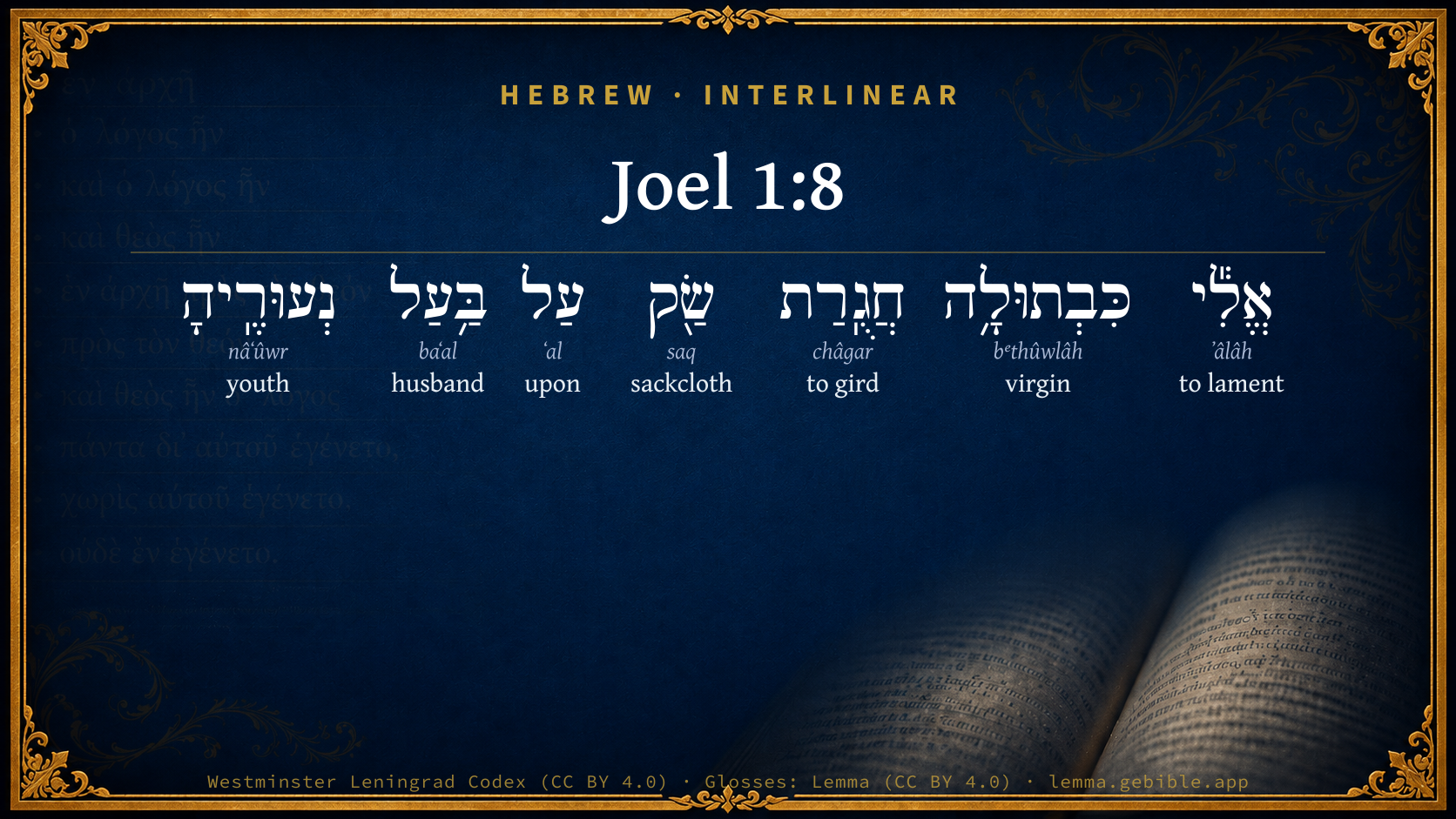
Hebrew (Westminster Leningrad Codex) Joel 1:8 appears in the Hebrew Old Testament. The text above is from the Westminster Leningrad Codex. Each word links to its Strong’s number, a concise gloss, and parsing drawn from the Open Scriptures Hebrew Bible morphology. Click any word for its full Brown-Driver-Briggs (BDB) entry.
Download image
Cite this verse

Joel 1:8 (World English Bible). Public Domain. Lemma interlinear Bible study tool, https://lemma.gebible.app/v/joel/1/8.

Show BibTeX & RIS
BibTeX
RIS
English Translation
Mourn like a virgin dressed in sackcloth for the husband of her youth!
World English Bible · Public Domain
Highlights
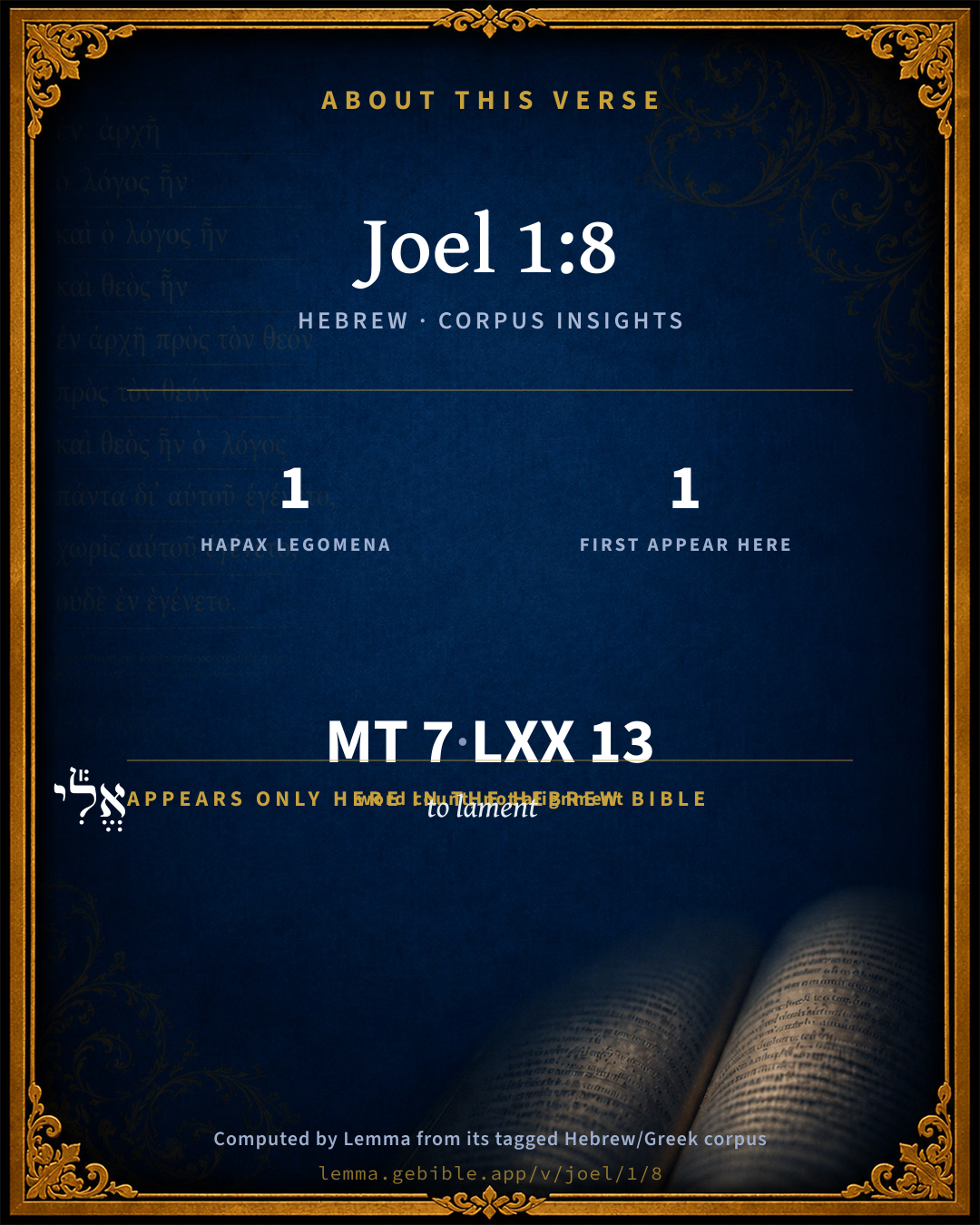
  • 1 hapax legomenon — only here in the Hebrew Bible
  • 1 first appearance in the Hebrew Bible
Full analysis ↓
Download a study sheet

One document with this verse’s original text, its word-by-word gloss line, the meaning frame, cross-references with their text, attributed commentary, and full source and license credits — printable, and it pastes into notes with its structure intact.

This verse Autodidact and up

Study sheet (.html) Plain text (.txt)

A passage Seminary Student

Up to 50 verses in one chapter. A passage sheet keeps up to 6 commentary sources and 12 cross-references per verse, in the order this page ranks them, and says so on the sheet whenever that leaves anything out. Ask for a single verse and you get the Autodidact verse sheet above.

Everything on this page stays free to read, with no account — the sheet is a download of what is already on screen, not access to it.

Want to remove ads? Support Godless Engineer
Compare translations 3

The same verse in 3 English versions, stacked beneath the original-language interlinear above. Click any original word for its lexicon entry.

Each is an independent rendering of the whole verse — the interlinear is not word-aligned to these translations.

Highlighted words mark where these versions differ — a whole-verse word diff, not a word-by-word alignment.

  • World English Bible Public Domain
    Mourn like a virgin dressed in sackcloth for the husband of her youth!
  • King James Version Public Domain
    Lament like a virgin girded with sackcloth for the husband of her youth.
  • unfoldingWord Literal Text CC BY-SA 4.0
    Mourn like a virgin dressed in sackcloth for the husband of her youth.

unfoldingWord Literal Text — © unfoldingWord, licensed CC BY-SA 4.0. Word-aligned USFM3 via Door43 (git.door43.org/unfoldingWord/en_ult).

Versions to compare (up to 4)

3 of 4 selected

Show all 18 translations

Every available English version of this verse, each an independent rendering of the whole verse.

  • World English Bible Public Domain
    Mourn like a virgin dressed in sackcloth for the husband of her youth!
  • Berean Standard Bible Public Domain
    Wail like a virgin dressed in sackcloth, grieving for the husband of her youth.
  • Majority Standard Bible Public Domain
    Wail like a virgin dressed in sackcloth, grieving for the husband of her youth.
  • King James Version Public Domain
    Lament like a virgin girded with sackcloth for the husband of her youth.
  • American Standard Version (1901) Public Domain
    Lament like a virgin girded with sackcloth for the husband of her youth.
  • Revised Version (1885) Public Domain
    Lament like a virgin girded with sackcloth for the husband of her youth.
  • Geneva Bible (1599) Public Domain
    Mourne like a virgine girded with sackcloth for the husband of her youth.
  • Douay-Rheims (1899) Public Domain
    Lament like a virgin girded with sackcloth for the husband of her youth.
  • Young's Literal Translation Public Domain
    Wail, as a virgin girdeth with sackcloth, For the husband of her youth.
  • Literal Standard Version CC BY-SA 4.0
    Wail, as a virgin girds with sackcloth, || For the husband of her youth.
  • Unlocked Literal Bible CC BY-SA 4.0
    Mourn like a virgin dressed in sackcloth for the death of her young husband.
  • unfoldingWord Literal Text CC BY-SA 4.0
    Mourn like a virgin dressed in sackcloth for the husband of her youth.
  • Darby Bible Public Domain
    Wail like a virgin girded with sackcloth for the husband of her youth.
  • World Messianic Bible Public Domain
    Mourn like a virgin dressed in sackcloth for the husband of her youth!
  • Webster's Bible Public Domain
    Lament like a virgin girded with sackcloth for the husband of her youth.
  • Free Bible Version CC BY-SA 4.0
    Mourn like a bride dressed in sackcloth, mourning the death of her husband-to-be.
  • Bible in Basic English Public Domain
    Make sounds of grief like a virgin dressed in haircloth for the husband of her early years.
  • JPS Tanakh (1917) Public Domain
    Lament like a virgin girded with sackcloth for the husband of her youth.

Literal Standard Version (2020), Covenant Press — licensed CC BY-SA 4.0. Text via the HelloAO Bible API (eBible.org). Unlocked Literal Bible (unfoldingWord) — licensed CC BY-SA 4.0. Text via the HelloAO Bible API (eBible.org). unfoldingWord Literal Text — © unfoldingWord, licensed CC BY-SA 4.0. Word-aligned USFM3 via Door43 (git.door43.org/unfoldingWord/en_ult). Free Bible Version, Dr. Jonathan Gallagher — licensed CC BY-SA 4.0. Text via the HelloAO Bible API (eBible.org).

Word by word

More ways to search: Search by grammar → Find every occurrence → Compare this word →

Practice this passage: Drill this verse → Learn its vocabulary →

About this verse

These counts appear in no published source. They are computed here, from the morphology-tagged text and Lemma’s own curated glosses. What Lemma adds →

7
words
7
distinct lemmas
Prophets
section

Notable vocabulary

1 hapax legomenon — a word that appears only here in the entire Hebrew Bible:

  • אֱלִ֕י to lament H421

First appearance in Scripture

This word makes its first canonical appearance in the Hebrew Bible here:

  • אֱלִ֕י to lament H421

Shared distinctive vocabulary

חֲגֻֽרַת to gird H2296 occurs in 41 verses of the Hebrew Bible. Also found in:

Grammatical profile

  • 2 verbs
  • 4 nouns
  • 1 preposition

Verb forms

  • אֱלִ֕י Qal · Imperative
  • חֲגֻֽרַת Qal · Participle Passive

Hebrew & Septuagint length

In English translation the verse runs 13 words from the Hebrew and 16 from the Septuagint (LXX English) — closely comparable.

A rough comparison of the two English renderings, which tokenize alike — not a word-level alignment.

Word counts can differ between the Hebrew and the Greek without any difference in meaning — e.g. the Hebrew direct-object marker אֵת has no separate Greek word, and Greek often adds the article ὁ.

In the original languages it is 7 Hebrew tokens and 13 Greek tokens — but the two are counted differently (Hebrew bundles its prefixes and suffixes into one token; the Greek is in lemma form), so that isn’t a like-for-like length.

Cross-references

12

Topical passages linked to Joel 1:8 in the Treasury of Scripture Knowledge — connected by theme and wording, ordered by reader-vote popularity; previews shown in the World English Bible.

  • Isaiah 22:12 In that day did the Lord, Yahweh of Hosts, call to weeping, and to mourning, and to baldness, and to girding with sackcloth:
  • Malachi 2:15 Did he not make one, although he had the residue of the Spirit? Why one? He sought a godly seed. Therefore take heed to your spirit, and let none deal treacherously against the wife of his youth.
  • James 5:1 Come now, you rich, weep and howl for your miseries that are coming on you.
  • Proverbs 2:17 Who forsakes the friend of her youth, And forgets the covenant of her God:
  • Isaiah 24:7–12 The new wine mourns, the vine languishes, all the merry-hearted do sigh.
  • Isaiah 32:11 Tremble, you women who are at ease; be troubled, you careless ones; strip yourselves, and make yourselves naked, and gird [sackcloth] on your loins.
  • Jeremiah 3:4 Will you not from this time cry to me, My Father, you are the guide of my youth?
  • Jeremiah 9:17–19 Thus says Yahweh of Hosts, Consider you, and call for the mourning women, that they may come; and send for the skillful women, that they may come:
  • Joel 1:13–15 Put on sackcloth and mourn, you priests! Wail, you ministers of the altar. Come, lie all night in sackcloth, you ministers of my God, For the meal offering and the drink offering are withheld from your God's house.
  • Joel 2:12–14 "Yet even now," says Yahweh, "turn to me with all your heart, And with fasting, and with weeping, and with mourning."
  • Amos 8:10 I will turn your feasts into mourning, And all your songs into lamentation; And I will make you wear sackcloth on all your bodies, And baldness on every head. I will make it like the mourning for an only son, And the end of it like a bitter day.
  • James 4:8–9 Draw near to God, and he will draw near to you. Cleanse your hands, you sinners; and purify your hearts, you double-minded.

Cross-references courtesy of OpenBible.info (CC BY 4.0).

Hebrew and Greek witnesses Masoretic Hebrew ↔ Greek Septuagint

The same verse in the two great witnesses to the Old Testament, shown verse-for-verse.

These are two independent witnesses, not word-aligned to each other, and the Septuagint is shown in lemma (dictionary) form.

Hebrew Joel 1:8 Masoretic · Westminster Leningrad Codex

אֱלִ֕י כִּבְתוּלָ֥ה חֲגֻֽרַת שַׂ֖ק עַל בַּ֥עַל נְעוּרֶֽיהָ

Mourn like a virgin dressed in sackcloth for the husband of her youth!

World English Bible · Public Domain

Greek LXX Joel 1:8 Septuagint · lemma form

θρήνέω πρός ἐγώ ὑπέρ νύμφη περιζώννυμι σάκκος ἐπί ὁ ἀνήρ αὐτός ὁ παρθενικός

Lament to me more than a virgin girded with sackcloth for the husband of her youth.

LXX2012 (modern English Septuagint) · Public Domain

On this verse, Whedon's Commentary on the Bible discusses the Septuagint’s reading. Read the note in Commentary ↓

Hebrew: Westminster Leningrad Codex (CC BY 4.0). Greek: Septuagint (public domain); English from LXX2012 (modern English Septuagint) (Public Domain). How the Septuagint differs from the Hebrew →

Targum (Aramaic paraphrase)

1

The Targum is the ancient Jewish Aramaic paraphrase of the Hebrew Scriptures — an interpretive translation, not the Hebrew text itself. Onkelos (literal) and Pseudo-Jonathan (expansive) render the Torah, and Jonathan the Prophets. Coverage is partial: where no permissively-licensed English translation exists for a verse, only the Aramaic is shown. This is verse-level text, not a word-by-word alignment to the Hebrew.

  1. Targum Jonathan Prophets (Joshua–Malachi)
    כְּנִשְׁתָּא דְיִשְׂרָאֵל עֲבִידוּ אִלְיָא כִּבְתוּלָה דַאֲסִירָא סַקָא לְמִסְפַּד עַל בְּעֵל עוּלֶמְתָּהָא:

    (no public-domain English translation for this verse)

    Targum Jonathan — Aramaic: “Mikraot Gedolot” (public domain). English: “Sefaria Community Translation” (CC0 1.0 (public-domain dedication)); “London "Chaldee Paraphrase," 1871” (public domain). Text via Sefaria.

Commentary

Notes on Joel 1:8 from classic Christian and Jewish commentators (each source and its license shown beneath its notes). The classic Christian expositions comment on the surrounding passage and are grouped to its opening verse, so a note may address several verses; the Jewish commentaries on the Tanakh (Rashi and others) are per-verse, so they appear only where the commentator wrote on this verse.

Lemma curates 59 commentaries, every one of them public domain or Creative Commons licensed, each selected and text-cleaned for this edition rather than reprinted as found. About our sources →

Matthew Henry's Commentary

The judgment is here described as very lamentable, and such as all sorts of people should share in; it shall not only rob the drunkards of their pleasure (if that were the worst of it, it might be the better borne), but it shall deprive others of their necessary subsistence, who are therefore called to lament (Joe 1:8), as a virgin laments the death of her lover to whom she was espoused, but not completely married, yet so that he was in effect her husband, or as a young woman lately married, from whom the husband of her youth, her young husband, or the husband to whom she was married when she was young, is suddenly taken away by death. Between a new-married couple that are young, that married for love, and that are every way amiable and agreeable to each other, there is great fondness, and consequently great grief if either be taken away. Such lamentation shall there be for the loss of their corn and wine. Note, The more we are wedded to our creature-comforts that harder it is to part with them. See that parallel place, Isa 32:10-12. Two sorts of people are here brought in, as concerned to lament this devastation, countrymen and clergymen.

I. Let the husbandmen and vine-dressers lament, Joe 1:11. Let them be ashamed of the care and pains they have taken about their vineyards, for it will be all labour lost, and they shall gain no advantage by it; they shall see the fruit of their labour eaten up before their eyes, and shall not be able to save any of it. Note, Those who labour only for the meat that perishes will, sooner or later, be ashamed of their labour. The vine-dressers will then express their extreme grief by howling, when they see their vineyards stripped of leaves and fruit, and the vines withered, so that nothing is to be had or hoped for from them, wherewith they might pay their rent and maintain their families. The destruction is particularly described here: The field is laid waste (Joe 1:10); all is consumed that is produced; the land mourns; the ground has a melancholy aspect, and looks ruefully; all the inhabitants of the land are in tears for what they have lost, are in fear of perishing for want, Isa 24:4; Jer 4:28. "The corn, the bread-corn, which is the staff of life, is wasted; the new wine, which should be brought into the cellars for a supply when the old is drunk, is dried up, is ashamed of having promised so fair what it is not now able to perform; the oil languishes, or is diminished, because (as the Chaldee renders it) the olives have fallen off." The people were not thankful to God as they should have been for the bread that strengthens man's heart, the wine that makes glad the heart, and the oil that makes the face to shine (Psa 104:14, Psa 104:15); and therefore they are justly brought to lament the loss and want of them, of all the products of the earth, which God had given either for necessity or for delight (this is repeated, Joe 1:11, Joe 1:12) - the wheat and barley, the two principal grains bread was then made of, wheat for the rich and barley for the poor, so that the rich and poor meet together in the calamity. The trees are destroyed, not only the vine and the fig-tree (as before, Joe 1:7), which were more useful and necessary, but other trees also that were for delight - the pomegranate, palm-tree, and apple-tree, yea, all the trees of the field, as well as those of the orchard, timber-trees as well as fruit-trees. In short, all the harvest of the field has perished, Joe 1:11. And by this means joy has withered away from the children of men (Joe 1:11); the joy of harvest, which is used to express great and general joy, has come to nothing, is turned into shame, is turned into lamentation. Note, The perishing of the harvest is the withering of the joy of the children of men. Those that place their happiness in the delights of the sense, when they are deprived of them, or in any way disturbed in the enjoyment of them, lose all their joy; whereas the children of God, who look upon the pleasures of sense with holy indifference and contempt, and know what it is to make God their hearts' delight, can rejoice in him as the God of their salvation even when the fig-tree does not blossom; spiritual joy is so far from withering then, that it flourishes more than ever, Hab 3:17, Hab 3:18. Let us see here, 1. What perishing uncertain things all our creature-comforts are. We can never be sure of the continuance of them. Here the heavens had given their rains in due season, the earth had yielded her strength, and, when the appointed weeks of harvest were at hand, they saw no reason to doubt but that they should have a very plentiful crop; yet then they are invaded by these unthought-of enemies, that lay all waste, and not by fire and sword. It is our wisdom not to lay up our treasure in those things which are liable to so many untoward accidents. 2. See what need we have to live in continual dependence upon God and his providence, for our own hands are not sufficient for us. When we see the full corn in the ear, and think we are sure of it - nay, when we have brought it home, if he blow upon it, nay, if he do not bless it, we are not likely to have any good of it. 3. See what ruinous work sin makes. A paradise is turned into a wilderness, a fruitful land, the most fruitful land upon earth, into barrenness, for the iniquity of those that dwelt therein.

II. Let the priests, the Lord's ministers, lament, for they share deeply in the calamity: Gird yourselves with sackcloth (Joe 1:13); nay, they do mourn, Joe 1:9. Observe, The priests are called the ministers of the altar, for on that they attended, and the ministers of the Lord (of my God, says the prophet), for in attending on the altar they served him, did is work, and did him honour. Note, Those that are employed in holy things are therein God's ministers, and on him they attend. The ministers of the altar used to rejoice before the Lord, and to spend their time very much in singing; but now they must lament and howl, for the meat-offering and drink-offering were cut off from the house of the Lord (Joe 1:9), and the same again (Joe 1:13), from the house of your God. "He is your God in a particular manner; you are in a nearer relation to him than other Israelites are; and therefore it is expected that you should be more concerned than others for that which is a hindrance to the service of his sanctuary." It is intimated, 1. That the people, as long as they had the fruits of the earth brought in in their season, presented to the Lord his dues out of them, and brought the offerings to the altar and tithes to those that served at the altar. Note, A people may be filling up the measure of their iniquity apace, and yet may keep up a course of external performances in religion. 2. That, when the meat and drink failed, the meat-offering and drink-offering failed of course; and this was the sorest instance of the calamity. Note, As far as any public trouble is an obstruction to the course of religion it is to be upon that account, more than any other, sadly lamented, especially by the priests, the Lord's ministers. As far as poverty occasions the decay of piety and the neglect of divine offices, and starves the cause of religion among a people, it is indeed a sore judgment. When the famine prevailed God could not have his sacrifices, nor could the priests have their maintenance; and therefore let the Lord's ministers mourn.

Matthew Henry's Commentary on the Whole Bible (1708–1710) — public domain (CC PDM 1.0). Text via the HelloAO Bible API.

Trapp's Complete Commentary

John Trapp

Joe 1:8 Lament like a virgin girded with sackcloth for the husband of her youth.

Ver. 8. Lament like a virgin] Our prophet hath done with his drunkards; and now applieth himself to the soberer sort, whom also he calleth to deep and downright mourning, in this case of common calamity; there being not any so innocent and holy, but had some hand, if not upon the greater cart ropes, yet surely upon the smaller cords, that drew down dearth and judgment upon the land.

Lament therefore like a virgin] Betrothed, but bereft of her espoused husband before she was married to him: so Placater. Others understand it of her that (lately a virgin, but now newly married) passionately loved her husband and bitterly bewaileth his death; which some young women have taken so grievously, that they have refused to live any longer; but have chosen to put an end to their life and grief together, as historians testify.

Girded with sackcloth] Sacco non serico, with mourning weeds as a testimony of help to your humiliation. The dead we see may be lawfully lamented; indeed, it is one of the dues of the dead, τα νομιζομενα, iusta defunctorum. It is fit that the body, when sown in corruption, should be watered by the tears of those that plant it in the earth. Only we must not mourn in this case as heathens, without hope, 1Th 4:13. Our grief must not be excessive, either for measure or continuance; neither must we mourn so much for our friends departed as for our sins against God. In the former case baldness is forbidden; in the latter it is required, Isa 22:12 Zec 12:10; Zec 11:13. One poor woman weeping over Christ shall be as deeply affected as all the people were in that unspeakable loss of their good king Josiah, at Hadadrimmon, in the valley of Megiddo, where Jeremiah lamented, and all the singing men and singing women spake of Josiah in their lamentation, and made them an ordinance, 2Ch 35:24-25.

John Trapp, A Commentary or Exposition upon All the Books of the Old and New Testament (1647–1656) — public domain. Text from a community e-Sword module.

The Biblical Illustrator

Joseph S. Exell

Joe_1:8-10

Lament like a virgin girded with sackcloth for the husband of her youth.

The meat-offering and the drink-offering is cut off from the house of the Lord.

The worship of God sadly neglected through the allure of temporal resource

I. That a neglected worship is often consequent upon the failure of the temporal resource of a people. To the Jews the suspension of the daily sacrifice was the suspension of the appointed sign indicating that they were in covenant with God, and therefore the last of evils. And so there is ever an intimate connection between temporal resource and the worship of God; a desolated commerce will probably involve a neglected temple. When the harvests fail the offerings of the soul are not brought into the sanctuary.

1. That anything which tends to increase the temporal resource of a people gives them an increased power of temple-worship. It is the duty of man to give himself to industry and profitable labour that he may win the means which shall enable him to come into the sanctuary with the offering of the Lord.

2. That our temporal resources are not to be devoted merely to the secular needs of a people but also to the worship of God. The people of Judah were required not merely to supply their own need with the fruit of the vine and of the field, they were required out of it to support the service of the temple and the worship of God. The fine flour and oil they gave to the priest they first received from God, and hence it was right that they should recognise the Divine beneficence. How many rich men amongst us would see the daily offering of the temple languish before they would aid it even by a small gift! Wealth can be consecrated to no higher service than that of the temple.

II. That a suspended worship cannot but be regarded as an indication of the Divine displeasure. Surely the announcement of the prophet, that the temple offerings were suspended, would run throughout the land of Judah, and would lead many souls to ask the reason why. Hence we gather--

1. That the agencies of Divine retribution are likely to prevent a sinful people from the enjoyment of secular prosperity. It is not improbable that the vines and fields Of a wicked people will be destroyed by the retributive hand of God. Secular prosperity is more dependent upon moral character than many are inclined to admit. Sin blights many harvests.

2. That a well-maintained temple-worship is an evidence of the Divine favour. A well-supported temple-worship is an index of sanctified wealth and of the Divine approval.

III. that a neglected worship calls for the deep grief of all reflective minds. The land of Judah waste lament like a virgin girded with sackcloth for the husband of her youth, who had been snatched from her when she was betrothed to him, but had not yet been taken to his house. The time of betrothal varied from a few days iii the Patriarchal age (Gen_24:55) to a full year in later times. Hence the people of Judah were not to regard the judgments which had come upon them With indifference, with a mere conventional grief, but with an anguish akin to that experienced by a youthful wife bereaved of her husband. We see--

1. That a neglected worship should awaken deep grief of soul. Lamentation in the hour of bereavement is commended by men, but in the cause of God is regarded as a sign of mental weakness. Ought this to be so?

2. That a neglected worship should lead to outward tokens of the grief of the soul, Judah was not merely to lament like a bereaved virgin, but was to be girded with sackcloth.

IV. That a suspended worship will especially awaken painful solicitude within the heart of the true minister. The priests, the Lords ministers, mourn.

1. That ministers of the truth are often the first to be affected by great calamities. The priests of Judah would pre-eminently feel the effect of the terrible devastation that had come upon the land; they would suffer through the, neglected worship of the temple, as they would cease to fulfil their office, and Would be deprived of their livelihood. He stands at the very heart of society, and the most deeply feels the woe inflicted by the retributive agencies of God.

2. That ministers of the truth ought to be the first to set an example of repentance In the hour of calamity. Lessons--

1. That all temporal resource should be regarded as the gift of God.

2. That the withdrawal of temporal prosperity is calculated to affect the worship of God.

3. That the suspension of the worship of the sanctuary is a token of the Divine displeasure. (J. S. Exell, M. A.)

The land mourneth.

Natures voice

The poets of all nations give nature a voice, and make her share mans feeling, as man shares her plenty or calamity. The Hebrew preacher shews the sanctity of life by mourning the dearth of Jehovahs altar. Instead of the abandoned license which in Florence, London, etc., great calamities produce, or the bloody offerings which the Phoenicians and earliest Greeks practised, he calls for prayer and solemnity. In all ages, when human effort is at an end, an irrepressible instinct bids us cry to God. We may be tempted to doubt whether unblest seasons are the days of the Lord (Joe_1:14), or are shortcomings of nature, bound by wider necessity than the law of our convenience; and such doubts are not useless in bidding us exhaust the range of human effort, while the preacher joins the philosopher in bidding us not appease God with cruelty or wrong; yet the instinct remains unreproved by anything we know of the Divine government; and our own prayers (Joe_1:18), justified by reason, seem joined by the instinctive cries (Joe_1:19) of brute creatures in distress. (Rowland Williams, D. D.)

The Biblical Illustrator, edited by Joseph S. Exell (c. 1880s–1900s) — public domain. Text from a community e-Sword module.

Joseph Benson's Commentary

Joe 1:8. Lament, &c. — The prophet here calls upon the inhabitants of Judea to deprecate this grievous judgment, by humiliation and unfeigned sorrow for their sins; like a virgin for the husband of her youth — That is, bitterly, and from the very heart; for the grief of a woman is generally very poignant and sincere for the loss of her first husband, to whom she was married in her youth. The expression is still stronger, if we suppose it spoken of a virgin betrothed to a man she loves, and whom she loses before they come together as man and wife.

Joseph Benson's Commentary on the Old and New Testaments (1811–1818) — public domain. Text from a community e-Sword module.

Whedon's Commentary on the Bible

Daniel D. Whedon

8. Lament — Hebrews ‘alah; only here, but the meaning is clear from the Aramaic and Syriac. The form is feminine; this and the comparison with the bereaved virgin indicate that a feminine is addressed, perhaps “my land” (Joe_1:6); at any rate, the whole community.

Like a virgin — Heb, bethulah; literally, one who is separated, that is, one who is separated from all others to cleave to one, and also one who has not “been known by any man” (Gen_24:16); always a virgin in the strictest sense of the term.

Girded with sackcloth — Sackcloth is a coarse material woven from goats’ and camels’ hair, used for sacks, tent covers, etc. The wearing of this cloth around the loins was one of the symbols of mourning, both in cases of private bereavement (Gen_37:34; 2Sa_3:31) and in lamentations over public calamities (Amo_8:10; Jer_48:37). What the origin of the custom and what the form of the garment worn is uncertain. (See article “Sackcloth,” Hastings’s Dictionary of the Bible.)

The husband of her youth — The word rendered “husband” means literally possessor, owner (Exo_21:28; Isa_1:3), so also the verb connected with the noun (Isa_26:13; 1Ch_4:22); but it is used very frequently in the sense of husband, the usage being due undoubtedly to the earlier conception of the marriage relation, when the wife was considered the property of the husband. But, since bethulah is apparently always used of a young woman who has not yet entered into actual marital relations, the word ba’al is used here in all probability in the sense of “betrothed” (ag. Nowack and Wellhausen whose explanations do not remove the difficulty but simply transfer it to bethulah); and in the light of the marriage customs of the ancient Hebrews such a use of the word is perfectly legitimate. The first important step in the betrothal procedure was the settlement of the amount of the mohar, the so-called dowry, and the payment or part payment of the same. The mohar was not a dowry in the modern sense of that term, that is, a portion brought by the bride into the husband’s family, but a price or ransom paid to the father or brother of the bride. (See article “Marriage,” Hastings’s Dictionary of the Bible; W.R. Smith, Kinship and Marriage in Early Arabia; Tristram, Eastern Customs.) “After the betrothal the bride was under the same restrictions as a wife. If unfaithful, she ranked and was punished as an adulteress (Deu_22:23-24); on the other hand, the bridegroom, if he wished to break the contract, had the same privileges, and also had to observe the same formalities, as in the case of divorce. The situation is illustrated in the history of Joseph and Mary, who were on the footing of betrothal (Mat_1:19).” The grief of the community is to be like the intense, bitter grief of one whose brightest hopes and most joyful anticipations have been shattered by the death of her loved one before she was ever led to his home. The comparison of the land with a virgin was especially appropriate, since in Hebrew the land, or city, or their inhabitants, are often personified as daughter, or, virgin (Amo_5:2; Isa_1:8; Lam_1:1).

Joe_1:9 gives the justification for the call to universal lamentation. The meal offering and the drink offering are cut off from the house of Jehovah. These offerings must of necessity cease, as a result of the general devastation described in Joe_1:10.

Meat offering — Better, R.V., “meal offering”; Hebrews minhah; literally, gift, present; therefore, perhaps, the oldest word for offerings in general. It is used in the Old Testament to designate the cereal or meal offerings, consisting of fine meal or of unleavened bread, cakes, wafers, or of ears of roasted grain, always with salt and, except in the sin offering, with olive oil (Lev_2:1; Lev_2:4; Lev_2:13-14; Lev_5:11). The meal offering might be offered by itself; if so, part might be offered upon the altar while the rest would go to the priests, or the whole might be consumed on the altar, as in the case of the burnt offering. The meal offering might also be an accompaniment of other offerings; then again it might be either wholly consumed, or part might be burned and the rest be given to the priests (Amo_5:22).

Drink offering — Heb, nesekh. Not an independent offering; a libation made with the meal offering usually accompanying a burnt offering (Num_15:5; Num_28:7-8). Wine was the common material used; sometimes oil was substituted (Gen_35:14), in a case of necessity perhaps even water (1Sa_7:6; 2Sa_23:16). In this verse the reference is undoubtedly to the meal offering which, according to Exo_29:38-41; Num_28:3-8, accompanied the daily morning and evening burnt offerings.

The house of Jehovah — The temple. According to Joel it is the only place where Jehovah is worshiped. Whether the bringing of the offerings had already ceased or was only threatened we cannot say; even the possibility of such serious calamity might call for loudest lamentation, for these daily offerings were a bond between heaven and earth; to discontinue them would be a breaking of the bond, a severing of the covenant relation between Jehovah and his people, and so would mark the utter rejection of the people by their God. This symbolic meaning of the daily sacrifice accounts for the determination of the priests, during the siege of Jerusalem by Pompey, to continue the daily sacrifice at all costs: “And anyone may hence learn how very great piety we exercise toward God,… since the priests were not at all hindered from their sacred ministrations,… but did still twice each day… offer their sacrifices on the altar; nor did they omit those sacrifices if any melancholy accident happened by the stones that were thrown among them; for although the city was taken… and the enemy then fell upon them, and cut the throats of them that were in the temple, yet could not those that offered the sacrifices be compelled to run away, neither by the fear they were in of their own lives, nor by the number that were already slain, as thinking it better to suffer whatever came upon them, at their very altars, than to omit anything that their laws required of them” (Josephus, Antiquities, xiv, 4:3). The terror of the Jews at the interruption of the daily sacrifice during the siege of the city by Titus is also described by Josephus (Wars of the Jews, vi, 2:1.)

The priests — The priests received a part of the meal offerings as a means of support; their grief might be due to the fear that their income would be cut off (Wuensche); but the additional thought seems to be in the mind of the prophet, that as the religious leaders they would feel more intensely the disaster and understand more fully its significance.

Jehovah’s ministers — Not the ordinary word for servant, but meshareth, the word commonly used in later times for a minister at the sanctuary; in New Hebrew the term for priestly service is derived from the same root. The ancient translations of this verse differ from the Hebrew, the Septuagint reads “the servants of the altar,” and one manuscript (B) adds, “of Jehovah.” It also takes the first two words of Joe_1:10 to Joe_1:9, connecting them with what precedes by “because.” The Arabic reads, “Grieve, ye priests, who minister at the altar, for it (the altar) is in need”; the Syriac, “the kings and princes sit in sorrow.”

Joe_1:10 explains why the daily offerings must be discontinued. The fields are wasted, the prospects for harvest gone. The real force of the original cannot be brought out in a translation; “Joel loads his clauses with the most leaden letters he can find, and drops them in quick succession, repeating the same heavy word again and again, as if he would stun the careless people into some sense of the bare, brutal weight of the calamity which has befallen them.” G.A. Smith translates the verse: —

The fields are blasted, the ground is in grief,

Blasted is the corn, abashed is the new wine, the oil pines away.

The field is wasted — A play upon words in the original.

The land mourneth — Land and field are practically synonymous, but when used together a distinction may be noted: sadheh, “field,” is in a narrower sense the cornfield, as distinguished from orchards and vineyards; ‘adhamah “land,” all cultivated land, be it corn-fields, or orchards, or vineyards. The land is endowed with powers of personality (Jer_12:4; Jer_12:11; Jer_23:10; Isa_33:9; in a similar way, Psa_65:13, “The valleys… shout for joy, they also sing”). The calamity is so great that even the lifeless ground is touched by it and participates in the lamentation. The loss is complete.

Corn… new wine… oil — The three principal products of Palestine, frequently mentioned as blessings from Jehovah which he may withdraw as a punishment (Num_18:12; Deu_7:13; Deu_11:14; Hos_2:8). “The words, though they may be used with reference to the corn in the ears, and the juice in the grapes and in the olives, denote more particularly these products after they have been adapted partially for the food or use of man.” Corn (Hebrews daghan) signifies the grain of wheat after it has been threshed; new wine (Hebrews tirosh), the grape juice after it has passed the stage of ‘asis (Joe_1:5) and has become partly fermented (see Driver, Joel and Amos, p. 79); oil (Hebrews yishar), the freshly made juice of the olive. Along with corn and wine, oil may be regarded as one of the indispensable necessities of life to the Oriental. Oil was used for illumination (Exo_25:6; Mat_25:3), for food (Eze_16:13), for baking (1Ki_17:12; Lev_2:1-7), for medicinal purposes (Isa_1:6), for anointing the body, especially after a bath (2Sa_14:2), for the anointing of the king (1Sa_10:1). (See, further, Van Lennep, Bible Lands, pp. 124ff.; Nowack, Archaeologie, pp. 237ff.)

Dried up — Margin, “ashamed.” It is not quite certain whether the verb is from a root “to be ashamed,” or from one “to dry up”; as far as the form is concerned, either is possible. The latter is the meaning adopted by the ancient versions, but the former is more probable in the sense of “be frustrated,” “fail.” The verb taken with the first word of Joe_1:11 may indicate an intentional play upon words.

Languisheth — Used of plants in the sense of “to wither” (Joe_1:12; Isa_16:8; Isa_24:7); in a secondary sense of a city (Jer_14:2); of a childless woman (1Sa_2:5; compare Jer_15:9); of persons disappointed in their hopes (Isa_19:8; compare Hos_4:3). The sense of the verse is clear: the locusts have wasted the grain, so that there will be no harvest; the vineyards, so that they can bear no grapes; and the olive orchards, so that they can bear no olives for oil.

Daniel D. Whedon (gen. ed.), Commentary on the Old and New Testaments (1874–1909) — public domain. Text from a community e-Sword module.

The Preacher's Complete Homiletical Commentary

Joseph S. Exell (gen. ed.)

CRITICAL NOTES.]

Joe_1:8. A virgin] The impersonated nation to lament with the sorrow and despair of a young girl, whose hopes have been blighted, and her beloved taken away by a stroke (Eze_16:8).

Joe_1:9.] The cessation of temple service would be the greatest sorrow, and would impress the nation with a sense of Divine displeasure. Cut off] by locusts, who have eaten up the vine, the olive, and the wheat, for sacrificial use. Priests] lost not merely subsistence, but appointed offerings to Jehovah.

Joe_1:10. The field] Nature sympathizing in the woes of men; the open uninclosed country and the land, Heb. rich red soil, fenced and cultivated, feel the loss.

NATIONAL LAMENTATION.—Joe_1:8-10

The second appeal is to the impersonated nation, clothed in sackcloth, and weeping for her lord, which death has taken away. The land is desolated, public worship is interrupted, and the temple forsaken by God and man. The nation’s hope is cut off, and she is left as “a virgin” to lament in passionate grief and utter despair.

I. The character of this lamentation. “Like a virgin girded with sackcloth for the husband of her youth.” Between young persons that are married or about to be married there is great love, and therefore great grief when separated by death. Virgin love is purest and most sincere. “She must weep or she will die.” The affections in youth are strongest and most capable of resentment. “I remember thee, the kindness of thy youth, the love of thine espousals” (Jer_2:2; Isa_62:5). The Church unfaithful to her Lord and Master, the professor who gives his heart to the world, will lose the protection and blessings of Christ, our Divine Head and Redeemer. The more wedded to the creatures the more bitter their loss. It is not mere conventional grief that God commands, but that of one who has lost all joy and who clothes herself with penitence—

Give sorrow words; the grief that does not speak

Whispers the o’er-fraught heart, and bids it break [Shakespere].

II. The reason of this lamentation.

1. The land is devastated. “The field is wasted, the land mourneth; for the corn is wasted.” The cultivated and the open lands were unproductive. The luxuries and the necessities, the corn and the wine: bread that strengthens man’s heart, wine that maketh glad the heart, and oil to make his face to shine, were all taken away (Psa_104:15). Nature shouts and sings for joy under the benediction of God (Psa_65:13); the valleys are covered with corn and all is vocal with praise. But under man’s sin creation mourns in sorrow and casts off its beauty and fruitfulness; “groaneth and travaileth in pain together until now” (Rom_8:22). “How long shall the land mourn and the herbs of every field wither, for the wickedness of them that dwell therein” (Jer_12:4)?

2. The temple was forsaken. The locusts devoured the vine, the olive, and everything that constituted the meat and drink offerings in the house of God. (a) Forsaken by God; for God was supposed to have forsaken the temple when the altar was not duly furnished. He was offended at the nation, and could not dwell with a sinful people. (b) Forsaken by men. The priests could no longer present the accustomed offerings. Public worship was suspended. The temple is the residence of God. Divine worship must be kept up in due order and regular time. On the continuance of our morning and evening service depends the continuance of God’s presence with us. Suspend the one, we suspend the other. Terrible must be that scourge which robs us of the benefits of Divine ordinances, and drives God from his own temple; when “joy and gladness are cut off from the house of the Lord.”

III. The extent of this lamentation.

1. The priests mourned. “The priests, the Lord’s ministers, mourn.” Some would spiritually lament the suspension of God’s offerings. True ministers feel deeply the ungodliness of men; set the first example of penitence and confession; and mourn greatly interrupted fellowship with God. Others mourn naturally for the loss of their perquisites and the means of self-indulgence. When the house of God is forsaken and holy communions become rare, the ministers of the sanctuary should mourn.

2. The nation mourned. Priest and people, rich and poor, were to lament the judgments that had fallen upon them. Vegetation had languished, the land was ravaged, and the temple forsaken. Judea was to lament like a virgin, and all were to bow to the dust in sackcloth and ashes. “In that day did the Lord God of hosts call to weeping, and to mourning, and to baldness, and to girding with sackcloth.”

HOMILETIC HINTS AND OUTLINES

Joe_1:9. Poverty and Religion.

1. Poverty the result of sin.

2. Poverty bringing Divine judgments.

3. Poverty prejudicial to public worship. “Want of means of livelihood must exert a very prejudicial influence on the public service of God. Under the old economy there would be of necessity a failure of tithes and offerings. So now, when people have a hard and constant struggle for the bare means of subsistence, they will be far behind others in knowledge of the truth, in the proper training of children, and in mutual love [Lange].

Joe_1:10. What reason we have to praise God for bountiful seasons, and for his goodness in filling our hearts with food and gladness! But cleave not too closely to temporal blessings, which may be cut off by judgment, and taken suddenly away. God takes from an ungodly people the means of gratifying their lusts, and will bring them to repentance by deep afflictions. The prosperity of the Church depends not on a grand ceremonial, or crowds of admiring devotees, or the countenance of the State, however desirable these things may be, but only on the favour of God, whose blessing and whose Spirit will be withdrawn, if we defile his sanctuary with superstitious rites [Robinson.]

ILLUSTRATIONS TO CHAPTER 1

Joe_1:8-10. When we bear in mind that in spite of the help given them from this country one fourth part of the people of Ireland died in one year (1847) through the failure of a single article of food, we may have some idea of the distress of successive years. Not all the vast wealth of England would restore the withered joy that would result from the failure of the harvest and the destruction of herbs for a single year. The blight of a fly might consume cereal crops and prove more terrible than destructive war.

The Preacher's Complete Homiletical Commentary (gen. ed. Joseph S. Exell; Funk & Wagnalls, c. 1892) — public domain (pre-1929). A full-Bible homiletical/sermon-outline anthology covering 65 of 66 books (2 John is absent from the source module). Text from a community e-Sword module.

Keil & Delitzsch

C. F. Keil & F. Delitzsch

The whole nation is to mourn over this devastation. Joe 1:8. "Lament like a virgin girded with sackcloth for the husband of her youth. Joe 1:9. The meat-offering and the drink-offering are destroyed from the house of Jehovah. The priests, the servant of Jehovah. mourn. Joe 1:10. The field is laid waste, the ground mourns: for the corn is laid waste: the new wine is spoiled, the oil decays. Joe 1:11. Turn pale, ye husbandmen; howl, ye vinedressers, over wheat and barley: for the harvest of the field is perished. Joe 1:12. The vine is spoiled, and the fig-tree faded; the pomegranate, also the palm and the apple tree: all the trees of the field are withered away; yea, joy has expired from the children of men." In Joe 1:8 Judah is addressed as the congregation of Jehovah. אלי is the imperative of the verb אלה, equivalent to the Syriac 'elā', to lament. The verb only occurs here. The lamentation of the virgin for the בּעל נעוּריה, i.e., the beloved of your youth, her bridegroom, whom she has lost by death (Isa 54:6), is the deepest and bitterest lamentation. With reference to חגרת־שׂק, see Delitzsch on Isa 3:24. The occasion of this deep lamentation, according to Joe 1:9, is the destruction of the meat-offering and drink-offering from the house of the Lord, over which the servants of Jehovah mourn. The meat and drink offerings must of necessity cease, because the corn, the new wine, and the oil are destroyed through the devastation of the field and soil. Hokhrath minchâh does not affirm that the offering of the daily morning and evening sacrifice (Exo 29:38-42) - for it is to this that מנחה ונסך chiefly, if not exclusively, refers - has already ceased; but simply that any further offering is rendered impossible by the failure of meal, wine, and oil. Now Israel could not suffer any greater calamity than the suspension of the daily sacrifice; for this was a practical suspension of the covenant relation - a sign that God had rejected His people. Therefore, even in the last siege of Jerusalem by the Romans, the sacrificial worship was not suspended till it had been brought to the last extremity; and even then it was for the want of sacrificers, and not of the material of sacrifice (Josephus, de bell. Jud. vi. 2, 1). The reason for this anxiety was the devastation of the field and land (Joe 1:10); and this is still further explained by a reference to the devastation and destruction of the fruits of the ground, viz., the corn, i.e., the corn growing in the field, so that the next harvest would be lost, and the new wine and oil, i.e., the vines and olive-trees, so that they could bear no grapes for new wine, and no olives for oil. The verbs in Joe 1:11 are not perfects, but imperatives, as in the fifth verse. הבישׁ has the same meaning as bōsh, as in Jer 2:26; Jer 6:15, etc., to stand ashamed, to turn pale with shame at the disappointment of their hope, and is probably written defectively, without ו, to distinguish it from הובישׁ, the hiphil of יבשׁ, to be parched or dried up (Joe 1:10 and Joe 1:12). The hope of the husbandmen was disappointed through the destruction of the wheat and barley, the most important field crops. The vine-growers had to mourn over the destruction of the vine and the choice fruit-trees (Joe 1:12), such as the fig and pomegranate, and even the date-palm (gam-tâmâr), which has neither a fresh green rind nor tender juicy leaves, and therefore is not easily injured by the locusts so as to cause it to dry up; and tappūăch, the apple-tree, and all the trees of the field, i.e., all the rest of the trees, wither. "All trees, whether fruit-bearing or not, are consumed by the devastating locusts" (Jerome). In the concluding clause of Joe 1:12, the last and principal ground assigned for the lamentation is, that joy is taken away and withered from the children of men (hōbbı̄sh min, constr. praegn.). כּי introduces a reason here as elsewhere, though not for the clause immediately preceding, but for the הבישׁוּ and הילילוּ in Joe 1:11, the leading thought in both verses; and we may therefore express it by an emphatic yea.

Keil & Delitzsch — Biblical Commentary on the Old Testament (1861–1891) — public domain (CC PDM 1.0). Text via the HelloAO Bible API. (Old Testament only.)

Tyndale Open Study Notes

Tyndale Open Resources

1:8 Weep like a bride (literally a virgin): Judah is compared to a young betrothed woman whose marriage is never consummated due to the death of her husband.

Tyndale Open Study Notes — © Tyndale Open Resources, licensed CC BY-SA 4.0. Text via the HelloAO Bible API.

Geneva Bible (1599)

Geneva Bible translators

Mourn grievously, as a woman which hath lost her husband to whom she hath been married in her youth.

Geneva Bible (1599) marginal notes — public domain. Text via Bolls.life.

Jamieson, Fausset & Brown

Robert Jamieson, A. R. Fausset & David Brown

Lament--O "my land" (Joe 1:6; Isa 24:4).

virgin . . . for the husband--A virgin betrothed was regarded as married (Deu 22:23; Mat 1:19). The Hebrew for "husband" is "lord" or "possessor," the husband being considered the master of the wife in the East.

of her youth--when the affections are strongest and when sorrow at bereavement is consequently keenest. Suggesting the thought of what Zion's grief ought to be for her separation from Jehovah, the betrothed husband of her early days (Jer 2:2; Eze 16:8; Hos 2:7; compare Pro 2:17; Jer 3:4).

Jamieson, Fausset & Brown — Commentary Critical and Explanatory on the Whole Bible (1871) — public domain (CC PDM 1.0). Text via the HelloAO Bible API.

Adam Clarke's Commentary

Verse 8. Lament like a virgin - for the husband of her youth.] Virgin is a very improper version here. The original is בתולה bethulah, which signifies a young woman or bride not a virgin, the proper Hebrew for which is עלמה almah. See Clarke on Isa 7:14, and "Mt 1:23".

Adam Clarke's Commentary on the Bible (1810–1826) — public domain. Text from a community e-Sword/MySword module.

John Calvin's Commentaries

The Prophet now addresses the whole land. Lament, he says; not in an ordinary way, but like a widow, whose husband is dead, whom she had married when young. The love, we know, of a young man towards a young woman, and so of a young woman towards a young man, is more tender than when a person in years marries an elderly woman. This is the reason that the Prophet here mentions the husband of her youth; he wished to set forth the heaviest lamentation, and hence he says “The Jews ought not surely to be otherwise affected by so many calamities, than a widow who has lost her husband while young, and not arrived at maturity, but in the flower of his age.” As then such widows feel bitterly their loss, so the Prophet has adduced their case.

The Hebrews often call a husband בעל bol, because he is the lord of his wife and has her under his protection. Literally it is, “For the lord of her youth;” and hence it is, that they also called their idols בעלים bolim, as though they were as we have often said in our comment on the Prophet Hosea, their patrons.

The sum of the whole is, That the Jews could not have continued in an unconcerned state, without being void of all reason and discernment; for they were forced, willing or unwilling, to feel a most grievous calamity. It is a monstrous thing, when a widow, losing her husband when yet young, refrains from mourning. Now then, since God had afflicted his land with so many evils, he wished to bring on them, as it were, the grief of widowhood. It follows —

John Calvin's Commentaries (1540-1563) — public domain. Text from the Calvin Translation Society English edition (1840s-50s) via the Christian Classics Ethereal Library (ccel.org). Calvin's coverage is partial (roughly two-thirds of the Bible); uncommented books and verses are honest gaps, never fabricated. The 19th-century editor's footnotes and remarks are omitted so the notes are faithfully Calvin's own voice.

Ellicott's Commentary for English Readers

(8) For the husband of her youth.—The land is addressed as a virgin betrothed, but not yet married, and forfeiting her marriage by unworthy conduct. Such was the relation of Israel to the Lord: He was faithful, but Israel unfaithful. Now let her mourn the penalty.

A Bible Commentary for English Readers, edited by Charles John Ellicott (1878–1897) — public domain. Text from a community e-Sword module.

The Cambridge Bible for Schools and Colleges

gen. ed. J. J. S. Perowne

8. Lament] The verb is fem in the Hebrew, the community, personified as a woman, the “daughter of Judah,” or “daughter of my people,” being addressed. So often in the prophets: comp. on Amo_5:2. The word rendered lament (’âlâh) occurs only here in the O.T., though it is common in Aramaic.

like a virgin, &c.] “The interruption of the fellowship between the land and Jehovah through the failure of the sacrifices the prophet throws into the figure of a young wife bereaved and in mourning. The land is the virgin; the dreary bleak aspect of it is the mourning which she wears. The bereavement lies in this: that through the cutting off of the meal-offering and the drink-offering, the tokens of Jehovah’s presence and favour, manifested in His acceptance of the offerings, have been removed; communications between the land and its God have been removed, and the land is bereaved” (A. B. Davidson).

sackcloth] The regular sign of mourning in the East (Amo_8:10).

husband] lit. possessor, owner (Deu_24:4; 2Sa_11:26 al.).

8–10. Interruption of the public services of the Temple.

The Cambridge Bible for Schools and Colleges (gen. ed. J. J. S. Perowne; Cambridge University Press, 1878–1918) — public domain. Text from a community e-Sword module.

John Gill's Exposition

Lament like a virgin,.... This is not the continuation of the prophet's speech to the drunkards; but, as Aben Ezra observes, he either speaks to himself, or to the land the Targum supplies it, O congregation of Israel; the more religious and godly part of the people are here addressed; who were concerned for the pure worship of God, and were as a chaste virgin espoused to Christ, though not yet come, and for whom they were waiting; these are called upon to lament the calamities of the times in doleful strains, like a virgin:

girded with sackcloth for the husband of her youth; either as one that had been betrothed to a young man, but not married, he dying after the espousals, and before marriage; which must be greatly distressing to one that passionately loved him; and therefore, instead of her nuptial robes, prepared to meet him and be married in, girds herself with sackcloth; a coarse hairy sort of cloth, as was usual, in the eastern countries, to put on in token of mourning: or as one lately married to a young man she dearly loved, and was excessively fond of, and lived extremely happy with; but, being suddenly snatched away from her by death, puts on her widow's garments, and mourns not in show only, but in reality; having lost in her youth her young husband, she had the strongest affection for: this is used to express the great lamentation the people are called unto in this time of their distress.

John Gill's Exposition of the Whole Bible (1746–1763) — public domain (CC PDM 1.0). Text via the HelloAO Bible API.

Albert Barnes' Notes on the Bible

Lament like a virgin - The prophet addresses the congregation of Israel, as one espoused to God ; “‘Lament thou,’ daughter of Zion,” or the like. He bids her lament, with the bitterest of sorrows, as one who, in her virgin years, was just knit into one with the husband of her youth, and then at once was, by God’s judgment, on the very day of her espousal, ere yet she ceased to be a virgin, parted by death. The mourning which God commands is not one of conventional or becoming mourning, but that of one who has put away all joy from her, and takes the rough garment of penitence, girding the haircloth upon her, enveloping and embracing, and therewith, wearing the whole frame. The haircloth was a coarse, rough, formless, garment, girt close round the waist, afflictive to the flesh, while it expressed the sorrow of the soul. God regarded as a virgin, the people which He had made holy to Himself Jer 2:2.

He so regards the soul which He has regenerated and sanctified. The people, by their idolatry, lost Him who was a Husband to them; the soul, by inordinate affections, is parted from its God. : “God Almighty was the Husband of the synagogue, having espoused it to Himself in the patriarchs and at the giving of the law. So long as she did not, through idolatry and other heavy sins, depart from God, she was a spouse in the integrity of mind, in knowledge, in love and worship of the true God.” : “The Church is a Virgin; Christ her Husband. By prevailing sins, the order, condition, splendor, worship of the Church, are, through negligence, concupiscence, avarice, irreverence, worsened, deformed, obscured.” “The soul is a virgin by its creation in nature; a virgin by privilege of grace; a virgin also by hope of glory. Inordinate desire maketh the soul a harlot; manly penitence restoreth to her chastity; wise innocence, virginity. For the soul recovereth a sort of chastity, when through thirst for righteousness, she undertakes the pain and fear of penitence; still she is not as yet raised to the eminence of innocence. - In the first state she is exposed to concupiscence; in the second, she doth works of repentance; in the third, bewailing her Husband, she is filled with the longing for righteousness; in the fourth, she is gladdened by virgin embraces and the kiss of Wisdom. For Christ is the Husband of her youth, the Betrother of her virginity. But since she parted from Him to evil concupiscence, she is monished to return to Him by sorrow and the works and garb of repentance.” : “So should every Christian weep who has lost Baptismal grace, or has fallen back after repentance, and, deprived of the pure embrace of the heavenly Bridegroom, embraced instead these earthly things which are as dunghills Lam 4:5, having been brought up in scarlet, and being in honor, had no understanding Psa 49:12, Psa 49:20. Whence it is written, “let tears run down like a river day and night; give thyself no rest” Lam 2:18. Such was he who said; rivers of waters run down mine eyes, because they keep not Thy law” Psa 119:136.

Albert Barnes' Notes on the Bible (1834–1885) — public domain. Text from a community e-Sword/MySword module.

Haydock's Catholic Bible Commentary

Youth, whom she espoused first. Such are more tenderly loved, particularly where polygamy prevails. (Calmet) --- So Dido speaks of Sichæus, Virgil, Æneid iv.: Ille meos primus qui se mihi junxit amores

Abstulit, ille habeat secum servetque sepulchro.

George Leo Haydock (1774–1849), Haydock's Catholic Family Bible and Commentary, 1859 edition — public domain. Excludes Psalms (Douay-Rheims chapter numbering differs from Protestant) and Deuterocanonical books (Catholic canon only).

Matthew Poole's English Annotations

The vicious and wicked among the Jews were alarmed and threatened in the former part of the chapter; now the prophet bespeaks the good and godly among them to prepare for mournful times.

Lament: this is minatory, and threatens calamitous times shall come, as well as directive, what to do when they are come; when God calls for weeping we must not rejoice.

Like a virgin: this tells us to whom the prophet directs this part of his sermon, it is to those who amidst the Jews were like chaste and modest virgins, whose heart was fixed on one, her own, her chosen beloved husband.

Girded with sackcloth: in deep mournings the people of those countries did use sackcloth in their mourning habit, and wore it girded close to their skin.

For the husband of her youth; either married to her in youth, or espoused to her, but snatched away from her by an untimely death, which she doth most bitterly lament.

Matthew Poole's English Annotations on the Holy Bible (1683–1685) — public domain. Text from a community e-Sword/MySword module.

The Pulpit Commentary

Vers. 8-13. The consequence of such ruin and havoc is great and general lamentation. The drunkards were first called on in the preceding verses to mourn, for the distress came first and nearest to them. But now the priests, the Lord"s ministers, mourn; things inanimate, by a touching personification, join in the lamentation the land mourneth; the husbandmen that till the ground mourn.

Lament like a virgin girded with sackcloth for the husband of her youth.

1. The verb here, which is an apax legomenon , is

(1) imperative feminine; the subject must, of course, correspond. That subject has been variously supplied:

(a) the ground, according to Aben Ezra;

(b) naphshi, my soul, i.e. the prophet"s address to himself;

(c) the daughter of Zion, or virgin daughter of Zion; but

(d) the congregation or people of Judah, as suggested in the Chaldee, is the real subject.

(2) The LXX has ywrhnhson prov me , evidently combining two readings, or rather two punctuations, of the same word, viz. yliae, to me, and ylia, lament.

2. The mourning is of the deepest, bitterest kind, like that of a virgin for the husband of her youth. It is either the case of a maiden betrothed to a youthful bridegroom, whom she sincerely loves, but he dies before they are married, and thus, instead of the wedding dress, she puts on the garment of mourning, the sackcloth of rough hair; or she has been married, and her husband, still in youth, is snatched away from her by death, and she is clothed in widow"s weeds in her case real weeds of woe, and outward tokens of sincere, not simulated, sorrow. The expression reminds us of Isaiah"s "wife of youth," and of the Homeric expression frequently translated "virgin or youthful spouse," though more correctly "wedded wife." Such is the lamentation to which the people of Judah are called.

The Pulpit Commentary (1880–1919), ed. H.D.M. Spence-Jones & Joseph S. Exell — public domain. Text from a community e-Sword module.

John Wesley's Explanatory Notes

The husband of her youth - Espoused to her, but snatched away by an untimely death.

John Wesley, Explanatory Notes Upon the Whole Bible (1754–1765) — public domain. Text via the GEBible commentary corpus.

unfoldingWord translationNotes

Door43 World Missions Community

General Information:

God continues speaking to the people of Israel.

the ground is mourning

Here the land is spoken of as if it were a person. These words could also be seen as a metonym for the people who are mourning or even as hyperbole, that the famine is so bad that even things that are not alive are mourning. AT: "the farmers are mourning" (See: Metaphor and Metonymy and Hyperbole and Generalization)

the grain has been destroyed

This can be translated in active form. AT: "the locusts have destroyed all of the grain" (See: Active or Passive)

translationWords

virgin

sackcloth

priest

grain

drink offering

Yahweh

servant

oil

unfoldingWord translationNotes — © Distant Shores Media and the Door43 World Missions Community, licensed CC BY-SA 4.0. Source: git.door43.org/Door43/en_tn.

Rashi

Rabbi Shlomo Yitzchaki (Rashi)

Lament Heb. אֱלִי. Lamentations (קִינָה) is translated into Aramic as אִילְיָא.

Rashi on the Tanakh — English translations: “The Judaica Press complete Tanach with Rashi, translated by A. J. Rosenberg” (CC BY 4.0); “Pentateuch with Rashi's commentary by M. Rosenbaum and A.M. Silbermann, 1929-1934” (public domain); “The Metsudah Tanach series, Lakewood, N.J” (CC BY 4.0); and “The Book of Joshua, Metsudah Publications, 1997” (CC BY 4.0). Text via Sefaria.

Lesson kit

Teaching starters — assembled from the data on this page, not authored interpretation. Every prompt links to the verse data it draws on. Edit before teaching.

Joel, in the Prophets, opens this verse with 7 words (7 distinct Hebrew lemmas). Its most distinctive word is ʼâlâh (“to lament”). A historical commentator’s framing appears above. Read the whole chapter for the surrounding context.

Discussion questions

  1. How does “to lament” (ʼâlâh) shape what this verse is saying?
  2. 1 word here appears nowhere else in the Hebrew Bible. Why might the author reach for such rare wording?
  3. This is the first place “to lament” appears in Scripture (first appears here). What does its debut here establish?
  4. How does Exodus 12:11, which shares the word «to gird», read alongside this verse?
  5. These translations render this verse differently; the difference is in the English rendering, not the original. What questions does that raise?
  6. «אֱלִ֕י» is a Qal Imperative verb. How does that grammatical form shape the action described?
  7. Compare how Matthew Henry's Commentary and Trapp's Complete Commentary read this verse. Where do they agree or differ?

Things to notice

Reading settings

Reading text

Shown beneath each verse's original-language words.

Old Testament
Old Testament edition

Read the OT as the Masoretic Hebrew (MT) or the Greek Septuagint (LXX).

English shown for the Greek Septuagint (in the Hebrew ↔ Greek comparison).

Comparing translations? Open the Compare panel on any verse page to stack up to four side by side.