
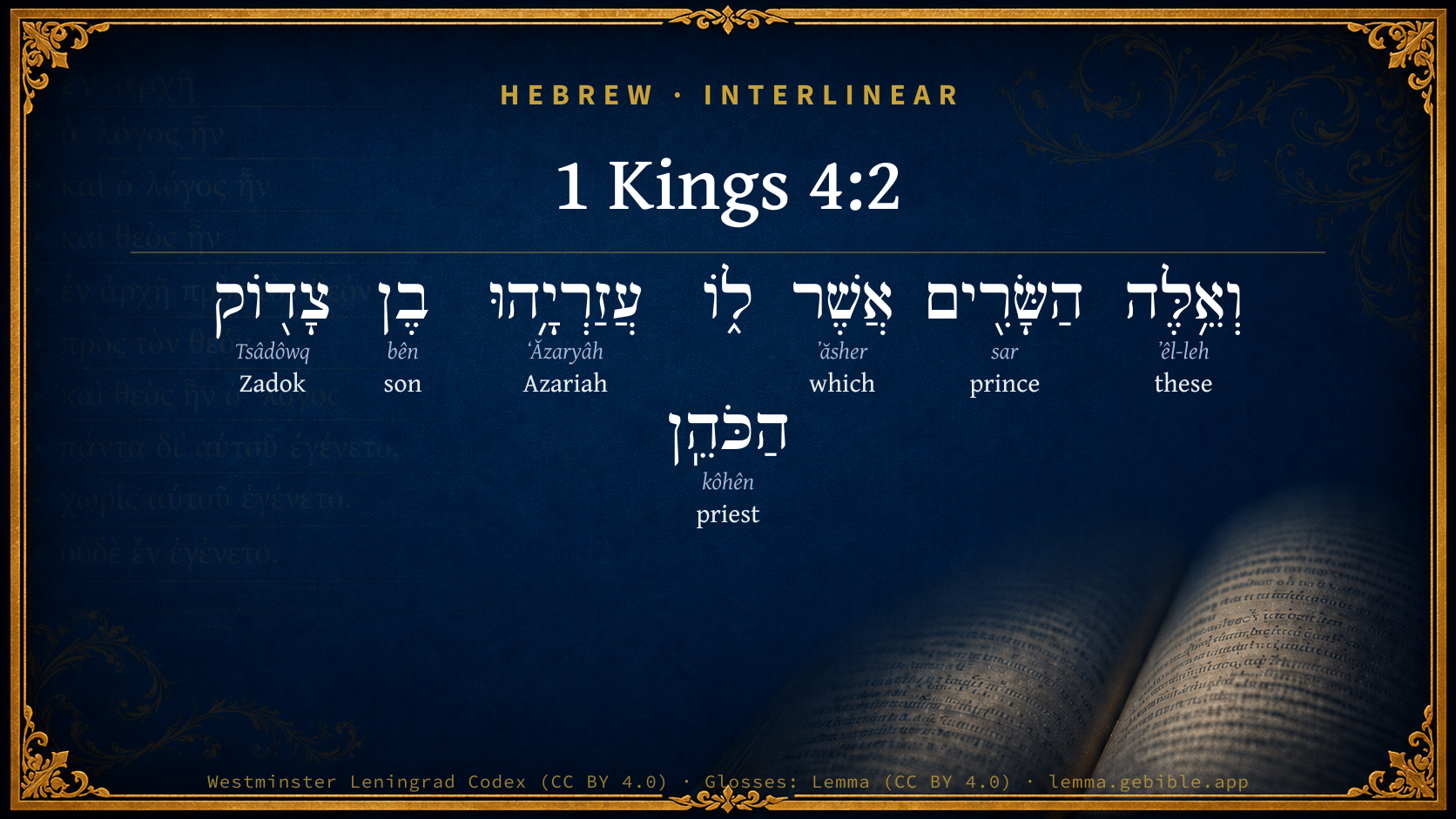
1 Kings 4:2

Hebrew (Westminster Leningrad Codex) 1 Kings 4:2 appears in the Hebrew Old Testament. The text above is from the Westminster Leningrad Codex. Each word links to its Strong’s number, a concise gloss, and parsing drawn from the Open Scriptures Hebrew Bible morphology. Click any word for its full Brown-Driver-Briggs (BDB) entry.
Download image
Cite this verse

1 Kings 4:2 (World English Bible). Public Domain. Lemma interlinear Bible study tool, https://lemma.gebible.app/v/1-kings/4/2.

Show BibTeX & RIS
BibTeX
RIS
English Translation
These were the princes whom he had: Azariah the son of Zadok, the priest;
World English Bible · Public Domain
Highlights
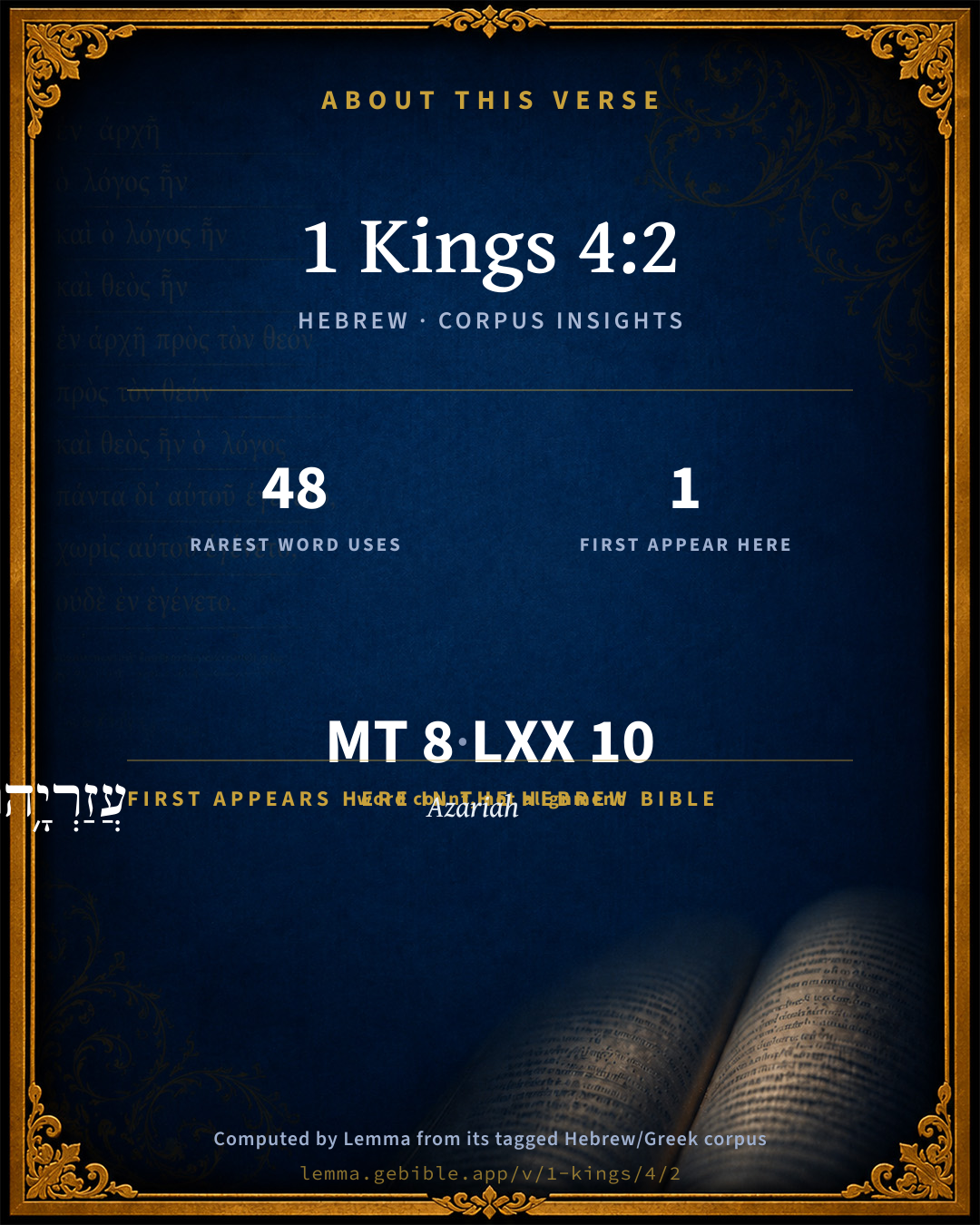
  • 1 first appearance in the Hebrew Bible
Full analysis ↓
Download a study sheet

One document with this verse’s original text, its word-by-word gloss line, the meaning frame, cross-references with their text, attributed commentary, and full source and license credits — printable, and it pastes into notes with its structure intact.

This verse Autodidact and up

Study sheet (.html) Plain text (.txt)

A passage Seminary Student

Up to 50 verses in one chapter. A passage sheet keeps up to 6 commentary sources and 12 cross-references per verse, in the order this page ranks them, and says so on the sheet whenever that leaves anything out. Ask for a single verse and you get the Autodidact verse sheet above.

Everything on this page stays free to read, with no account — the sheet is a download of what is already on screen, not access to it.

Want to remove ads? Support Godless Engineer
Compare translations 3

The same verse in 3 English versions, stacked beneath the original-language interlinear above. Click any original word for its lexicon entry.

Each is an independent rendering of the whole verse — the interlinear is not word-aligned to these translations.

Highlighted words mark where these versions differ — a whole-verse word diff, not a word-by-word alignment.

  • World English Bible Public Domain
    These were the princes whom he had: Azariah the son of Zadok, the priest;
  • King James Version Public Domain
    And these were the princes which he had; Azariah the son of Zadok the priest,
  • unfoldingWord Literal Text CC BY-SA 4.0
    And these the officials who to him. Azariah, the son of Zadok, was the priest.

unfoldingWord Literal Text — © unfoldingWord, licensed CC BY-SA 4.0. Word-aligned USFM3 via Door43 (git.door43.org/unfoldingWord/en_ult).

Versions to compare (up to 4)

3 of 4 selected

Show all 18 translations

Every available English version of this verse, each an independent rendering of the whole verse.

  • World English Bible Public Domain
    These were the princes whom he had: Azariah the son of Zadok, the priest;
  • Berean Standard Bible Public Domain
    and these were his chief officials: Azariah son of Zadok was the priest;
  • Majority Standard Bible Public Domain
    and these were his chief officials: Azariah son of Zadok was the priest;
  • King James Version Public Domain
    And these were the princes which he had; Azariah the son of Zadok the priest,
  • American Standard Version (1901) Public Domain
    And these were the princes whom he had: Azariah the son of Zadok, the priest;
  • Revised Version (1885) Public Domain
    And these were the princes which he had; Azariah the son of Zadok, the priest;
  • Geneva Bible (1599) Public Domain
    And these were his princes, Azariah the sonne of Zadok the Priest,
  • Douay-Rheims (1899) Public Domain
    And these were the princes which he had: Azarias the son of Sadoc the priest:
  • Young's Literal Translation Public Domain
    and these `are' the heads whom he hath: Azariah son of Zadok `is' the priest;
  • Literal Standard Version CC BY-SA 4.0
    and these [are] the heads whom he has: Azariah son of Zadok [is] the priest;
  • Unlocked Literal Bible CC BY-SA 4.0
    These were his officials: Azariah son of Zadok was the priest.
  • unfoldingWord Literal Text CC BY-SA 4.0
    And these the officials who to him. Azariah, the son of Zadok, was the priest.
  • Darby Bible Public Domain
    And these are the princes whom he had: Azariah the son of Zadok was priest;
  • World Messianic Bible Public Domain
    These were the princes whom he had: Azariah the son of Zadok, the priest;
  • Webster's Bible Public Domain
    And these were the princes which he had; Azariah the son of Zadok the priest,
  • Free Bible Version CC BY-SA 4.0
    These were his officials: Azariah, son of Zadok, was the priest;
  • Bible in Basic English Public Domain
    And these were his chief men: Azariah, the son of Zadok, was the priest;
  • JPS Tanakh (1917) Public Domain
    And these were the princes whom he had: Azariah the son of Zadok, the priest;

Literal Standard Version (2020), Covenant Press — licensed CC BY-SA 4.0. Text via the HelloAO Bible API (eBible.org). Unlocked Literal Bible (unfoldingWord) — licensed CC BY-SA 4.0. Text via the HelloAO Bible API (eBible.org). unfoldingWord Literal Text — © unfoldingWord, licensed CC BY-SA 4.0. Word-aligned USFM3 via Door43 (git.door43.org/unfoldingWord/en_ult). Free Bible Version, Dr. Jonathan Gallagher — licensed CC BY-SA 4.0. Text via the HelloAO Bible API (eBible.org).

Word by word

More ways to search: Search by grammar → Find every occurrence → Compare this word →

Practice this passage: Drill this verse → Learn its vocabulary →

עֲזַרְיָ֥הוּ
ʻĂzaryâh
H5838
“Azariah”
Noun, Proper
Part of Speech
Noun
Type
Proper
Full BDB Definition

Origin: from H5826 and H3050

TWOT: None

Azariah = "Jehovah has helped" - son of king Amaziah of Judah and king of Judah himself for 52 years; also 'Uzziah' - the godly friend of Daniel who Nebuchadnezzar renamed Abednego; one of the three friends who with Daniel refused to make themselves unclean by eating food from the king's table which went against the dietary laws which God had given the Jews; also one of the three who were thrown into the fiery furnace for refusing to bow down to a graven image of Nebuchadnezzar and who were saved by the angel of the Lord - son of Nathan and an officer of Solomon; perhaps David's grandson and Solomon's nephew - a prophet in the days of king Asa of Judah - son of king Jehoshaphat of Judah and brother to 5 - another son of king Jehoshaphat of Judah and brother to 4 - a priest, son of Ahimaaz, grandson of Zadok and high priest in the reign of king Solomon - the high priest in the reign of king Uzziah of Judah - a priest who sealed the covenant with Nehemiah; probably same as 18 - a Kohathite Levite, father of Joel in the reign of king Hezekiah of Judah - a Merarite Levite, son of Jehalelel in the reign of king Hezekiah of Judah - a Kohathite Levite, son of Zephaniah and ancestor of Samuel the prophet - a Levite who helped Ezra in instructing the people in the law - son of Jeroham and one of the temple captains of Judah in the time of queen Athaliah; probably the same as 21 - son of Maaseiah who repaired part of the wall of Jerusalem in the time of Nehemiah - one of the leaders who returned from Babylon with Zerubbabel - a man who assisted in the dedication of the wall of Jerusalem in the time of Nehemiah; probably the same as 10 - son of Johanan, one of the captains of Ephraim in the reign of king Ahaz of Judah - a Judaite, son of Ethan of the sons of Zerah - a Judaite, son of Jehu of the family of the Jerahmeelites and descended from Jarha the Egyptian slave of Sheshan; probably one of the captains of the time of queen Athaliah and the same as 15 - a priest, son of Hilkiah - a priest, son of Johanan - son of king Jehoram of Judah; probably clerical error for 'Ahaziah' - son of Meraioth - son of Hoshaiah and one of the proud men who confronted Jeremiah
  1. וְאֵ֥לֶּה ʼêl-leh H428 “and · these” Conjunction + Pronoun, Demonstrative, Common, Plural
  2. הַשָּׂרִ֖ים sar H8269 “the · princes” Particle, Definite Article + Noun, Common, Masculine, Plural, Absolute
  3. אֲשֶׁר ʼăsher H834 “which” Particle, Relative
  4. בֶן bên H1121 “son of” Noun, Common, Masculine, Singular, Construct
  5. צָד֖וֹק Tsâdôwq H6659 “Zadok” Noun, Proper
  6. הַכֹּהֵֽן kôhên H3548 “the · priest” Particle, Definite Article + Noun, Common, Masculine, Singular, Absolute

About this verse

These counts appear in no published source. They are computed here, from the morphology-tagged text and Lemma’s own curated glosses. What Lemma adds →

8
words
7
distinct lemmas
Historical
section

First appearance in Scripture

This word makes its first canonical appearance in the Hebrew Bible here:

  • עֲזַרְיָ֥הוּ Azariah H5838

Shared distinctive vocabulary

עֲזַרְיָ֥הוּ Azariah H5838 occurs in 44 verses of the Hebrew Bible. Also found in:

Grammatical profile

  • 5 nouns
  • 1 pronoun
  • 1 preposition
  • 1 particle

Hebrew & Septuagint length

In English translation the verse runs 14 words from the Hebrew and 12 from the Septuagint (LXX English) — closely comparable.

A rough comparison of the two English renderings, which tokenize alike — not a word-level alignment.

Word counts can differ between the Hebrew and the Greek without any difference in meaning — e.g. the Hebrew direct-object marker אֵת has no separate Greek word, and Greek often adds the article ὁ.

In the original languages it is 8 Hebrew tokens and 10 Greek tokens — but the two are counted differently (Hebrew bundles its prefixes and suffixes into one token; the Greek is in lemma form), so that isn’t a like-for-like length.

Cross-references

6

Topical passages linked to 1 Kings 4:2 in the Treasury of Scripture Knowledge — connected by theme and wording, ordered by reader-vote popularity; previews shown in the World English Bible.

  • Exodus 18:21 Moreover you shall provide out of all the people able men, such as fear God: men of truth, hating unjust gain; and place such over them, to be rulers of thousands, rulers of hundreds, rulers of fifties, and rulers of tens.
  • 1 Corinthians 12:28 God has set some in the assembly: first apostles, second prophets, third teachers, then miracle workers, then gifts of healings, helps, governments, and various kinds of languages.
  • 2 Samuel 8:15–18 David reigned over all Israel; and David executed justice and righteousness to all his people.
  • 2 Samuel 20:23–26 Now Joab was over all the host of Israel; and Benaiah the son of Jehoiada was over the Cherethites and over the Pelethites;
  • 1 Chronicles 6:8–10 and Ahitub became the father of Zadok, and Zadok became the father of Ahimaaz,
  • 1 Chronicles 27:17 of Levi, Hashabiah the son of Kemuel: of Aaron, Zadok:

Cross-references courtesy of OpenBible.info (CC BY 4.0).

Hebrew and Greek witnesses Masoretic Hebrew ↔ Greek Septuagint

The same verse in the two great witnesses to the Old Testament, shown verse-for-verse.

These are two independent witnesses, not word-aligned to each other, and the Septuagint is shown in lemma (dictionary) form.

Hebrew 1 Kings 4:2 Masoretic · Westminster Leningrad Codex

וְאֵ֥לֶּה הַשָּׂרִ֖ים אֲשֶׁר ל֑וֹ עֲזַרְיָ֥הוּ בֶן צָד֖וֹק הַכֹּהֵֽן

These were the princes whom he had: Azariah the son of Zadok, the priest;

World English Bible · Public Domain

Greek LXX 1 Kings 4:2 Septuagint · lemma form

καί οὗτος ὁ ἄρχων ὅς εἰμί αὐτός αζαριου υἱός σαδωκ

And these are the princes which he had; Azarias son of Sadoc.

LXX2012 (modern English Septuagint) · Public Domain

On this verse, Whedon's Commentary on the Bible discusses the Septuagint’s reading. Read the note in Commentary ↓

Hebrew: Westminster Leningrad Codex (CC BY 4.0). Greek: Septuagint (public domain); English from LXX2012 (modern English Septuagint) (Public Domain). How the Septuagint differs from the Hebrew →

Targum (Aramaic paraphrase)

1

The Targum is the ancient Jewish Aramaic paraphrase of the Hebrew Scriptures — an interpretive translation, not the Hebrew text itself. Onkelos (literal) and Pseudo-Jonathan (expansive) render the Torah, and Jonathan the Prophets. Coverage is partial: where no permissively-licensed English translation exists for a verse, only the Aramaic is shown. This is verse-level text, not a word-by-word alignment to the Hebrew.

  1. Targum Jonathan Prophets (Joshua–Malachi)
    וְאִלֵין רַבְרְבַיָא דִי לֵיהּ עֲזַרְיָהוּ בַר צָדוֹק כַּהֲנָא:

    (no public-domain English translation for this verse)

    Targum Jonathan — Aramaic: “Mikraot Gedolot” (public domain). English: “Sefaria Community Translation” (CC0 1.0 (public-domain dedication)); “London "Chaldee Paraphrase," 1871” (public domain). Text via Sefaria.

Commentary

Notes on 1 Kings 4:2 from classic Christian and Jewish commentators (each source and its license shown beneath its notes). The classic Christian expositions comment on the surrounding passage and are grouped to its opening verse, so a note may address several verses; the Jewish commentaries on the Tanakh (Rashi and others) are per-verse, so they appear only where the commentator wrote on this verse.

Lemma curates 59 commentaries, every one of them public domain or Creative Commons licensed, each selected and text-cleaned for this edition rather than reprinted as found. About our sources →

Trapp's Complete Commentary

John Trapp

1Ki 4:2 And these [were] the princes which he had; Azariah the son of Zadok the priest,

Ver. 2. Azariah the son of Zadok,] i.e., The son’s son. {1Ch 6:8-9} Priests and their sons were in great request in those days. Our king Edward III made clergymen his chief officers.

John Trapp, A Commentary or Exposition upon All the Books of the Old and New Testament (1647–1656) — public domain. Text from a community e-Sword module.

Joseph Benson's Commentary

1Ki 4:2. These were the princes which he had — The principal officers employed under him. Azariah the son — Or the grandson; of Zadok —

1Ch 6:8-9. The priest — The second priest, or the priest that attended upon Solomon’s person, in holy offices and administrations. Or, as the Hebrew word here rendered priest may be, and is often, translated prince, in Scripture, this Azariah might be the highest officer of the state, next to the king; or the chief minister of state, by whom the great affairs of the kingdom were managed and prepared for the king’s consideration.

Joseph Benson's Commentary on the Old and New Testaments (1811–1818) — public domain. Text from a community e-Sword module.

Whedon's Commentary on the Bible

Daniel D. Whedon

2. Princes — Hebrew, the Sarim, Superior officers; high state-dignitaries, in distinction from the prefects, or lesser officers mentioned below, 1Ki_4:7-19.

Azariah the son of Zadok the priest — The word כהן, here rendered priest, but in verse v principal officer, occurs three times in this list of officers, and if we adopt the present punctuation of the Hebrew, Septuagint, and English texts, and explain with Keil, Bahr, and others, that כהן here means a regent, or some privy counsellor of the king, then we have the word used in the space of four verses in three different senses. That כהןmeans an intimate counsellor of the king in 1Ki_4:5 and in 2Sa_8:18, is admitted in our notes; but if it means the same thing here, and defines the office of Azariah to be identical with that of Zabud the son of Nathan, why in the world are not these two persons holding the same office placed together in the list? Certainly the relative position of these two names in the record most naturally indicates that Azariah and Zabud did not hold the same office. It seems better, therefore, to adopt the punctuation of the Vulgate, and construe Azariah with the first two names of 1Ki_4:3, and כהן, the priest, in apposition with Zadok. Thus, connecting 1Ki_4:2-3, we read, “Azariah the son of Zadok the priest, Elihoreph and Ahiah, the sons of Shisha, scribes.”

Daniel D. Whedon (gen. ed.), Commentary on the Old and New Testaments (1874–1909) — public domain. Text from a community e-Sword module.

Tyndale Open Study Notes

Tyndale Open Resources

4:2 Because Zadok was now quite old, his grandson (see 1 Chr 6:8-9) Azariah succeeded him as high priest.

Tyndale Open Study Notes — © Tyndale Open Resources, licensed CC BY-SA 4.0. Text via the HelloAO Bible API.

Geneva Bible (1599)

Geneva Bible translators

He was the son of Ahimaaz and Zadok’s nephew.

That is, his chief officers.

Geneva Bible (1599) marginal notes — public domain. Text via Bolls.life.

Jamieson, Fausset & Brown

Robert Jamieson, A. R. Fausset & David Brown

these were the princes--or chief officers, as is evident from two of them marrying Solomon's daughters.

Azariah the son of Zadok the priest--rather, "the prince," as the Hebrew word frequently signifies (Gen 41:45; Exo 2:16; Sa2 8:18); so that from the precedency given to his person in the list, he seems to have been prime minister, the highest in office next the king.

Jamieson, Fausset & Brown — Commentary Critical and Explanatory on the Whole Bible (1871) — public domain (CC PDM 1.0). Text via the HelloAO Bible API.

Adam Clarke's Commentary

Verse 2. These were the princes which he had; Azariah the son of Zadok the priest.] These were his great, chief, or principal men. None of them were princes in the common acceptation of the word.

Adam Clarke's Commentary on the Bible (1810–1826) — public domain. Text from a community e-Sword/MySword module.

Ellicott's Commentary for English Readers

(2) And these were.—The officers described are of two classes—those attached to Solomon’s Court, and those invested with local authority.

The princes are evidently Solomon’s high counsellors and officers, “eating at the king’s table.” The word is derived from a root which means to “set in order.” It is significant that whereas in the lists of David’s officers in 2Sa_8:16-18; 2Sa_20:23-26, the captain of the host stands first, and is followed in one list by the captain of the body-guard, both are here preceded by the peaceful offices of the priests, scribes, and the recorder.

Azariah the son of Zadok the priest.—In 1Ch_6:9-10, we find Azariah described as the son of Ahimaaz, and so grandson of Zadok; and the note in 1Ki_4:10 (which is apparently out of its right place) seems to show that he was high priest at the time when the Temple was built. The title the “priest” in this place must be given by anticipation, for it is expressly said below that “Zadok and Abiathar were now the priests.” The use of the original word, Cohen (probably signifying “one who ministers”), appears sometimes to retain traces of the old times, when the priesthood and headship of the family were united, and to be applied accordingly to princes, to whom perhaps still attached something of the ancient privilege. Thus it is given to the sons of David in 2Sa_8:18, where the parallel passage in 1Ch_18:17 has a paraphrase, “chief about the king,” evidently intended to explain the sense in which it is used in the older record. We may remember that David himself on occasions wore the priestly ephod (see 2Sa_6:14). Possibly in this sense it is applied in 1Ki_4:5 to Zabud, the “king’s friend” (where the Authorised Version renders it by “principal officer”). But in this verse there is every reason for taking it in the usual sense. Azariah was already a “prince” before he succeeded to the high priesthood. The mingling, of priestly and princely functions is characteristic of the time.

A Bible Commentary for English Readers, edited by Charles John Ellicott (1878–1897) — public domain. Text from a community e-Sword module.

The Cambridge Bible for Schools and Colleges

gen. ed. J. J. S. Perowne

2. Azariah the son of Zadok the priest] The two last words are to be referred to Azariah and not to Zadok. The Vat. LXX. omits the title, but the Alex. text has ὁ ἱερεύς. On the contrary the Vulgate renders ‘Sadoc Sacerdotis.’ The Zadok here named is the son of Ahitub (1Ch_6:8), and Azariah was really his grandson, the order being Zadok-Ahimaaz-Azariah. The use of ‘son’ thus loosely for grandson is not uncommon in the Old Test. Thus (Gen_29:5) Laban is called the son of Nahor. He was really the son of Bethuel. Similarly (Ezr_5:1) Zachariah the prophet is called the son of Iddo, though Barachiah was his father and Iddo his grandfather.

The words ‘the priest’ have caused much discussion, and on the margin of the A.V. ‘chief officer’ is given as an alternative meaning. That the word may have another sense seems plain from 2Sa_8:18. In that passage the same word is used of David’s sons, and is rendered ‘chief rulers’ or ‘princes’ in A.V. The R.V. translates ‘priests’ in the text, with ‘chief ministers’ in the margin. We can hardly however think that David’s sons were priests. But in the verse before us Azariah belongs to the priestly family, as much as Zadok and Abiathar who are called ‘priests’ (the same Hebrew word) in 1Ki_4:4. Where there is no such connexion with the priestly line, Zabud the son of Nathan, in 1Ki_4:5, is styled ‘principal officer’; the R.V. is consistent and renders ‘priest’ there too, but puts ‘chief minister’ as an alternative.

It is probably on account of the difficulty of so many persons being called by the title usually rendered ‘priest’ that the LXX. omits the title both after Azariah’s name, and after Zabud’s, calling the latter merely ἑταῖρος τοῦ βασιλέως. It seems clear however from the instance of David’s sons that the title had a sense in which it could be applied to others than those of the priestly line.

The Cambridge Bible for Schools and Colleges (gen. ed. J. J. S. Perowne; Cambridge University Press, 1878–1918) — public domain. Text from a community e-Sword module.

John Gill's Exposition

Elihoreph and Ahiah, the sons of Shisha, scribes,.... Their father Shisha, the same with Sheva, was scribe only in David's time; and he being dead very probably, both his sons were continued in the office as secretaries of state, Solomon having more business for such an office, see Sa2 20:25;

Jehoshaphat the son of Ahilud, the recorder; who was in the same office in the times of David, and now held it under Solomon, Sa2 8:16.

John Gill's Exposition of the Whole Bible (1746–1763) — public domain (CC PDM 1.0). Text via the HelloAO Bible API.

Albert Barnes' Notes on the Bible

Azariah, the son of Zadok, the priest - “The priest” here belongs to Azariah, not to Zadok. The term used כהן kôhên means sometimes a priest, sometimes a civil officer, with perhaps a semi-priestly character. (See 2Sa 8:18 note.) In this place it has the definite article prefixed, and can only mean “the high priest.” Azariah, called here the “son,” but really the “grandson,” of Zadok, seems to have succeeded him in the priesthood 1Ch 6:10. His position as high priest at the time when this list was made out gives Azariah the foremost place in it.

Albert Barnes' Notes on the Bible (1834–1885) — public domain. Text from a community e-Sword/MySword module.

Haydock's Catholic Bible Commentary

Azarias. Some translate, "grandson of Sadoc, (and son of Achimaas) was priest," to assist his father, unless he was born of some other. Cohen signifies also prince, ver. 5. Azarias was scribe, as well as the two following, though not all at the same time. The office was very important, Judges v. 14.

George Leo Haydock (1774–1849), Haydock's Catholic Family Bible and Commentary, 1859 edition — public domain. Excludes Psalms (Douay-Rheims chapter numbering differs from Protestant) and Deuterocanonical books (Catholic canon only).

Matthew Poole's English Annotations

The princes which he had, i.e. the chief rulers or officers belonging to him.

The son, or, the grandson, by comparing this with 1Ch 6:8,9.

Of Zadok; either Zadok the priest, 1Ch 6:8,9, or some other of that name.

The priest; So he was the second priest, or the priest that attended upon Solomon’s person in holy offices and administrations. But when this sacred writer professeth to give an account of Solomon’s princes, why should he put the second priest, or Solomon’s domestic priest, in the first place? or why should he be mentioned distinctly from his father, who was generally present with Solomon, and could easily, either by himself, or some other fit person or persons appointed by him, manage all the king’s sacred concerns? or why is he named before his father? Others therefore render this Hebrew word

prince, as it is used Gen 41:45; 47:22,26; Exo 2:16; 2Sa 8:18. So he was either the chief in dignity, the first prince, and the highest officer in the state next to the king; or the chief minister of state, by whom the great affairs of state were managed and prepared for the king’s consideration, &c.

Matthew Poole's English Annotations on the Holy Bible (1683–1685) — public domain. Text from a community e-Sword/MySword module.

The Pulpit Commentary

And these were the princes i.e. ministers, officers. Cf. 2Sa_8:15-18, and 2Sa_20:23-26 which he had, Azariah the son i.e., descendant, probably grandson. See on 1Ch_6:10 of Zadok the priest. We are here confronted by two questions of considerable difficulty. First, to whom does the title "priest" here belong, to Azariah or to Zadok? Second, what are we to understand by the term, a spiritual, or a more or less secular person iJereuv or bouleuthv?

As to 1. the Vulgate (sacerdotis) and apparently the Authorized Version, with the Rabbins, Luther, and many later expounders, connect the title with Zadok (who is mentioned as priest in ver. 4), and understand that Azariah, the son of the high priest Zadok, was, together with the sons of Shisha, one of the scribes (ver. 3). It is true that this view obviates some difficulties, but against it are these considerations.

(1) The accents.

(2) The Chaldee and LXX (oJ iJereuv Cod. Alex.; Cod. Vat. omits the words) Versions.

(3) Hebrew usage, according to which the patronymic is regarded as almost parenthetical.

(4) The fact that in every other case in this list the title is predicate nominative (vers. 3-6).

(5) The position of Azariah"s name, first in the list a position which would hardly be assigned to a scribe.

(6) The absence of any copula (w), which, it is submitted, would be required if Azariah and the sons of Shisha alike were scribes. The question is one of some nicety, but the balance of evidence is distinctly in favour of connecting the title with Azariah, i.e., " Azariah son of Zadok was the priest." This brings us to

2. What are we to understand by "the priest heKoh?" It is urged by Keil, Bahr, al. that this cannot mean "priest" in the ordinary sense of the word, still less "high priest," for the following reasons:

(1) Because the high priests of Solomon are mentioned presently, viz., Abiathar and Zadok, and the Jews never had three high priests.

(2) Because the Azariah who was high priest under Solomon for the words 1Ch_6:10, "He it is that executed the priest"s office," etc, must belong to the Azariah of ver. 9, and have got accidentally misplaced was the son of Ahimaaz, not of Zadok.

(3) Because no grandson of Zadok could then be old enough to sustain the office of high priest.

(4) Because in one passage (2Sa_8:18, compared with 1Ch_18:17) is used of privy councillors and of the sons of David, who cannot have been sacrificing priests. Keil consequently would understand that Azariah was "administrator of the kingdom, or prime minister." Similarly Bahr. But in favour of the ordinary meaning of the word are these powerful considerations:

(1) All the versions translate the word by "priest," i.e., they understand by the term a spiritual person.

(2) Whatever may be the case with heKo, heKoh," the priest" (par excellence) can only be understood of the high priest (ch. 1:8, 38; Exo_29:30; Lev_21:21; 2Ki_11:9, 15 22:4, 8, 10, 12, 14. Comp. 2Ch_26:17)

(3) It is extremely doubtful whether heKo is ever used except in the sense of iJereuv, Rawlinson, who says it sometimes indicates "a civil officer, with perhaps a semi-priestly character," refers to Gesenius sub hac voce, who, however, distinctly affirms that the word only means priest, and accounts for the application of the term to the sons of David (2Sa_8:18) on the supposition that the Jews had priests who were not of the tribe of Levi. The question is discussed with great learning by Professor Plumptre (Dict. Bib., art. "Priest"), who suggests that "David and his sons may have been admitted, not to distinctively priestly functions, such as burning incense (Num_16:40; 2Ch_26:18) but to an honorary, titular priesthood. To wear the ephod in processions (2Sa_6:14) at the time when this was the special badge of the order, (1Sa_22:18) to join the priests and Levites in their songs and dances, might have been conceded, with no deviation from the Law, to the members of the royal house." There is one difficulty however in the way of accepting this ingenious and otherwise sufficient explanation, namely, that it seems hardly likely that the title of priest would be freely accorded by Hebrew writers to men who were expressly excluded from all "distinctively priestly functions," especially after the use of the same word in the preceding verse (17) to designate the high priest. And I venture to suggest that thedischarge by David"s sons of the semi-priestly functions just referred to occasioned so much remark as to head to the application of the term "priest" to them in a special conventional sense; in fact, that it became a sort of soubriquet, which rather implied that they were not priests than that they were. (Notice the order of 2Sa_8:18, Hebrews) And observe

(4) if we are to understand by "the priest in ver. 2, "prime minister;" by "priests in ver. 4, "high priests," and by "priest in ver 5, "principal officer," language has no certain meaning.

(5) The mention of Azariah as "the priest" in the same list with Zadok and Abiathar is easily accounted for. We know that Abiathar was deposed at the beginning of Solomon"s reign, (1Ki_2:27) and Zadok must then have been an old man. Their names consequently are recorded (ver. 4) because they were high priests for a brief period of the reign, but Azariah is mentioned first as "the priest" because he was high priest during most of the time.

(6) "Azariah the son of Zadok" is quite compatible with the fact that Azariah was really the son of Ahimaaz. Be is constantly used in the sense of "descendant," and especially "grandson." (Gen_29:5:31:28, 55: and see on ch. 2:8,"the son of Gera.") Zadok is no doubt mentioned as better known than Ahimaaz, and probably because Azariah succeeded him directly in the office.

(7) The age of Azariah must be uncertain, and Solomon"s reign was a long one.

(8) The position of his name first accords well with the idea that he was high priest, which I conclude that he was. It is worthy of remark that in the lists of David the military officers of the kingdom occupy the first place; in those of Solomon, the civil and religious dignitaries. "The princes of Solomon are, with one exception (ver. 4) ministers of peace. Wordsworth.

Vers. 2 sqq. The Servants of Solomon.

were the princes which he had." "All Scripture is profitable for instruction," etc. A bare list of names may teach some lessons. We shall find in this list, first, some proofs of Solomon"s wisdom, and secondly, some principles to guide our own conduct. First, however, let us remember that to select faithful and efficient servants is one of the most difficult tasks of rulers. The welfare of the whole State depends very largely on the choice. (Cf. Psa_101:5-7) Now observe that here

I THE FIRST PLACE IS FILLED BY GOD"S PRIEST (ver. 2). The minister of religion takes precedence of the ministers of state. The universal tendency is to put man first and God second. Solomon if this list preserves the order of his arrangenments put God first, in the person of His high priest. Under the theocracy the king was a sort of summus episcopus. It was meet that next to the anointed Prince should stand the anointed Pontiff.

II PRIORITY IS GIVEN TO THE OFFICERS OF PEACE (vers. 3, 4). Scribes come before warriors. In David"s day it was otherwise. But there has been an advance, and here is the proof of it. War is essentially barbarous. Among savage tribes warfare is chronic. As men become wiser and more civilized, the appeal to brute force is less frequent. Wiser, for war means unwisdom somewhere. More civilized, for the history of civilization tells how the wager of battle, which is now confined to nations, was once employed by tribes, provinces, and private persons. So that, in this particular, the wise son was greater than the pious father. For this reason Solomon may build the temple which his father"s blood-red hand may not touch. For this reason the son, not the father, is the favourite type of the Prince of Peace. One of the world"s greatest generals (Napoleon) said there were but two great powers, the sword and the pen, and that, in the long run, the former was sure to be overcome by the latter. Solomon would seem to have been of the same opinion. The "scribes" and the "recorder" precede the "captain of the host.

III MANY PLACES ARE FILLED BY THE FUNCTIONARIES OF HIS FATHER (vers. 3, 4, 6, and cf. ver. 16). An Eastern autocrat generally appoints his associates of the harem, (1Ki_12:10) his personal favourites, to positions of trust. Solomon showed his wisdom in retaining the faithful servants of his predecessor (compare the folly of Rehoboam, 1Ki_12:8) and his example thus confirms his precept, (Pro_27:10) "Thine own friend and thy father"s friend forsake not.

IV SOME PLACES ARE FILLED BY HIS OWN SONS-IN-LAW (vers. 11, 15). This does not argue nepotism, or favouritism as the hand of the king"s daughter was often bestowed as the reward of distinguished services. (1Sa_17:25 1Sa_18:17, 1Sa_18:27) It may have been the due recognition of fidelity and ability. In any case the alliances would strengthen Solomon"s throne.

The friends thou hast, and their adoption, tried, Grapple them to thy heart with hooks of steel.

Alien princes would, no doubt, have been proud to espouse Solomon"s daughters, but he preferred to marry them to faithful subjects. Blood is thicker than water.

V ALL PLACES OF TRUST WERE FILLED BY PERSONS OF PIETY. The number of priests" or prophets" sons employed by Solomon is very remarkable (vers. 4, 5, 14, and possibly 15). He knew that those who were taught in the law of the Lord would best keep and best enforce the law of the realm. Those who "fear God" are those who "honour the king". (1Pe_2:17) Witness Joseph, Obadiah, Daniel, and the three Hebrew children. Even irreligious masters know the value of God-fearing servants. God blesses the house of Potiphar for the sake of its pious steward. Piety involves probity and excludes peculation and malfeasance.

VI EVERY OFFICER HAD HIS PLACE AND KEPT IT. There were definite duties, definite districts. The prefectures were so many parishes. Each was responsible for his own and for that only. Order is Heaven"s first law. The prosperity of Solomon"s reign may have been largely due to his system and method. There is a hierarchy and a due order in heaven. The angels would almost seem to have their districts. (Deu_32:8, LXX) The great King gives "to every man according to his work". Mar_13:34

The Pulpit Commentary (1880–1919), ed. H.D.M. Spence-Jones & Joseph S. Exell — public domain. Text from a community e-Sword module.

John Wesley's Explanatory Notes

Princes - That is, the chief rulers or officers. The son - Or the grand-son. The priest - The second priest, or the priest that attended upon Solomon's person in holy offices and administrations.

John Wesley, Explanatory Notes Upon the Whole Bible (1754–1765) — public domain. Text via the GEBible commentary corpus.

Lesson kit

Teaching starters — assembled from the data on this page, not authored interpretation. Every prompt links to the verse data it draws on. Edit before teaching.

1 Kings, in the Historical, opens this verse with 8 words (7 distinct Hebrew lemmas). Its most distinctive word is ʻĂzaryâh (“Azariah”). A historical commentator’s framing appears above. Read the whole chapter for the surrounding context.

Discussion questions

  1. How does “Azariah” (ʻĂzaryâh) shape what this verse is saying?
  2. This is the first place “Azariah” appears in Scripture (first appears here). What does its debut here establish?
  3. How does 1 Kings 4:5, which shares the word «Azariah», read alongside this verse?
  4. These translations render this verse differently; the difference is in the English rendering, not the original. What questions does that raise?
  5. Compare how Trapp's Complete Commentary and Joseph Benson's Commentary read this verse. Where do they agree or differ?

Things to notice

Reading settings

Reading text

Shown beneath each verse's original-language words.

Old Testament
Old Testament edition

Read the OT as the Masoretic Hebrew (MT) or the Greek Septuagint (LXX).

English shown for the Greek Septuagint (in the Hebrew ↔ Greek comparison).

Comparing translations? Open the Compare panel on any verse page to stack up to four side by side.