
Numbers 22:9

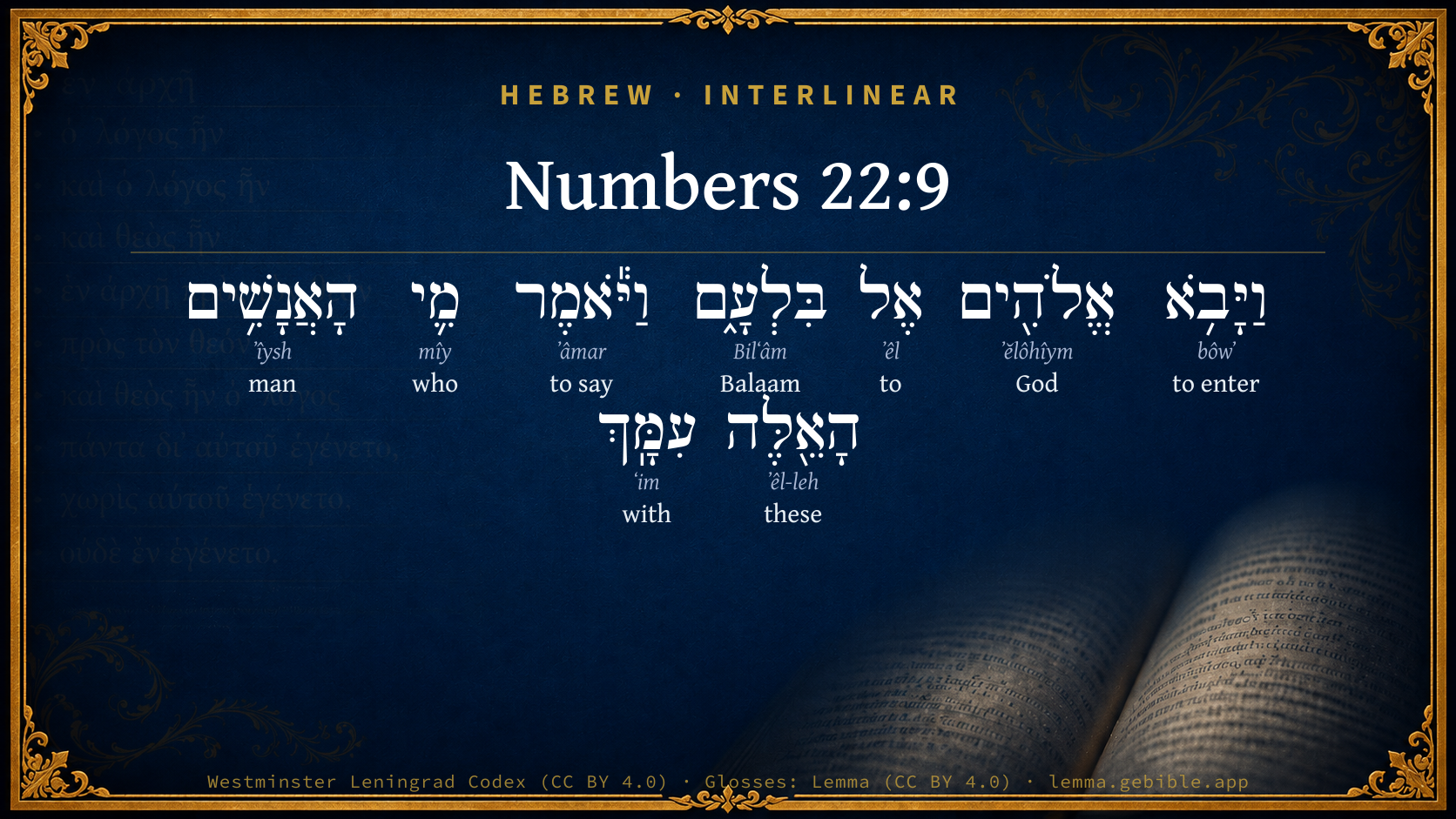
Hebrew (Westminster Leningrad Codex) Numbers 22:9 appears in the Hebrew Old Testament. The text above is from the Westminster Leningrad Codex. Each word links to its Strong’s number, a concise gloss, and parsing drawn from the Open Scriptures Hebrew Bible morphology. Click any word for its full Brown-Driver-Briggs (BDB) entry.
Download image
Cite this verse

Numbers 22:9 (World English Bible). Public Domain. Lemma interlinear Bible study tool, https://lemma.gebible.app/v/numbers/22/9.

Show BibTeX & RIS
BibTeX
RIS
English Translation
God came to Balaam, and said, What men are these with you?
World English Bible · Public Domain
Download a study sheet

One document with this verse’s original text, its word-by-word gloss line, the meaning frame, cross-references with their text, attributed commentary, and full source and license credits — printable, and it pastes into notes with its structure intact.

This verse Autodidact and up

Study sheet (.html) Plain text (.txt)

A passage Seminary Student

Up to 50 verses in one chapter. A passage sheet keeps up to 6 commentary sources and 12 cross-references per verse, in the order this page ranks them, and says so on the sheet whenever that leaves anything out. Ask for a single verse and you get the Autodidact verse sheet above.

Everything on this page stays free to read, with no account — the sheet is a download of what is already on screen, not access to it.

Want to remove ads? Support Godless Engineer
Compare translations 3

The same verse in 3 English versions, stacked beneath the original-language interlinear above. Click any original word for its lexicon entry.

Each is an independent rendering of the whole verse — the interlinear is not word-aligned to these translations.

Highlighted words mark where these versions differ — a whole-verse word diff, not a word-by-word alignment.

  • World English Bible Public Domain
    God came to Balaam, and said, What men are these with you?
  • King James Version Public Domain
    And God came unto Balaam, and said, What men are these with thee?
  • unfoldingWord Literal Text CC BY-SA 4.0
    And God came to Balaam and said, “Who these men with you?”

unfoldingWord Literal Text — © unfoldingWord, licensed CC BY-SA 4.0. Word-aligned USFM3 via Door43 (git.door43.org/unfoldingWord/en_ult).

Versions to compare (up to 4)

3 of 4 selected

Show all 18 translations

Every available English version of this verse, each an independent rendering of the whole verse.

  • World English Bible Public Domain
    God came to Balaam, and said, What men are these with you?
  • Berean Standard Bible Public Domain
    Then God came to Balaam and asked, “Who are these men with you?”
  • Majority Standard Bible Public Domain
    Then God came to Balaam and asked, “Who are these men with you?”
  • King James Version Public Domain
    And God came unto Balaam, and said, What men are these with thee?
  • American Standard Version (1901) Public Domain
    And God came unto Balaam, and said, What men are these with thee?
  • Revised Version (1885) Public Domain
    And God came unto Balaam, and said, What men are these with thee?
  • Geneva Bible (1599) Public Domain
    Then God came vnto Balaam, and sayde, What men are these with thee?
  • Douay-Rheims (1899) Public Domain
    What mean these men that are with thee?
  • Young's Literal Translation Public Domain
    And God cometh in unto Balaam, and saith, `Who `are' these men with thee?'
  • Literal Standard Version CC BY-SA 4.0
    And God comes to Balaam and says, “Who [are] these men with you?”
  • Unlocked Literal Bible CC BY-SA 4.0
    God came to Balaam and said, “Who are these men who came to you?”
  • unfoldingWord Literal Text CC BY-SA 4.0
    And God came to Balaam and said, “Who these men with you?”
  • Darby Bible Public Domain
    And God came to Balaam, and said, Who are these men with thee?
  • World Messianic Bible Public Domain
    God came to Balaam, and said, “Who are these men with you?”
  • Webster's Bible Public Domain
    And God came to Balaam, and said, What men are these with thee?
  • Free Bible Version CC BY-SA 4.0
    God came to Balaam and asked him, “Who are these men staying with you?”
  • Bible in Basic English Public Domain
    And God came to Balaam and said, Who are these men with you?
  • JPS Tanakh (1917) Public Domain
    And God came unto Balaam, and said: 'What men are these with thee?'

Literal Standard Version (2020), Covenant Press — licensed CC BY-SA 4.0. Text via the HelloAO Bible API (eBible.org). Unlocked Literal Bible (unfoldingWord) — licensed CC BY-SA 4.0. Text via the HelloAO Bible API (eBible.org). unfoldingWord Literal Text — © unfoldingWord, licensed CC BY-SA 4.0. Word-aligned USFM3 via Door43 (git.door43.org/unfoldingWord/en_ult). Free Bible Version, Dr. Jonathan Gallagher — licensed CC BY-SA 4.0. Text via the HelloAO Bible API (eBible.org).

Word by word

More ways to search: Search by grammar → Find every occurrence → Compare this word →

Practice this passage: Drill this verse → Learn its vocabulary →

About this verse

These counts appear in no published source. They are computed here, from the morphology-tagged text and Lemma’s own curated glosses. What Lemma adds →

9
words
9
distinct lemmas
Pentateuch
section

Grammatical profile

  • 2 verbs
  • 3 nouns
  • 1 pronoun
  • 2 prepositions
  • 1 particle

Verb forms

  • וַיָּבֹ֥א Qal · Sequential Imperfect
  • וַיֹּ֕אמֶר Qal · Sequential Imperfect

Hebrew & Septuagint length

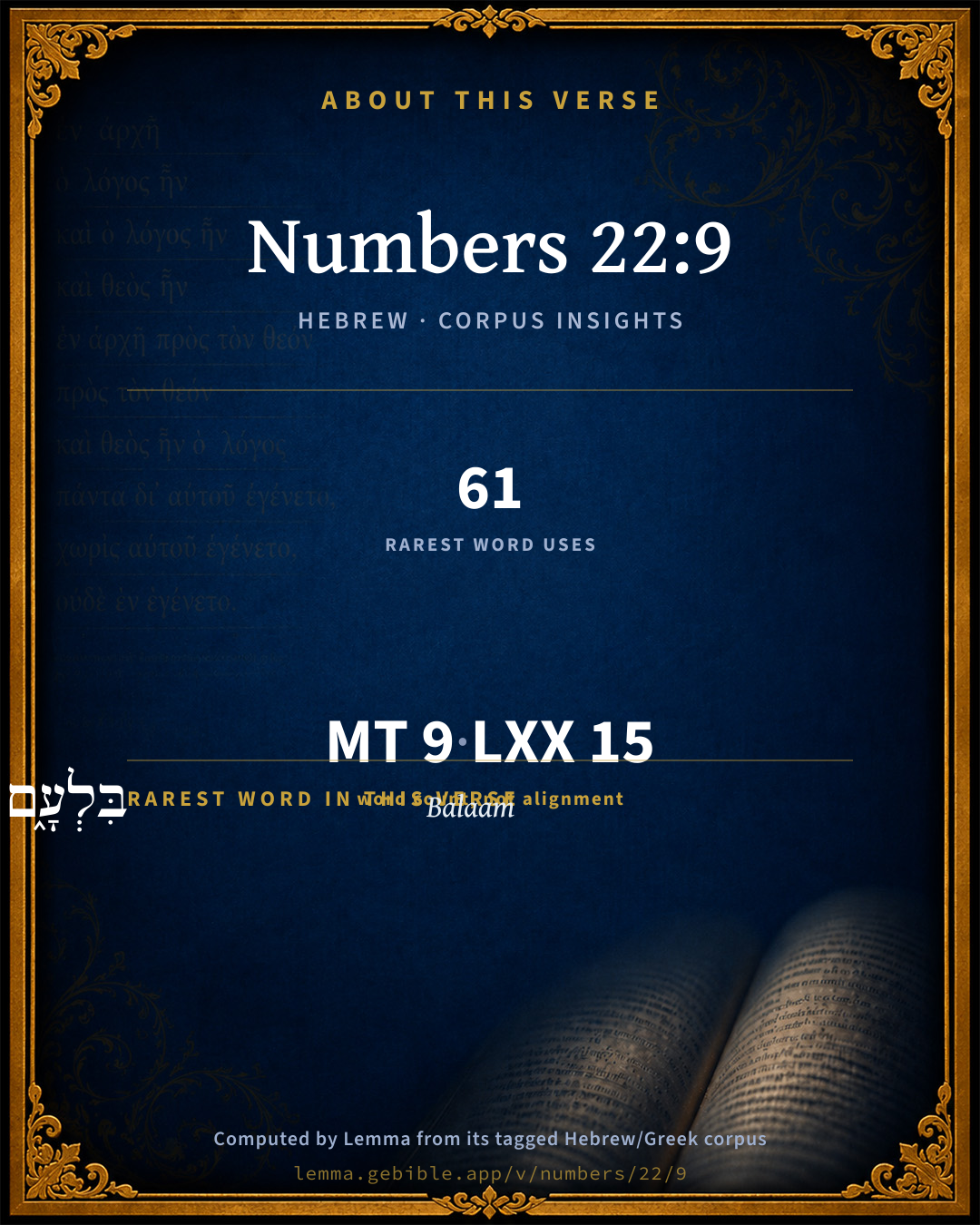
In English translation the verse runs 12 words from the Hebrew and 15 from the Septuagint (LXX English) — closely comparable.

A rough comparison of the two English renderings, which tokenize alike — not a word-level alignment.

Word counts can differ between the Hebrew and the Greek without any difference in meaning — e.g. the Hebrew direct-object marker אֵת has no separate Greek word, and Greek often adds the article ὁ.

In the original languages it is 9 Hebrew tokens and 15 Greek tokens — but the two are counted differently (Hebrew bundles its prefixes and suffixes into one token; the Greek is in lemma form), so that isn’t a like-for-like length.

Cross-references

14

Topical passages linked to Numbers 22:9 in the Treasury of Scripture Knowledge — connected by theme and wording, ordered by reader-vote popularity; previews shown in the World English Bible.

  • Genesis 20:3 But God came to Abimelech in a dream of the night, and said to him, "Behold, you are a dead man, because of the woman whom you have taken. For she is a man's wife."
  • Numbers 22:20 God came to Balaam at night, and said to him, If the men are come to call you, rise up, go with them; but only the word which I speak to you, that shall you do.
  • Genesis 3:9–11 Yahweh God called to the man, and said to him, "Where are you?"
  • Genesis 4:9 Yahweh said to Cain, "Where is Abel, your brother?" He said, "I don't know. Am I my brother's keeper?"
  • Genesis 16:8 He said, "Hagar, Sarai's handmaid, where did you come from? Where are you going?" She said, "I am fleeing from the face of my mistress Sarai."
  • Exodus 4:2 Yahweh said to him, "What is that in your hand?" He said, "A rod."
  • 2 Kings 20:14–15 Then came Isaiah the prophet to king Hezekiah, and said to him, What said these men? and from whence came they to you? Hezekiah said, They are come from a far country, even from Babylon.
  • Daniel 4:31–32 While the word was in the king's mouth, there fell a voice from the sky, [saying], O king Nebuchadnezzar, to you it is spoken: The kingdom is departed from you:
  • Genesis 31:24 God came to Laban, the Syrian, in a dream of the night, and said to him, "Take heed to yourself that you don't speak to Jacob either good or bad."
  • Genesis 41:25 Joseph said to Pharaoh, "The dream of Pharaoh is one. What God is about to do he has declared to Pharaoh.
  • Daniel 2:45 Because you saw that a stone was cut out of the mountain without hands, and that it broke in pieces the iron, the brass, the clay, the silver, and the gold; the great God has made known to the king what shall happen hereafter: and the dream is certain, and the interpretation of it sure.
  • Matthew 7:22 Many will tell me in that day, 'Lord, Lord, didn't we prophesy in your name, in your name cast out demons, and in your name do many mighty works?'
  • Matthew 24:24 For there will arise false christs, and false prophets, and they will show great signs and wonders, so as to lead astray, if possible, even the chosen ones.
  • John 11:51 Now he didn't say this of himself, but being high priest that year, he prophesied that Jesus would die for the nation,

Cross-references courtesy of OpenBible.info (CC BY 4.0).

Hebrew and Greek witnesses Masoretic Hebrew ↔ Greek Septuagint

The same verse in the two great witnesses to the Old Testament, shown verse-for-verse.

These are two independent witnesses, not word-aligned to each other, and the Septuagint is shown in lemma (dictionary) form.

Hebrew Numbers 22:9 Masoretic · Westminster Leningrad Codex

וַיָּבֹ֥א אֱלֹהִ֖ים אֶל בִּלְעָ֑ם וַיֹּ֕אמֶר מִ֛י הָאֲנָשִׁ֥ים הָאֵ֖לֶּה עִמָּֽךְ

God came to Balaam, and said, What men are these with you?

World English Bible · Public Domain

Greek LXX Numbers 22:9 Septuagint · lemma form

καί ἔρχομαι ὁ θεός πρός βαλααμ καί εἶπον αὐτός τίς ὁ ἄνθρωπος οὗτος παρά σύ

And God came to Balaam, and said to him, Who are these men with you?

LXX2012 (modern English Septuagint) · Public Domain

Hebrew: Westminster Leningrad Codex (CC BY 4.0). Greek: Septuagint (public domain); English from LXX2012 (modern English Septuagint) (Public Domain). How the Septuagint differs from the Hebrew →

Targum (Aramaic paraphrase)

2

The Targum is the ancient Jewish Aramaic paraphrase of the Hebrew Scriptures — an interpretive translation, not the Hebrew text itself. Onkelos (literal) and Pseudo-Jonathan (expansive) render the Torah, and Jonathan the Prophets. Coverage is partial: where no permissively-licensed English translation exists for a verse, only the Aramaic is shown. This is verse-level text, not a word-by-word alignment to the Hebrew.

  1. Targum Onkelos Torah (Genesis–Deuteronomy)
    וַאֲתָא מֵימַר מִן קֳדָם יְיָ לְוַת בִּלְעָם וַאֲמַר מָן גוּבְרַיָא הָאִלֵין דְעִמָךְ

    (no public-domain English translation for this verse)

    Targum Onkelos — Aramaic: “Onkelos Genesis” (public domain); “Onkelos Exodus” (public domain); “Onkelos Leviticus” (public domain); “Onkelos Numbers” (public domain); “Onkelos Deuteronomy” (public domain). English: “Sefaria Community Translation” (CC0 1.0 (public-domain dedication)); “J.W. Etheridge. The Targums of Onkelos and Jonathan Ben Uzziel on the Pentateuch. London: Longmans, Green, 1862” (public domain). Text via Sefaria.

  2. Targum Pseudo-Jonathan Torah (Genesis–Deuteronomy)
    וְאָתָא מֵימַר מִן קֳדָם יְיָ לְבִלְעָם וַאֲמַר מַאן גוּבְרַיָא הָאִלֵין כְּעַן דְבִיתוּ עִמָךְ

    And the Word from before the Lord came to Bileam, and He said, What men are these who are now lodging with thee?

    Targum Pseudo-Jonathan — Aramaic: “Targum Jonathan on Genesis” (public domain); “Targum Jonathan on Exodus” (public domain); “Targum Jonathan on Leviticus” (public domain); “Targum Jonathan on Numbers” (public domain); “Targum Jonathan on Deuteronomy” (public domain). English: “The Targum of Jonathan ben Uzziel, trans. J. W. Etheridge, London, 1862” (public domain). Text via Sefaria.

Commentary

Notes on Numbers 22:9 from classic Christian and Jewish commentators (each source and its license shown beneath its notes). The classic Christian expositions comment on the surrounding passage and are grouped to its opening verse, so a note may address several verses; the Jewish commentaries on the Tanakh (Rashi and others) are per-verse, so they appear only where the commentator wrote on this verse.

Lemma curates 59 commentaries, every one of them public domain or Creative Commons licensed, each selected and text-cleaned for this edition rather than reprinted as found. About our sources →

Trapp's Complete Commentary

John Trapp

Num 22:9 And God came unto Balaam, and said, What men [are] these with thee?

Ver. 9. And God came to Balaam.] So he came to Abimelech, to Laban, &c. He never credited his word to these, as he did to the holy prophets, of whom it is said, "The word of the Lord came to them."

John Trapp, A Commentary or Exposition upon All the Books of the Old and New Testament (1647–1656) — public domain. Text from a community e-Sword module.

Joseph Benson's Commentary

Num 22:9. What men are these? — He asks this that Balaam, by repeating the thing in God’s presence, might be convinced and ashamed of his sin and folly, in offering his service in such a business, and for a foundation to the following answer.

Joseph Benson's Commentary on the Old and New Testaments (1811–1818) — public domain. Text from a community e-Sword module.

Lange's Commentary on the Holy Scriptures

B.—BALAAM’S FORMAL BUT HEARTLESS REFUSAL

Num_22:9-14

9And God came unto Balaam, and said, What men are these with thee? 10And Balaam said unto God, Balak the son of Zippor, king of Moab, hath sent 11unto me, saying, Behold, there is a people come out of Egypt, which covereth the face of the earth: come now, curse me them; peradventure 2I shall be able to overcome them, and drive them out. 12And God said unto Balaam, Thou shalt not go with them; thou shalt not curse the people: for they are blessed. 13And Balaam rose up in the morning, and said unto the princes of Balak, Get you into your land: for the Lord refuseth to give me leave to go with you. 14And the princes of Moab rose up, and they went unto Balak, and said, Balaam refuseth to come with us.

TEXTUAL AND GRAMMATICAL

[Num_22:11. קָכָהּ from a root which signifies to hollow out; to pierce, perforate, and so curse from the penetrating power of the curse. Hirsch regards it as an anomalous form used in the sense of curse only in this narrative, and signifying to hollow, make empty, to take away the whole contents of its object—to make it as chaff—or a shadow.—A. G.].

EXEGETICAL AND CRITICAL

God (Elohim) the writer tells us comes to Balaam in the night. Balaam speaks of Jehovah as if he knew the God of Salvation. [He had this knowledge partly from the primeval traditions which were probably preserved more fully and clearly in his native region than elsewhere, but mainly from the report of the great things which God had done in the deliverance and leading of His people, which had spread far and wide and produced a deep impression on all the neighboring tribes. Balaam was prepared to welcome the report and turn it to his own selfish ends, if possible. See Kurtz’s History.—A. G.]. What men are these with thee? asks Jehovah, so that his vague, uneasy suspicion that these guests might bring him to ruin, might work itself out clearly. [Hengstenberg: The question was intended to awaken the slumbering conscience of Balaam, to lead him to reflect upon the proposal which they had made, and to break the force of his sinful inclination.—A. G.]. Balak had said He whom thou blessest is blessed, and he whom thou cursest is cursed. But God speaks otherwise. Thou shalt not curse the people, for they are blessed, i.e., thy curses would have no effect. The cunning seer, however, tells them nothing of this; he simply says: The lord refuseth to give me leave to go with you.—The answer was intelligible to the Moabitish courtiers. [Their report to Balak shows clearly that they understood the position and inclination of Balaam. They saw that he wished to come, and that a larger bribe would probably bring him. Balaam does not appear to have sought the counsel of God. When asked, Who are those men with thee? the question was a surprise to him. And he fails intentionally to give to the messengers the very gist and kernel of the announcement God made to him. That would have defeated his secret plan and hopes. It would have convinced Balak and Midian that their effort was useless.—A. G.].

Footnotes:

[2]Marg. I shall prevail in fighting against them.

Lange's Commentary on the Holy Scriptures (Critical, Doctrinal, and Homiletical), ed. John Peter Lange, English translation edited by Philip Schaff (1864–1880) — public domain. Text from a community e-Sword module.

Tyndale Open Study Notes

Tyndale Open Resources

22:9-18 God prohibited Balaam from going with Balak’s messengers.

Tyndale Open Study Notes — © Tyndale Open Resources, licensed CC BY-SA 4.0. Text via the HelloAO Bible API.

Ellicott's Commentary for English Readers

(9) What men are these with thee?—This inquiry, like that addressed to Elijah, “What doest thou here?” (1Ki_19:9), or that to Hezekiah, “What said these men? and from whence came they unto thee?” and “What have they seen in thine house?” (Isa_39:3-4) was calculated to arouse the slumbering conscience of Balaam, and to open his eyes to a perception of his sin and of his danger.

A Bible Commentary for English Readers, edited by Charles John Ellicott (1878–1897) — public domain. Text from a community e-Sword module.

John Gill's Exposition

And Balaam said unto God,.... In answer to the question he put to him:

Balak the son of Zippor, king of Moab, hath sent unto me; these men, and a message by them:

saying; as follows.

John Gill's Exposition of the Whole Bible (1746–1763) — public domain (CC PDM 1.0). Text via the HelloAO Bible API.

Matthew Poole's English Annotations

God came unto Balaam, not to gratify his covetous desire, but to advance his own honour and service, even by the counsels of his enemies. He asketh not for his own information, but partly that Balaam by repeating the thing in God’s presence might be convinced and ashamed of his sin and folly in offering his service in such a cursed business; and partly for a foundation to the following answer.

Matthew Poole's English Annotations on the Holy Bible (1683–1685) — public domain. Text from a community e-Sword/MySword module.

Whedon's Commentary on the Bible

Daniel D. Whedon

9. What men are these with thee — Says Calvin, “By asking the question, ‘Who are these men?’ God indirectly rebukes Balaam’s perverse inclination to go with the messengers.” But Knobel sees no reproof in these words, which he thinks only served to introduce the dialogue.

Daniel D. Whedon (gen. ed.), Commentary on the Old and New Testaments (1874–1909) — public domain. Text from a community e-Sword module.

John Wesley's Explanatory Notes

What men are these - He asks this that Balaam by repeating the thing in God's presence might be convinced and ashamed of his sin and folly, in offering his service in such a business: and for a foundation to the following answer.

John Wesley, Explanatory Notes Upon the Whole Bible (1754–1765) — public domain. Text via the GEBible commentary corpus.

unfoldingWord translationNotes

Door43 World Missions Community

God came to Balaam

"God appeared to Balaam"

Who are these men who came to you?

Yahweh uses a question to introduce a new topic of conversation. This rhetorical question can be translated as a statement. AT: "Tell me about these men who came to you." (See: Rhetorical Question)

Balak ... Zippor

These are the names of men. See how you translated these in Numbers 22:2.

Look, the people ... drive them out

Balaam restates the message that Balak sent to him. See how you translated many of these phrases in Numbers 22:5-6.

drive them out

"chase them away"

translationWords

God

Balaam

Moab

Egypt

unfoldingWord translationNotes — © Distant Shores Media and the Door43 World Missions Community, licensed CC BY-SA 4.0. Source: git.door43.org/Door43/en_tn.

Rashi

Rabbi Shlomo Yitzchaki (Rashi)

מי האנשים האלה עמך WHO ARE THESE MEN WITH THEE? — By putting this question He intended to delude him. And indeed he (Balaam) thereupon said: “It seems, then, that there are times when everything is not manifest to Him; His knowledge is not always alike. I will select a time when I can curse and when He will not observe it” (Midrash Tanchuma, Balak 5).

Rashi on the Tanakh — English translations: “The Judaica Press complete Tanach with Rashi, translated by A. J. Rosenberg” (CC BY 4.0); “Pentateuch with Rashi's commentary by M. Rosenbaum and A.M. Silbermann, 1929-1934” (public domain); “The Metsudah Tanach series, Lakewood, N.J” (CC BY 4.0); and “The Book of Joshua, Metsudah Publications, 1997” (CC BY 4.0). Text via Sefaria.

Lesson kit

Teaching starters — assembled from the data on this page, not authored interpretation. Every prompt links to the verse data it draws on. Edit before teaching.

Numbers, in the Pentateuch, opens this verse with 9 words (9 distinct Hebrew lemmas). Its most distinctive word is Bilʻâm (“Balaam”). A historical commentator’s framing appears above. Read the whole chapter for the surrounding context.

Discussion questions

  1. How does “Balaam” (Bilʻâm) shape what this verse is saying?
  2. How does Genesis 20:3, which shares this passage’s theme, read alongside this verse?
  3. These translations render this verse differently; the difference is in the English rendering, not the original. What questions does that raise?
  4. «וַיָּבֹ֥א» is a Qal Sequential Imperfect verb. How does that grammatical form shape the action described?
  5. Compare how Trapp's Complete Commentary and Joseph Benson's Commentary read this verse. Where do they agree or differ?

Things to notice

Reading settings

Reading text

Shown beneath each verse's original-language words.

Old Testament
Old Testament edition

Read the OT as the Masoretic Hebrew (MT) or the Greek Septuagint (LXX).

English shown for the Greek Septuagint (in the Hebrew ↔ Greek comparison).

Comparing translations? Open the Compare panel on any verse page to stack up to four side by side.