1 Samuel 2:23

Hebrew (Westminster Leningrad Codex) 1 Samuel 2:23 appears in the Hebrew Old Testament. The text above is from the Westminster Leningrad Codex. Each word links to its Strong’s number, a concise gloss, and parsing drawn from the Open Scriptures Hebrew Bible morphology. Click any word for its full Brown-Driver-Briggs (BDB) entry.
Download image
Cite this verse

1 Samuel 2:23 (World English Bible). Public Domain. Lemma interlinear Bible study tool, https://lemma.gebible.app/v/1-samuel/2/23.

Show BibTeX & RIS
BibTeX
RIS
English Translation
He said to them, Why do you such things? for I hear of your evil dealings from all this people.
World English Bible · Public Domain
Download a study sheet

One document with this verse’s original text, its word-by-word gloss line, the meaning frame, cross-references with their text, attributed commentary, and full source and license credits — printable, and it pastes into notes with its structure intact.

This verse Autodidact and up

Study sheet (.html) Plain text (.txt)

A passage Seminary Student

Up to 50 verses in one chapter. A passage sheet keeps up to 6 commentary sources and 12 cross-references per verse, in the order this page ranks them, and says so on the sheet whenever that leaves anything out. Ask for a single verse and you get the Autodidact verse sheet above.

Everything on this page stays free to read, with no account — the sheet is a download of what is already on screen, not access to it.

Want to remove ads? Support Godless Engineer
Compare translations 3

The same verse in 3 English versions, stacked beneath the original-language interlinear above. Click any original word for its lexicon entry.

Each is an independent rendering of the whole verse — the interlinear is not word-aligned to these translations.

Highlighted words mark where these versions differ — a whole-verse word diff, not a word-by-word alignment.

  • World English Bible Public Domain
    He said to them, Why do you such things? for I hear of your evil dealings from all this people.
  • King James Version Public Domain
    And he said unto them, Why do ye such things? for I hear of your evil dealings by all this people.
  • unfoldingWord Literal Text CC BY-SA 4.0
    And he said to them, “Why do you do like these things, that I am hearing evil things of you from all of these people?

unfoldingWord Literal Text — © unfoldingWord, licensed CC BY-SA 4.0. Word-aligned USFM3 via Door43 (git.door43.org/unfoldingWord/en_ult).

Versions to compare (up to 4)

3 of 4 selected

Show all 18 translations

Every available English version of this verse, each an independent rendering of the whole verse.

  • World English Bible Public Domain
    He said to them, Why do you such things? for I hear of your evil dealings from all this people.
  • Berean Standard Bible Public Domain
    “Why are you doing these things?” Eli said to his sons. “I hear about your wicked deeds from all these people.
  • Majority Standard Bible Public Domain
    “Why are you doing these things?” Eli said to his sons. “I hear about your wicked deeds from all these people.
  • King James Version Public Domain
    And he said unto them, Why do ye such things? for I hear of your evil dealings by all this people.
  • American Standard Version (1901) Public Domain
    And he said unto them, Why do ye such things? for I hear of your evil dealings from all this people.
  • Revised Version (1885) Public Domain
    And he said unto them, Why do ye such things? for I hear of your evil dealings from all this people.
  • Geneva Bible (1599) Public Domain
    And hee saide vnto them, Why doe ye such things? for of all this people I heare euill reportes of you.
  • Douay-Rheims (1899) Public Domain
    And he said to them: Why do ye these kinds of things, which I hear, very wicked things, from all the people?
  • Young's Literal Translation Public Domain
    and he saith to them, `Why do ye things like these? for I am hearing of your evil words from all the people -- these!
  • Literal Standard Version CC BY-SA 4.0
    and he says to them, “Why do you do things like these? For I am hearing of your evil words from all the people—these!
  • Unlocked Literal Bible CC BY-SA 4.0
    He said to them, “Why do you such things? For I hear of your evil actions from all these people.”
  • unfoldingWord Literal Text CC BY-SA 4.0
    And he said to them, “Why do you do like these things, that I am hearing evil things of you from all of these people?
  • Darby Bible Public Domain
    And he said to them, Why do ye such things? for I hear of your evil deeds from all this people.
  • World Messianic Bible Public Domain
    He said to them, “Why do you do such things? For I hear of your evil dealings from all these people.
  • Webster's Bible Public Domain
    And he said to them, Why do ye such things? for I hear of your evil dealings by all this people.
  • Free Bible Version CC BY-SA 4.0
    He asked them, “Why are you doing all this? I keep on hearing from everyone about your evil actions.
  • Bible in Basic English Public Domain
    And he said to them, Why are you doing such things? for from all this people I get accounts of your evil ways.
  • JPS Tanakh (1917) Public Domain
    And he said unto them: 'Why do ye such things? for I hear evil reports concerning you from all this people.

Literal Standard Version (2020), Covenant Press — licensed CC BY-SA 4.0. Text via the HelloAO Bible API (eBible.org). Unlocked Literal Bible (unfoldingWord) — licensed CC BY-SA 4.0. Text via the HelloAO Bible API (eBible.org). unfoldingWord Literal Text — © unfoldingWord, licensed CC BY-SA 4.0. Word-aligned USFM3 via Door43 (git.door43.org/unfoldingWord/en_ult). Free Bible Version, Dr. Jonathan Gallagher — licensed CC BY-SA 4.0. Text via the HelloAO Bible API (eBible.org).

Word by word

More ways to search: Search by grammar → Find every occurrence → Compare this word →

Practice this passage: Drill this verse → Learn its vocabulary →

אָנֹכִ֤י
ʼânôkîy
H595
“I”
Pronoun, Personal, 1st Person, Common, Singular
Part of Speech
Pronoun
Type
Personal
Person
1st Person
Gender
Common
Number
Singular
Full BDB Definition

Origin: a primitive pronoun

TWOT: 130

I (first person singular)
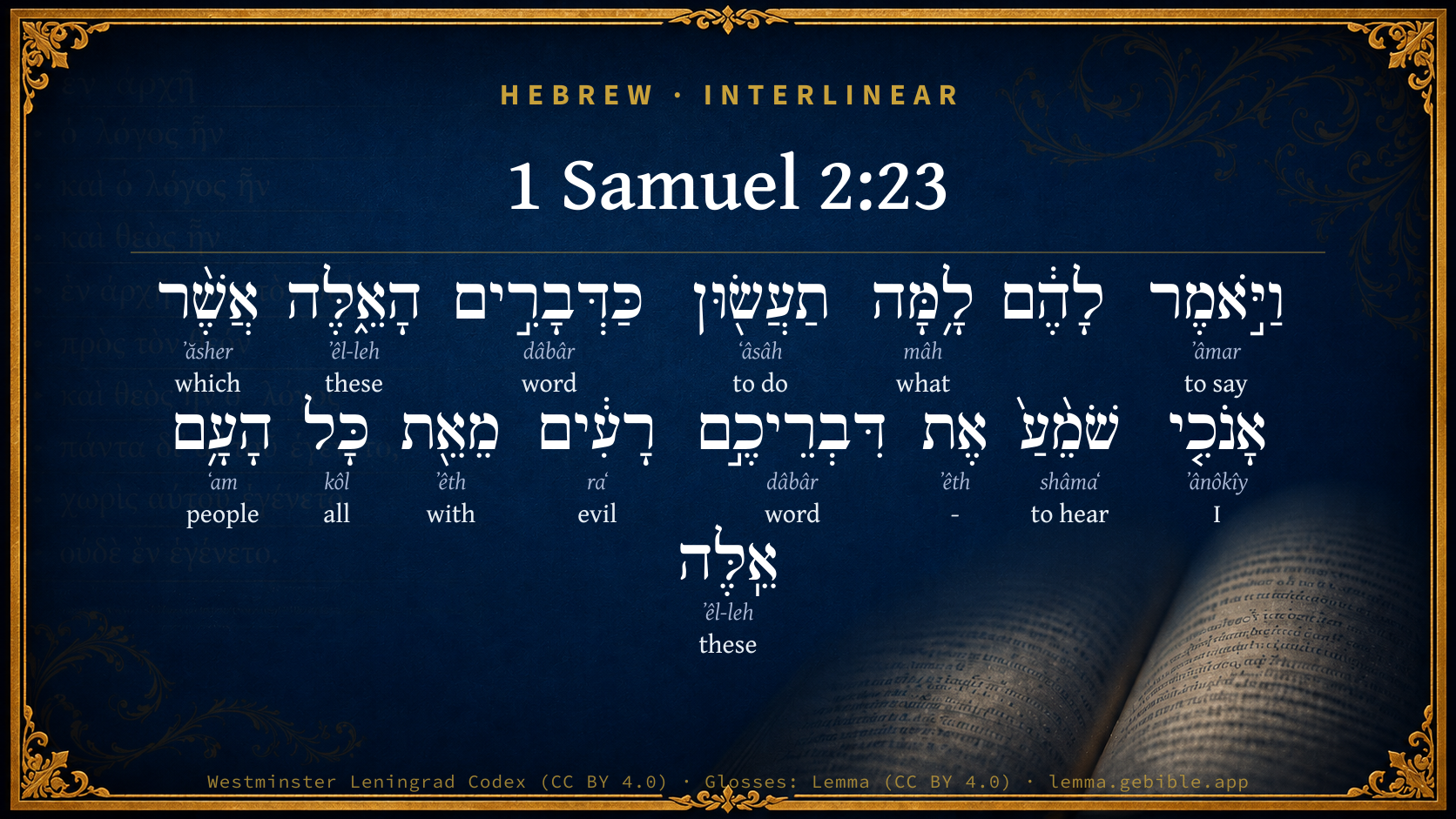
  1. וַיֹּ֣אמֶר ʼâmar H559 “and · to say” Conjunction + Verb, Qal, Sequential Imperfect, 3rd Person, Masculine, Singular
  2. לָ֥מָּה mâh H4100 “to/for · what” Preposition + Particle, Interrogative
  3. תַעֲשׂ֖וּן ʻâsâh H6213 “to do” Verb, Qal, Imperfect, 2nd Person, Masculine, Plural + Suffix, n
  4. כַּדְּבָרִ֣ים dâbâr H1697 “like/as the · words” Preposition, Determined + Noun, Common, Masculine, Plural, Absolute
  5. הָאֵ֑לֶּה ʼêl-leh H428 “the · these” Particle, Definite Article + Pronoun, Demonstrative, Common, Plural
  6. אֲשֶׁ֨ר ʼăsher H834 “which” Particle, Relative
  7. שֹׁמֵ֨עַ֙ shâmaʻ H8085 “hearing” Verb, Qal, Participle Active, Masculine, Singular, Absolute
  8. אֶת ʼêth H853 “-” Particle, Direct Object
  9. דִּבְרֵיכֶ֣ם dâbâr H1697 “words · your” Noun, Common, Masculine, Plural, Construct + Suffix, Personal, 2nd Person, Masculine, Plural
  10. רָעִ֔ים raʻ H7451 “evil” Adjective, Adjective, Masculine, Plural, Absolute
  11. מֵאֵ֖ת ʼêth H854 “from · with” Preposition + Preposition
  12. כָּל kôl H3605 “all of” Noun, Common, Masculine, Singular, Construct
  13. הָעָ֥ם ʻam H5971 “the · people” Particle, Definite Article + Noun, Common, Masculine, Singular, Absolute
  14. אֵֽלֶּה ʼêl-leh H428 “these” Pronoun, Demonstrative, Common, Plural

About this verse

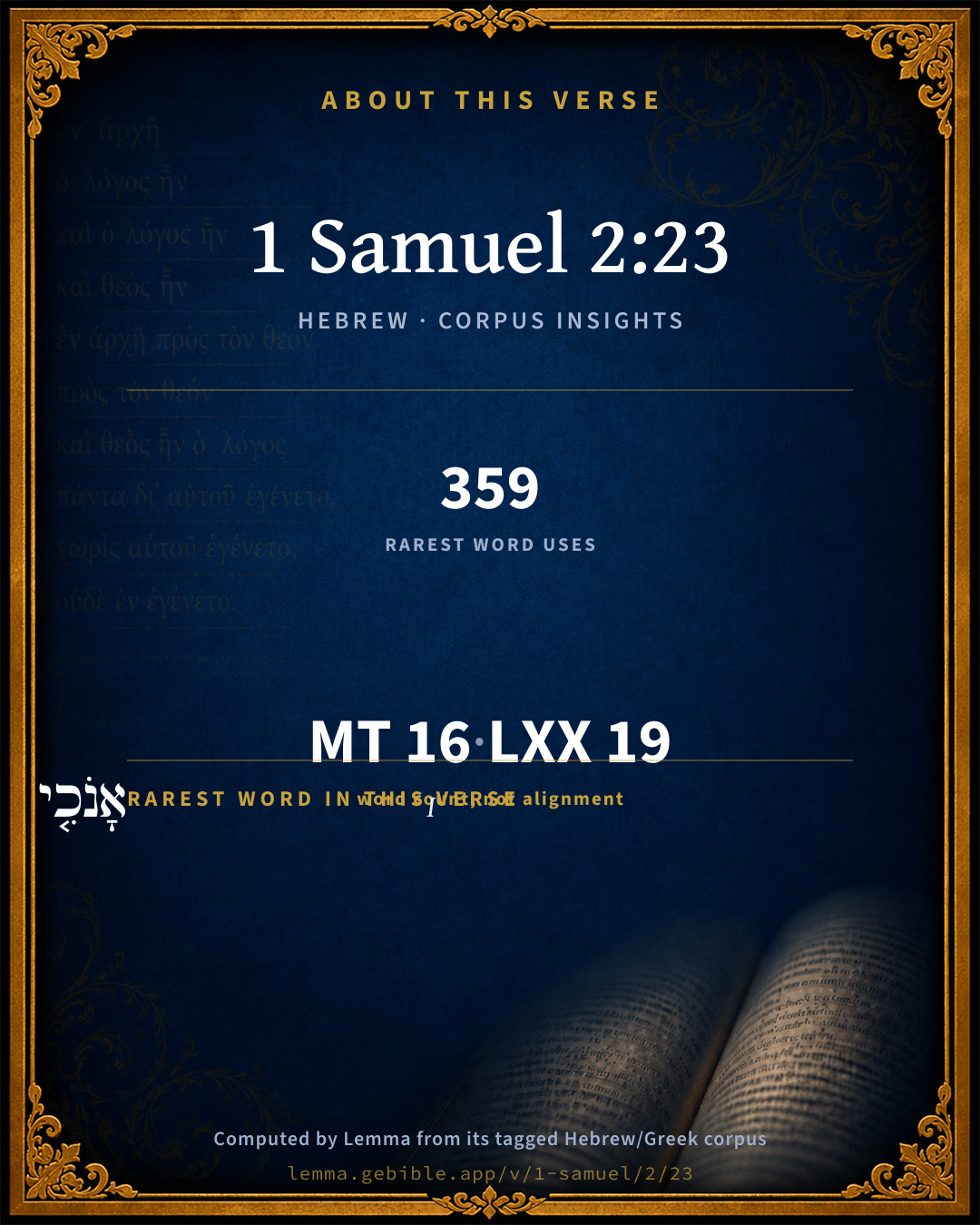
These counts appear in no published source. They are computed here, from the morphology-tagged text and Lemma’s own curated glosses. What Lemma adds →

16
words
13
distinct lemmas
Historical
section

Grammatical profile

  • 3 verbs
  • 4 nouns
  • 1 adjective
  • 3 pronouns
  • 2 prepositions
  • 3 particles

Verb forms

  • וַיֹּ֣אמֶר Qal · Sequential Imperfect
  • תַעֲשׂ֖וּן Qal · Imperfect
  • שֹׁמֵ֨עַ֙ Qal · Participle Active

Repetition

Words recur within this verse — often emphatic in Hebrew:

  • כַּדְּבָרִ֣ים word H1697 ×2
  • הָאֵ֑לֶּה these H428 ×2

Hebrew & Septuagint length

In English translation the verse runs 20 words from the Hebrew and 25 from the Septuagint (LXX English) — closely comparable.

A rough comparison of the two English renderings, which tokenize alike — not a word-level alignment.

Word counts can differ between the Hebrew and the Greek without any difference in meaning — e.g. the Hebrew direct-object marker אֵת has no separate Greek word, and Greek often adds the article ὁ.

In the original languages it is 16 Hebrew tokens and 19 Greek tokens — but the two are counted differently (Hebrew bundles its prefixes and suffixes into one token; the Greek is in lemma form), so that isn’t a like-for-like length.

Cross-references

7

Topical passages linked to 1 Samuel 2:23 in the Treasury of Scripture Knowledge — connected by theme and wording, ordered by reader-vote popularity; previews shown in the World English Bible.

  • 1 Kings 1:6 His father had not displeased him at any time in saying, Why have you done so? and he was also a very goodly man; and he was born after Absalom.
  • Isaiah 3:9 The look of their faces testify against them. They parade their sin like Sodom. They don't hide it. Woe to their soul! For they have brought disaster upon themselves.
  • Jeremiah 3:3 Therefore the showers have been withheld, and there has been no latter rain; yet you have a prostitute's forehead, you refused to be ashamed.
  • Jeremiah 8:12 Were they ashamed when they had committed abomination? nay, they were not at all ashamed, neither could they blush: therefore shall they fall among those who fall; in the time of their visitation they shall be cast down, says Yahweh.
  • Acts 9:4 He fell on the earth, and heard a voice saying to him, "Saul, Saul, why do you persecute me?"
  • Acts 14:15 "Men, why are you doing these things? We also are men of like passions with you, and bring you good news, that you should turn from these vain things to the living God, who made the sky and the earth and the sea, and all that is in them;
  • Philippians 3:19 whose end is destruction, whose god is the belly, and whose glory is in their shame, who think about earthly things.

Cross-references courtesy of OpenBible.info (CC BY 4.0).

Hebrew and Greek witnesses Masoretic Hebrew ↔ Greek Septuagint

The same verse in the two great witnesses to the Old Testament, shown verse-for-verse.

These are two independent witnesses, not word-aligned to each other, and the Septuagint is shown in lemma (dictionary) form.

Hebrew 1 Samuel 2:23 Masoretic · Westminster Leningrad Codex

וַיֹּ֣אמֶר לָהֶ֔ם לָ֥מָּה תַעֲשׂ֖וּן כַּדְּבָרִ֣ים הָאֵ֑לֶּה אֲשֶׁ֨ר אָנֹכִ֤י שֹׁמֵ֨עַ֙ אֶת דִּבְרֵיכֶ֣ם רָעִ֔ים מֵאֵ֖ת כָּל הָעָ֥ם אֵֽלֶּה

He said to them, Why do you such things? for I hear of your evil dealings from all this people.

World English Bible · Public Domain

Greek LXX 1 Samuel 2:23 Septuagint · lemma form

καί εἶπον αὐτός ἵνα τίς ποιέω κατά ὁ ῥῆμα οὗτος ὅς ἐγώ ἀκούω ἐκ στόμα πᾶς ὁ λαός κύριος

And he said to them, Why do you⌃ according to this thing, which I hear from the mouth of all the people of the Lord?

LXX2012 (modern English Septuagint) · Public Domain

Hebrew: Westminster Leningrad Codex (CC BY 4.0). Greek: Septuagint (public domain); English from LXX2012 (modern English Septuagint) (Public Domain). How the Septuagint differs from the Hebrew →

Targum (Aramaic paraphrase)

1

The Targum is the ancient Jewish Aramaic paraphrase of the Hebrew Scriptures — an interpretive translation, not the Hebrew text itself. Onkelos (literal) and Pseudo-Jonathan (expansive) render the Torah, and Jonathan the Prophets. Coverage is partial: where no permissively-licensed English translation exists for a verse, only the Aramaic is shown. This is verse-level text, not a word-by-word alignment to the Hebrew.

  1. Targum Jonathan Prophets (Joshua–Malachi)
    וַאֲמַר לְהוֹן לְמָא תַעְבְּדוּן כְּפִתְגָמַיָא הָאֵלִין דִי אֲנָא שְׁמַע יַת פִּתְגָמֵיכוֹן בִּישִׁין מִן כָּל עַמָא אִלֵין:

    (no public-domain English translation for this verse)

    Targum Jonathan — Aramaic: “Mikraot Gedolot” (public domain). English: “Sefaria Community Translation” (CC0 1.0 (public-domain dedication)); “London "Chaldee Paraphrase," 1871” (public domain). Text via Sefaria.

Commentary

Notes on 1 Samuel 2:23 from classic Christian and Jewish commentators (each source and its license shown beneath its notes). The classic Christian expositions comment on the surrounding passage and are grouped to its opening verse, so a note may address several verses; the Jewish commentaries on the Tanakh (Rashi and others) are per-verse, so they appear only where the commentator wrote on this verse.

Lemma curates 59 commentaries, every one of them public domain or Creative Commons licensed, each selected and text-cleaned for this edition rather than reprinted as found. About our sources →

Trapp's Complete Commentary

John Trapp

1Sa 2:23 And he said unto them, Why do ye such things? for I hear of your evil dealings by all this people.

Ver. 23. And he said unto them, Why do ye such things?] This was to reprove them, Lenitate patris, non auctoritate pontificis, saith Jerome, i.e., with the lenity of a father, and not with the authority of a magistrate. This was to shave the head, which deserved cutting off, saith another. A weak dose doth but stir bad humours, and anger them, not purge them out: so it fareth with sins. Castigantur a parente Eli, leniter tamen et molli tantum brachio: Chastised these varlets {A person of a low, mean, or knavish disposition; a knave, rogue, rascal.} were by their father, but so lightly, as if he were afraid to hurt them. It is likely he had always marred them with too much indulgence: David’s fault also. Pope Paul III, hearing of the abominable practices of his son Petro Alvigi Farnesis, thought it enough to say, Haec vitia me non commonstratore didicit, He never learned these faults of his father.

For I hear of your evil dealings.] Which Eli should have instanced and aggravated for their terror and shame. A reproof should be soundly set on. Jehoshaphat was to blame with his "Let not the king say so."

John Trapp, A Commentary or Exposition upon All the Books of the Old and New Testament (1647–1656) — public domain. Text from a community e-Sword module.

The Biblical Illustrator

Joseph S. Exell

1Sa_2:23-24

Nay, my sons: for it is no good report that I hear.

Weakness is wickedness

It does not often occur to us what shame and guilt belong to mortal vacillation and weakness. Too often a mans weakness is accepted as a sufficient excuse for his sin. Outbursts of evil passion are excused because a man has a passionate nature. Vacillation is condoned, because a man by nature is pliant and indecisive. Inconsiderateness is held to be blameless, because a man is impulsive by natural disposition. That all this is wrong in judgment and false in principle, could not be more sternly taught than in the experience of Eli. Blameless and pure, humble and devout, there is no more beautiful character, in many of its aspects, to be found in Scripture than his; yet how stern the rebuke which is passed upon him, and how terrible the retribution! Plain it is that in Gods sight moral weakness is sin. At the Bar of Judgment I cannot finds no acceptance as a plea against You must. To say that you have not the strength, the courage, the resoluteness to do right is a confession which is itself a shameful wrong. It is the plea of a weakling, and weakness in Gods sight is wickedness. It is the plea of a coward, and moral cowardice is sin. (J. Bainton.)

Paternal leniency

I. Elis fatal leniency.

1. He saith over softly to them, Why do ye such things? (v. 23). This was to reprove them, saith Jerome, with the lenity of a father, not with the authority of a magistrate: Tis an old saying, Pity spoils a city; sure I am it did so here, for it spoiled his family, causing the priesthood to be removed from it.

2. I hear of your evil doings. This was too gentle, to mention them in the general only, and not to particularise them with their detestable aggravations, he should have rebuked them, cuttingly, or sharply (Tit_2:15) with all authority.

3. By all the people: As if it were their report only, and that he was put on by the people to say what he said.

4. Nay, my sons. He should have set on his reproof, by saying Ye act more like sons of Belial than my sons, the sons of the high priests of the Most High God.

5. Tis no good report: He should have called it, the most dismal and diabolical, if he had had a right zeal for Gods glory, etc.

6. He was not willing to reprove them, but the clamours of others forced him to do it.

7. He did not rebuke them publicly (1Ti_5:20) for the public sins to make the plaster as broad as the wound.

8. It was only a verbal reproof, whereas he should have put them out of their priesthood and punished them for their adultery according to the law, without respect of persons as a judge, etc.

9. He did not rebuke them in time, but let them live long in sin. 10. He soon ceased chiding them, so tis said, He restrained them not, (ch. 3:18.)

II. Apology for Eli in this case is--That he now was very old, some suppose him to be now come to his ninetieth year, even in his dotage, so could not himself converse with his sons, so as to observe their maladministrations, and withal, he was dim-sighted, so could not so well see their sinful practices: his superannuation caused his frequent absence from the Tabernacle, which gave a greater opportunity for his sons wickedness, to whom the management of Gods worship was (in their fathers retirement) be trusted, and tis not improbable, his sons did not much regard his reproofs, because he was old and over-worn, but themselves, being in their vigour, had married wives, and were fathers of children. And tis commonly known that old ago doth incline men to mercy, so that it is no wonder if Eli seem rather to flatter than to chastise his sons.

III. Judgement pronounced on Eli. The promise for the perpetuation of the priesthood to Aarons family (Exo_28:43; Exo_29:9) was conditional only so long as they did honour God therein, which condition the elder line of Aaron kept not in the case of Jephtahs vow, therefore was the high priesthood transferred to the younger line, which now upon the like failure in the condition, made a new forfeiture thereof, by dishonouring God so notoriously in Elis sons.

1. This may be called breach of promise, as that is (Num_14:34) when the old generation were wasted in the wilderness, and yet the new one was brought into Canaan as God had promised.

2. This Man of God threatens the extirpation of Elis family (1Sa_2:31-32). His arm shall be cut off.

3. This Man of God threatens him with a rival in the place of the priesthood, which he or his posterity should behold with their eyes, to their great grief and regret (1Sa_2:32-33).

4. This Man of God threatens him with the violent, death of his sons before their fathers death (1Sa_2:34-35).

5. He threatens him with the poverty of his posterity (1Sa_2:36). They shall come crouching as Abiathar did (1Ki_2:26) when banished to Anathoth. (C. Ness.)

Elis imbecility

Ells are out of place in this world; they are only fit for the society of angels. Place one of them over a business. Oh, he is such a good man! Trusts everybody, dismisses nobody, lets every knave and idle fellow about the premises play tricks with him. By-and-bye the end comes, and you spell it with ruin. Such a dear, well-meaning man, and so unfortunate; you all pity him. Yes, such men are to be pitied, but mainly because they are so weak and easygoing. Good men, but not fit to be at the head of anything. Not fit to rule a kingdom or a lunatic asylum, or even a church, and perhaps, least of all, a home. It is a pity when domestic government gets into their hands. Such nice meal such angelic women! But, alas! they make a pitiable business of it if they become fathers and mothers. (J. G. Greenough.)

Necessity of parental severity

When George III wished his two sons, the Prince of Wales and the Duke of York, to be instructed, he sent for one of the most rigid disciplinarians of the day; and when the king and the teacher stood together, one would have been at a loss to know whether to admire more the majesty of royalty or the majesty of learning. The king gave a side glance at the two boys who stood at, his feet, and said to the stern doctor who stood before him, Sir, I wish you to teach these, my two sons. And, please your majesty, replied the teacher, how do you wish these princes to be treated? Just treat them, returned the king, as you would treat the sons of a private gentleman; if they require it, flog them; just do with them as you do at Westminster School. And so the doctor did; he let them know by hard experience that the rod was made for the fools back. And when Louis XIV of France, one of the proudest kings that ever sat on the French throne, began to feel his inferiority in knowledge after he had arrived at the years of maturity, he complained to his courtiers that he was ignorant of many things which they knew. Upon which a nobleman near him ventured to hint that when a child he was wilful and wayward, and refused listen to the voice of instruction. What! he exclaimed, was there not birch enough, in the forest of Fontainebleau? (J. Hutchinson.)

Laxity of parental authority

Eli surely has his parallel in many a moral household which presents the spectacle of a father of exemplary life and character surrounded by children who, as they phrase it, take their own line in whatever form of dissipation or extravagance, or at best of aimless and frivolous living. The fault may be altogether with the child, but generally in this world when sons go wrong there are at least faults on both sides. And may it not be that in the critical years, when character was taking shape, and temptations were pressing hard with eager importunity, nothing was done, perhaps nothing was said to check, to rebuke, to guide, to encourage? The boys character was allowed to drift; it was allowed to drift by the man whose sense of responsibility as his father should have saved him from a mistake so ruinous. Authority need not be despotism; it may be tender and considerate to any extent, provided only that it is authority, and that its voice is not silent, nor its arm paralysed by a misplaced affection or by a want of moral courage, or by secret indifference, to the greatest issues which He before every human being. (Canon Liddon.)

The Biblical Illustrator, edited by Joseph S. Exell (c. 1880s–1900s) — public domain. Text from a community e-Sword module.

Joseph Benson's Commentary

1Sa 2:23-24. And he said, Why do ye do such things? — He reproved them, but far too gently, as these and the following words manifest. This might proceed partly from the coldness of old age, but it arose chiefly from his too great indulgence to his children. I hear of your evil dealings by all this people — Their wickedness was so notorious that there was a general complaint of it, which should have moved him to much greater severity than merely to reprove and chide them. He ought to have restrained them, and if he could not otherwise have done it, to have inflicted those punishments upon them which such high crimes deserved, according to God’s law, and which he, as high-priest and judge, was in duty bound to inflict without respect of persons. Nay, my sons, for it is no good report that I hear — This is the language of a father, not of a zealous judge. Ye make the Lord’s people to transgress — By causing them to neglect and despise the service of God, and tempting them to lewdness.

Joseph Benson's Commentary on the Old and New Testaments (1811–1818) — public domain. Text from a community e-Sword module.

Adam Clarke's Commentary

Verse 23. Why do ye such things!] Eli appears to have been a fondly affectionate, easy father, who wished his sons to do well, but did not bring them under proper discipline, and did not use his authority to restrain them. As judge, he had power to cast them immediately out of the vineyard, as wicked and unprofitable servants; this he did not, and his and their ruin was the consequence.

Adam Clarke's Commentary on the Bible (1810–1826) — public domain. Text from a community e-Sword/MySword module.

The Cambridge Bible for Schools and Colleges

gen. ed. J. J. S. Perowne

23. for I hear of your evil dealings] Rather, for I hear evil things of yon from all this people.

The Cambridge Bible for Schools and Colleges (gen. ed. J. J. S. Perowne; Cambridge University Press, 1878–1918) — public domain. Text from a community e-Sword module.

John Gill's Exposition

Nay, my sons,.... This seems to be too soft and smooth an appellation, too kind and endearing, considering the offence they were guilty of, and were now reproving for; rather they deserved to be called sons of Belial, the children of the devil, than sons of Eli, or brutes and shameless wretches, and such like hard names:

for it is no good report that I hear; a very bad one; far from being good, scarce anything worse could have been said of them; to rob persons of the flesh of their offerings, when there was a sufficient allowance made for them by law, and to be so impious as to require what was not their due, and even before the Lord had his; and to debauch the women that came to religious worship, and that in the sacred place of worship, they also being priests of the Lord, and married men; sins very shocking and sadly aggravated, and yet Eli treats them in this gentle manner:

ye make the Lord's people to transgress: by causing them to forbear to bring their sacrifices, being used in such an injurious and overbearing way; and by decoying the women into uncleanness, and by setting examples to others: or, "to cry out"; as in the margin of our Bibles, to exclaim against them for their exorbitant and lewd practices; so the Targum,

"the people of the Lord murmur because so ill used by them:''this clause may be read in connection with the former, "it is no good report that I hear, which ye cause to pass through the Lord's people"; ye occasion the people to speak ill of you everywhere, in the camp of Israel, throughout the whole nation; the report as it is bad, it is general, is in everyone's mouth; so Maimonides (u) interprets it; with which Jarchi and others agree (w).

(u) Moreh Nevochim, par. 1. c. 21. (w) Vid. T. Bab. Sabbat, fol. 55. 2. & praefat. Ben Chayim. ad Bib. Heb. Bomberg. & Buxtorf.

John Gill's Exposition of the Whole Bible (1746–1763) — public domain (CC PDM 1.0). Text via the HelloAO Bible API.

Haydock's Catholic Bible Commentary

People. They could not refrain from complaining of the iniquity of his children, how much soever they might revere him. Though he was not a witness himself of their abominations, such an uproar must have convinced him that they were guilty. (Haydock) --- The Fathers in general blame the lenity of the high priest, who ought not only to have rebuked, but also to have put a stop to the crying sins of his sons, by the utmost severity. (Calmet)

George Leo Haydock (1774–1849), Haydock's Catholic Family Bible and Commentary, 1859 edition — public domain. Excludes Psalms (Douay-Rheims chapter numbering differs from Protestant) and Deuterocanonical books (Catholic canon only).

Matthew Poole's English Annotations

Such things, as those above mentioned, 1Sa 2:13,22. Eli’s sin in this matter was not only that he reproved them too gently, and generally, and sparingly; but especially that he contented himself with a verbal rebuke and did not

restrain them, as is said 1Sa 3:13, and inflict those punishments upon them, of putting them out of their priest’s office, and cutting them off from God’s people; which such high crimes deserved by God’s law, and which he as judge and high priest ought to have done, without all respect of persons.

By all this people, that dwell here, or come hither to worship.

Matthew Poole's English Annotations on the Holy Bible (1683–1685) — public domain. Text from a community e-Sword/MySword module.

Whedon's Commentary on the Bible

Daniel D. Whedon

23. Why do ye such things — The fond father merely remonstrates and reasons, but young men so deeply sunken in sin as were Hophni and Phinehas are not to be benefitted or reclaimed by kind moral suasion alone. He should have put forth the hand of his authority as judge, to punish severely such violence and crime.

Daniel D. Whedon (gen. ed.), Commentary on the Old and New Testaments (1874–1909) — public domain. Text from a community e-Sword module.

John Wesley's Explanatory Notes

He said, &c. - Eli's sin was not only that he reproved them too gently, but that he contented himself with a verbal rebuke, and did not restrain them, and inflict those punishments upon them which such high crimes deserved by God's law, and which he as judge and high-priest ought to have done, without respect of persons.

John Wesley, Explanatory Notes Upon the Whole Bible (1754–1765) — public domain. Text via the GEBible commentary corpus.

Lesson kit

Teaching starters — assembled from the data on this page, not authored interpretation. Every prompt links to the verse data it draws on. Edit before teaching.

1 Samuel, in the Historical, opens this verse with 16 words (13 distinct Hebrew lemmas). Its most distinctive word is ʼânôkîy (“I”). A historical commentator’s framing appears above. Read the whole chapter for the surrounding context.

Discussion questions

  1. How does “I” (ʼânôkîy) shape what this verse is saying?
  2. How does 1 Kings 1:6, which shares this passage’s theme, read alongside this verse?
  3. What does the repetition of “word” (2× in this one verse) do in this verse?
  4. These translations render this verse differently. What is at stake in choosing one wording over another?
  5. «וַיֹּ֣אמֶר» is a Qal Sequential Imperfect verb. How does that grammatical form shape the action described?
  6. Compare how Trapp's Complete Commentary and The Biblical Illustrator read this verse. Where do they agree or differ?

Things to notice

Reading settings

Reading text

Shown beneath each verse's original-language words.

Old Testament
Old Testament edition

Read the OT as the Masoretic Hebrew (MT) or the Greek Septuagint (LXX).

English shown for the Greek Septuagint (in the Hebrew ↔ Greek comparison).

Comparing translations? Open the Compare panel on any verse page to stack up to four side by side.