
Numbers 35:29

Hebrew (Westminster Leningrad Codex) Numbers 35:29 appears in the Hebrew Old Testament. The text above is from the Westminster Leningrad Codex. Each word links to its Strong’s number, a concise gloss, and parsing drawn from the Open Scriptures Hebrew Bible morphology. Click any word for its full Brown-Driver-Briggs (BDB) entry.
Download image
Cite this verse

Numbers 35:29 (World English Bible). Public Domain. Lemma interlinear Bible study tool, https://lemma.gebible.app/v/numbers/35/29.

Show BibTeX & RIS
BibTeX
RIS
English Translation
These things shall be for a statute [and] ordinance to you throughout your generations in all your dwellings.
World English Bible · Public Domain
Download a study sheet

One document with this verse’s original text, its word-by-word gloss line, the meaning frame, cross-references with their text, attributed commentary, and full source and license credits — printable, and it pastes into notes with its structure intact.

This verse Autodidact and up

Study sheet (.html) Plain text (.txt)

A passage Seminary Student

Up to 50 verses in one chapter. A passage sheet keeps up to 6 commentary sources and 12 cross-references per verse, in the order this page ranks them, and says so on the sheet whenever that leaves anything out. Ask for a single verse and you get the Autodidact verse sheet above.

Everything on this page stays free to read, with no account — the sheet is a download of what is already on screen, not access to it.

Want to remove ads? Support Godless Engineer
Compare translations 3

The same verse in 3 English versions, stacked beneath the original-language interlinear above. Click any original word for its lexicon entry.

Each is an independent rendering of the whole verse — the interlinear is not word-aligned to these translations.

Highlighted words mark where these versions differ — a whole-verse word diff, not a word-by-word alignment.

  • World English Bible Public Domain
    These things shall be for a statute [and] ordinance to you throughout your generations in all your dwellings.
  • King James Version Public Domain
    So these things shall be for a statute of judgment unto you throughout your generations in all your dwellings.
  • unfoldingWord Literal Text CC BY-SA 4.0
    And these shall be for you as a statute of judgment for your generations in all your dwellings.

unfoldingWord Literal Text — © unfoldingWord, licensed CC BY-SA 4.0. Word-aligned USFM3 via Door43 (git.door43.org/unfoldingWord/en_ult).

Versions to compare (up to 4)

3 of 4 selected

Show all 18 translations

Every available English version of this verse, each an independent rendering of the whole verse.

  • World English Bible Public Domain
    These things shall be for a statute [and] ordinance to you throughout your generations in all your dwellings.
  • Berean Standard Bible Public Domain
    This will be a statutory ordinance for you for the generations to come, wherever you live.
  • Majority Standard Bible Public Domain
    This will be a statutory ordinance for you for the generations to come, wherever you live.
  • King James Version Public Domain
    So these things shall be for a statute of judgment unto you throughout your generations in all your dwellings.
  • American Standard Version (1901) Public Domain
    And these things shall be for a statute `and' ordinance unto you throughout your generations in all your dwellings.
  • Revised Version (1885) Public Domain
    And these things shall be for a statute of judgment unto you throughout your generations in all your dwellings.
  • Geneva Bible (1599) Public Domain
    So these thinges shall be a lawe of iudgement vnto you, throughout your generations in all your dwellings.
  • Douay-Rheims (1899) Public Domain
    These things shall be perpetual, and for an ordinance in all your dwellings.
  • Young's Literal Translation Public Domain
    `And these things have been to you for a statute of judgment to your generations, in all your dwellings:
  • Literal Standard Version CC BY-SA 4.0
    And these things have been for a statute of judgment to you throughout your generations, in all your dwellings.
  • Unlocked Literal Bible CC BY-SA 4.0
    These laws must be statutes for you through all your people's generations in all the places where you live.
  • unfoldingWord Literal Text CC BY-SA 4.0
    And these shall be for you as a statute of judgment for your generations in all your dwellings.
  • Darby Bible Public Domain
    And this shall be unto you a statute of right throughout your generations in all your dwellings.
  • World Messianic Bible Public Domain
    “‘These things shall be for a statute and ordinance to you throughout your generations in all your dwellings.
  • Webster's Bible Public Domain
    So these things shall be for a statute of judgment to you throughout your generations in all your dwellings.
  • Free Bible Version CC BY-SA 4.0
    These regulations apply to all future generations wherever you live.
  • Bible in Basic English Public Domain
    These rules are to be your guide in judging through all your generations wherever you may be living.
  • JPS Tanakh (1917) Public Domain
    And these things shall be for a statute of judgment unto you throughout your generations in all your dwellings.

Literal Standard Version (2020), Covenant Press — licensed CC BY-SA 4.0. Text via the HelloAO Bible API (eBible.org). Unlocked Literal Bible (unfoldingWord) — licensed CC BY-SA 4.0. Text via the HelloAO Bible API (eBible.org). unfoldingWord Literal Text — © unfoldingWord, licensed CC BY-SA 4.0. Word-aligned USFM3 via Door43 (git.door43.org/unfoldingWord/en_ult). Free Bible Version, Dr. Jonathan Gallagher — licensed CC BY-SA 4.0. Text via the HelloAO Bible API (eBible.org).

Word by word

More ways to search: Search by grammar → Find every occurrence → Compare this word →

Practice this passage: Drill this verse → Learn its vocabulary →

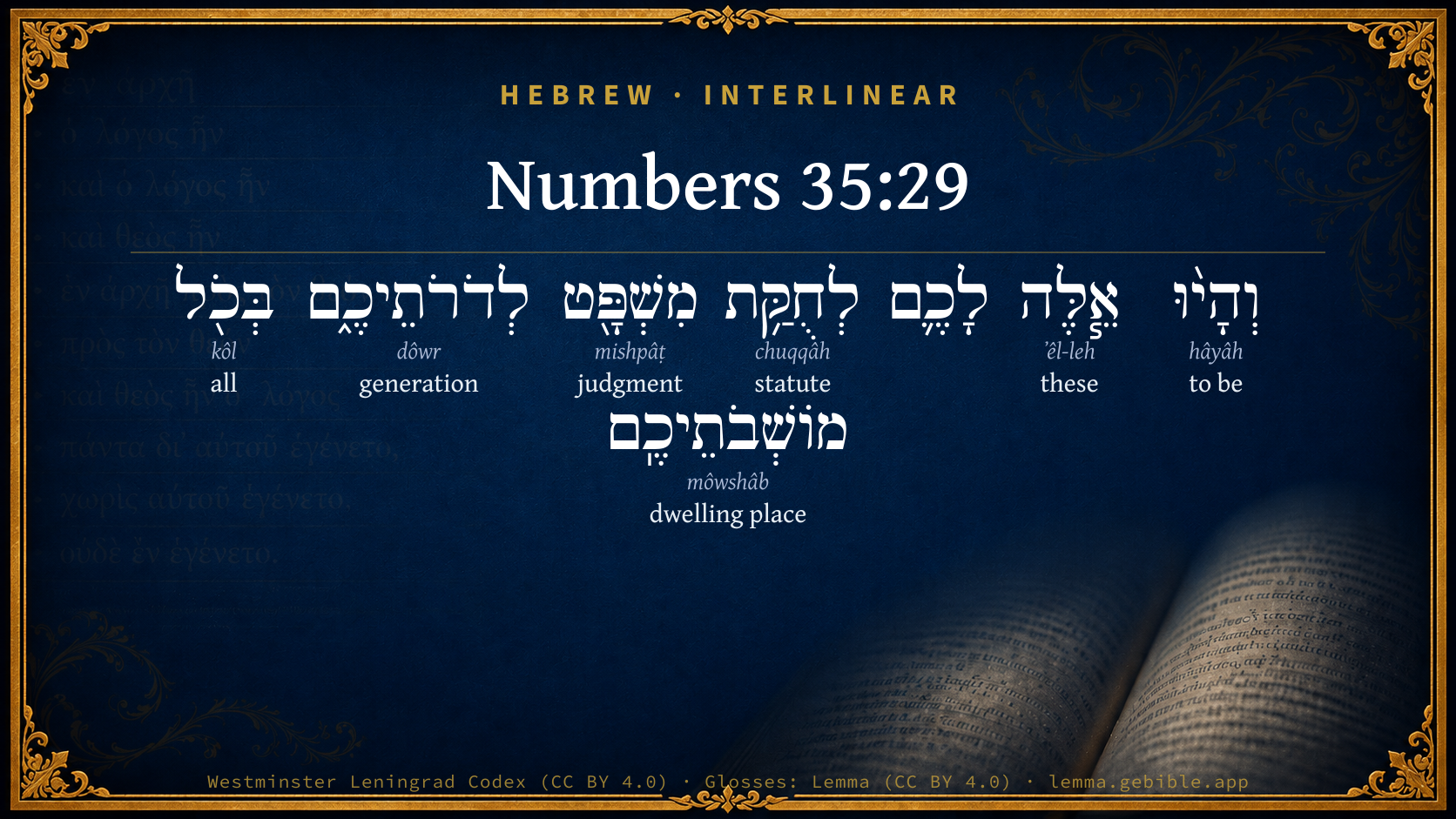
מוֹשְׁבֹתֵיכֶֽם
môwshâb
H4186
“dwelling places · your”
Noun, Common, Masculine, Plural, Construct + Suffix, Personal, 2nd Person, Masculine, Plural
Part of Speech
Noun
Type
Common
Gender
Masculine
Number
Plural
State
Construct
Full BDB Definition

Origin: from H3427 ; a seat

TWOT: 922c

seat, assembly, dwelling-place, dwelling, dwellers - seat, sitting, those sitting, sitting company or assembly - dwelling place, dwelling - situation, location - time of dwelling - those dwelling, dweller
  1. וְהָי֨וּ hâyâh H1961 “and · to be” Conjunction + Verb, Qal, Sequential Perfect, 3rd Person, Common, Plural
  2. אֵ֧לֶּה ʼêl-leh H428 “these” Pronoun, Demonstrative, Common, Plural
  3. לְחֻקַּ֥ת chuqqâh H2708 “to/for · statute of” Preposition + Noun, Common, Both, Singular, Construct
  4. מִשְׁפָּ֖ט mishpâṭ H4941 “judgment” Noun, Common, Masculine, Singular, Absolute
  5. לְדֹרֹתֵיכֶ֑ם dôwr H1755 “to/for · generations · your” Preposition + Noun, Common, Masculine, Plural, Construct + Suffix, Personal, 2nd Person, Masculine, Plural
  6. בְּכֹ֖ל kôl H3605 “in/at · all of” Preposition + Noun, Common, Masculine, Singular, Construct

About this verse

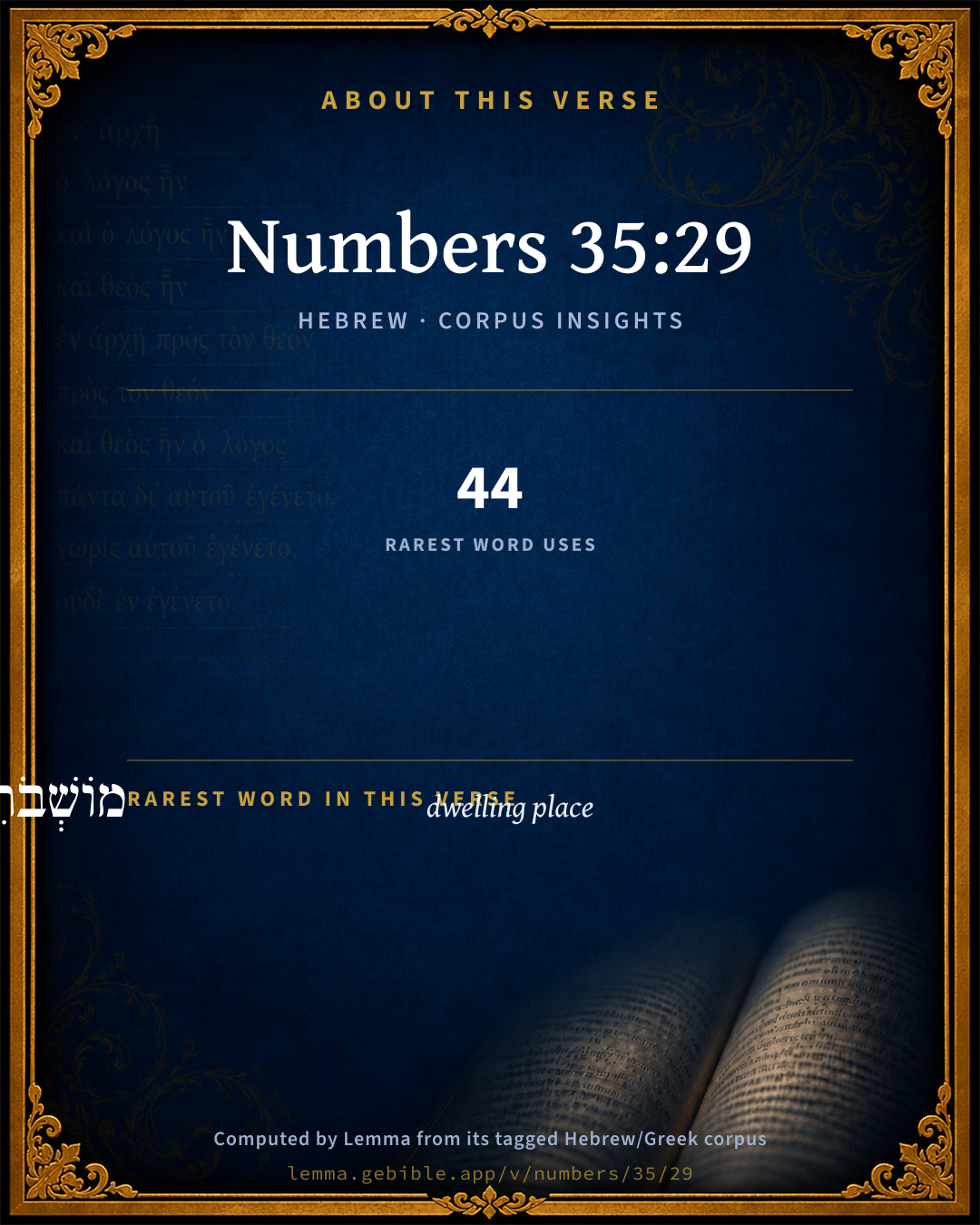
These counts appear in no published source. They are computed here, from the morphology-tagged text and Lemma’s own curated glosses. What Lemma adds →

8
words
7
distinct lemmas
Pentateuch
section

Shared distinctive vocabulary

מוֹשְׁבֹתֵיכֶֽם dwelling place H4186 occurs in 43 verses of the Hebrew Bible. Also found in:

Grammatical profile

  • 1 verb
  • 5 nouns
  • 1 pronoun
  • 1 preposition

Verb forms

  • וְהָי֨וּ Qal · Sequential Perfect

Hebrew & Septuagint length

In English translation the verse runs 18 words from the Hebrew and 19 from the Septuagint (LXX English) — closely comparable.

A rough comparison of the two English renderings, which tokenize alike — not a word-level alignment.

Word counts can differ between the Hebrew and the Greek without any difference in meaning — e.g. the Hebrew direct-object marker אֵת has no separate Greek word, and Greek often adds the article ὁ.

Cross-references

2

Topical passages linked to Numbers 35:29 in the Treasury of Scripture Knowledge — connected by theme and wording, ordered by reader-vote popularity; previews shown in the World English Bible.

  • Numbers 27:11 If his father have no brothers, then you shall give his inheritance to his kinsman who is next to him of his family, and he shall possess it: and it shall be to the children of Israel a statute [and] ordinance, as Yahweh commanded Moses.
  • Numbers 27:1 Then drew near the daughters of Zelophehad, the son of Hepher, the son of Gilead, the son of Machir, the son of Manasseh, of the families of Manasseh the son of Joseph; and these are the names of his daughters: Mahlah, Noah, and Hoglah, and Milcah, and Tirzah.

Cross-references courtesy of OpenBible.info (CC BY 4.0).

Hebrew and Greek witnesses Masoretic Hebrew ↔ Greek Septuagint

The same verse in the two great witnesses to the Old Testament, shown verse-for-verse.

These are two independent witnesses, not word-aligned to each other, and the Septuagint is shown in lemma (dictionary) form.

Hebrew Numbers 35:29 Masoretic · Westminster Leningrad Codex

וְהָי֨וּ אֵ֧לֶּה לָכֶ֛ם לְחֻקַּ֥ת מִשְׁפָּ֖ט לְדֹרֹתֵיכֶ֑ם בְּכֹ֖ל מוֹשְׁבֹתֵיכֶֽם

These things shall be for a statute [and] ordinance to you throughout your generations in all your dwellings.

World English Bible · Public Domain

Greek LXX Numbers 35:29 Septuagint · lemma form

καί εἰμί οὗτος σύ εἰς δικαίωμα κρίμα εἰς ὁ γενεά σύ ἐν πᾶς ὁ κατοικία σύ

And these things shall be to you for an ordinance of judgment throughout your generations in all your dwellings.

LXX2012 (modern English Septuagint) · Public Domain

Hebrew: Westminster Leningrad Codex (CC BY 4.0). Greek: Septuagint (public domain); English from LXX2012 (modern English Septuagint) (Public Domain). How the Septuagint differs from the Hebrew →

Targum (Aramaic paraphrase)

2

The Targum is the ancient Jewish Aramaic paraphrase of the Hebrew Scriptures — an interpretive translation, not the Hebrew text itself. Onkelos (literal) and Pseudo-Jonathan (expansive) render the Torah, and Jonathan the Prophets. Coverage is partial: where no permissively-licensed English translation exists for a verse, only the Aramaic is shown. This is verse-level text, not a word-by-word alignment to the Hebrew.

  1. Targum Onkelos Torah (Genesis–Deuteronomy)
    וִיהוֹן אִלֵין לְכוֹן לִגְזֵרַת דִין לְדָרֵיכוֹן בְּכֹל מוֹתְבָנֵיכוֹן

    (no public-domain English translation for this verse)

    Targum Onkelos — Aramaic: “Onkelos Genesis” (public domain); “Onkelos Exodus” (public domain); “Onkelos Leviticus” (public domain); “Onkelos Numbers” (public domain); “Onkelos Deuteronomy” (public domain). English: “Sefaria Community Translation” (CC0 1.0 (public-domain dedication)); “J.W. Etheridge. The Targums of Onkelos and Jonathan Ben Uzziel on the Pentateuch. London: Longmans, Green, 1862” (public domain). Text via Sefaria.

  2. Targum Pseudo-Jonathan Torah (Genesis–Deuteronomy)
    וְיֶהֱווֹן אִלֵין אַחְוָיָתָא לְכוֹן לִגְזֵירַת דִינִין לְדָרֵיכוֹן בְּכָל מוֹתְבָנֵיכוֹן

    And these indications shall be to you a decree of judgment for your generations in all your dwellings:

    Targum Pseudo-Jonathan — Aramaic: “Targum Jonathan on Genesis” (public domain); “Targum Jonathan on Exodus” (public domain); “Targum Jonathan on Leviticus” (public domain); “Targum Jonathan on Numbers” (public domain); “Targum Jonathan on Deuteronomy” (public domain). English: “The Targum of Jonathan ben Uzziel, trans. J. W. Etheridge, London, 1862” (public domain). Text via Sefaria.

Commentary

Notes on Numbers 35:29 from classic Christian and Jewish commentators (each source and its license shown beneath its notes). The classic Christian expositions comment on the surrounding passage and are grouped to its opening verse, so a note may address several verses; the Jewish commentaries on the Tanakh (Rashi and others) are per-verse, so they appear only where the commentator wrote on this verse.

Lemma curates 59 commentaries, every one of them public domain or Creative Commons licensed, each selected and text-cleaned for this edition rather than reprinted as found. About our sources →

Keil & Delitzsch

C. F. Keil & F. Delitzsch

If, therefore, the confinement of the unintentional manslayer in the city of refuge was neither an ordinary exile nor merely a means of rescuing him from the revenge of the enraged goel, but an appointment of the just and merciful God for the expiation of human blood even though not wilfully shed, that, whilst there was no violation of judicial righteousness, a barrier might be set to the unrighteousness of family revenge; it was necessary to guard against any such abuse of this gracious provision of the righteous God, as that into which the heathen right of asylum had degenerated.

(Note: On the asyla, in general, see Winer's Real-Wrterbuch, art. Freistatt; Pauly, Real-encyckl. der class. Alterthums-wissenschaft, Bd. i. s. v. Asylum; but more especially K. Dann, "ber den Ursprung des Asylrechts und dessen Schicksale und Ueberreste in Europa," in his Ztschr. fr deutsches Recht, Lpz. 1840. "The asyla of the Greeks, Romans, and Germans differed altogether from those of the Hebrews; for whilst the latter were never intended to save the wilful criminal from the punishment he deserved, but were simply established for the purpose of securing a just sentence, the former actually answered the purpose of rescuing the criminal from the punishment which he legally deserved.")

The instructions which follow in Num 35:29-34 were intended to secure this object. In Num 35:29, there is first of all the general law, that these instructions (those given in vv. 11-28) were to be for a statute of judgment (see Num 27:11) for all future ages ("throughout your generations," see Exo 12:14, Exo 12:20). Then, in Num 35:30, a just judgment is enforced in the treatment of murder. "Whoso killeth any person (these words are construed absolutely), at the mouth (the testimony) of witnesses shall the murderer be put to death; and one witness shall not answer (give evidence) against a person to die;" i.e., if the taking of life were in question, capital punishment was not to be inflicted upon the testimony of one person only, but upon that of a plurality of witnesses. One witness could not only be more easily mistaken than several, but would be more likely to be partial than several persons who were unanimous in bearing witness to one and the same thing. The number of witnesses was afterwards fixed at two witnesses, at least, in the case of capital crimes (Deu 17:6), and two or three in the case of every crime (Deu 19:15; cf. Joh 8:17; Co2 13:1; Heb 10:28). - Lastly (Num 35:31.), the command is given not to take redemption money, either for the life of the murderer, who was a wicked man to die, i.e., deserving of death (such a man was to be put to death); nor "for fleeing into the city of refuge, to return to dwell in the land till the death of the high priest:" that is to say, they were neither to allow the wilful murderer to come to terms with the relative of the man who had been put to death, by the payment of a redemption fee, and so to save his life, as is not unfrequently the case in the East at the present day (cf. Robinson, Pal. i. p. 209, and Lane's Manners and Customs); nor even to allow the unintentional murderer to purchase permission to return home from the city of refuge before the death of the high priest, by the payment of a money compensation.

Keil & Delitzsch — Biblical Commentary on the Old Testament (1861–1891) — public domain (CC PDM 1.0). Text via the HelloAO Bible API. (Old Testament only.)

Geneva Bible (1599)

Geneva Bible translators

A law to judge murders done either of purpose, or unadvisedly.

Geneva Bible (1599) marginal notes — public domain. Text via Bolls.life.

Jamieson, Fausset & Brown

Robert Jamieson, A. R. Fausset & David Brown

these things shall be for a statute of judgment unto you throughout your generations--The law of the blood-avenger, as thus established by divine authority, was a vast improvement on the ancient practice of Goelism. By the appointment of cities of refuge, the manslayer was saved, in the meantime, from the blind and impetuous fury of vindictive relatives; but he might be tried by the local court, and, if proved guilty on sufficient evidence, condemned and punished as a murderer, without the possibility of deliverance by any pecuniary satisfaction. The enactment of Moses, which was an adaptation to the character and usages of the Hebrew people, secured the double advantage of promoting the ends both of humanity and of justice.

Next: Numbers Chapter 36

Jamieson, Fausset & Brown — Commentary Critical and Explanatory on the Whole Bible (1871) — public domain (CC PDM 1.0). Text via the HelloAO Bible API.

The Cambridge Bible for Schools and Colleges

gen. ed. J. J. S. Perowne

29. a statute of judgement] See on Num_27:11.

The Cambridge Bible for Schools and Colleges (gen. ed. J. J. S. Perowne; Cambridge University Press, 1878–1918) — public domain. Text from a community e-Sword module.

John Gill's Exposition

So these things shall be for a statute of judgment unto you,.... A judicial law, according to which they were to proceed in all the above cases:

throughout your generations in all your dwellings; throughout all ages, as long as they dwelt in the land of Canaan, even unto the times of the Messiah, in whom the things figured hereby had their accomplishment: the cities of refuge were types of Christ: hence a divine person, even the Messiah, is often spoken of as the refuge of his people, Psa 9:9 with which compare Heb 6:18 these were places to flee to, as the word is rendered by the Greek version; to Christ sensible sinners flee for shelter and safety, which supposes danger in themselves from the law and justice of God; a sense of that danger which makes them flee from wrath to come; a view of Christ, as a place of refuge, and that no other but he will serve their purpose, and therefore make all the haste and speed they can unto him. The word properly signifies cities of gathering, or of reception. There was a gathering of the elect of God to Christ at his death; and there is another at effectual calling, which is an act of God's grace, and a distinguishing one, when souls gather to Christ as their Saviour for righteousness, peace, pardon, rest, and everlasting life; and when Christ receives them, though sinners, into his arms, and into his heart, and into open fellowship with him, so as to dwell in him, where they dwell pleasantly and safely; he receives them into his house here, and into heaven hereafter; and by, and in Christ, those that flee to him, and are received by him, are retained and preserved from Satan, law, hell and death. The cities of refuge were of God's appointing; so Christ, as a Saviour, and rock of refuge to his people, is appointed and foreordained of God; they were well known for refuges, as the Lord is in the places of Zion; they were open for all, at all times, as Christ is for all sinners, even the chief of sinners, Jews or Gentiles; they are all one in Christ, the Israelite, and the stranger and sojourner; all impediments were removed out of the way of them, and plain directions to them given, as are in the Gospel, and by the ministers of it; and there is always room in Christ for such that flee to him, as there was in those cities; and being in him, they are safe from the curse and condemnation of the law, from wrath to come, and from the second death; and their redemption and atonement, peace and reconciliation, liberty, life and salvation, are owing to the death of Christ, their high priest. Abendana (a) observes, that the death of the high priest atoned for the offence (of manslaughter), which was the reason the manslayer continued in the city of refuge till his death, and then was released: however, certain it is, that the death of Christ, our high priest, atones for every sin of those that flee to him, and by which they are reconciled to God. In some things there is a difference between these cities of refuge and Christ; they were six, he but one; they were for such only who shed blood ignorantly, he for such that were enemies to him, and lived in malice towards others, and guilty of the most enormous crimes: to be in these cities of refuge was a kind of exile and imprisonment, but they that are in Christ are freemen; it was possible that such might die that were in them, and at most were only delivered from temporal death, but they that flee to Christ for refuge are saved with an everlasting salvation.

(a) Not. in Miclol Yophi in ver. 25.

John Gill's Exposition of the Whole Bible (1746–1763) — public domain (CC PDM 1.0). Text via the HelloAO Bible API.

unfoldingWord translationNotes

Door43 World Missions Community

General Information:

Yahweh continues telling Moses what the people must do.

through all your people's generations

"and all of your descendants who will live after you"

the murderer must be killed

This can be stated in active form. AT: "someone must execute the murderer" (See: Active or Passive)

as testified to by the words of witnesses

This can be stated in active form. AT: "according to the testimony of witnesses" or "as witnesses testify to the murder" (See: Active or Passive)

But one witness' word alone may not cause any person to be put to death

The testimony of one witness is not enough to execute a person for murder. This can be stated in active form. AT: "But the word of only one witness is not enough for you to execute a person" (See: Active or Passive)

translationWords

law

statute

generation

testimony

testimony

unfoldingWord translationNotes — © Distant Shores Media and the Door43 World Missions Community, licensed CC BY-SA 4.0. Source: git.door43.org/Door43/en_tn.

Rashi

Rabbi Shlomo Yitzchaki (Rashi)

בכל מושבתיכם [AND THESE THINGS SHOULD BE AN ORDINANCE OF JUSTICE FOR YOU] IN ALL YOUR DWELLINGS — This teaches that the "minor Sanhedrin" functions outside the Land as long as there is [the main] one functioning in the Land of Israel [namely, while the Temple stood].(Makkot 7a)

Rashi on the Tanakh — English translations: “The Judaica Press complete Tanach with Rashi, translated by A. J. Rosenberg” (CC BY 4.0); “Pentateuch with Rashi's commentary by M. Rosenbaum and A.M. Silbermann, 1929-1934” (public domain); “The Metsudah Tanach series, Lakewood, N.J” (CC BY 4.0); and “The Book of Joshua, Metsudah Publications, 1997” (CC BY 4.0). Text via Sefaria.

Ramban (Nachmanides)

Rabbi Moshe ben Nachman (Ramban / Nachmanides)

IN ALL YOUR HABITATIONS. “This teaches us that a Sanhedrin may function outside the Land [of Israel] as long as one functions in the Land of Israel itself.” This is Rashi’s language. This is indeed correct, because after the destruction [of the Temple] the Sanhedrin cannot function in the Land of Israel nor outside it, just as our Rabbis have said in the Chapter Arba Mithoth Beth Din: “And thou shalt come unto the priests the Levites, and unto the judge that shall be in those days — when there is a priest [performing the Divine Service in the Sanctuary] there is [execution of] judgment; when there is no priest [at the Sanctuary] there is no judgment.” And we have been taught in the Mechilta: “Whence do we know that judicial execution can take place only during the existence of the Sanctuary? Because it says, From Mine altar, thou shalt take him, that he may die. If you have an altar, you may render capital punishment, and if not, you may not do so.”But I have nowhere found in connection with a commandment which is limited to the [duration of the] existence of the Sanctuary that Scripture should say about it, throughout your generations in all your habitations [as it does here], because this [expression] indicates [the contrary, namely that it is binding] even during the exile, outside the Land. Thus [it uses this expression] in connection with [the obligation of abstaining from work on the Festival of Shavuoth,. and in connection with the prohibition of [eating from] the new crop [before bringing the omer on the sixteenth day of Nisan], Verse 14. For the explanation of the word omer, see Vol. III, p. 368, Note 243. in order to make [these laws] obligatory even outside the Land [of Israel] and even nowadays [when the Temple is destroyed], so that we should not [think that the prohibition against eating of the new crop is] dependent upon [the actual offering of] the omer, and [so that we should not make the commandment to abstain from work on Shavuoth dependent] upon the offering of the new meal-offering, Verse 16. [on that day]. Likewise [the expression throughout your generations in all your habitations is used] in connection with [the prohibition against eating certain] fats, 3:17. so that we should not think that it is dependent upon the offerings. [And so here too the expression throughout your generations in all your dwellings would indicate that the execution of judgment including the death-penalty, applies at all times, and is not dependent upon the existence of the Sanctuary!] Perhaps the Rabbis interpreted the words [in our verse here]: And these things shall be for a statute of judgment [as referring not to the criminal cases mentioned in this section, but] to [the general law of] the Sanhedrin mentioned continually in this section, as it is said, [until he stand] before ‘the congregation’ for judgment; then ‘the congregation’ shall judge, Verse 24. and Scripture is thus saying that we should always have, throughout all generations, and even after the destruction [of the Sanctuary], “a congregation that judges” [i.e., a Sanhedrin, or court] in order to adjudicate upon the laws of fines, robberies, personal injury, and all monetary matters, and to deal with the law of forty stripes.

Ramban (Nachmanides) on the Tanakh — English translation: “Commentary on the Torah by Ramban (Nachmanides). Translated and annotated by Charles B. Chavel. New York, Shilo Pub. House, 1971-1976” (CC BY 4.0). Text via Sefaria.

Lesson kit

Teaching starters — assembled from the data on this page, not authored interpretation. Every prompt links to the verse data it draws on. Edit before teaching.

Numbers, in the Pentateuch, opens this verse with 8 words (7 distinct Hebrew lemmas). Its most distinctive word is môwshâb (“dwelling place”). A historical commentator’s framing appears above. Read the whole chapter for the surrounding context.

Discussion questions

  1. How does “dwelling place” (môwshâb) shape what this verse is saying?
  2. How does Genesis 10:30, which shares the word «dwelling place», read alongside this verse?
  3. These translations render this verse differently. What is at stake in choosing one wording over another?
  4. «וְהָי֨וּ» is a Qal Sequential Perfect verb. How does that grammatical form shape the action described?
  5. Compare how Keil & Delitzsch and Geneva Bible (1599) read this verse. Where do they agree or differ?

Things to notice

Reading settings

Reading text

Shown beneath each verse's original-language words.

Old Testament
Old Testament edition

Read the OT as the Masoretic Hebrew (MT) or the Greek Septuagint (LXX).

English shown for the Greek Septuagint (in the Hebrew ↔ Greek comparison).

Comparing translations? Open the Compare panel on any verse page to stack up to four side by side.