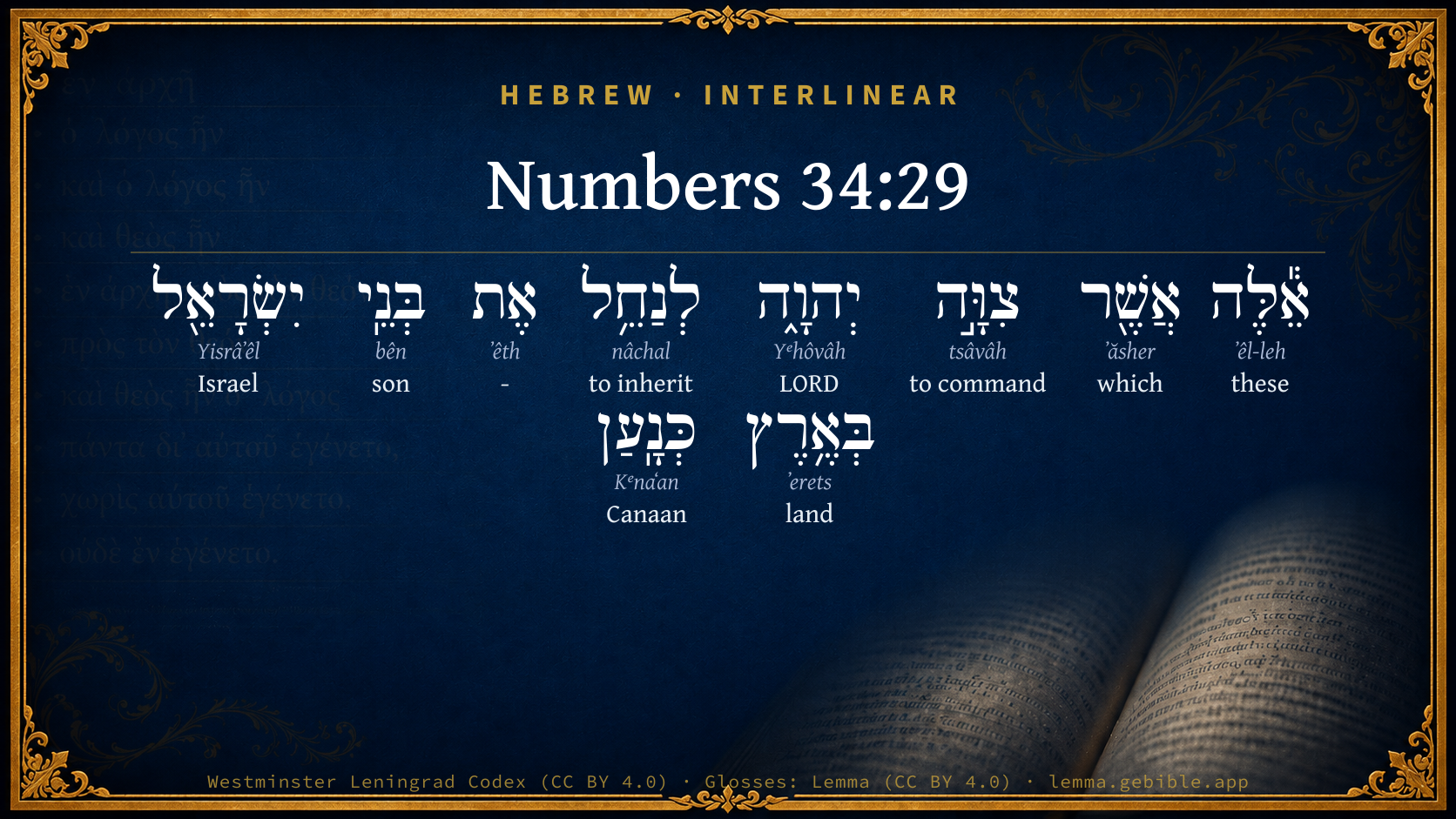
Numbers 34:29

Hebrew (Westminster Leningrad Codex) Numbers 34:29 appears in the Hebrew Old Testament. The text above is from the Westminster Leningrad Codex. Each word links to its Strong’s number, a concise gloss, and parsing drawn from the Open Scriptures Hebrew Bible morphology. Click any word for its full Brown-Driver-Briggs (BDB) entry.
Download image
Cite this verse

Numbers 34:29 (World English Bible). Public Domain. Lemma interlinear Bible study tool, https://lemma.gebible.app/v/numbers/34/29.

Show BibTeX & RIS
BibTeX
RIS
English Translation
These are they whom Yahweh commanded to divide the inheritance to the children of Israel in the land of Canaan.
World English Bible · Public Domain
Download a study sheet

One document with this verse’s original text, its word-by-word gloss line, the meaning frame, cross-references with their text, attributed commentary, and full source and license credits — printable, and it pastes into notes with its structure intact.

This verse Autodidact and up

Study sheet (.html) Plain text (.txt)

A passage Seminary Student

Up to 50 verses in one chapter. A passage sheet keeps up to 6 commentary sources and 12 cross-references per verse, in the order this page ranks them, and says so on the sheet whenever that leaves anything out. Ask for a single verse and you get the Autodidact verse sheet above.

Everything on this page stays free to read, with no account — the sheet is a download of what is already on screen, not access to it.

Want to remove ads? Support Godless Engineer
Compare translations 3

The same verse in 3 English versions, stacked beneath the original-language interlinear above. Click any original word for its lexicon entry.

Each is an independent rendering of the whole verse — the interlinear is not word-aligned to these translations.

Highlighted words mark where these versions differ — a whole-verse word diff, not a word-by-word alignment.

  • World English Bible Public Domain
    These are they whom Yahweh commanded to divide the inheritance to the children of Israel in the land of Canaan.
  • King James Version Public Domain
    These are they whom the LORD commanded to divide the inheritance unto the children of Israel in the land of Canaan.
  • unfoldingWord Literal Text CC BY-SA 4.0
    These are whom Yahweh commanded to divide an inheritance for the sons of Israel in the land of Canaan.

unfoldingWord Literal Text — © unfoldingWord, licensed CC BY-SA 4.0. Word-aligned USFM3 via Door43 (git.door43.org/unfoldingWord/en_ult).

Versions to compare (up to 4)

3 of 4 selected

Show all 18 translations

Every available English version of this verse, each an independent rendering of the whole verse.

  • World English Bible Public Domain
    These are they whom Yahweh commanded to divide the inheritance to the children of Israel in the land of Canaan.
  • Berean Standard Bible Public Domain
    These are the ones whom the LORD commanded to apportion the inheritance to the Israelites in the land of Canaan.
  • Majority Standard Bible Public Domain
    These are the ones whom the LORD commanded to apportion the inheritance to the Israelites in the land of Canaan.
  • King James Version Public Domain
    These are they whom the LORD commanded to divide the inheritance unto the children of Israel in the land of Canaan.
  • American Standard Version (1901) Public Domain
    These are they whom Jehovah commanded to divide the inheritance unto the children of Israel in the land of Canaan.
  • Revised Version (1885) Public Domain
    These are they whom the LORD commanded to divide the inheritance unto the children of Israel in the land of Canaan.
  • Geneva Bible (1599) Public Domain
    These are they, whome the Lord commanded to deuide the inheritance vnto the children of Israel, in the land of Canaan.
  • Douay-Rheims (1899) Public Domain
    These are they whom the Lord hath commanded to divide the land of Chanaan to the children of Israel,.
  • Young's Literal Translation Public Domain
    These `are' those whom Jehovah hath commanded to give the sons of Israel inheritance in the land of Canaan.
  • Literal Standard Version CC BY-SA 4.0
    These [are] those whom YHWH has commanded to give the sons of Israel inheritance in the land of Canaan.
  • Unlocked Literal Bible CC BY-SA 4.0
    Yahweh commanded these men to divide the land of Canaan and to give each of the tribes of Israel their share.
  • unfoldingWord Literal Text CC BY-SA 4.0
    These are whom Yahweh commanded to divide an inheritance for the sons of Israel in the land of Canaan.
  • Darby Bible Public Domain
    These are they whom Jehovah commanded to distribute to the children of Israel their inheritance in the land of Canaan.
  • World Messianic Bible Public Domain
    These are they whom the LORD commanded to divide the inheritance to the children of Israel in the land of Canaan.
  • Webster's Bible Public Domain
    These are they whom the LORD commanded to divide the inheritance to the children of Israel in the land of Canaan.
  • Free Bible Version CC BY-SA 4.0
    These are the names of those the Lord put in charge of allocating land ownership in the country of Canaan.
  • Bible in Basic English Public Domain
    These are they to whom the Lord gave orders to make the distribution of the heritage among the children of Israel in the land of Canaan.
  • JPS Tanakh (1917) Public Domain
    These are they whom the LORD commanded to divide the inheritance unto the children of Israel in the land of Canaan.'

Literal Standard Version (2020), Covenant Press — licensed CC BY-SA 4.0. Text via the HelloAO Bible API (eBible.org). Unlocked Literal Bible (unfoldingWord) — licensed CC BY-SA 4.0. Text via the HelloAO Bible API (eBible.org). unfoldingWord Literal Text — © unfoldingWord, licensed CC BY-SA 4.0. Word-aligned USFM3 via Door43 (git.door43.org/unfoldingWord/en_ult). Free Bible Version, Dr. Jonathan Gallagher — licensed CC BY-SA 4.0. Text via the HelloAO Bible API (eBible.org).

Word by word

More ways to search: Search by grammar → Find every occurrence → Compare this word →

Practice this passage: Drill this verse → Learn its vocabulary →

לְנַחֵ֥ל
nâchal
H5157
“to inherit”
Preposition + Verb, Piel, Infinitive Construct
Part of Speech
Preposition + Verb
Stem
Piel
Form
Infinitive Construct
Full BDB Definition

Origin: a primitive root

TWOT: 1342

to get as a possession, acquire, inherit, possess - (Qal) - to take possession, inherit - to have or get as a possession or property (figuratively) - to divide the land for a possession - to acquire (testimonies) (figuratively) - (Piel) to divide for a possession - (Hithpael) to possess oneself of - (Hiphil) - to give as a possession - to cause to inherit, give as an inheritance - (Hophal) to be allotted, be made to possess
  1. אֵ֕לֶּה ʼêl-leh H428 “these” Pronoun, Demonstrative, Common, Plural
  2. אֲשֶׁ֖ר ʼăsher H834 “which” Particle, Relative
  3. צִוָּ֣ה tsâvâh H6680 “to command” Verb, Piel, Perfect, 3rd Person, Masculine, Singular
  4. יְהוָ֑ה Yᵉhôvâh H3068 “LORD” Noun, Proper
  5. אֶת ʼêth H853 “-” Particle, Direct Object
  6. בְּנֵֽי bên H1121 “sons of” Noun, Common, Masculine, Plural, Construct
  7. יִשְׂרָאֵ֖ל Yisrâʼêl H3478 “Israel” Noun, Proper
  8. בְּאֶ֥רֶץ ʼerets H776 “in/at · land of” Preposition + Noun, Common, Both, Singular, Construct
  9. כְּנָֽעַן Kᵉnaʻan H3667 “Canaan” Noun, Proper

About this verse

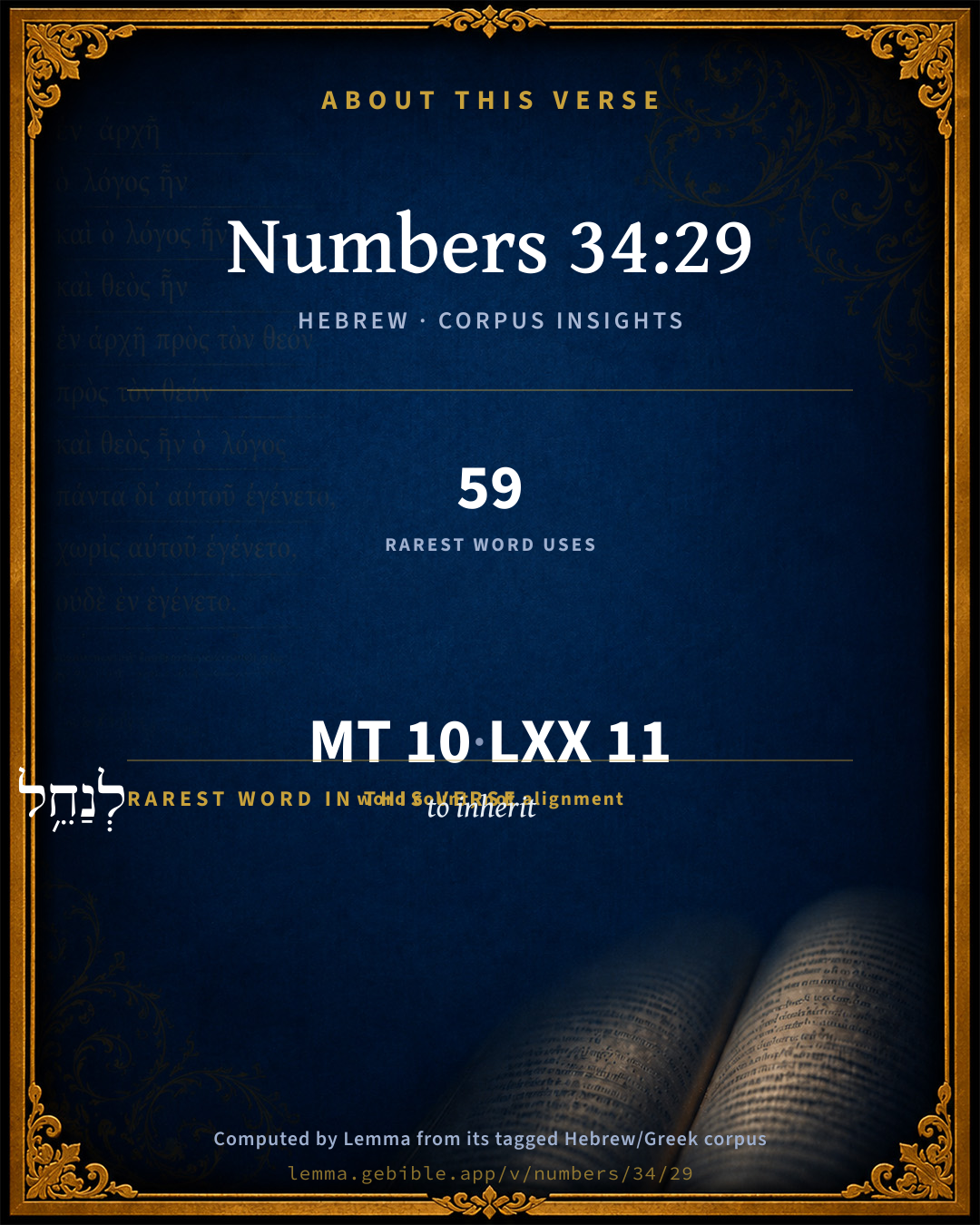
These counts appear in no published source. They are computed here, from the morphology-tagged text and Lemma’s own curated glosses. What Lemma adds →

10
words
10
distinct lemmas
Pentateuch
section

Shared distinctive vocabulary

לְנַחֵ֥ל to inherit H5157 occurs in 57 verses of the Hebrew Bible. Also found in:

Grammatical profile

  • 2 verbs
  • 5 nouns
  • 1 pronoun
  • 2 particles

Verb forms

  • צִוָּ֣ה Piel · Perfect
  • לְנַחֵ֥ל Piel · Infinitive Construct

Hebrew & Septuagint length

In English translation the verse runs 20 words from the Hebrew and 19 from the Septuagint (LXX English) — closely comparable.

A rough comparison of the two English renderings, which tokenize alike — not a word-level alignment.

Word counts can differ between the Hebrew and the Greek without any difference in meaning — e.g. the Hebrew direct-object marker אֵת has no separate Greek word, and Greek often adds the article ὁ.

In the original languages it is 10 Hebrew tokens and 11 Greek tokens — but the two are counted differently (Hebrew bundles its prefixes and suffixes into one token; the Greek is in lemma form), so that isn’t a like-for-like length.

Cross-references

2

Topical passages linked to Numbers 34:29 in the Treasury of Scripture Knowledge — connected by theme and wording, ordered by reader-vote popularity; previews shown in the World English Bible.

  • Numbers 34:18 You shall take one prince of every tribe, to divide the land for inheritance.
  • Joshua 19:51 These are the inheritances, which Eleazar the priest, and Joshua the son of Nun, and the heads of the fathers' [houses] of the tribes of the children of Israel, distributed for inheritance by lot in Shiloh before Yahweh, at the door of the tent of meeting. So they made an end of dividing the land.

Cross-references courtesy of OpenBible.info (CC BY 4.0).

Hebrew and Greek witnesses Masoretic Hebrew ↔ Greek Septuagint

The same verse in the two great witnesses to the Old Testament, shown verse-for-verse.

These are two independent witnesses, not word-aligned to each other, and the Septuagint is shown in lemma (dictionary) form.

Hebrew Numbers 34:29 Masoretic · Westminster Leningrad Codex

אֵ֕לֶּה אֲשֶׁ֖ר צִוָּ֣ה יְהוָ֑ה לְנַחֵ֥ל אֶת בְּנֵֽי יִשְׂרָאֵ֖ל בְּאֶ֥רֶץ כְּנָֽעַן

These are they whom Yahweh commanded to divide the inheritance to the children of Israel in the land of Canaan.

World English Bible · Public Domain

Greek LXX Numbers 34:29 Septuagint · lemma form

οὗτος ὅς ἐντέλλομαι κύριος καταμερίζω ὁ υἱός ἰσραήλ ἐν γῆ χανααν

These did the Lord command to distribute the inheritances to the children of Israel in the land of Chanaan.

LXX2012 (modern English Septuagint) · Public Domain

Hebrew: Westminster Leningrad Codex (CC BY 4.0). Greek: Septuagint (public domain); English from LXX2012 (modern English Septuagint) (Public Domain). How the Septuagint differs from the Hebrew →

Targum (Aramaic paraphrase)

2

The Targum is the ancient Jewish Aramaic paraphrase of the Hebrew Scriptures — an interpretive translation, not the Hebrew text itself. Onkelos (literal) and Pseudo-Jonathan (expansive) render the Torah, and Jonathan the Prophets. Coverage is partial: where no permissively-licensed English translation exists for a verse, only the Aramaic is shown. This is verse-level text, not a word-by-word alignment to the Hebrew.

  1. Targum Onkelos Torah (Genesis–Deuteronomy)
    אִלֵין דִי פַּקִיד יְיָ לְאַחֲסָנָא יָת בְּנֵי יִשְׂרָאֵל בְּאַרְעָא דִכְנָעַן

    (no public-domain English translation for this verse)

    Targum Onkelos — Aramaic: “Onkelos Genesis” (public domain); “Onkelos Exodus” (public domain); “Onkelos Leviticus” (public domain); “Onkelos Numbers” (public domain); “Onkelos Deuteronomy” (public domain). English: “Sefaria Community Translation” (CC0 1.0 (public-domain dedication)); “J.W. Etheridge. The Targums of Onkelos and Jonathan Ben Uzziel on the Pentateuch. London: Longmans, Green, 1862” (public domain). Text via Sefaria.

  2. Targum Pseudo-Jonathan Torah (Genesis–Deuteronomy)
    אִלֵין דְפַקֵיד יְיָ לְאַחְסָנָא יַת בְּנֵי יִשְרָאֵל בְּאַרְעָא דִכְנָעַן

    These are they whom the Lord commanded to divide the inheritance of the land of Kenaan to the children of Israel.

    Targum Pseudo-Jonathan — Aramaic: “Targum Jonathan on Genesis” (public domain); “Targum Jonathan on Exodus” (public domain); “Targum Jonathan on Leviticus” (public domain); “Targum Jonathan on Numbers” (public domain); “Targum Jonathan on Deuteronomy” (public domain). English: “The Targum of Jonathan ben Uzziel, trans. J. W. Etheridge, London, 1862” (public domain). Text via Sefaria.

Commentary

Notes on Numbers 34:29 from classic Christian and Jewish commentators (each source and its license shown beneath its notes). The classic Christian expositions comment on the surrounding passage and are grouped to its opening verse, so a note may address several verses; the Jewish commentaries on the Tanakh (Rashi and others) are per-verse, so they appear only where the commentator wrote on this verse.

Lemma curates 59 commentaries, every one of them public domain or Creative Commons licensed, each selected and text-cleaned for this edition rather than reprinted as found. About our sources →

Geneva Bible (1599)

Geneva Bible translators

And be judges over every piece of ground that should fall to any by lot, to the intent that all things might be done orderly and without contention.

Geneva Bible (1599) marginal notes — public domain. Text via Bolls.life.

Rashi

Rabbi Shlomo Yitzchaki (Rashi)

לנחל את בני ישראל [THESE ARE THEY WHOM THE LORD COMMANDED] TO DIVIDE THE INHERITANCE UNTO THE CHILDREN OF ISRAEL — It means, that they should make you inherit it according to its divisions (according to how it should be divided amongst families and again amongst individuals).

Rashi on the Tanakh — English translations: “The Judaica Press complete Tanach with Rashi, translated by A. J. Rosenberg” (CC BY 4.0); “Pentateuch with Rashi's commentary by M. Rosenbaum and A.M. Silbermann, 1929-1934” (public domain); “The Metsudah Tanach series, Lakewood, N.J” (CC BY 4.0); and “The Book of Joshua, Metsudah Publications, 1997” (CC BY 4.0). Text via Sefaria.

Lesson kit

Teaching starters — assembled from the data on this page, not authored interpretation. Every prompt links to the verse data it draws on. Edit before teaching.

Numbers, in the Pentateuch, opens this verse with 10 words (10 distinct Hebrew lemmas). Its most distinctive word is nâchal (“to inherit”). A historical commentator’s framing appears above. Read the whole chapter for the surrounding context.

Discussion questions

  1. How does “to inherit” (nâchal) shape what this verse is saying?
  2. Exodus 23:30 shares the word «to inherit» with this verse. How do the two illuminate each other?
  3. These translations render this verse differently; the difference is in the English rendering, not the original. What questions does that raise?
  4. The verb «צִוָּ֣ה» is Piel Perfect. How does its form color the action?
  5. Reading how Geneva Bible (1599) and Rashi read this verse, where do the two commentators agree and where do they part?

Things to notice

Reading settings

Reading text

Shown beneath each verse's original-language words.

Old Testament
Old Testament edition

Read the OT as the Masoretic Hebrew (MT) or the Greek Septuagint (LXX).

English shown for the Greek Septuagint (in the Hebrew ↔ Greek comparison).

Comparing translations? Open the Compare panel on any verse page to stack up to four side by side.