Jeremiah 18:13

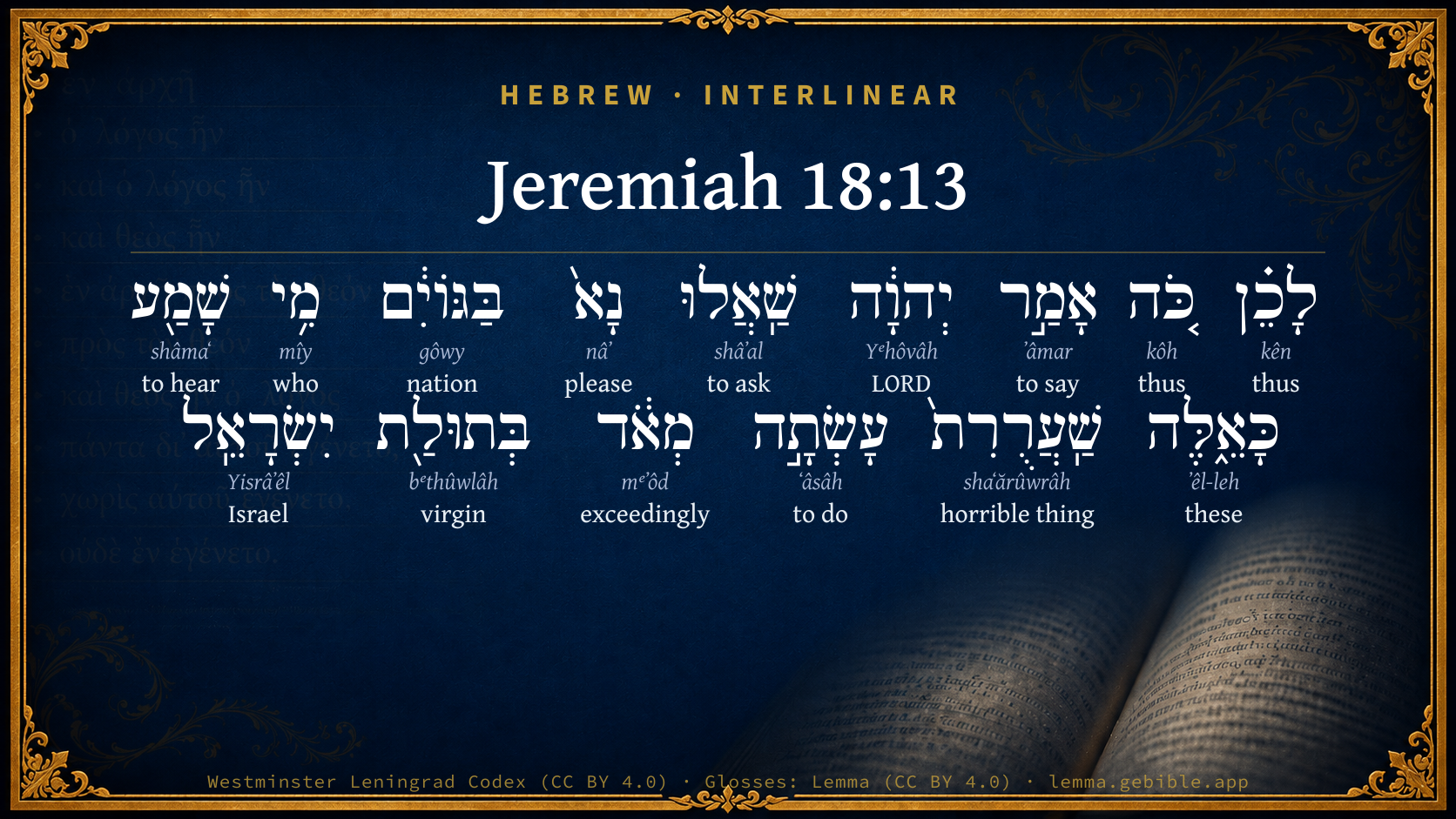
Hebrew (Westminster Leningrad Codex) Jeremiah 18:13 appears in the Hebrew Old Testament. The text above is from the Westminster Leningrad Codex. Each word links to its Strong’s number, a concise gloss, and parsing drawn from the Open Scriptures Hebrew Bible morphology. Click any word for its full Brown-Driver-Briggs (BDB) entry.
Download image
Cite this verse

Jeremiah 18:13 (World English Bible). Public Domain. Lemma interlinear Bible study tool, https://lemma.gebible.app/v/jeremiah/18/13.

Show BibTeX & RIS
BibTeX
RIS
English Translation
Therefore thus says Yahweh: Ask you now among the nations, who has heard such things; the virgin of Israel has done a very horrible thing.
World English Bible · Public Domain
Download a study sheet

One document with this verse’s original text, its word-by-word gloss line, the meaning frame, cross-references with their text, attributed commentary, and full source and license credits — printable, and it pastes into notes with its structure intact.

This verse Autodidact and up

Study sheet (.html) Plain text (.txt)

A passage Seminary Student

Up to 50 verses in one chapter. A passage sheet keeps up to 6 commentary sources and 12 cross-references per verse, in the order this page ranks them, and says so on the sheet whenever that leaves anything out. Ask for a single verse and you get the Autodidact verse sheet above.

Everything on this page stays free to read, with no account — the sheet is a download of what is already on screen, not access to it.

Want to remove ads? Support Godless Engineer
Compare translations 3

The same verse in 3 English versions, stacked beneath the original-language interlinear above. Click any original word for its lexicon entry.

Each is an independent rendering of the whole verse — the interlinear is not word-aligned to these translations.

Highlighted words mark where these versions differ — a whole-verse word diff, not a word-by-word alignment.

  • World English Bible Public Domain
    Therefore thus says Yahweh: Ask you now among the nations, who has heard such things; the virgin of Israel has done a very horrible thing.
  • King James Version Public Domain
    Therefore thus saith the LORD; Ask ye now among the heathen, who hath heard such things: the virgin of Israel hath done a very horrible thing.
  • unfoldingWord Literal Text CC BY-SA 4.0
    Therefore, thus says Yahweh: “Please ask among the nations, who has heard like these? The virgin of Israel has done a very horrible thing.

unfoldingWord Literal Text — © unfoldingWord, licensed CC BY-SA 4.0. Word-aligned USFM3 via Door43 (git.door43.org/unfoldingWord/en_ult).

Versions to compare (up to 4)

3 of 4 selected

Show all 18 translations

Every available English version of this verse, each an independent rendering of the whole verse.

  • World English Bible Public Domain
    Therefore thus says Yahweh: Ask you now among the nations, who has heard such things; the virgin of Israel has done a very horrible thing.
  • Berean Standard Bible Public Domain
    Therefore this is what the LORD says: “Inquire among the nations: Who has ever heard things like these? Virgin Israel has done a most terrible thing.
  • Majority Standard Bible Public Domain
    Therefore this is what the LORD says: “Inquire among the nations: Who has ever heard things like these? Virgin Israel has done a most terrible thing.
  • King James Version Public Domain
    Therefore thus saith the LORD; Ask ye now among the heathen, who hath heard such things: the virgin of Israel hath done a very horrible thing.
  • American Standard Version (1901) Public Domain
    Therefore thus saith Jehovah: Ask ye now among the nations, who hath heard such things; the virgin of Israel hath done a very horrible thing.
  • Revised Version (1885) Public Domain
    Therefore thus saith the LORD: Ask ye now among the nations, who hath heard such things; the virgin of Israel hath done a very horrible thing.
  • Geneva Bible (1599) Public Domain
    Therefore thus saith the Lord, Aske now among the heathen, who hath heard such thinges? the virgin of Israel hath done very filthily.
  • Douay-Rheims (1899) Public Domain
    Therefore thus saith the Lord: Ask among the nations: Who hath heard such horrible things, as the virgin of Israel hath done to excess?
  • Young's Literal Translation Public Domain
    Therefore, thus said Jehovah: Ask, I pray you, among the nations, Who hath heard like these? A very horrible thing hath the virgin of Israel done.
  • Literal Standard Version CC BY-SA 4.0
    Therefore, thus said YHWH: “Now ask among the nations, || Who has heard such things? The virgin of Israel has done a very horrible thing.
  • Unlocked Literal Bible CC BY-SA 4.0
    Therefore Yahweh says this, 'Ask the nations, who has ever heard of such a thing as this? The virgin Israel has committed a horrible act.
  • unfoldingWord Literal Text CC BY-SA 4.0
    Therefore, thus says Yahweh: “Please ask among the nations, who has heard like these? The virgin of Israel has done a very horrible thing.
  • Darby Bible Public Domain
    Therefore thus saith Jehovah: Ask ye now among the nations, Who hath heard such things? The virgin of Israel hath done a very horrible thing.
  • World Messianic Bible Public Domain
    Therefore the LORD says: “Ask now among the nations, ‘Who has heard such things?’ The virgin of Israel has done a very horrible thing.
  • Webster's Bible Public Domain
    Therefore thus saith the LORD; Ask ye now among the heathen, who hath heard such things: the virgin of Israel hath done a very horrible thing.
  • Free Bible Version CC BY-SA 4.0
    Consequently this is what the Lord says: Ask around the nations—has anybody ever heard anything like this? Virgin Israel has acted really badly.
  • Bible in Basic English Public Domain
    So this is what the Lord has said: Make search among the nations and see who has had word of such things; the virgin of Israel has done a very shocking thing.
  • JPS Tanakh (1917) Public Domain
    Therefore thus saith the LORD: Ask ye now among the nations, who hath heard such things; the virgin of Israel hath done a very horrible thing.

Literal Standard Version (2020), Covenant Press — licensed CC BY-SA 4.0. Text via the HelloAO Bible API (eBible.org). Unlocked Literal Bible (unfoldingWord) — licensed CC BY-SA 4.0. Text via the HelloAO Bible API (eBible.org). unfoldingWord Literal Text — © unfoldingWord, licensed CC BY-SA 4.0. Word-aligned USFM3 via Door43 (git.door43.org/unfoldingWord/en_ult). Free Bible Version, Dr. Jonathan Gallagher — licensed CC BY-SA 4.0. Text via the HelloAO Bible API (eBible.org).

Word by word

More ways to search: Search by grammar → Find every occurrence → Compare this word →

Practice this passage: Drill this verse → Learn its vocabulary →

שַֽׁעֲרֻרִת֙
shaʻărûwrâh
H8186
“horrible thing”
Noun, Common, Feminine, Singular, Absolute
Part of Speech
Noun
Type
Common
Gender
Feminine
Number
Singular
State
Absolute
Full BDB Definition

Origin: from H8176 in the sense of H8175

TWOT: 2439b

horrible thing
  1. לָכֵ֗ן kên H3651 “to/for · thus” Preposition + Adverb
  2. כֹּ֚ה kôh H3541 “thus” Adverb
  3. אָמַ֣ר ʼâmar H559 “to say” Verb, Qal, Perfect, 3rd Person, Masculine, Singular
  4. יְהוָ֔ה Yᵉhôvâh H3068 “LORD” Noun, Proper
  5. שַֽׁאֲלוּ shâʼal H7592 “ask” Verb, Qal, Imperative, 2nd Person, Masculine, Plural
  6. נָא֙ nâʼ H4994 “please” Particle, Exhortation
  7. בַּגּוֹיִ֔ם gôwy H1471 “in/at the · nations” Preposition, Determined + Noun, Common, Masculine, Plural, Absolute
  8. מִ֥י mîy H4310 “who” Particle, Interrogative
  9. שָׁמַ֖ע shâmaʻ H8085 “to hear” Verb, Qal, Perfect, 3rd Person, Masculine, Singular
  10. כָּאֵ֑לֶּה ʼêl-leh H428 “like/as · these” Preposition + Pronoun, Demonstrative, Common, Plural
  11. עָשְׂתָ֣ה ʻâsâh H6213 “to do” Verb, Qal, Perfect, 3rd Person, Feminine, Singular
  12. מְאֹ֔ד mᵉʼôd H3966 “exceedingly” Adverb
  13. בְּתוּלַ֖ת bᵉthûwlâh H1330 “virgin of” Noun, Common, Feminine, Singular, Construct
  14. יִשְׂרָאֵֽל Yisrâʼêl H3478 “Israel” Noun, Proper

About this verse

These counts appear in no published source. They are computed here, from the morphology-tagged text and Lemma’s own curated glosses. What Lemma adds →

15
words
15
distinct lemmas
Prophets
section

Notable vocabulary

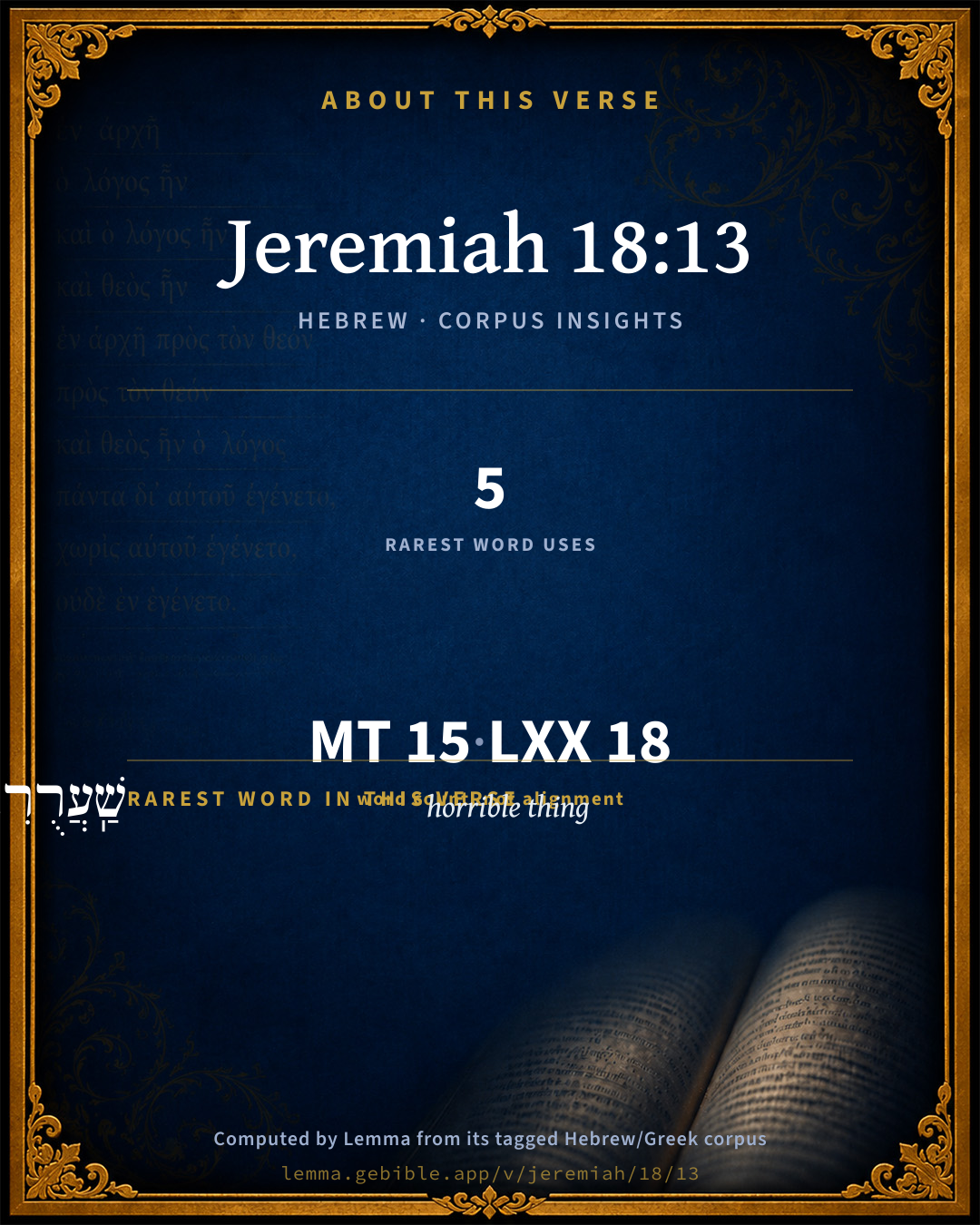
The rarest word here is שַֽׁעֲרֻרִת֙ horrible thing H8186 — appearing just 5 times in the whole Hebrew Bible.

Shared distinctive vocabulary

שַֽׁעֲרֻרִת֙ horrible thing H8186 occurs in 4 verses of the Hebrew Bible. Also found in:

Grammatical profile

  • 4 verbs
  • 5 nouns
  • 1 pronoun
  • 3 adverbs
  • 2 particles

Verb forms

  • אָמַ֣ר Qal · Perfect
  • שַֽׁאֲלוּ Qal · Imperative
  • שָׁמַ֖ע Qal · Perfect
  • עָשְׂתָ֣ה Qal · Perfect

Hebrew & Septuagint length

In the original languages it is 15 Hebrew tokens and 18 Greek tokens — but the two are counted differently (Hebrew bundles its prefixes and suffixes into one token; the Greek is in lemma form), so that isn’t a like-for-like length.

Cross-references

11

Topical passages linked to Jeremiah 18:13 in the Treasury of Scripture Knowledge — connected by theme and wording, ordered by reader-vote popularity; previews shown in the World English Bible.

  • Jeremiah 5:30 A wonderful and horrible thing is happen in the land:
  • Isaiah 66:8 Who has heard such a thing? who has seen such things? Shall a land be born in one day? shall a nation be brought forth at once? for as soon as Zion travailed, she brought forth her children.
  • Jeremiah 2:10–13 For pass over to the isles of Kittim, and see; and send to Kedar, and consider diligently; and see if there has been such a thing.
  • Jeremiah 23:14 In the prophets of Jerusalem also I have seen a horrible thing: they commit adultery, and walk in lies; and they strengthen the hands of evil-doers, so that none does return from his wickedness: they are all of them become to me as Sodom, and the inhabitants of it as Gomorrah.
  • Hosea 6:10 In the house of Israel I have seen a horrible thing. There is prostitution in Ephraim. Israel is defiled.
  • Jeremiah 14:17 You shall say this word to them, Let my eyes run down with tears night and day, and let them not cease; for the virgin daughter of my people is broken with a great breach, with a very grievous wound.
  • Jeremiah 31:4 Again will I build you, and you shall be built, O virgin of Israel: again shall you be adorned with your tambourines, and shall go forth in the dances of those who make merry.
  • 1 Samuel 4:7 The Philistines were afraid, for they said, God is come into the camp. They said, Woe to us! for there has not been such a thing heretofore.
  • Isaiah 36:22 Then came Eliakim the son of Hilkiah, who was over the household, and Shebna the scribe, and Joah, the son of Asaph, the recorder, to Hezekiah with their clothes torn, and told him the words of Rabshakeh.
  • Lamentations 1:15 The Lord has set at nothing all my mighty men in the midst of me; He has called a solemn assembly against me to crush my young men: The Lord has trodden as in a winepress the virgin daughter of Judah.
  • 1 Corinthians 5:1 It is actually reported that there is sexual immorality among you, and such sexual immorality as is not even named among the Gentiles, that one has his father's wife.

Cross-references courtesy of OpenBible.info (CC BY 4.0).

Hebrew and Greek witnesses Masoretic Hebrew ↔ Greek Septuagint

The same verse in the two great witnesses to the Old Testament, shown verse-for-verse.

These are two independent witnesses, not word-aligned to each other, and the Septuagint is shown in lemma (dictionary) form.

Hebrew Jeremiah 18:13 Masoretic · Westminster Leningrad Codex

לָכֵ֗ן כֹּ֚ה אָמַ֣ר יְהוָ֔ה שַֽׁאֲלוּ נָא֙ בַּגּוֹיִ֔ם מִ֥י שָׁמַ֖ע כָּאֵ֑לֶּה שַֽׁעֲרֻרִת֙ עָשְׂתָ֣ה מְאֹ֔ד בְּתוּלַ֖ת יִשְׂרָאֵֽל

Therefore thus says Yahweh: Ask you now among the nations, who has heard such things; the virgin of Israel has done a very horrible thing.

World English Bible · Public Domain

Greek LXX Structure differs

In the Septuagint, Jeremiah is about an eighth shorter than the Hebrew and arranges its material differently — the Oracles Against the Nations (Hebrew chapters 46–51) appear in the middle of the Greek book, after 25:13. Because the chapter and verse boundaries do not line up, a verse-for-verse comparison with the Hebrew is not shown.

A verse-for-verse comparison isn’t shown here because the chapters and verses don’t line up. Switch to the LXX edition with the MT / LXX toggle above to read the Greek directly.

On this verse, Joseph Benson's Commentary discusses the Septuagint’s reading. Read the note in Commentary ↓

Hebrew: Westminster Leningrad Codex (CC BY 4.0). Greek: Septuagint (public domain); English from a public-domain English Septuagint. How the Septuagint differs from the Hebrew →

Targum (Aramaic paraphrase)

1

The Targum is the ancient Jewish Aramaic paraphrase of the Hebrew Scriptures — an interpretive translation, not the Hebrew text itself. Onkelos (literal) and Pseudo-Jonathan (expansive) render the Torah, and Jonathan the Prophets. Coverage is partial: where no permissively-licensed English translation exists for a verse, only the Aramaic is shown. This is verse-level text, not a word-by-word alignment to the Hebrew.

  1. Targum Jonathan Prophets (Joshua–Malachi)
    בְּכֵן כִּדְנַן אֲמַר יְיָ שְׁאִילוּ כְּעַן בְּעַמְמַיָא מַן שְׁמַע כְּאִלֵין שְׁנוּי עֲבָדַת לַחֲדָא כְּנִשְׁתָּא דְיִשְׂרָאֵל:

    (no public-domain English translation for this verse)

    Targum Jonathan — Aramaic: “Mikraot Gedolot” (public domain). English: “Sefaria Community Translation” (CC0 1.0 (public-domain dedication)); “London "Chaldee Paraphrase," 1871” (public domain). Text via Sefaria.

Commentary

Notes on Jeremiah 18:13 from classic Christian and Jewish commentators (each source and its license shown beneath its notes). The classic Christian expositions comment on the surrounding passage and are grouped to its opening verse, so a note may address several verses; the Jewish commentaries on the Tanakh (Rashi and others) are per-verse, so they appear only where the commentator wrote on this verse.

Lemma curates 59 commentaries, every one of them public domain or Creative Commons licensed, each selected and text-cleaned for this edition rather than reprinted as found. About our sources →

Trapp's Complete Commentary

John Trapp

Jer 18:13 Therefore thus saith the LORD; Ask ye now among the heathen, who hath heard such things: the virgin of Israel hath done a very horrible thing.

Ver. 13. Therefore thus saith the Lord.] God himself seemeth here to wonder at the desperate obstinace of this people, as not to be matched again. Like as our Saviour marvelled at the unbelief of the Nazarites, and could do for them no mighty work. {Mar 6:5-6} {See Trapp on "Mar 6:5"} {See Trapp on "Mar 6:6"}

The virgin of Israel hath done a very horrible thing.] A "virgin" she is called, either by an irony, or else because she should have been a pure virgin, sincere in God’s service, but was nothing less. What this horrible thing was, see Jer 18:15 cf. Jer 2:13; Jer 2:32.

John Trapp, A Commentary or Exposition upon All the Books of the Old and New Testament (1647–1656) — public domain. Text from a community e-Sword module.

Joseph Benson's Commentary

Jer 18:13-14. Ask ye now among the heathen — Such an apostacy as you are guilty of (see Jer 18:15) is not to be paralleled among the heathen. Compare Jer 2:10. Who hath heard such things — When did people ever behave toward their idols, which yet were no gods, as my people have behaved toward me? The virgin of Israel — That people who were dedicated to me as a chaste virgin, have since corrupted themselves, and gone a whoring after idols. Will a man leave the snow of Lebanon, &c. — “The two similitudes in this verse are evidently designed to illustrate the unnatural and absurd conduct of the Jewish nation in deserting their own God, and adopting the superstitions of a strange idolatry, in preference to the good old paths which God had ordained for them to walk in. As to the first, Lebanon, it must be observed, was the highest mountain in Israel, lying to the north of it, and having its summit almost always covered with snow; from the whiteness of which it is supposed to have derived its name.” See Ancient Univ. Hist. vol. 1. book 1. p. 570, fol. The same circumstance is also recorded by Tacitus, Hist. lib. 5. c. 6. “Præcipuum montium Libanum erigit, mirum dictu, tantos inter ardores opacum fidumque nivibus.” If we follow the translation in our text, the sense is, It is as strange and unreasonable for men to forsake the true God for idols, as it would be for a thirsty traveller to forego the cold refreshing streams that come in his way, flowing from the melting snows of Lebanon, or the clear waters issuing from a pure spring, in order that he might drink of the stagnant waters of some muddy pool. But, it is to be observed, the words a man, and which cometh, are not in the Hebrew, but supplied by our translators, and considerably alter the sense, which literally is, Will the snow of Lebanon cease from the rock of the field? That is, Will it cease to flow, &c. And by the rock of the field, may be meant the rocks on the level ground on the very top of Lebanon; from which the snow, being melted, flowed down into the vales at the bottom of the mountain. Or, shall the cold overflowing waters, running down, fail? The Vulgate translates the verse to exactly the same sense, “Nunquid deficiet de petra agri nix Libani; aut evelli possunt aquæ erumpentes frigidæ, et defluentes?” And the LXX. to nearly that sense, Μη εκλειψουσιν απο πετρας μασοι, η χιων απο του Λιβανου; μη εκκλινη υδωρ βιαιως ανεμω φερομενον; Shall the breasts (that is, the springs) fail from the rock, or snow from Lebanon? Shall water, borne along violently by the wind, turn aside? The sense of the verse seems to be, that the Jews ought no more to have failed in their adherence to the true God, and his service, than the snow on mount Lebanon, or the waters which flow from that mountain into the fields under it, ever fail; in other words, That, as the works of nature preserve their order, and fail not of answering the ends for which they were appointed; so the Jews ought not to have failed of performing their duty to, and showing forth the praises of, Him who chose them to be his peculiar people, and conferred singular privileges upon them in order to these very ends.

Joseph Benson's Commentary on the Old and New Testaments (1811–1818) — public domain. Text from a community e-Sword module.

Tyndale Open Study Notes

Tyndale Open Resources

18:13-17 The Lord answered that he would scatter his people who had deserted him.

18:13 Has anyone ever heard of such a thing? In other nations, people did not turn their backs on their national deities (2:11-13), but Israel blatantly mocked the one true God.

Tyndale Open Study Notes — © Tyndale Open Resources, licensed CC BY-SA 4.0. Text via the HelloAO Bible API.

Jamieson, Fausset & Brown

Robert Jamieson, A. R. Fausset & David Brown

(Jer 2:10-11). Even among the heathen it was a thing unheard of, that a nation should lay aside its gods for foreign gods, though their gods are false gods. But Israel forsook the true God for foreign false gods.

virgin of Israel-- (Kg2 19:21). It enhances their guilt, that Israel was the virgin whom God had specially betrothed to Him.

horrible thing-- (Jer 5:30).

Jamieson, Fausset & Brown — Commentary Critical and Explanatory on the Whole Bible (1871) — public domain (CC PDM 1.0). Text via the HelloAO Bible API.

Adam Clarke's Commentary

Verse 13. The virgin of Israel] Instead of ישראל Yisrael, three of Kennicott's and De Rossi's MSS., with the Alexandrian copy of the Septuagint, have ירושלם Yerushalem, Jerusalem.

Adam Clarke's Commentary on the Bible (1810–1826) — public domain. Text from a community e-Sword/MySword module.

John Calvin's Commentaries

God shews here that the Jews were become wholly irreclaimable, for they arrived at the highest pitch of impiety, when they were so daring as to reject the salvation offered to them; for what had the Prophet in view but, to extricate them from ruin? God himself by his Prophet wished to secure their safety. How great then was their ingratitude to reject God’s paternal care, and not to give ear to the Prophet who was to be a minister of salvation to them? Now as they were extremely deaf and stupid: God turns to the Gentiles.

Enquire, or ask, he says, among the Gentiles, Has any one heard such a thing? as though he had said, “I will no more contend with those brute animals, for there is no reason in them; but the Gentiles, destitute of the light of knowledge, can be made witnesses of so gross an impiety.” And he says the same thing in Jeremiah 2:10,

“Go, pass through the isles and survey the whole world, has any nation forsaken its own gods, and yet they are no gods?”

As though he had said, “Religion so much prevails among wretched idolaters, that they continue steadfast in their superstitions; as they consider it a dreadful thing to change their god, they therefore shun it as a monstrous thing. Hence it is, that they are devoted to their superstitions, for the god whom they have once received, they think it the highest impiety to forsake, while yet they are no gods; but my people have forsaken me, who am the fountain of living water.” Jeremiah repeats now the same thing in other words, that such an example could not be found among heathens.

He then adds, A base thing has the virgin of Israel done. Some indeed render שעררת, shorret, “a monstrous thing,” and it may be thus taken metaphorically, for the verb שער shor, means to count, to think; and this meaning may be adopted here; but as in many places it signifies baseness, I will not depart from that common meaning. He says then, that it was an extremely base thing for the people to forsake him. He does not call the people the virgin of Israel by way of honor, but to augment their reproach. For God, as we have before seen, had espoused the people to himself; and so it was their duty to observe conjugal fidelity, as a virgin espoused by a husband, who ought not to regard any other, for she is not to look for any other after she has pledged her faith. But the people of Israel, who ought to have been as it were the bride of God, sinned most basely, yea, most disgracefully and infamously, when they prostituted themselves to wicked counsels as well as to superstitions. He now adds comparisons, by whichlte more fully exposes their wickedness, —

John Calvin's Commentaries (1540-1563) — public domain. Text from the Calvin Translation Society English edition (1840s-50s) via the Christian Classics Ethereal Library (ccel.org). Calvin's coverage is partial (roughly two-thirds of the Bible); uncommented books and verses are honest gaps, never fabricated. The 19th-century editor's footnotes and remarks are omitted so the notes are faithfully Calvin's own voice.

Ellicott's Commentary for English Readers

(13) Ask ye now among the heathen.—The appeal of Jer_2:10-11 is renewed. Judah had not been true, even as heathen nations were true, to its inherited faith and worship. The virgin daughter of Israel (Isa_1:8; Jer_14:17)—the epithet is emphasised, as contrasted with the shame that follows—had fallen from a greater height to a profounder depth of debasement.

A Bible Commentary for English Readers, edited by Charles John Ellicott (1878–1897) — public domain. Text from a community e-Sword module.

The Cambridge Bible for Schools and Colleges

gen. ed. J. J. S. Perowne

13. Ask ye now among the nations] Cp. ch. Jer_2:10 f., Jer_5:30.

the virgin of Israel] The people collectively (see on Jer_4:11), tended with the utmost care by the Almighty, have in spite of it all broken through the sanctity which hedged them around. Cp. Jer_14:17 for the collective use of the expression.

The Cambridge Bible for Schools and Colleges (gen. ed. J. J. S. Perowne; Cambridge University Press, 1878–1918) — public domain. Text from a community e-Sword module.

John Gill's Exposition

Because my people hath forgotten me,.... Or, "that they have forgotten me" (z); this is the horrible thing they have done, which was unheard of among the Gentiles, who were always tenacious of their gods, and the worship of them; and that foolish and unwise thing, which was like leaving pure flowing streams of water for dirty puddles. This is to be understood of their forsaking the worship of God, as the Targum interprets it, and following after idols:

they have burnt incense to vanity; to idols, which are vain empty things, and which cannot give their worshippers what they expect from them: or, "in vain they burn incense" (a); even to the true God, while they also sacrificed unto idols; which to do was an abomination to the Lord, Isa 1:13; and especially burning incense to idols must be a vain thing; and so the Targum,

"to no profit a they burn incense or spices:''

and they have caused them to stumble in their ways; that is, either the idols they worshipped, or the false prophets caused the professing people of the Jews to stumble and fall in the ways into which they led them: and

from the ancient paths; or, "the paths of eternity" (b); which lead to eternal life; or which were of old marked out by the revealed will of God for the saints to walk in; and in which the patriarchs and people of God, in all former ages, did walk; and which were appointed from everlasting, and will remain for ever; and these are the good old paths in Jer 6:16;

to walk in paths, in a way not cast up; a new way, unknown in former times; an unbeaten track, which the saints had never walked in; a rough path, unsafe and dangerous; and hence they stumbled, and fell, and came to ruin; as follows:

(z) "quod obliti sunt", Schmidt. (a) "frustra adolebunt, vel adolent", Pagninus, Calvin. (b) "semitae quae a seculo, seu antiquo", vid. Schmidt; so Targum; "semitis jam olim praescriptis", Piscator.

John Gill's Exposition of the Whole Bible (1746–1763) — public domain (CC PDM 1.0). Text via the HelloAO Bible API.

Albert Barnes' Notes on the Bible

The contrast between the chaste retirement of a virgin and Judah’s eagerness after idolatry, serves to heighten the horror at her conduct.

Albert Barnes' Notes on the Bible (1834–1885) — public domain. Text from a community e-Sword/MySword module.

Haydock's Catholic Bible Commentary

Virgin. The disorders of Israel are thus enhanced. (Calmet)

George Leo Haydock (1774–1849), Haydock's Catholic Family Bible and Commentary, 1859 edition — public domain. Excludes Psalms (Douay-Rheims chapter numbering differs from Protestant) and Deuterocanonical books (Catholic canon only).

Matthew Poole's English Annotations

God was moved at this desperate obstinacy and hardness of this people’s hearts, he appeals to the world whether ever any heathens behaved themselves so towards their idols, which were no gods, as this people had, behaved themselves towards him. He calls Israel a

virgin; it is a term given to Zidon, Isa 23:12, and to Babylon, Isa 47:1. The horrible thing which they had done was their forsaking God, their God, a thing not usual amongst the heathens, as God tells them, Jer 2:11.

Matthew Poole's English Annotations on the Holy Bible (1683–1685) — public domain. Text from a community e-Sword/MySword module.

Whedon's Commentary on the Bible

Daniel D. Whedon

13. Heathen — Literally, nations. The word is steadily used as standing over against Israel. Hence the version is good.

Virgin of Israel — See on Isa_1:8; Jer_14:17.

Daniel D. Whedon (gen. ed.), Commentary on the Old and New Testaments (1874–1909) — public domain. Text from a community e-Sword module.

The Pulpit Commentary

Will a man leave the anew of Lebanon, etc.? This passage is unusually obscure. Literally we must, it would seem, render, Doth the snow of Lebanon fail from the rock of the field (or possibly, cease to flow from the rock unto the field)? This is explained as pointing a contrast to the infidelity of God"s people. "The snow never leaves the summit of Lebanon; the waters which take their rise therein never dry up; but my people have forgotten the law of their being, the source of their prosperity." The rendering of the first clause is, however, grammatically dubious (there is no example of this construction of azabh), and all the old versions point to (or at least favor) a reading, Shaddai (the Almighty) instead of sadai (the field). If we keep the text, we must explain "the rock of the field" on the analogy of "my mountain in the field", (Jer_17:3) as meaning "the rock which commands a wide prospect over the open lowland country," i.e. Mount Lebanon. The cold flowing waters; i.e. the numerous "streams from Lebanon," referred to in Son_4:15. That come from another place; i.e. whoso sources are foreign. But as this does not suit the connection, it is better to take the Hebrew word (zarim), usually rendered "foreign," in the sense of "pressing or hurrying along," with Ewald, Graf, and virtually Henderson. It thus becomes descriptive of these streams "as contracted within narrow channels while descending through the gorges and defiles of the rocks." comp. "like an oppressing stream," Isa_59:19 (a cognate verb). Be forsaken. The Hebrew text has "be plucked up" (i.e. destroyed?); but as this is unsuitable, we must transpose two letters (as in not a few other cases), and render, dry up. So Gesenius, Graf, Keil, Delitzsch, and Payne Smith.

Mountain snow.

Any one who has found himself in the valley of Chamounix on a sultry summer afternoon must have felt the striking contrast between the eternal winter of the vast snow-fields of Mont Blanc, spread out in blazing sunlight high above his head, and the dust and heat of the parched land around. The permanence of this mountain snow is suggestive of spiritual lessons.

I MOUNTAIN SNOW IS AN EMBLEM OF SPIRITUAL LIFE MAINTAINED IN THE MIDST OF WORLDLY SCENES. Mountain snow is found in the hottest countries. You need not travel to arctic regions for perpetual snow, it may be found in the tropics. Christians need not be transported to heaven in order to live a pure Divine life. The duty of the Christian is to preserve this fresh and holy in the midst of the world, not to flee from the world. By remaining in the world the Christian is a means of blessing it as the mountain snow descending in glaciers and streams refreshes and fertilizes the valley. But the Christian"s mission to the world is dependent on the preservation of his unworldly spirituality, as the refreshing streams that flow down the gorges of the mountain are dependent on the snows high above them. If the snow fails the stream is dried up. If the spirituality fails the Christian work becomes barren.

II MOUNTAIN SNOW IS AN EMBLEM OF SPIRITUAL LIFE MAINTAINED IN THE MOST TRYING TIMES. The remarkable fact about the mountain snow is that it is perpetual. It is nothing that there is snow on the hills in winter; are not the plains then equally snow-clad? The Christian who only remains faithful under favorable circumstances is but superficially religious. The difficulty is to be true when all things are adverse, in the heat and burden of work, under the fierce onslaught of temptation, while the spirit of the age is against us, when Christianity is out of fashion, out of season. Yet we are to be instant out of season as well as in season, (2Ti_4:2) to be independent of the weather, of the social atmosphere, in the changeless purity of a spiritual life.

III THE CAUSES OF THE PERSISTENCE OF MOUNTAIN SNOW ARE SUGGESTIVE OF THE CAUSES OF THE PRESERVATION OF THE FRESHNESS AND PURITY OF THE SPIRITUAL LIFE. How is it that we find snow in the tropics, snow in summer?

1. Great elevation. A few thousand feet in height will produce climatic changes equal to those caused by a distance of many degrees of latitude. The Christian must find his fidelity preserved by elevation of life. He must live on high, a risen life, with affections above the earth, with a treasure in heaven, and his heart there also. By constant communion with heaven constant purity on earth may be maintained, as the silent solitudes of snow remain through the summer in the cool regions of their great elevation.

2. Constantly renewed supplies. The snows melt under the sun and send roaring torrents down the hillsides, and in course of time they would disappear unless they were renewed. But clouds gather round the mountain summits and descend in fresh snows, and winter on its return makes up for the partial loss of snow in summer. So the Christian must maintain his spiritual life, not only by the elevation of his own thoughts, but by receiving repeated supplies of heavenly grace. He may be thankful that he is favored by "times of refreshing" when the fierce heat of trial is abated, and strength is accumulated for the time of need.

The Pulpit Commentary (1880–1919), ed. H.D.M. Spence-Jones & Joseph S. Exell — public domain. Text from a community e-Sword module.

unfoldingWord translationNotes

Door43 World Missions Community

Ask the nations, who has ever heard of such a thing as this?

Here the word "nations" represents the people in the nations. Yahweh asks this question to scold the people of Judah. AT: "Ask the nations if any of them have ever heard of such a thing as this." or "Nowhere on earth has anyone ever heard of such a thing like this." (See: Rhetorical Question)

The virgin Israel has committed a horrible act

It was common to refer to nations as if they were women. Yahweh speaks of Israel being pure and faithful towards him as if she were a virgin and of Israel being unfaithful to him as if she had "committed a horrible act." AT: "Israel, who is like a virgin, has done something horrible" (See: Personification and Metaphor)

Does the snow in Lebanon ever leave the rocky hills on its sides?

Yahweh asks this rhetorical question to emphasize that the snow on the mountains never melts. AT: "The snow in Lebanon never leaves the rocky hills on its sides." (See: Rhetorical Question)

the rocky hills on its sides

"the sides of the rocky hills"

Are the mountain streams coming from far away ever destroyed, those cold streams?

Yahweh asks this rhetorical question to emphasize that the mountain streams never cease to flow. He speaks of the streams drying up as if they were destroyed. AT: "Those cold mountain streams that come from far away never cease to flow." (See: Rhetorical Question and Metaphor)

translationWords

Yahweh

nation

virgin

Israel

snow

Lebanon

unfoldingWord translationNotes — © Distant Shores Media and the Door43 World Missions Community, licensed CC BY-SA 4.0. Source: git.door43.org/Door43/en_tn.

Rashi

Rabbi Shlomo Yitzchaki (Rashi)

disgraceful thing Heb. שַעֲרֻרִת.

Rashi on the Tanakh — English translations: “The Judaica Press complete Tanach with Rashi, translated by A. J. Rosenberg” (CC BY 4.0); “Pentateuch with Rashi's commentary by M. Rosenbaum and A.M. Silbermann, 1929-1934” (public domain); “The Metsudah Tanach series, Lakewood, N.J” (CC BY 4.0); and “The Book of Joshua, Metsudah Publications, 1997” (CC BY 4.0). Text via Sefaria.

Lesson kit

Teaching starters — assembled from the data on this page, not authored interpretation. Every prompt links to the verse data it draws on. Edit before teaching.

Jeremiah, in the Prophets, opens this verse with 15 words (15 distinct Hebrew lemmas). Its most distinctive word is shaʻărûwrâh (“horrible thing”). A historical commentator’s framing appears above. Read the whole chapter for the surrounding context.

Discussion questions

  1. How does “horrible thing” (shaʻărûwrâh) shape what this verse is saying?
  2. Jeremiah 5:30 shares the word «horrible thing» with this verse. How do the two illuminate each other?
  3. These translations render this verse differently; the difference is in the English rendering, not the original. What questions does that raise?
  4. The verb «אָמַ֣ר» is Qal Perfect. How does its form color the action?
  5. Reading how Trapp's Complete Commentary and Joseph Benson's Commentary read this verse, where do the two commentators agree and where do they part?

Things to notice

Reading settings

Reading text

Shown beneath each verse's original-language words.

Old Testament
Old Testament edition

Read the OT as the Masoretic Hebrew (MT) or the Greek Septuagint (LXX).

English shown for the Greek Septuagint (in the Hebrew ↔ Greek comparison).

Comparing translations? Open the Compare panel on any verse page to stack up to four side by side.