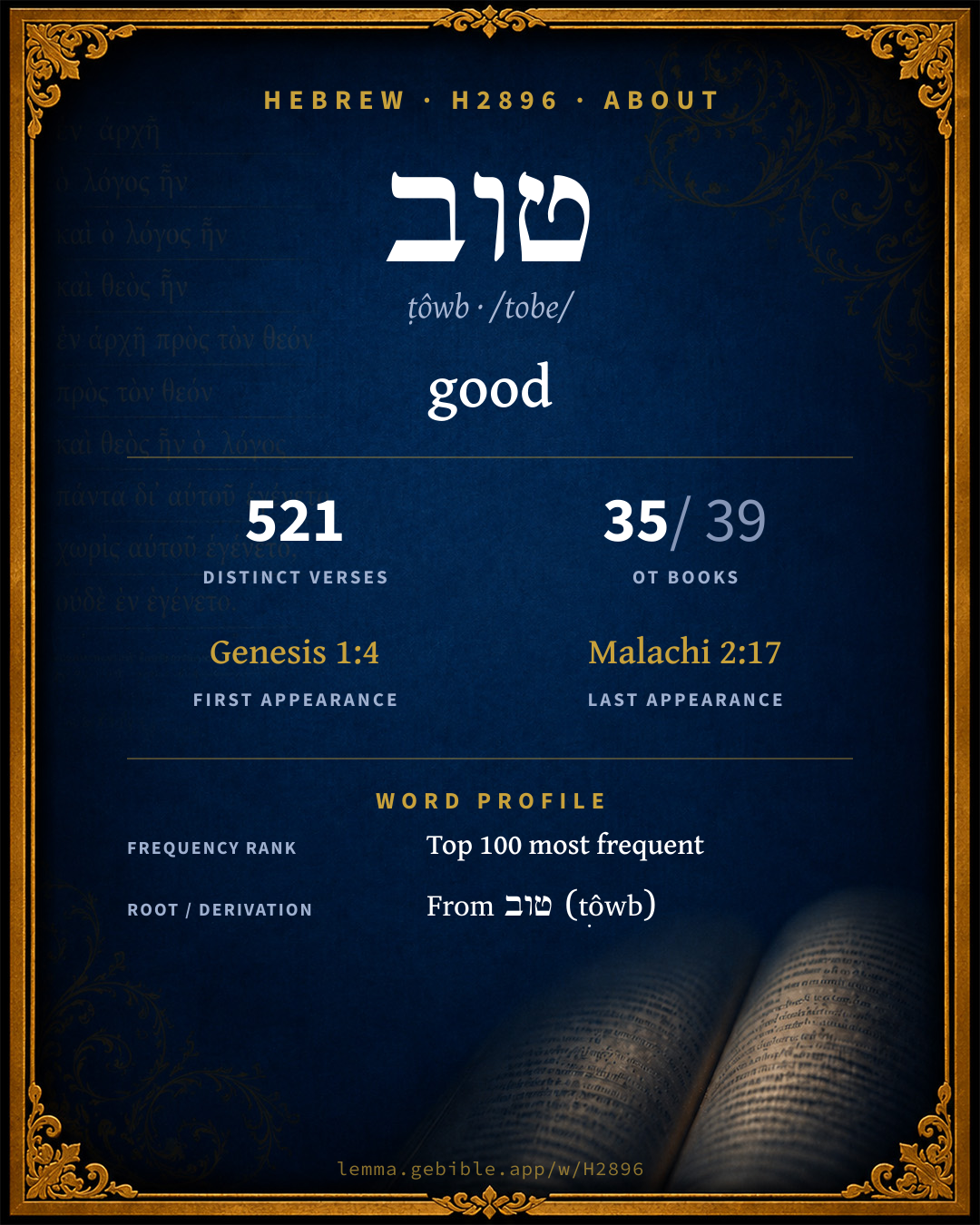
טוֹב
good
also: pleasant, agreeable fuller range ↓
Full lexicon entry — Brown-Driver-Briggs (BDB)
From Brown-Driver-Briggs (BDB)
Where this word appears
Grammar key — what these labels mean
Part of speech
- Adjective
- A word that describes or qualifies a noun.
- Verb
- An action or state-of-being word.
Stem
- Qal
- The basic, simple active stem — the plain form of the verb (“he wrote”). Here: ‘be pleasant’
Form
- Perfect
- A completed action or state — Hebrew marks aspect (completeness) more than strict tense (“he wrote”).
- Infinitive Construct
- A bound verbal noun, frequently with prepositions (“to write / in writing”).
- Sequential Perfect
- A perfect with prefixed waw continuing a preceding imperfect or command (waw-consecutive perfect).
State
- Absolute
- The independent form of a noun, not bound to a following word.
- Construct
- A noun bound to a following noun in a possessive / “of” relationship (the construct chain).
Person
- 3rd Person
- The one spoken about (“he / she / it / they”).
Gender
- Masculine
- Grammatically masculine.
- Feminine
- Grammatically feminine.
Number
- Singular
- One.
- Plural
- More than one (in Hebrew, generally three or more).
Every verse where H2896 appears in the Book of Ecclesiastes — 41 distinct verses. Click any verse to open its interlinear word-by-word view. Verse text shown in the World English Bible for context — . Each verse’s Hebrew form is shown with its reference; the English is not keyword-highlighted, since the data carries no word-level English alignment. Use “Compare translations” on any verse to read it across multiple English versions. This concordance covers the Hebrew Bible; Septuagint (Greek Old Testament) occurrences are not indexed here.
Ecclesiastes
- Ecclesiastes 2:1 בְ/ט֑וֹב prep + Adjective Adjective ms I said in my heart, "Come now, I will test you with mirth: therefore enjoy pleasure;" and, behold, this also was vanity.
- Ecclesiastes 2:3 ט֜וֹב adj Adjective ms I searched in my heart how to cheer my flesh with wine, my heart yet guiding me with wisdom, and how to lay hold of folly, until I might see what it was good for the sons of men that they should do under heaven all the days of their lives.
- Ecclesiastes 2:24 ט֤וֹב ט֖וֹב adj Adjective ms adj Adjective ms There is nothing better for a man than that he should eat and drink, and make his soul enjoy good in his labor. This also I saw, that it is from the hand of God.
- Ecclesiastes 2:26 שֶׁ/טּ֣וֹב לְ/טוֹב֙ ptcl rel + Adjective Adjective ms prep + Adjective Adjective ms For to the man who pleases him, God gives wisdom, knowledge, and joy; but to the sinner he gives travail, to gather and to heap up, that he may give to him who pleases God. This also is vanity and a chasing after wind.
- Ecclesiastes 3:12 ט֖וֹב ט֖וֹב adj Adjective ms adj Adjective ms I know that there is nothing better for them than to rejoice, and to do good as long as they live.
- Ecclesiastes 3:13 ט֖וֹב adj Adjective ms Also that every man should eat and drink, and enjoy good in all his labor, is the gift of God.
- Ecclesiastes 3:22 טוֹב֙ adj Adjective ms Therefore I saw that there is nothing better, than that a man should rejoice in his works; for that is his portion: for who can bring him to see what will be after him?
- Ecclesiastes 4:3 וְ/טוֹב֙ conj + Adjective Adjective ms Yes, better than them both is him who has not yet been, who has not seen the evil work that is done under the sun.
- Ecclesiastes 4:6 ט֕וֹב adj Adjective ms Better is a handful, with quietness, than two handfuls with labor and chasing after wind.
- Ecclesiastes 4:8 מִ/טּוֹבָ֔ה prep + Adjective Adjective fs There is one who is alone, and he has neither son nor brother. There is no end to all of his labor, neither are his eyes satisfied with wealth. For whom then, do I labor, and deprive my soul of enjoyment? This also is vanity, yes, it is a miserable business.
- Ecclesiastes 4:9 טוֹבִ֥ים ט֖וֹב adj Adjective mp adj Adjective ms Two are better than one, because they have a good reward for their labor.
- Ecclesiastes 4:13 ט֛וֹב adj Adjective ms Better is a poor and wise youth than an old and foolish king who doesn't know how to receive admonition any more.
- Ecclesiastes 5:5 ט֖וֹב adj Adjective ms It is better that you should not vow, than that you should vow and not pay.
- Ecclesiastes 5:11 הַ/טּוֹבָ֔ה ptcl def.art + Adjective Adjective fs When goods increase, those who eat them are increased; and what advantage is there to its owner, except to feast on them with his eyes?
- Ecclesiastes 5:18 ט֣וֹב טוֹבָ֜ה adj Adjective ms adj Adjective fs Behold, that which I have seen to be good and proper is for one to eat and to drink, and to enjoy good in all his labor, in which he labors under the sun, all the days of his life which God has given him; for this is his portion.
- Ecclesiastes 6:3 הַ/טּוֹבָ֔ה ט֥וֹב ptcl def.art + Adjective Adjective fs adj Adjective ms If a man fathers a hundred children, and lives many years, so that the days of his years are many, but his soul is not filled with good, and moreover he has no burial; I say, that an untimely birth is better than he:
- Ecclesiastes 6:6 וְ/טוֹבָ֖ה conj + Adjective Adjective fs Yes, though he live a thousand years twice told, and yet fails to enjoy good, don't all go to one place?
- Ecclesiastes 6:9 ט֛וֹב adj Adjective ms Better is the sight of the eyes than the wandering of the desire. This also is vanity and a chasing after wind.
- Ecclesiastes 6:12 טּ֨וֹב adj Adjective ms For who knows what is good for man in life, all the days of his vain life which he spends like a shadow? For who can tell a man what will be after him under the sun?
- Ecclesiastes 7:1 ט֥וֹב ט֑וֹב adj Adjective ms adj Adjective ms A good name is better than fine perfume; and the day of death better than the day of one's birth.
- Ecclesiastes 7:2 ט֞וֹב adj Adjective ms It is better to go to the house of mourning than to go to the house of feasting: for that is the end of all men, and the living should take this to heart.
- Ecclesiastes 7:3 ט֥וֹב adj Adjective ms Sorrow is better than laughter; for by the sadness of the face the heart is made good.
- Ecclesiastes 7:5 ט֕וֹב adj Adjective ms It is better to hear the rebuke of the wise, than for a man to hear the song of fools.
- Ecclesiastes 7:8 ט֛וֹב ט֥וֹב adj Adjective ms adj Adjective ms Better is the end of a thing than its beginning. The patient in spirit is better than the proud in spirit.
- Ecclesiastes 7:10 טוֹבִ֖ים adj Adjective mp Don't say, "Why were the former days better than these?" For you do not ask wisely about this.
- Ecclesiastes 7:11 טוֹבָ֥ה adj Adjective fs Wisdom is as good as an inheritance. Yes, it is more excellent for those who see the sun.
- Ecclesiastes 7:14 טוֹבָה֙ בְ/ט֔וֹב adj Adjective fs prep + Adjective Adjective ms In the day of prosperity be joyful, and in the day of adversity consider; yes, God has made the one side by side with the other, to the end that man should not find out anything after him.
- Ecclesiastes 7:18 ט֚וֹב adj Adjective ms It is good that you should take hold of this. Yes, also from that don't withdraw your hand; for he who fears God will come forth from them all.
- Ecclesiastes 7:20 טּ֖וֹב adj Adjective ms Surely there is not a righteous man on earth, who does good and doesn't sin.
- Ecclesiastes 7:26 ט֞וֹב adj Adjective ms I find more bitter than death the woman whose heart is snares and traps, whose hands are chains. Whoever pleases God shall escape from her; but the sinner will be ensnared by her.
- Ecclesiastes 8:12 טּוֹב֙ adj Adjective ms Though a sinner commits crimes a hundred times, and lives long, yet surely I know that it will be better with those who fear God, who are reverent before him.
- Ecclesiastes 8:13 וְ/טוֹב֙ conj + Adjective Adjective ms But it shall not be well with the wicked, neither shall he lengthen days like a shadow; because he doesn't fear God.
- Ecclesiastes 8:15 ט֤וֹב adj Adjective ms Then I commended mirth, because a man has no better thing under the sun, than to eat, and to drink, and to be joyful: for that will accompany him in his labor all the days of his life which God has given him under the sun.
- Ecclesiastes 9:2 לַ/טּוֹב֙ כַּ/טּוֹב֙ prep det + Adjective Adjective ms prep det + Adjective Adjective ms All things come alike to all. There is one event to the righteous and to the wicked; to the good, to the clean, to the unclean, to him who sacrifices, and to him who doesn't sacrifice. As is the good, so is the sinner; he who takes an oath, as he who fears an oath.
- Ecclesiastes 9:4 ט֔וֹב adj Adjective ms For to him who is joined with all the living there is hope; for a living dog is better than a dead lion.
- Ecclesiastes 9:7 ט֖וֹב adj Adjective ms Go your way--eat your bread with joy, and drink your wine with a merry heart; for God has already accepted your works.
- Ecclesiastes 9:16 טוֹבָ֥ה adj Adjective fs Then said I, Wisdom is better than strength. Nevertheless the poor man's wisdom is despised, and his words are not heard.
- Ecclesiastes 9:18 טוֹבָ֥ה טוֹבָ֥ה adj Adjective fs adj Adjective fs Wisdom is better than weapons of war; but one sinner destroys much good.
- Ecclesiastes 11:6 טוֹבִֽים adj Adjective mp In the morning sow your seed, And in the evening don't withhold your hand; For you don't know which will prosper, whether this or that, Or whether they both will be equally good.
- Ecclesiastes 11:7 וְ/ט֥וֹב conj + Adjective Adjective ms Truly the light is sweet, And a pleasant thing it is for the eyes to see the sun.
- Ecclesiastes 12:14 ט֖וֹב adj Adjective ms For God will bring every work into judgment, with every hidden thing, whether it is good, or whether it is evil.
About this entry
At a glance — auto-summarized from this page’s data, not written by a person. Every figure links to its source below. This summary describes the numbers; it doesn’t interpret them.
טוב (ṭôwb) is a Hebrew word most often rendered “good.” It first appears in Genesis 1:4. Spanning 521 verses in 35 books, it ranks among the most common words of the Hebrew Bible. It also covers “pleasant” and “agreeable”, alongside “good” — see its full sense range. Related forms include טוב, טוב and טבאל. The sections below give every sense, occurrence, and version rendering.
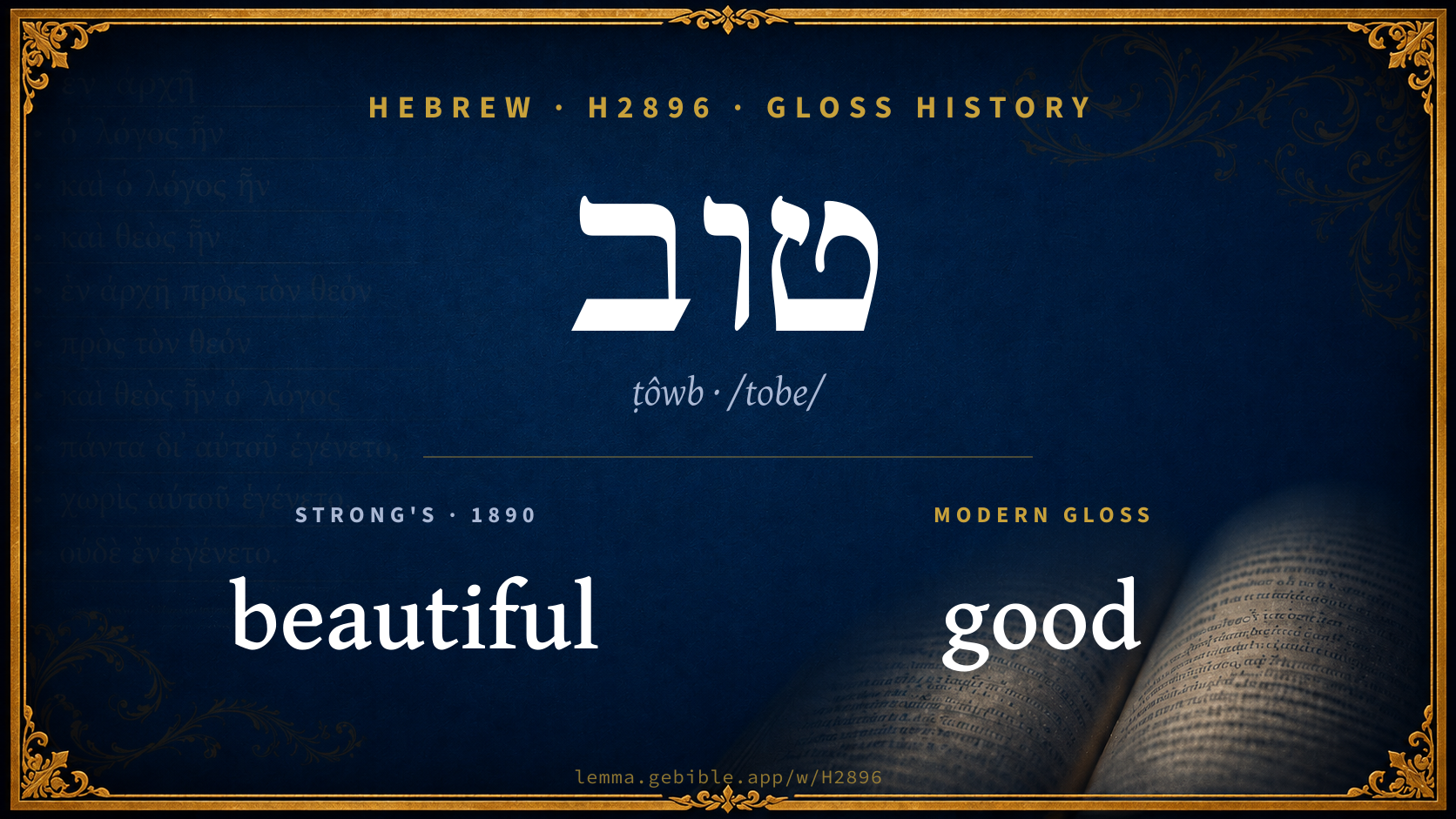
Gloss history
Strong's 1890 vs modern scholarship
About this word
Strong's H2896 catalogs a Hebrew word from the Hebrew Old Testament.
These counts are not copied from any lexicon or concordance. They are computed here, from the morphology-tagged Hebrew Old Testament. What Lemma adds →
- 521
- distinct verses
- The word appears in 521 distinct verses.
- 35 / 39
- OT books
- The word appears in 35 of 39 Old Testament books.
- #89
- by frequency
- Top 100 most frequent Hebrew words (rank 89 of 8,640 Hebrew words by occurrence).
View all 521 occurrences in the concordance →
Most concentrated in
- Psalms 68 verses 13%
- Proverbs 62 verses 12%
- Ecclesiastes 41 verses 8%
By section of the Old Testament
By traditional corpus
Conventional, traditional groupings — biblical authorship is debated, so this is a traditional corpus grouping, not an authorship claim. Each share is this word’s portion of its verses in that division of the Hebrew canon. Each figure is a share of the word’s 521 distinct verses.
- Writings (Ketuvim) 257 verses · 49%
- Prophets (Nevi'im) 184 verses · 35%
- Torah (Pentateuch) 80 verses · 15%
How translations render this word
Counts come from each version’s own published word-to-Strong’s tagging or interlinear alignment — an approximate guide to how each version renders this word, not a word-level alignment the data otherwise carries. Because each total is that version’s own tagged count, the per-version totals vary from one another and need not match the appearance or distinct-verse counts above. These counts may also differ from a printed concordance because Lemma counts each distinctly tagged rendering and does not collapse phrase taggings into a single head-word total. This is a fixed set of word-tagged versions (KJV, ASV, BSB, ULT) and does not change with the reading translation you choose elsewhere. Each version’s license is shown beside its name below (and on Sources).
BDB lists this Strong’s number as 5 distinct words (homographs). Each count above pools all of them and is not split by sense — see the Senses section below. A low-frequency rendering may belong to a different one of those words, not the primary meaning.
- King James Version†: Good 197×, Is good 42×, Is better 32×
- American Standard Version†: Good 172×, Is good 35×, Is better 24×
- Berean Standard Bible†: Good 189×, Better 39×, Is good 34×
- unfoldingWord Literal Text†: Good 312×, Is good 57×, Better 47×
King James Version Public Domain
Renders H2896 across 558† tagged occurrences — most commonly:
Plus other, less common renderings. Plus 103 renderings that appear only once — usually multi-word phrases or single function words the recovered tagging swept in, not distinct renderings. Not rendered by a distinct English word in 1 further occurrence.
American Standard Version Public Domain
Renders H2896 across 557† tagged occurrences — most commonly:
Plus other, less common renderings. Plus 152 renderings that appear only once — usually multi-word phrases or single function words the recovered tagging swept in, not distinct renderings.
Berean Standard Bible Public Domain
Renders H2896 across 538† tagged occurrences — most commonly:
Plus other, less common renderings. Plus 87 renderings that appear only once — usually multi-word phrases or single function words the recovered tagging swept in, not distinct renderings. Not rendered by a distinct English word in 23 further occurrences.
unfoldingWord Literal Text CC BY-SA 4.0
Renders H2896 across 607† tagged occurrences — most commonly:
Plus other, less common renderings. Plus 53 renderings that appear only once — usually multi-word phrases or single function words the recovered tagging swept in, not distinct renderings.
47 senses and sub-senses in the full BDB
Hebrew verbs can shift meaning by stem (binyan): Qal is the basic action, Niphal is often passive or reflexive, Piel often intensifies or makes it factitive, and Hiphil is typically causative. The senses below are grouped under the stem BDB assigns to each.
What do BDB’s symbols mean?
BDB uses these scholarly abbreviations:
| Symbol | Meaning |
|---|---|
| 𝔊 | the Septuagint (the ancient Greek translation, LXX) |
| 𝔙 | the Vulgate (the Latin translation) |
| 𝔖 | the Syriac version (the Peshitta) |
| 𝔗 | the Targum (the Aramaic translation) |
| ψ | the Psalms |
| √ | root (the underlying root or stem) |
| ‖ | parallel passage (a synonymous or contrasted parallel) |
| † | the dagger: every passage where the word occurs is cited |
The 47 senses and sub-senses the full Brown-Driver-Briggs lexicon distinguishes for this word, in lexicon order (not ranked by frequency), with BDB’s own verbatim wording and sub-sense lettering. Shown in Hebrew script with BDB’s own scholarly abbreviations. The condensed entry is in the Lexicon Entry tab. See also the Forms in the corpus table below.
טוב I pleasing, good (NH id., Hiph.
Qal
- Pf. טוֹב Nu 11:18 + 32 times; pl. טֹבוּ Nu 24:5 Ct 4:10; (Impf. יִיטַב from יָטַב); Inf. abs. טוֹב Ju 11:25; cstr. טוֹב Je 32:39 + 6 times, כְּטוֹב Ju 16:25 Qr (Kt כי טוב); Pt. טוֹב Ju 11:25 1 S 2:26; (for these forms v. Bö§ 1133, 4 SS s.v.; Ges recognises only Pfs. and fewer of them than above. It is often difficult to decide between vb. and adj.);— e.g. Numbers 11:18
- 1. be pleasant, delightful, of tents of Jacob Nu 24:5 (JE; poet.); of caresses Ct 4:10 (sq. מִיַּיִן comp.) e.g. Numbers 24:5
- 2. be glad, joyful טוֹב לֵב Ju 16:25 (Qr), 1 S 25:36 2 S 13:28 Est 1:10 (v. טוּב 2 c). e.g. Judges 16:25
- 3. of rank, position, claim: הֲטוֹב טוֹב אתה מבלק Ju 11:25 art thou really better than Balak? e.g. Judges 11:25
- 4. טוֹב לְ be well with, good for Nu 11:18 (J), Dt 5:30; 15:16; 19:13; 1 S 16:16, 23; 2 S 14:32 ψ 119:71; 128:2; Je 22:15; so (sc. לוֹ) Is 3:10 it is well (with him); אז טוב Je 22:16 (cf. v 15); טוֹב אֶל־ 1 S 20:12 there is good toward David. e.g. Numbers 11:18
- 5. be pleasing טוֹב בְּעֵינֵי (v. ii. טוֹב 2 b c f) Nu 24:1 (J) 2 S 3:19, 36; 15:26; 19:38; אִם טוֹב בְּעֵינֵי 1 K 21:2; Je 40:4; Zc 11:12; later usage is אִם טוֹב עַל if it seem good unto (so Assyrian ṭâbu eli, be pleasing unto, DlHWB 300 a), 1 Ch 13:2; Ne 2:5, 7 Est 1:19; 3:9; 5:4, 8; 7:3; 8:5; 9:13 (cf. טוֹב adj.). e.g. Numbers 24:1
Hiphil
- Pf. 2 ms. הֱטִיבוֹתָ 2 Ch 6:8, הֱטִיבֹתָ 1 K 8:18; 2 K 10:30;—do well, act right, sq. כִּי that 1 K 8:18 thou didst well, that it was in thine heart = 2 Ch 6:8; sq. inf. c. לְ 2 K 10:30 thou hast done well in performing what was right in mine eyes. e.g. 2 Chronicles 6:8
טוב II pleasant, agreeable, good (v. LagBN 26
- 1. pleasant, agreeable to the senses:
- a. to the sight, fair, of daughters of men Gn 6:2 (J); of a son Ex 2:2 (E), 1 S 9:2; 1 K 20:3, young men (but read herds 𝔊 Th We Klo Dr Bu) 1 S 8:16; מראיהם their appearance Dn 1:15, טֹבַת מראה Gn 24:16; 26:7 (both J), 2 S 11:2; Est 1:11; 2:3, 7; טוב ראי 1 S 16:12; טוב תאר 1 K 1:6; טובַת חן Na 3:4; טוֹבוֹת מראה Est 2:2; טוֹבֵי מראה Dn 1:4; טוב לעינים Ec 11:7; טובה בעיניו fair in his eyes Est 8:5; of mantle Jos 7:21 (J); goodly houses Is 5:9 Dt 8:12; cities Dt 6:10; situation of city 2 K 2:19. e.g. Genesis 6:2
- b. to the taste, good, sweet, agreeable for eating למאכל Gn 2:9; 3:6 (both J); ears of grain Gn 41:5, 22, 24, 26 (E); figs Je 24:2, 3(×2), 5; honey Pr 24:13; כְּיֵין הטוב Ct 7:10 as wine of the best sort (Hi reads כַּיַּיִן); תְּנוּבָתִי הַטּוֹבָה Ju 9:11 my sweet fruit (‖ מָתְקִי). e.g. Genesis 2:9
- c. to the smell, sweet-scented, of ointment Ct 1:3; קנה הטוב Je 6:20 the fragrant cane. e.g. Song of Solomon 1:3
- d. of pleasant shadow of tree Ho 4:13. e.g. Hosea 4:13
- 2. pleasant to the higher nature, giving pleasure, happiness, prosperity, and so agreeable, pleasing, well:
- a. of time: יום טוב good day, festal day 1 S 25:8; Est 8:17; 9:19, 22; of feasts Zc 8:19; prosperous years Gn 41:35 (E). e.g. 1 Samuel 25:8
- b. of place, טוב בית הנשׁים Est 2:9 the best part of the women’s house; בַּטּ׳ לוֹ Dt 23:17, בַּטּ׳ בְּעֵינֵי Gn 20:15 (v. c f infr.) e.g. Esther 2:9
- c. of persons, (אתה) טוב בעיני pleasing in the eyes of 1 S 29:6(×2), 9 טוב בעיני י׳ Mal 2:17 (cf. vb. 5, and f infr.); later לִפְנֵי Ec 2:26(×2); 7:26; inserted in 1 S 29:10 𝔊 We Dr; cf. ט׳ עם 1 S 2:26. e.g. 1 Samuel 29:6
- d. of word or message, בְּשׂוֹרָה טוֹבָה 2 S 18:27 good tidings; שְׁמוּעָה ט׳ good report 1 S 2:24 Pr 15:30; 25:25; דבר בעתו Pr 15:23 a word in its season; דבר טוב Pr 12:25 an agreeable word (maketh the heart glad); דבר טוב ψ 45:2 a good theme. e.g. 2 Samuel 18:27
- e. of other things, דֶּרֶךְ טובה 1 S 24:20 a pleasant, prosperous journey; מנחה כי טוב Gn 49:15 (poem); of unity of brethren מה טוב ומה נעים ψ 133:1 how good and how pleasant it is! טוב לְ (יהיה) it shall be well for Ec 2:3; 6:12; 8:12, 13 (cf. vb. 3); הֲטוֹב כִּי Jb 13:9 will it be advantageous that (v. 5). e.g. 1 Samuel 24:20
- f. עשׂה הטוב בעיני do what is pleasing in the eyes of Gn 16:6 (J), Ju 19:24; 1 S 1:23; 3:18; 14:40; 2 S 10:12 = 1 Ch 19:13, 2 S 19:19, 28, 39; 2 K 10:5; 20:3 = Is 38:3, 1 Ch 21:23 = 2 S 24:22 where obj. of העלה; (ה)טוב בע׳ (כל) (כ) עשׂה Gn 19:8 (J), Ju 10:15 1 S 11:10; 14:36 Est 3:11; עשׂה (כ)הטוב ו(כ)הישׁר בע׳ Dt 12:28; Jos 9:25 (D), 2 Ch 14:1; Je 26:14, cf. Est 8:8; nouns reversed Dt 6:18; עשׂה הטוב והישׁר לפני 2 Ch 31:20; טוב בע׳ in other combinations Nu 36:6 (P), Je 40:4; ראה הטוב והישׁר 2 K 10:3; דבּר ט׳ 1 K 22:13 = 2 Ch 18:12, Nu 10:29 (J), 1 S 19:4; Est 7:9; דבּר מטוב עד־רע speak either good or bad Gn 31:24, 29 (E); למרע ועד טוב 2 S 13:22; רע או טוב Gn 24:50 (J); התנבא ט׳ 1 K 22:8, 18 = 2 Ch 18:17; cf. 1 K 22:13 = 2 Ch 18:12. e.g. Genesis 16:6
- 3. good, excellent of its kind:
- a. of the several creations, וירא אלהים כי טוֹב and God saw that it was good, excellent Gn 1:4, 10, 12, 18, 21, 25 (P); כל אשׁר עשׂה והנּה טוֹב מאד 1:31 (P) God saw all that he had made, and behold it was very excellent. So e.g. Genesis 1:4
- b. of land, soil, fruitful, fertile: ארץ Ex 3:8; Nu 13:19 (both J), 14:7 (P), Dt 1:25, 35; 3:25; 4:21, 22; 6:18; 8:7, 10; 9:6; 11:17; Jos 23:16 (D), Ju 18:9; 1 Ch 28:8; אדמה 1 K 14:15; Jos 23:13, 15 (D); הר Dt 3:25; חלקה 2 K 3:19, 25; שׂדה Ez 17:8; נָוֶה Ez 34:14; מרעה 1 Ch 4:40; Ez 34:14, 18. e.g. Exodus 3:8
- c. of vegetation, choice, fruitful זֵיתִים 1 S 8:14; עץ 2 K 3:19, 25 Ez 31:16; שׁמן טוב 2 K 20:13 precious oil = Is 39:2, ψ 133:2 Ec 7:1; of seed, אם שׁניהם טובים Ec 11:6 whether both of them will be fruitful. e.g. 1 Samuel 8:14
- d. of animals, fat בקר Gn 18:7 (J); עזים Gn 27:9 (J); פרות Gn 41:26 (E); יָרֵךְ Ez 24:4. e.g. Genesis 18:7
- e. of minerals, fine, pure זהב Gn 2:12 (J), 2 Ch 3:5, 8; כֶּתֶם La 4:1; brass Ezr 8:27, soldering Is 41:7. e.g. Genesis 2:12
- 4. good, rich, valuable in estimation:
- a. in quantity, שׂיבה טובה good old age Gn 15:15 (R), 25:8 (P), Ju 8:32; 1 Ch 29:28; dowry Gn 30:20 (E; many sons); treasury Dt 28:12 (from which י׳ sends blessings). e.g. Genesis 15:15
- b. in price, goodly, valuable: of the estimation put upon house, beast, and tithe Lv 27:10(×2), 12, 14, 33 (H); profit Pr 31:18; hire Ec 4:9; מחמדי הטבים Jo 4:5 my goodly precious things. e.g. Leviticus 27:10
- 5. good, appropriate, becoming, טוב אשׁר Ec 7:18 (cf. 5:4 infr.); טובה חכמה עם נחלה Ec 7:11 wisdom is good with an inheritance (other trans. see in VB); ‖ יָפֶה Ec 5:17; c. עֵצָה 2 S 17:7, 14 good advice; טוב פתר Gn 40:16 (E) that he interpreted well; טוב הדבר (לא) Ex 18:17 (E) the thing is (not) good, wise, so Dt 1:14 1 S 26:16; טוב (ה)דבר the word is good, is well said 1 S 9:10 1 K 2:38, 42; 18:24; 2 K 20:19 = Is 39:8, for which abbreviated טוב well! good! exclamation Ru 3:13 1 S 20:7 2 S 3:13 1 K 2:18; followed by כּי it is good that 2 S 18:3 Ru 2:22 La 3:27 Jb 10:3 (cf. 13:9 2 e); c. inf. Gn 2:18 (J), ψ 73:28; 92:2; 147:1 Pr 25:27 (cf. sub 10); with וְ (strangely) טוֹב וְיָחִיל וגו׳ La 3:26 it is good that one wait (v. דּוּמָם, יָחִיל); בלא דעת נֶפֶשׁ לא טוב Pr 19:2 that a soul be without knowledge is not good. e.g. Ecclesiastes 7:18
- 6. c. מִן compar. = better, sq. inf. Gn 29:19 (E), Ex 14:12 (J), ψ 118:8, 9 Pr 16:19; 25:7 Ec 6:9; 7:2; inf. om. Pr 21:9, 19; 25:24; מן om. Nu 14:3 (J; compar. only implied); c. מן pers. Ju 15:2; Ru 4:15; 1 S 1:8; 9:2; 15:28; 1 K 2:32; 19:4; 2 Ch 21:13; Pr 12:9; 16:32; 19:1, 22; 27:10; 28:6; La 4:9; Est 1:19; Ec 4:3, 9, 13; 6:3; 7:5, 8; c. מן rei Ju 8:2; 1 S 15:22; 2 S 17:14; 1 K 21:2; 2 K 5:12; Ho 2:9; Am 6:2; Is 56:5; Jon 4:3, 8 ψ 37:16; 63:4; 84:11; 119:72; Pr 3:14; 8:11, 19; 15:16, 17; 16:8, 16; 17:1; 22:1; 27:5; Ct 1:2; Ec 4:6; 7:1, 3, 8, 10; 9:4, 16, 18; sq. מִשֶּׁ- Ec 5:4; מַה־טּוֹב … הֲ … אִם is it better … or? Ju 9:2; הֲטוב … אוֹ 18:19; אין טוב שֶׁ- Ec 2:24 (read מִשֶּׁ- v. Comm.); אין טוב מאשׁר Ec 3:22; אין טוב כִי אִם Ec 3:12; 8:15; so 1 S 27:1 𝔊 We Dr Klo Kit Bu (MT only כי c. Impf.) e.g. Genesis 29:19
- 7. of man’s sensuous nature, glad, happy, prosperous: טוב לב merry, glad heart Pr 15:15; Est 5:9; Ec 9:7; טוֹבֵי לב 1 K 8:66 = 2 Ch 7:10; וַנּהיה טובים Je 44:17 we were prosperous; similarly ψ 112:5. e.g. Proverbs 15:15
- 8. of man’s intellectual nature, שֵׂכֶל טוֹב good understanding 2 Ch 30:22 ψ 111:10 Pr 3:4; 13:15; טוֹבַת שֶׂכֶל 1 S 25:3. e.g. 2 Chronicles 30:22
- 9. good, kind, benign:
- a. of men, themselves 1 S 25:15; 2 S 18:27; 2 Ch 10:7; the eye Pr 22:9; דברים טובים kind words 1 K 12:7 = 2 Ch 10:7. e.g. 1 Samuel 25:15
- b. of God, himself Na 1:7; 2 Ch 30:18 ψ 86:5; כי טוב for he is good, kind ψ 34:9; 100:5; 135:3 Je 33:11; כי טוב כי לעולם חסדוֹ 1 Ch 16:34; 2 Ch 5:13; 7:3; Ezr 3:11 ψ 106:1; 107:1; 118:1, 29; 136:1; טוב לְ kind to 73:1; 145:9; La 3:25; יד (ה)טובה על Ezr 7:9; 8:18; Ne 2:8, 18; רוחךָ (ה)טובה 9:20 ψ 143:10; שׁמךָ כי טוב 52:11; 54:8; כּי טוב חסדךָ 69:17; 109:21; הדבר(ים) הטוב(ים) the good, kind word(s) spoken in promise Jos 21:43; 23:14, 15 (D), 1 K 8:56; Je 29:10; 33:14; Zc 1:13. e.g. Nahum 1:7
- 10. good (ethical), right: מה טוב ‖ what Yahweh requires Mi 6:8, ‖ משׁפט Jb 34:4: e.g. Micah 6:8
- a. of man himself ‖ ישׁר Mi 7:4; אישׁ טוב Pr 14:14; (ה)טוב(ים) = (the) good 2 Ch 19:11 ψ 125:4 Pr 2:20; 12:2; 13:22; 14:19; 15:3; Ec 9:2(×2); man’s deeds דברים 2 Ch 12:12; 19:3; מעשׂה 1 S 19:4; Ec 12:14; מעללים Ez 36:31; דֶּרֶךְ הטובה והישׂרה 1 S 12:23 the good and right way; (הַ)דֶּרֶךְ (ה)טוב(ה) (the) good way 1 K 8:36 = 2 Ch 6:27, Is 65:2; Je 6:16 ψ 36:5; Pr 16:29; דבריךָ טובים ונכחים 2 S 15:3 good and right is thy case; דבר טוב good thing 1 K 14:13; לא טוב הדבר Ne 5:9; אשׁר לא טוב עשׂה Ez 18:18; so of מאזני מרמה etc., Pr 20:23; לא טוב c. inf. (v. 5) it is not good or right to: ענושׁ לצדּיק Pr 17:26; שׂאת פני רשׁע 18:5; הכּר פנים 28:21; 24:23 (בל טוב). e.g. Micah 7:4
- b. of God טוב אתה ומטיב ψ 119:68; טוב וישׁר יהוה 25:8; משׁפטיך טובים 119:39; his commands מצות Ne 9:13; חקים Ez 20:25 (לא טובים); לקח טוב Pr 4:2; מפי עליון לא תצא הרעות והטוב La 3:38. e.g. Psalms 119:68
טוב III
- 1. welfare, prosperity, happiness: ‖ שָׁלוֹם Is 52:7; Je 8:15; 14:19; אם טוב ואם רע 42:6 whether prosperity or adversity; יבוא טוב 17:6 prosperity cometh; שׂמח בט׳ Dt 26:11; 2 Ch 6:41; ראה בט׳ Ec 2:1; Je 29:32; obj. of ראה ψ 4:7; 34:13; Ec 2:24; 3:13; Jb 7:7; of דרשׁ Est 10:3; of בקשׁ ψ 122:9; מנע 84:12; Je 5:25; נתן ψ 85:13; קוה Jb 30:26; מצא Pr 16:20; 17:20; 18:22; 19:8; נחל Pr 28:10; חסר ψ 34:11; בשׂר 1 K 1:42; Is 52:7; חול לט׳ Mi 1:12; חכמה וט׳ 1 K 10:7; טוב וחסד ψ 23:6; בטוב in prosperity 25:13; Jb 21:13; 36:11; Ec 7:14; מטוב because of prosperity Zc 1:17; afar from happiness ψ 39:3; כטוב Ho 10:1; לטוב Dt 30:9; Je 15:11; לטוב לָנוּ Dt 6:24 for good to us, = for our good, 10:13 (לְךָ), Je 32:39 (לָהֶם; cf. לרע ל Je 7:6; 25:7) e.g. Isaiah 52:7
- 2. good things, (coll.) ברך(ו)ת ט׳ blessing of good things ψ 21:4 Pr 24:25; מִלֵּא בָתֵּיהֶם ט׳ Jb 22:18 filled their houses with good things; obj. of שׂבע ψ 104:28 Pr 12:14; מלא ψ 107:9; אכל Pr 13:2 Is 55:2; לקח Ho 14:3; השׂביע בט׳ ψ 103:5; goods, possessions 1 S 15:9. e.g. Psalms 21:4
- 3. good = benefit: גְּמָלַתְהוּ טוֹב וְלֹא־רָע Pr 31:12 she doeth him good and not evil; תַּאֲוַת צַדִּיקִים אַךְ־טוֹב Pr 11:23 the desire of the righteous is only good; obj. of קבּל Jb 2:10; מנע Pr 3:27; שׁחר 11:27; שׁלּם 13:21; עשׂה Gn 26:29 (J), ψ 119:65; היטיב Nu 10:32 (J); ערב לט׳ ψ 119:122; חֹרְשֵׁי ט׳ Pr 14:22 who devise good. e.g. Proverbs 31:12
- 4. moral good, ידע טוב ורע Gn 2:9, 17; 3:5, 22 (J), Dt 1:39; בין טוב לרע 2 S 19:36; in antithesis with רע elsewhere Dt 30:15; 2 S 14:17; 1 K 3:9; Is 5:20(×2); 7:15, 16 Am 5:14, 15 Mi 3:2 ψ 34:15; 37:27; 52:5; זנח ט׳ Ho 8:3 cast off good; עשׂה טוֹב do good ψ 14:1, 3 = 53:2, 4, 37:3; Ec 7:20, in 3:12 this meaning seems less fitting; read perh. לִרְאוֹת ט׳ (Gr, v. also De) and tr. to 1; רדף ט׳ ψ 38:21 pursue good; מַעְגַּל־ט׳ Pr 2:9 path of good. e.g. Genesis 2:9
טוב IV welfare, benefit, good things, good
- 1. welfare, prosperity, happiness: ‖ שׁלום Dt 23:7; Je 33:9; Ezr 9:12; La 3:17; יוֹם טובה Ec 7:14 day of prosperity; טוֹבָתִי בַּל־עָלֶיךָ ψ 16:2 is not my welfare dependent upon thee? תְּבוֹאָֽתְךָ ט׳ Jb 22:21 prosperity shall come to thee; לטובה Gn 50:20 (E), Dt 28:11; 30:9; 2 Ch 18:7 Je 14:11; לרעה ולא לטובה Am 9:4; Je 21:10; 39:16; 44:27; obj. of vb. בקּשׁ Ne 2:10; הביא Je 32:42; ראה Jb 9:25; Ec 5:17; 6:6; אבּד Ec 9:18; ראה בט׳ ψ 106:5; חסר מט׳ Ec 4:8; obj. of אכל fig. Jb 21:25 = taste happiness; of שׂבע Ec 6:3; after נחם על Je 18:10. e.g. Deuteronomy 23:7
- 2. good things (coll.):
- a. of good words, obj. of דבּר 1 S 25:30 2 S 7:28 = 1 Ch 17:26, Je 18:20; pl. דבּר טובות Je 12:6; 52:32 = 2 K 25:28. e.g. 1 Samuel 25:30
- b. of material possessions ברבות הט׳ Ec 5:10 when good things increase. e.g. Ecclesiastes 5:10
- 3. bounty, good שְׁנַת טוֹבָחֶ֑ךָ ψ 65:12 year of thy bounty (harvest bestowed by God), so also טובתך ψ 68:11; עשׂה (ה)ט׳ Ex 18:9 (E), Nu 24:13 (JE), Ju 8:35; 9:16 1 S 24:19; 2 S 2:6; 1 K 8:66 = 2 Ch 7:10, 2 Ch 24:16; Je 33:9; obj. of גמל 1 S 24:18; שׁלּם 1 S 24:20; רעה תחת טובה Gn 44:4 (J), 1 S 25:21 ψ 35:12; 38:21; 109:5 Pr 17:13; Je 18:20; ט׳ תחת קללה 2 S 16:12; זכר לי לט׳ remember it for me for good Ne 5:19; 13:31; לטובה Ezr 8:22; Ne 2:18; Je 24:5, 6 ψ 86:17; pl. טוֹבֹתָיו Ne 6:19 his benefits (i.e. good deeds of Tobiah). e.g. Psalms 65:12
טוב V loc. (perh. from above √)
Senses from the full Brown-Driver-Briggs lexicon (Brown, Driver, Briggs; Oxford 1906 — public domain), digitized via Sefaria, supplemented by the OpenScriptures HebrewLexicon (CC BY 4.0). Full attribution on Sources.
Word origin
I. vb. pleasing, good (NH id., Hiph.; also deriv.; Arabic طَابَ med. ى be pleasant, delightful, delicious, sweet or savoury in taste or odour, be pure and clean, cheerful, happy (Lane); Aramaic ܛܶܐܒ, ܛܳܒ, טְאֵב, טַב, טַיֵּב and especially deriv. glad, joyful; Assyrian ṭâbu, be good, kind, acceptable, joyful, vigorous DlHWB 299)—
II. adj. pleasant, agreeable, good (v. LagBN 26; Aramaic טַב, Palm. טב Vog No. 81, טבא Vog No. 75)—m. ט׳ Gn 2:12 + 22 times, טוֹבָם Mi 7:4; f. טוֹבָה Est 8:5 + 50 times, טֹבָה Dt 6:18 + 2 times; cstr. טוֹבַת Gn 26:7 + 6 times, טֹבַת Gn 24:16; pl. טוֹבִים Je 44:17 + 28 times; טֹבִים Gn 27:9 + 4 times; cstr. טוֹבֵי Dn 1:4 + 2 times; pl. טוֹבוֹת Est 2:2, טֹבוֹת Je 24:2 + 6 times, טֹבֹת Gn 6:2 + 4 times;—
III. n.m. Je 17:6 (cf. טוֹבָה n.f.) a good thing, benefit, welfare;—ט׳ Gn 26:29 + 134 times;—
I. n.f. welfare, benefit, good things, good;—abs. ט׳ Dt 28:11 + 54 times; cstr. טוֹבַת ψ 106:5; sf. טוֹבָתִי ψ 16:2 etc. + 4 times sfs.; pl. טוֹבוֹת Je 12:6; טֹבוֹת 2 K 25:28; Je 52:32; sf. טוֹבֹתָיו Ne 6:19;—
IV. n.pr.loc. (perh. from above √)—a region beyond Jordan, N. or NE. of Gilead, prob. Aramean; אֶרֶץ טוֹב Ju 11:3, 5, 𝔊 Τωβ; אישׁ טוֹב 2 S 10:6, 8 men of Ṭôb, 𝔊 (Ε)ιστωβ; = Τούβιον, Τώβιον 1 Macc 5:13; identif. by ConderHandb. 295 with southern Bashan, where is still Taiyibeh, 12 m. SE. from Sea of Galilee.
— Brown-Driver-Briggs (Oxford 1906, public domain), digitized via Sefaria, supplemented by the OpenScriptures HebrewLexicon (CC BY 4.0). See Sources.
Derived from טוב (ṭôwb) (H2895) — to be good.
Jastrow Dictionary
A second Hebrew/Aramaic lexicon for comparison, covering Aramaic and post-biblical (Talmudic, Targumic, Midrashic) usage that the biblical-Hebrew BDB does not. Matched by lemma rather than by Strong’s number, so a lemma may carry more than one Jastrow headword (shown separately below), and the entries cover usage well beyond the Bible.
טוֹב I
- (b. h.) to be good, fit, handsome, valuable.
- 1. to prepare, outfit, dress, adorn. Gen. R. s. 26, v. טַבָּת. Gen. R. s. 83 (play on מהיטבאל, Gen. XXXVI, 39) מְטִיבֵי אלוהות היו they were dressers of idols; שהיו מֵטִיבִין עצמן וכ׳ they adorned themselves in honor of the idols. Ib. מטיבי נשים וכ׳ they dressed women for their wedding; a. e.—Esp. (את הנרות) ה׳ to trim, cleanse the lamps. Yoma III, 4 ולהֵטֵיב. Ib. I, 2. Ib. 14ᵇ יֵיטִיב; a. fr.—V. הֲטָבָה. e.g. Genesis 36:39
- 2. to turn a dream unto good (saying, ‘I have dreamt a good dream’). Ber. 55ᵇ יְטִיבֶנּוּ בפני וכ׳ he shall turn it in the presence of three persons, and say &c.
- 3. to do good, be beneficent. Ib. IX, 2 הטוב והמטיב who is good and beneficent. Taan. 31ᵃ תקנו … הטוב והמ׳ they introduced in Jabneh the benediction ‘who is good &c.’ (in the grace after meal).—Kidd. I, 10 מטיבין לו good will be done to him; a. fr.—Part. Hof. מוּטָב, q. v.
- to improve a field, to till oftener than usual. Y. Shebi. IV, 35ᵇ top טִיְּיבָהּ וכ׳ if, after he improved a field, he died &c.
- to be improved. Shebi. IV, 2; Tosef. ib. III, 10; a. e.—Denom. טִיּיוּב.
טוֹב
- Pa. טַיֵּיב, Af. אָטֵיב to do good, to favor. Targ. Y. I Ex. XXIII, 2 למְטַיְּיבָא; Y. II למֵיטְבָא. V. יְטַב.
טוֹב II
- (b. h.)
- 1. good; a good thing. Ber. 5ᵃ (ref. to Ps. XXXIX, 3) אין ט׳ אלא וכ׳ under good the Torah is meant. Ib. 60ᵇ זו מדה ט׳ this refers to a good dispensation; a. v. fr.—יום טוב (abbr. י"ט) festival. Bets. I, 1; a. fr.—כי טוב (ref. to Gen. I, 4) day-time. Pes. 2ᵃ.—Ber. V, 3 (33ᵇ) על טוב וכ׳ thy name be praised for the good (thou doest).—זכור לַטּוֹב, v. עין טובה—.זָכַר, v. עַיִן.—Pl. טוֹבְים, f. טוֹבוֹת. Ber. l. c. (34ᵃ, omitt. in Mish.) האומר יברכוך ט׳ he who says in prayer, The good praise thee. Ib. IX, 2 בשורות ט׳, v. בְּשוֹרָה; a. v. fr.—V. טוֹבָה. e.g. Psalms 39:3
- 2. noble, elder.—Pl. טוֹבִים. Tosef. Shek. II, 16 בני ט׳ of noble descent; a. fr.—טוֹבֵי העיר representatives of the town. Meg. 27ᵃ
טוּב
- preced.) goodness, good. Ber. 44ᵃ לשבוע מטוּבָהּ to be satisfied out of its (the land’s) riches; a. e.
A Dictionary of the Targumim, the Talmud Babli and Yerushalmi, and the Midrashic Literature (Marcus Jastrow; London, Luzac, 1903) — Public Domain. Digitized via Sefaria. Digitized via Sefaria. Full attribution on Sources.
Forms in the corpus
The 180 distinct written forms H2896 takes in the Hebrew Bible, most frequent first — each parse links to that state’s occurrences in the concordance. Hebrew forms include their vowel points and cantillation, so a single lemma takes many written forms.
The 60 most common forms are shown; 120 rarer forms follow in the full concordance.
Same root — word family
Other BDB entries built from the same root as H2896, grouped by Strong’s listed origin. These share a root / origin per the lexicon — not necessarily a shared meaning. Each links to that word’s own entry.
Derives from
Shares the same root
Proper names from this root
People and places named from this root — a name, not an additional meaning of the word.
- טבאל ṭâbᵉʼêl H2870 Tabeel
- טברמון Ṭabrimmôwn H2886 Tabrimon
- טוב Ṭôwb H2897 Tob
- טוב אדניהו Ṭôwb ʼĂdônîyâhûw H2899 Tob-adonijah
- טוביה Ṭôwbîyâh H2900 Tobiah
Compare all same-root words → Showing 4 of 8 — not the complete family. 5 of the same-root words are proper names (people or places). They share a root, not necessarily a meaning.
Septuagint verse parallels
This word appears in 486 verses that also exist in the Greek Old Testament (Septuagint), out of the 521 Hebrew verses it occurs in. You can read those verses in Greek by switching the Old Testament edition to the Septuagint.
Read these verses in the Septuagint
- Genesis 1:4
- Exodus 2:2
- Leviticus 27:10
- Numbers 10:29
- Deuteronomy 1:14
- Joshua 7:21
- Judges 8:2
- Ruth 2:22
- 1 Samuel 1:8
- 2 Samuel 2:6
- 1 Kings 1:6
- 2 Kings 2:19
This is a verse-level parallel only — the same verses exist in both the Hebrew and Greek Old Testaments. No word-level Hebrew↔Greek correspondence is claimed: the data carries no such alignment, so no Greek word is shown as this Hebrew word’s translation. Coverage is not total — the Septuagint omits the deuterocanon and renumbers the Psalms, so some Hebrew verses have no direct Greek parallel.