2 Chronicles 31:20

Hebrew (Westminster Leningrad Codex) 2 Chronicles 31:20 appears in the Hebrew Old Testament. The text above is from the Westminster Leningrad Codex. Each word links to its Strong’s number, a concise gloss, and parsing drawn from the Open Scriptures Hebrew Bible morphology. Click any word for its full Brown-Driver-Briggs (BDB) entry.
Download image
Cite this verse

2 Chronicles 31:20 (World English Bible). Public Domain. Lemma interlinear Bible study tool, https://lemma.gebible.app/v/2-chronicles/31/20.

Show BibTeX & RIS
BibTeX
RIS
English Translation
Thus did Hezekiah throughout all Judah; and he worked that which was good and right and faithful before Yahweh his God.
World English Bible · Public Domain
Download a study sheet

One document with this verse’s original text, its word-by-word gloss line, the meaning frame, cross-references with their text, attributed commentary, and full source and license credits — printable, and it pastes into notes with its structure intact.

This verse Autodidact and up

Study sheet (.html) Plain text (.txt)

A passage Seminary Student

Up to 50 verses in one chapter. A passage sheet keeps up to 6 commentary sources and 12 cross-references per verse, in the order this page ranks them, and says so on the sheet whenever that leaves anything out. Ask for a single verse and you get the Autodidact verse sheet above.

Everything on this page stays free to read, with no account — the sheet is a download of what is already on screen, not access to it.

Want to remove ads? Support Godless Engineer
Compare translations 3

The same verse in 3 English versions, stacked beneath the original-language interlinear above. Click any original word for its lexicon entry.

Each is an independent rendering of the whole verse — the interlinear is not word-aligned to these translations.

Highlighted words mark where these versions differ — a whole-verse word diff, not a word-by-word alignment.

  • World English Bible Public Domain
    Thus did Hezekiah throughout all Judah; and he worked that which was good and right and faithful before Yahweh his God.
  • King James Version Public Domain
    And thus did Hezekiah throughout all Judah, and wrought that which was good and right and truth before the LORD his God.
  • unfoldingWord Literal Text CC BY-SA 4.0
    And Hezekiah did like this in all Judah. And he did what is good, and what is right, and faithful before Yahweh his God.

unfoldingWord Literal Text — © unfoldingWord, licensed CC BY-SA 4.0. Word-aligned USFM3 via Door43 (git.door43.org/unfoldingWord/en_ult).

Versions to compare (up to 4)

3 of 4 selected

Show all 18 translations

Every available English version of this verse, each an independent rendering of the whole verse.

  • World English Bible Public Domain
    Thus did Hezekiah throughout all Judah; and he worked that which was good and right and faithful before Yahweh his God.
  • Berean Standard Bible Public Domain
    So this is what Hezekiah did throughout Judah. He did what was good and upright and true before the LORD his God.
  • Majority Standard Bible Public Domain
    So this is what Hezekiah did throughout Judah. He did what was good and upright and true before the LORD his God.
  • King James Version Public Domain
    And thus did Hezekiah throughout all Judah, and wrought that which was good and right and truth before the LORD his God.
  • American Standard Version (1901) Public Domain
    And thus did Hezekiah throughout all Judah; and he wrought that which was good and right and faithful before Jehovah his God.
  • Revised Version (1885) Public Domain
    And thus did Hezekiah throughout all Judah; and he wrought that which was good and right and faithful before the LORD his God.
  • Geneva Bible (1599) Public Domain
    And thus did Hezekiah throughout al Iudah, and did well, and vprightly, and truely before the Lord his God.
  • Douay-Rheims (1899) Public Domain
    So Ezechias did all things, which we have said in all Juda, and wrought that which was good; and right, and truth, before the Lord his God,
  • Young's Literal Translation Public Domain
    And Hezekiah doth thus in all Judah, and doth that which is good, and that which is right, and that which is true, before Jehovah his God;
  • Literal Standard Version CC BY-SA 4.0
    And Hezekiah does thus in all Judah, and does that which is good, and that which is right, and that which is true, before his God YHWH;
  • Unlocked Literal Bible CC BY-SA 4.0
    Hezekiah did this throughout all Judah. He accomplished what was good, right, and faithful before Yahweh, his God.
  • unfoldingWord Literal Text CC BY-SA 4.0
    And Hezekiah did like this in all Judah. And he did what is good, and what is right, and faithful before Yahweh his God.
  • Darby Bible Public Domain
    And thus did Hezekiah throughout Judah, and wrought what was good and right and true before Jehovah his God.
  • World Messianic Bible Public Domain
    Hezekiah did so throughout all Judah; and he did that which was good, right, and faithful before the LORD his God.
  • Webster's Bible Public Domain
    And thus did Hezekiah throughout all Judah, and performed that which was good and right and truth before the LORD his God.
  • Free Bible Version CC BY-SA 4.0
    This is what Hezekiah did throughout the whole of Judah. He did what was good, right, and true before the Lord his God.
  • Bible in Basic English Public Domain
    This Hezekiah did through all Judah; he did what was good and right and true before the Lord his God.
  • JPS Tanakh (1917) Public Domain
    And thus did Hezekiah throughout all Judah; and he wrought that which was good and right and faithful before the LORD his God.

Literal Standard Version (2020), Covenant Press — licensed CC BY-SA 4.0. Text via the HelloAO Bible API (eBible.org). Unlocked Literal Bible (unfoldingWord) — licensed CC BY-SA 4.0. Text via the HelloAO Bible API (eBible.org). unfoldingWord Literal Text — © unfoldingWord, licensed CC BY-SA 4.0. Word-aligned USFM3 via Door43 (git.door43.org/unfoldingWord/en_ult). Free Bible Version, Dr. Jonathan Gallagher — licensed CC BY-SA 4.0. Text via the HelloAO Bible API (eBible.org).

Word by word

More ways to search: Search by grammar → Find every occurrence → Compare this word →

Practice this passage: Drill this verse → Learn its vocabulary →

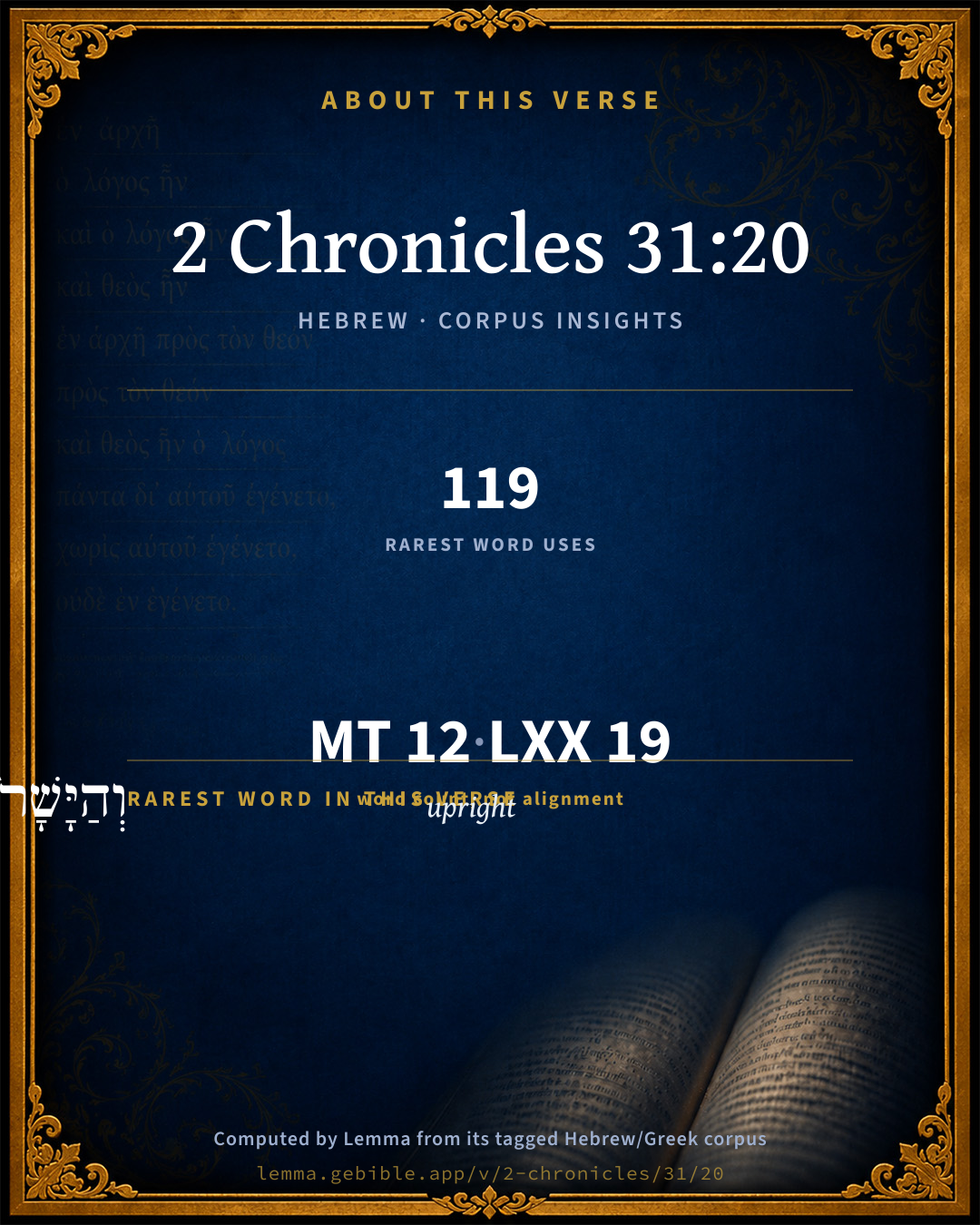
וְהַיָּשָׁר֙
yâshâr
H3477
“and · the · upright”
Conjunction + Particle, Definite Article + Adjective, Adjective, Masculine, Singular, Absolute
Part of Speech
Conjunction + Particle + Adjective
Type
Adjective
Gender
Masculine
Number
Singular
State
Absolute
Full BDB Definition

Origin: from H3474

TWOT: 930a

straight, upright, correct, right - straight, level - right, pleasing, correct - straightforward, just, upright, fitting, proper - uprightness, righteous, upright - that which is upright (substantive)
  1. וַיַּ֧עַשׂ ʻâsâh H6213 “and · to do” Conjunction + Verb, Qal, Sequential Imperfect, 3rd Person, Masculine, Singular
  2. כָּזֹ֛את zôʼth H2063 “like/as · this” Preposition + Pronoun, Demonstrative, Feminine, Singular
  3. יְחִזְקִיָּ֖הוּ Chizqîyâh H2396 “Hezekiah” Noun, Proper
  4. בְּכָל kôl H3605 “in/at · all of” Preposition + Noun, Common, Masculine, Singular, Construct
  5. יְהוּדָ֑ה Yᵉhûwdâh H3063 “Judah” Noun, Proper
  6. וַיַּ֨עַשׂ ʻâsâh H6213 “and · to do” Conjunction + Verb, Qal, Sequential Imperfect, 3rd Person, Masculine, Singular
  7. הַטּ֤וֹב ṭôwb H2896 “the · good” Particle, Definite Article + Adjective, Adjective, Masculine, Singular, Absolute
  8. וְהָ֣אֱמֶ֔ת ʼemeth H571 “and · the · faithfulness” Conjunction + Particle, Definite Article + Noun, Common, Feminine, Singular, Absolute
  9. לִפְנֵ֖י pânîym H6440 “to/for · face(s) of” Preposition + Noun, Common, Both, Plural, Construct
  10. יְהוָ֥ה Yᵉhôvâh H3068 “LORD” Noun, Proper
  11. אֱלֹהָֽיו ʼĕlôhîym H430 “God(s) · his” Noun, Common, Masculine, Plural, Construct + Suffix, Personal, 3rd Person, Masculine, Singular

About this verse

These counts appear in no published source. They are computed here, from the morphology-tagged text and Lemma’s own curated glosses. What Lemma adds →

12
words
11
distinct lemmas
Historical
section

Grammatical profile

  • 2 verbs
  • 7 nouns
  • 2 adjectives
  • 1 pronoun

Verb forms

  • וַיַּ֧עַשׂ Qal · Sequential Imperfect
  • וַיַּ֨עַשׂ Qal · Sequential Imperfect

Repetition

A word recurs within this verse — often emphatic in Hebrew:

  • וַיַּ֧עַשׂ to do H6213 ×2

Hebrew & Septuagint length

In English translation the verse runs 21 words from the Hebrew and 20 from the Septuagint (LXX English) — closely comparable.

A rough comparison of the two English renderings, which tokenize alike — not a word-level alignment.

Word counts can differ between the Hebrew and the Greek without any difference in meaning — e.g. the Hebrew direct-object marker אֵת has no separate Greek word, and Greek often adds the article ὁ.

In the original languages it is 12 Hebrew tokens and 19 Greek tokens — but the two are counted differently (Hebrew bundles its prefixes and suffixes into one token; the Greek is in lemma form), so that isn’t a like-for-like length.

Cross-references

7

Topical passages linked to 2 Chronicles 31:20 in the Treasury of Scripture Knowledge — connected by theme and wording, ordered by reader-vote popularity; previews shown in the World English Bible.

  • 2 Kings 20:3 Remember now, Yahweh, I beg you, how I have walked before you in truth and with a perfect heart, and have done that which is good in your sight. Hezekiah wept sore.
  • 2 Kings 22:2 He did that which was right in the eyes of Yahweh, and walked in all the way of David his father, and didn't turn aside to the right hand or to the left.
  • Acts 24:16 Herein I also practice always having a conscience void of offense toward God and men.
  • John 1:47 Jesus saw Nathanael coming to him, and said about him, "Behold, an Israelite indeed, in whom is no deceit!"
  • 1 Thessalonians 2:10 You are witnesses with God, how holy, righteously, and blamelessly we behaved ourselves toward you who believe.
  • 3 John 1:5 Beloved, you do a faithful work in whatever you accomplish for those who are brothers and strangers.
  • 1 Kings 15:5 because David did that which was right in the eyes of Yahweh, and didn't turn aside from anything that he commanded him all the days of his life, except only in the matter of Uriah the Hittite.

Cross-references courtesy of OpenBible.info (CC BY 4.0).

Hebrew and Greek witnesses Masoretic Hebrew ↔ Greek Septuagint

The same verse in the two great witnesses to the Old Testament, shown verse-for-verse.

These are two independent witnesses, not word-aligned to each other, and the Septuagint is shown in lemma (dictionary) form.

Hebrew 2 Chronicles 31:20 Masoretic · Westminster Leningrad Codex

וַיַּ֧עַשׂ כָּזֹ֛את יְחִזְקִיָּ֖הוּ בְּכָל יְהוּדָ֑ה וַיַּ֨עַשׂ הַטּ֤וֹב וְהַיָּשָׁר֙ וְהָ֣אֱמֶ֔ת לִפְנֵ֖י יְהוָ֥ה אֱלֹהָֽיו

Thus did Hezekiah throughout all Judah; and he worked that which was good and right and faithful before Yahweh his God.

World English Bible · Public Domain

Greek LXX 2 Chronicles 31:20 Septuagint · lemma form

καί ποιέω οὕτως εζεκιας ἐν πᾶς ἰουδά καί ποιέω ὁ καλός καί ὁ εὐθής ἐναντίον ὁ κύριος θεός αὐτός

And Ezekias did so through all Juda, and did that which was good and right before the Lord his God.

LXX2012 (modern English Septuagint) · Public Domain

Hebrew: Westminster Leningrad Codex (CC BY 4.0). Greek: Septuagint (public domain); English from LXX2012 (modern English Septuagint) (Public Domain). How the Septuagint differs from the Hebrew →

Commentary

Notes on 2 Chronicles 31:20 from classic Christian and Jewish commentators (each source and its license shown beneath its notes). The classic Christian expositions comment on the surrounding passage and are grouped to its opening verse, so a note may address several verses; the Jewish commentaries on the Tanakh (Rashi and others) are per-verse, so they appear only where the commentator wrote on this verse.

Lemma curates 59 commentaries, every one of them public domain or Creative Commons licensed, each selected and text-cleaned for this edition rather than reprinted as found. About our sources →

Jamieson, Fausset & Brown

Robert Jamieson, A. R. Fausset & David Brown

HIS SINCERITY OF HEART. (Ch2 31:20-21)

Hezekiah . . . wrought that which was good and right--He displayed the qualities of a constitutional king, in restoring and upholding the ancient institutions of the kingdom; while his zealous and persevering efforts to promote the cause of true religion and the best interests of his subjects entitled him to be ranked with the most illustrious of his predecessors (Kg2 18:15).

Next: 2 Chronicles Chapter 32

Jamieson, Fausset & Brown — Commentary Critical and Explanatory on the Whole Bible (1871) — public domain (CC PDM 1.0). Text via the HelloAO Bible API.

Trapp's Complete Commentary

John Trapp

2Ch 31:20 And thus did Hezekiah throughout all Judah, and wrought [that which was] good and right and truth before the LORD his God.

Ver. 20. And wrought that which was good, &c.] This his uprightness was the best stake in his hedge, when the news of death made all crack. {Isa 38:3}

John Trapp, A Commentary or Exposition upon All the Books of the Old and New Testament (1647–1656) — public domain. Text from a community e-Sword module.

The Biblical Illustrator

Joseph S. Exell

2Ch_31:20-21

And thus did Hezekiah throughout all Judah, and wrought that which was good.

Hezekiah-an example for young men

I. Hezekiahs religion.

1. It was expensive. He set about reforming the national religion. The spirit of such a life should be, must be, respected in every one of us if the religion we possess is to be worth anything. The young man whose mind is that of Jesus Christ has learned to live, not for himself, but for others. Harlan Page was a house joiner at Coventry, in America. His social position gave him but little influence, but what he had he gave to God. He was the living missionary wherever he went. See how Gods grace brought him out of self. He wrote: When I first obtained a hope I felt that I must labour for souls. I prayed, year after year, that God would make me the means of saving souls. Is your position that of a clerk? Imitate David Nasmith, who without talent or money sanctified the desk by working for Christ and perishing souls. He was the founder of City Missions, and the home heathen owe more to the Glasgow clerk than to any man who ever lived. Is your position that of a military officer? Imitate Hadley Vicars. The soldier of the Queen became the soldier of Christ. He had hard work to stand his ground at mess, but he did stand it; and one of the soldiers said, Since Mr. Vicars became so good he has steadied about four hundred men in the regiment. Is your position that of a merchant? Imitate George Moore, who rose to his partnership by sterling integrity, high principle, and hard work. He had no idea of growing rich and forgetting those by whose labours he accumulated his wealth. Every clerk and servant in his employment knew, in a very tangible way, that a good years business had been done. In a word, young men, whatever you may be, peer or peasant, professional man or tradesman, merchant or mechanic--come out in Gods strength as a religious man, and live for others. Let your sympathies embrace suffering bodies and perishing souls. Never mind being poor. Much of Gods work in this world has been done by men of little education, slender means, and few advantages. Do your duty for Christ and your influence will reach further than you think. Thus did Hezekiah throughout all Judah.

2. It was sound. He wrought that which was good and right, and truth before the Lord his God.. A young mans religion, to be worth anything, must be sound. If he is to do anything which is good and right and truth, he must--

(1) Be able to give some account of the hope which is in him; he must get out of the company of those who understand neither what they say, nor what they affirm.

(2) Base his religion on a personal study of the Bible.

(3) Support his religion by the plain lessons of history; the religious history of our own country.

(4) Continually submit to the teaching of the Holy Spirit.

(5) Above all, his religion must be centred in a personal Saviour.

3. It was whole-hearted.

II. Hezekiahs reward. And prospered.

1. His reward was of God.

2. He had his reward in his country. What a benefactor he must have appeared in the eyes of his subjects.

3. He had his reward in himself. (John Burbidge.)

Life in earnest

I. The sphere which Christian earnestness occupies in the Divine life.

1. It will make a man think very earnestly for his Lord and Master. In the diary of Jonathan Edwards we find the following account of his feelings towards the Lords work: I had great longing for the advancement of Christs kingdom in the world; my secret prayer used to be in great part taken up in praying for it. If I heard the least hint of anything that had happened in any part of the world which appeared to me in some respect or other to have favourable aspect on the interest of Christs kingdom, my soul eagerly caught at it, and it would much animate and refresh me. I used to read public news letters, mainly to see if I could find some news favourable to the interest of religion in the world. When we are full of zeal for God it is the same with us.

2. It will make a man plan and purpose for the cause of Christ.

3. It will show itself in perseverance.

4. It will show its zeal in an entire dependence upon God, and in intensely fervent prayer for Gods help and for Gods blessing.

II. Arguments which provoke to this earnestness.

1. The greatness of the work we have to deal with.

2. The earnestness of Satan.

3. The responsibilities which lie upon us as a Church.

4. The onflowing of the stream of death.

5. The love which we have received of Jesus.

III. May god give me fresh grace while i undertake the solemn work of dealing with careless and unconverted souls. (C. H. Spurgeon.)

The character of Hezekiah

Every man who wishes to do good in his generation, who would bless others and be blessed himself, must cultivate the same principle of goodness that Hezekiah did. In every work that he began, he did it with all his heart.

I. Inducements which should lead us to adopt this prudent and decisive conduct.

1. It saves time; or at least it leads us to apply every part of it to the best advantage. It prevents our life being abridged by years of irresolution and delay. It gives us the assurance that we are husbanding our talent well.

2. It secures our continual happiness.

3. Its beneficial effects on society are incalculable.

II. Examples of this principle are to be found--

1. In the Bible. Moses, Ezra, Nehemiah, etc.

2. In general history.

The origin and progress of almost everything great and good in society has been achieved by the zeal and active virtues of a few individuals. The advancement of the arts and sciences; the extension of commerce; the blessings and security of a legal government; the inestimable value of a pure and reformed religion, etc. (J. Hewlett, B.D.)

Hezekiahs good reign

A beautiful lily laid in your hand would show you nothing of the mud and slime of the river bed from which it sprung. Like such a lily is Hezekiah, the flower of kings. Some natures seem to grow strong in virtue, by contact with its opposite. Joseph, Moses, end Daniel ripened in strange gardens, and Hezekiah must have sucked honey out of thistles. Consider--

I. His reverence. Victor Hugo affirms that neither Wellington nor Blucher won the battle of Waterloo. Napoleon conquered himself. His own excessive weight destroyed the equilibrium. He vexed God by his importance, and so his fall was decreed. Hezekiah began his reign by exalting God and humbling himself.

II. His religious zeal.

III. His public spirit.

IV. His sincerity of heart. (Monday Club Sermons.)

How to succeed in life

There are three lessons we may learn from Hezekiah.

I. He was not afraid of work. He did not seek success without toil. Depend upon it, said Sir Walter Scott, there is nothing to be had without labour. Horace Greely said to the youth of America, The darkest day in any mans earthly career is that wherein he first fancies that there is some easier way of gaining a dollar than by squarely earning it. When I was a telegraph operator in Pittsburgh, said Andrew Carnegie, I knew all the men who speculated. I have lived to see all of them ruined--bankrupt in money and bankrupt in character. There is scarcely an instance of a man who has made a fortune by speculation and kept it.

II. Hezekiah concentrated his effort. What he did, he did with all his heart. The one prudence in life is concentration, says Emerson, the one evil is dissipation. There is a proverb which says, A canoe is paddled on both sides, which means that to succeed you must do one thing at a time, and do it with all your heart and all your powers.

III. Hezekiah aimed at thoroughness in his work. (A. F. Forrest.)

Hezekiahs thoroughness in God s service

I. We learn from Hezekiah a lesson of concentration of energy.

II. Method and punctuality, too, seem to be hinted at in the text, and they are almost indispensable to prosperity.

III. The great lesson is the value of thoroughness in doing whatever we undertake, and doing it well. Do nothing as if it were trifling.

IV. Emulate Hezekiahs ardent and consistent piety. He stands in the front rank among the saints of Scripture as a man of prayer. (J. Thain Davidson.)

Concentration

A number of tiny brooklets will turn no mill, and will probably dry up when the sun is hot, but all the water turned into one channel will move the wheel to grind the corn which may supply a town with bread. All apostles of progress in religion, or science, or philosophy, have been men whose aims have all converged to one great centre, and whose forces have been thrown upon one sublime purpose. (Handbook of Illustration.)

The objective point

In military operations there is always what is called the objective point. The objective point is the point to be made, the thing to be done; all the forces in the army are concentrated on the making of that point, and when that is made, success follows. In one sense life is a warfare, and every one should have his objective point, a clearly defined purpose, and work up to it with undeviating persistency. This is the only way he can succeed.

Enthusiastic service

A dealer in pictures who makes it his business to find as many new painters as possible, both in this country and abroad, was asked recently in regard to his methods of selecting pictures to buy. He was very frank in his talk, and one thing which he said is shrewd enough to be worth quoting. Of course, he said, with my experience I am able to judge whether there is promise in a painters work, but I never buy with any idea of putting the painter on my list until I have seen the man and talked with him myself. I always watch him closely, and I never buy his pictures unless his eye lights up when I talk to him about his work and about his profession. The artist whose heart was really in his work could not discuss it without kindling, and the man who did not paint from the heart was not the one whose pictures the dealer wanted. The remark was not only one which showed insight and shrewdness on the part of the dealer, but it is one of a good deal of significance in regard to all work. The man who does anything worth doing is the man who cannot talk about what he has accomplished or what he hopes to accomplish without enthusiasm, no matter how far short of his ideals what he has actually done may seem to him to fall.

National righteousness

From Hezekiahs conduet, and from Gods approval of it, we learn--

I. That to establish religion in a land is the duty of every righteous government.

II. That to employ the power and appliances of the state in order to extend the knowledge of God, is beneficial both to the individual and to the nation at large. (Louis Stenham, M.A.)

Impassioned men

It is the impassioned men that have made history always, religious and secular both. They are the torch to the heaped-up combustibles; they are the pulse to the general body that is listless and waiting. No man has moved the world like Jesus Christ, because no man besides Him has embodied so wide, so profound, and so Divine enthusiasm. People are passionate in everything but their passion for men; and that is the one Christian passion. (C. H. Parkhurst.)

.

The Biblical Illustrator, edited by Joseph S. Exell (c. 1880s–1900s) — public domain. Text from a community e-Sword module.

Joseph Benson's Commentary

2Ch 31:20-21. Thus did Hezekiah throughout all Judah — His pious zeal was extended through his whole kingdom; and all parts of the country, as well as those that lay next him, shared in the good fruits of his government. And wrought that which was good, and right, and truth — Whatsoever he thought was pleasing to God, conformable to the law, and profitable for his people, he performed with integrity of heart. And in every work that he began he did it with all his heart, and prospered — He prosecuted it with vigour, and brought all his good intentions to a good issue. And in all that he did in the service of the house of God, and in the government of his kingdom, he prospered. What is undertaken with a sincere and disinterested regard to the glory of God, will succeed to our own honour and comfort at last.

Joseph Benson's Commentary on the Old and New Testaments (1811–1818) — public domain. Text from a community e-Sword module.

Adam Clarke's Commentary

Verse 20. Wrought - good and right and truth] Here is the proper character of a worthy king: he is GOOD, and he does good; he is UPRIGHT, and he acts justly and maintains justice; he is truly RELIGIOUS, and he lives according to that truth which he receives as a revelation from God.

Adam Clarke's Commentary on the Bible (1810–1826) — public domain. Text from a community e-Sword/MySword module.

Ellicott's Commentary for English Readers

(20) Truth (ha’ĕmeth).—Faithfulness, or sincerity.

(20, 21) Conclusion of the account of Hezekiah’s reformation.

A Bible Commentary for English Readers, edited by Charles John Ellicott (1878–1897) — public domain. Text from a community e-Sword module.

The Cambridge Bible for Schools and Colleges

gen. ed. J. J. S. Perowne

20. and truth] R.V. and faithful.

The Cambridge Bible for Schools and Colleges (gen. ed. J. J. S. Perowne; Cambridge University Press, 1878–1918) — public domain. Text from a community e-Sword module.

John Gill's Exposition

And in every work that he began in the service of the house of God,.... In cleansing the temple, providing sacrifices, placing the priests and Levites order, taking care of the maintenance of them:

and in the law and in the commandments; in the observation of all the laws, statutes, and judgments of God, moral, ceremonial, and judicial:

to seek his God; and serve and worship him, and therein his honour and glory:

he did it with all his heart; in the most cordial, sincere, and upright manner:

and prospered; he succeeded in all he undertook, God being with him, and blessing him in his civil and religious concerns.

Next: 2 Chronicles Chapter 32

John Gill's Exposition of the Whole Bible (1746–1763) — public domain (CC PDM 1.0). Text via the HelloAO Bible API.

Haydock's Catholic Bible Commentary

God. This is the highest praise that can be given to a prince; and, in effect, we read there was none like him, 4 K. xviii. 5. C. --- Sept. omit and truth. Ezechias loved it, and sincerely desired to serve the Lord. H.

George Leo Haydock (1774–1849), Haydock's Catholic Family Bible and Commentary, 1859 edition — public domain. Excludes Psalms (Douay-Rheims chapter numbering differs from Protestant) and Deuterocanonical books (Catholic canon only).

The Pulpit Commentary

This verse, when rendered with literal exactness, is a fine instance of the force and brevity of the Hebrew style in Old Testament history; And thus did Hezekiah in all Judah, and he did the good and the right and the truth in the sight of Jehovah his God.

Vers. 20, 21.

Earnestness.

Perhaps the characteristic of Hezekiah was moral earnestness. There was no hesitation or half-heartedness about him. What he did he did "with all his heart," as is stated in the text. Under his direction everything was carried out and completed with a vigour and determination that showed that his heart as well as his hand was in his work. Hence his success in accomplishing that in which even Asa, Jehoshaphat, and Jotham, failed; by him "the high places were removed" (ver. 1); and hence the historian could say, shortly but significantly, of him that "he prospered." Regarding earnestness itself, we may consider

I ITS ESSENTIALLY SPIRITUAL NATURE. It is not a question of mere temperament; it is a distinctly moral quality. Men may be endowed with a very ardent nature, and they may, as a consequence of their natural disposition, without any praise or blame attaching to them, espouse any and every cause they adopt with the greatest warmth, throwing into it an almost consuming energy. Yet they may be far from being earnest men. Such moral earnestness as Hezekiah had, which was the glory and crown of his character, was more than this, was different from this. It was the consecration and concentration of his powers to the full performance of that which he saw to be right. It was the conscientious and determined keeping to the front, holding in full view of his soul those things which he knew to be of the first importance, which he felt entailed the weightiest obligation. Earnestness was with him, as it should be with us, not a constitutional peculiarity, but a spiritual force.

II THE DIRECTIONS IT SHOULD TAKE. Just those which it took with the wise King of Judah; he sought and wrought the good and the right and the true thing.

1. The pursuit of truth. The first thing for a man to know is What is the truth? Who is right? What is our life? Who and what are we ourselves? What can we accomplish on the earth? What is the range and what are the limits of our powers? To whom are we accountable for all we are and do? When we die, shall we live again? Has God spoken to us now in the Person of Jesus Christ? It becomes every man patiently, diligently, determinately, earnestly, to seek an answer to these questions until he finds it.

2. The acquisition of rectitude of character. To become right with God, to be right at heart, to be governed by fight principles, to be moved and prompted by a right spirit, to have a character that is sound and strong, this also is a thing to be earnestly endeavoured after until it is attained.

3. The accomplishment of that which is good and useful. It should be our most earnest hope and effort to live a life that will be one of faithful service; and, in particular, to be the servants of God. Here the earnestness of Hezekiah shone forth most brightly. "In every work that he began in the service of the house of God to seek his God, he did it with all his heart." To promote the cause and kingdom of Jesus Christ, and in this way to contribute toward the elevation and well-being of our kind, this is a direction in which our earnestness should stand out strong and clear. Let us be unmistakably in earnest in all the work we do for our Divine Saviour for him who gave himself for us. Let us live and labour "with all our heart," and with all our strength, never flagging nor failing, maintaining our devotedness through the heats of youth, and through the vigour of manhood, past the golden days of prime, still "bringing forth fruit in old age.

III ITS SUCCESS. Hezekiah "prospered;" he prospered generally because God loved him and smiled upon him, and was "with him." He prospered also in those particular spheres in which he manifested so much earnestness. It is earnestness that does prosper. Indifference does not leave the starting-post. Impulsiveness soon turns back. Halfheartedness is weary long before the course is run. But earnestness clasps the goal and wins the prize. C.

Vers. 20, 21.

The secret of prosperity.

I A LOFTY CONCEPTION OF WHAT TRUE PROSPERITY IS.

1. Negatively. It is not personal, material, and temporal aggrandizement, inasmuch as one might gain the whole world, and yet lose his own soul; (Mat_16:26) thus seeming to succeed, but in reality only gaining a disastrous failure.

2. Positively. It is working that which is good, right, and faithful before the Lord as Hezekiah did constructing a life in harmony with the Divine ideal of what a life should be, viz.

(1) good, such as God can approve, admire, and pronounce excellent; (Gen_1:31)

(2) right, according with the law of duty prescribed for God"s intelligent creatures; and

(3) faithful, in the sense of proceeding from a spirit of fidelity towards God. A life fashioned after this model is prosperous, no matter what its external environment may be.

II A RIGHT IDEA OF HOW TRUE PROSPERITY SHOULD BE SOUGHT.

1. Generally, by seeking God. Only in the knowledge and service, favour and fellowship of God, can the ideal of life above outlined be realized. To designate that career successful which has never proposed for its aim, and consequently never reached as its end, a personal acquaintance with God which has never occupied itself with either ascertaining or doing God"swill is simply to misapply language.

2. Particularly, by rendering to God acceptable worship and true obedience. To worship and obey God the chief end of man. No life can be successful which offers its homage and service to another than God, or offers only homage self-devised, and service self-directed. Both in worship and in duty the Law of God, with its specific commandments, must rule.

III A CORRECT METHOD OF PURSUING AFTER TRUE PROSPERITY. It must be sought after:

1. Always. Hezekiah kept the above aim before him "in every work that he began." Mere occasional efforts after goodness will result in nothing but failure.

2. Earnestly. Hezekiah sought it with all his heart. Half-hearted endeavours can only terminate in feeble achievements. "Whatsoever thy hand findeth to do," etc.; (Ecc_9:10) "This one thing I do". (Php_3:13)

3. Religiously. Whatever works Hezekiah engaged in were done "before the Lord his God," as in his sight and for his glory. So should it be with Christians. "Whether therefore ye eat or drink," etc.; (1Co_10:31) and "Whatsoever ye do, do it heartily, as to the Lord," etc.. W. (Col_3:23)

The Pulpit Commentary (1880–1919), ed. H.D.M. Spence-Jones & Joseph S. Exell — public domain. Text from a community e-Sword module.

unfoldingWord translationNotes

Door43 World Missions Community

to seek his God

Seeking Yahweh represents choosing to know, worship, and obey him. AT: "to obey his God" (See: Metaphor)

he performed it with all his heart

Here the word "heart" refers to a person's will and desire. AT: "he performed it with all his will" or "he was completely committed to what he did" (See: Metonymy)

translationWords

Hezekiah

Judah

good

faithful

servant

house of God

law

command

heart

unfoldingWord translationNotes — © Distant Shores Media and the Door43 World Missions Community, licensed CC BY-SA 4.0. Source: git.door43.org/Door43/en_tn.

Lesson kit

Teaching starters — assembled from the data on this page, not authored interpretation. Every prompt links to the verse data it draws on. Edit before teaching.

2 Chronicles, in the Historical, opens this verse with 12 words (11 distinct Hebrew lemmas). Its most distinctive word is yâshâr (“upright”). A historical commentator’s framing appears above. Read the whole chapter for the surrounding context.

Discussion questions

  1. How does “upright” (yâshâr) shape what this verse is saying?
  2. 2 Kings 20:3 shares this passage’s theme. How do the two illuminate each other?
  3. “to do” occurs 2× in this one verse. What is the effect of the repetition?
  4. These translations render this verse differently; the difference is in the English rendering, not the original. What questions does that raise?
  5. The verb «וַיַּ֧עַשׂ» is Qal Sequential Imperfect. How does its form color the action?
  6. Reading how Jamieson, Fausset & Brown and Trapp's Complete Commentary read this verse, where do the two commentators agree and where do they part?

Things to notice

Reading settings

Reading text

Shown beneath each verse's original-language words.

Old Testament
Old Testament edition

Read the OT as the Masoretic Hebrew (MT) or the Greek Septuagint (LXX).

English shown for the Greek Septuagint (in the Hebrew ↔ Greek comparison).

Comparing translations? Open the Compare panel on any verse page to stack up to four side by side.