1 Samuel 11:10

Hebrew (Westminster Leningrad Codex) 1 Samuel 11:10 appears in the Hebrew Old Testament. The text above is from the Westminster Leningrad Codex. Each word links to its Strong’s number, a concise gloss, and parsing drawn from the Open Scriptures Hebrew Bible morphology. Click any word for its full Brown-Driver-Briggs (BDB) entry.
Download image
Cite this verse

1 Samuel 11:10 (World English Bible). Public Domain. Lemma interlinear Bible study tool, https://lemma.gebible.app/v/1-samuel/11/10.

Show BibTeX & RIS
BibTeX
RIS
English Translation
Therefore the men of Jabesh said, Tomorrow we will come out to you, and you shall do with us all that seems good to you.
World English Bible · Public Domain
Download a study sheet

One document with this verse’s original text, its word-by-word gloss line, the meaning frame, cross-references with their text, attributed commentary, and full source and license credits — printable, and it pastes into notes with its structure intact.

This verse Autodidact and up

Study sheet (.html) Plain text (.txt)

A passage Seminary Student

Up to 50 verses in one chapter. A passage sheet keeps up to 6 commentary sources and 12 cross-references per verse, in the order this page ranks them, and says so on the sheet whenever that leaves anything out. Ask for a single verse and you get the Autodidact verse sheet above.

Everything on this page stays free to read, with no account — the sheet is a download of what is already on screen, not access to it.

Want to remove ads? Support Godless Engineer
Compare translations 3

The same verse in 3 English versions, stacked beneath the original-language interlinear above. Click any original word for its lexicon entry.

Each is an independent rendering of the whole verse — the interlinear is not word-aligned to these translations.

Highlighted words mark where these versions differ — a whole-verse word diff, not a word-by-word alignment.

  • World English Bible Public Domain
    Therefore the men of Jabesh said, Tomorrow we will come out to you, and you shall do with us all that seems good to you.
  • King James Version Public Domain
    Therefore the men of Jabesh said, To morrow we will come out unto you, and ye shall do with us all that seemeth good unto you.
  • unfoldingWord Literal Text CC BY-SA 4.0
    And the men of Jabesh said, “Tomorrow we will go out to you. And you may do to us according to all of the good in your eyes.”

unfoldingWord Literal Text — © unfoldingWord, licensed CC BY-SA 4.0. Word-aligned USFM3 via Door43 (git.door43.org/unfoldingWord/en_ult).

Versions to compare (up to 4)

3 of 4 selected

Show all 18 translations

Every available English version of this verse, each an independent rendering of the whole verse.

  • World English Bible Public Domain
    Therefore the men of Jabesh said, Tomorrow we will come out to you, and you shall do with us all that seems good to you.
  • Berean Standard Bible Public Domain
    Then the men of Jabesh said to Nahash, “Tomorrow we will come out, and you can do with us whatever seems good to you.”
  • Majority Standard Bible Public Domain
    Then the men of Jabesh said to Nahash, “Tomorrow we will come out, and you can do with us whatever seems good to you.”
  • King James Version Public Domain
    Therefore the men of Jabesh said, To morrow we will come out unto you, and ye shall do with us all that seemeth good unto you.
  • American Standard Version (1901) Public Domain
    Therefore the men of Jabesh said, To-morrow we will come out unto you, and ye shall do with us all that seemeth good unto you.
  • Revised Version (1885) Public Domain
    Therefore the men of Jabesh said, Tomorrow we will come out unto you, and ye shall do with us all that seemeth good unto you.
  • Geneva Bible (1599) Public Domain
    Therefore the men of Iabesh sayde, To morowe we will come out vnto you, and yee shall doe with vs all that pleaseth you.
  • Douay-Rheims (1899) Public Domain
    And they said: In the morning we will come out to you: and you shall do what you please with us.
  • Young's Literal Translation Public Domain
    and the men of Jabesh say `to the Ammonites', `To-morrow we come out unto you, and ye have done to us according to all that `is' good in your eyes.'
  • Literal Standard Version CC BY-SA 4.0
    and the men of Jabesh say [to the Ammonites], “Tomorrow we come out to you, and you have done to us according to all that [is] good in your eyes.”
  • Unlocked Literal Bible CC BY-SA 4.0
    Then the men of Jabesh said to Nahash, “Tomorrow we will surrender to you, and you can do to us whatever seems good to you.”
  • unfoldingWord Literal Text CC BY-SA 4.0
    And the men of Jabesh said, “Tomorrow we will go out to you. And you may do to us according to all of the good in your eyes.”
  • Darby Bible Public Domain
    And the men of Jabesh said, To-morrow we will come out to you, and ye may do with us according to all that is good in your sight.
  • World Messianic Bible Public Domain
    Therefore the men of Jabesh said, “Tomorrow we will come out to you, and you shall do with us all that seems good to you.”
  • Webster's Bible Public Domain
    Therefore the men of Jabesh said, To-morrow we will come out to you, and ye shall do with us all that seemeth good to you.
  • Free Bible Version CC BY-SA 4.0
    They told the Ammonites, “We will surrender to you tomorrow, and then you can do to us whatever you want.”
  • Bible in Basic English Public Domain
    So the men of Jabesh said, Tomorrow we will come out to you, and you may do to us whatever seems good to you.
  • JPS Tanakh (1917) Public Domain
    And the men of Jabesh said: 'To-morrow we will come out unto you, and ye shall do with us all that seemeth good unto you.'

Literal Standard Version (2020), Covenant Press — licensed CC BY-SA 4.0. Text via the HelloAO Bible API (eBible.org). Unlocked Literal Bible (unfoldingWord) — licensed CC BY-SA 4.0. Text via the HelloAO Bible API (eBible.org). unfoldingWord Literal Text — © unfoldingWord, licensed CC BY-SA 4.0. Word-aligned USFM3 via Door43 (git.door43.org/unfoldingWord/en_ult). Free Bible Version, Dr. Jonathan Gallagher — licensed CC BY-SA 4.0. Text via the HelloAO Bible API (eBible.org).

Word by word

More ways to search: Search by grammar → Find every occurrence → Compare this word →

Practice this passage: Drill this verse → Learn its vocabulary →

יָבֵ֔ישׁ
Yâbêsh
H3003
“Jabesh”
Noun, Proper
Part of Speech
Noun
Type
Proper
Full BDB Definition

Origin: the same as H3002 (also Yabeysh yaw-bashe')

TWOT: None

Jabesh = "dry" - a town in the territory of Gilead; according to Eusebius, it is beyond the Jordan, 6 miles (10 kilometers) from Pella, on the mountain road to Gerasa; site unknown but may be modern 'Wadi Yabes' (noun proper locative) - father of Shallum, the 15th king of the northern kingdom (noun proper masculine)
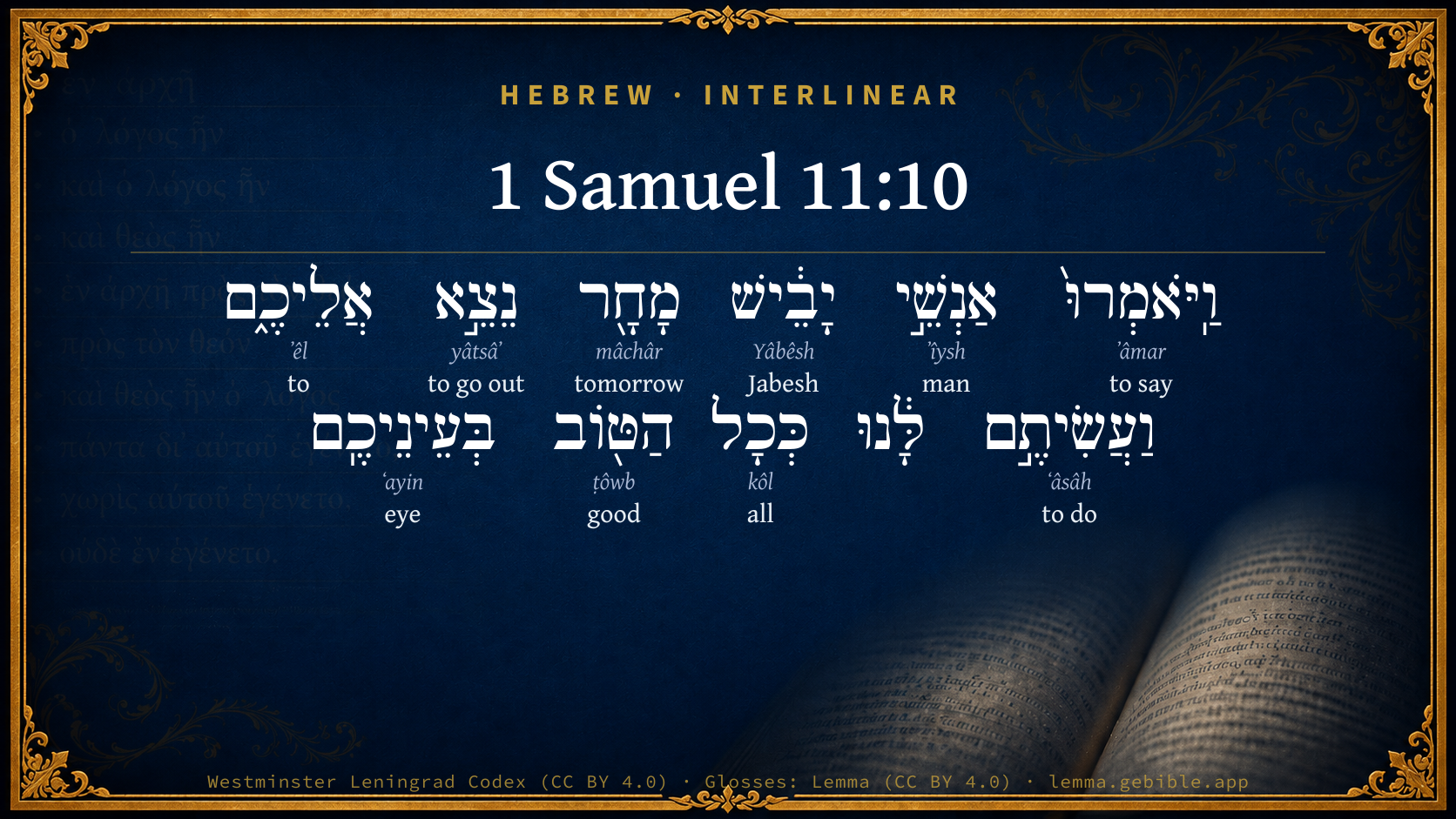
  1. וַֽיֹּאמְרוּ֙ ʼâmar H559 “and · to say” Conjunction + Verb, Qal, Sequential Imperfect, 3rd Person, Masculine, Plural
  2. אַנְשֵׁ֣י ʼîysh H376 “men of” Noun, Common, Masculine, Plural, Construct
  3. מָחָ֖ר mâchâr H4279 “tomorrow” Noun, Common, Masculine, Singular, Absolute
  4. נֵצֵ֣א yâtsâʼ H3318 “to go out” Verb, Qal, Imperfect, 1st Person, Common, Plural
  5. אֲלֵיכֶ֑ם ʼêl H413 “to · you” Preposition + Suffix, Personal, 2nd Person, Masculine, Plural
  6. וַעֲשִׂיתֶ֣ם ʻâsâh H6213 “and · to do” Conjunction + Verb, Qal, Sequential Perfect, 2nd Person, Masculine, Plural
  7. כְּכָל kôl H3605 “like/as · all of” Preposition + Noun, Common, Masculine, Singular, Construct
  8. הַטּ֖וֹב ṭôwb H2896 “the · good” Particle, Definite Article + Adjective, Adjective, Masculine, Singular, Absolute
  9. בְּעֵינֵיכֶֽם ʻayin H5869 “in/at · eyes · your” Preposition + Noun, Common, Both, Dual, Construct + Suffix, Personal, 2nd Person, Masculine, Plural

About this verse

These counts appear in no published source. They are computed here, from the morphology-tagged text and Lemma’s own curated glosses. What Lemma adds →

11
words
10
distinct lemmas
Historical
section

Notable vocabulary

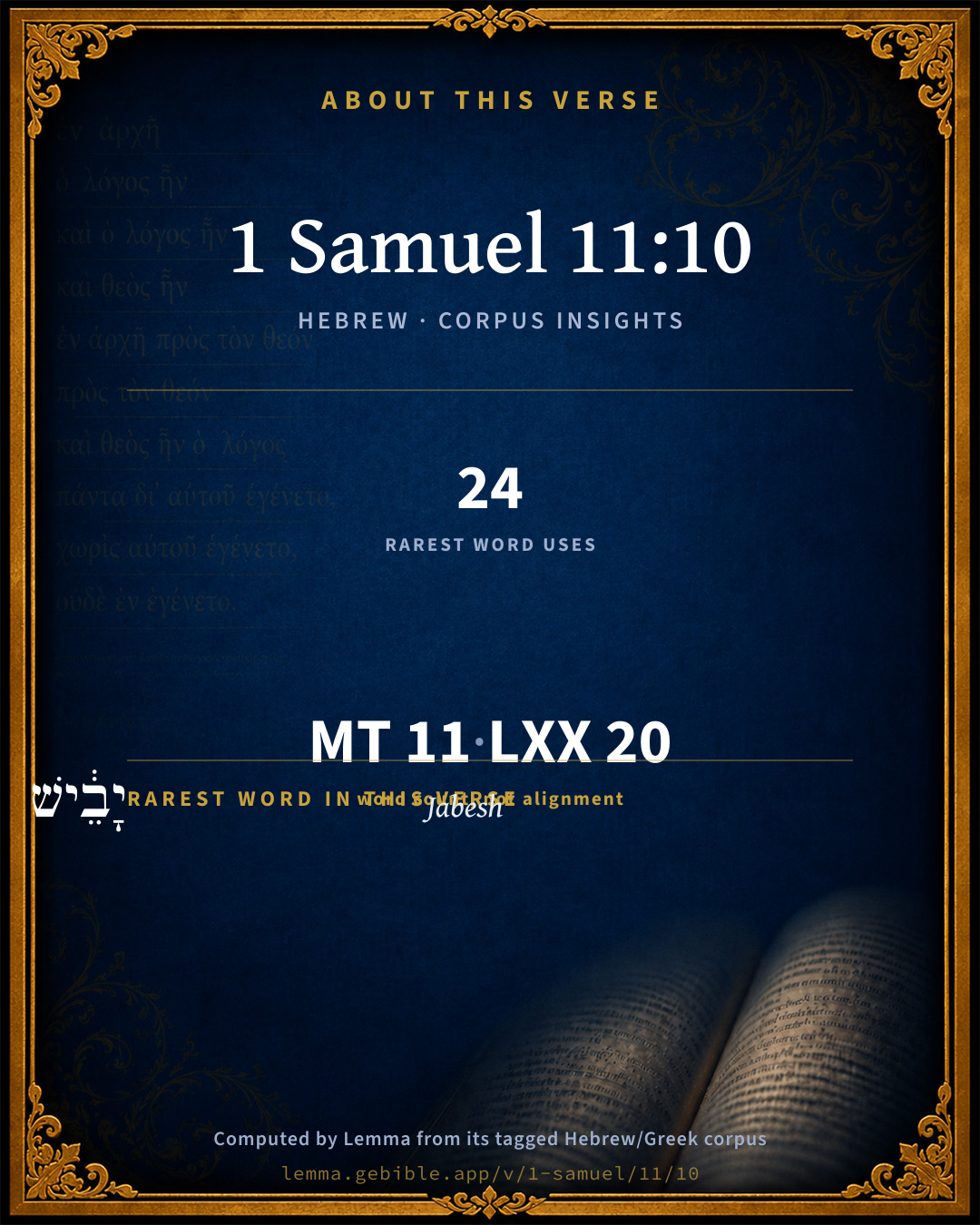
The rarest word here is יָבֵ֔ישׁ Jabesh H3003 — appearing just 24 times in the whole Hebrew Bible.

Shared distinctive vocabulary

יָבֵ֔ישׁ Jabesh H3003 occurs in 21 verses of the Hebrew Bible. Also found in:

Grammatical profile

  • 3 verbs
  • 5 nouns
  • 1 adjective
  • 2 prepositions

Verb forms

  • וַֽיֹּאמְרוּ֙ Qal · Sequential Imperfect
  • נֵצֵ֣א Qal · Imperfect
  • וַעֲשִׂיתֶ֣ם Qal · Sequential Perfect

Hebrew & Septuagint length

In English translation the verse runs 25 words from the Hebrew and 29 from the Septuagint (LXX English) — closely comparable.

A rough comparison of the two English renderings, which tokenize alike — not a word-level alignment.

Word counts can differ between the Hebrew and the Greek without any difference in meaning — e.g. the Hebrew direct-object marker אֵת has no separate Greek word, and Greek often adds the article ὁ.

In the original languages it is 11 Hebrew tokens and 20 Greek tokens — but the two are counted differently (Hebrew bundles its prefixes and suffixes into one token; the Greek is in lemma form), so that isn’t a like-for-like length.

Cross-references

1

Topical passages linked to 1 Samuel 11:10 in the Treasury of Scripture Knowledge — connected by theme and wording, ordered by reader-vote popularity; previews shown in the World English Bible.

  • 1 Samuel 11:2–3 Nahash the Ammonite said to them, On this condition will I make it with you, that all your right eyes be put out; and I will lay it for a reproach on all Israel.

Cross-references courtesy of OpenBible.info (CC BY 4.0).

Hebrew and Greek witnesses Masoretic Hebrew ↔ Greek Septuagint

The same verse in the two great witnesses to the Old Testament, shown verse-for-verse.

These are two independent witnesses, not word-aligned to each other, and the Septuagint is shown in lemma (dictionary) form.

Hebrew 1 Samuel 11:10 Masoretic · Westminster Leningrad Codex

וַֽיֹּאמְרוּ֙ אַנְשֵׁ֣י יָבֵ֔ישׁ מָחָ֖ר נֵצֵ֣א אֲלֵיכֶ֑ם וַעֲשִׂיתֶ֣ם לָּ֔נוּ כְּכָל הַטּ֖וֹב בְּעֵינֵיכֶֽם

Therefore the men of Jabesh said, Tomorrow we will come out to you, and you shall do with us all that seems good to you.

World English Bible · Public Domain

Greek LXX 1 Samuel 11:10 Septuagint · lemma form

καί εἶπον ὁ ἀνήρ ιαβις πρός ναας ὁ αμμανίτης αὔριον ἐκἔρχομαι πρός σύ καί ποιέω ἐγώ ὁ ἀγαθός ἐνώπιον σύ

And the men of Jabis said to Naas the Ammanite, To-morrow we will come forth to you, and you⌃ shall do to us what seems good in your sight.

LXX2012 (modern English Septuagint) · Public Domain

Hebrew: Westminster Leningrad Codex (CC BY 4.0). Greek: Septuagint (public domain); English from LXX2012 (modern English Septuagint) (Public Domain). How the Septuagint differs from the Hebrew →

Targum (Aramaic paraphrase)

1

The Targum is the ancient Jewish Aramaic paraphrase of the Hebrew Scriptures — an interpretive translation, not the Hebrew text itself. Onkelos (literal) and Pseudo-Jonathan (expansive) render the Torah, and Jonathan the Prophets. Coverage is partial: where no permissively-licensed English translation exists for a verse, only the Aramaic is shown. This is verse-level text, not a word-by-word alignment to the Hebrew.

  1. Targum Jonathan Prophets (Joshua–Malachi)
    וַאֲמַרוּ אֱנָשֵׁי יָבֵשׁ מְחַר נִפּוֹק לְוַתְכוּן וְתַעְבְּדוּן לָנָא כְּכוֹל דְתַקִין בְּעֵינֵיכוֹן:

    (no public-domain English translation for this verse)

    Targum Jonathan — Aramaic: “Mikraot Gedolot” (public domain). English: “Sefaria Community Translation” (CC0 1.0 (public-domain dedication)); “London "Chaldee Paraphrase," 1871” (public domain). Text via Sefaria.

Commentary

Notes on 1 Samuel 11:10 from classic Christian and Jewish commentators (each source and its license shown beneath its notes). The classic Christian expositions comment on the surrounding passage and are grouped to its opening verse, so a note may address several verses; the Jewish commentaries on the Tanakh (Rashi and others) are per-verse, so they appear only where the commentator wrote on this verse.

Lemma curates 59 commentaries, every one of them public domain or Creative Commons licensed, each selected and text-cleaned for this edition rather than reprinted as found. About our sources →

Trapp's Complete Commentary

John Trapp

1Sa 11:10 Therefore the men of Jabesh said, To morrow we will come out unto you, and ye shall do with us all that seemeth good unto you.

Ver. 10. Tomorrow we will come out,] viz., If help come not in the meanwhile; but this they cunningly concealed.

John Trapp, A Commentary or Exposition upon All the Books of the Old and New Testament (1647–1656) — public domain. Text from a community e-Sword module.

Joseph Benson's Commentary

1Sa 11:10. Tomorrow we will come out unto you — They spoke this by way of stratagem, to make the Ammonites easy and secure.

Joseph Benson's Commentary on the Old and New Testaments (1811–1818) — public domain. Text from a community e-Sword module.

Geneva Bible (1599)

Geneva Bible translators

That is, to the Ammonites, dissembling that they had hope of aid.

Geneva Bible (1599) marginal notes — public domain. Text via Bolls.life.

Adam Clarke's Commentary

Verse 10. To-morrow we will come out unto you] They concealed the information they had received of Saul's promised assistance. They did come out unto them; but it was in a different manner to what the Ammonites expected.

Adam Clarke's Commentary on the Bible (1810–1826) — public domain. Text from a community e-Sword/MySword module.

The Cambridge Bible for Schools and Colleges

gen. ed. J. J. S. Perowne

10. the men of Jabesh said] To Nahash, in order to lull him into careless security, by leading him to suppose that their efforts to get help had failed.

The Cambridge Bible for Schools and Colleges (gen. ed. J. J. S. Perowne; Cambridge University Press, 1878–1918) — public domain. Text from a community e-Sword module.

John Gill's Exposition

And it was so on the morrow,.... After the messengers were returned, and delivered their message, and the men of Jabeshgilead had given the Ammonites reason to expect that they would come out to them according to their agreement:

that Saul put the people into three companies; or "heads" (a), under so many commanders, assigning to each their number, if equally, 110,000 in each, as Gideon divided his three hundred into three companies, one hundred in each, Jdg 7:16 and Abimelech, Jdg 9:43 it seems to have been their way of fighting in those days:

and they came unto the midst of the host: that is, of the Ammonites:

in the morning watch; the third and last watch of the night, by break of day, or before, however before the sun was up; so quick was Saul and his men in their march, though on foot. Bunting (b) computes the distance from Gibeah to Bezek forty miles, and from thence to Jabesh sixteen; it is commonly reckoned that it was about sixty miles from Gibeah to Jabesh. Josephus (c) says it was ten "schaeni", each of which contained five or six miles:

and slew the Ammonites until the heat of the day; that is, till noon, so that from the morning watch till noon he was making slaughter of them:

and it came to pass, that they which remained were scattered; those that were not cut off by the sword of Saul were broken and dispersed, they could not stand their ground against him:

so that two of them were not left together; to flee together, but every one shifted for himself, and fled alone.

(a) "capita", Pagninus, Montanus, &c. (b) Travels of the Patriarchs, &c. p. 126. (c) Ut supra. (Antiqu. l. 6. c. 5. sect. 3.)

John Gill's Exposition of the Whole Bible (1746–1763) — public domain (CC PDM 1.0). Text via the HelloAO Bible API.

Albert Barnes' Notes on the Bible

Tomorrow - Probably the last of the “seven days’ respite” 1Sa 11:3. Their words were spoken in guile, to throw the Ammonites off their guard.

Albert Barnes' Notes on the Bible (1834–1885) — public domain. Text from a community e-Sword/MySword module.

Haydock's Catholic Bible Commentary

To you, Naas, (Haydock) which they speak in irony, and that the enemy may be off his guard. (Calmet) --- We must thus deceive our passions, that we may not be blinded (Haydock) or slain by them. (St. Gregory, v. 1. in Reg.) (Worthington)

George Leo Haydock (1774–1849), Haydock's Catholic Family Bible and Commentary, 1859 edition — public domain. Excludes Psalms (Douay-Rheims chapter numbering differs from Protestant) and Deuterocanonical books (Catholic canon only).

Matthew Poole's English Annotations

They did and might reasonably and justly understand their own condition before proposed, 1Sa 11:3, if none came to save them; which they were not now obliged to repeat, although they conjectured that their enemies would understand it absolutely, whose error therein they were no more obliged to correct, than to prevent their destruction. Nor did they tell any lie herein, but only concealed part of their intentions, to render their enemy more secure and fit for ruin; which kind of stratagems are usual, and allowed by all persons.

Matthew Poole's English Annotations on the Holy Bible (1683–1685) — public domain. Text from a community e-Sword/MySword module.

Whedon's Commentary on the Bible

Daniel D. Whedon

10. To-morrow we will come out unto you — By this guileful message they sought to make the enemy feel all the more secure and confident of success, and thus subject them to a more humiliating defeat.

Daniel D. Whedon (gen. ed.), Commentary on the Old and New Testaments (1874–1909) — public domain. Text from a community e-Sword module.

The Pulpit Commentary

Tomorrow we will come out unto you. This was apparently intended to throw the Ammonites off their guard, as they would suppose that the men of Jabesh-Gilead had given up all hopes of deliverance.

The Pulpit Commentary (1880–1919), ed. H.D.M. Spence-Jones & Joseph S. Exell — public domain. Text from a community e-Sword module.

Lesson kit

Teaching starters — assembled from the data on this page, not authored interpretation. Every prompt links to the verse data it draws on. Edit before teaching.

1 Samuel, in the Historical, opens this verse with 11 words (10 distinct Hebrew lemmas). Its most distinctive word is Yâbêsh (“Jabesh”). A historical commentator’s framing appears above. Read the whole chapter for the surrounding context.

Discussion questions

  1. How does “Jabesh” (Yâbêsh) shape what this verse is saying?
  2. How does Judges 21:8, which shares the word «Jabesh», read alongside this verse?
  3. These translations render this verse differently; the difference is in the English rendering, not the original. What questions does that raise?
  4. «וַֽיֹּאמְרוּ֙» is a Qal Sequential Imperfect verb. How does that grammatical form shape the action described?
  5. Compare how Trapp's Complete Commentary and Joseph Benson's Commentary read this verse. Where do they agree or differ?

Things to notice

Reading settings

Reading text

Shown beneath each verse's original-language words.

Old Testament
Old Testament edition

Read the OT as the Masoretic Hebrew (MT) or the Greek Septuagint (LXX).

English shown for the Greek Septuagint (in the Hebrew ↔ Greek comparison).

Comparing translations? Open the Compare panel on any verse page to stack up to four side by side.