

2 Samuel 18:27

Hebrew (Westminster Leningrad Codex) 2 Samuel 18:27 appears in the Hebrew Old Testament. The text above is from the Westminster Leningrad Codex. Each word links to its Strong’s number, a concise gloss, and parsing drawn from the Open Scriptures Hebrew Bible morphology. Click any word for its full Brown-Driver-Briggs (BDB) entry.
Download image
Cite this verse

2 Samuel 18:27 (World English Bible). Public Domain. Lemma interlinear Bible study tool, https://lemma.gebible.app/v/2-samuel/18/27.

Show BibTeX & RIS
BibTeX
RIS
English Translation
The watchman said, I think the running of the foremost is like the running of Ahimaaz the son of Zadok. The king said, He is a good man, and comes with good news.
World English Bible · Public Domain
Highlights
  • 1 first appearance in the Hebrew Bible
Full analysis ↓
Download a study sheet

One document with this verse’s original text, its word-by-word gloss line, the meaning frame, cross-references with their text, attributed commentary, and full source and license credits — printable, and it pastes into notes with its structure intact.

This verse Autodidact and up

Study sheet (.html) Plain text (.txt)

A passage Seminary Student

Up to 50 verses in one chapter. A passage sheet keeps up to 6 commentary sources and 12 cross-references per verse, in the order this page ranks them, and says so on the sheet whenever that leaves anything out. Ask for a single verse and you get the Autodidact verse sheet above.

Everything on this page stays free to read, with no account — the sheet is a download of what is already on screen, not access to it.

Want to remove ads? Support Godless Engineer
Compare translations 3

The same verse in 3 English versions, stacked beneath the original-language interlinear above. Click any original word for its lexicon entry.

Each is an independent rendering of the whole verse — the interlinear is not word-aligned to these translations.

Highlighted words mark where these versions differ — a whole-verse word diff, not a word-by-word alignment.

  • World English Bible Public Domain
    The watchman said, I think the running of the foremost is like the running of Ahimaaz the son of Zadok. The king said, He is a good man, and comes with good news.
  • King James Version Public Domain
    And the watchman said, Me thinketh the running of the foremost is like the running of Ahimaaz the son of Zadok. And the king said, He is a good man, and cometh with good tidings.
  • unfoldingWord Literal Text CC BY-SA 4.0
    And the watcher said, “I am seeing the running of the first like the running of Ahimaaz, the son of Zadok.” And the king said, “This a good man, and he comes with good news.”

unfoldingWord Literal Text — © unfoldingWord, licensed CC BY-SA 4.0. Word-aligned USFM3 via Door43 (git.door43.org/unfoldingWord/en_ult).

Versions to compare (up to 4)

3 of 4 selected

Show all 18 translations

Every available English version of this verse, each an independent rendering of the whole verse.

  • World English Bible Public Domain
    The watchman said, I think the running of the foremost is like the running of Ahimaaz the son of Zadok. The king said, He is a good man, and comes with good news.
  • Berean Standard Bible Public Domain
    The watchman said, “The first man appears to me to be running like Ahimaaz son of Zadok.” “This is a good man,” said the king. “He comes with good news.”
  • Majority Standard Bible Public Domain
    The watchman said, “The first man appears to me to be running like Ahimaaz son of Zadok.” “This is a good man,” said the king. “He comes with good news.”
  • King James Version Public Domain
    And the watchman said, Me thinketh the running of the foremost is like the running of Ahimaaz the son of Zadok. And the king said, He is a good man, and cometh with good tidings.
  • American Standard Version (1901) Public Domain
    And the watchman said, I think the running of the foremost is like the running of Ahimaaz the son of Zadok. And the king said, He is a good man, and cometh with good tidings.
  • Revised Version (1885) Public Domain
    And the watchman said, Me thinketh the running of the foremost is like the running of Ahimaaz the son of Zadok. And the king said, He is a good man, and cometh with good tidings.
  • Geneva Bible (1599) Public Domain
    And the watchman said, Me thinketh the running of the formost is like the running of Ahimaaz the sonne of Zadok. Then the King said, He is a good man, and commeth with good tidings.
  • Douay-Rheims (1899) Public Domain
    And the watchman said: The running of the foremost seemeth to me like the running of Achimaas the son of Sadoc. And the king said: He is a good man: and cometh with good news.
  • Young's Literal Translation Public Domain
    And the watchman saith, `I see the running of the first as the running of Ahimaaz son of Zadok.' And the king saith, `This `is' a good man, and with good tidings he cometh.'
  • Literal Standard Version CC BY-SA 4.0
    And the watchman says, “I see the running of the first as the running of Ahimaaz son of Zadok.” And the king says, “This [is] a good man, and he comes with good tidings.”
  • Unlocked Literal Bible CC BY-SA 4.0
    So the watchman said, “I think the running of the man in front is like the running of Ahimaaz son of Zadok.” The king said, “He is a good man and is coming with good news.”
  • unfoldingWord Literal Text CC BY-SA 4.0
    And the watcher said, “I am seeing the running of the first like the running of Ahimaaz, the son of Zadok.” And the king said, “This a good man, and he comes with good news.”
  • Darby Bible Public Domain
    And the watchman said, I see the running of the foremost like the running of Ahimaaz the son of Zadok. And the king said, He is a good man; and comes with good news.
  • World Messianic Bible Public Domain
    The watchman said, “I think the running of the first one is like the running of Ahimaaz the son of Zadok.” The king said, “He is a good man, and comes with good news.”
  • Webster's Bible Public Domain
    And the watchman said, I think the running of the foremost is like the running of Ahimaaz the son of Zadok. And the king said, He is a good man, and cometh with good news.
  • Free Bible Version CC BY-SA 4.0
    “The first man seems to me to be running like Ahimaaz, son of Zadok,” said the watchman. “He's a good man,” the king replied. “He'll bring good news.”
  • Bible in Basic English Public Domain
    And the watchman said, It seems to me that the running of the first is like the running of Ahimaaz, the son of Zadok. And the king said, He is a good man, and his news will be good.
  • JPS Tanakh (1917) Public Domain
    And the watchman said: 'I think the running of the foremost is like the running of Ahimaaz the son of Zadok.' And the king said: 'He is a good man, and cometh with good tidings.'

Literal Standard Version (2020), Covenant Press — licensed CC BY-SA 4.0. Text via the HelloAO Bible API (eBible.org). Unlocked Literal Bible (unfoldingWord) — licensed CC BY-SA 4.0. Text via the HelloAO Bible API (eBible.org). unfoldingWord Literal Text — © unfoldingWord, licensed CC BY-SA 4.0. Word-aligned USFM3 via Door43 (git.door43.org/unfoldingWord/en_ult). Free Bible Version, Dr. Jonathan Gallagher — licensed CC BY-SA 4.0. Text via the HelloAO Bible API (eBible.org).

Word by word

More ways to search: Search by grammar → Find every occurrence → Compare this word →

Practice this passage: Drill this verse → Learn its vocabulary →

מְרוּצַ֣ת
mᵉrûwtsâh
H4794
“course of”
Noun, Common, Feminine, Singular, Construct
Part of Speech
Noun
Type
Common
Gender
Feminine
Number
Singular
State
Construct
Full BDB Definition

Origin: from H4793

TWOT: 2137b

running, course (of life) - running, mode or style of running - course (of life)
  1. וַיֹּ֨אמֶר֙ ʼâmar H559 “and · to say” Conjunction + Verb, Qal, Sequential Imperfect, 3rd Person, Masculine, Singular
  2. הַצֹּפֶ֔ה tsâphâh H6822 “the · keeping watch” Particle, Definite Article + Verb, Qal, Participle Active, Masculine, Singular, Absolute
  3. אֲנִ֤י ʼănîy H589 “I” Pronoun, Personal, 1st Person, Common, Singular
  4. רֹאֶה֙ râʼâh H7200 “seeing” Verb, Qal, Participle Active, Masculine, Singular, Absolute
  5. אֶת ʼêth H853 “-” Particle, Direct Object
  6. הָרִאשׁ֔וֹן riʼshôwn H7223 “the · first” Particle, Definite Article + Adjective, Ordinal number, Masculine, Singular, Absolute
  7. כִּמְרֻצַ֖ת mᵉrûwtsâh H4794 “like/as · course of” Preposition + Noun, Common, Feminine, Singular, Construct
  8. אֲחִימַ֣עַץ ʼĂchîymaʻats H290 “Ahimaaz” Noun, Proper
  9. בֶּן bên H1121 “son of” Noun, Common, Masculine, Singular, Construct
  10. צָד֑וֹק Tsâdôwq H6659 “Zadok” Noun, Proper
  11. וַיֹּ֤אמֶר ʼâmar H559 “and · to say” Conjunction + Verb, Qal, Sequential Imperfect, 3rd Person, Masculine, Singular
  12. הַמֶּ֨לֶךְ֙ melek H4428 “the · king” Particle, Definite Article + Noun, Common, Masculine, Singular, Absolute
  13. אִֽישׁ ʼîysh H376 “man” Noun, Common, Masculine, Singular, Absolute
  14. ט֣וֹב ṭôwb H2896 “good” Adjective, Adjective, Masculine, Singular, Absolute
  15. זֶ֔ה zeh H2088 “this” Pronoun, Demonstrative, Masculine, Singular
  16. וְאֶל ʼêl H413 “and · to” Conjunction + Preposition
  17. בְּשׂוֹרָ֥ה bᵉsôwrâh H1309 “good news” Noun, Common, Feminine, Singular, Absolute
  18. טוֹבָ֖ה ṭôwb H2896 “good” Adjective, Adjective, Feminine, Singular, Absolute
  19. יָבֽוֹא bôwʼ H935 “to enter” Verb, Qal, Imperfect, 3rd Person, Masculine, Singular

About this verse

These counts appear in no published source. They are computed here, from the morphology-tagged text and Lemma’s own curated glosses. What Lemma adds →

20
words
17
distinct lemmas
Historical
section

Notable vocabulary

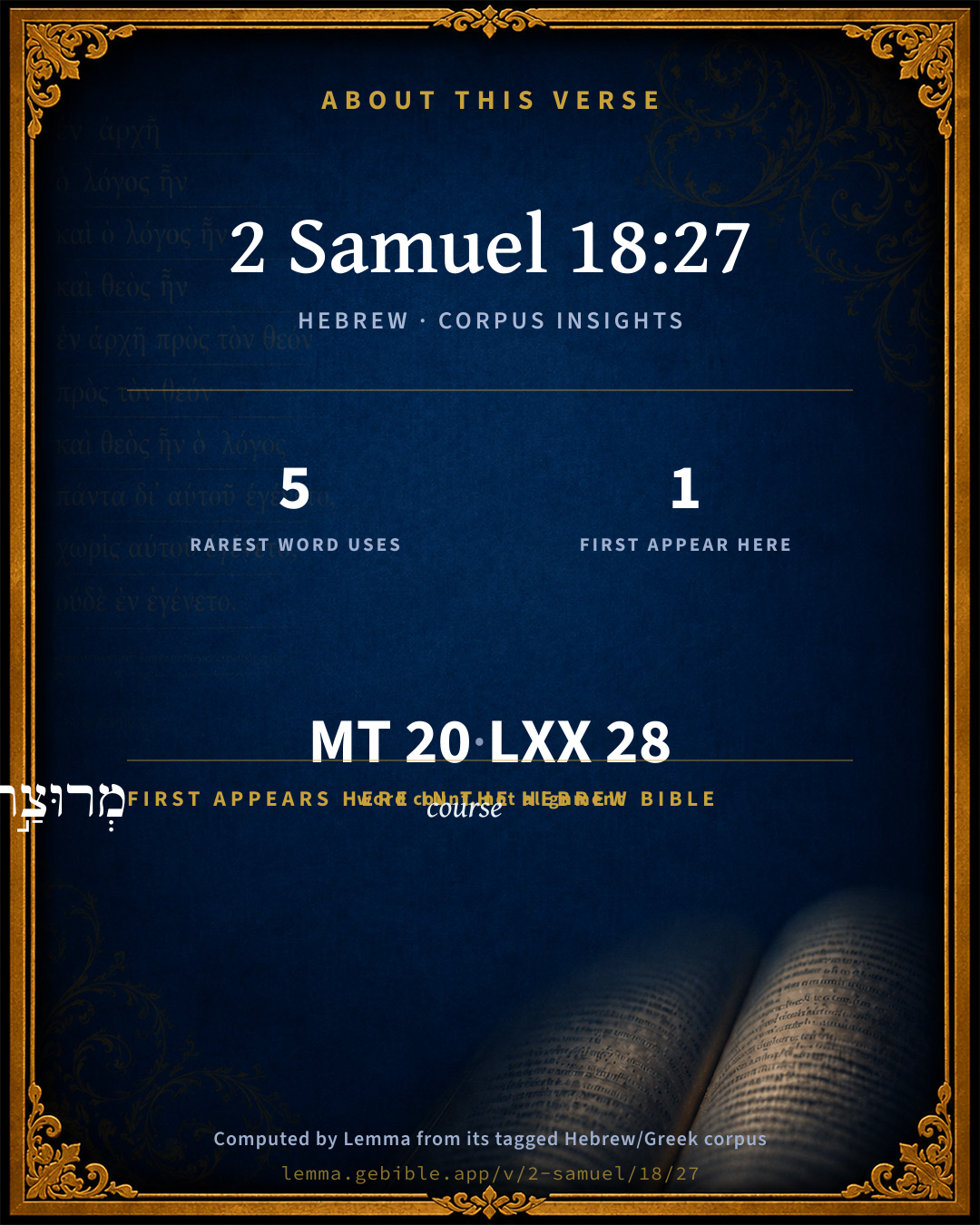
The rarest word here is מְרוּצַ֣ת course H4794 — appearing just 5 times in the whole Hebrew Bible.

First appearance in Scripture

This word makes its first canonical appearance in the Hebrew Bible here:

  • מְרוּצַ֣ת course H4794

Shared distinctive vocabulary

מְרוּצַ֣ת course H4794 occurs in 3 verses of the Hebrew Bible. Also found in:

Grammatical profile

  • 5 verbs
  • 8 nouns
  • 3 adjectives
  • 2 pronouns
  • 1 preposition
  • 1 particle

Verb forms

  • וַיֹּ֨אמֶר֙ Qal · Sequential Imperfect
  • הַצֹּפֶ֔ה Qal · Participle Active
  • רֹאֶה֙ Qal · Participle Active
  • וַיֹּ֤אמֶר Qal · Sequential Imperfect
  • יָבֽוֹא Qal · Imperfect

Repetition

Words recur within this verse — often emphatic in Hebrew:

  • וַיֹּ֨אמֶר֙ to say H559 ×2
  • מְרוּצַ֣ת course H4794 ×2
  • ט֣וֹב good H2896 ×2

Hebrew & Septuagint length

In English translation the verse runs 33 words from the Hebrew and 36 from the Septuagint (LXX English) — closely comparable.

A rough comparison of the two English renderings, which tokenize alike — not a word-level alignment.

Word counts can differ between the Hebrew and the Greek without any difference in meaning — e.g. the Hebrew direct-object marker אֵת has no separate Greek word, and Greek often adds the article ὁ.

In the original languages it is 20 Hebrew tokens and 28 Greek tokens — but the two are counted differently (Hebrew bundles its prefixes and suffixes into one token; the Greek is in lemma form), so that isn’t a like-for-like length.

Cross-references

6

Topical passages linked to 2 Samuel 18:27 in the Treasury of Scripture Knowledge — connected by theme and wording, ordered by reader-vote popularity; previews shown in the World English Bible.

  • 2 Kings 9:20 The watchman told, saying, He came even to them, and isn't coming back: and the driving is like the driving of Jehu the son of Nimshi; for he drives furiously.
  • 1 Kings 1:42 While he yet spoke, behold, Jonathan the son of Abiathar the priest came: and Adonijah said, Come in; for you are a worthy man, and bring good news.
  • Romans 10:15 And how will they preach unless they are sent? As it is written: "How beautiful are the feet of those who preach the Gospel of peace, Who bring glad tidings of good things!"
  • Proverbs 25:13 As the cold of snow in the time of harvest, So is a faithful messenger to those who send him; For he refreshes the soul of his masters.
  • Proverbs 25:25 Like cold water to a thirsty soul, So is good news from a far country.
  • Isaiah 52:7 How beautiful on the mountains are the feet of him who brings good news, who publishes peace, who brings good news of good, who publishes salvation, who says to Zion, Your God reigns!

Cross-references courtesy of OpenBible.info (CC BY 4.0).

Hebrew and Greek witnesses Masoretic Hebrew ↔ Greek Septuagint

The same verse in the two great witnesses to the Old Testament, shown verse-for-verse.

These are two independent witnesses, not word-aligned to each other, and the Septuagint is shown in lemma (dictionary) form.

Hebrew 2 Samuel 18:27 Masoretic · Westminster Leningrad Codex

וַיֹּ֨אמֶר֙ הַצֹּפֶ֔ה אֲנִ֤י רֹאֶה֙ אֶת מְרוּצַ֣ת הָרִאשׁ֔וֹן כִּמְרֻצַ֖ת אֲחִימַ֣עַץ בֶּן צָד֑וֹק וַיֹּ֤אמֶר הַמֶּ֨לֶךְ֙ אִֽישׁ ט֣וֹב זֶ֔ה וְאֶל בְּשׂוֹרָ֥ה טוֹבָ֖ה יָבֽוֹא

The watchman said, I think the running of the foremost is like the running of Ahimaaz the son of Zadok. The king said, He is a good man, and comes with good news.

World English Bible · Public Domain

Greek LXX 2 Samuel 18:27 Septuagint · lemma form

καί εἶπον ὁ σκοπός ἐγώ ὁράω ὁ δρόμος ὁ πρῶτος ὡς δρόμος αχιμαας υἱός σαδωκ καί εἶπον ὁ βασιλεύς ἀνήρ ἀγαθός οὗτος καί γέ εἰς εὐαγγελία ἀγαθός ἔρχομαι

And the watchman said, I see the running of the first as the running of Achimaas the son of Sadoc. And the king said, He is a good man, and will come to report glad tidings.

LXX2012 (modern English Septuagint) · Public Domain

On this verse, The Pulpit Commentary discusses the Septuagint’s reading. Read the note in Commentary ↓

Hebrew: Westminster Leningrad Codex (CC BY 4.0). Greek: Septuagint (public domain); English from LXX2012 (modern English Septuagint) (Public Domain). How the Septuagint differs from the Hebrew →

Targum (Aramaic paraphrase)

1

The Targum is the ancient Jewish Aramaic paraphrase of the Hebrew Scriptures — an interpretive translation, not the Hebrew text itself. Onkelos (literal) and Pseudo-Jonathan (expansive) render the Torah, and Jonathan the Prophets. Coverage is partial: where no permissively-licensed English translation exists for a verse, only the Aramaic is shown. This is verse-level text, not a word-by-word alignment to the Hebrew.

  1. Targum Jonathan Prophets (Joshua–Malachi)
    וַאֲמַר סַכְוָאָה אֲנָא חֲזֵי יַת רִיהֲטָא דְקַדְמָאָה כְּרִיהֲטָא דַאֲחִימַעַץ בַּר צָדוֹק וַאֲמַר מַלְכָּא גְבַר טַב דֵין וְאַף בְּסוֹרָא טָבָא יַיְתֵי:

    (no public-domain English translation for this verse)

    Targum Jonathan — Aramaic: “Mikraot Gedolot” (public domain). English: “Sefaria Community Translation” (CC0 1.0 (public-domain dedication)); “London "Chaldee Paraphrase," 1871” (public domain). Text via Sefaria.

Commentary

Notes on 2 Samuel 18:27 from classic Christian and Jewish commentators (each source and its license shown beneath its notes). The classic Christian expositions comment on the surrounding passage and are grouped to its opening verse, so a note may address several verses; the Jewish commentaries on the Tanakh (Rashi and others) are per-verse, so they appear only where the commentator wrote on this verse.

Lemma curates 59 commentaries, every one of them public domain or Creative Commons licensed, each selected and text-cleaned for this edition rather than reprinted as found. About our sources →

Trapp's Complete Commentary

John Trapp

2Sa 18:27 And the watchman said, Me thinketh the running of the foremost is like the running of Ahimaaz the son of Zadok. And the king said, He [is] a good man, and cometh with good tidings.

Ver. 27. He is a good man.] We should have the same good esteem of God’s faithful ministers, whose "feet," if they be not "beautiful" to us, how much more their faces! - it is a sign that our hearts are foul with infidelity and secure worldliness.

John Trapp, A Commentary or Exposition upon All the Books of the Old and New Testament (1647–1656) — public domain. Text from a community e-Sword module.

Joseph Benson's Commentary

2Sa 18:27-29. He is a good man, and cometh with good tidings — He is true to my interest, and loves me well, and therefore would not afflict me with evil tidings. Blessed be the Lord thy God, which hath delivered. &c. — Like a truly religious man, he ascribes the victory which they had obtained unto the Lord; who still showed his mercy unto David, and continued to be his God and benefactor. Is the young man Absalom safe? — David is so much a father that he forgets he is a king; and therefore cannot rejoice in the news of victory till he knows whether his son be safe; for whom his heart trembled, almost as much as Eli’s, in a like case, for the ark of God. Ahimaaz answered, When Joab sent the king’s servant — That is, Cushi, who appears by this to have been one belonging to the court; I saw a great tumult, but I knew not what it was — He dissembled his knowledge of Absalom’s death; and perhaps in this said true, that he did not know the particular manner of it; though it appears plainly from 2Sa 18:20, that he knew he was dead. The king, doubtless, apprehended the worst, and he was thus, in some degree, prepared for the afflictive information Cushi was to give him.

Joseph Benson's Commentary on the Old and New Testaments (1811–1818) — public domain. Text from a community e-Sword module.

Whedon's Commentary on the Bible

Daniel D. Whedon

DAVID AT MAHANAIM, 2Sa_18:27-29.

27. Shobi the son of Nahash — And therefore the brother of Hanun, who so shamefully treated David’s servants. 2Sa_10:1-4. Unlike Hanun he showed kindness to David, as his father had done. Josephus calls him the ruler of the Ammonites, and it is probable that he joined not with his brother in the war with Israel, and that after the fall of Rabbah, David placed him over the subjected territory.

Machir — The friend and protector also of Mephibosheth. 2Sa_9:4.

Barzillai — An aged and very wealthy man, as we further learn from 2Sa_19:32.

Rogelim — A place in Gilead now unknown.

27. Methinketh — Rather, as the margin, I see the running of the foremost, etc. The swift-footed Ahimaaz was well known for his fleetness.

He is a good man — One of the most valuable and cheering of all the tidings David ever received was borne by this messenger, (comp. 2Sa_15:31; 2Sa_15:34; 2Sa_17:14-17,) and this fact made Ahimaaz to be loved by him.

Daniel D. Whedon (gen. ed.), Commentary on the Old and New Testaments (1874–1909) — public domain. Text from a community e-Sword module.

Geneva Bible (1599)

Geneva Bible translators

Hebrew, I see the running.

He had experience of his fidelity, 2 Sam. 17:21.

Geneva Bible (1599) marginal notes — public domain. Text via Bolls.life.

The Cambridge Bible for Schools and Colleges

gen. ed. J. J. S. Perowne

27. He is a good man, &c.] The king rightly judged, that Joab would not choose a distinguished messenger like Ahimaaz to carry bad news (2Sa_18:20).

The Cambridge Bible for Schools and Colleges (gen. ed. J. J. S. Perowne; Cambridge University Press, 1878–1918) — public domain. Text from a community e-Sword module.

John Gill's Exposition

And the watchman said, me thinketh,.... Or, "I see" (b); I perceive, so it appears to me:

that the running of the foremost is like the running of Ahimaaz the son of Zadok; who it seems was well known, and famous for his manner of running and swiftness in it, having been employed in carrying expresses before from Jerusalem to David, and his army, wheresoever they were; and some of these persons thus employed were very swift; we read (c) of one that was a king's messenger, that went from Jerusalem to Tyre, on the first of Elul, or August, in a night and a day; which, according to Bunting (d) was an hundred miles: this watchman must be one of David's sentinels, who was well acquainted with the people about him:

and the king said, he is a good man, and cometh with good tidings; he knew he was a man of courage, and therefore was not one that fled, but must be a messenger; and that he was well affected to him, and would never be the messenger of evil tidings to him.

(b) , Sept. "ego videns", Montanus; "video", Tigurine version. (c) T. Hieros. Taanioth, fol. 68. 3. (d) Travels, p. 200.

John Gill's Exposition of the Whole Bible (1746–1763) — public domain (CC PDM 1.0). Text via the HelloAO Bible API.

Matthew Poole's English Annotations

He loves me well, and therefore would not afflict me with evil tidings.

Matthew Poole's English Annotations on the Holy Bible (1683–1685) — public domain. Text from a community e-Sword/MySword module.

The Pulpit Commentary

A good messenger of good news.

is a good man, and cometh with good tidings." Underlying this phrase is probably the feeling that there is a congruity between good tidings and a good man. David may have thought that such a messenger as Ahimaaz would not have been sent with bad news; and, indeed, Joab was unwilling that he should run with the news, because he knew how grievous part of it would be to David. It may be permissible to take these words as applicable to the proclaimers of the heavenly good news the gospel of God. It should be true of every Christian minister and teacher, yea, of every Christian, that "he is a good man, and cometh with good tidings." We are the more readily led to such an accommodation of the words, because the terms used throughout this section of the narrative are in the Septuagint identical with those (eujaggelia eujaggelizw) with which we are so familiar in the New Testament.

I THERE ARE GOOD TIDINGS TO BE PROCLAIMED. Christianity is pre-eminently "gospel" (equivalent to "good news"), and is often called by this name. It is good tidings from the region and the Person from whence we might reasonably expect bad; and about the Being and the things which are of most importance to us. It declares to us the love of God to sinful men. It announces the coming and the work of a Divine Saviour; the reign of a Divine King; an all-sufficient propitiation for sin; a full and free redemption; an almighty, most loving and ever abiding Comforter and Helper. It proclaims pardon for the guilty, cleansing for the impure, life for the dead, comfort for the sad and sorrowful, Divine righteousness for the unrighteous, Divine strength for the weak, peace and joy on earth, perfection alike of holiness and happiness in heaven. It offers all these blessings on the simple condition of "repentance toward God, and faith toward our Lord Jesus Christ". (Act_20:21)

II THESE GOOD TIDINGS ARE COMMITTED TO GOOD MEN TO MAKE KNOWN. Only good men, real Christians, have a Divine commission to engage in this work. God does not need the services of his enemies in the work of turning enemies into friends and ministering to their good. No unconverted man, no one that is carnal, worldly, unholy, can be a true Christian preacher or teacher.

1. Only good men really know the gospel. (see 1Co_2:14; Mat_11:25) We need to be "taught of God" (Joh_6:45) in order to our real reception and. understanding of Christian truth.

2. Only good men can rightly make it known. We cannot teach what we do not know; we cannot teach aright that with which we are out of harmony and sympathy. The work of teaching the gospel requires love to God, to the Lord Jesus Christ, to the truth, to the souls of men; sympathy with the mind and heart and purposes of God as revealed in the gospel; a character consistent with it, and adapted to illustrate and recommend it; and the earnest and believing prayerfulness which secures the Divine aid and blessing. "But unto the wicked God saith, What hast thou to do to declare my statutes, or that thou shouldest take my covenant in thy mouth?". (Psa_50:16)

III GOOD MEN SHOULD MAKE KNOWN THE GOOD TIDINGS ZEALOUSLY, All Christians should do this according to the measure of their abilities and opportunities. They should be incited to do this by:

1. The nature of the tidings. With which only intense earnestness in the messenger is in harmony.

2. Their personal obligations to the redeeming love which they announce.

3. The unspeakable blessings they have received through the knowledge ofthem.

4. The commands of their Lord.

5. The natural impulses of the Christian heart. Which are the promptings of the Holy Ghost.

6. The good they can thus confer on their fellow men. Good of the most important and lasting kind, and of which they are most of all in need.

IV THOSE WHO MAKE KNOWN THE GOOD TIDINGS OUGHT MORE AND MORE TO BECOME GOOD. The work of learning and teaching the gospel ought to greatly benefit the teachers. It is adapted to do so, on account of:

1. The nature of the gospel. Its every truth is sanctifying.

2. The special character of the work. It exercises and trains every Christian virtue. It brings into close communion with the infinitely Good, who is also the Inspirer of all good in his creatures.

3. The regard for consistency which the worker is likely to cherish.

4. His desire for success in his work. This will increase his desire and endeavour after greater personal consecration and holiness.

5. The concern which he will feel to be accepted of God. "Lest that by any means, when I have preached to others, I myself should be a castaway". (1Co_9:27)

In conclusion:

1. The subject appeals to all who have part in the teaching of Christianity. Not only preachers, but parents and other teachers of the young, district visitors, etc.

2. Some need to be reminded that the Christian religion is not all of thenature of good tidings to each one to whom it comes. If it says, "He that believeth and is baptized shall be saved," it says also, "He that believeth not shall be damned". (Mar_16:16) If of the righteous it declares, "It shall be well with him," it also says, "Woe unto the wicked, it shall be ill with. (Isa_3:10, Isa_3:11) But its tidings of evil, as well as of good, need good men to bear them properly. It needs faith and faithfulness toward God, tender love and pity toward men, to utter them aright, and with probability of success. G.W.

The Pulpit Commentary (1880–1919), ed. H.D.M. Spence-Jones & Joseph S. Exell — public domain. Text from a community e-Sword module.

Keil & Delitzsch

C. F. Keil & F. Delitzsch

When the watchman saw by the running of the first that it was Ahimaaz, recognising him probably by the swiftness of his running, and announced it to the king, he replied, "He is a good man, and cometh with good tidings," because Joab would not have selected him to bring any other than good news.

Keil & Delitzsch — Biblical Commentary on the Old Testament (1861–1891) — public domain (CC PDM 1.0). Text via the HelloAO Bible API. (Old Testament only.)

Lesson kit

Teaching starters — assembled from the data on this page, not authored interpretation. Every prompt links to the verse data it draws on. Edit before teaching.

2 Samuel, in the Historical, opens this verse with 20 words (17 distinct Hebrew lemmas). Its most distinctive word is mᵉrûwtsâh (“course”). A historical commentator’s framing appears above. Read the whole chapter for the surrounding context.

Discussion questions

  1. What does “course” (mᵉrûwtsâh) contribute to the verse as a whole?
  2. This is the first place “course” appears in Scripture (first appears here). What does its debut here establish?
  3. How does Jeremiah 8:6, which shares the word «course», read alongside this verse?
  4. What does the repetition of “to say” (2× in this one verse) do in this verse?
  5. These translations render this verse differently; the difference is in the English rendering, not the original. What questions does that raise?
  6. «וַיֹּ֨אמֶר֙» is a Qal Sequential Imperfect verb. How does that grammatical form shape the action described?
  7. Compare how Trapp's Complete Commentary and Joseph Benson's Commentary read this verse. Where do they agree or differ?

Things to notice

Reading settings

Reading text

Shown beneath each verse's original-language words.

Old Testament
Old Testament edition

Read the OT as the Masoretic Hebrew (MT) or the Greek Septuagint (LXX).

English shown for the Greek Septuagint (in the Hebrew ↔ Greek comparison).

Comparing translations? Open the Compare panel on any verse page to stack up to four side by side.