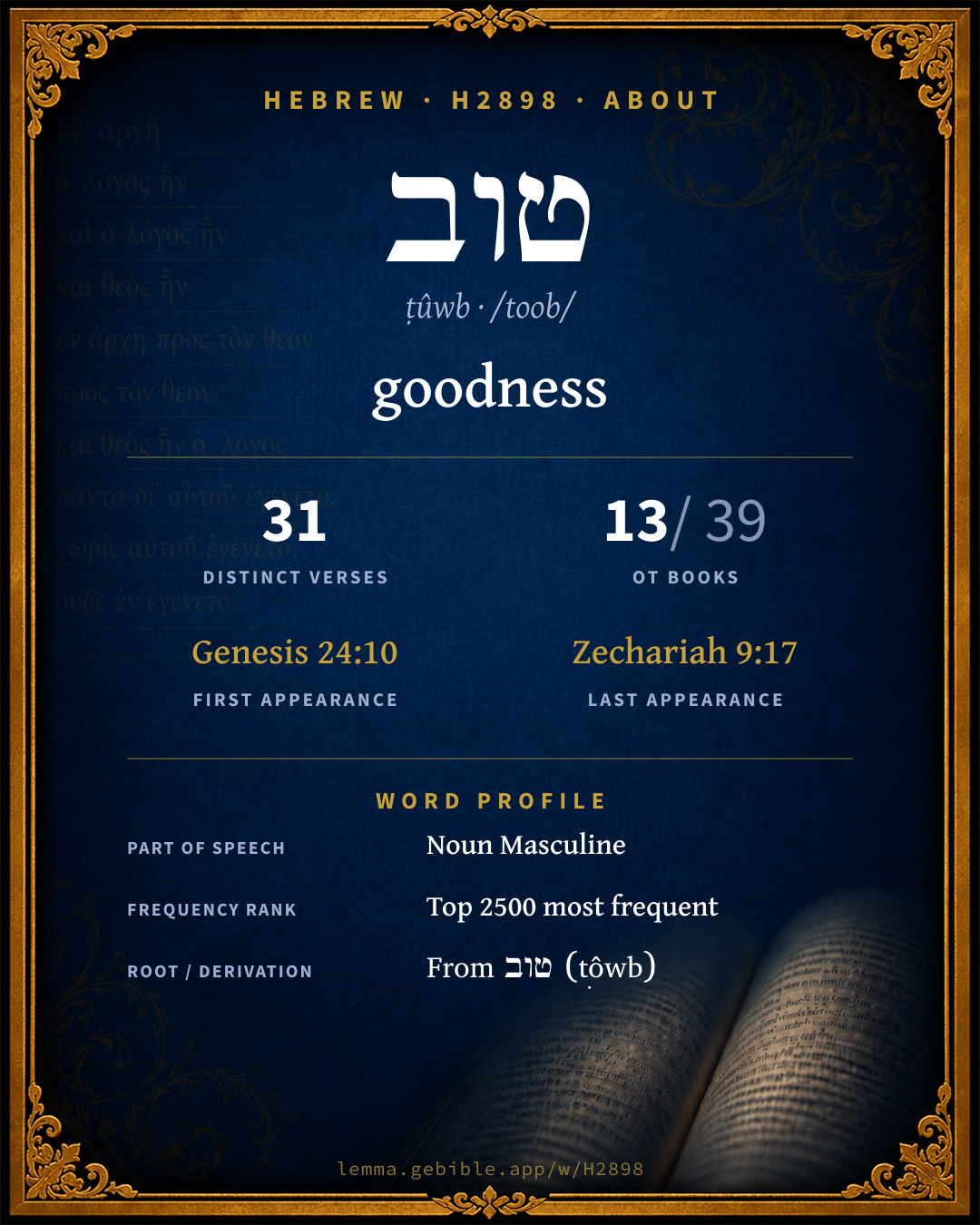
טוּב
goodness
also: goods, good things fuller range ↓
Full lexicon entry — Brown-Driver-Briggs (BDB)
From Brown-Driver-Briggs (BDB)
Where this word appears
See every Construct-state word in the Hebrew Bible →
Grammar key — what these labels mean
Part of speech
- Noun
- A naming word — a person, place, thing, or idea.
Noun type
- Common
- A common noun — a general class of person, place, or thing (“king,” “city,” “water”), not a specific name.
State
- Construct
- A noun bound to a following noun in a possessive / “of” relationship (the construct chain).
- Absolute
- The independent form of a noun, not bound to a following word.
Gender
- Masculine
- Grammatically masculine.
Number
- Singular
- One.
Grammatical forms
- Noun, Common, Masculine, Singular, Construct 29 times (91%)
- Noun, Common, Masculine, Singular, Absolute 3 times (9%)
Parsed forms decoded from the imported morphology (morphhb / Westminster Leningrad Codex — WLC text public domain, morphhb tagging CC BY 4.0), counted across 32 parsed occurrences — not distinct verses.
Every verse where H2898 appears — 31 distinct verses across 13 books. Click any verse to open its interlinear word-by-word view. Verse text shown in the World English Bible for context — . Each verse’s Hebrew form is shown with its reference; the English is not keyword-highlighted, since the data carries no word-level English alignment. Use “Compare translations” on any verse to read it across multiple English versions. This concordance covers the Hebrew Bible; Septuagint (Greek Old Testament) occurrences are not indexed here.
Genesis 4 verses
- Genesis 24:10 ט֥וּב n c ms cs The servant took ten camels, of his master's camels, and departed, having all goodly things of his master's in his hand. He arose, and went to Mesopotamia, to the city of Nahor.
- Genesis 45:18 טוּב֙ n c ms cs Take your father and your households, and come to me, and I will give you the good of the land of Egypt, and you will eat the fat of the land.'
- Genesis 45:20 ט֛וּב n c ms cs Also, don't concern yourselves about your belongings, for the good of all of the land of Egypt is yours."
- Genesis 45:23 מִ/טּ֣וּב prep + n c ms cs To his father, he sent after this manner: ten donkeys loaded with the good things of Egypt, and ten female donkeys loaded with grain and bread and provision for his father by the way.
Exodus 1 verse
Deuteronomy 2 verses
- Deuteronomy 6:11 טוּב֮ n c ms and houses full of all good things, which you didn't fill, and cisterns dug out, which you didn't dig, vineyards and olive trees, which you didn't plant, and you shall eat and be full;
- Deuteronomy 28:47 וּ/בְ/ט֣וּב conj + prep + n c ms cs Because you didn't serve Yahweh your God with joyfulness, and with gladness of heart, by reason of the abundance of all things;
2 Kings 1 verse
Ezra 1 verse
Nehemiah 3 verses
- Nehemiah 9:25 ט֠וּב בְּ/טוּבְ/ךָ֥ n c ms prep + n c ms cs + sfx pers 2ms They took fortified cities, and a fat land, and possessed houses full of all good things, cisterns hewn out, vineyards, and olive groves, and fruit trees in abundance: so they ate, and were filled, and became fat, and delighted themselves in your great goodness.
- Nehemiah 9:35 וּ/בְ/טוּבְ/ךָ֨ conj + prep + n c ms cs + sfx pers 2ms For they have not served you in their kingdom, and in your great goodness that you gave them, and in the large and fat land which you gave before them, neither turned they from their wicked works.
- Nehemiah 9:36 טוּבָ֔/הּ n c ms cs + sfx pers 3fs Behold, we are servants this day, and as for the land that you gave to our fathers to eat the fruit of it and the good of it, behold, we are servants in it.
Job 2 verses
Psalms 7 verses
- Psalms 25:7 טוּבְ/ךָ֣ n c ms cs + sfx pers 2ms Don't remember the sins of my youth, nor my transgressions. Remember me according to your loving kindness, For your goodness' sake, Yahweh.
- Psalms 27:13 בְּֽ/טוּב prep + n c ms cs I am still confident of this: I will see the goodness of Yahweh in the land of the living.
- Psalms 31:19 טוּבְ/ךָ֮ n c ms cs + sfx pers 2ms Oh how great is your goodness, Which you have laid up for those who fear you, Which you have worked for those who take refuge in you, Before the sons of men!
- Psalms 65:4 בְּ/ט֣וּב prep + n c ms cs Blessed is one whom you choose, and cause to come near, That he may live in your courts. We will be filled with the goodness of your house, Your holy temple.
- Psalms 119:66 ט֤וּב n c ms cs Teach me good judgment and knowledge, For I believe in your commandments.
- Psalms 128:5 בְּ/ט֣וּב prep + n c ms cs May Yahweh bless you out of Zion, And may you see the good of Jerusalem all the days of your life.
- Psalms 145:7 טוּבְ/ךָ֣ n c ms cs + sfx pers 2ms They will utter the memory of your great goodness, And will sing of your righteousness.
Proverbs 1 verse
Isaiah 3 verses
- Isaiah 1:19 ט֥וּב n c ms cs If you are willing and obedient, You shall eat the good of the land;
- Isaiah 63:7 טוּב֙ n c ms I will make mention of the loving kindnesses of Yahweh, [and] the praises of Yahweh, according to all that Yahweh has bestowed on us, and the great goodness toward the house of Israel, which he has bestowed on them according to his mercies, and according to the multitude of his loving kindnesses.
- Isaiah 65:14 מִ/טּ֣וּב prep + n c ms cs behold, my servants shall sing for joy of heart, but you shall cry for sorrow of heart, and shall wail for vexation of spirit.
Jeremiah 3 verses
- Jeremiah 2:7 וְ/טוּבָ֑/הּ conj + n c ms cs + sfx pers 3fs I brought you into a plentiful land, to eat the fruit of it and the goodness of it; but when you entered, you defiled my land, and made my heritage an abomination.
- Jeremiah 31:12 ט֣וּב n c ms cs They shall come and sing in the height of Zion, and shall flow to the goodness of Yahweh, to the grain, and to the new wine, and to the oil, and to the young of the flock and of the herd: and their soul shall be as a watered garden; and they shall not sorrow any more at all.
- Jeremiah 31:14 טוּבִ֥/י n c ms cs + sfx pers 1cs I will satiate the soul of the priests with fatness, and my people shall be satisfied with my goodness, says Yahweh.
Hosea 2 verses
- Hosea 3:5 טוּב֖/וֹ n c ms cs + sfx pers 3ms Afterward the children of Israel shall return, and seek Yahweh their God, and David their king, and shall come with trembling to Yahweh and to his blessings in the last days.
- Hosea 10:11 ט֖וּב n c ms cs Ephraim is a trained heifer that loves to thresh; So I will put a yoke on her beautiful neck. I will set a rider on Ephraim. Judah will plow. Jacob will break his clods.
Zechariah 1 verse
About this entry
At a glance — auto-summarized from this page’s data, not written by a person. Every figure links to its source below. This summary describes the numbers; it doesn’t interpret them.
טוב (ṭûwb) is a Hebrew noun most often rendered “goodness.” Beyond its headline sense, its full sense range takes in “goods” and “good things”. It turns up in 31 verses across 13 books, a moderately common footprint. Scripture first uses it in Genesis 24:10. It clusters with טוב, טוב and טבאל under a shared root. For the data behind this summary, explore the sense tree and the renderings breakdown below.
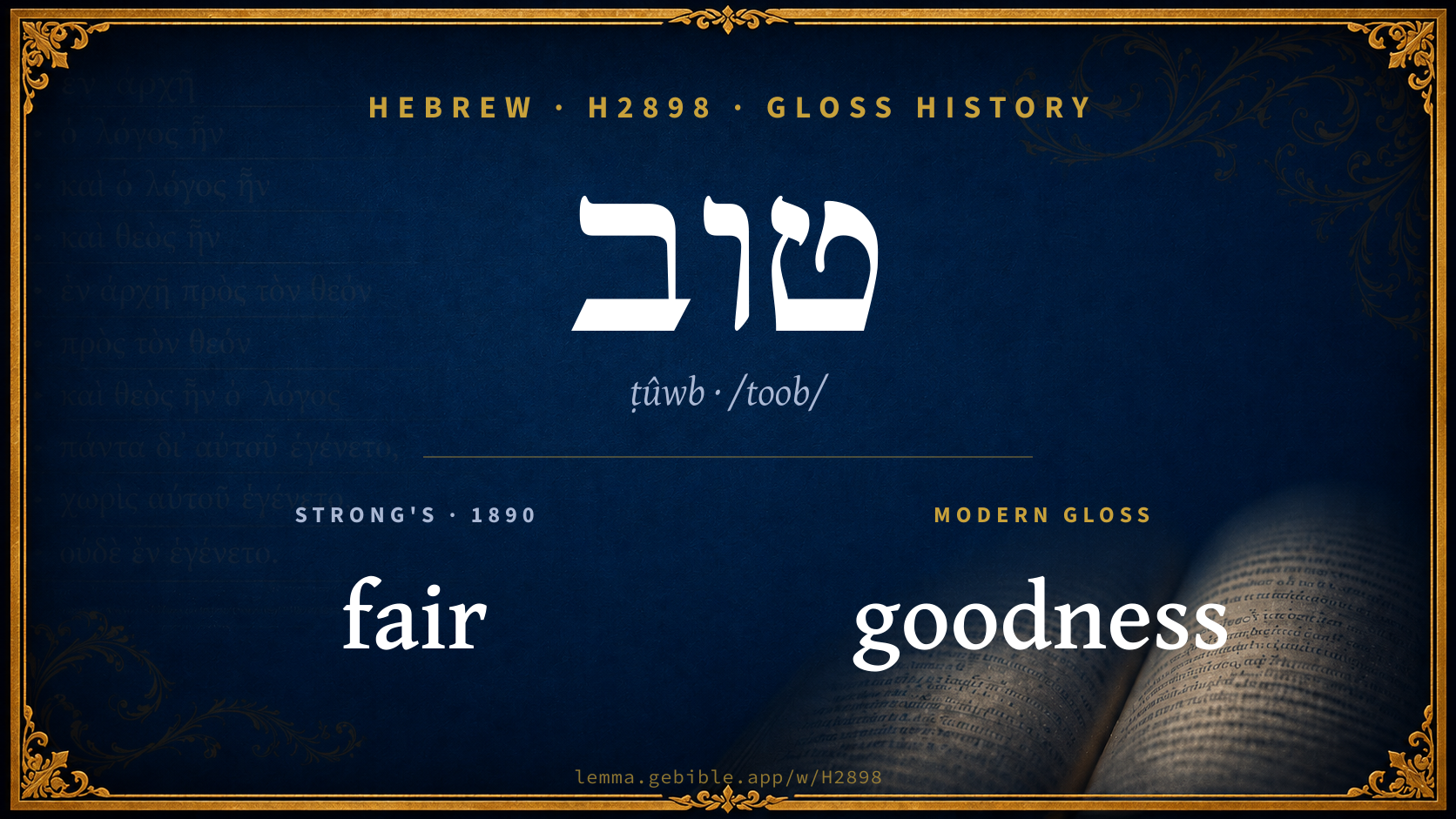
Gloss history
Strong's 1890 vs modern scholarship
About this word
Strong's H2898 catalogs a Hebrew word from the Hebrew Old Testament.
These counts are not copied from any lexicon or concordance. They are computed here, from the morphology-tagged Hebrew Old Testament. What Lemma adds →
- 31
- distinct verses
- The word appears in 31 distinct verses.
- 13 / 39
- OT books
- The word appears in 13 of 39 Old Testament books.
- #1,086
- by frequency
- Top 2500 most frequent Hebrew words (rank 1,086 of 8,640 Hebrew words by occurrence).
View all 31 occurrences in the concordance →
By section of the Old Testament
By traditional corpus
Conventional, traditional groupings — biblical authorship is debated, so this is a traditional corpus grouping, not an authorship claim. Each share is this word’s portion of its verses in that division of the Hebrew canon. Each figure is a share of the word’s 31 distinct verses.
- Writings (Ketuvim) 14 verses · 45%
- Prophets (Nevi'im) 10 verses · 32%
- Torah (Pentateuch) 7 verses · 23%
How translations render this word
Counts come from each version’s own published word-to-Strong’s tagging or interlinear alignment — an approximate guide to how each version renders this word, not a word-level alignment the data otherwise carries. Because each total is that version’s own tagged count, the per-version totals vary from one another and need not match the appearance or distinct-verse counts above. These counts may also differ from a printed concordance because Lemma counts each distinctly tagged rendering and does not collapse phrase taggings into a single head-word total. This is a fixed set of word-tagged versions (KJV, ASV, BSB, ULT) and does not change with the reading translation you choose elsewhere. Each version’s license is shown beside its name below (and on Sources).
- King James Version: Goodness 9×, Good 5×
- American Standard Version: Goodness 8×, Good 4×
- Berean Standard Bible: Goodness 10×, Best 4×, Good things 3×
- unfoldingWord Literal Text: Goodness 8×, Good 4×, Goodness of 4×
King James Version Public Domain
Renders H2898 across 32 tagged occurrences — most commonly:
Plus 18 renderings that appear only once — usually multi-word phrases or single function words the recovered tagging swept in, not distinct renderings.
American Standard Version Public Domain
Renders H2898 across 32 tagged occurrences — most commonly:
Plus 20 renderings that appear only once — usually multi-word phrases or single function words the recovered tagging swept in, not distinct renderings.
Berean Standard Bible Public Domain
Renders H2898 across 32 tagged occurrences — most commonly:
Plus 8 renderings that appear only once — usually multi-word phrases or single function words the recovered tagging swept in, not distinct renderings.
unfoldingWord Literal Text CC BY-SA 4.0
Renders H2898 across 34 tagged occurrences — most commonly:
Plus 6 renderings that appear only once — usually multi-word phrases or single function words the recovered tagging swept in, not distinct renderings.
11 senses and sub-senses in the full BDB
What do BDB’s symbols mean?
BDB uses these scholarly abbreviations:
| Symbol | Meaning |
|---|---|
| 𝔊 | the Septuagint (the ancient Greek translation, LXX) |
| 𝔙 | the Vulgate (the Latin translation) |
| 𝔖 | the Syriac version (the Peshitta) |
| 𝔗 | the Targum (the Aramaic translation) |
| ψ | the Psalms |
| √ | root (the underlying root or stem) |
| ‖ | parallel passage (a synonymous or contrasted parallel) |
| † | the dagger: every passage where the word occurs is cited |
The 11 senses and sub-senses the full Brown-Driver-Briggs lexicon distinguishes for this word, in lexicon order (not ranked by frequency), with BDB’s own verbatim wording and sub-sense lettering. Shown in Hebrew script with BDB’s own scholarly abbreviations. The condensed entry is in the Lexicon Entry tab. See also the Forms in the corpus table below.
- 1. good things, coll., produce of the land to be eaten Gn 45:18, 20, 23 (E), Is 1:19; Je 2:7; Ezr 9:12; Ne 9:35, 36, to be enjoyed; good things of י׳ as given by him Ho 3:5; Je 31:12, 14 ψ 27:13; of house of י׳ ψ 65:5, fig. of spiritual blessings. e.g. Genesis 45:18
- 2. goods, property Gn 24:10 (J), Dt 6:11; 2 K 8:9; Ne 9:25. e.g. Genesis 24:10
- 3. abstr.:
- a. fairness, beauty, of neck of heifer Ho 10:11; of people of י׳ Zc 9:17; of י׳ himself Ex 33:19 (JE). e.g. Hosea 10:11
- b. טוּב לב(ב) joy of heart Dt 28:47 Is 65:14 (v. i. טוֹב 2, ii. ט׳ 7). e.g. Deuteronomy 28:47
- c. prosperity Jb 20:21; 21:16; of Jerusalem ψ 128:5; בְּטוּב צַדִּיקִים Pr 11:10 in the prosperity of the righteous the city rejoiceth. e.g. Job 20:21
- d. goodness of taste, discernment ψ 119:66. e.g. Psalms 119:66
- 4. abstr., goodness of God:
- a. in bestowing good things Ne 9:25. e.g. Nehemiah 9:25
- b. in the salvation of his people Is 63:7 ψ 25:7; 145:7. e.g. Isaiah 63:7
- c. stored up for his saints ψ 31:20. e.g. Psalms 31:20
Senses from the full Brown-Driver-Briggs lexicon (Brown, Driver, Briggs; Oxford 1906 — public domain), digitized via Sefaria, supplemented by the OpenScriptures HebrewLexicon (CC BY 4.0). Full attribution on Sources.
Word origin
n.m. Jb 20:21 good things, goods, goodness;—ט׳ Gn 24:10 + 17 times; sf. טוּבִי Ex 33:19; Je 31:14; טוּבְךָ ψ 25:7 + 4 times; טוּבוֹ Ho 3:5 + 2times; טוּבָהּ Ne 9:36 Je 2:7; טוּבָם Jb 21:16;—not in H P Chr Ez or postex. proph.—
— Brown-Driver-Briggs (Oxford 1906, public domain), digitized via Sefaria, supplemented by the OpenScriptures HebrewLexicon (CC BY 4.0). See Sources.
Derived from טוב (ṭôwb) (H2895) — to be good.
Jastrow Dictionary
A second Hebrew/Aramaic lexicon for comparison, covering Aramaic and post-biblical (Talmudic, Targumic, Midrashic) usage that the biblical-Hebrew BDB does not. Matched by lemma rather than by Strong’s number, so a lemma may carry more than one Jastrow headword (shown separately below), and the entries cover usage well beyond the Bible.
טוֹב I
- (b. h.) to be good, fit, handsome, valuable.
- 1. to prepare, outfit, dress, adorn. Gen. R. s. 26, v. טַבָּת. Gen. R. s. 83 (play on מהיטבאל, Gen. XXXVI, 39) מְטִיבֵי אלוהות היו they were dressers of idols; שהיו מֵטִיבִין עצמן וכ׳ they adorned themselves in honor of the idols. Ib. מטיבי נשים וכ׳ they dressed women for their wedding; a. e.—Esp. (את הנרות) ה׳ to trim, cleanse the lamps. Yoma III, 4 ולהֵטֵיב. Ib. I, 2. Ib. 14ᵇ יֵיטִיב; a. fr.—V. הֲטָבָה. e.g. Genesis 36:39
- 2. to turn a dream unto good (saying, ‘I have dreamt a good dream’). Ber. 55ᵇ יְטִיבֶנּוּ בפני וכ׳ he shall turn it in the presence of three persons, and say &c.
- 3. to do good, be beneficent. Ib. IX, 2 הטוב והמטיב who is good and beneficent. Taan. 31ᵃ תקנו … הטוב והמ׳ they introduced in Jabneh the benediction ‘who is good &c.’ (in the grace after meal).—Kidd. I, 10 מטיבין לו good will be done to him; a. fr.—Part. Hof. מוּטָב, q. v.
- to improve a field, to till oftener than usual. Y. Shebi. IV, 35ᵇ top טִיְּיבָהּ וכ׳ if, after he improved a field, he died &c.
- to be improved. Shebi. IV, 2; Tosef. ib. III, 10; a. e.—Denom. טִיּיוּב.
טוֹב
- Pa. טַיֵּיב, Af. אָטֵיב to do good, to favor. Targ. Y. I Ex. XXIII, 2 למְטַיְּיבָא; Y. II למֵיטְבָא. V. יְטַב.
טוֹב II
- (b. h.)
- 1. good; a good thing. Ber. 5ᵃ (ref. to Ps. XXXIX, 3) אין ט׳ אלא וכ׳ under good the Torah is meant. Ib. 60ᵇ זו מדה ט׳ this refers to a good dispensation; a. v. fr.—יום טוב (abbr. י"ט) festival. Bets. I, 1; a. fr.—כי טוב (ref. to Gen. I, 4) day-time. Pes. 2ᵃ.—Ber. V, 3 (33ᵇ) על טוב וכ׳ thy name be praised for the good (thou doest).—זכור לַטּוֹב, v. עין טובה—.זָכַר, v. עַיִן.—Pl. טוֹבְים, f. טוֹבוֹת. Ber. l. c. (34ᵃ, omitt. in Mish.) האומר יברכוך ט׳ he who says in prayer, The good praise thee. Ib. IX, 2 בשורות ט׳, v. בְּשוֹרָה; a. v. fr.—V. טוֹבָה. e.g. Psalms 39:3
- 2. noble, elder.—Pl. טוֹבִים. Tosef. Shek. II, 16 בני ט׳ of noble descent; a. fr.—טוֹבֵי העיר representatives of the town. Meg. 27ᵃ
טוּב
- preced.) goodness, good. Ber. 44ᵃ לשבוע מטוּבָהּ to be satisfied out of its (the land’s) riches; a. e.
A Dictionary of the Targumim, the Talmud Babli and Yerushalmi, and the Midrashic Literature (Marcus Jastrow; London, Luzac, 1903) — Public Domain. Digitized via Sefaria. Digitized via Sefaria. Full attribution on Sources.
Forms in the corpus
The 24 distinct written forms H2898 takes in the Hebrew Bible, most frequent first — each parse links to that state’s occurrences in the concordance. Hebrew forms include their vowel points and cantillation, so a single lemma takes many written forms.
Same root — word family
Other BDB entries built from the same root as H2898, grouped by Strong’s listed origin. These share a root / origin per the lexicon — not necessarily a shared meaning. Each links to that word’s own entry.
Derives from
Shares the same root
Proper names from this root
People and places named from this root — a name, not an additional meaning of the word.
Compare all same-root words → Showing 4 of 5 — not the complete family. 2 of the same-root words are proper names (people or places). They share a root, not necessarily a meaning.
Septuagint verse parallels
This word appears in 25 verses that also exist in the Greek Old Testament (Septuagint), out of the 31 Hebrew verses it occurs in. You can read those verses in Greek by switching the Old Testament edition to the Septuagint.
Read these verses in the Septuagint
- Genesis 24:10
- Exodus 33:19
- Deuteronomy 6:11
- 2 Kings 8:9
- Ezra 9:12
- Job 20:21
- Psalms 25:7
- Proverbs 11:10
- Isaiah 1:19
- Jeremiah 2:7
- Hosea 3:5
- Zechariah 9:17
This is a verse-level parallel only — the same verses exist in both the Hebrew and Greek Old Testaments. No word-level Hebrew↔Greek correspondence is claimed: the data carries no such alignment, so no Greek word is shown as this Hebrew word’s translation. Coverage is not total — the Septuagint omits the deuterocanon and renumbers the Psalms, so some Hebrew verses have no direct Greek parallel.