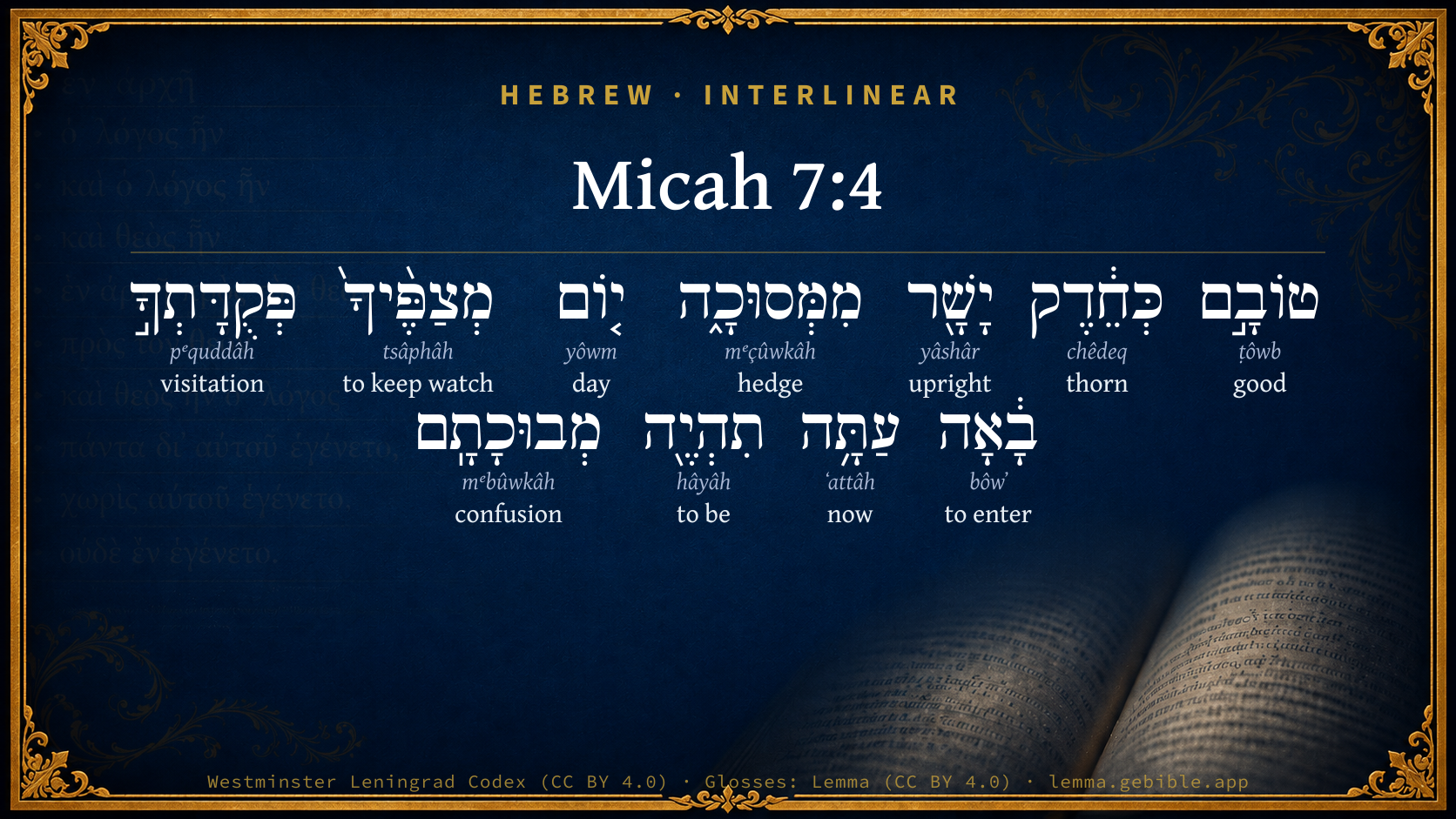
Micah 7:4

Hebrew (Westminster Leningrad Codex) Micah 7:4 appears in the Hebrew Old Testament. The text above is from the Westminster Leningrad Codex. Each word links to its Strong’s number, a concise gloss, and parsing drawn from the Open Scriptures Hebrew Bible morphology. Click any word for its full Brown-Driver-Briggs (BDB) entry.
Download image
Cite this verse

Micah 7:4 (World English Bible). Public Domain. Lemma interlinear Bible study tool, https://lemma.gebible.app/v/micah/7/4.

Show BibTeX & RIS
BibTeX
RIS
English Translation
The best of them is like a brier. The most upright is worse than a thorn hedge. The day of your watchmen, Even your visitation, has come; Now is the time of their confusion.
World English Bible · Public Domain
Highlights
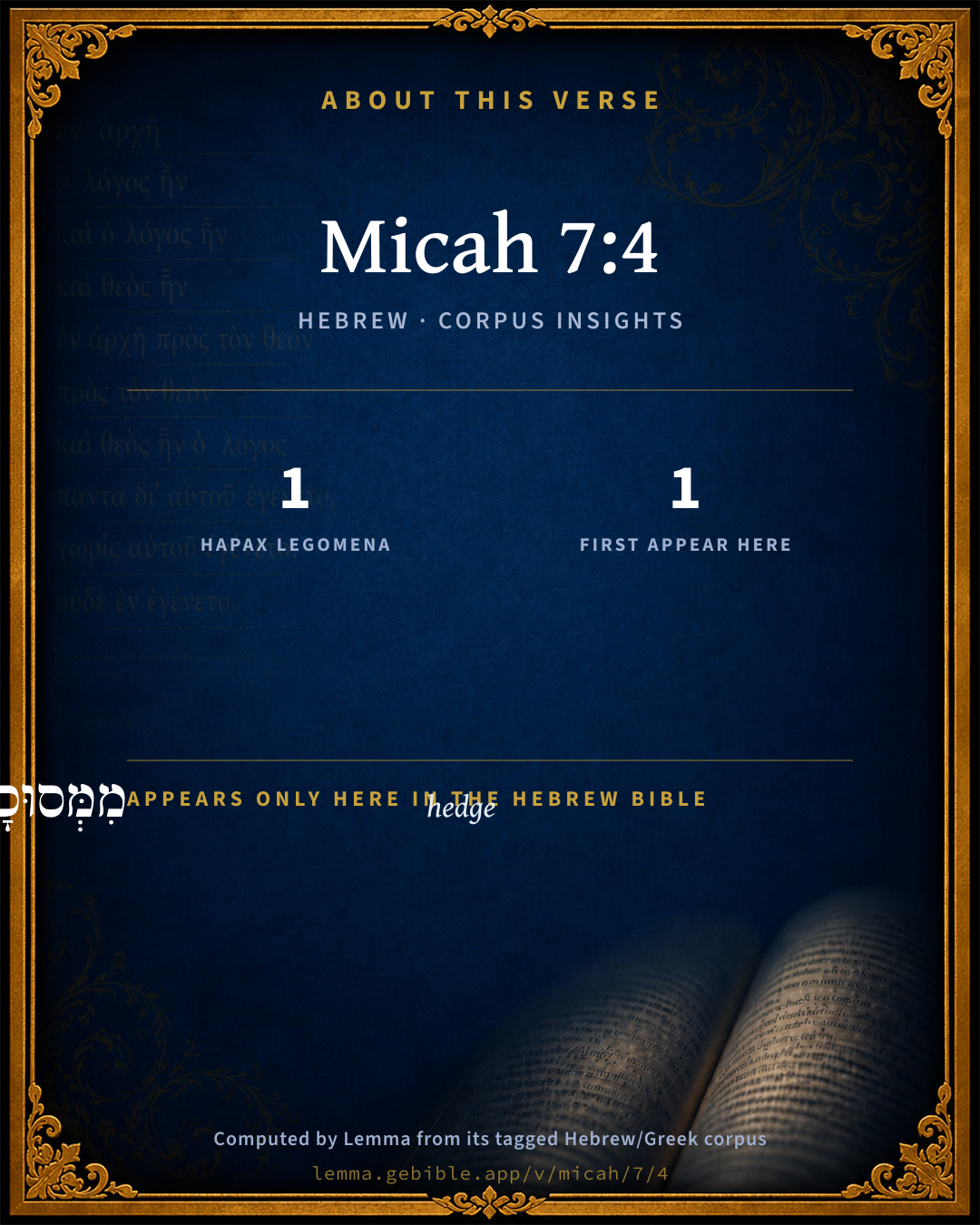
  • 1 hapax legomenon — only here in the Hebrew Bible
  • 1 first appearance in the Hebrew Bible
Full analysis ↓
Download a study sheet

One document with this verse’s original text, its word-by-word gloss line, the meaning frame, cross-references with their text, attributed commentary, and full source and license credits — printable, and it pastes into notes with its structure intact.

This verse Autodidact and up

Study sheet (.html) Plain text (.txt)

A passage Seminary Student

Up to 50 verses in one chapter. A passage sheet keeps up to 6 commentary sources and 12 cross-references per verse, in the order this page ranks them, and says so on the sheet whenever that leaves anything out. Ask for a single verse and you get the Autodidact verse sheet above.

Everything on this page stays free to read, with no account — the sheet is a download of what is already on screen, not access to it.

Want to remove ads? Support Godless Engineer
Compare translations 3

The same verse in 3 English versions, stacked beneath the original-language interlinear above. Click any original word for its lexicon entry.

Each is an independent rendering of the whole verse — the interlinear is not word-aligned to these translations.

Highlighted words mark where these versions differ — a whole-verse word diff, not a word-by-word alignment.

  • World English Bible Public Domain
    The best of them is like a brier. The most upright is worse than a thorn hedge. The day of your watchmen, Even your visitation, has come; Now is the time of their confusion.
  • King James Version Public Domain
    The best of them is as a brier: the most upright is sharper than a thorn hedge: the day of thy watchmen and thy visitation cometh; now shall be their perplexity.
  • unfoldingWord Literal Text CC BY-SA 4.0
    The best of them is like a brier, the most upright is worse than a thorn hedge. It is the day foretold by your watchmen, the day of your punishment. Now is the time of their confusion.

unfoldingWord Literal Text — © unfoldingWord, licensed CC BY-SA 4.0. Word-aligned USFM3 via Door43 (git.door43.org/unfoldingWord/en_ult).

Versions to compare (up to 4)

3 of 4 selected

Show all 18 translations

Every available English version of this verse, each an independent rendering of the whole verse.

  • World English Bible Public Domain
    The best of them is like a brier. The most upright is worse than a thorn hedge. The day of your watchmen, Even your visitation, has come; Now is the time of their confusion.
  • Berean Standard Bible Public Domain
    The best of them is like a brier; the most upright is sharper than a hedge of thorns. The day for your watchmen has come, the day of your visitation. Now is the time of their confusion.
  • Majority Standard Bible Public Domain
    The best of them is like a brier; the most upright is sharper than a hedge of thorns. The day for your watchmen has come, the day of your visitation. Now is the time of their confusion.
  • King James Version Public Domain
    The best of them is as a brier: the most upright is sharper than a thorn hedge: the day of thy watchmen and thy visitation cometh; now shall be their perplexity.
  • American Standard Version (1901) Public Domain
    The best of them is as a brier; the most upright is `worse' than a thorn hedge: the day of thy watchmen, even thy visitation, is come; now shall be their perplexity.
  • Revised Version (1885) Public Domain
    The best of them is as a brier: the most upright is worse than a thorn hedge: the day of thy watchmen, even thy visitation, is come; now shall be their perplexity.
  • Geneva Bible (1599) Public Domain
    The best of them is as a brier, and the most righteous of them is sharper then a thorne hedge: the day of thy watchmen and thy visitation commeth: then shalbe their confusion.
  • Douay-Rheims (1899) Public Domain
    He that is best among them, is as a brier: and he that is righteous, as the thorn of the hedge. The day of thy inspection, thy visitation cometh: now shall be their destruction.
  • Young's Literal Translation Public Domain
    Their best one `is' as a brier, The upright one -- than a thorn-hedge, The day of thy watchmen -- Thy visitation -- hath come. Now is their perplexity.
  • Literal Standard Version CC BY-SA 4.0
    Their best one [is] as a brier, || The upright one—than a thorn-hedge, || The day of your watchmen—Your visitation—has come. Now is their perplexity.
  • Unlocked Literal Bible CC BY-SA 4.0
    The best of them is like a brier, the most upright is worse than a thorn hedge. It is the day foretold by your watchmen, the day of your punishment. Now is the time of their confusion.
  • unfoldingWord Literal Text CC BY-SA 4.0
    The best of them is like a brier, the most upright is worse than a thorn hedge. It is the day foretold by your watchmen, the day of your punishment. Now is the time of their confusion.
  • Darby Bible Public Domain
    The best of them is as a briar; the most upright, [worse] than a thorn-fence. The day of thy watchmen, thy visitation is come; now shall be their perplexity.
  • World Messianic Bible Public Domain
    The best of them is like a brier. The most upright is worse than a thorn hedge. The day of your watchmen, even your visitation, has come; now is the time of their confusion.
  • Webster's Bible Public Domain
    The best of them is as a brier: the most upright is sharper than a thorn hedge: the day of thy watchmen and thy visitation cometh; now shall be their perplexity.
  • Free Bible Version CC BY-SA 4.0
    Even the best of them is like a thorny bush, the most honest like a thorn hedge. Your day of judgment that was announced by the prophets, your time of punishment, has arrived. You're thrown into complete confusion.
  • Bible in Basic English Public Domain
    The best of them is like a waste plant, and their upright ones are like a wall of thorns. Sorrow! the day of their fate has come; now will trouble come on them.
  • JPS Tanakh (1917) Public Domain
    The best of them is as a brier; the most upright is worse than a thorn hedge; the day of thy watchmen, even thy visitation, is come; now shall be their perplexity.

Literal Standard Version (2020), Covenant Press — licensed CC BY-SA 4.0. Text via the HelloAO Bible API (eBible.org). Unlocked Literal Bible (unfoldingWord) — licensed CC BY-SA 4.0. Text via the HelloAO Bible API (eBible.org). unfoldingWord Literal Text — © unfoldingWord, licensed CC BY-SA 4.0. Word-aligned USFM3 via Door43 (git.door43.org/unfoldingWord/en_ult). Free Bible Version, Dr. Jonathan Gallagher — licensed CC BY-SA 4.0. Text via the HelloAO Bible API (eBible.org).

Word by word

More ways to search: Search by grammar → Find every occurrence → Compare this word →

Practice this passage: Drill this verse → Learn its vocabulary →

מִמְּסוּכָ֑ה
mᵉçûwkâh
H4534
“from · hedge”
Preposition + Noun, Common, Feminine, Singular, Absolute
Part of Speech
Preposition + Noun
Type
Common
Gender
Feminine
Number
Singular
State
Absolute
Full BDB Definition

Origin: for H4881

TWOT: 1475a

hedge
  1. טוֹבָ֣ם ṭôwb H2896 “good · their” Adjective, Adjective, Masculine, Singular, Construct + Suffix, Personal, 3rd Person, Masculine, Plural
  2. כְּחֵ֔דֶק chêdeq H2312 “like/as · thorn” Preposition + Noun, Common, Masculine, Singular, Absolute
  3. יָשָׁ֖ר yâshâr H3477 “upright” Adjective, Adjective, Masculine, Singular, Absolute
  4. י֤וֹם yôwm H3117 “day of” Noun, Common, Masculine, Singular, Construct
  5. מְצַפֶּ֨יךָ֙ tsâphâh H6822 “keeping watch · you” Verb, Piel, Participle Active, Masculine, Plural, Construct + Suffix, Personal, 2nd Person, Masculine, Singular
  6. פְּקֻדָּתְךָ֣ pᵉquddâh H6486 “visitation · your” Noun, Common, Feminine, Singular, Construct + Suffix, Personal, 2nd Person, Masculine, Singular
  7. בָ֔אָה bôwʼ H935 “to enter” Verb, Qal, Perfect, 3rd Person, Feminine, Singular
  8. עַתָּ֥ה ʻattâh H6258 “now” Adverb
  9. תִהְיֶ֖ה hâyâh H1961 “to be” Verb, Qal, Imperfect, 3rd Person, Feminine, Singular
  10. מְבוּכָתָֽם mᵉbûwkâh H3998 “confusion · their” Noun, Common, Feminine, Singular, Construct + Suffix, Personal, 3rd Person, Masculine, Plural

About this verse

These counts appear in no published source. They are computed here, from the morphology-tagged text and Lemma’s own curated glosses. What Lemma adds →

11
words
11
distinct lemmas
Prophets
section

Notable vocabulary

1 hapax legomenon — a word that appears only here in the entire Hebrew Bible:

  • מִמְּסוּכָ֑ה hedge H4534

First appearance in Scripture

This word makes its first canonical appearance in the Hebrew Bible here:

  • מִמְּסוּכָ֑ה hedge H4534

Shared distinctive vocabulary

כְּחֵ֔דֶק thorn H2312 occurs in 2 verses of the Hebrew Bible. Also found in:

Grammatical profile

  • 3 verbs
  • 5 nouns
  • 2 adjectives
  • 1 adverb

Verb forms

  • מְצַפֶּ֨יךָ֙ Piel · Participle Active
  • בָ֔אָה Qal · Perfect
  • תִהְיֶ֖ה Qal · Imperfect

Hebrew & Septuagint length

In English translation the verse runs 34 words from the Hebrew and 38 from the Septuagint (LXX English) — closely comparable.

A rough comparison of the two English renderings, which tokenize alike — not a word-level alignment.

Word counts can differ between the Hebrew and the Greek without any difference in meaning — e.g. the Hebrew direct-object marker אֵת has no separate Greek word, and Greek often adds the article ὁ.

Cross-references

13

Topical passages linked to Micah 7:4 in the Treasury of Scripture Knowledge — connected by theme and wording, ordered by reader-vote popularity; previews shown in the World English Bible.

  • Isaiah 22:5 For it is a day of confusion, and of treading down, and of perplexity, from the Lord, Yahweh of Hosts, in the valley of vision; a breaking down of the walls, and a crying to the mountains.
  • Ezekiel 2:6 You, son of man, don't be afraid of them, neither be afraid of their words, though briers and thorns are with you, and you do dwell among scorpions: don't be afraid of their words, nor be dismayed at their looks, though they are a rebellious house.
  • Isaiah 10:3 What will you do in the day of visitation, and in the desolation which shall come from far? to whom will you flee for help? and where will you leave your glory?
  • 2 Samuel 23:6–7 But the ungodly shall be all of them as thorns to be thrust away, Because they can't be taken with the hand
  • Hosea 9:7–8 The days of visitation have come. The days of reckoning have come. Israel will consider the prophet to be a fool, And the man who is inspired to be insane, Because of the abundance of your sins, And because your hostility is great.
  • Isaiah 55:13 Instead of the thorn shall come up the fir tree; and instead of the brier shall come up the myrtle tree: and it shall be to Yahweh for a name, for an everlasting sign that shall not be cut off.
  • Jeremiah 8:12 Were they ashamed when they had committed abomination? nay, they were not at all ashamed, neither could they blush: therefore shall they fall among those who fall; in the time of their visitation they shall be cast down, says Yahweh.
  • Jeremiah 10:15 They are vanity, a work of delusion: in the time of their visitation they shall perish.
  • Ezekiel 12:23–24 Tell them therefore, Thus says the Lord Yahweh: I will make this proverb to cease, and they shall no more use it as a proverb in Israel; but tell them, The days are at hand, and the fulfillment of every vision.
  • Amos 8:2 He said, "Amos, what do you see?" I said, "A basket of summer fruit." Then Yahweh said to me, "The end has come on my people Israel. I will not again pass by them any more.
  • Nahum 1:10 For entangled like thorns, and drunken as with their drink, they are consumed utterly like dry stubble.
  • Luke 21:25 There will be signs in the sun, moon, and stars; and on the earth anxiety of nations, in perplexity for the roaring of the sea and the waves;
  • Hebrews 6:8 but if it bears thorns and thistles, it is rejected and near being cursed, whose end is to be burned.

Cross-references courtesy of OpenBible.info (CC BY 4.0).

Hebrew and Greek witnesses Masoretic Hebrew ↔ Greek Septuagint

The same verse in the two great witnesses to the Old Testament, shown verse-for-verse.

These are two independent witnesses, not word-aligned to each other, and the Septuagint is shown in lemma (dictionary) form.

Hebrew Micah 7:4 Masoretic · Westminster Leningrad Codex

טוֹבָ֣ם כְּחֵ֔דֶק יָשָׁ֖ר מִמְּסוּכָ֑ה י֤וֹם מְצַפֶּ֨יךָ֙ פְּקֻדָּתְךָ֣ בָ֔אָה עַתָּ֥ה תִהְיֶ֖ה מְבוּכָתָֽם

The best of them is like a brier. The most upright is worse than a thorn hedge. The day of your watchmen, Even your visitation, has come; Now is the time of their confusion.

World English Bible · Public Domain

Greek LXX Micah 7:4 Septuagint · lemma form

ὁ ἀγαθός αὐτός ὡς σός ἐκτρώγω καί βαδίζω ἐπί κανών ἐν ἡμέρα σκοπιά οὐαί οὐαί ὁ ἐκδίκησις σύ ἥκω νῦν εἰμί κλαυθμός αὐτός

therefore I will take away their goods as a devouring moth, and as one who acts by a rigid rule in a day of visitation. Woe, woe, your times of vengeance are come; now shall be their lamentations.

LXX2012 (modern English Septuagint) · Public Domain

On this verse, Haydock's Catholic Bible Commentary discusses the Septuagint’s reading. Read the note in Commentary ↓

Hebrew: Westminster Leningrad Codex (CC BY 4.0). Greek: Septuagint (public domain); English from LXX2012 (modern English Septuagint) (Public Domain). How the Septuagint differs from the Hebrew →

Targum (Aramaic paraphrase)

1

The Targum is the ancient Jewish Aramaic paraphrase of the Hebrew Scriptures — an interpretive translation, not the Hebrew text itself. Onkelos (literal) and Pseudo-Jonathan (expansive) render the Torah, and Jonathan the Prophets. Coverage is partial: where no permissively-licensed English translation exists for a verse, only the Aramaic is shown. This is verse-level text, not a word-by-word alignment to the Hebrew.

  1. Targum Jonathan Prophets (Joshua–Malachi)
    טָבָא דִבְהוֹן קָשֵׁי לְמִפַּק מִן יְדֵיהּ כַּד מִן חִדְקָא וּדְקָשֵׁיט בְּהוֹן מִסְיוּגַת סְיַג בִּישׁ יוֹם סִבּוּרָךְ לְטַב עִדַן סְעוּרַת בִּישְׁתָךְ מְטַת כְּעַן יְהֵי עֲרָבוּ לְהוֹן:

    (no public-domain English translation for this verse)

    Targum Jonathan — Aramaic: “Mikraot Gedolot” (public domain). English: “Sefaria Community Translation” (CC0 1.0 (public-domain dedication)); “London "Chaldee Paraphrase," 1871” (public domain). Text via Sefaria.

Commentary

Notes on Micah 7:4 from classic Christian and Jewish commentators (each source and its license shown beneath its notes). The classic Christian expositions comment on the surrounding passage and are grouped to its opening verse, so a note may address several verses; the Jewish commentaries on the Tanakh (Rashi and others) are per-verse, so they appear only where the commentator wrote on this verse.

Lemma curates 59 commentaries, every one of them public domain or Creative Commons licensed, each selected and text-cleaned for this edition rather than reprinted as found. About our sources →

Trapp's Complete Commentary

John Trapp

Mic 7:4 The best of them [is] as a brier: the most upright [is sharper] than a thorn hedge: the day of thy watchmen [and] thy visitation cometh; now shall be their perplexity.

Ver. 4. The best of them is as a brier] Which a man cannot handle without harm. See 2Sa 23:6 Psa 55:21; Psa 58:10 Eze 2:6 Mat 7:16; Mat 13:7; Mat 13:22; so, you cannot deal with them without danger; guilt, or grief you shall be sure of. Lot felt it so at Sodom, 2Pe 2:7-8, and so did those that set up that bramble Abimelech for their king, Jdg 9:15-16.

The most upright is sharper than a thornhedge] Ut ibi inveniatur dolor, ubi sperabatur auxilium, saith Jerome here; so that a man shall have grief where he hoped for help and succour; as a man that, taking hold of a thorn hedge to get over, hath his fingers pricked by it, and is glad to let go; or, as a sheep that, fleeing to the bush for defence in weather, loses part of her fleece. Now if the best and most upright among them were no better, what can be imagined of the many (οι πολλοι)? and what better can be hoped for by us (for one egg is not more like another than these times are those here described; it is but the same fable acted over again, only everything is now worse than ever) than a day of visitation, a time of perplexity, as it followeth here? For while they be folded together as thorns, and while they be drunken as drunkards, they shall be devoured as stubble fully dry, Nah 1:10, as sear thorns under the pot, Ecc 7:6. I will go through these briers, saith God, I will burn them together, Isa 27:4, they shall be utterly burnt with fire in the same place, 2Sa 23:7, that is, in hell, as some interpret it.

The day of thy watchmen, and thy visitation cometh] Where sin is in the saddle punishment will be upon the crupper. {a} God will have a visitation day; and that for his watchmen, prophets, and governors, as well as for the common sort. "Thy visitation cometh," thou shalt share in punishment with them, as thou hast done in sin; neither shall it help thee to say, Our watchmen were in fault; for God will visit you all; and his visitation articles will be very strict and critical.

Now shall be their perplexity] They shall be so intricated and entangled; so ensnared and ensnarled, as that they shall not know which way to turn them. They shall be in as great a distress as Israel was at the Red Sea, Exo 14:3, or as the Jews at Shushan were, when the decree was gone out for their utter destruction, Est 3:15, or as Manasseh was, when taken by the Assyrians among the thorns, he was bound with fetters, and carried to Babylon, 2Ch 33:11.

{a} A leathern strap buckled to the back of the saddle and passing under the horse’s tail, to prevent the saddle from slipping forwards. ŒD

John Trapp, A Commentary or Exposition upon All the Books of the Old and New Testament (1647–1656) — public domain. Text from a community e-Sword module.

Keil & Delitzsch

C. F. Keil & F. Delitzsch

And even the best men form no exception to the rule. Mic 7:4. "Their best man is like a briar; the upright man more than a hedge: the day of thy spies, thy visitation cometh, then will their confusion follow. Mic 7:5. Trust not in the neighbour, rely not upon the intimate one; keep the doors of thy mouth before her that is thy bosom friend. Mic 7:6. For the son despiseth the father, the daughter rises up against her mother, the daughter-in-law against her mother-in-law; a man's enemies are the people of his own house." טובם, the good man among them, i.e., the best man, resembles the thorn-bush, which only pricks, hurts, and injures. In ישׁר the force of the suffix still continues: the most righteous man among them; and מן before ממּסוּכה is used in a comparative sense: "is more, i.e., worse, than a thorn-hedge." The corruption of the nation has reached such a terrible height, that the judgment must burst in upon them. This thought comes before the prophet's mind, so that he interrupts the description of the corrupt condition of things by pointing to the day of judgment. The "day of thy watch-men," i.e., of thy prophets (Jer 6:17; Eze 3:17; Eze 33:7), is explained in the apposition peqŭddâthekhâ (thy visitation). The perfect בּאה is prophetic of the future, which is as certain as if it were already there. עתּה, now, i.e., when this day has come (really therefore = "then"), will their confusion be, i.e., then will the wildest confusion come upon them, as the evil, which now envelopes itself in the appearance of good, will then burst forth without shame and without restraint, and everything will be turned upside down. In the same sense as this Isaiah also calls the day of divine judgment a day of confusion (Isa 22:5). In the allusion to the day of judgment the speaker addresses the people, whereas in the description of the corruption he speaks of them. This distinction thus made between the person speaking and the people is not at variance with the assumption that the prophet speaks in the name of the congregation, any more than the words "thy watchmen, thy visitation," furnish an objection to the assumption that the prophet was one of the watchmen himself. This distinction simply proves that the penitential community is not identical with the mass of the people, but to be distinguished from them. In Mic 7:5 the description of the moral corruption is continued, and that in the form of a warning not to trust one another any more, neither companion (רע) with whom one has intercourse in life, nor the confidential friend ('allūph), nor the most intimate friend of all, viz., the wife lying on the husband's bosom. Even before her the husband was to beware of letting the secrets of his heart cross his lips, because she would betray them. The reason for this is assigned in Mic 7:6, in the fact that even the holiest relations of the moral order of the world, the deepest ties of blood-relationship, are trodden under foot, and all the bonds of reverence, love, and chastity are loosened. The son treats his father as a fool (nibbēl, as in Deu 32:15). "The men of his house" (the subject of the last clause) are servants dwelling in the house, not relations (cf. Gen 17:23, Gen 17:27; Gen 39:14; Sa2 12:17-18). This verse is applied by Christ to the period of the κρίσις which will attend His coming, in His instruction to the apostles in Mat 10:35-36 (cf. Luk 12:53). It follows from this, that we have not to regard Mic 7:5 and Mic 7:6 as a simple continuation of the description in Mic 7:2-4, but that these verses contain the explanation of עתּה תהיה מבוּכתם, in this sense, that at the outbreak of the judgment and of the visitation the faithlessness will reach the height of treachery to the nearest friends, yea, even of the dissolution of every family tie (cf. Mat 24:10, Mat 24:12).

Keil & Delitzsch — Biblical Commentary on the Old Testament (1861–1891) — public domain (CC PDM 1.0). Text via the HelloAO Bible API. (Old Testament only.)

Tyndale Open Study Notes

Tyndale Open Resources

7:4 your judgment day is coming: The people of Israel would soon be conquered by the Assyrians, the people of Judah would soon face destruction at the hands of the Babylonians, and all the people of the earth will soon face God in judgment.

Tyndale Open Study Notes — © Tyndale Open Resources, licensed CC BY-SA 4.0. Text via the HelloAO Bible API.

Geneva Bible (1599)

Geneva Bible translators

They that are of most estimation and are counted most honest among them, are but thorns and briers to prick.

Meaning of the Prophets and governors.

Geneva Bible (1599) marginal notes — public domain. Text via Bolls.life.

Jamieson, Fausset & Brown

Robert Jamieson, A. R. Fausset & David Brown

as a brier--or thorn; pricking with injury all who come in contact with them (Sa2 23:6-7; Isa 55:13; Eze 2:6).

the day of thy watchmen--the day foretold by thy (true) prophets, as the time of "thy visitation" in wrath [GROTIUS]. Or, "the day of thy false prophets being punished"; they are specially threatened as being not only blind themselves, but leading others blindfold [CALVIN].

now--at the time foretold, "at that time"; the prophet transporting himself into it.

perplexity-- (Isa 22:5). They shall not know whither to turn.

Jamieson, Fausset & Brown — Commentary Critical and Explanatory on the Whole Bible (1871) — public domain (CC PDM 1.0). Text via the HelloAO Bible API.

Adam Clarke's Commentary

Verse 4. The best of them is as a brier] They are useless in themselves, and cannot be touched without wounding him that comes in contact with them. He alludes to the thick thorn hedges, still frequent in Palestine.

The day of thy watchmen] The day of vengeance, which the prophets have foreseen and proclaimed, is at hand. Now shall be their perplexity; no more wrapping up, all shall be unfolded. In that day every man will wish that he were different from what he is found to be; but he shall be judged for what he is, and for the deeds he has done.

Adam Clarke's Commentary on the Bible (1810–1826) — public domain. Text from a community e-Sword/MySword module.

John Calvin's Commentaries

The Prophet confirms what he had previously said, — that the land was so full of every kind of wickedness, that they who were deemed the best were yet thorns and briers, full of bitterness, or very sharp to prick; as though he said, “The best among them is a thief; the most upright among them is a robber.” We hence see, that in these words he alludes to their accumulated sins, as though he said, “The condition of the people cannot be worse; for iniquity has advanced to its extreme point: when any one seeks for a good or an upright man, he only finds thorns and briers; that is, he is instantly pricked.” But if the best were then like thorns, what must have been the remainder? We have already seen that the judges were so corrupt that they abandoned themselves without feeling any shame to any thing that was base. What then could have been said of them, when the Prophet compares here the upright and the just to thorns; yea, when he says, that they were rougher than briers? Though it is an improper language to say, that the good and the upright among them were like briers; for words are used contrary to their meaning, as it is certain, that those who inhumanely pricked others were neither good nor just: yet the meaning of the Prophet is in no way obscure, — that there was then such license taken in wickedness, that even those who retained in some measure the credit of being upright were yet nothing better than briers and thorns. There is then in the words what may be deemed a concession.

He then adds, The day of thy watchmen, thy visitation comes He here denounces the near judgment of God, generally on the people, and especially on the rulers. But he begins with the first ranks and says The day of thy watchmen; as though he said, “Ruin now hangs over thy governors, though they by no means expect it.” Watchmen he calls the Prophets, who, by their flatteries, deceived the people, as well as their rulers: and he sets the Prophets in the front, because they were the cause of the common ruin. He does not yet exempt the body of the people from punishment; nay, he joins together these two things, — the visitation of the whole people, and the day of the watchmen.

And justly does he direct his discourse to these watchmen, who, being blind, blinded all the rest; and who, being perverted, led astray the whole people. This is the reason why the Prophet now, in an especial manner, threatens them; but, as I have already said, the people were not on this account to be excused. There may seem indeed to have been here a fair pretense for extenuating their guilt: the common people might have said that they had not been warned as they ought to have been; nay, that they had been destroyed through delusive falsehoods. And we see at this day that many make such a pretense as this. But a defense of this kind is of no avail before God; for though the common people are blinded, yet they go astray off their own accord, since they lend a willing ear to impostors. And even the reason why God gave loose reins to Satan as well as to his ministers, and why he gives, as Paul says, (2 Thessalonians 2:11,) power to delusion, is this, — because the greater part of the world ever seeks to be deceived. The denunciation of the Prophet then is this, — that as the judges and the Prophets had badly exercised their office, they would be led to the punishment which they deserved, for they had been, as it has been elsewhere observed, the cause of ruin to others: in the meantime, the common people were not excusable. The vengeance of God then would overtake them and from the least to the greatest, without any exemption. Thy visitation then comes.

He afterwards speaks in the third person, Then shall be their confusion, or perplexity, or they shall be ashamed. The Prophet here alludes indirectly to the hardness of the people; for though the Prophets daily threatened them, they yet remained all of them secure; nay, we know that all God’s judgments were held in derision by them. As then the faithful teachers could not have moved wicked men either with fear or with shame, the Prophet says, Then confusion shall come to them; as though he said, “Be hardened now as much as ye wish to be, as I see that you are stupid, yea, senseless, and attend not to the word of the Lord; but the time of visitation will come, and then the Lord will constrain you to be ashamed, for he will really show you to be such as ye are; and he will not then contend with you in words as he does now; but the announced punishment will divest you of all your false pretenses; and he will also remove that waywardness which now hardens you against wholesome doctrine and all admonitions.”

John Calvin's Commentaries (1540-1563) — public domain. Text from the Calvin Translation Society English edition (1840s-50s) via the Christian Classics Ethereal Library (ccel.org). Calvin's coverage is partial (roughly two-thirds of the Bible); uncommented books and verses are honest gaps, never fabricated. The 19th-century editor's footnotes and remarks are omitted so the notes are faithfully Calvin's own voice.

Ellicott's Commentary for English Readers

(4) The day of thy watchmen—i.e., the time which thy prophets have foreseen, about which they have continually warned thee. “Also I set watchmen over you, saying, Hearken to the sound of the trumpet. But they said, We will not hearken” (Jer_6:17).

A Bible Commentary for English Readers, edited by Charles John Ellicott (1878–1897) — public domain. Text from a community e-Sword module.

The Cambridge Bible for Schools and Colleges

gen. ed. J. J. S. Perowne

4. The best of them is as a brier] Comp. 2Sa_23:6 ‘and good-for-nothing men are all of them as thorns thrust away.’ ‘Thorns’ are in the Bible symbols of sin and its effects, and of the temptations which beset man’s path. But the Hebrew text has not the appearance of being sound.

the day of thy watchmen] i.e. the day foreseen by thy prophets. A prophet is stationed to look out for the approach of the ‘day of Jehovah;’ comp. Isa_21:6 (where the same form is used in the Hebrew as here), Jer_6:17 (a different form).

thy visitation] i.e. thy punishment.

now shall be their perplexity] ‘Now,’ i.e. when this day has come. Wild confusion shall prevail, even among the faithful servants of Jehovah, when the long-predicted ‘day of Jehovah’ shall dawn. For the first result to the faithful Israel will be, not happiness, but misery—the chastisement due to past sins. The change of persons from the second to the third is harsh, but not unexampled.

The Cambridge Bible for Schools and Colleges (gen. ed. J. J. S. Perowne; Cambridge University Press, 1878–1918) — public domain. Text from a community e-Sword module.

John Gill's Exposition

The best of them is as a brier,.... Good for nothing but for burning, very hurtful and mischievous, pricking and scratching those that have to do with them:

the most upright is sharper than a thorn hedge; which, if a man lays hold on to get over, or attempts to pass through, his hands will be pricked, his face scratched, and his clothes tore off his back; so the best of these princes, judges, and great inch, who put on a show of goodness, and pretended to do justice, yet fetched blood, and got money out of everyone they were concerned with, and did them injury in one respect or another; or the best and most upright of the people of the land in general, that made the greatest pretensions to religion and virtue, yet in their dealings were sharp, and biting, and tricking; and took every fraudulent method to cheat, and overreach, and hurt men in their property:

the day of thy watchmen; either which the true prophets of the Lord, sometimes called watchmen, foretold should come, but were discredited and despised, will now most assuredly come; and it will be found to be true what they said should come to pass: or the day of the false prophets, as Kimchi and Ben Melech; either which they predicted as a good day, and now it should be seen whether it would be so or not; or the day of their punishment, for their false prophecies and deception of the people:

and thy visitation cometh; the time that God would punish the people in general for their iniquities, as! well as their false prophets, princes, judges, and great men; who also may be designed by watchmen:

now shall be their perplexity: the prince, the judge, and the great man, in just retaliation for their perplexing the cause of the poor; or of all the people, who would be surrounded and entangled with calamities and distresses, and not know which way to turn themselves, or how to get out of them.

John Gill's Exposition of the Whole Bible (1746–1763) — public domain (CC PDM 1.0). Text via the HelloAO Bible API.

Albert Barnes' Notes on the Bible

The best of them is as a brier - The gentlest of them is a thorn , strong, hard, piercing, which letteth nothing unresisting pass by but it taketh from it, “robbing the fleece, and wounding the sheep.” “The most upright”, those who, in comparison of others still worse, seem so, “is sharper than a thorn hedge”, (literally, the upright, them a thorn hedge.) They are not like it only, but worse, and that in all ways; none is specified, and so none excepted; they were more crooked, more tangled, sharper. Both, as hedges, were set for protection; both, turned to injury. Jerome: “So that, where you would look for help, thence comes suffering.” And if such be the best, what the rest?

The day of thy watchmen and thy visitation cometh - When all, even the good, are thus corrupted, the iniquity is full. Nothing now hinders the “visitation”, which “the watchmen”, or prophets, had so long foreseen and forewarned of. “Now shall be their perplexity” ; “now”, without delay; for the day of destruction ever breakcth suddenly upon the sinner. “When they say, peace and safety, then sudden destruction cometh upon them” 1Th 5:3. : “whose destruction cometh suddenly at an instant”. They had perplexed the cause of the oppressed; they themselves were tangled together, intertwined in mischief, as a thorn-hedge. They should be caught in their own snare; they had perplexed their paths and should find no outlet.

Albert Barnes' Notes on the Bible (1834–1885) — public domain. Text from a community e-Sword/MySword module.

Haydock's Catholic Bible Commentary

Brier. Hebrew chedek, or "thorn." Septuagint, "a consuming moth." --- Inspection, or of thy chiefs (Haydock) and prophets. (Calmet)

George Leo Haydock (1774–1849), Haydock's Catholic Family Bible and Commentary, 1859 edition — public domain. Excludes Psalms (Douay-Rheims chapter numbering differs from Protestant) and Deuterocanonical books (Catholic canon only).

Matthew Poole's English Annotations

The best; among all naught, who is least naught passeth for best; and so must it be here, not one good, but the least evil man is by the prophet called the best.

Of them; of people, prophets, judges, great men, and princes.

Is as a brier; mischievous and hurtful to all that meddle with them; and perhaps the prophet alludes to briers infolded in each other, that shall so be devoured at last. The most upright; in the same sense upright as they are said to be best.

Is sharper than a thorn hedge; the same in different words, i.e. hurtful and mischievous to all.

The day of thy watchmen; literally taken for such as on the watchtowers observe whether enemies approach; the day in which they shall give the affrighting intelligence, and sound the alarm. Or else figuratively, watchmen, i.e. governors, prophets, and teachers, either good and faithful, or evil and unfaithful. The day which the true prophets foretold would come, which faithful teachers confirmed, good governors believed, feared, and, as Hezekiah, endeavoured to prevent, will certainly overtake you, that day of evil which your sins have provoked God to appoint. Or else, that day of good, which your false prophets have promised, your corrupt princes, judges, great men do expect and hope for, shall be a day of visitation, grievous punishment, by which the falsehood of flattering prophets shall be discovered, and the truth of Micah, and Isaiah, &c., true prophets, be confirmed.

Cometh, i.e. surely, speedily, and unavoidably on impenitent ones, how many or how great soever.

Now; when the day is come as to Samaria in its captivity by the Assyrian tyrant, and to Jerusalem in the Babylonish captivity by Nebuchadnezzar, and in many other nows intervening between the time of Micah’s minatory predictions and the full accomplishment of them.

Shall be their perplexity; the astonishing, overwhelming sorrows, fears, and confusions which shall wreck these great, notorious, and impudent oppressors, hunters, and sellers of justice. They shall be perplexed because the sore evils foretold by the true prophets of God shall overwhelm them, and because the peace and prosperity promised by the false prophets is unexpectedly turned into troubles, desolation, and utter ruin to their state, cities, and families.

Matthew Poole's English Annotations on the Holy Bible (1683–1685) — public domain. Text from a community e-Sword/MySword module.

The Pulpit Commentary

The best of them is as a briar; hard and piercing, catching and holding all that passes by. The plant intended by the word chedek is a thorny one used for hedges. (Pro_15:19) Under another aspect thorns are a symbol of what is noxious and worthless, (2Sa_23:6) or of sin and temptation. The most upright is sharper (worse) than a thorn hedge. Those who seem comparatively upright are more injurious, tangled, and inaccessible than a hedge of thorns. In punishment of all this corruption, the prophet points to the day of judgment. The day of thy watchmen. The day of retribution foretold by the prophets. (Jer_6:17 Eze_3:17) And (even) thy visitation; in apposition with the day, the time, and explanatory of punishment. Cometh; is come the perfect tense denoting the certainty of the future event. Septuagint, Ouai ai ekdikhseiv sou hkasi , "Woe! thy vengeance is come." Now shall be their perplexity. When this day of the Lord comes, there shall be confusion; (Isa_22:5) it shall bring chastisement before deliverance. The prophet here, as elsewhere, changes from the second to the third person, speaking of the people gene rally. Septuagint, Nun esontai klauymoi autwn "Now shall be their weeping;" so the Syriac. Pusey notes the paronomasia here. They were as bad as a thorn hedge (merucah); they shall fall into perplexity (mebucah).

The Pulpit Commentary (1880–1919), ed. H.D.M. Spence-Jones & Joseph S. Exell — public domain. Text from a community e-Sword module.

John Wesley's Explanatory Notes

As a briar - Mischievous and hurtful. The day - The day in which they shall sound the alarm. Cometh - Surely, speedily, and unavoidably. Now - When that day is come.

John Wesley, Explanatory Notes Upon the Whole Bible (1754–1765) — public domain. Text via the GEBible commentary corpus.

Rashi

Rabbi Shlomo Yitzchaki (Rashi)

The best of them is like a brier—The best among them - it is as hard to extricate oneself from his hand as from a brier (Targum Jonathan). It is as hard to extricate oneself from their hand as [it is to extricate] the briers that are entangled in wool.

the most upright, [worse] than a thorn hedge—The most upright among them is worse than a thorn hedge. than a thorn hedge Heb. מִמְּסוּכָה. Cf. (Isa. 5: 5) “Remove its hedge (מְשׂוּכָּתוֹ).”

the day to which you look forward—On the day to which you look forward for good, your visitation shall come.

their perplexity Heb. מְבוּכָתָם. [Jonathan renders:] עֲרָבוּלָהוֹן. Cf. (Ex. 14:3) “They are entangled (נְבֻכִים).” Their confusion.

Rashi on the Tanakh — English translations: “The Judaica Press complete Tanach with Rashi, translated by A. J. Rosenberg” (CC BY 4.0); “Pentateuch with Rashi's commentary by M. Rosenbaum and A.M. Silbermann, 1929-1934” (public domain); “The Metsudah Tanach series, Lakewood, N.J” (CC BY 4.0); and “The Book of Joshua, Metsudah Publications, 1997” (CC BY 4.0). Text via Sefaria.

Lesson kit

Teaching starters — assembled from the data on this page, not authored interpretation. Every prompt links to the verse data it draws on. Edit before teaching.

Micah, in the Prophets, opens this verse with 11 words (11 distinct Hebrew lemmas). Its most distinctive word is mᵉçûwkâh (“hedge”). A historical commentator’s framing appears above. Read the whole chapter for the surrounding context.

Discussion questions

  1. How does “hedge” (mᵉçûwkâh) shape what this verse is saying?
  2. 1 word here appears nowhere else in the Hebrew Bible. Why might the author reach for such rare wording?
  3. This is the first place “hedge” appears in Scripture (first appears here). What does its debut here establish?
  4. How does Proverbs 15:19, which shares the word «thorn», read alongside this verse?
  5. The translations on this page render this verse differently — a whole-verse word diff, not a word-by-word alignment. What might account for the different wordings?
  6. «מְצַפֶּ֨יךָ֙» is a Piel Participle Active verb. How does that grammatical form shape the action described?
  7. Compare how Trapp's Complete Commentary and Keil & Delitzsch read this verse. Where do they agree or differ?

Things to notice

  • 1 word in this verse appears nowhere else in the Hebrew Bible.
  • 1 word makes its first canonical appearance in Scripture here.
  • These translations choose different wording for 14 words in this verse.
  • 11 distinct Hebrew lemmas span 11 words in this verse.

Reading settings

Reading text

Shown beneath each verse's original-language words.

Old Testament
Old Testament edition

Read the OT as the Masoretic Hebrew (MT) or the Greek Septuagint (LXX).

English shown for the Greek Septuagint (in the Hebrew ↔ Greek comparison).

Comparing translations? Open the Compare panel on any verse page to stack up to four side by side.