
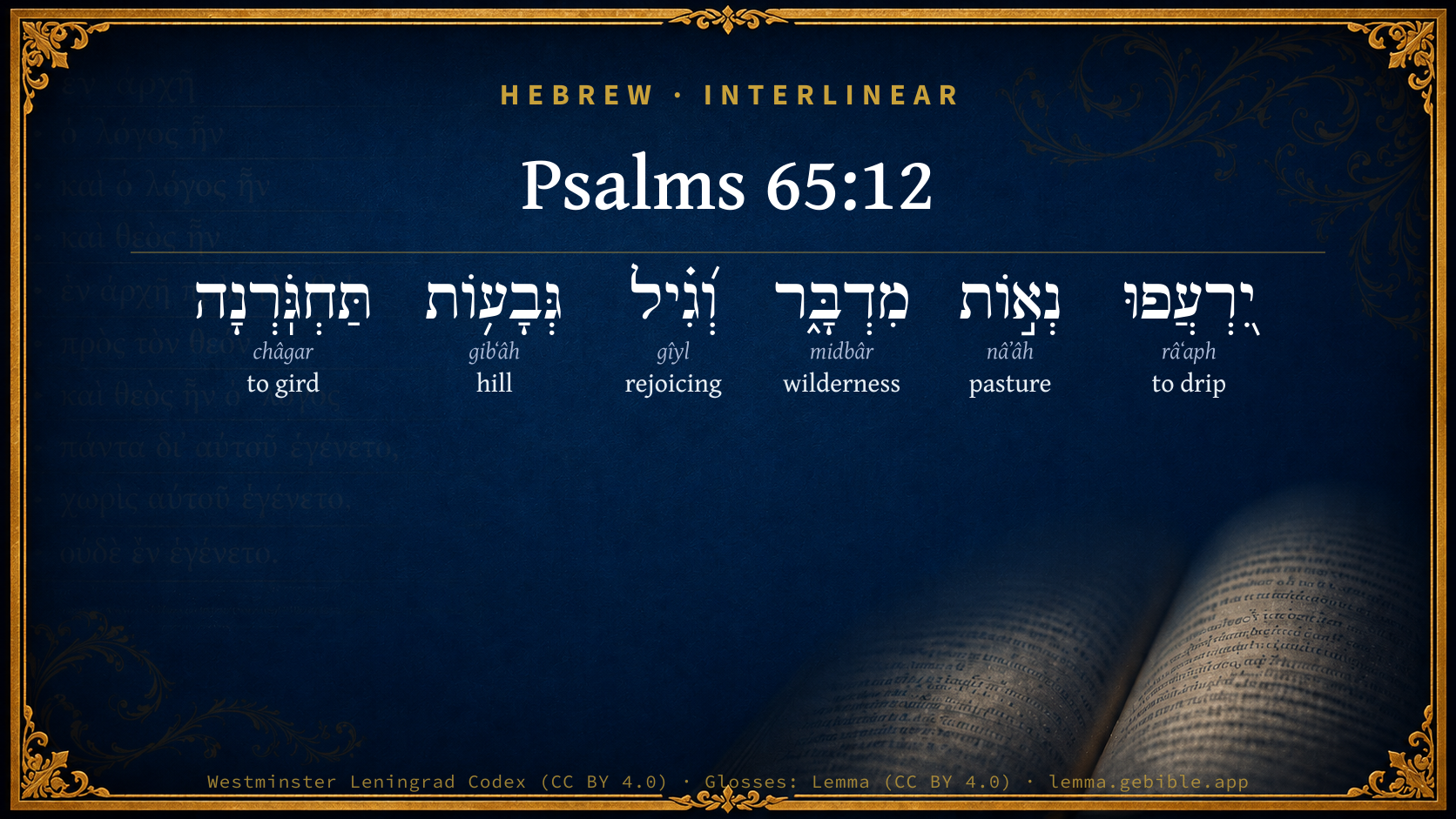
Psalms 65:12

Hebrew (Westminster Leningrad Codex) Psalms 65:12 appears in the Hebrew Old Testament. The text above is from the Westminster Leningrad Codex. Each word links to its Strong’s number, a concise gloss, and parsing drawn from the Open Scriptures Hebrew Bible morphology. Click any word for its full Brown-Driver-Briggs (BDB) entry.
Download image
Cite this verse

Psalms 65:12 (World English Bible). Public Domain. Lemma interlinear Bible study tool, https://lemma.gebible.app/v/psalms/65/12.

Show BibTeX & RIS
BibTeX
RIS
English Translation
The wilderness grasslands overflow. The hills are clothed with gladness.
World English Bible · Public Domain
Download a study sheet

One document with this verse’s original text, its word-by-word gloss line, the meaning frame, cross-references with their text, attributed commentary, and full source and license credits — printable, and it pastes into notes with its structure intact.

This verse Autodidact and up

Study sheet (.html) Plain text (.txt)

A passage Seminary Student

Up to 50 verses in one chapter. A passage sheet keeps up to 6 commentary sources and 12 cross-references per verse, in the order this page ranks them, and says so on the sheet whenever that leaves anything out. Ask for a single verse and you get the Autodidact verse sheet above.

Everything on this page stays free to read, with no account — the sheet is a download of what is already on screen, not access to it.

Want to remove ads? Support Godless Engineer
Compare translations 3

The same verse in 3 English versions, stacked beneath the original-language interlinear above. Click any original word for its lexicon entry.

Each is an independent rendering of the whole verse — the interlinear is not word-aligned to these translations.

Highlighted words mark where these versions differ — a whole-verse word diff, not a word-by-word alignment.

  • World English Bible Public Domain
    The wilderness grasslands overflow. The hills are clothed with gladness.
  • King James Version Public Domain
    They drop upon the pastures of the wilderness: and the little hills rejoice on every side.
  • unfoldingWord Literal Text CC BY-SA 4.0
    The pastures of the wilderness drip, and the hills gird on rejoicing.

unfoldingWord Literal Text — © unfoldingWord, licensed CC BY-SA 4.0. Word-aligned USFM3 via Door43 (git.door43.org/unfoldingWord/en_ult).

Versions to compare (up to 4)

3 of 4 selected

Show all 18 translations

Every available English version of this verse, each an independent rendering of the whole verse.

  • World English Bible Public Domain
    The wilderness grasslands overflow. The hills are clothed with gladness.
  • Berean Standard Bible Public Domain
    The pastures of the wilderness overflow; the hills are robed with joy.
  • Majority Standard Bible Public Domain
    The pastures of the wilderness overflow; the hills are robed with joy.
  • King James Version Public Domain
    They drop upon the pastures of the wilderness: and the little hills rejoice on every side.
  • American Standard Version (1901) Public Domain
    They drop upon the pastures of the wilderness; And the hills are girded with joy.
  • Revised Version (1885) Public Domain
    They drop upon the pastures of the wilderness: and the hills are girded with joy.
  • Geneva Bible (1599) Public Domain
    They drop vpon the pastures of the wildernesse: and the hils shalbe compassed with gladnes.
  • Douay-Rheims (1899) Public Domain
    Thou shalt bless the crown of the year of thy goodness: and thy fields shall be filled with plenty.
  • Young's Literal Translation Public Domain
    Drop do the pastures of a wilderness, And joy of the heights Thou girdest on.
  • Literal Standard Version CC BY-SA 4.0
    The pastures of a wilderness drop, || And You gird the hills with joy.
  • Unlocked Literal Bible CC BY-SA 4.0
    The pastures in the wilderness drip with dew, and the hills are clothed with joy.
  • unfoldingWord Literal Text CC BY-SA 4.0
    The pastures of the wilderness drip, and the hills gird on rejoicing.
  • Darby Bible Public Domain
    They drop upon the pastures of the wilderness, and the hills are girded with gladness.
  • World Messianic Bible Public Domain
    The wilderness grasslands overflow. The hills are clothed with gladness.
  • Webster's Bible Public Domain
    \\65:11\\Thou crownest the year with thy goodness; and thy paths drop fatness.
  • Free Bible Version CC BY-SA 4.0
    The pastures in the wilderness grow lush; the hillsides are clothed in bright flowers.
  • Bible in Basic English Public Domain
    Falling on the grass of the waste land: and the little hills are glad on every side.
  • JPS Tanakh (1917) Public Domain
    (65-13) The pastures of the wilderness do drop; and the hills are girded with joy.

Literal Standard Version (2020), Covenant Press — licensed CC BY-SA 4.0. Text via the HelloAO Bible API (eBible.org). Unlocked Literal Bible (unfoldingWord) — licensed CC BY-SA 4.0. Text via the HelloAO Bible API (eBible.org). unfoldingWord Literal Text — © unfoldingWord, licensed CC BY-SA 4.0. Word-aligned USFM3 via Door43 (git.door43.org/unfoldingWord/en_ult). Free Bible Version, Dr. Jonathan Gallagher — licensed CC BY-SA 4.0. Text via the HelloAO Bible API (eBible.org).

Word by word

More ways to search: Search by grammar → Find every occurrence → Compare this word →

Practice this passage: Drill this verse → Learn its vocabulary →

About this verse

These counts appear in no published source. They are computed here, from the morphology-tagged text and Lemma’s own curated glosses. What Lemma adds →

6
words
6
distinct lemmas
Wisdom
section

Notable vocabulary

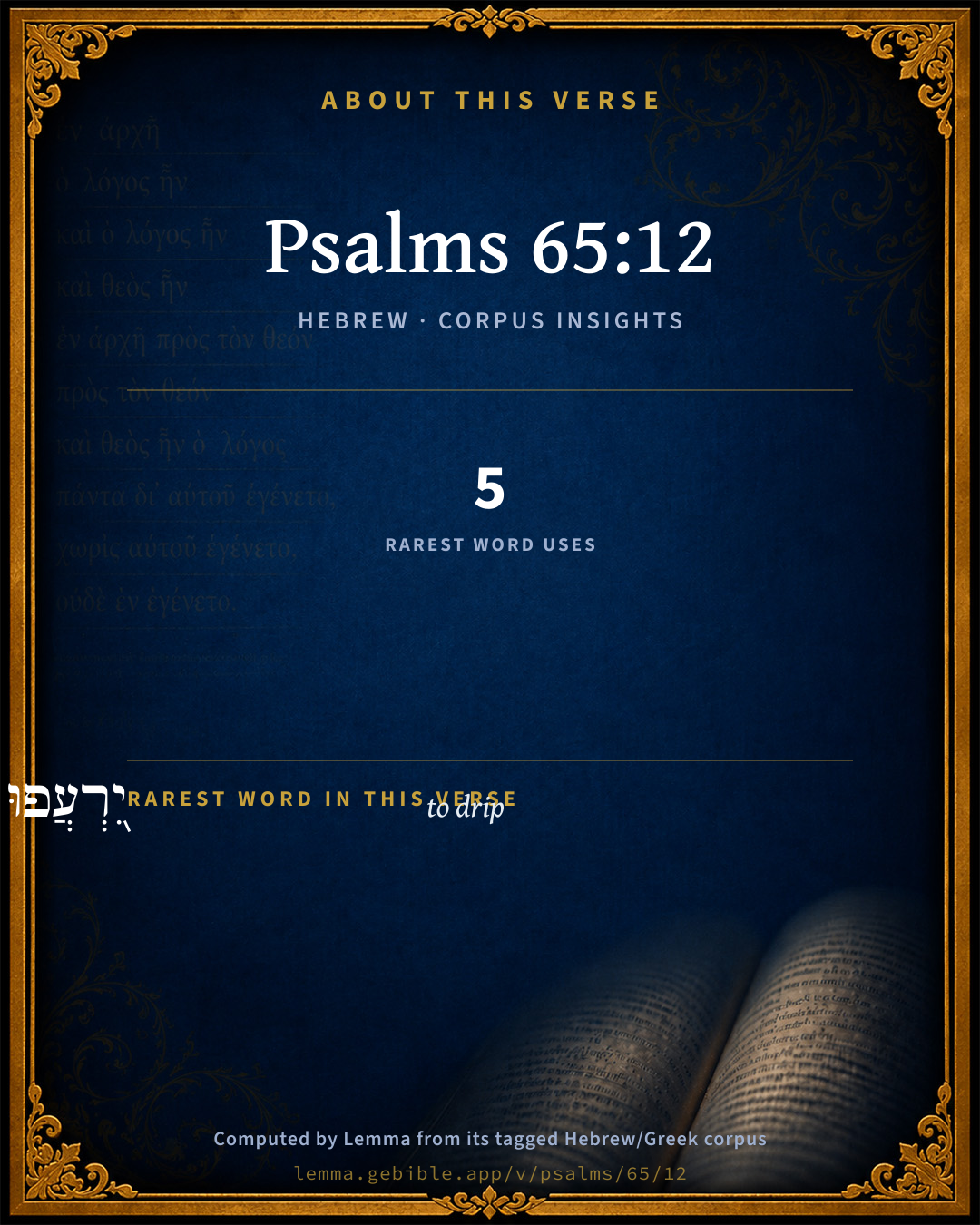
The rarest word here is יִ֭רְעֲפוּ to drip H7491 — appearing just 5 times in the whole Hebrew Bible.

Shared distinctive vocabulary

יִ֭רְעֲפוּ to drip H7491 occurs in 5 verses of the Hebrew Bible. Also found in:

Grammatical profile

  • 2 verbs
  • 4 nouns

Verb forms

  • יִ֭רְעֲפוּ Qal · Imperfect
  • תַּחְגֹּֽרְנָה Qal · Imperfect

Hebrew & Septuagint length

In English translation the verse runs 10 words from the Hebrew and 16 from the Septuagint (LXX English) — closely comparable.

A rough comparison of the two English renderings, which tokenize alike — not a word-level alignment.

Word counts can differ between the Hebrew and the Greek without any difference in meaning — e.g. the Hebrew direct-object marker אֵת has no separate Greek word, and Greek often adds the article ὁ.

Cross-references

6

Topical passages linked to Psalms 65:12 in the Treasury of Scripture Knowledge — connected by theme and wording, ordered by reader-vote popularity; previews shown in the World English Bible.

  • Job 38:26–27 To cause it to rain on a land where no man is; On the wilderness, in which there is no man;
  • Psalms 104:10–13 He sends forth springs into the valleys. They run among the mountains.
  • Joel 2:22 Don't be afraid, you animals of the field; For the pastures of the wilderness spring up, For the tree bears its fruit. The fig tree and the vine yield their strength.
  • Psalms 65:6 Who by his power forms the mountains, Having armed yourself with strength;
  • Isaiah 61:10–11 I will greatly rejoice in Yahweh, my soul shall be joyful in my God; for he has clothed me with the garments of salvation, he has covered me with the robe of righteousness, as a bridegroom decks himself with a garland, and as a bride adorns herself with her jewels.
  • Isaiah 55:9–13 For as the heavens are higher than the earth, so are my ways higher than your ways, and my thoughts than your thoughts.

Cross-references courtesy of OpenBible.info (CC BY 4.0).

Hebrew and Greek witnesses Masoretic Hebrew ↔ Greek Septuagint

The same verse in the two great witnesses to the Old Testament, shown verse-for-verse.

You’re reading Greek Psalm 64 (Hebrew Psalm 65). The Septuagint counts the superscription, so verse numbers can differ from the Hebrew — chapter-level alignment, not verse-by-verse. Numbering follows Rahlfs.

These are two independent witnesses, not word-aligned to each other, and the Septuagint is shown in lemma (dictionary) form.

Hebrew Psalms 65:12 Masoretic · Westminster Leningrad Codex

יִ֭רְעֲפוּ נְא֣וֹת מִדְבָּ֑ר וְ֝גִ֗יל גְּבָע֥וֹת תַּחְגֹּֽרְנָה

The wilderness grasslands overflow. The hills are clothed with gladness.

World English Bible · Public Domain

Greek LXX Greek Psalm 64:12 Septuagint · lemma form

εὐλογέω ὁ στέφανος ὁ ἐνιαυτός ὁ χρηστότης σύ καί ὁ πεδίον σύ πίμπλημι πιότης

The mountains of the wilderness shall be enriched; and the hills shall gird themselves with joy.

LXX2012 (modern English Septuagint) · Public Domain

Hebrew: Westminster Leningrad Codex (CC BY 4.0). Greek: Septuagint (public domain); English from LXX2012 (modern English Septuagint) (Public Domain). How the Septuagint differs from the Hebrew →

Commentary

Notes on Psalms 65:12 from classic Christian and Jewish commentators (each source and its license shown beneath its notes). The classic Christian expositions comment on the surrounding passage and are grouped to its opening verse, so a note may address several verses; the Jewish commentaries on the Tanakh (Rashi and others) are per-verse, so they appear only where the commentator wrote on this verse.

Lemma curates 59 commentaries, every one of them public domain or Creative Commons licensed, each selected and text-cleaned for this edition rather than reprinted as found. About our sources →

Trapp's Complete Commentary

John Trapp

Psa 65:12 They drop [upon] the pastures of the wilderness: and the little hills rejoice on every side.

Ver. 12. Rejoice on every side] Heb. Are girded with joy, which in time of drought seems to be clad in sackcloth.

John Trapp, A Commentary or Exposition upon All the Books of the Old and New Testament (1647–1656) — public domain. Text from a community e-Sword module.

Albert Barnes' Notes on the Bible

They drop upon the pastures of the wilderness - The waste places, or the waste parts of the land; the uncultivated places, the places of rocks and sands. The word wilderness in the Scriptures does not mean, as with us, a tract of country covered with trees, but a place of barren rocks or sands - an uncultivated or thinly inhabited region. See the notes at Mat 3:1; notes at Isa 35:1. In those wastes, however, there would be valleys, or places watered by springs and streams that would afford pastures for flocks and herds. Such are the “pastures of the wilderness” referred to here. God’s passing along those valleys would seem to “drop,” or distil, fertility and beauty, causing grass and flowers to spring up in abundance, and clothing them with luxuriance.

And the little hills rejoice on every side - Margin, as in Hebrew, are girded with joy. That is, Joyful, happy scenes surround them; or, they seem to be full of joy and happiness. The valleys and the hills alike seem to be made glad. The following remarks of Professor Hackett (“Illustrations of Scripture,” p. 30), will explain this passage. “Another peculiarity of the desert is that, though the soil is sandy, it rarely consists, for successive days together, of mere sand; it is interspersed, at frequent intervals, with clumps of coarse grass and low shrubs, affording very good pasturage, not only for camels, the proper tenants of the desert, but for sheep and goats. The people of the villages on the borders of the desert are accustomed to lead forth their flocks to the pastures found there. We frequently passed on our way shepherds so employed; and it was interesting to observe as a verification of what is implied in the Saviour’s statement Mat 25:33, that the sheep and goats were not kept distinct, but intermixed with one another. The shepherds not only frequent the parts of the desert near their places of abode, but go often to a considerable distance from them; they remain absent for weeks and months, only changing their station from time to time, as their needs in respect to water and herbage may require. The incident related of Moses shows that the pastoral habits of the people were the same in his day: ‘Now Moses kept the flock of Jethro, his father-in-law, the priest of Midian; and he led the flock to the further part of the desert, even to Horeb,’ Exo 3:1. It is of the desert in this sense, as supplying to some extent the means of pasturage, that the prophet Joel speaks in Joe 1:19; Joe 2:22. The psalmist also says Psa 65:12-13, with the same reference:

Thou crownest the year with thy goodness,

And thy paths drop fatness;

They drop fatness on the pastures of the wilderness.

Albert Barnes' Notes on the Bible (1834–1885) — public domain. Text from a community e-Sword/MySword module.

J. A. Alexander on Psalms

Joseph Addison Alexander

13. (Psa 65:12). They drop—the pastures of the wilderness, and (with) joy the hills are girt. The word translated pastures properly means dwellings, but is specially applied to folds and pastures, as the places to which flocks resort. See above, on Psa 23:1. The word translated wilderness, according to its most probable etymology, originally signifies, not a barren desert, but a tract of country neither tilled nor thickly peopled, though perhaps luxuriant and abundant as a pasture ground. The general metaphor of clothing which occurs in the next verse, is here anticipated by the specific one of a girdle, as that which surrounds the body and confines the dress. See above, on Psa 18:32.

14 (13). The pastures are clothed with flocks, and the vales shall be robed in grain; they shall shout (for joy), yea, they shall sing. Some translate the first clause, the flocks are clothed with lambs, denying that the first noun in Hebrew ever means pastures. But see above, on Psa 37:20. The image presented in the first translation is certainly more natural and beautiful. It also makes the parallelism more complete, the fields being covered by the waving crops in the same sense that the meadows are covered by the grazing flocks. In the last clause the pastures and valleys, by a beautiful personification, are described as breaking forth into shouts of joy and songs of praise. See above, on Psa 65:8.

Joseph Addison Alexander, The Psalms Translated and Explained (1850) — public domain. Text from a community e-Sword module.

Jamieson, Fausset & Brown

Robert Jamieson, A. R. Fausset & David Brown

wilderness--places, though not inhabited by men, fit for pasture (Lev 16:21-22; Job 24:5).

pastures--is literally, "folds," or "enclosures for flocks"; and in Psa 65:13 it may be "lambs," the same word used and so translated in Psa 37:20; so that "the flocks are clothed with lambs" (a figure for abundant increase) would be the form of expression.

Next: Psalms Chapter 66

Jamieson, Fausset & Brown — Commentary Critical and Explanatory on the Whole Bible (1871) — public domain (CC PDM 1.0). Text via the HelloAO Bible API.

Adam Clarke's Commentary

Verse 12. The pastures of the wilderness] Even the places which are not cultivated have their sufficiency of moisture, so as to render them proper places of pasturage for cattle. The terms wilderness and desert, in the Sacred Writings, mean, in general, places not inhabited and uncultivated, though abounding with timber, bushes, and herbage.

The little hills rejoice] Literally, The hills gird themselves with exultation. The metaphor appears to be taken from the frisking of lambs, bounding of kids, and dancing of shepherds and shepherdesses, in the joy-inspiring summer season.

Adam Clarke's Commentary on the Bible (1810–1826) — public domain. Text from a community e-Sword/MySword module.

Ellicott's Commentary for English Readers

(12) They drop upon.—Supply “fatness” from the last verse.

And the little hills.—See margin. The freshness and beauty of plant life, which suddenly, as by a miracle, in Eastern lands clothes the hill-sides, resembles a fair mantle thrown round their shoulders, as if to deck them for some festival.

A Bible Commentary for English Readers, edited by Charles John Ellicott (1878–1897) — public domain. Text from a community e-Sword module.

The Cambridge Bible for Schools and Colleges

gen. ed. J. J. S. Perowne

12. the pastures of the wilderness] Jer_9:10; Jer_23:10; Joe_1:19-20; Joe_2:22. ‘Wilderness’ denotes the open uncultivated country used for pasturage, in contrast to the cultivated land or ‘field.’

and the little hills &c.] R.V., And the hills are girded with joy. For the personification of nature cp. Psa_96:11 ff; Isa_44:23; &c.

The Cambridge Bible for Schools and Colleges (gen. ed. J. J. S. Perowne; Cambridge University Press, 1878–1918) — public domain. Text from a community e-Sword module.

John Gill's Exposition

They drop upon the pastures of the wilderness,.... As well as upon the ploughed land, and turn them into a fruitful field; which may denote the Gentile world, whither the Gospel was sent by Christ, and preached by his apostles; and whose doctrines dropped as the rain, and prospered to the thing whereunto they were sent, and made this wilderness as the garden of God;

and the little hills rejoice on every side; or "joy girds the hills"; or "they are girded with joy" (r); or "gird themselves with joy", as the Targum; being covered on all sides with grass, herbs, and trees: these may denote the churches of Christ, and little hills of Sion, who rejoice when the interest of Christ flourishes, Psa 68:14.

(r) "collesque exultatione accinguntur", Tigurine version, Junius & Tremellius, Piscator; so Ainsworth; "accinxerunt se", Pagninus; "accingent se", Montanus.

John Gill's Exposition of the Whole Bible (1746–1763) — public domain (CC PDM 1.0). Text via the HelloAO Bible API.

Matthew Poole's English Annotations

They, God’s paths,

drop upon the pastures of the wilderness; which, though neglected by men, are furnished by God with food for wild beasts, which, being his creatures, he careth for by this means.

The little hills; the hills of Canaan, which for the generality of them were but small, if compared with the great and high mountains in divers parts of the world. He mentions

the hills, because these being most dry and parched with the sun, most need and are most refreshed with the rain.

Rejoice on every side; as being moistened and satisfied with rain in all parts and sides of them.

Matthew Poole's English Annotations on the Holy Bible (1683–1685) — public domain. Text from a community e-Sword/MySword module.

The Treasury of David

Charles H. Spurgeon

Ver. 12. They drop upon the pastures of the wilderness. Not alone where man is found do the showers descend, but away in the lone places, where only wild animals have their haunt, there the bountiful Lord makes the refreshing rain to drop. Ten thousand oases smile while the Lord of mercy passes by. The birds of the air, the wild goats, and the fleet stags rejoice as they drink from the pools, new filled from heaven. The most lonely and solitary souls God will visit in love.

And the little hills rejoice on every side. On all hands the eminences are girt with gladness. Soon they languish under the effects of drought, but after a season of rain they laugh again with verdure.

Ver. 12. The wilderness. By desert, or wilderness, the reader is not always to understand a country altogether barren and unfruitful, but such only as is rarely or never sown or cultivated; which, though it yields no crops of corn or fruit, yet affords herbage more or less for the grazing of cattle, with fountains or rills of water, though more sparingly interspersed than in other places. Thomas Shaw (1692-1751).

Ver. 12. (first clause).

I. Our dwelling place: the wilderness.

II. Our spiritual provision: pastures.

III. Our heavenly refreshment: they drop.

Ver. 12. Causes for joy for small churches. God remembers them, establishes and increases them, feeds them and revives them, etc.

Psalms 65:13*

Charles H. Spurgeon's The Treasury of David (1869–1885) — public domain. Psalms only. Text from a community e-Sword/MySword module.

The Pulpit Commentary

They drop upon the pastures of the wilderness; rather, the pastures of the wilderness drip with it; i.e. with the "fatness" which is shed from God"s presence. And the little hills rejoice on every side; literally, are girded with joy.

The Pulpit Commentary (1880–1919), ed. H.D.M. Spence-Jones & Joseph S. Exell — public domain. Text from a community e-Sword module.

John Wesley's Explanatory Notes

Wilderness - Which though neglected by men, are furnished with food for beasts.

John Wesley, Explanatory Notes Upon the Whole Bible (1754–1765) — public domain. Text via the GEBible commentary corpus.

Rashi

Rabbi Shlomo Yitzchaki (Rashi)

You crowned a year of Your goodness Through the rains, You crown with total goodness the year that You wish to benefit.

and Your paths They are the heavens, which are the dust of Your feet.

Rashi on the Tanakh — English translations: “The Judaica Press complete Tanach with Rashi, translated by A. J. Rosenberg” (CC BY 4.0); “Pentateuch with Rashi's commentary by M. Rosenbaum and A.M. Silbermann, 1929-1934” (public domain); “The Metsudah Tanach series, Lakewood, N.J” (CC BY 4.0); and “The Book of Joshua, Metsudah Publications, 1997” (CC BY 4.0). Text via Sefaria.

Lesson kit

Teaching starters — assembled from the data on this page, not authored interpretation. Every prompt links to the verse data it draws on. Edit before teaching.

Psalms, in the Wisdom, opens this verse with 6 words (6 distinct Hebrew lemmas). Its most distinctive word is râʻaph (“to drip”). A historical commentator’s framing appears above. Read the whole chapter for the surrounding context.

Discussion questions

  1. How does “to drip” (râʻaph) shape what this verse is saying?
  2. Job 36:28 shares the word «to drip» with this verse. How do the two illuminate each other?
  3. The translations on this page render this verse differently — a whole-verse word diff, not a word-by-word alignment. What might account for the different wordings?
  4. The verb «יִ֭רְעֲפוּ» is Qal Imperfect. How does its form color the action?
  5. Reading how Trapp's Complete Commentary and Albert Barnes' Notes on the Bible read this verse, where do the two commentators agree and where do they part?

Things to notice

Reading settings

Reading text

Shown beneath each verse's original-language words.

Old Testament
Old Testament edition

Read the OT as the Masoretic Hebrew (MT) or the Greek Septuagint (LXX).

English shown for the Greek Septuagint (in the Hebrew ↔ Greek comparison).

Comparing translations? Open the Compare panel on any verse page to stack up to four side by side.