
Ezekiel 20:25

Hebrew (Westminster Leningrad Codex) Ezekiel 20:25 appears in the Hebrew Old Testament. The text above is from the Westminster Leningrad Codex. Each word links to its Strong’s number, a concise gloss, and parsing drawn from the Open Scriptures Hebrew Bible morphology. Click any word for its full Brown-Driver-Briggs (BDB) entry.
Download image
Cite this verse

Ezekiel 20:25 (World English Bible). Public Domain. Lemma interlinear Bible study tool, https://lemma.gebible.app/v/ezekiel/20/25.

Show BibTeX & RIS
BibTeX
RIS
English Translation
Moreover also I gave them statutes that were not good, and ordinances in which they should not live;
World English Bible · Public Domain
Download a study sheet

One document with this verse’s original text, its word-by-word gloss line, the meaning frame, cross-references with their text, attributed commentary, and full source and license credits — printable, and it pastes into notes with its structure intact.

This verse Autodidact and up

Study sheet (.html) Plain text (.txt)

A passage Seminary Student

Up to 50 verses in one chapter. A passage sheet keeps up to 6 commentary sources and 12 cross-references per verse, in the order this page ranks them, and says so on the sheet whenever that leaves anything out. Ask for a single verse and you get the Autodidact verse sheet above.

Everything on this page stays free to read, with no account — the sheet is a download of what is already on screen, not access to it.

Want to remove ads? Support Godless Engineer
Compare translations 3

The same verse in 3 English versions, stacked beneath the original-language interlinear above. Click any original word for its lexicon entry.

Each is an independent rendering of the whole verse — the interlinear is not word-aligned to these translations.

Highlighted words mark where these versions differ — a whole-verse word diff, not a word-by-word alignment.

  • World English Bible Public Domain
    Moreover also I gave them statutes that were not good, and ordinances in which they should not live;
  • King James Version Public Domain
    Wherefore I gave them also statutes that were not good, and judgments whereby they should not live;
  • unfoldingWord Literal Text CC BY-SA 4.0
    Then I also gave them statutes that were not good, and decrees by which they could not live.

unfoldingWord Literal Text — © unfoldingWord, licensed CC BY-SA 4.0. Word-aligned USFM3 via Door43 (git.door43.org/unfoldingWord/en_ult).

Versions to compare (up to 4)

3 of 4 selected

Show all 18 translations

Every available English version of this verse, each an independent rendering of the whole verse.

  • World English Bible Public Domain
    Moreover also I gave them statutes that were not good, and ordinances in which they should not live;
  • Berean Standard Bible Public Domain
    I also gave them over to statutes that were not good and ordinances by which they could not live.
  • Majority Standard Bible Public Domain
    I also gave them over to statutes that were not good and ordinances by which they could not live.
  • King James Version Public Domain
    Wherefore I gave them also statutes that were not good, and judgments whereby they should not live;
  • American Standard Version (1901) Public Domain
    Moreover also I gave them statutes that were not good, and ordinances wherein they should not live;
  • Revised Version (1885) Public Domain
    Moreover also I gave them statutes that were not good, and judgments wherein they should not live;
  • Geneva Bible (1599) Public Domain
    Wherefore I gaue them also statutes that were not good, and iudgements, wherein they should not liue.
  • Douay-Rheims (1899) Public Domain
    Therefore I also gave them statutes that were not good, and judgments, in which they shall not live.
  • Young's Literal Translation Public Domain
    And I also, I have given to them statutes not good, And judgments by which they do not live.
  • Literal Standard Version CC BY-SA 4.0
    And I also, I have given statutes to them [that are] not good, || And judgments by which they do not live.
  • Unlocked Literal Bible CC BY-SA 4.0
    Then I also gave them statutes that were not good, and decrees by which they could not live.
  • unfoldingWord Literal Text CC BY-SA 4.0
    Then I also gave them statutes that were not good, and decrees by which they could not live.
  • Darby Bible Public Domain
    And I also gave them statutes that were not good, and ordinances whereby they should not live;
  • World Messianic Bible Public Domain
    Moreover also I gave them statutes that were not good, and ordinances in which they couldn’t live.
  • Webster's Bible Public Domain
    Wherefore I gave them also statutes that were not good, and judgments by which they should not live;
  • Free Bible Version CC BY-SA 4.0
    I also let them follow the regulations they wanted that weren't good; laws that wouldn't help them live.
  • Bible in Basic English Public Domain
    And further, I gave them rules which were not good and orders in which there was no life for them;
  • JPS Tanakh (1917) Public Domain
    Wherefore I gave them also statutes that were not good, and ordinances whereby they should not live;

Literal Standard Version (2020), Covenant Press — licensed CC BY-SA 4.0. Text via the HelloAO Bible API (eBible.org). Unlocked Literal Bible (unfoldingWord) — licensed CC BY-SA 4.0. Text via the HelloAO Bible API (eBible.org). unfoldingWord Literal Text — © unfoldingWord, licensed CC BY-SA 4.0. Word-aligned USFM3 via Door43 (git.door43.org/unfoldingWord/en_ult). Free Bible Version, Dr. Jonathan Gallagher — licensed CC BY-SA 4.0. Text via the HelloAO Bible API (eBible.org).

Word by word

More ways to search: Search by grammar → Find every occurrence → Compare this word →

Practice this passage: Drill this verse → Learn its vocabulary →

חֻקִּ֖ים
chôq
H2706
“statutes”
Noun, Common, Masculine, Plural, Absolute
Part of Speech
Noun
Type
Common
Gender
Masculine
Number
Plural
State
Absolute
Full BDB Definition

Origin: from H2710

TWOT: 728a

statute, ordinance, limit, something prescribed, due - prescribed task - prescribed portion - action prescribed (for oneself), resolve - prescribed due - prescribed limit, boundary - enactment, decree, ordinance - specific decree - law in general - enactments, statutes - conditions - enactments - decrees - civil enactments prescribed by God
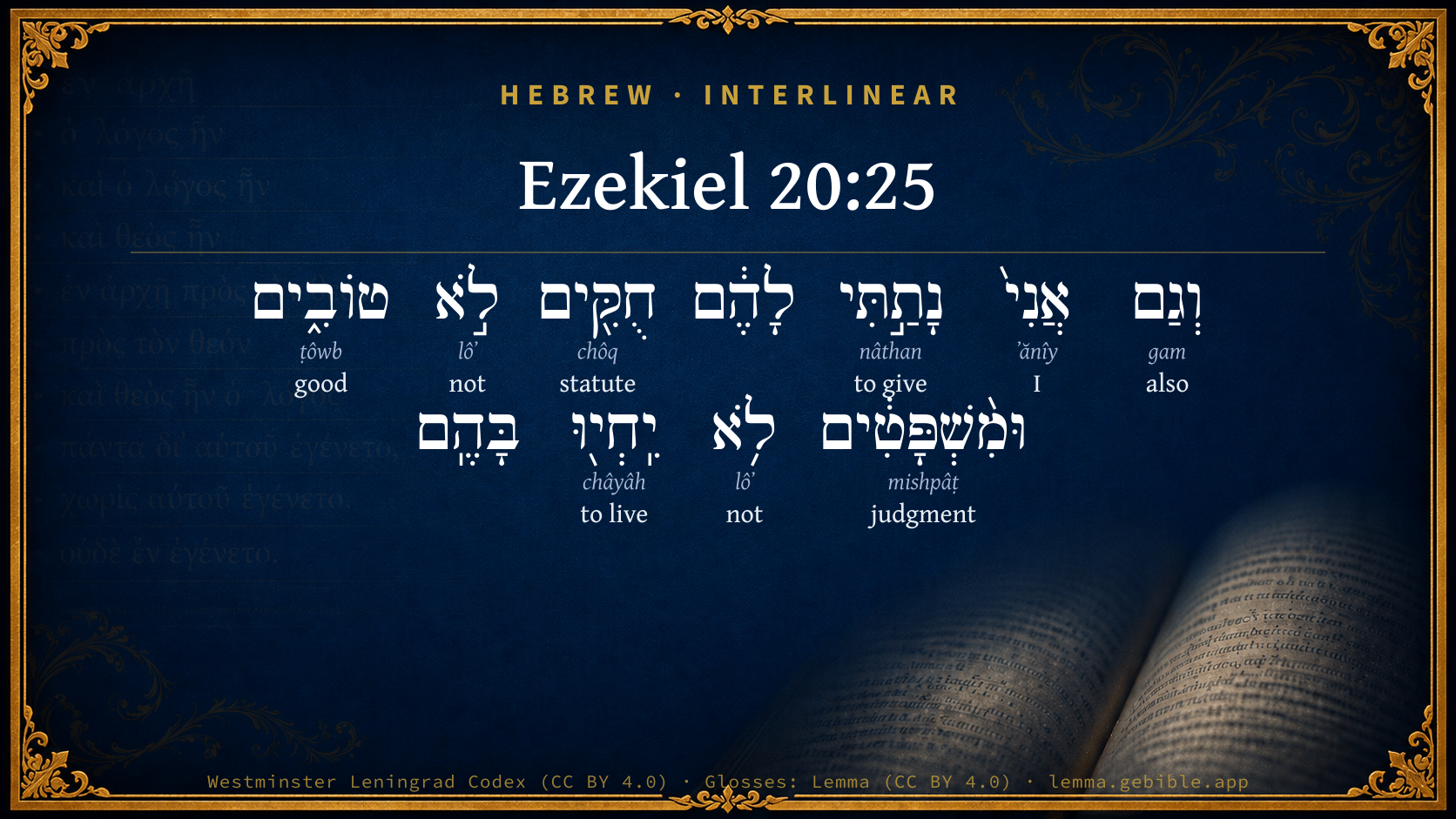
  1. וְגַם gam H1571 “and · also” Conjunction + Particle, Accusative
  2. אֲנִי֙ ʼănîy H589 “I” Pronoun, Personal, 1st Person, Common, Singular
  3. נָתַ֣תִּי nâthan H5414 “to give” Verb, Qal, Perfect, 1st Person, Common, Singular
  4. לֹ֣א lôʼ H3808 “not” Particle, Negative
  5. טוֹבִ֑ים ṭôwb H2896 “good” Adjective, Adjective, Masculine, Plural, Absolute
  6. וּמִ֨שְׁפָּטִ֔ים mishpâṭ H4941 “and · judgments” Conjunction + Noun, Common, Masculine, Plural, Absolute
  7. לֹ֥א lôʼ H3808 “not” Particle, Negative
  8. יִֽחְי֖וּ châyâh H2421 “to live” Verb, Qal, Imperfect, 3rd Person, Masculine, Plural

About this verse

These counts appear in no published source. They are computed here, from the morphology-tagged text and Lemma’s own curated glosses. What Lemma adds →

11
words
8
distinct lemmas
Prophets
section

Grammatical profile

  • 2 verbs
  • 2 nouns
  • 1 adjective
  • 1 pronoun
  • 2 prepositions
  • 3 particles

Verb forms

  • נָתַ֣תִּי Qal · Perfect
  • יִֽחְי֖וּ Qal · Imperfect

Repetition

A word recurs within this verse — often emphatic in Hebrew:

Hebrew & Septuagint length

In English translation the verse runs 18 words from the Hebrew and 17 from the Septuagint (LXX English) — closely comparable.

A rough comparison of the two English renderings, which tokenize alike — not a word-level alignment.

Word counts can differ between the Hebrew and the Greek without any difference in meaning — e.g. the Hebrew direct-object marker אֵת has no separate Greek word, and Greek often adds the article ὁ.

In the original languages it is 11 Hebrew tokens and 15 Greek tokens — but the two are counted differently (Hebrew bundles its prefixes and suffixes into one token; the Greek is in lemma form), so that isn’t a like-for-like length.

Cross-references

9

Topical passages linked to Ezekiel 20:25 in the Treasury of Scripture Knowledge — connected by theme and wording, ordered by reader-vote popularity; previews shown in the World English Bible.

  • Psalms 81:12 So I let them go after the stubbornness of their hearts, That they might walk in their own counsels.
  • Isaiah 66:4 I also will choose their delusions, and will bring their fears on them; because when I called, none did answer; when I spoke, they did not hear: but they did that which was evil in my eyes, and chose that in which I didn't delight.
  • Ezekiel 20:39 As for you, house of Israel, thus says the Lord Yahweh: Go you, serve everyone his idols, and hereafter also, if you will not listen to me; but my holy name shall you no more profane with your gifts, and with your idols.
  • Deuteronomy 4:27–28 Yahweh will scatter you among the peoples, and you shall be left few in number among the nations, where Yahweh shall lead you away.
  • Deuteronomy 28:36 Yahweh will bring you, and your king whom you shall set over you, to a nation that you have not known, you nor your fathers; and there shall you serve other gods, wood and stone.
  • Ezekiel 14:9–11 If the prophet be deceived and speak a word, I, Yahweh, have deceived that prophet, and I will stretch out my hand on him, and will destroy him from the midst of my people Israel.
  • Ezekiel 20:26 and I polluted them in their own gifts, in that they caused to pass through [the fire] all that opens the womb, that I might make them desolate, to the end that they might know that I am Yahweh.
  • 2 Thessalonians 2:9–11 even he whose coming is according to the working of Satan with all power and signs and lying wonders,
  • Romans 1:21–28 Because, knowing God, they didn't glorify him as God, neither gave thanks, but became vain in their reasoning, and their senseless heart was darkened.

Cross-references courtesy of OpenBible.info (CC BY 4.0).

Hebrew and Greek witnesses Masoretic Hebrew ↔ Greek Septuagint

The same verse in the two great witnesses to the Old Testament, shown verse-for-verse.

These are two independent witnesses, not word-aligned to each other, and the Septuagint is shown in lemma (dictionary) form.

Hebrew Ezekiel 20:25 Masoretic · Westminster Leningrad Codex

וְגַם אֲנִי֙ נָתַ֣תִּי לָהֶ֔ם חֻקִּ֖ים לֹ֣א טוֹבִ֑ים וּמִ֨שְׁפָּטִ֔ים לֹ֥א יִֽחְי֖וּ בָּהֶֽם

Moreover also I gave them statutes that were not good, and ordinances in which they should not live;

World English Bible · Public Domain

Greek LXX Ezekiel 20:25 Septuagint · lemma form

καί ἐγώ δίδωμι αὐτός πρόσταγμα οὐ καλός καί δικαίωμα ἐν ὅς οὐ ζάω ἐν αὐτός

So I gave them commandments that were not good, and ordinances in which they should not live.

LXX2012 (modern English Septuagint) · Public Domain

Hebrew: Westminster Leningrad Codex (CC BY 4.0). Greek: Septuagint (public domain); English from LXX2012 (modern English Septuagint) (Public Domain). How the Septuagint differs from the Hebrew →

Targum (Aramaic paraphrase)

1

The Targum is the ancient Jewish Aramaic paraphrase of the Hebrew Scriptures — an interpretive translation, not the Hebrew text itself. Onkelos (literal) and Pseudo-Jonathan (expansive) render the Torah, and Jonathan the Prophets. Coverage is partial: where no permissively-licensed English translation exists for a verse, only the Aramaic is shown. This is verse-level text, not a word-by-word alignment to the Hebrew.

  1. Targum Jonathan Prophets (Joshua–Malachi)
    וְאַף אֲנָא מִדְמָרְדוּ בְמֵימְרֵי וְלָא אָבוּ לְקַבָּלָא לִנְבִיאַי אַרְחֵיקְתִּינוּן וּמְסַרְתִּינוּן בְּיַד שַׂנְאֵיהוֹן וּבָתַר יִצְרֵיהוֹן טִפְּשָׁא אֲזָלוּ וַעֲבָדוּ גְזֵירָן דְלָא תַקְנָן וְנִימוּסִין דְלָא אִתְקַיֵמְתּוּן בְּהוֹן:

    (no public-domain English translation for this verse)

    Targum Jonathan — Aramaic: “Mikraot Gedolot” (public domain). English: “Sefaria Community Translation” (CC0 1.0 (public-domain dedication)); “London "Chaldee Paraphrase," 1871” (public domain). Text via Sefaria.

Commentary

Notes on Ezekiel 20:25 from classic Christian and Jewish commentators (each source and its license shown beneath its notes). The classic Christian expositions comment on the surrounding passage and are grouped to its opening verse, so a note may address several verses; the Jewish commentaries on the Tanakh (Rashi and others) are per-verse, so they appear only where the commentator wrote on this verse.

Lemma curates 59 commentaries, every one of them public domain or Creative Commons licensed, each selected and text-cleaned for this edition rather than reprinted as found. About our sources →

Trapp's Complete Commentary

John Trapp

Eze 20:25 Wherefore I gave them also statutes [that were] not good, and judgments whereby they should not live;

Ver. 25. Wherefore I gave them also statutes that were not good.] i.e., I gave them up to their own inventions and hearts’ lusts (which was worse than to be delivered up to Satan), because they were ingrati gratiae Dei, as Ambrose hath it; they received the grace of God in vain. By "statutes not good," some understand the ceremonial laws, which commanded neither virtue nor vice in themselves. Others, such decrees and ordinances of God in the wilderness as were not good for them, but hurtful; as that for the execution of the calf worshippers, of the Baalpeorites, of Korah and his company, of the murmurers at Kibrothhattaavah, &c. Solon being asked whether he had given the best laws to the Athenians? answered, The best that they could bear.

John Trapp, A Commentary or Exposition upon All the Books of the Old and New Testament (1647–1656) — public domain. Text from a community e-Sword module.

The Biblical Illustrator

Joseph S. Exell

Eze_20:25

I gave them also statutes that were not good, and judgments whereby they should not live.

The judgment of invincible ignorance

These words have often formed the ground of infidel cavils, and therefore require perhaps to be explained; also they open up to us a very important subject, namely, that of our responsibility to God, not only for our actions, but for our opinions. There is a great tendency now to consider that moral guilt can hardly be incurred by a purely intellectual act. It is assumed by the majority that no alarm need he felt about the future life on the score of a mans principles. If he is mistaken in his ideas of right and wrong, truth and falsehood, his mistake, it is urged, will not injure him. Now we believe the tenour of Scripture to be opposed to this. It distinctly states that the thoughts of the heart and the words of the mouth shall be brought into judgment; and it speaks of false opinions on points of religion as strongly as of unrighteous actions. Ezekiel announces a very solemn judgment of God upon those who refuse truth. The chiefs of the nation are before the prophet, requiring to know how God might be propitiated, so as to bring them again to their country and their homes. Then, it is written, came the word of the Lord to Ezekiel. Suddenly, yet perceptibly to himself and them, the Eternal Spirit entered into him, so that the words he spake were no longer his own. Possessed by this awful Indweller, he recapitulates the history of the Jews from the beginning; their repeated sins, Gods reiterated forgiveness; their falls, their chastisements, their restoration to favour. Amongst these mingled visitations of wrath and mercy is described that on which we propose now to dwell.

1. It has been supposed by some that the statutes and judgments here alluded to were those of the Mosaic Law, and that in describing them as statutes not good, the Almighty designed to express their deficiency, as contrasted with the Gospel system, in future times to be made known. A short consideration, however, of the context will show that this theory is unsound, and at the same time explain the real meaning of the text. God having first promulgated to the Israelites laws of life, upon their indifference to these gave them laws of death; and the general principle here involved is, that the punishment of transgressing or refusing holy laws is to have unholy laws assigned us. If we will reject truth we shall be caused to take falsehood for our guide. If a man have truth proposed for his acceptance, and reject it; if he turn away through carelessness, or shut his heart through perverseness of will to the truth as it is in Jesus, what we should most fear for such an one is not famine, or pestilence, or sword. There is a more terrible vial still than these in the treasury of God. Of those who having ears hear not, the punishment would appear to be, that eventually the capacity of understanding shall be taken from them. We cannot, of course, in any particular case pronounce whether the curse of invincible ignorance has been poured out, and the veil drawn finally over the heart; but we urge it upon yea as strong ground for never playing with your convictions, or shutting your souls against the voice of instruction.

2. But now we can imagine that many and great objections present themselves to your minds in connection with the foregoing doctrine. Is this, you ask, agreeable to the goodness and justice of the Deity? Can it be reconciled with His attributes, that He should thus, at any period of human life, take away the power of belief, and Himself blind the soul and make dull the heart? Now let us pause for a moment upon the nature of Gods punishment, so far as we may discover it. We may trace one grand principle pervading and colouring all the visitations of Divine vengeance; the principle is this, that the punishment should in its quality bear a resemblance to the sin. Adam and Eve, presuming to eat the fruit of the tree of good and evil, were debarred access to the tree of life. Jacob, deceiving his father Isaac, was in his turn deceived by his own sons. And it is not difficult to perceive why this should be. The punishment of sin is to preach against sin. How much more striking this preaching becomes when the penalty inflicted is of a sort to call to remembrance the precise iniquity of which it is the penalty. Now, if this be correct, the particular judgment spoken of in the text is just what we might expect would overtake those who will not when they may amend their opinions and embrace the truth. If the sin be to resist truth, what should the penalty be but the being incapacitated from embracing truth? (Bishop Woodford.)

The Biblical Illustrator, edited by Joseph S. Exell (c. 1880s–1900s) — public domain. Text from a community e-Sword module.

Joseph Benson's Commentary

Eze 20:25-26. Wherefore I gave them statutes that were not good, &c. — This some understand of the ceremonial law, as if it were given purely to be a check and restraint to that perverse people, consisting of numerous rites and observances, many of which had no intrinsic good in them. “But I conceive,” says Lowth, “the statutes here spoken of to be of a different nature from those mentioned Eze 20:11, because they have a quite contrary character given of them; and therefore I take the words to import, that God, in a just judgment for their disobedience to his own laws, gave them up to a reprobate mind, and suffered them to walk after the idolatrous and impious customs of the heathen around them. And whereas, by obeying the laws and ordinances which he had given them, they might have lived happily, (Eze 20:11,) they became slaves to the vile and cruel practices of the heathen idolatries, so as to offer up their very children in sacrifice to idols, to the utter destruction of themselves and their posterity, Eze 20:26. This will appear to be the sense of the text, if we compare it with Eze 20:39, and with Deu 4:28; Deu 28:36; Jer 16:13; in which texts God threatens them, as a punishment for their neglect of his worship, to disperse them into the heathen countries, and thereby deprive them of an opportunity of serving him in public, and expose them to the peril of being seduced to idols. Just as David complains to Saul of the hardship of his exile, that it laid him open to the temptation of serving the heathen gods, 1Sa 26:19.” In the same light Bishop Newcome views the passage, interpreting the sense to be, “I permitted them to observe statutes, or idolatrous rites, of an evil and execrable nature.” And I polluted them in their own gifts — I suffered them to pollute themselves in offering abominable sacrifices. In that they caused to pass through the fire, &c. — In offering their firstborn sons in sacrifice to Moloch. That I might make them desolate — Which occasioned the destruction of great numbers of them, and made a desolation in the land. That they might know that I am the Lord — This I permitted, that they might be made sensible that I am the living and true God, and a being infinitely more excellent than any or all of the idols, to the worship of which they had foolishly addicted themselves: or, that they might be compelled to acknowledge, that I am a mighty king in punishing those that would not have me for a gracious king in governing them.

Joseph Benson's Commentary on the Old and New Testaments (1811–1818) — public domain. Text from a community e-Sword module.

Tyndale Open Study Notes

Tyndale Open Resources

20:25-26 I gave them over to worthless decrees and regulations . . . I let them pollute themselves: The Lord allowed the people of Israel to exercise their depravity in the complex and corrupting rituals of paganism and to suffer all of its terrible consequences (see Rom 1:18-25).

Tyndale Open Study Notes — © Tyndale Open Resources, licensed CC BY-SA 4.0. Text via the HelloAO Bible API.

Geneva Bible (1599)

Geneva Bible translators

Because they would not obey my laws, I gave them up to themselves, that they should obey their own fantasies, as verse 39; Rom. 1:21, 24.

Geneva Bible (1599) marginal notes — public domain. Text via Bolls.life.

Jamieson, Fausset & Brown

Robert Jamieson, A. R. Fausset & David Brown

I gave them . . . statutes . . . not good--Since they would not follow My statutes that were good, "I gave them" their own (Eze 20:18) and their fathers' "which were not good"; statutes spiritually corrupting, and, finally, as the consequence, destroying them. Righteous retribution (Psa 81:12; Hos 8:11; Rom 1:24; Th2 2:11). Eze 20:39 proves this view to be correct (compare Isa 63:17). Thus on the plains of Moab (Num. 25:1-18), in chastisement for the secret unfaithfulness to God in their hearts, He permitted Baal's worshippers to tempt them to idolatry (the ready success of the tempters, moreover, proving the inward unsoundness of the tempted); and this again ended necessarily in punitive judgments.

Jamieson, Fausset & Brown — Commentary Critical and Explanatory on the Whole Bible (1871) — public domain (CC PDM 1.0). Text via the HelloAO Bible API.

Adam Clarke's Commentary

Verse 25. I gave them also statutes that were not good] What a foolish noise has been made about this verse by critics, believers and infidels! How is it that God can be said "to give a people statutes that were not good, and judgments whereby they could not live?" I answer, in their sense of the words, God never gave any such, at any time, to any people. Let any man produce an example of this kind if he can; or show even the fragment of such a law, sanctioned by the Most High! The simple meaning of this place and all such places is, that when they had rebelled against the Lord, despised his statutes, and polluted his Sabbaths - in effect cast him off, and given themselves wholly to their idols, then he abandoned them, and they abandoned themselves to the customs and ordinances of the heathen. That this is the meaning of the words, requires no proof to them who are the least acquainted with the genius and idioms of the Hebrew language, in which God is a thousand times said to do, what in the course of his providence or justice he only permits to be done.

Adam Clarke's Commentary on the Bible (1810–1826) — public domain. Text from a community e-Sword/MySword module.

John Calvin's Commentaries

Here God announces that he had taken vengeance upon people so hard and obstinate, by permitting them to endure another yoke, since they would not be ruled by the doctrine of the law; for we saw that, when God imposed the law upon the Israelites, they would have been extremely happy, had they only considered how honorable it was to be in covenant with God, who deigned to bind them to himself in mutual fidelity. This was a remarkable honor and privilege, since God not only showed them what was right, but promised them a reward which he by no means owed them. But what was the conduct of that unteachable nation? It threw off the yoke of the law; hence it deserved to experience a different government. God, therefore, gave them laws that were not good, when he suffered them to be miserably subjected to an immense heap of errors: such laws as these were not good. Some writers have violently distorted this passage, by thinking the law itself, as promulgated by Moses, “not good,” since Paul calls it deadly; but they corrupt the Prophet’s sense, since God is comparing his law with the superstitions of the Gentiles: others explain it of the tributes which the people were compelled to pay to foreigners. But, first of all, God does not speak here of only one age; nay, during the, time of the Israelites’ freedom his vengeance was nevertheless severe.

Thus, in the next verse, the Prophet confirms what I have briefly touched on, namely, that the laws called not good are all the fictions of men, by which they harass themselves, while they think that God is worshipped acceptably in this way: for we know how miserably men labor and distract themselves when Satan has fascinated them with his toils, and when they anxiously invent numerous rites, because there is no end of their superstitions; hence these statutes are not good: for when they have undergone much labor in their idolatry, no other reward awaits them than God’s appearance against them as an avenger to punish the profanation of his own lawful worship. They indeed by no means look for this, but they utterly deceive themselves; hence they must hope for no reward but what is founded on the covenant and promise of God; for all false and vicious forms of worship, all adventitious rites, which men heap together from all sides, have no promise from God, and hence they vainly trust to them for life. God began to show them this in the wilderness; but in succeeding ages he did not fail to exercise the same vengeance. We see how they fell in with the superstitions of the Moabites; and why so? unless God blinded them by his just judgments. (Numbers 25:1-3.) He had experienced their untamed dispositions, and so he set them free from control; and not only so, but afterwards gave them up to Satan, and so he says that he gave them laws that were not good. The Prophet might indeed have said, that they despised God’s law through their own wisdom, that they foolishly and rashly legislated for themselves: this was indeed true; but he wished to express the penalty of which Paul speaks, when he says that the impious were delivered to a reprobate mind, and to obedience to a lie, (Romans 1:24-26,) since they did not submit to the truth, and did not suffer themselves to be ruled by God, and thus were given up to the tyranny of Satan and to the service of mere creatures. Now, therefore, we understand the Prophet’s meaning, I have given them also, says he, laws not good, as if he had said that the people so threw themselves into various idolatries, that God desired in this way to avenge their incredible obstinacy; for if the Jews had calmly acquiesced in God’s sovereignty, he had not given them evil laws, that is, he had not suffered them to be so tormented under Satan’s tyranny; but when they were entangled in his snares, God openly shows them to be unworthy of his government and care, since they were too refractory. It follows —

John Calvin's Commentaries (1540-1563) — public domain. Text from the Calvin Translation Society English edition (1840s-50s) via the Christian Classics Ethereal Library (ccel.org). Calvin's coverage is partial (roughly two-thirds of the Bible); uncommented books and verses are honest gaps, never fabricated. The 19th-century editor's footnotes and remarks are omitted so the notes are faithfully Calvin's own voice.

Ellicott's Commentary for English Readers

(25) Statutes that were not good.—In this verse the general statement is made of which a particular instance is given in the next. The “statutes that were not good, and judgments whereby they should not live,” cannot be the same with those described in Eze_20:11 as “judgments which, if a man do, he shall even live in them.” They are not, therefore, to be understood (as many of the fathers took them) of any part of the Mosaic law. Neither is it a sufficient explanation to say that God gave them what was intrinsically good, but it became evil to them through their sins; such a view of the law is emphatically discarded in Rom_7:13. The statutes of the Mosaic law are not intended here at all, as is plain from the particular instance of the consecration of children to Moloch in the next verse. These evil statutes and judgments were those adopted from the heathen whom they had suffered to dwell among them, and from the surrounding nations. But how can the Lord say that He gave these to them? In the same way that it is said in Isa_63:17, “O Lord, why hast thou made us to err from Thy ways, and hardened our heart from Thy fear?” So also St. Paul says of the heathen (Rom_1:21-28) that God “gave them up to uncleanness,” “unto vile affections,” “to a reprobate mind;” and of certain wicked persons (2Th_2:11-12) “God shall send them strong delusion, that they should believe a lie: that they all might be damned who believe not the truth.” And St. Stephen says of these very Israelites at this very time, “God gave them up to worship the host of heaven” (Act_7:42). It is part of that universal moral government of the world, to which Ezekiel so frequently refers, that the effect of disobedience and neglect of grace is to lead the sinner on to greater sin. The Israelites rebelled against the Divine government, and neglected the grace given them; the natural consequence was that they fell under the influence of the heathen. Comp. Note on Eze_14:9.

A Bible Commentary for English Readers, edited by Charles John Ellicott (1878–1897) — public domain. Text from a community e-Sword module.

The Cambridge Bible for Schools and Colleges

gen. ed. J. J. S. Perowne

25. Wherefore I gave … also] Moreover also I gave, see Eze_20:23.

statutes … not good] These statutes are of a kind contrary to those given before (Eze_20:11) which were good. These points seem plain: 1. The practice referred to is that of passing the firstborn male children through the fire as a burnt-offering to the deity. 2. The law in Israel was that all the male firstborn of men and the male firstlings of beasts were the Lord’s. The firstborn of men were to be redeemed, as also the firstlings of unclean animals, but the firstlings of clean animals were to be offered in sacrifice to Jehovah (Exo_13:2; Exo_13:12-13; Exo_22:29, cf. Num_3:46-47; Num_18:15-16). The law requiring the sacrifice of the firstborn had become extended, so as to include children. The practice was one prevailing among the peoples around Israel, and probably it first crept into use in Israel and was then justified by the law or custom relating to cattle, of which it might seem a natural extension; but in Jer_7:31; Jer_19:5 Jehovah vehemently protests that to command it never came into his mind. The question to whom the children were offered, lit. passed over in the fire, is not quite easy to decide. In passages where the practice is condemned it is represented as a sacrifice to “the Molech,” Lev_18:21; Deu_12:31; Deu_18:10, or to the Baal, Jer_7:31, or generally, to the idols, Eze_16:21; Psa_106:38 (idols of Canaan). Though the spelling of the name Molech is peculiar, the word probably means “the king” originally, just as the Baal means “the lord,” both names being descriptive of the same deity. In Isa_57:9 “the king” has the ordinary spelling. Though borrowing the practice from the Canaanites it is probable that in Israel the sacrifice was offered to Jehovah, particularly as the law under which it was made was considered given by him. On the other hand Jer., though repudiating this popular inference, speaks of the offering as being made to Baal. The name “Baal,” however, from Hosea downwards is used somewhat laxly, including the images of Jehovah, and all heathenish ceremonies in his service are called worship of Baal. 3. This law is described as not good, one by which men could not live. The effect of it was that men were polluted in their gifts (Eze_20:26), and the purpose of it was to destroy them. This evil law, entailing this consequence, was a judicial punishment of them for their former sins, just as the “deception” of the false prophets was, ch. Eze_14:9. Whether the people, familiar with the Baal worship, drew the false inference from the law of the firstborn, or whether false teachers set the idea before them, is uncertain (Jer_8:8 appears to refer to written perversions of the law). The sacrifice of children was a practice that gained ground in the disastrous times before the exile (Hos_13:2 has another meaning: men who sacrifice kiss calves; it is the irrationality of men kissing calves that the prophet mocks, not the enormity of human sacrifices). Ezekiel appears to regard the practice as ancient, as he connects it with the second generation in the wilderness. The instances noted in early history are transjordanic (Jephthah and king of Moab), and possibly, though the practice became aggravated only at a later period, the prophet may have considered that the people became acquainted with it on the other side of the Jordan.

The Cambridge Bible for Schools and Colleges (gen. ed. J. J. S. Perowne; Cambridge University Press, 1878–1918) — public domain. Text from a community e-Sword module.

John Gill's Exposition

Wherefore I gave them also statutes that were not good,.... Yea, were very bad; not the moral law, and the statutes of it; for that is holy, just, and good, though the killing letter and ministration of condemnation and death to the transgressors of it; indeed those laws were both good and bad to different persons, as Abendana observes; good to those that observed them, but not good to those that transgressed them, the issue of which was death: rather these were the statutes and rites of the ceremonial law, which were not in their own nature good; nor did they arise from the nature and holiness of God, but from his will; and though very good and useful under the legal dispensation, until the Messiah came, especially when attended to by faith, and with a view to him; yet had the sanction of death to many of them, that a man could not live by them: but it may be, the punishments inflicted on them for their sins, by the plague, by fire, and by serpents, are meant; which may be called "statutes" and "judgments", because ordered and appointed by the Lord, and according to justice: or, as many, both Jews and Christians, think, the idolatrous laws, usages, and customs of other nations, the traditions of their fathers, their wicked laws and statutes, and their own; which, being left to a reprobate mind, they were suffered to walk in, to their hurt and ruin; which is sometimes the sense of the word give; and so here, he "gave", that is, he permitted them to observe such statutes; and this sense is countenanced and confirmed by Eze 20:26; to which agrees Jarchi's note,

"I delivered them into the hand of their imagination (or corrupt nature) to stumble at their iniquity;''

see Rom 1:28. Kimchi interprets them of laws, decrees, tribute, and taxes, imposed upon them by their enemies that conquered them. The Targum is,

"and I also, when they rebelled against my word, and would not obey my prophets, cast them far off, and delivered them into the hands of their enemies; and they went after their foolish imagination, and made decrees which were not right:''

and judgments, whereby they should not live; yea, which were deadly and destructive to them; which brought ruin, destruction, and death upon them; for more is designed than is expressed: this was the effect of following the customs of the nations, and of walking in the statutes of their fathers, and of their own; whereas, had they walked according to the judgments and statutes of God, moral and ceremonial, they had lived comfortably and prosperously.

John Gill's Exposition of the Whole Bible (1746–1763) — public domain (CC PDM 1.0). Text via the HelloAO Bible API.

Haydock's Catholic Bible Commentary

Not good. The laws and ordinances of their enemies: or those imposed upon them by that cruel tyrant the devil, to whose power they were delivered up for their sins; (Challoner) which may be styled the statutes of your fathers, &c., ver. 18. (Haydock) --- God is often said to do what he only permits. (Calmet) --- He abandoned them to their own perversity. (St. Jerome) (Deuteronomy xxxii. 21, 37.) --- If God had spoken of the Decalogue, &c., would he say such laws were not good, after he had testified that the observers shall live in them? ver. 11. He established the ceremonial law, at the same time. See Kimchi; Menochius, &c. Chaldean, "I have given them up to their foolish desires. They have established bad statutes and laws which will not give them life." This seems the best explanation. (Calmet) --- Hebrew, "Have I given....(26) and have I polluted them?" &c. (Manasse Ben. Israel.) The precepts had also a bad effect, and were given in condescension to the weakness of the people, (Origen) particularly the ceremonial part. (St. Just.[St. Justin Martyr?]; St. Chrysostom; St. Jerome, &c.) --- They did not justify, (St. Augustine) and were not good, compared with those of the new law. (St. Gregory, mor. xxviii. 9.) --- Thus Solon gave the Athenians "the best laws that they would receive," (Plutarch) though others more perfect might have been devised. (Calmet)

George Leo Haydock (1774–1849), Haydock's Catholic Family Bible and Commentary, 1859 edition — public domain. Excludes Psalms (Douay-Rheims chapter numbering differs from Protestant) and Deuterocanonical books (Catholic canon only).

Matthew Poole's English Annotations

Because they did by such perverse obstinacy reject the statutes I did in mercy give them; my good laws and judgments, saith God, they despised; for this cause God proceeds to punish them in a dreadful kind and manner,

Gave them; not by appointing or enjoining, but by permitting them to make such for themselves, much like that Rom 1:24, giving up to a reprobate sense, or that 2Th 2:11; Psa 81:11,12, as a governor or father, after long and fruitless strivings with an obstinate and unruly youth, gives him up at last as hopeless, and casts off the care and guidance of him.

Statutes; orders and rules about their religious worship, which they first invented, next approved, and lastly made their established religion, where all they could love in it was, that it was their own.

Were not good; had nothing in them that was morally good, pious, or suited to the spiritual nature of God; that were unprofitable, and ministered nothing to the edifying and bettering of men, nor could commend the users of them to God; that were indeed pernicious to the users, and increased their sins, being superstitious and idolatrous: so the not good is very bad, inconvenient, and hurtful.

Whereby they should not live: if it be not explicatory of the former, it may, it is possible, refer distinctly to the inconvenient, oppressive, and unsafe courses, decrees, and edicts about civil matters, which were such as they could never thrive under; for however some heathen nations have thrived under an evident blessing from Heaven, though their religion were idolatrous, yet I do not remember that an apostate nation ever retained their good government and civil prosperity under their apostacy from God; thus the judgments given were such they could not live in them; they made grievous and destructive laws for themselves and theirs.

Matthew Poole's English Annotations on the Holy Bible (1683–1685) — public domain. Text from a community e-Sword/MySword module.

Whedon's Commentary on the Bible

Daniel D. Whedon

25. Wherefore I gave them also statutes that were not good — Does this refer to certain Mosaic regulations which were “permitted because of the hardness of their hearts?” (Mat_19:8.) Or does it express the common Scripture truth that Jehovah is so fully the supreme ruler of Israel that when the people attempt to escape from his rule the edicts of evil kings (such as the “statutes of Omri” (Mic_6:16) and Jeroboam (1Ki_12:28-33), the utterances of false prophets (Eze_14:9), and even the cruel statutes and ordinances of the heathen worship which they chose to obey, become really divine chastisements which Jehovah gives to them? (Eze_5:8; Eze_5:10; Eze_7:4; Eze_7:9; Eze_7:22; Eze_7:26-27; see especially, note Eze_14:9.) Or does it only mean that Jehovah has given up these willful transgressors to the unclean law which has been written by persistent sin upon the tablets of their hearts? (Compare 2Th_2:11.) In either case the ethical principles justifying Jehovah’s action are nearly the same. Laws for the disobedient and criminal cannot be the same as for the obedient and pure. Such laws are not “good,” but they are the best possible under the circumstances. “The soul that sinneth, it shall die” (Eze_18:4), is just as truly a divine law as that which offers life through obedience (Eze_20:11). It is God’s law that the man who willfully follows the false will finally lose the power to follow or even to know the true. Since God is the author of this law the New Testament rightly declares that it is God who blinds the eyes and hardens the heart of the impenitent. This does not mean that God desires any man to lose his spiritual eyesight. It simply means that, by refusing to obey God’s laws of mercy — obedience to which might have saved him his sight — he has necessarily become subject to God’s law of judgment under which he must inevitably, if unrepentant, suffer the penalty of blindness. (See notes Mar_4:12; Luk_8:10; Joh_12:40; Rom_1:21-28; Rom_11:9.) Because of willful rejection of the truth he has become unable to see and therefore unable to obey the truth. The very agencies which were intended to be to him a savor of life unto life have become a savor of death unto death (2Co_2:16; Exo_14:4). He has brought himself under the dominion of the divine statutes which were ordained for the government of incorrigibles, and he finds them to be hard and painful.

Daniel D. Whedon (gen. ed.), Commentary on the Old and New Testaments (1874–1909) — public domain. Text from a community e-Sword module.

The Pulpit Commentary

I gave them also statutes that were not good, etc. The words have sometimes been understood as though Ezekiel applied these terms to the Law itself, either as speaking of what St. Paul calls its "weak and beggarly elements", (Gal_4:9) or as unable to work out the righteousness which it commanded, (Rom_3:20) and the language of Heb_7:19 and Eze_10:1 has been urged in support of this view. One who has studied Ezekiel with any care will not need many words to show that such a conclusion was not in his thoughts at all. For him the Law was "holy and just and good," and its statutes such that a man who should keep them should even live in them (vers. 13, 21). He is speaking of the time that followed on the second publication of that Law, and what he Says is that the people who rebelled against it were left, as it were, to a law of another kind. The baser, darker forms of idolatry are described by him, with a grave irony, as statutes and judgments of another kind, working, not life, but death. Sin became, by God"s appointment, the punishment of sin, that it might be manifest as exceeding sinful. So Stephen says of Israel that "God turned, and gave them up to worship the host of heaven". (Act_7:42) So St. Paul paints the corruptions of the heathen world as the result of God"s giving them up to "vile affections". (Rom_1:24, Rom_1:25) So in God"s future dealings with an apostate form of Christianity, the same apostle declares that "God shall send them strong delusions that they should believe a lie". (2Th_2:11) Psa_81:12 may have been in Ezekiel"s thoughts as asserting the same general law.

The Pulpit Commentary (1880–1919), ed. H.D.M. Spence-Jones & Joseph S. Exell — public domain. Text from a community e-Sword module.

John Wesley's Explanatory Notes

Wherefore - Because they rejected my good laws and judgments. I gave them - Not by enjoining, but by permitting them to make such for themselves. Not good - That were pernicious to the users.

John Wesley, Explanatory Notes Upon the Whole Bible (1754–1765) — public domain. Text via the GEBible commentary corpus.

unfoldingWord translationNotes

Door43 World Missions Community

General Information:

Yahweh continues giving Ezekiel his message to the elders of Israel.

Then I also gave them statutes that were not good, and decrees by which they could not live

The words statutes in this phrase do not refer to God's law. God permitted them to live by human laws and judgments that were not good.

gave them

The word "them" refers to the children of those whom Yahweh brought out of Egypt.

through their gifts

Here the word "gifts" refers to the sacrifices that the people made to the idols that they worshiped. AT: "because of their sacrifices" or "because they gave gifts to idols" (See: Assumed Knowledge and Implicit Information)

they made a sacrifice of every firstborn of the womb

The phrase "firstborn of the womb" refers to the firstborn child of a woman. The phrase "made a sacrifice" can be translated with the verb "sacrifice." AT: "they sacrificed every woman's firstborn child" (See: Assumed Knowledge and Implicit Information)

caused them to pass through the fire

It is implicit that they caused their children to pass through the fire in order to offer them as burnt offerings to their idols. AT: "sacrificed them as burnt offerings" (See: Assumed Knowledge and Implicit Information)

translationWords

statute

decree

clean

gift

firstborn

womb

fire

know

Yahweh

unfoldingWord translationNotes — © Distant Shores Media and the Door43 World Missions Community, licensed CC BY-SA 4.0. Source: git.door43.org/Door43/en_tn.

Rashi

Rabbi Shlomo Yitzchaki (Rashi)

statutes that were not good I delivered them into the hands of their temptation to stumble over their iniquity, and so did Jonathan render: And I delivered them into the hands of their foolish temptation, and they went and made decrees that were not good, and practices by which they cannot live.

Rashi on the Tanakh — English translations: “The Judaica Press complete Tanach with Rashi, translated by A. J. Rosenberg” (CC BY 4.0); “Pentateuch with Rashi's commentary by M. Rosenbaum and A.M. Silbermann, 1929-1934” (public domain); “The Metsudah Tanach series, Lakewood, N.J” (CC BY 4.0); and “The Book of Joshua, Metsudah Publications, 1997” (CC BY 4.0). Text via Sefaria.

Lesson kit

Teaching starters — assembled from the data on this page, not authored interpretation. Every prompt links to the verse data it draws on. Edit before teaching.

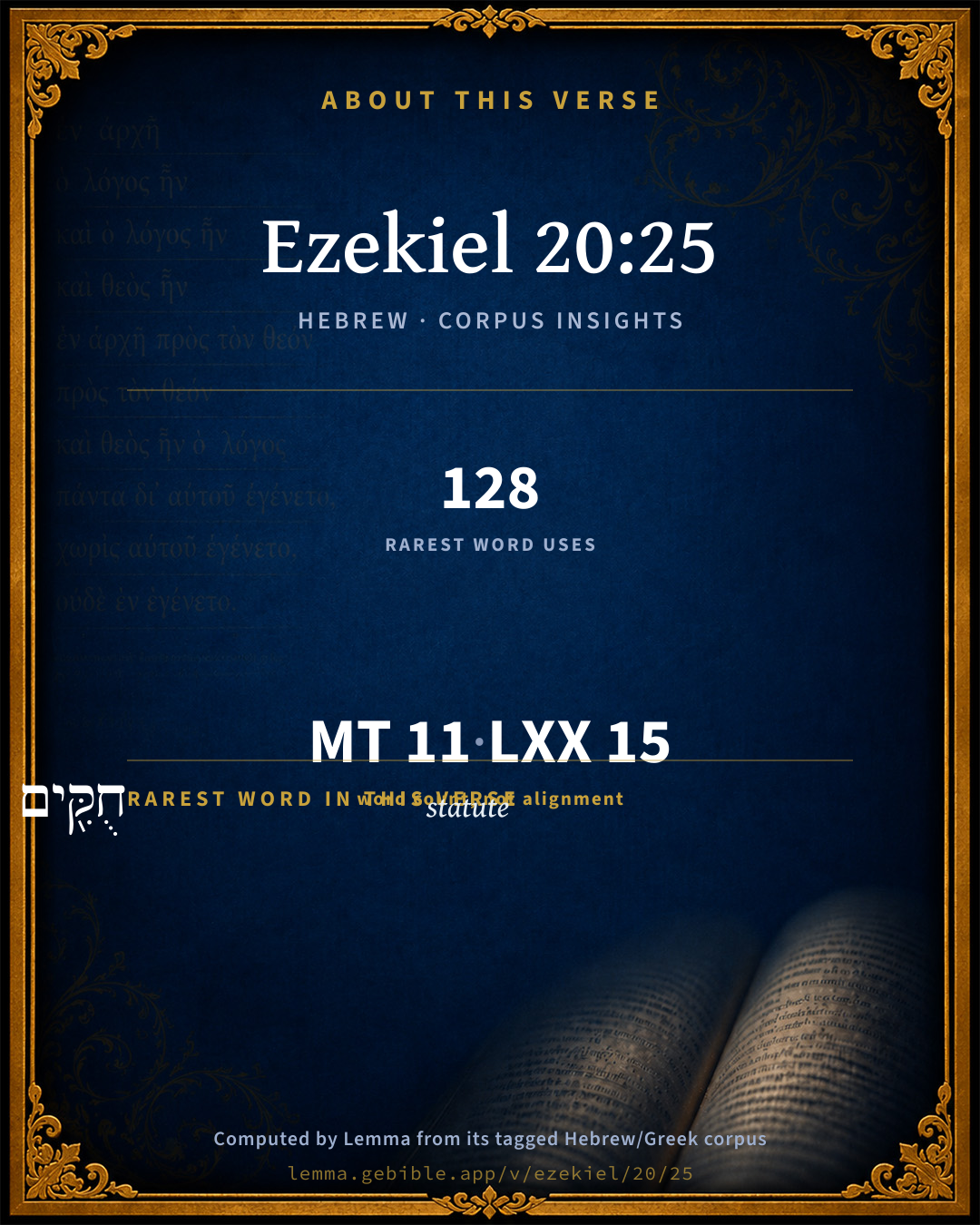
Ezekiel, in the Prophets, opens this verse with 11 words (8 distinct Hebrew lemmas). Its most distinctive word is chôq (“statute”). A historical commentator’s framing appears above. Read the whole chapter for the surrounding context.

Discussion questions

  1. The word chôq carries the sense “statute.” How does it shape the verse?
  2. Psalms 81:12 shares this passage’s theme. How do the two illuminate each other?
  3. “not” occurs 2× in this one verse. What is the effect of the repetition?
  4. These translations render this verse differently. What is at stake in choosing one wording over another?
  5. The verb «נָתַ֣תִּי» is Qal Perfect. How does its form color the action?
  6. Reading how Trapp's Complete Commentary and The Biblical Illustrator read this verse, where do the two commentators agree and where do they part?

Things to notice

Reading settings

Reading text

Shown beneath each verse's original-language words.

Old Testament
Old Testament edition

Read the OT as the Masoretic Hebrew (MT) or the Greek Septuagint (LXX).

English shown for the Greek Septuagint (in the Hebrew ↔ Greek comparison).

Comparing translations? Open the Compare panel on any verse page to stack up to four side by side.