
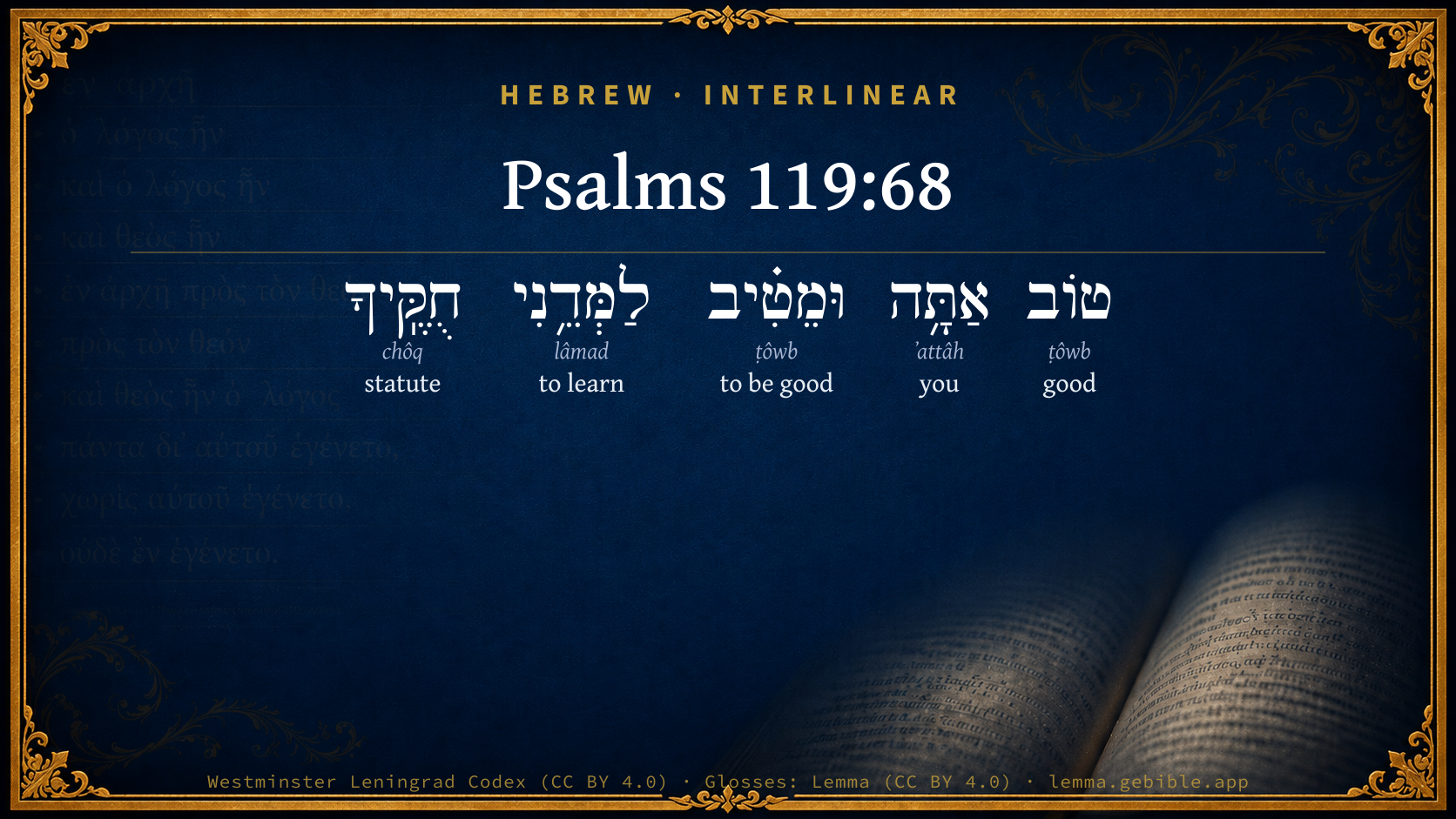
Psalms 119:68

Hebrew (Westminster Leningrad Codex) Psalms 119:68 appears in the Hebrew Old Testament. The text above is from the Westminster Leningrad Codex. Each word links to its Strong’s number, a concise gloss, and parsing drawn from the Open Scriptures Hebrew Bible morphology. Click any word for its full Brown-Driver-Briggs (BDB) entry.
Download image
Cite this verse

Psalms 119:68 (World English Bible). Public Domain. Lemma interlinear Bible study tool, https://lemma.gebible.app/v/psalms/119/68.

Show BibTeX & RIS
BibTeX
RIS
English Translation
You are good, and do good. Teach me your statutes.
World English Bible · Public Domain
Download a study sheet

One document with this verse’s original text, its word-by-word gloss line, the meaning frame, cross-references with their text, attributed commentary, and full source and license credits — printable, and it pastes into notes with its structure intact.

This verse Autodidact and up

Study sheet (.html) Plain text (.txt)

A passage Seminary Student

Up to 50 verses in one chapter. A passage sheet keeps up to 6 commentary sources and 12 cross-references per verse, in the order this page ranks them, and says so on the sheet whenever that leaves anything out. Ask for a single verse and you get the Autodidact verse sheet above.

Everything on this page stays free to read, with no account — the sheet is a download of what is already on screen, not access to it.

Want to remove ads? Support Godless Engineer
Compare translations 3

The same verse in 3 English versions, stacked beneath the original-language interlinear above. Click any original word for its lexicon entry.

Each is an independent rendering of the whole verse — the interlinear is not word-aligned to these translations.

Highlighted words mark where these versions differ — a whole-verse word diff, not a word-by-word alignment.

  • World English Bible Public Domain
    You are good, and do good. Teach me your statutes.
  • King James Version Public Domain
    Thou art good, and doest good; teach me thy statutes.
  • unfoldingWord Literal Text CC BY-SA 4.0
    You good, and you do good. Teach me your statutes.

unfoldingWord Literal Text — © unfoldingWord, licensed CC BY-SA 4.0. Word-aligned USFM3 via Door43 (git.door43.org/unfoldingWord/en_ult).

Versions to compare (up to 4)

3 of 4 selected

Show all 17 translations

Every available English version of this verse, each an independent rendering of the whole verse.

  • World English Bible Public Domain
    You are good, and do good. Teach me your statutes.
  • Berean Standard Bible Public Domain
    You are good, and You do what is good; teach me Your statutes.
  • Majority Standard Bible Public Domain
    You are good, and You do what is good; teach me Your statutes.
  • King James Version Public Domain
    Thou art good, and doest good; teach me thy statutes.
  • American Standard Version (1901) Public Domain
    Thou art good, and doest good; Teach me thy statutes.
  • Revised Version (1885) Public Domain
    Thou art good, and doest good; teach me thy statutes.
  • Geneva Bible (1599) Public Domain
    Thou art good and gracious: teach me thy statutes.
  • Young's Literal Translation Public Domain
    Good Thou `art', and doing good, Teach me Thy statutes.
  • Literal Standard Version CC BY-SA 4.0
    You [are] good, and doing good, || Teach me Your statutes.
  • Unlocked Literal Bible CC BY-SA 4.0
    You are good, and you are one who does good; teach me your statutes.
  • unfoldingWord Literal Text CC BY-SA 4.0
    You good, and you do good. Teach me your statutes.
  • Darby Bible Public Domain
    Thou art good, and doest good; teach me thy statutes.
  • World Messianic Bible Public Domain
    You are good, and do good. Teach me your statutes.
  • Webster's Bible Public Domain
    Thou art good, and doest good; teach me thy statutes.
  • Free Bible Version CC BY-SA 4.0
    Since you are good, everything you do is good. Teach me your ways.
  • Bible in Basic English Public Domain
    You are good, and your works are good; give me knowledge of your rules.
  • JPS Tanakh (1917) Public Domain
    Thou art good, and doest good; teach me Thy statutes.

Literal Standard Version (2020), Covenant Press — licensed CC BY-SA 4.0. Text via the HelloAO Bible API (eBible.org). Unlocked Literal Bible (unfoldingWord) — licensed CC BY-SA 4.0. Text via the HelloAO Bible API (eBible.org). unfoldingWord Literal Text — © unfoldingWord, licensed CC BY-SA 4.0. Word-aligned USFM3 via Door43 (git.door43.org/unfoldingWord/en_ult). Free Bible Version, Dr. Jonathan Gallagher — licensed CC BY-SA 4.0. Text via the HelloAO Bible API (eBible.org).

Word by word

More ways to search: Search by grammar → Find every occurrence → Compare this word →

Practice this passage: Drill this verse → Learn its vocabulary →

וּמֵטִ֗יב
ṭôwb
H2895
“and · being good”
Conjunction + Verb, Hiphil, Participle Active, Masculine, Singular, Absolute
Part of Speech
Conjunction + Verb
Stem
Hiphil
Form
Participle Active
Gender
Masculine
Number
Singular
State
Absolute
Full BDB Definition

Origin: a primitive root

TWOT: 793

to be good, be pleasing, be joyful, be beneficial, be pleasant, be favourable, be happy, be right - (Qal) - to be pleasant, be delightful - to be glad, be joyful - to be better - to be well with, be good for - to be pleasing - (Hiphil) to do well, do good, act right, act rightly
  1. טוֹב ṭôwb H2896 “good” Adjective, Adjective, Masculine, Singular, Absolute
  2. אַתָּ֥ה ʼattâh H859 “you” Pronoun, Personal, 2nd Person, Masculine, Singular
  3. לַמְּדֵ֥נִי lâmad H3925 “learn · me” Verb, Piel, Imperative, 2nd Person, Masculine, Singular + Suffix, Personal, 1st Person, Common, Singular
  4. חֻקֶּֽיךָ chôq H2706 “statutes · your” Noun, Common, Masculine, Plural, Construct + Suffix, Personal, 2nd Person, Masculine, Singular

About this verse

These counts appear in no published source. They are computed here, from the morphology-tagged text and Lemma’s own curated glosses. What Lemma adds →

5
words
5
distinct lemmas
Wisdom
section

Notable vocabulary

The rarest word here is וּמֵטִ֗יב to be good H2895 — appearing just 24 times in the whole Hebrew Bible.

Shared distinctive vocabulary

וּמֵטִ֗יב to be good H2895 occurs in 24 verses of the Hebrew Bible. Also found in:

Grammatical profile

  • 2 verbs
  • 1 noun
  • 1 adjective
  • 1 pronoun

Verb forms

  • וּמֵטִ֗יב Hiphil · Participle Active
  • לַמְּדֵ֥נִי Piel · Imperative

Hebrew & Septuagint length

In English translation the verse runs 10 words from the Hebrew and 13 from the Septuagint (LXX English) — closely comparable.

A rough comparison of the two English renderings, which tokenize alike — not a word-level alignment.

Word counts can differ between the Hebrew and the Greek without any difference in meaning — e.g. the Hebrew direct-object marker אֵת has no separate Greek word, and Greek often adds the article ὁ.

Cross-references

14

Topical passages linked to Psalms 119:68 in the Treasury of Scripture Knowledge — connected by theme and wording, ordered by reader-vote popularity; previews shown in the World English Bible.

  • Psalms 119:12 Blessed are you, Yahweh. Teach me your statutes.
  • Psalms 106:1 Praise Yahweh! Give thanks to Yahweh, for he is good, For his loving kindness endures forever.
  • Exodus 34:6–7 Yahweh passed by before him, and proclaimed, "Yahweh! Yahweh, a merciful and gracious God, slow to anger, and abundant in loving kindness and truth,
  • Psalms 86:5 For you, Lord, are good, and ready to forgive; Abundant in loving kindness to all those who call on you.
  • Matthew 19:17 He said to him, "Why do you call me good? No one is good but one, that is, God. But if you want to enter into life, keep the commandments."
  • Psalms 107:1 Give thanks to Yahweh, For he is good, For his loving kindness endures forever.
  • Exodus 33:18–19 He said, "Please show me your glory."
  • Matthew 5:45 that you may be children of your Father who is in heaven. For he makes his sun to rise on the evil and the good, and sends rain on the just and the unjust.
  • Psalms 25:8–9 Good and upright is Yahweh, Therefore he will instruct sinners in the way.
  • Isaiah 63:7 I will make mention of the loving kindnesses of Yahweh, [and] the praises of Yahweh, according to all that Yahweh has bestowed on us, and the great goodness toward the house of Israel, which he has bestowed on them according to his mercies, and according to the multitude of his loving kindnesses.
  • Mark 10:18 Jesus said to him, "Why do you call me good? No one is good except one-- God.
  • Luke 18:19 Jesus asked him, "Why do you call me good? No one is good, except one--God.
  • Psalms 119:26 I declared my ways, and you answered me. Teach me your statutes.
  • Psalms 145:7–9 They will utter the memory of your great goodness, And will sing of your righteousness.

Cross-references courtesy of OpenBible.info (CC BY 4.0).

Hebrew and Greek witnesses Masoretic Hebrew ↔ Greek Septuagint

The same verse in the two great witnesses to the Old Testament, shown verse-for-verse.

You’re reading Greek Psalm 118 (Hebrew Psalm 119). The Septuagint counts the superscription, so verse numbers can differ from the Hebrew — chapter-level alignment, not verse-by-verse. Numbering follows Rahlfs.

These are two independent witnesses, not word-aligned to each other, and the Septuagint is shown in lemma (dictionary) form.

Hebrew Psalms 119:68 Masoretic · Westminster Leningrad Codex

טוֹב אַתָּ֥ה וּמֵטִ֗יב לַמְּדֵ֥נִי חֻקֶּֽיךָ

You are good, and do good. Teach me your statutes.

World English Bible · Public Domain

Greek LXX Greek Psalm 118:68 Septuagint · lemma form

χρηστός εἰμί σύ κύριος καί ἐν ὁ χρηστότης σύ διδάσκω ἐγώ ὁ δικαίωμα σύ

Good are you, O Lord; therefore in your goodness teach me your ordinances.

LXX2012 (modern English Septuagint) · Public Domain

Hebrew: Westminster Leningrad Codex (CC BY 4.0). Greek: Septuagint (public domain); English from LXX2012 (modern English Septuagint) (Public Domain). How the Septuagint differs from the Hebrew →

Commentary

Notes on Psalms 119:68 from classic Christian and Jewish commentators (each source and its license shown beneath its notes). The classic Christian expositions comment on the surrounding passage and are grouped to its opening verse, so a note may address several verses; the Jewish commentaries on the Tanakh (Rashi and others) are per-verse, so they appear only where the commentator wrote on this verse.

Lemma curates 59 commentaries, every one of them public domain or Creative Commons licensed, each selected and text-cleaned for this edition rather than reprinted as found. About our sources →

Trapp's Complete Commentary

John Trapp

Psa 119:68 Thou [art] good, and doest good; teach me thy statutes.

Ver. 68. Thou art good, and doest good] Good in thyself (indeed there is none good but thyself) and good to thy creatures, inexpressibly bounteous and beneficial.

Teach me thy statutes] And so impart unto me thy special goodness, that I may resemble thee in being and doing good; full of goodness, filled with knowledge, Rom 15:14.

John Trapp, A Commentary or Exposition upon All the Books of the Old and New Testament (1647–1656) — public domain. Text from a community e-Sword module.

The Biblical Illustrator

Joseph S. Exell

Psa_119:68

Thou art good and doest good.

God good in being and good in action

I. God good in being. Thou art good. Good in the sense of kindness and in the sense of moral perfection,--the primal Font of all happiness in the universe, and the immutable Standard of all excellence.

1. Essentially good. His goodness is not a quality of Himself, it is Himself.

2. Immutably good. Because Himself absolutely unalterable, His goodness is immutable.

II. God good in action. And doest good. This follows of necessity, a good being must do good. (Homilist.)

The goodness of God

I. Describe it.

1. It is absolutely pure, and free from everything of a selfish or sinful nature.

2. Permanent and immutable as His existence.

3. Universal.

II. Show that it moves Him to do good.

1. The goodness of God must have moved Him to form, before the foundation of the world, the best possible method of doing the greatest possible good. His goodness must have moved Him to employ His wisdom in the best possible manner.

2. It must have moved Him to bring into existence the best possible system of intelligent creatures.

3. It continually moves Him to exert His power and wisdom in governing all His creatures and all His works in the wisest and best manner.

4. It must move Him to make the intelligent universe as holy and happy as possible, through the interminable ages of eternity.

III. Improvement.

1. The goodness of God is discoverable by the light of nature. Actions speak louder than words.

2. Then all the objections that ever have been made, or ever can be made, against any part of His conduct, are objections against His goodness, which must be altogether unreasonable and absurd.

3. Then no creature in the universe ever has had, or ever will have, any just cause to murmur or complain under the dispensations of Providence.

4. Then it is owing to the knowledge, and not to the ignorance of sinners, that they hate God.

5. Then He will display His goodness in the everlasting punishment of the finally impenitent.

6. Then those who are finally happy will for ever approve of the Divine conduct towards the finally miserable.

7. Then while sinners remain impenitent, they have no grounds to rely upon His mere goodness to save them. (N. Emmons, D. D.)

The goodness of God

I. As subsisting in himself.

1. It constitutes the perfection of His nature. Godhead and goodness are convertible terms.

2. It is original and underived.

3. It harmonizes with all the perfections of His nature.

4. It is impressed with the immutability of His will.

II. Its display.

1. The rich provision which God has made for the happiness of man.

2. The mysterious price by which man is redeemed.

3. The modes employed for the recovery of man.

4. The glorious result of all this in time and in eternity. (T. Lessey.)

Pain and pity

We will not deny that evil is evil, we will make no hard pretence that pain is anything but painful; but leaving that insoluble problem, we may rest, at any rate, in the conviction that pain and misery are the accidents--to a great extent the avoidable accidents--of life, not its end and object; that happiness and blessing so far preponderate over them that every one of us may sincerely thank God for His creation.

1. First, as regards ourselves, pain and sickness are chiefly due to the working of laws which have this obviously beneficent nature that they are meant to warn us against things inherently vile, hateful to God, and destructive to our own nature. Physical anguish and moral remorse, often in the individual, and always in the race, are nothing in the world but a part of the stream of sin taken a little lower down in its course. Man himself, if he would but keep the Ten Commandments, if he would but live in temperance, soberness, and chastity, might, to an immense extent, sweep his own life clean of foul diseases.

2. But even as regards ourselves, pain and sorrow are not only salutary warnings against impurity and excess, but, when rightly borne, they uplift us in every other respect. They help us to endure as seeing Him who is invisible, they make us yearn for unrealized ideals beyond our small moods and our vulgar comforts; they turn us from the near and the present to the distant and the future; they enable us to pass the death-doom on our mean and shivering egotisms. Take even the most innocent of all our sorrows--the aching anguish of bereavement. When we have lost those whom we have loved, has it not been to thousands simply as a golden chain between their hearts and God?

3. I turn to the lessons which pain and sorrow have for us as regards the world in general. I do not hesitate again to say that they are the stern saviours of society, that they have enriched humanity with its noblest types of character, that they have been as the storms which lash into fury the lazy elements lest they should stagnate in pestilence.

(1) For, first of all, they save society from itself. A dissolute society, says a thoughtful writer, is the most tragical spectacle which history has ever to present; a nest of disease, of jealousy, of ruin, of despair, whose last hope is to be washed off the world and to disappear. Such societies must die sooner or later by their own gangrene, by their own corruption, because the infection of evil, spreading into unbounded selfishness, ever intensifying and reproducing passions which defeat their own aim, can never end in anything except moral desolation. They go too far, such societies; they overreach themselves; they culminate at last in some hideous crime which awakens the flame of a moral indignation in which all their social shame and gorgeous gluttonies become as scum in the avenging flame. Nor do pain and sorrow only help the deliverers of the oppressed. They tend further to enrich the blood and uplift the ideals of the world. It is the pity for them which kindles the passion of the prophet standing undaunted before angry kings and mocking peoples, and the supremacy of the martyr who wields Gods lightning while he stands in his shirt of flame. (Dean Farrar.)

The Biblical Illustrator, edited by Joseph S. Exell (c. 1880s–1900s) — public domain. Text from a community e-Sword module.

J. A. Alexander on Psalms

Joseph Addison Alexander

68. (Psa 119:68) Good (art) thou and doing good—teach me thy statutes! Good, both essentially and actively or practically; good in thyself and good to ethers. The participle, as in Psa 119:67, denotes habitual, constant action, (ever) doing good. It is characteristic of this psalm, that the petition founded en the goodness of God's nature, on his beneficence, and even on his infinite perfection, is still, teach me thy statutes! Make me acquainted with thy will, and shew me how to do it! See above, on Psa 119:12; Psa 119:64.

Joseph Addison Alexander, The Psalms Translated and Explained (1850) — public domain. Text from a community e-Sword module.

Matthew Henry's Commentary

Here, 1. David praises God's goodness and gives him the glory of it: Thou art good and doest good. All who have any knowledge of God and dealings with him wilt own that he does good, and therefore will conclude that he is good. The streams of God's goodness are so numerous, and run so full, so strong, to all the creatures, that we must conclude the fountain that is in himself to be inexhaustible. We cannot conceive how much good our God does every day, much less can we conceive how good he is. Let us acknowledge it with admiration and with holy love and thankfulness. 2. He prays for God's grace, and begs to be under the guidance and influence of it: Teach me thy statutes. "Lord, thou doest good to all, art the bountiful benefactor of all the creatures; this is the good I beg thou wilt do to me, - Instruct me in my duty, incline me to it, and enable me to do it. Thou art good, and doest good; Lord, teach me thy statutes, that I may be good and do good, may have a good heart and live a good life." It is an encouragement to poor sinners to hope that God will teach them his way because he is good and upright, Psa 25:8.

Matthew Henry's Commentary on the Whole Bible (1708–1710) — public domain (CC PDM 1.0). Text via the HelloAO Bible API.

Adam Clarke's Commentary

Verse 68. Thou art good] And because thou art good, thou doest good; and because thou delightest to do good, teach me thy statutes.

Adam Clarke's Commentary on the Bible (1810–1826) — public domain. Text from a community e-Sword/MySword module.

Ellicott's Commentary for English Readers

(68) It is characteristic of this psalm that the higher the conception of the Divine nature, the more earnest becomes the prayer for knowledge of His will in relation to conduct.

A Bible Commentary for English Readers, edited by Charles John Ellicott (1878–1897) — public domain. Text from a community e-Sword module.

The Cambridge Bible for Schools and Colleges

gen. ed. J. J. S. Perowne

68. God is good in nature and in action, kind and beneficent. ‘Bonus es tu, beneficus’ (Jer.). Cp. Deu_8:16. To such a loving God he can appeal with confidence to teach him (Mat_7:11).

The Cambridge Bible for Schools and Colleges (gen. ed. J. J. S. Perowne; Cambridge University Press, 1878–1918) — public domain. Text from a community e-Sword module.

John Gill's Exposition

It is good for me that I have been afflicted,.... The good and profit of which he had observed before; See Gill on Psa 119:67. The following end being also answered thereby,

that I might learn thy statutes; to understand them, and to keep them. Afflictions are sometimes as a school to the people of God, in which they learn much both of their duty and of their privileges; and when they are teaching and instructive, they are for good; see Psa 94:12.

John Gill's Exposition of the Whole Bible (1746–1763) — public domain (CC PDM 1.0). Text via the HelloAO Bible API.

Albert Barnes' Notes on the Bible

Thou art good - See the Psa 100:5, note; Psa 107:1, note.

And doest good - As the expression or manifestation of goodness. The goodness of God is not a mere sentiment; not mere feeling; not an inactive principle; not a mere wish: it finds expression in acts which tend to promote the happiness of his creatures everywhere.

Teach me thy statutes - See Psa 119:12, note; Psa 119:26, note. As one of the acts of the divine goodness, the psalmist prays that God will make him more and more acquainted with his law.

Albert Barnes' Notes on the Bible (1834–1885) — public domain. Text from a community e-Sword/MySword module.

Matthew Poole's English Annotations

Thou art good; gracious and bountiful in thy nature.

And doest good to all men, both good and bad, Mat 5:45, and in all things, yea, even when thou afflictest.

Teach me thy statutes; which is the good that I desire above all things.

Matthew Poole's English Annotations on the Holy Bible (1683–1685) — public domain. Text from a community e-Sword/MySword module.

The Treasury of David

Charles H. Spurgeon

Ver. 68. Thou art good, and doest good. Even in affliction God is good, and does good. This is the confession of experience. God is essential goodness in himself, and in every attribute of his nature he is good in the fullest sense of the term; indeed, he has a monopoly of goodness, for there is none good but one, that is God. His acts are according to his nature: from a pure source flow pure streams. God is not latent and ill active goodness; he displays himself by his doings, he is actively beneficent, he does good. How much good he does no tongue can tell! How good he is no heart can conceive! It is well to worship the Lord as the poet here does by describing him. Facts about God are the best praise of God. All the glory we can give to God is to reflect his own glory upon himself. We can say no more good of God than God is and does. We believe in his goodness, and so honour him by our faith; we admire that goodness, and so glorify him by our love; we declare that goodness, and so magnify him by our testimony.

Teach me thy statutes. The same prayer as before, backed with the same argument. He prays, "Lord be good, and do good to me that I may both be good and do good through thy teaching." The man of God was a learner, and delighted to learn: he ascribed this to the goodness of the Lord, and hoped that for the same reason he would be allowed to remain in the school and learn on till he could perfectly practise every lesson. His chosen class book was the royal statutes, he wanted no other. He knew the sad result of breaking those statutes, and by a painful experience he had been led back to the way of righteousness; and therefore he begged as the greatest possible instance of the divine goodness that he might be taught a perfect knowledge of the law, and a complete conformity to it. He who mourns that he has not kept the word longs to be taught it, and he who rejoices that by grace he has been taught to keep it is not less anxious for the like instruction to be continued to him.

In verse 12, which is the fourth verse of Beth, we have much the same sense as in this fourth verse of Teth.

Ver. 68. Thou art good, and doest good. There is a good God set before us, that we may not take tip with any low pattern of goodness. He is represented to us as all goodness. He is good in his nature; and his work is agreeable to his nature; nothing is wanting to it, or defective in it. Nothing can be added to it to make it better. Philo saith, w ontwl wn to prwtoon agayov: the first being must needs be the first good. As soon as we conceive that there is a God, we presently conceive that he is good, He is good of himself, good in himself, goodness itself, and both the fountain and the pattern of all the good that is in the creatures.

1. As to his nature, he is originally "good", good in himself, and good to others; as the sun hath light in himself, and giveth light to all other things. Essentially good; not only good, but goodness itself. Goodness in us is an accessory quality or superadded gift; but in God it is not a quality, but his essence. In a vessel that is gilded with gold the gilding or lustre is a superadded quality; but in a vessel all of gold, the lustre and the substance is the same. God is infinitely good; the creatures' good is limited, but there is nothing to limit the perfection of God, or give it any measure. He is an ocean of goodness without banks or bottom. Alas! what is our drop to this ocean! God is immutably good; his goodness can never be more or less than it is; as there can be no addition to it, so no subtraction from it. Man in his innocency was 'peccabilis', or liable to sin, afterwards 'peccator',or an actual sinner; but God ever was and is good. Now this is the pattern propounded to us, but his nature is a great deep. Therefore

2. As to his work; "he doeth good." What hath God been acting upon the great theatre of the world but goodness for these six thousand years? Ac 14:17, "Nevertheless he left not himself without witness, in that he did good, and gave us rain from heaven, and fruitful seasons, filling our hearts with food and gladness." He left not himself without a witness, anayopiwn, not by taking vengeance of their idolatries, but by distributing benefits. This is propounded to our imitation, that our whole life may be nothing else but doing good: Mt 5:48, "Be ye therefore perfect, even as your Father which is in heaven is perfect." Well, therefore, doth the Psalmist say, "Teach me thy statutes." Thomas Manton.

Ver. 68. Thou art good and doest good. We should bless the Lord at all times, and keep up good thoughts of God, on every occasion, especially in the time of affliction. Hence we are commanded to glorify God in the fires (Isa 24:15); and this the three children did in the hottest furnace... I grant, indeed, we cannot give thanks for affliction as affliction, but either as it is the means of some good to us, or as the gracious hand of God is some way remarkable therein toward us. In this respect there is no condition on this side of hell but we have reason to praise God in it, though it be the greatest of calamities. Hence it was that David, when he speaks of his affliction, adds presently, "Thou art good, and doest good"; and he declares (Ps 119:65), "Thou hast dealt well with thy servant, O Lord, according unto thy word." Hence Paul and Silas praised God when they were scourged and imprisoned. John Willison, 1680-1750.

Ver. 68. Thou art good. The blessed effects of chastisement, as a special instance of the Lord's goodness, might naturally lead to an acknowledgment of his general goodness, in his own character, and in his unwearied dispensations of love. Judging in unbelieving haste of his providential and gracious dealings, feeble sense imagines a frown, when the eye of faith discerns a smile upon his face; and therefore in proportion as faith is exercised in the review of the past, and the experience of the present, we shall be prepared with the ascription of praise "Thou art good". Charles Bridges.

Ver. 68. The double plea for a choice blessing. The goodness of God the hope of our ignorance.

Ver. 68. Thou art good and doest good. The nature and work of God are manifest in nature, providence, grace, and glory. They are morally good; beneficially good; perfectly good; immeasurably good; immutably good; experimentally good; satisfactorily good. W.J.

Ver. 68 (first clause). A sermon on God's goodness.

1. The perfectness of it.

2. The proofs of it.

3. The power it should have over us. J.F.

Psalms 119:69*

Charles H. Spurgeon's The Treasury of David (1869–1885) — public domain. Psalms only. Text from a community e-Sword/MySword module.

The Pulpit Commentary

Thou art good, and doest good. Even chastening is a proof of thy goodness. By it thou "doest good" to thy servants. (see Heb_12:10, Heb_12:11) Teach me thy statutes. Impress thy Law upon me, even though it be by chastening.

The Pulpit Commentary (1880–1919), ed. H.D.M. Spence-Jones & Joseph S. Exell — public domain. Text from a community e-Sword module.

Lesson kit

Teaching starters — assembled from the data on this page, not authored interpretation. Every prompt links to the verse data it draws on. Edit before teaching.

Psalms, in the Wisdom, opens this verse with 5 words (5 distinct Hebrew lemmas). Its most distinctive word is ṭôwb (“to be good”). A historical commentator’s framing appears above. Read the whole chapter for the surrounding context.

Discussion questions

  1. What does “to be good” (ṭôwb) contribute to the verse as a whole?
  2. How does Numbers 11:18, which shares the word «to be good», read alongside this verse?
  3. These translations render this verse differently; the difference is in the English rendering, not the original. What questions does that raise?
  4. «וּמֵטִ֗יב» is a Hiphil Participle Active verb. How does that grammatical form shape the action described?
  5. Compare how Trapp's Complete Commentary and The Biblical Illustrator read this verse. Where do they agree or differ?

Things to notice

Reading settings

Reading text

Shown beneath each verse's original-language words.

Old Testament
Old Testament edition

Read the OT as the Masoretic Hebrew (MT) or the Greek Septuagint (LXX).

English shown for the Greek Septuagint (in the Hebrew ↔ Greek comparison).

Comparing translations? Open the Compare panel on any verse page to stack up to four side by side.