
2 Chronicles 30:22

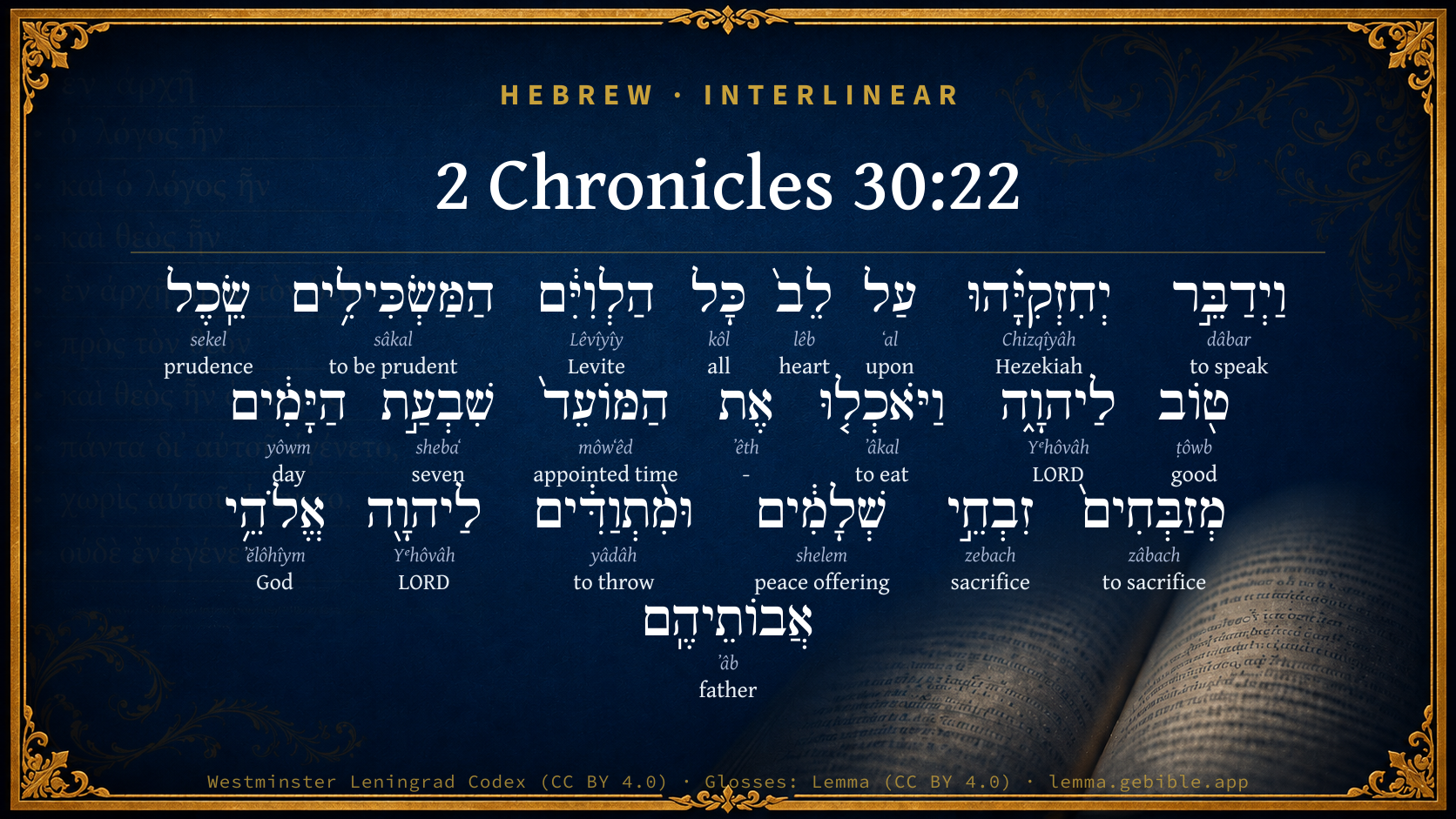
Hebrew (Westminster Leningrad Codex) 2 Chronicles 30:22 appears in the Hebrew Old Testament. The text above is from the Westminster Leningrad Codex. Each word links to its Strong’s number, a concise gloss, and parsing drawn from the Open Scriptures Hebrew Bible morphology. Click any word for its full Brown-Driver-Briggs (BDB) entry.
Download image
Cite this verse

2 Chronicles 30:22 (World English Bible). Public Domain. Lemma interlinear Bible study tool, https://lemma.gebible.app/v/2-chronicles/30/22.

Show BibTeX & RIS
BibTeX
RIS
English Translation
Hezekiah spoke comfortably to all the Levites who had good understanding [in the service] of Yahweh. So they ate throughout the feast for the seven days, offering sacrifices of peace-offerings, and making confession to Yahweh, the God of their fathers.
World English Bible · Public Domain
Download a study sheet

One document with this verse’s original text, its word-by-word gloss line, the meaning frame, cross-references with their text, attributed commentary, and full source and license credits — printable, and it pastes into notes with its structure intact.

This verse Autodidact and up

Study sheet (.html) Plain text (.txt)

A passage Seminary Student

Up to 50 verses in one chapter. A passage sheet keeps up to 6 commentary sources and 12 cross-references per verse, in the order this page ranks them, and says so on the sheet whenever that leaves anything out. Ask for a single verse and you get the Autodidact verse sheet above.

Everything on this page stays free to read, with no account — the sheet is a download of what is already on screen, not access to it.

Want to remove ads? Support Godless Engineer
Compare translations 3

The same verse in 3 English versions, stacked beneath the original-language interlinear above. Click any original word for its lexicon entry.

Each is an independent rendering of the whole verse — the interlinear is not word-aligned to these translations.

Highlighted words mark where these versions differ — a whole-verse word diff, not a word-by-word alignment.

  • World English Bible Public Domain
    Hezekiah spoke comfortably to all the Levites who had good understanding [in the service] of Yahweh. So they ate throughout the feast for the seven days, offering sacrifices of peace-offerings, and making confession to Yahweh, the God of their fathers.
  • King James Version Public Domain
    And Hezekiah spake comfortably unto all the Levites that taught the good knowledge of the LORD: and they did eat throughout the feast seven days, offering peace offerings, and making confession to the LORD God of their fathers.
  • unfoldingWord Literal Text CC BY-SA 4.0
    And Hezekiah spoke to the heart of all the Levites, who were insightful with good insight of Yahweh. And they ate the appointed seven days, sacrificing sacrifices of peace offerings and confessing to Yahweh, the God of their fathers.

unfoldingWord Literal Text — © unfoldingWord, licensed CC BY-SA 4.0. Word-aligned USFM3 via Door43 (git.door43.org/unfoldingWord/en_ult).

Versions to compare (up to 4)

3 of 4 selected

Show all 18 translations

Every available English version of this verse, each an independent rendering of the whole verse.

  • World English Bible Public Domain
    Hezekiah spoke comfortably to all the Levites who had good understanding [in the service] of Yahweh. So they ate throughout the feast for the seven days, offering sacrifices of peace-offerings, and making confession to Yahweh, the God of their fathers.
  • Berean Standard Bible Public Domain
    And Hezekiah encouraged all the Levites who performed skillfully before the LORD. For seven days they ate their assigned portion, sacrificing fellowship offerings and giving thanks to the LORD, the God of their fathers.
  • Majority Standard Bible Public Domain
    And Hezekiah encouraged all the Levites who performed skillfully before the LORD. For seven days they ate their assigned portion, sacrificing peace offerings and giving thanks to the LORD, the God of their fathers.
  • King James Version Public Domain
    And Hezekiah spake comfortably unto all the Levites that taught the good knowledge of the LORD: and they did eat throughout the feast seven days, offering peace offerings, and making confession to the LORD God of their fathers.
  • American Standard Version (1901) Public Domain
    And Hezekiah spake comfortably unto all the Levites that had good understanding `in the service' of Jehovah. So they did eat throughout the feast for the seven days, offering sacrifices of peace-offerings, and making confession to Jehovah, the God of their fathers.
  • Revised Version (1885) Public Domain
    And Hezekiah spake comfortably unto all the Levites that were well skilled in the service of the LORD. So they did eat throughout the feast for the seven days, offering sacrifices of peace offerings, and making confession to the LORD, the God of their fathers.
  • Geneva Bible (1599) Public Domain
    And Hezekiah spake comfortably vnto all the Leuites that had good knowledge to sing vnto the Lord: and they did eate in that feast seuen dayes, and offred peace offrings, and praysed the Lord God of their fathers.
  • Douay-Rheims (1899) Public Domain
    And the children of Israel, that were found at Jerusalem, kept the feast of unleavened bread seven days with great joy, praising the Lord every day: the Levites also, and the priests, with instruments that agreed to their office.
  • Young's Literal Translation Public Domain
    And Hezekiah speaketh unto the heart of all the Levites, those giving good understanding concerning Jehovah, and they eat the appointed thing seven days; sacrificing sacrifices of peace-offerings, and making confession to Jehovah, God of their fathers.
  • Literal Standard Version CC BY-SA 4.0
    And Hezekiah speaks to the heart of all the Levites, those giving good understanding concerning YHWH, and they eat the appointed thing [for] seven days; sacrificing sacrifices of peace-offerings, and making confession to YHWH, God of their fathers.
  • Unlocked Literal Bible CC BY-SA 4.0
    Hezekiah spoke encouragingly to all the Levites who understood the service of Yahweh. So they ate throughout the festival for the seven days, offering sacrifices of fellowship offerings, and making confession to Yahweh, the God of their ancestors.
  • unfoldingWord Literal Text CC BY-SA 4.0
    And Hezekiah spoke to the heart of all the Levites, who were insightful with good insight of Yahweh. And they ate the appointed seven days, sacrificing sacrifices of peace offerings and confessing to Yahweh, the God of their fathers.
  • Darby Bible Public Domain
    And Hezekiah spoke consolingly to all the Levites that had understanding in the good knowledge of Jehovah; and they ate the feast-offerings the seven days, sacrificing peace-offerings, and extolling Jehovah the God of their fathers.
  • World Messianic Bible Public Domain
    Hezekiah spoke encouragingly to all the Levites who had good understanding in the service of the LORD. So they ate throughout the feast for the seven days, offering sacrifices of peace offerings and making confession to the LORD, the God of their fathers.
  • Webster's Bible Public Domain
    And Hezekiah spoke comfortably to all the Levites that taught the good knowledge of the LORD: and they ate throughout the feast seven days, offering peace-offerings, and making confession to the LORD God of their fathers.
  • Free Bible Version CC BY-SA 4.0
    Hezekiah spoke positively to all the Levites who showed a good understanding of the Lord. For seven days they ate the food that was assigned to them, presented friendship offerings, and gave thanks to the Lord, the God of their forefathers.
  • Bible in Basic English Public Domain
    And Hezekiah said kind words to the Levites who were expert in the ordering of the worship of the Lord: so they kept the feast for seven days, offering peace-offerings and praising the Lord, the God of their fathers.
  • JPS Tanakh (1917) Public Domain
    And Hezekiah spoke encouragingly unto all the Levites that were well skilled in the service of the LORD. So they did eat throughout the feast for the seven days, offering sacrifices of peace-offerings, and giving thanks to the LORD, the God of their fathers.

Literal Standard Version (2020), Covenant Press — licensed CC BY-SA 4.0. Text via the HelloAO Bible API (eBible.org). Unlocked Literal Bible (unfoldingWord) — licensed CC BY-SA 4.0. Text via the HelloAO Bible API (eBible.org). unfoldingWord Literal Text — © unfoldingWord, licensed CC BY-SA 4.0. Word-aligned USFM3 via Door43 (git.door43.org/unfoldingWord/en_ult). Free Bible Version, Dr. Jonathan Gallagher — licensed CC BY-SA 4.0. Text via the HelloAO Bible API (eBible.org).

Word by word

More ways to search: Search by grammar → Find every occurrence → Compare this word →

Practice this passage: Drill this verse → Learn its vocabulary →

שֵֽׂכֶל
sekel
H7922
“prudence of”
Noun, Common, Masculine, Singular, Construct
Part of Speech
Noun
Type
Common
Gender
Masculine
Number
Singular
State
Construct
Full BDB Definition

Origin: from H7919

TWOT: 2263a

prudence, insight, understanding - prudence, good sense - insight, understanding - cunning, craft (bad sense)
  1. וַיְדַבֵּ֣ר dâbar H1696 “and · to speak” Conjunction + Verb, Piel, Sequential Imperfect, 3rd Person, Masculine, Singular
  2. יְחִזְקִיָּ֗הוּ Chizqîyâh H2396 “Hezekiah” Noun, Proper
  3. עַל ʻal H5921 “upon” Preposition
  4. לֵב֙ lêb H3820 “heart of” Noun, Common, Masculine, Singular, Construct
  5. כָּל kôl H3605 “all of” Noun, Common, Masculine, Singular, Construct
  6. הַלְוִיִּ֔ם Lêvîyîy H3881 “the · Levites” Particle, Definite Article + Noun, Gentilic, Masculine, Plural, Absolute
  7. הַמַּשְׂכִּילִ֥ים sâkal H7919 “the · being prudent” Particle, Definite Article + Verb, Hiphil, Participle Active, Masculine, Plural, Absolute
  8. ט֖וֹב ṭôwb H2896 “good” Adjective, Adjective, Masculine, Singular, Absolute
  9. לַיהוָ֑ה Yᵉhôvâh H3068 “to/for · LORD” Preposition + Noun, Proper
  10. וַיֹּאכְל֤וּ ʼâkal H398 “and · to eat” Conjunction + Verb, Qal, Sequential Imperfect, 3rd Person, Masculine, Plural
  11. אֶת ʼêth H853 “-” Particle, Direct Object
  12. הַמּוֹעֵד֙ môwʻêd H4150 “the · appointed time” Particle, Definite Article + Noun, Common, Masculine, Singular, Absolute
  13. שִׁבְעַ֣ת shebaʻ H7651 “seven” Adjective, Cardinal number, Masculine, Singular, Construct
  14. הַיָּמִ֔ים yôwm H3117 “the · days” Particle, Definite Article + Noun, Common, Masculine, Plural, Absolute
  15. מְזַבְּחִים֙ zâbach H2076 “sacrificing” Verb, Piel, Participle Active, Masculine, Plural, Absolute
  16. זִבְחֵ֣י zebach H2077 “sacrifices of” Noun, Common, Masculine, Plural, Construct
  17. שְׁלָמִ֔ים shelem H8002 “peace offerings” Noun, Common, Masculine, Plural, Absolute
  18. וּמִ֨תְוַדִּ֔ים yâdâh H3034 “and · throwing” Conjunction + Verb, Hithpael, Participle Active, Masculine, Plural, Absolute
  19. לַיהוָ֖ה Yᵉhôvâh H3068 “to/for · LORD” Preposition + Noun, Proper
  20. אֱלֹהֵ֥י ʼĕlôhîym H430 “God(s) of” Noun, Common, Masculine, Plural, Construct
  21. אֲבוֹתֵיהֶֽם ʼâb H1 “fathers · their” Noun, Common, Masculine, Plural, Construct + Suffix, Personal, 3rd Person, Masculine, Plural

About this verse

These counts appear in no published source. They are computed here, from the morphology-tagged text and Lemma’s own curated glosses. What Lemma adds →

22
words
21
distinct lemmas
Historical
section

Notable vocabulary

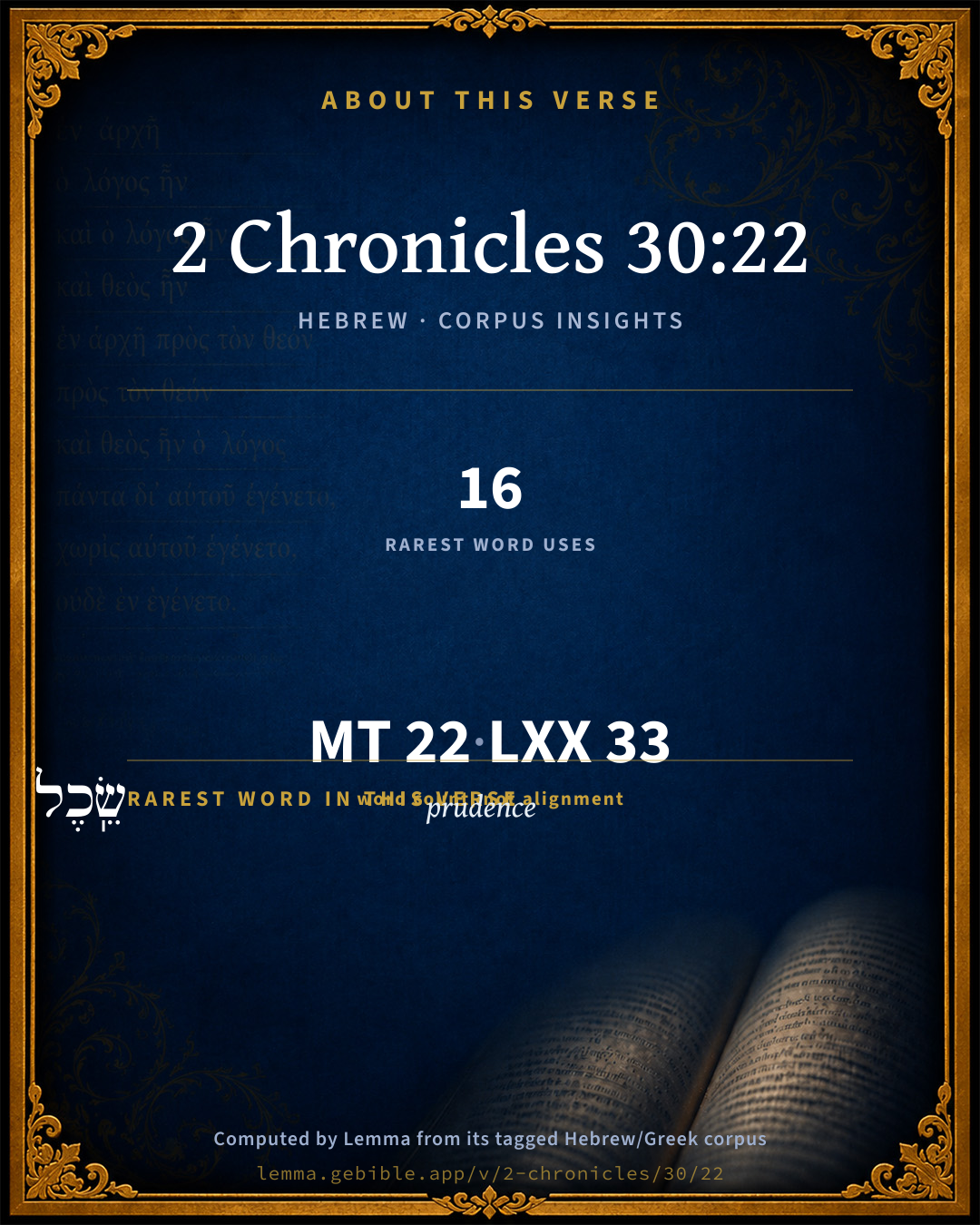
The rarest word here is שֵֽׂכֶל prudence H7922 — appearing just 16 times in the whole Hebrew Bible.

Shared distinctive vocabulary

שֵֽׂכֶל prudence H7922 occurs in 16 verses of the Hebrew Bible. Also found in:

Grammatical profile

  • 5 verbs
  • 13 nouns
  • 2 adjectives
  • 1 preposition
  • 1 particle

Verb forms

  • וַיְדַבֵּ֣ר Piel · Sequential Imperfect
  • הַמַּשְׂכִּילִ֥ים Hiphil · Participle Active
  • וַיֹּאכְל֤וּ Qal · Sequential Imperfect
  • מְזַבְּחִים֙ Piel · Participle Active
  • וּמִ֨תְוַדִּ֔ים Hithpael · Participle Active

Repetition

A word recurs within this verse — often emphatic in Hebrew:

  • לַיהוָ֑ה LORD H3068 ×2

Hebrew & Septuagint length

In English translation the verse runs 40 words from the Hebrew and 37 from the Septuagint (LXX English) — closely comparable.

A rough comparison of the two English renderings, which tokenize alike — not a word-level alignment.

Word counts can differ between the Hebrew and the Greek without any difference in meaning — e.g. the Hebrew direct-object marker אֵת has no separate Greek word, and Greek often adds the article ὁ.

In the original languages it is 22 Hebrew tokens and 33 Greek tokens — but the two are counted differently (Hebrew bundles its prefixes and suffixes into one token; the Greek is in lemma form), so that isn’t a like-for-like length.

Cross-references

20

Topical passages linked to 2 Chronicles 30:22 in the Treasury of Scripture Knowledge — connected by theme and wording, ordered by reader-vote popularity; previews shown in the World English Bible.

  • 2 Chronicles 32:6 He set captains of war over the people, and gathered them together to him in the broad place at the gate of the city, and spoke comfortably to them, saying,
  • Nehemiah 9:3 They stood up in their place, and read in the book of the law of Yahweh their God a fourth part of the day; and [another] fourth part they confessed, and worshiped Yahweh their God.
  • Ezra 10:11 Now therefore make confession to Yahweh, the God of your fathers, and do his pleasure; and separate yourselves from the peoples of the land, and from the foreign women.
  • Isaiah 40:1–2 Comfort you, comfort you my people, says your God.
  • Deuteronomy 26:3–11 You shall come to the priest who shall be in those days, and tell him, I profess this day to Yahweh your God, that I am come to the land which Yahweh swore to our fathers to give us.
  • Deuteronomy 33:10 They shall teach Jacob your ordinances, Israel your law: They shall put incense before you, Whole burnt offering on your altar.
  • 2 Chronicles 15:3 Now for a long season Israel was without the true God, and without a teaching priest, and without law:
  • 2 Chronicles 17:9 They taught in Judah, having the book of the law of Yahweh with them; and they went about throughout all the cities of Judah, and taught among the people.
  • 2 Chronicles 35:3 He said to the Levites who taught all Israel, who were holy to Yahweh, Put the holy ark in the house which Solomon the son of David king of Israel did build; there shall no more be a burden on your shoulders: now serve Yahweh your God, and his people Israel.
  • Ezra 7:10 For Ezra had set his heart to seek the law of Yahweh, and to do it, and to teach in Israel statutes and ordinances.
  • Ezra 7:25 You, Ezra, after the wisdom of your God who is in your hand, appoint magistrates and judges, who may judge all the people who are beyond the River, all such as know the laws of your God; and teach you him who doesn't know them.
  • Nehemiah 8:7–8 Also Jeshua, and Bani, and Sherebiah, Jamin, Akkub, Shabbethai, Hodiah, Maaseiah, Kelita, Azariah, Jozabad, Hanan, Pelaiah, and the Levites, caused the people to understand the law: and the people [stood] in their place.
  • Nehemiah 8:18 Also day by day, from the first day to the last day, he read in the book of the law of God. They kept the feast seven days; and on the eighth day was a solemn assembly, according to the ordinance.
  • Proverbs 2:6–7 For Yahweh gives wisdom. Out of his mouth comes knowledge and understanding.
  • Proverbs 8:6 Hear, for I will speak excellent things. The opening of my lips is for right things.
  • Hosea 2:14 "Therefore, behold, I will allure her, And bring her into the wilderness, And speak tenderly to her.
  • John 17:3 This is eternal life, that they should know you, the only true God, and him whom you sent, Jesus Christ.
  • 2 Corinthians 4:6 seeing it is God who said, "Light will shine out of darkness," who has shone in our hearts, to give the light of the knowledge of the glory of God in the face of Jesus Christ.
  • Philippians 3:8 Yes most assuredly, and I count all things to be loss for the excellency of the knowledge of Christ Jesus, my Lord, for whom I suffered the loss of all things, and count them nothing but refuse, that I may gain Christ
  • 2 Timothy 4:2 preach the word; be urgent in season and out of season; reprove, rebuke, and exhort, with all patience and teaching.

Cross-references courtesy of OpenBible.info (CC BY 4.0).

Hebrew and Greek witnesses Masoretic Hebrew ↔ Greek Septuagint

The same verse in the two great witnesses to the Old Testament, shown verse-for-verse.

These are two independent witnesses, not word-aligned to each other, and the Septuagint is shown in lemma (dictionary) form.

Hebrew 2 Chronicles 30:22 Masoretic · Westminster Leningrad Codex

וַיְדַבֵּ֣ר יְחִזְקִיָּ֗הוּ עַל לֵב֙ כָּל הַלְוִיִּ֔ם הַמַּשְׂכִּילִ֥ים שֵֽׂכֶל ט֖וֹב לַיהוָ֑ה וַיֹּאכְל֤וּ אֶת הַמּוֹעֵד֙ שִׁבְעַ֣ת הַיָּמִ֔ים מְזַבְּחִים֙ זִבְחֵ֣י שְׁלָמִ֔ים וּמִ֨תְוַדִּ֔ים לַיהוָ֖ה אֱלֹהֵ֥י אֲבוֹתֵיהֶֽם

Hezekiah spoke comfortably to all the Levites who had good understanding [in the service] of Yahweh. So they ate throughout the feast for the seven days, offering sacrifices of peace-offerings, and making confession to Yahweh, the God of their fathers.

World English Bible · Public Domain

Greek LXX 2 Chronicles 30:22 Septuagint · lemma form

καί λαλέω εζεκιας ἐπί πᾶς καρδία ὁ λευείτης καί ὁ σύνεσις ἀγαθός ὁ κύριος καί συντελέω ὁ ἑορτή ὁ ἄζυμος ἑπτά ἡμέρα θύω θυσία σωτήριον καί ἐκὁμολογέω ὁ κύριος θεός ὁ πατήρ αὐτός

And Ezekias encouraged all the Levites, and those that had good understanding of the Lord: and they completely kept the feast of unleavened bread seven days, offering peace-offerings, and confessing to the Lord God of their fathers.

LXX2012 (modern English Septuagint) · Public Domain

On this verse, Ellicott's Commentary for English Readers discusses the Septuagint’s reading. Read the note in Commentary ↓

Hebrew: Westminster Leningrad Codex (CC BY 4.0). Greek: Septuagint (public domain); English from LXX2012 (modern English Septuagint) (Public Domain). How the Septuagint differs from the Hebrew →

Commentary

Notes on 2 Chronicles 30:22 from classic Christian and Jewish commentators (each source and its license shown beneath its notes). The classic Christian expositions comment on the surrounding passage and are grouped to its opening verse, so a note may address several verses; the Jewish commentaries on the Tanakh (Rashi and others) are per-verse, so they appear only where the commentator wrote on this verse.

Lemma curates 59 commentaries, every one of them public domain or Creative Commons licensed, each selected and text-cleaned for this edition rather than reprinted as found. About our sources →

Trapp's Complete Commentary

John Trapp

2Ch 30:22 And Hezekiah spake comfortably unto all the Levites that taught the good knowledge of the LORD: and they did eat throughout the feast seven days, offering peace offerings, and making confession to the LORD God of their fathers.

Ver. 22. And Hezekiah spake comfortably to all the Levites.] Heb., To the heart of all the Levites: he cheered them up, and encouraged them to do their work lustily, promising them his best assistance. Few such princes. Some {a} sense the words thus: He spake unto them words piercing to the heart, that they should take upon them and continue the care of instructing the people. Others thus: He instructed them in the free grace and rich mercy of God, who accepteth of those that are upright in heart, though there may be some outward failings. A most comfortable doctrine indeed.

That taught the good knowledge of the Lord.] And therefore had the more need of encouragement under so laborious an employment.

{a} Cajetan.

John Trapp, A Commentary or Exposition upon All the Books of the Old and New Testament (1647–1656) — public domain. Text from a community e-Sword module.

Joseph Benson's Commentary

2Ch 30:22. Hezekiah spake comfortably unto all the Levites — Commended them for their care and diligence, and thereby encouraged them to a cheerful and diligent attendance upon their holy ministrations, and to continue to instruct the people in their duty, promising, it is likely, to reward them for what they had already done. That taught the good knowledge of the Lord — Who by their office were to instruct and build up the people in the knowledge and fear of God; which is mentioned as the cause of his respect and kindness to them. Princes and magistrates, by encouraging faithful and laborious preachers of God’s word, greatly promote the kingdom of God.

Joseph Benson's Commentary on the Old and New Testaments (1811–1818) — public domain. Text from a community e-Sword module.

Geneva Bible (1599)

Geneva Bible translators

Hebrew, spake to the heart.

Geneva Bible (1599) marginal notes — public domain. Text via Bolls.life.

Adam Clarke's Commentary

Verse 22. Spake comfortably unto all the Levites] On such occasions the priests and Levites had great fatigue, and suffered many privations; and therefore had need of that encouragement which this prudent and pious king gave. It is a fine and expressive character given of these men, "They taught the good knowledge of God to the people." This is the great work, or should be so, of every Christian minister. They should convey that knowledge of God to the people by which they may be saved; that is, the good knowledge of the Lord.

Adam Clarke's Commentary on the Bible (1810–1826) — public domain. Text from a community e-Sword/MySword module.

Ellicott's Commentary for English Readers

(22) Spake comfortably.—See margin, and comp. Isa_40:2.

That taught the good knowledge of the Lord.—Rather, were showing good skill for (in honour of) Jehovah, in their chanting and playing. The king encouraged the musicians with kindly words of praise.

They did eat throughout the feast.—Literally, they ate the feast, like “they ate the passover.” The meaning is that the assembly ate the sacrificial meals, which were supplied from the flesh of the “peace offerings.” The phrase is peculiar to this passage. The LXX. has καὶ συνετέλεσαν, “and they finished:” a difference which implies no great change in the Hebrew writing, but is against the context.

Making confession.—LXX. rightly, ἐξομολογούμενοι. The meaning is “yielding hearty thanks,” “acknowledging “the Divine goodness. Everywhere else the Hebrew word means “to confess guilt” (Neh_9:3; Lev_5:5; Num_5:7).

A Bible Commentary for English Readers, edited by Charles John Ellicott (1878–1897) — public domain. Text from a community e-Sword module.

The Cambridge Bible for Schools and Colleges

gen. ed. J. J. S. Perowne

22. that taught the good knowledge of the Lord] R.V. that were well skilled in the service of the LORD.

and they did eat … seven days] R.V. So they did eat … for the seven days, i.e. the usual seven days of unleavened bread.

pace offerings] R.V. sacrifices of peace offerings; cp. 1Ch_16:1.

making confession] Or “giving thanks” R.V. mg. LXX. ἐξομολογούμενοι.

The Cambridge Bible for Schools and Colleges (gen. ed. J. J. S. Perowne; Cambridge University Press, 1878–1918) — public domain. Text from a community e-Sword module.

John Gill's Exposition

And the whole assembly took counsel to keep other seven days,.... They consulted among themselves, and with the king and his nobles about it, who all agreed to it:

and they kept other seven days with gladness; not altogether in the same manner they had kept the preceding seven days; they did not slay and eat passover lambs, nor did they eat unleavened bread, but offered peace offerings, and feasted upon them; and sung the praises of God, and attended to the instructions of the priests and Levites, being in a very agreeable frame of mind for religious exercises.

John Gill's Exposition of the Whole Bible (1746–1763) — public domain (CC PDM 1.0). Text via the HelloAO Bible API.

Albert Barnes' Notes on the Bible

The “knowledge” intended is perhaps chiefly ritualistic and musical - such knowledge as enabled them to conduct the service of the sanctuary satisfactorily.

They did eat throughout the feast - literally, “they did eat the feast;” i. e. “they kept the feast,” which was essentially kept by the eating of unleavened bread. The Levites kept the feast during the full term appointed for it, never failing in their duties, but taking their part day after day, both in the sacrifice of the victims and in singing praises to God.

Albert Barnes' Notes on the Bible (1834–1885) — public domain. Text from a community e-Sword/MySword module.

Haydock's Catholic Bible Commentary

Heart; encouraged them to bear the fatigue for other seven days. --- Lord; being of good dispositions, (C.) and able musicians. Sa) M. --- Praising. Prot. "making confession to." But the sense is the same. H. --- During the seven days, unleavened bread and peace-offerings were used, v. 24. C.

George Leo Haydock (1774–1849), Haydock's Catholic Family Bible and Commentary, 1859 edition — public domain. Excludes Psalms (Douay-Rheims chapter numbering differs from Protestant) and Deuterocanonical books (Catholic canon only).

Matthew Poole's English Annotations

Spake comfortably unto all the Levites; encouraged them to a cheerful and diligent attendance upon their holy ministrations by the promise of his favour and utmost care for them, which he faithfully performed, 2Ch 31:4, &c.

That taught the good knowledge of the Lord; who by their office were to instruct and build up the people in the knowledge and fear of God; which is mentioned as the cause of his respect and kindness to them, which was for their work’s sake, as it is said, 1Th 5:13.

Making confession: either,

1. Confessing their sins; which work was to accompany many of their sacrifices; of which see Lev 5:5; 16:21. Or rather,

2. Confessing God’s goodness, or praising of God, which oft goes under this name, as 1Ch 16:8,24, which also seems to be more proper work for this season of joy.

Matthew Poole's English Annotations on the Holy Bible (1683–1685) — public domain. Text from a community e-Sword/MySword module.

Whedon's Commentary on the Bible

Daniel D. Whedon

22. Hezekiah spake comfortably unto all the Levites — Hebrew, spoke to the heart. He spoke encouraging and cheering words to them, commending their zeal and wisdom.

That taught the good knowledge of the Lord — Rather, who were proficient in a good understanding of Jehovah; that is, well skilled to perform their part of the sanctuary service.

Daniel D. Whedon (gen. ed.), Commentary on the Old and New Testaments (1874–1909) — public domain. Text from a community e-Sword module.

The Pulpit Commentary

Spake comfortably; literally, to the heart of, etc. That taught the good knowledge. This rendering is in some error, and is awkward in not indicating the direction of the knowledge. A better rendering (see Revised Version) will be, who were well skilled in rendering such service to Jehovah. And perhaps the simplest rendering, "who served with good service to Jehovah," will be the most correct to the real meaning of the Hebrew text (Psa_111:10; Pro_13:15) Making confession; i.e. the confession or uttering forth of praise (so Psa_75:2 Psa_92:1; 1Ch_16:4, 1Ch_16:7, 1Ch_16:35, 41 23:30 25:3; 2Ch_5:13 2Ch_7:3, 6 31:2)

The Pulpit Commentary (1880–1919), ed. H.D.M. Spence-Jones & Joseph S. Exell — public domain. Text from a community e-Sword module.

John Wesley's Explanatory Notes

Spoke comfortably - Encouraged them to a chearful and diligent attendance upon their holy ministrations. Princes and magistrates by encouraging faithful and labourious preachers, greatly promote the kingdom of God. That taught - Who by their office were to instruct and build up the people in the knowledge and fear of God: which is mentioned as the cause of his respect and kindness to them.

John Wesley, Explanatory Notes Upon the Whole Bible (1754–1765) — public domain. Text via the GEBible commentary corpus.

Rashi

Rabbi Shlomo Yitzchaki (Rashi)

who were experts in the service of the Lord it is appropriate to use the term “expertise” (שֵׂכֶל) in regards to song, as it is written, (above I Chron. 26:14): “And the lot to the east fell to Shelemiah, and Zechariah, his son, a prudent counselor, etc.,” (יוֹעֵץבְּשֵׂכֶל). Hezekiah spoke to their hearts with consolations and pleasant words to encourage them and assist them, in order that they too strengthen the song with expertise for the Lord.

and thanking the Lord over the thanksgiving offerings, and they thanked the Lord for the miracle that He had wrought for them, for the thanksgiving offering comes for a miracle.

Rashi on the Tanakh — English translations: “The Judaica Press complete Tanach with Rashi, translated by A. J. Rosenberg” (CC BY 4.0); “Pentateuch with Rashi's commentary by M. Rosenbaum and A.M. Silbermann, 1929-1934” (public domain); “The Metsudah Tanach series, Lakewood, N.J” (CC BY 4.0); and “The Book of Joshua, Metsudah Publications, 1997” (CC BY 4.0). Text via Sefaria.

Lesson kit

Teaching starters — assembled from the data on this page, not authored interpretation. Every prompt links to the verse data it draws on. Edit before teaching.

2 Chronicles, in the Historical, opens this verse with 22 words (21 distinct Hebrew lemmas). Its most distinctive word is sekel (“prudence”). A historical commentator’s framing appears above. Read the whole chapter for the surrounding context.

Discussion questions

  1. What does “prudence” (sekel) contribute to the verse as a whole?
  2. How does 1 Samuel 25:3, which shares the word «prudence», read alongside this verse?
  3. What does the repetition of “LORD” (2× in this one verse) do in this verse?
  4. The translations on this page render this verse differently — a whole-verse word diff, not a word-by-word alignment. What might account for the different wordings?
  5. «וַיְדַבֵּ֣ר» is a Piel Sequential Imperfect verb. How does that grammatical form shape the action described?
  6. Compare how Trapp's Complete Commentary and Joseph Benson's Commentary read this verse. Where do they agree or differ?

Things to notice

Reading settings

Reading text

Shown beneath each verse's original-language words.

Old Testament
Old Testament edition

Read the OT as the Masoretic Hebrew (MT) or the Greek Septuagint (LXX).

English shown for the Greek Septuagint (in the Hebrew ↔ Greek comparison).

Comparing translations? Open the Compare panel on any verse page to stack up to four side by side.