

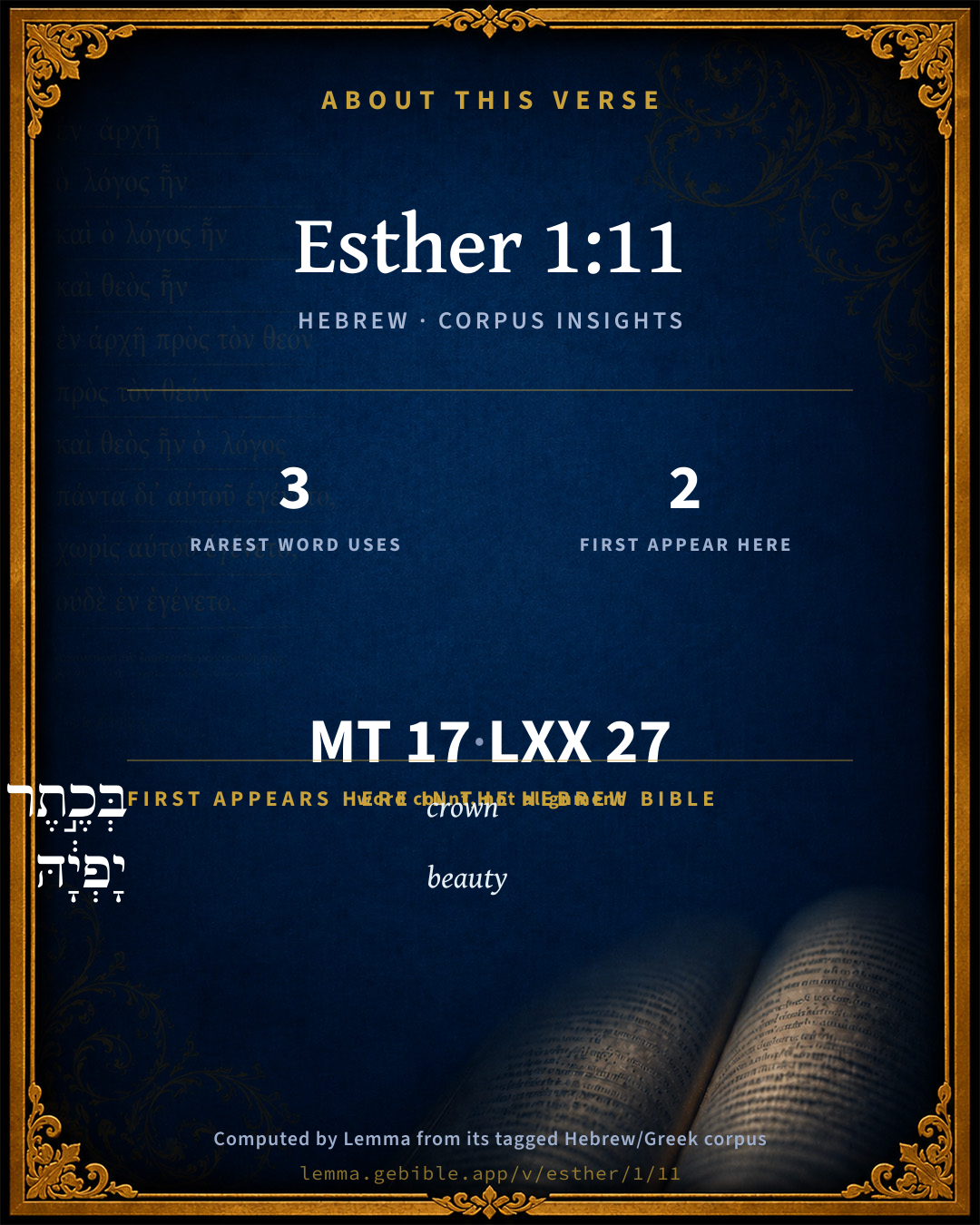
Esther 1:11

Hebrew (Westminster Leningrad Codex) Esther 1:11 appears in the Hebrew Old Testament. The text above is from the Westminster Leningrad Codex. Each word links to its Strong’s number, a concise gloss, and parsing drawn from the Open Scriptures Hebrew Bible morphology. Click any word for its full Brown-Driver-Briggs (BDB) entry.
Download image
Cite this verse

Esther 1:11 (World English Bible). Public Domain. Lemma interlinear Bible study tool, https://lemma.gebible.app/v/esther/1/11.

Show BibTeX & RIS
BibTeX
RIS
English Translation
to bring Vashti the queen before the king with the crown royal, to show the peoples and the princes her beauty; for she was beautiful to look on.
World English Bible · Public Domain
Highlights
  • 2 first appearances in the Hebrew Bible
Full analysis ↓
Download a study sheet

One document with this verse’s original text, its word-by-word gloss line, the meaning frame, cross-references with their text, attributed commentary, and full source and license credits — printable, and it pastes into notes with its structure intact.

This verse Autodidact and up

Study sheet (.html) Plain text (.txt)

A passage Seminary Student

Up to 50 verses in one chapter. A passage sheet keeps up to 6 commentary sources and 12 cross-references per verse, in the order this page ranks them, and says so on the sheet whenever that leaves anything out. Ask for a single verse and you get the Autodidact verse sheet above.

Everything on this page stays free to read, with no account — the sheet is a download of what is already on screen, not access to it.

Want to remove ads? Support Godless Engineer
Compare translations 3

The same verse in 3 English versions, stacked beneath the original-language interlinear above. Click any original word for its lexicon entry.

Each is an independent rendering of the whole verse — the interlinear is not word-aligned to these translations.

Highlighted words mark where these versions differ — a whole-verse word diff, not a word-by-word alignment.

  • World English Bible Public Domain
    to bring Vashti the queen before the king with the crown royal, to show the peoples and the princes her beauty; for she was beautiful to look on.
  • King James Version Public Domain
    To bring Vashti the queen before the king with the crown royal, to shew the people and the princes her beauty: for she was fair to look on.
  • unfoldingWord Literal Text CC BY-SA 4.0
    to bring Vashti the queen to the face of the king in a crown of royalty in order to show the people and the officials her beauty, for she was pleasing of appearance.

unfoldingWord Literal Text — © unfoldingWord, licensed CC BY-SA 4.0. Word-aligned USFM3 via Door43 (git.door43.org/unfoldingWord/en_ult).

Versions to compare (up to 4)

3 of 4 selected

Show all 18 translations

Every available English version of this verse, each an independent rendering of the whole verse.

  • World English Bible Public Domain
    to bring Vashti the queen before the king with the crown royal, to show the peoples and the princes her beauty; for she was beautiful to look on.
  • Berean Standard Bible Public Domain
    to bring Queen Vashti before him, wearing her royal crown, to display her beauty to the people and officials. For she was beautiful to behold.
  • Majority Standard Bible Public Domain
    to bring Queen Vashti before him, wearing her royal crown, to display her beauty to the people and officials. For she was beautiful to behold.
  • King James Version Public Domain
    To bring Vashti the queen before the king with the crown royal, to shew the people and the princes her beauty: for she was fair to look on.
  • American Standard Version (1901) Public Domain
    to bring Vashti the queen before the king with the crown royal, to show the peoples and the princes her beauty; for she was fair to look on.
  • Revised Version (1885) Public Domain
    to bring Vashti the queen before the king with the crown royal, to shew the peoples and the princes her beauty: for she was fair to look on.
  • Geneva Bible (1599) Public Domain
    To bring Queene Vashti before the King with the crowne royall, that he might shewe the people and the princes her beautie: for shee was fayre to looke vpon.
  • Douay-Rheims (1899) Public Domain
    To bring in queen Vasthi before the king, with the crown set upon her head, to shew her beauty to all the people and the princes: for she was exceeding beautiful.
  • Young's Literal Translation Public Domain
    to bring in Vashti the queen before the king, with a royal crown, to shew the peoples and the heads her beauty, for she `is' of good appearance,
  • Literal Standard Version CC BY-SA 4.0
    to bring in Vashti the queen before the king, with a royal crown, to show the peoples and the heads her beauty, for she [is] of good appearance,
  • Unlocked Literal Bible CC BY-SA 4.0
    to bring Queen Vashti before him with her royal crown. He wanted to show the people and the officials her beauty, for her features were stunning.
  • unfoldingWord Literal Text CC BY-SA 4.0
    to bring Vashti the queen to the face of the king in a crown of royalty in order to show the people and the officials her beauty, for she was pleasing of appearance.
  • Darby Bible Public Domain
    to bring Vashti the queen before the king with the royal crown to shew the peoples and the princes her beauty; for she was of beautiful countenance.
  • World Messianic Bible Public Domain
    to bring Vashti the queen before the king wearing the royal crown, to show the people and the princes her beauty; for she was beautiful.
  • Webster's Bible Public Domain
    To bring Vashti the queen before the king with the crown royal, to show the people and the princes her beauty: for she was fair to look on.
  • Free Bible Version CC BY-SA 4.0
    to bring Queen Vashti to him wearing her royal headdress, so he could show her beauty to the people and officials, for she was very good-looking.
  • Bible in Basic English Public Domain
    That Vashti the queen was to come before him, crowned with her crown, and let the people and the captains see her: for she was very beautiful.
  • JPS Tanakh (1917) Public Domain
    to bring Vashti the queen before the king with the crown royal, to show the peoples and the princes her beauty; for she was fair to look on.

Literal Standard Version (2020), Covenant Press — licensed CC BY-SA 4.0. Text via the HelloAO Bible API (eBible.org). Unlocked Literal Bible (unfoldingWord) — licensed CC BY-SA 4.0. Text via the HelloAO Bible API (eBible.org). unfoldingWord Literal Text — © unfoldingWord, licensed CC BY-SA 4.0. Word-aligned USFM3 via Door43 (git.door43.org/unfoldingWord/en_ult). Free Bible Version, Dr. Jonathan Gallagher — licensed CC BY-SA 4.0. Text via the HelloAO Bible API (eBible.org).

Word by word

More ways to search: Search by grammar → Find every occurrence → Compare this word →

Practice this passage: Drill this verse → Learn its vocabulary →

בְּכֶ֣תֶר
kether
H3804
“in/at · crown of”
Preposition + Noun, Common, Masculine, Singular, Construct
Part of Speech
Preposition + Noun
Type
Common
Gender
Masculine
Number
Singular
State
Construct
Full BDB Definition

Origin: from H3803

TWOT: 1060a

crown
  1. לְ֠הָבִיא bôwʼ H935 “to enter” Preposition + Verb, Hiphil, Infinitive Construct
  2. אֶת ʼêth H853 “-” Particle, Direct Object
  3. וַשְׁתִּ֧י Vashtîy H2060 “Vashti” Noun, Proper
  4. הַמַּלְכָּ֛ה malkâh H4436 “the · queen” Particle, Definite Article + Noun, Common, Feminine, Singular, Absolute
  5. לִפְנֵ֥י pânîym H6440 “to/for · face(s) of” Preposition + Noun, Common, Both, Plural, Construct
  6. הַמֶּ֖לֶךְ melek H4428 “the · king” Particle, Definite Article + Noun, Common, Masculine, Singular, Absolute
  7. מַלְכ֑וּת malkûwth H4438 “kingdom” Noun, Common, Feminine, Singular, Absolute
  8. לְהַרְא֨וֹת râʼâh H7200 “to see” Preposition + Verb, Hiphil, Infinitive Construct
  9. הָֽעַמִּ֤ים ʻam H5971 “the · peoples” Particle, Definite Article + Noun, Common, Masculine, Plural, Absolute
  10. וְהַשָּׂרִים֙ sar H8269 “and · the · princes” Conjunction + Particle, Definite Article + Noun, Common, Masculine, Plural, Absolute
  11. אֶת ʼêth H853 “-” Particle, Direct Object
  12. יָפְיָ֔הּ yŏphîy H3308 “beauty · her” Noun, Common, Masculine, Singular, Construct + Suffix, Personal, 3rd Person, Feminine, Singular
  13. כִּֽי kîy H3588 “that” Conjunction
  14. טוֹבַ֥ת ṭôwb H2896 “good of” Adjective, Adjective, Feminine, Singular, Construct
  15. מַרְאֶ֖ה marʼeh H4758 “sight” Noun, Common, Masculine, Singular, Absolute
  16. הִֽיא hûwʼ H1931 “he” Pronoun, Personal, 3rd Person, Feminine, Singular

About this verse

These counts appear in no published source. They are computed here, from the morphology-tagged text and Lemma’s own curated glosses. What Lemma adds →

17
words
16
distinct lemmas
Historical
section

Notable vocabulary

The rarest word here is בְּכֶ֣תֶר crown H3804 — appearing just 3 times in the whole Hebrew Bible.

First appearance in Scripture

These words make their first canonical appearance in the Hebrew Bible here:

  • בְּכֶ֣תֶר crown H3804
  • יָפְיָ֔הּ beauty H3308

Shared distinctive vocabulary

בְּכֶ֣תֶר crown H3804 occurs in 3 verses of the Hebrew Bible. Also found in:

Grammatical profile

  • 2 verbs
  • 10 nouns
  • 1 adjective
  • 1 pronoun
  • 1 conjunction
  • 2 particles

Verb forms

  • לְ֠הָבִיא Hiphil · Infinitive Construct
  • לְהַרְא֨וֹת Hiphil · Infinitive Construct

Hebrew & Septuagint length

In English translation the verse runs 28 words from the Hebrew and 33 from the Septuagint (LXX English) — closely comparable.

A rough comparison of the two English renderings, which tokenize alike — not a word-level alignment.

Word counts can differ between the Hebrew and the Greek without any difference in meaning — e.g. the Hebrew direct-object marker אֵת has no separate Greek word, and Greek often adds the article ὁ.

In the original languages it is 17 Hebrew tokens and 27 Greek tokens — but the two are counted differently (Hebrew bundles its prefixes and suffixes into one token; the Greek is in lemma form), so that isn’t a like-for-like length.

Cross-references

8

Topical passages linked to Esther 1:11 in the Treasury of Scripture Knowledge — connected by theme and wording, ordered by reader-vote popularity; previews shown in the World English Bible.

  • Proverbs 31:30 Charm is deceitful, and beauty is vain; But a woman who fears Yahweh, she shall be praised.
  • Mark 6:21–22 Then a convenient day came, that Herod on his birthday made a supper for his nobles, the high officers, and the chief men of Galilee.
  • Proverbs 16:9 A man's heart plans his course, But Yahweh directs his steps.
  • 1 Samuel 25:3 Now the name of the man was Nabal; and the name of his wife Abigail; and the woman was of good understanding, and of a beautiful face: but the man was churlish and evil in his doings; and he was of the house of Caleb.
  • 2 Samuel 14:25 Now in all Israel there was none to be so much praised as Absalom for his beauty: from the sole of his foot even to the crown of his head there was no blemish in him.
  • Esther 6:8 let royal clothing be brought which the king uses to wear, and the horse that the king rides on, and on the head of which a crown royal is set:
  • Esther 2:17 The king loved Esther above all the women, and she obtained favor and kindness in his sight more than all the virgins; so that he set the royal crown on her head, and made her queen instead of Vashti.
  • Proverbs 23:29–33 Who has woe? Who has sorrow? Who has strife? Who has complaints? Who has needless bruises? Who has bloodshot eyes?

Cross-references courtesy of OpenBible.info (CC BY 4.0).

Hebrew and Greek witnesses Masoretic Hebrew ↔ Greek Septuagint

The same verse in the two great witnesses to the Old Testament, shown verse-for-verse.

These are two independent witnesses, not word-aligned to each other, and the Septuagint is shown in lemma (dictionary) form.

Hebrew Esther 1:11 Masoretic · Westminster Leningrad Codex

לְ֠הָבִיא אֶת וַשְׁתִּ֧י הַמַּלְכָּ֛ה לִפְנֵ֥י הַמֶּ֖לֶךְ בְּכֶ֣תֶר מַלְכ֑וּת לְהַרְא֨וֹת הָֽעַמִּ֤ים וְהַשָּׂרִים֙ אֶת יָפְיָ֔הּ כִּֽי טוֹבַ֥ת מַרְאֶ֖ה הִֽיא

to bring Vashti the queen before the king with the crown royal, to show the peoples and the princes her beauty; for she was beautiful to look on.

World English Bible · Public Domain

Greek LXX Esther 1:11 Septuagint · lemma form

εἰςἄγω ὁ βασίλισσα πρός αὐτός βασιλεύω αὐτός καί περιτίθημι αὐτός ὁ διάδημα καί δεικνύω αὐτός πᾶς ὁ ἄρχων καί ὁ ἔθνος ὁ κάλλος αὐτός ὅτι καλός εἰμί

to bring in the queen to him, to enthrone her, and crown her with the diadem, and to show her to the princes, and her beauty to the nations: for she was beautiful.

LXX2012 (modern English Septuagint) · Public Domain

Hebrew: Westminster Leningrad Codex (CC BY 4.0). Greek: Septuagint (public domain); English from LXX2012 (modern English Septuagint) (Public Domain). How the Septuagint differs from the Hebrew →

Commentary

Notes on Esther 1:11 from classic Christian and Jewish commentators (each source and its license shown beneath its notes). The classic Christian expositions comment on the surrounding passage and are grouped to its opening verse, so a note may address several verses; the Jewish commentaries on the Tanakh (Rashi and others) are per-verse, so they appear only where the commentator wrote on this verse.

Lemma curates 59 commentaries, every one of them public domain or Creative Commons licensed, each selected and text-cleaned for this edition rather than reprinted as found. About our sources →

Trapp's Complete Commentary

John Trapp

Est 1:11 To bring Vashti the queen before the king with the crown royal, to shew the people and the princes her beauty: for she [was] fair to look on.

Ver. 11. To bring Vashti the queen before the king] This was their errand, and they went readily about it (though it beseemed not their state, as being chief about the king), whether they envied the queen, and so sought occasion against her (as the bishops did against Queen Catharine Parr), or were in the king’s predicament, and therefore desired fuel to their fire.

With the crown royal] In all her best, that nest of pride, as one calleth it, and incentive of lust.

To shew the princes and the people her beauty] And thereby to show them all his own imprudence and impudence; this he would not have done, if sober, for any good. Quid non ebrietas designat? "Wine is a mocker, and strong drink is raging." Could he not consider what he had oft read befell Candaules, king of the Sardians, for showing his fair wife to Gyges in a vain glorious humour? (Herodot., Justin.) Knew he not that those well whittled courtiers would soon be inflamed with the sight of such a peerless beauty, and that her gay attire would not make her more comely than common?

For she was fair to look on] Xenophon testifieth of the Persian and Median women, that they are proper and beautiful beyond all other nations. Vashti, we must needs think, then, was a choice beauty; and if she were (as Aspasia Milesia, wife to king Cyrus) fair and wise, it was no small commendation, καλλει τας γυναικας απασας υτερβαλλουσα (Joseph.); καλη και σοφη (Aelian.). But if (as Aurelia Orestilla in Sallust) she had nothing in her praise worthy but her beauty, it was ill bestowed on her. The Jews give a very ill character of her. They say she was daughter to Belshazzar (that notable quaffer, who might therefore call her Vashti, that is, a drinker), that she hated the Jews extremely, and abused various of their daughters (her slaves), making them work on the sabbath day, and putting them every day to the basest offices, not affording them rags to hide their nakedness, &c. This perhaps is but a Jewish fable.

John Trapp, A Commentary or Exposition upon All the Books of the Old and New Testament (1647–1656) — public domain. Text from a community e-Sword module.

The Biblical Illustrator

Joseph S. Exell

Est_1:11-12

To bring Vashti the queen before the king.

Vanity

Whatever be the ruling passion of a man, whether it be pride, vanity, or anger, or lust, or impiety, or even benevolence, it will display itself when he is inflamed by strong drink. Vanity was the ruling passion in the breast of the Persian monarch. He had feasted his nobles for weeks to show the riches of his glorious kingdom; and now he would bring in the queen, to show the people and the princes her beauty. He was vain of Vashti; and having displayed the honour of his royal majesty, he would now exhibit the beauty of her royal majesty. We are hurt by the ebullition of pride--but ready to laugh at the display of vanity. It is true that it makes its subject ridiculous, but it is a vice as well as a weakness, and is often productive of great mischief. The female sex is commonly supposed to be most addicted to vanity; but men axe not free from it, and, if they have nothing to be vain of themselves, are sometimes fain to shine in borrowed feathers. (T. McCrie.)

Vashtis refusal

What the reason was that swayed her to this bold step we are not told. Her motives may have been mixed. Perhaps she was tired with her own exertions. Perhaps she felt that for the time she was not beautiful, and would not look queenly. Perhaps she thought the summons too peremptory, and the bearers of it not dignified enough to come to her with such a message. We cannot certainly tell. All human motives are more or less mixed, and so were hers--but one feels bound to say that by far the most probable cause of her refusal was a deep sense of injury done to her womanhood, and of course to her queenliness, in this sudden call to show herself in such a company, at such a time. (A. Raleigh, D. D.)

The pride of Vashti

Bad as the conduct of the king was in issuing the order, it does not follow that the queen was right in disobeying it. If the action had been in itself positively immoral, then it would have been her duty to have resisted, whatever the consequences might be. No authority can bind, and no danger should constrain, a woman to do anything which is vicious or essentially immodest. Had Vashti of her own accord gone into the company, had she sought the opportunity, or embraced it joyfully, she would have been convicted of immodesty; but had she complied merely out of respect to authority, and to prevent her husband from being dishonoured by her refusal, in the presence of his subjects, her conduct would have appeared in a very different light in the eyes of all reasonable persons. She was a subject, as well as a wife; and if her royal husband had, when heated with wine, issued an order which reflected on her honour, she, being perfectly sober, might have consulted his. But Vashti was as proud as Ahasuerus was vain, and determined that if he was imperious, she would be haughty and unyielding. She was piqued that such a message should be sent to her in the presence of her maids of honour and the great ladies of Persia, and resolved to show her spirit by setting at nought the request of the king her husband. Instead of making a modest excuse, or sending a soft answer which turneth away wrath, she gave a flat and peremptory refusal. (T. McCrie.)

Vashti obeyed the higher law

Thus the question was publicly forced on all, Is this man, who rules from India to Ethiopia, really a great man, after all? For Vashti disobeyed him; and Vashti was right. There is a higher law than even the will of a king and a husband--the law that gives a woman right to guard her own modesty when those who should guard it for her do not. Vashti obeyed that higher law written by the Creator in the nature of men and women; and we can think nothing but good of her in the matter. Had force been used, her responsibility would have ceased, but she had no right to yield; and the crown royal was a cheap price to pay for her own self-respect.

Selfishness is unfeeling

Did he send a message to Vashti to ask if she would be willing? When was woman ever honoured out of Christ, who redeemed her out of her social estrangement and solitude, and set her forth invested with the queenliness of a God-given beauty and modesty. Hear the king: Fetch Vashti now, and make a show of her beauty, for she is fair to look upon. All this is in natural order. Selfishness never considers the feelings of others. Selfishness will be gratified at all costs and hazards. When a mans heart is merry with wine all that is most sacred in humanity goes out of him. Who can withhold anything from a ravenous beast? Who should stay his power and say be quiet, be self-controlled, be contented? None. This is human nature when left to itself. (J. Parker, D. D.)

Amestris

If Ahasuerus is to be identified with Xerxes, it is probable that Vashti is the same as the Amestris who is spoken of by the Greeks as the wife of Xerxes, and whom he must have wedded before his accession to the throne. (W. M. Taylor, D. D.)

Vashti right

But for my part I consider it worthy of all praise, and hold that she was entirely right in what she did. It is true that by the appointment of God the husband is the head of the wife, but the headship is not absolute and autocratic. Here, too, the government must be constitutional and within limits which have been fixed by the Lord Himself. No husband has a right to command a wife to do that which is wrong, and liberty of conscience ought to be as sacred in the home as in the State. (W. M. Taylor, D. D.)

Vashti had good reason to be excused

Vashti had good reason to beg to be excused from appearing in a company where too many were merry with wine, and it is probable that if she had sent her humble request to the king to spare her modesty he might have recalled his orders. (G. Lawson.)

Disobedience of Vashti

She was in no danger of being insulted by indecent words or wanton glances in the presence of her royal husband, whose frown was death to his subjects. She thought she was supporting the honour of her sex. But did not she see that she was affronting her husband and her king not only before his chamberlains but before all his people? It he suffered his own family to trample upon his authority his respectability amongst his other subjects must have been greatly lessened. The queen is the first subject in the kingdom; she ought, therefore, to go before all the other subjects in showing a becoming deference to the kings pleasure. If men expect due obedience from their wives, let them be always reasonable in their commands, otherwise half the guilt of the disobedience of their wives will remain with themselves. Never impose a burden upon your wife which either female delicacy or her particular temper, which you ought to know, will render too heavy for her to bear. Ahasuerus hoped to show to all his princes and people in Shushan how happy he was, and only showed them his misery. (G. Lawson.)

Worldly indulgence disappointing

Was Ahasuerus contented with what he had so richly enjoyed? We stand in this chamber of the world to witness a remarkable scene of its madness and folly.

1. Behold the thorough dissatisfaction which attends its joys. See the conscious wretchedness which limits all its pleasures. Man finds an inherent and inseparable element of dissatisfaction in all the scenes of his earthly joys. They do not, they cannot meet his wants. He awakes always to find that his soul is empty, and sad in the consciousness of the fact. Ahasuerus is just as unsatisfied with all his magnificent display and with his six months pompous festival as the poorest subject of his realm is with his own hard lot unlimited opportunity of indulgence is nothing, while there is a limited capacity to enjoy and an unlimited craving for enjoyment. Such was Ahasuerus. His heart was empty of joy though filled with madness. He imagines a new spectacle which will awaken a new admiration. He commands his seven chamberlains to bring Vashti the queen before the king, with the crown royal, to show the people and the princes her beauty, for she was fair to look on. But he is not alone. Where is the feast or where the provision of the world for human gratification in which there is nothing left for the heart to desire? Ahasuerus is but a specimen. His folly has been multiplied in myriads of instances, and in every variety in the scale of imitation. It only shows what emptiness there is in the whole of this scheme of sensual gratification.

2. Behold the bitter disappointment. Queen Vashti refused to come at the kings commandment by his chamberlains. Refused to come!--what a disappointment to morbid, vulgar curiosity! What a fall to intoxicated pride! But it was a noble specimen of womans dignity, modesty, and virtue. All his indulgence is forgotten--the happiness of his palace has passed away. The worldly heart is empty and vexed with itself. His dream of glory has vanished. Its beauty and splendour have withered completely for him. One dead fly has destroyed the fragrance of the whole provision. But is this a peculiar case in the disappointment which it describes? Was Ahasuerus the only victim of such conscious mistake in the midst of indulgence? You see the madness, the disappointment in the sensual heart which worldly indulgence everywhere produces. Go where you will, as far as you will, still desire anal imagination press further on. Something is yet demanded to complete your attainment. This is the inevitable law of the result in human pleasure. The brightest portion leaves something still to ask. The highest attainment is as unsatisfying as the lowest.

3. Behold the degradation to which this disappointment has brought its victim. The king is wretched in the presence of them all Ahasuerus is degraded, but he has degraded himself. The man who has sacrificed his virtue, his integrity, his self-respect, may be sure that, sooner or later, his sin will find him out. But this is another lesson in the chamber of worldly indulgence. This is the habitual end of a life of mere sensual gratification. Personal degradation is its habitual result--in some shape or other its final, inevitable result. Moral, outward degradation frequently! Intellectual, conscious degradation, social degradation! what can be more degrading than such a subjection? What can be more degrading than such a slavery to brute appetite and sensual display? It is the defiling and destroying of a mind that might be elevated to God and educated for glory. (S. H. Tyng, D. D.)

Vashti

1. In the first place I want you to look upon Vashti the queen. A blue ribbon rayed with white, drawn around her forehead, indicated her queenly position. It was no small honour to be queen in such a realm as that. Hark to the rustle of her robes! See the blaze of her jewels! And yet it is not necessary to have palace and regal robe in order to be queenly. When I see a woman with stout faith in God, putting her foot upon all meanness and selfishness and godless display, going right forward to serve Christ and the race by a grand and glorious service, I say, That woman is a queen, and whether she comes up from the shanty on the common or the mansion of the fashionable square I greet her with the shout, All hail, Queen Vashti! When Scarron, the wit and ecclesiastic, as poor as he was brilliant, was about to marry Madame de Maintenon he was asked by the notary what he proposed to settle upon Mademoiselle. The reply was, Immortality; the names of the wives of kings die with them; the name of the wife of Scarron will live always. In a higher and better sense upon all women who do their duty God will settle immortality! Not the immortality of earthly fame, but the immortality celestial. And they shall reign for ever and ever! Oh, the opportunity which every woman has of being a queen! The longer I live the more I admire good womanhood. If a man have a depressed idea of womanly character he is a bad man, and there is no exception to the rule. The writings of Goethe can never have any such attractions for me as Shakespeare, because nearly all the womanly characters of the great German have some kind of turpitude.

2. Again, I want you to consider Vashti the veiled. Had she appeared before Ahasuerus and his court on that day with her face uncovered she would have shocked all the delicacies of Oriental society, and the very men who in their intoxication demanded that she come, in their sober moments would have despised her. As some flowers seem to thrive best in the dark lane and in the shadow, and where the sun does not seem to reach them, so God appoints to most womanly natures a retiring and unobtrusive spirit. God once in a while does call an Isabella to a throne, or a Miriam to strike the timbrel at the front of a host, or a Marie Antoinette to quell a French mob, or a Deborah to stand at the front of an armed battalion crying out, Up! Up! This is the day in which the Lord will deliver Sisera into thy hands. And when women are called to such outdoor work and to such heroic positions God prepares them for it. When I see a woman going about her daily duty--with cheerful dignity presiding at the table; with kind and gentle but firm discipline presiding in the nursery; going out into the world without any blast of trumpets, following in the footsteps of Him who went about doing good--I say, This is Vashti with a veil on. But when I see a woman of unblushing boldness, loud-voiced, with a tongue of infinite clitter-clatter, with arrogant look, passing through the streets with a masculine swing, gaily arrayed in a very hurricane of millinery, I cry out, Vashti has lost her veil.

3. Again, I want you to consider Vashti the sacrifice. Who is this that I see coming out of that palace gate of Shushan? She comes homeless, houseless, friendless, trudging along with a broken heart. Who is she? It is Vashti the sacrifice. Oh, what a change it was from regal position to a wayfarers crust! Ah! you and I have seen it many a time. Here is a home empalaced with beauty. All that refinement and books and wealth can do for that home has been done; but Ahasuerus, the husband and the father, is taking hold on paths of sin. He is gradually going down. Soon the bright apparel of the children will turn to rags; soon the household song will become the sobbing of a broken heart. The old story over again. The house full of outrage and cruelty and abomination, while trudging forth from the palace gate are Vashti and her children. Oh, Ahasuerus, that you should stand in a home by a dissipated life destroying the peace and comfort of that home!

4. Once more, I want you to look at Vashti the silent. You do not hear any outcry from this woman as she goes forth from the palace gate. From the very dignity of her nature you know there will be no vociferation, Sometimes in life it is necessary to make a retort; sometimes in life it is necessary to resist; but there are crises when the most triumphant thing to do is to keep silence. Affliction, enduring without any complaint the sharpness of the pang, and the violence of the storm, and the fetter of the chain, and the darkness of the night--waiting until a Divine hand shall be put forth to soothe the pang and hush the storm and release the captive. An Arctic explorer found a ship floating helplessly about among the icebergs, and going on board he found that the captain was frozen at his log-book, and the helmsman was frozen at the wheel, and the men on the look-out were frozen in their places. That was awful, but magnificent. All the Arctic blasts and all the icebergs could not drive them from their duty. Their silence was louder than thunder. And this old ship of the world has many at their posts in the awful chill of neglect, and frozen of the worlds scorn, and their silence shall be the eulogy of the skies, and be rewarded long after this weather-beaten craft of a planet shall have made its last voyage. I thank God that the mightiest influences are the most silent. The fires in a furnace of a factory or of a steamship roar though they only move a few shuttles or a few thousand tons, but the sun that warms the world rises and sets without a crackle or faintest sound. Travellers visiting Mount Etna, having heard of the glories of sunrise on that peak went up to spend the night there and see the sun rise next morning, but when it came up it was so far behind their anticipations that they actually hissed it. The mightiest influences of to-day are like the planetary system--completely silent. Dont hiss the sun! (T. De Witt Talmage.)

Therefore was the king very wroth.

Self-control the highest attainment

Therefore was the king very wroth, and his anger burned in him. Literally, he frothed at the mouth and became as a wild boar. The strength of manhood is in self-control. The Oriental king could not brook that his will should be resisted. It is the very highest attainment of Christian education that a man shall accept the resistance of his will as an element in his culture. No man will seek to force his will; he will reason about it, he will be mighty in argument, tender and gentle in persuasion, and if he cannot win the first day or the second day, he may be successful on the third day. But mere force never won a true victory. Conquer by love and you will reign by consent. Let men feel that your wisdom is greater than theirs, and they will say, God save the king! The time is coming when every man will have to prove his kingliness not because of the insignia he keeps in the tower, but because of a wise head, a noble heart, and a hand that never refused its offices to an honest cause. (J. Parker, D. D.)

Anger

I. The deformity of anger. What an ugly thing is anger.

II. The disgrace of anger.

III. The danger of anger. (J. Trapp.)

The batteries of passion

Regular ill-temper is altogether a different thing from passion. The one corrodes incessantly like an acid or metal, the other discharges desperate shocks like the electric shocks of the gymnotus, and spends itself. Do not get in the way of passionate men until their batteries are discharged. The exhaustion of these batteries is only a matter of time and opportunity. And you may watch the process calmly, and be instructed by Humboldts description of the way in which the gymnotes use their batteries, and see if you discover therein any resemblance to and lesson for passionate persons. He tells us that the gymnotes abound in the vicinity of Calaboza in South America, and the Indians, well aware of the danger of encountering them when their powers are in vigour, collect from twenty to thirty horses, drive them into the pools, and when the gymnotes have exhausted their electric batteries on the poor horses they can be taken without risk. Time and repose are needed before the batteries are ready to act again. The first assault of the gymnotes, says Humboldt, was chiefly to be dreaded. In fact, after a time the eels resembled discharged batteries. Their muscular motion continued active, but they had lost the power of giving energetic shocks. When the combat had endured for a quarter of an hour the horses seemed to be less in fear. They were no longer seen to fall backwards, and the gymnotes, swimming with their bodies half out of the water, were now flying from the horses and making for the shore. The Indians then began to use their harpoons, and by means of long cords attached to them drew the fish out of the water. When the batteries of his passion have been discharged many a passionate man has also afforded a similarly easy conquest to those who have just watched and waited. (Scientific Illustrations, etc.)

The passionate character

The panther rarely attacks man without being provoked; but it is irritated at the merest trifle, and its anger is manifested by the lightning rapidity of its onset, which invariably results in the speedy death of the imprudent being who has aroused its fury. Avoid passionate people, for they are like the panther. (Scientific Illustrations, etc.)

Beautiful surroundings may be inoperative for good

Surely a palace will be a sanctuary. The palace of this man was worse than a stable. Surely in the presence of beauty men must grow beautiful! This man looked on beauty but did not see it, and perpetrated the irony of living amongst beautiful things until he became ghastly and hideous. Never did Pleasure hold such carnival; never were such Saturnalia known in all the earth. Yet the men did not retire from it heroes and chief of virtue and beneficence; they staggered away half beast and half devil. (J. Parker, D. D.)

Character is not in circumstances

Sometimes we say, looking upon the abodes of poverty, What can we expect here of decency, moral education, and progress? See how the poor are huddled and crowded together! What can be looked for here but a hotbed bringing forth a most evil harvest? All that is right. But if there is any argument in it at all it is an argument that covers a large space. Here is a man who has room enough, he has everything at his command; if he wants gold or silver or precious stones he can have them by a nod of his head, what can we expect here but piety, contentment, thankfulness, moral progress? Family life under such a canopy must be a daily doxology, a sweet, hallowed thing more of heaven than of earth. We must beware of the sophism in both sides of this popular argument. Character is not in circumstances. The poorest people have, in no solitary instances easily numbered, most vividly illustrated the purest and noblest character. There are kings who are paupers, there are paupers who are kings. We owe everything to moral education--we owe nothing to kingly splendour. (J. Parker, D. D.)

The Biblical Illustrator, edited by Joseph S. Exell (c. 1880s–1900s) — public domain. Text from a community e-Sword module.

Tyndale Open Study Notes

Tyndale Open Resources

1:11 she was a very beautiful woman: The king wanted to display one of his prized possessions.

Tyndale Open Study Notes — © Tyndale Open Resources, licensed CC BY-SA 4.0. Text via the HelloAO Bible API.

Adam Clarke's Commentary

Verse 11. To bring Vashti the queen] The Targum adds naked.

For she was fair to look on.] Hence she had her name [Persian] Vashti, which signifies beautiful. See Es 1:9.

Adam Clarke's Commentary on the Bible (1810–1826) — public domain. Text from a community e-Sword/MySword module.

Ellicott's Commentary for English Readers

(11) To bring Vashti.—It is evident from the way in which the incident is introduced that had Ahasuerus been sober he would not have asked such a thing. Vashti naturally sends a refusal.

Crown royal.—If this were like that worn by a king, it would be a tall cap decked with gems, and with a linen fillet of blue and white; this last was the diadem. (See Trench, New Testament Synonyms, § 23.)

A Bible Commentary for English Readers, edited by Charles John Ellicott (1878–1897) — public domain. Text from a community e-Sword module.

The Cambridge Bible for Schools and Colleges

gen. ed. J. J. S. Perowne

11. with the crown royal] a species of peaked turban, perhaps set off with jewels.

the peoples] A.V. the people. The R.V., by using the plural, brings out more clearly the sense of the original that the company included persons of different races.

to shew … her beauty] Similar stories are told of other Eastern kings, but none involving so public an exposure.

The Cambridge Bible for Schools and Colleges (gen. ed. J. J. S. Perowne; Cambridge University Press, 1878–1918) — public domain. Text from a community e-Sword module.

John Gill's Exposition

To bring Vashti the queen before the king,.... Not against her will, or by force; but they were sent to let her know it was the king's pleasure that she should come to him immediately:

with the crown royal; that is, upon her head, to make her look the more grand and majestic:

to show the people and the princes her beauty; for she was fair to look upon; which was not wisely done, neither was it comely nor safe.

John Gill's Exposition of the Whole Bible (1746–1763) — public domain (CC PDM 1.0). Text via the HelloAO Bible API.

Albert Barnes' Notes on the Bible

To bring Vashti the queen - This command, though contrary to Persian customs, is not out of harmony with the character of Xerxes; and is evidently related as something strange and unusual. Otherwise, the queen would not have refused to come.

Albert Barnes' Notes on the Bible (1834–1885) — public domain. Text from a community e-Sword/MySword module.

Haydock's Catholic Bible Commentary

Head. But without any other covering. (Chaldean) Sulpitius entertained perhaps the same idea. Stulto rege consultior, pudens, virorum oculis spectaculum corporis præbere jussa, abnuit. (Haydock) --- Some Greek copies assert, very improbably, (Calmet) that she was sent for "to be crowned queen." --- Beautiful. "The Persian ladies were noted for beauty," (Ammian) insomuch that Alexander called them eye-sores, oculorum dolores. (Curtius) --- Only prostitutes appeared publicly at feasts. (Macrobius vii. 1.) (St. Ambrose, de Elia. i. 15.) --- In effect, Vasthi’s refusal conformable to the laws of the country. (Josephus) (Plutarch in Themist.) --- Her offence consisted, therefore, rather in her haughty carriage or words. (Haydock) --- For the proposal was neither decent nor safe for the king, (Grotius) as the history of Candaules shews. (Herodotus i.) (Not. Var. in Sulpitius)

George Leo Haydock (1774–1849), Haydock's Catholic Family Bible and Commentary, 1859 edition — public domain. Excludes Psalms (Douay-Rheims chapter numbering differs from Protestant) and Deuterocanonical books (Catholic canon only).

Whedon's Commentary on the Bible

Daniel D. Whedon

11. The crown royal — “The crown royal, or ordinary headdress of a Persian king, was a stiff cap, probably of felt or cloth, ornamented with a blue and white band or ribbon — which was the diadem proper. The character of the queen’s crown is unknown.” — Rawlinson. This mention of the crown royal does not prove Vashti to have been the principal and legitimate wife of Ahasuerus, for, as shown above, (see note on Est_1:9,) a favourite concubine may have been thus honoured.

Daniel D. Whedon (gen. ed.), Commentary on the Old and New Testaments (1874–1909) — public domain. Text from a community e-Sword module.

The Pulpit Commentary

Vashti with the crown royal. We have no representation of a Persian queen among the sculptures; but Mousa, a Parthian queen, appears on a coin of her son Phraataces ("Sixth Oriental Monarchy," p. 220), crowned with a very elaborate tiara. It consists of a tall stiff cap, not unlike the cidaris of a Persian king, but is apparently set with large jewels. Vashti"s "crown royal" was probably not very dissimilar. To show the princes and the people her beauty. More than one Oriental monarch is reported to have desired to have his own opinion of his wife"s beauty confirmed by the judgment of others. Candaules, king of Lydia, is said to have lost his crown and his life through imprudently indulging this desire (Herod., 1:8-12). So public an exposure, however, as that designed by Ahasuerus is not recorded of any other monarch, and would scarcely have been attempted by any one less extravagant in his conduct than Xerxes.

The Pulpit Commentary (1880–1919), ed. H.D.M. Spence-Jones & Joseph S. Exell — public domain. Text from a community e-Sword module.

Lesson kit

Teaching starters — assembled from the data on this page, not authored interpretation. Every prompt links to the verse data it draws on. Edit before teaching.

Esther, in the Historical, opens this verse with 17 words (16 distinct Hebrew lemmas). Its most distinctive word is kether (“crown”). A historical commentator’s framing appears above. Read the whole chapter for the surrounding context.

Discussion questions

  1. The word kether carries the sense “crown.” How does it shape the verse?
  2. 2 words here appear for the first time in Scripture. What is being introduced at this debut?
  3. Esther 2:17 shares the word «crown» with this verse. How do the two illuminate each other?
  4. These translations render this verse differently; the difference is in the English rendering, not the original. What questions does that raise?
  5. The verb «לְ֠הָבִיא» is Hiphil Infinitive Construct. How does its form color the action?
  6. Reading how Trapp's Complete Commentary and The Biblical Illustrator read this verse, where do the two commentators agree and where do they part?

Things to notice

Reading settings

Reading text

Shown beneath each verse's original-language words.

Old Testament
Old Testament edition

Read the OT as the Masoretic Hebrew (MT) or the Greek Septuagint (LXX).

English shown for the Greek Septuagint (in the Hebrew ↔ Greek comparison).

Comparing translations? Open the Compare panel on any verse page to stack up to four side by side.