1 Chronicles 4:40

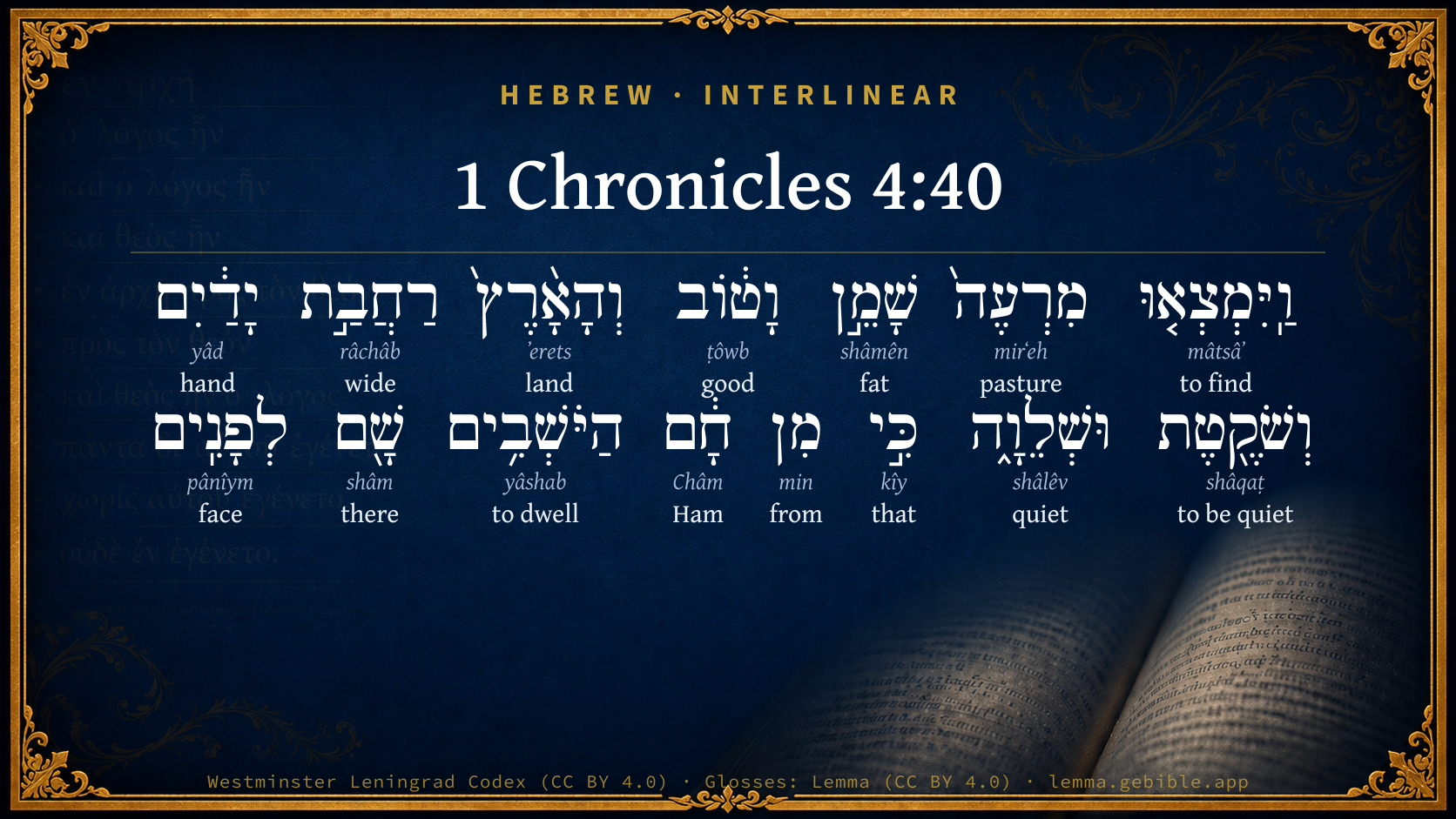
Hebrew (Westminster Leningrad Codex) 1 Chronicles 4:40 appears in the Hebrew Old Testament. The text above is from the Westminster Leningrad Codex. Each word links to its Strong’s number, a concise gloss, and parsing drawn from the Open Scriptures Hebrew Bible morphology. Click any word for its full Brown-Driver-Briggs (BDB) entry.
Download image
Cite this verse

1 Chronicles 4:40 (World English Bible). Public Domain. Lemma interlinear Bible study tool, https://lemma.gebible.app/v/1-chronicles/4/40.

Show BibTeX & RIS
BibTeX
RIS
English Translation
They found fat pasture and good, and the land was wide, and quiet, and peaceable; for those who lived there before were of Ham.
World English Bible · Public Domain
Highlights
  • 1 first appearance in the Hebrew Bible
Full analysis ↓
Download a study sheet

One document with this verse’s original text, its word-by-word gloss line, the meaning frame, cross-references with their text, attributed commentary, and full source and license credits — printable, and it pastes into notes with its structure intact.

This verse Autodidact and up

Study sheet (.html) Plain text (.txt)

A passage Seminary Student

Up to 50 verses in one chapter. A passage sheet keeps up to 6 commentary sources and 12 cross-references per verse, in the order this page ranks them, and says so on the sheet whenever that leaves anything out. Ask for a single verse and you get the Autodidact verse sheet above.

Everything on this page stays free to read, with no account — the sheet is a download of what is already on screen, not access to it.

Want to remove ads? Support Godless Engineer
Compare translations 3

The same verse in 3 English versions, stacked beneath the original-language interlinear above. Click any original word for its lexicon entry.

Each is an independent rendering of the whole verse — the interlinear is not word-aligned to these translations.

Highlighted words mark where these versions differ — a whole-verse word diff, not a word-by-word alignment.

  • World English Bible Public Domain
    They found fat pasture and good, and the land was wide, and quiet, and peaceable; for those who lived there before were of Ham.
  • King James Version Public Domain
    And they found fat pasture and good, and the land was wide, and quiet, and peaceable; for they of Ham had dwelt there of old.
  • unfoldingWord Literal Text CC BY-SA 4.0
    And they found rich and good pasture, and the land was broad of hands and quiet and peaceful, for from Ham were living there to their faces.

unfoldingWord Literal Text — © unfoldingWord, licensed CC BY-SA 4.0. Word-aligned USFM3 via Door43 (git.door43.org/unfoldingWord/en_ult).

Versions to compare (up to 4)

3 of 4 selected

Show all 18 translations

Every available English version of this verse, each an independent rendering of the whole verse.

  • World English Bible Public Domain
    They found fat pasture and good, and the land was wide, and quiet, and peaceable; for those who lived there before were of Ham.
  • Berean Standard Bible Public Domain
    There they found rich, good pasture, and the land was spacious, peaceful, and quiet; for some Hamites had lived there formerly.
  • Majority Standard Bible Public Domain
    There they found rich, good pasture, and the land was spacious, peaceful, and quiet; for some Hamites had lived there formerly.
  • King James Version Public Domain
    And they found fat pasture and good, and the land was wide, and quiet, and peaceable; for they of Ham had dwelt there of old.
  • American Standard Version (1901) Public Domain
    And they found fat pasture and good, and the land was wide, and quiet, and peaceable; for they that dwelt there aforetime were of Ham.
  • Revised Version (1885) Public Domain
    And they found fat pasture and good, and the land was wide, and quiet, and peaceable; for they that dwelt there aforetime were of Ham.
  • Geneva Bible (1599) Public Domain
    And they found fat pasture and good, and a wide land, both quiet and fruitfull: for they of Ham had dwelt there before.
  • Douay-Rheims (1899) Public Domain
    And they found fat pastures, and very good, and a country spacious, and quiet, and fruitful, in which some of the race of Cham had dwelt before.
  • Young's Literal Translation Public Domain
    and they find pasture, fat and good, and the land broad of sides, and quiet, and safe, for of Ham are those dwelling there before.
  • Literal Standard Version CC BY-SA 4.0
    and they find pasture, fat and good, and the land broad of sides, and quiet, and safe, for those dwelling there before are of Ham.
  • Unlocked Literal Bible CC BY-SA 4.0
    They found abundant and good pasture. The land was broad, quiet, and peaceable. The Hamites had formerly lived there.
  • unfoldingWord Literal Text CC BY-SA 4.0
    And they found rich and good pasture, and the land was broad of hands and quiet and peaceful, for from Ham were living there to their faces.
  • Darby Bible Public Domain
    And they found fat and good pasture, and a land widely extended and quiet and fertile, for they who had dwelt there formerly were of Ham.
  • World Messianic Bible Public Domain
    They found rich, good pasture, and the land was wide, and quiet, and peaceful, for those who lived there before were descended from Ham.
  • Webster's Bible Public Domain
    And they found rich pasture and good, and the land was wide, and quiet, and peaceable; for they of Ham had dwelt there of old.
  • Free Bible Version CC BY-SA 4.0
    They found good pastureland there, and the area was open, quiet, and peaceful, for those who used to live there were Ham's descendants.
  • Bible in Basic English Public Domain
    And they came to some good fertile grass-land, in a wide quiet country of peace-loving people; for the people who were living there before were of the offspring of Ham.
  • JPS Tanakh (1917) Public Domain
    And they found fat pasture and good, and the land was wide, and quiet, and peaceable; for they that dwelt there aforetime were of Ham.

Literal Standard Version (2020), Covenant Press — licensed CC BY-SA 4.0. Text via the HelloAO Bible API (eBible.org). Unlocked Literal Bible (unfoldingWord) — licensed CC BY-SA 4.0. Text via the HelloAO Bible API (eBible.org). unfoldingWord Literal Text — © unfoldingWord, licensed CC BY-SA 4.0. Word-aligned USFM3 via Door43 (git.door43.org/unfoldingWord/en_ult). Free Bible Version, Dr. Jonathan Gallagher — licensed CC BY-SA 4.0. Text via the HelloAO Bible API (eBible.org).

Word by word

More ways to search: Search by grammar → Find every occurrence → Compare this word →

Practice this passage: Drill this verse → Learn its vocabulary →

וּשְׁלֵוָ֑ה
shâlêv
H7961
“and · quiet”
Conjunction + Adjective, Adjective, Feminine, Singular, Absolute
Part of Speech
Conjunction + Adjective
Type
Adjective
Gender
Feminine
Number
Singular
State
Absolute
Full BDB Definition

Origin: from H7951

TWOT: 2392c

quiet, at ease, prosperous - at ease (of persons) - quiet (of land) - quiet, ease - ease (substantive)
  1. וַֽיִּמְצְא֤וּ mâtsâʼ H4672 “and · to find” Conjunction + Verb, Qal, Sequential Imperfect, 3rd Person, Masculine, Plural
  2. מִרְעֶה֙ mirʻeh H4829 “pasture” Noun, Common, Masculine, Singular, Absolute
  3. שָׁמֵ֣ן shâmên H8082 “fat” Adjective, Adjective, Masculine, Singular, Absolute
  4. וָט֔וֹב ṭôwb H2896 “and · good” Conjunction + Adjective, Adjective, Masculine, Singular, Absolute
  5. וְהָאָ֨רֶץ֙ ʼerets H776 “and · the · land” Conjunction + Particle, Definite Article + Noun, Common, Both, Singular, Absolute
  6. רַחֲבַ֣ת râchâb H7342 “wide of” Adjective, Adjective, Feminine, Singular, Construct
  7. יָדַ֔יִם yâd H3027 “hands” Noun, Common, Both, Dual, Absolute
  8. וְשֹׁקֶ֖טֶת shâqaṭ H8252 “and · being quiet” Conjunction + Verb, Qal, Participle Active, Feminine, Singular, Absolute
  9. כִּ֣י kîy H3588 “that” Conjunction
  10. מִן min H4480 “from” Preposition
  11. חָ֔ם Châm H2526 “Ham” Noun, Proper
  12. הַיֹּשְׁבִ֥ים yâshab H3427 “the · dwelling” Particle, Definite Article + Verb, Qal, Participle Active, Masculine, Plural, Absolute
  13. שָׁ֖ם shâm H8033 “there” Adverb
  14. לְפָנִֽים pânîym H6440 “to/for · face(s)” Preposition + Noun, Common, Both, Plural, Absolute

About this verse

These counts appear in no published source. They are computed here, from the morphology-tagged text and Lemma’s own curated glosses. What Lemma adds →

15
words
15
distinct lemmas
Historical
section

Notable vocabulary

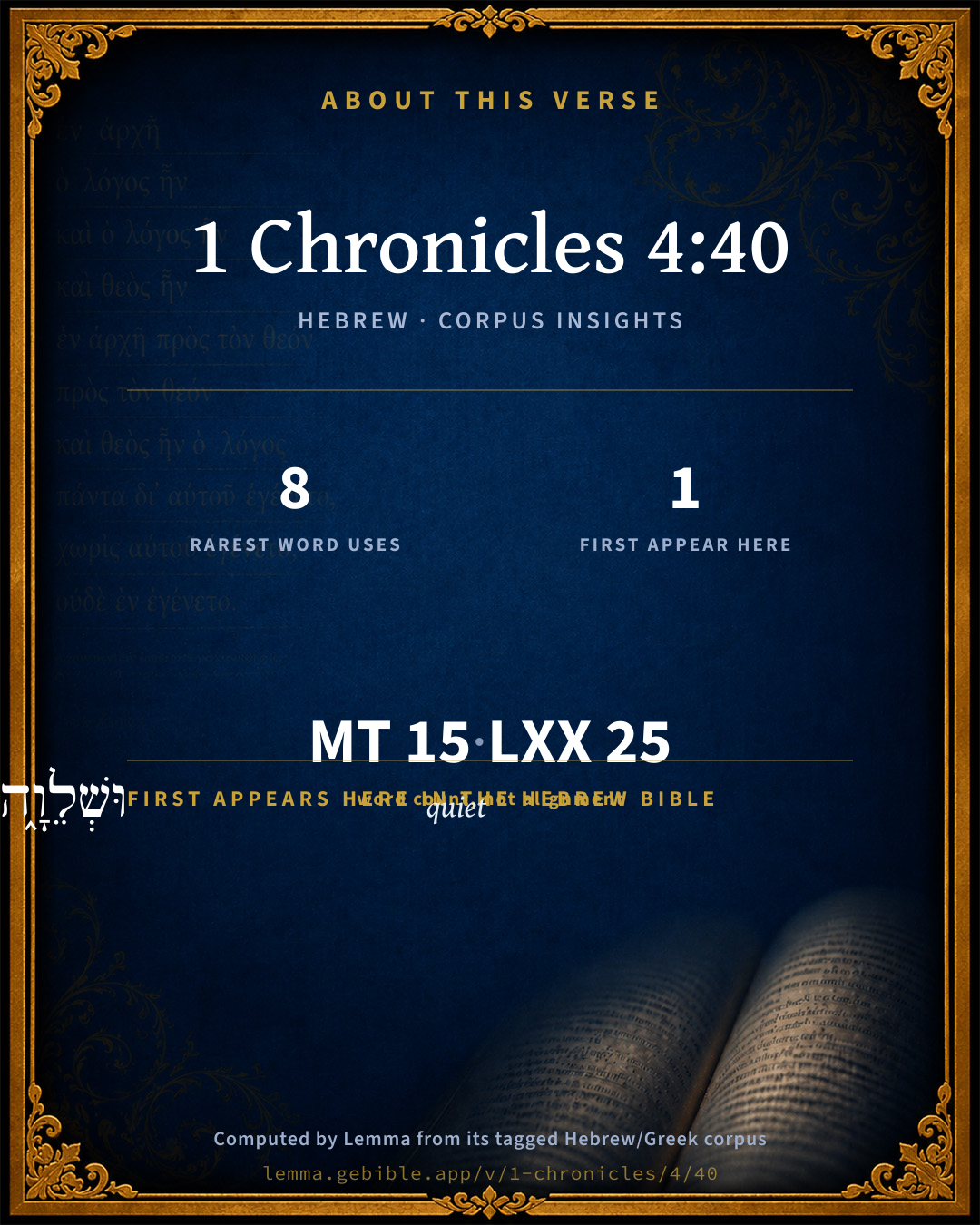
The rarest word here is וּשְׁלֵוָ֑ה quiet H7961 — appearing just 8 times in the whole Hebrew Bible.

First appearance in Scripture

This word makes its first canonical appearance in the Hebrew Bible here:

  • וּשְׁלֵוָ֑ה quiet H7961

Shared distinctive vocabulary

וּשְׁלֵוָ֑ה quiet H7961 occurs in 8 verses of the Hebrew Bible. Also found in:

Grammatical profile

  • 3 verbs
  • 5 nouns
  • 4 adjectives
  • 1 preposition
  • 1 conjunction
  • 1 adverb

Verb forms

  • וַֽיִּמְצְא֤וּ Qal · Sequential Imperfect
  • וְשֹׁקֶ֖טֶת Qal · Participle Active
  • הַיֹּשְׁבִ֥ים Qal · Participle Active

Hebrew & Septuagint length

In English translation the verse runs 24 words from the Hebrew and 33 from the Septuagint (LXX English) — closely comparable.

A rough comparison of the two English renderings, which tokenize alike — not a word-level alignment.

Word counts can differ between the Hebrew and the Greek without any difference in meaning — e.g. the Hebrew direct-object marker אֵת has no separate Greek word, and Greek often adds the article ὁ.

In the original languages it is 15 Hebrew tokens and 25 Greek tokens — but the two are counted differently (Hebrew bundles its prefixes and suffixes into one token; the Greek is in lemma form), so that isn’t a like-for-like length.

Cross-references

5

Topical passages linked to 1 Chronicles 4:40 in the Treasury of Scripture Knowledge — connected by theme and wording, ordered by reader-vote popularity; previews shown in the World English Bible.

  • Judges 18:7–10 Then the five men departed, and came to Laish, and saw the people who were therein, how they lived in security, after the manner of the Sidonians, quiet and secure; for there was none in the land, possessing authority, that might put [them] to shame in anything, and they were far from the Sidonians, and had no dealings with any man.
  • Genesis 9:22–29 Ham, the father of Canaan, saw the nakedness of his father, and told his two brothers outside.
  • Genesis 10:6 The sons of Ham: Cush, Mizraim, Put, and Canaan.
  • Psalms 78:51 And struck all the firstborn in Egypt, The chief of their strength in the tents of Ham.
  • Psalms 105:23 Israel also came into Egypt. Jacob sojourned in the land of Ham.

Cross-references courtesy of OpenBible.info (CC BY 4.0).

Hebrew and Greek witnesses Masoretic Hebrew ↔ Greek Septuagint

The same verse in the two great witnesses to the Old Testament, shown verse-for-verse.

These are two independent witnesses, not word-aligned to each other, and the Septuagint is shown in lemma (dictionary) form.

Hebrew 1 Chronicles 4:40 Masoretic · Westminster Leningrad Codex

וַֽיִּמְצְא֤וּ מִרְעֶה֙ שָׁמֵ֣ן וָט֔וֹב וְהָאָ֨רֶץ֙ רַחֲבַ֣ת יָדַ֔יִם וְשֹׁקֶ֖טֶת וּשְׁלֵוָ֑ה כִּ֣י מִן חָ֔ם הַיֹּשְׁבִ֥ים שָׁ֖ם לְפָנִֽים

They found fat pasture and good, and the land was wide, and quiet, and peaceable; for those who lived there before were of Ham.

World English Bible · Public Domain

Greek LXX 1 Chronicles 4:40 Septuagint · lemma form

καί εὑρίσκω νομή πίων καί ἀγαθός καί ὁ γῆ πλατεῖα ἐναντίον αὐτός καί εἰρήνη καί ἡσυχία ὅτι ἐκ ὁ υἱός χαμ ὁ καταοἰκέω ἐκεῖ ἔμπροσθεν

And they found abundant and good pastures, and the land before them was wide, and there was peace and quietness; for there were some of the children of Cham who lived there before.

LXX2012 (modern English Septuagint) · Public Domain

Hebrew: Westminster Leningrad Codex (CC BY 4.0). Greek: Septuagint (public domain); English from LXX2012 (modern English Septuagint) (Public Domain). How the Septuagint differs from the Hebrew →

Commentary

Notes on 1 Chronicles 4:40 from classic Christian and Jewish commentators (each source and its license shown beneath its notes). The classic Christian expositions comment on the surrounding passage and are grouped to its opening verse, so a note may address several verses; the Jewish commentaries on the Tanakh (Rashi and others) are per-verse, so they appear only where the commentator wrote on this verse.

Lemma curates 59 commentaries, every one of them public domain or Creative Commons licensed, each selected and text-cleaned for this edition rather than reprinted as found. About our sources →

Trapp's Complete Commentary

John Trapp

1Ch 4:40 And they found fat pasture and good, and the land [was] wide, and quiet, and peaceable; for [they] of Ham had dwelt there of old.

Ver. 40. And they found fat pasture and good.] This tempted the Simeonites to set upon them, as the wealth of Cyprus did the old Romans; {a} and as the pearls usually cast out with the flood and gathered at the ebb, drew Caesar’s affection for the conquest of Britain. {b}

For quiet, and peaceable.] See on Jdg 18:27-28.

And they of Ham had dwelt there.] The cursed Canaanites.

{a} Sext. Rufus

{b} {Suetonius, Julius Caesar, l. 1. c. 47. 1:95}

John Trapp, A Commentary or Exposition upon All the Books of the Old and New Testament (1647–1656) — public domain. Text from a community e-Sword module.

Joseph Benson's Commentary

1Ch 4:40. They found fat pasture, &c. — Those who thus dwelt (as we do) in a fruitful country, and whose land is wide, and quiet, and peaceable, have reason to own themselves indebted to that God, who appoints the bounds o four habitation. Of Ham — The Canaanites, who descended from Ham. And, accordingly, these words contain a reason why they went and possessed this place, because it was not in the hands of their brethren of Judah, but in the possession of that people which they had authority to expel.

Joseph Benson's Commentary on the Old and New Testaments (1811–1818) — public domain. Text from a community e-Sword module.

Adam Clarke's Commentary

Verse 40. They of Ham had dwelt there of old.] These were probably either Philistines or Egyptians, who dwelt at Gedor, which was situated in the environs of Joppa and Samnia.

Those whom the five hundred Simeonites expelled from Seir were Amalekites, 1Ch 4:43.

Adam Clarke's Commentary on the Bible (1810–1826) — public domain. Text from a community e-Sword/MySword module.

Ellicott's Commentary for English Readers

(40) And they found fat pasture and good.—If Gerar was the right reading in 1Ch_4:39, we might compare Gen_26:17 seq.

And the land was wide.—Gen_34:21. Literally, broad of both hands—i.e., on both sides. An open plain is meant.

And quiet and peaceable.—Like Laish, which the Danites took by surprise (Jdg_18:7; Jdg_18:28).

They of Ham had dwelt there of old.—That is, they who were then dwelling there were Hamites or Canaanites (1Ch_1:8).

Of old.—Literally, before (lephânîm); that is, before the Simeonite invasion.

A Bible Commentary for English Readers, edited by Charles John Ellicott (1878–1897) — public domain. Text from a community e-Sword module.

The Cambridge Bible for Schools and Colleges

gen. ed. J. J. S. Perowne

40. they of Ham] Canaanites who had not been dispossessed at the Conquest and therefore expected no disturbance at a later time.

The Cambridge Bible for Schools and Colleges (gen. ed. J. J. S. Perowne; Cambridge University Press, 1878–1918) — public domain. Text from a community e-Sword module.

John Gill's Exposition

And some of them, even of the sons of Simeon, five hundred men went to Mount Seir,.... In the land of Edom:

having for their captains Pelatiah, and Neariah, and Rephaiah, and Uzziel, the sons of Ishi; these four captains are said, by the ancient Rabbins, to be of the tribe of Manasseh, as Kimchi observes; see Ch1 5:24 but as the five hundred they were at the head of were of the sons of Simeon, the captains, no doubt, were of the same race.

John Gill's Exposition of the Whole Bible (1746–1763) — public domain (CC PDM 1.0). Text via the HelloAO Bible API.

Haydock's Catholic Bible Commentary

Cham. It is not certain that the Philistines, who came from the country of the Casluim, were descendants of Mezraim, Genesis x. 14. But it is very clear that the Egyptians sprung from Cham, Psalm lxxvii. 51.

George Leo Haydock (1774–1849), Haydock's Catholic Family Bible and Commentary, 1859 edition — public domain. Excludes Psalms (Douay-Rheims chapter numbering differs from Protestant) and Deuterocanonical books (Catholic canon only).

Matthew Poole's English Annotations

They of Ham, i.e. the posterity of that cursed Ham; either the Arabians; or the Canaanites or Philistines, who descended from Ham, Gen 10:6. And accordingly these words contain a reason, either,

1. To prove that the land was good; because the Arabians, who, being wholly given to pasturage, used to find out the choicest grounds, had formerly pitched their tents there. Or,

2. Why they went and possessed this place, because it was not in the hands of their brethren of Judah, but in the possession of that people which they had authority and command to expel.

Had dwelt there of old, i.e. had possessed it of old and hitherto. Or, dwelt there before, i.e. before they came and cast them out of their possessions.

Matthew Poole's English Annotations on the Holy Bible (1683–1685) — public domain. Text from a community e-Sword/MySword module.

The Pulpit Commentary

Fat pasture.

This passage relates an expedition of certain Simeonite chiefs and their followers, which took place in the days of Hezekiah. The tribe of Simeon was restless and warlike. This exploit was performed, apparently, from selfish, rapacious motives. The Simeonites wanted more pasture for their flocks; and, finding just what suited them in a territory possessed by their neighbours, they invaded their fertile and peaceful valley, slew the inhabitants, and seized their lands for their own use. What circumstances may have justified or extenuated such a proceeding we are not told.

I PLENTY IS A DIVINE GIFT. The land itself is the gift of God. Its favourable situation, its chemical constituents, the sunshine and the moisture, which make up its fertility, all are from him, and are proofs of his creative wisdom and goodness. The flocks and herds, and their increase, are his, whose are "the cattle upon a thousand hills." When the valleys are covered over with corn, when the sheep bleat in the pastures, when there is abundant provision for man and beast, then let our hearts ascend in gratitude to him who "openeth his hand, and satisfieth the desire of every living thing.

II PLENTY HAS MANY ADVANTAGES. In communities which are abundantly supplied with the necessities and comforts of life, there is opportunity and leisure for the cultivation of arts and learning, there is stimulus for commerce and manufactures, there is capacity for benevolence and for evangelization. If it is well used, plenty is a blessing. Only let all things be received as immediately from God"s hand, and be regarded as a sacred trust to be used for his glory and in his service.

III PLENTY IS NOT WITHOUT ITS DANGERS. It was foreseen that when Israel quitted the wilderness, and entered upon possession of the land flowing with milk and honey, there would be a temptation to forget God, and to take credit for national prosperity and wealth. Against the perils of plenty and prosperity, let the fortunate and happy be ever on their guard.

T.

The Pulpit Commentary (1880–1919), ed. H.D.M. Spence-Jones & Joseph S. Exell — public domain. Text from a community e-Sword module.

John Wesley's Explanatory Notes

Fat pasture, &c. - Those who thus dwelt (as we do) in a fruitful country, and whose land is wide and quiet and peaceable, have reason to own themselves indebted to that God, who appoints the bounds of our habitation. Of Ham - The Canaanites, who descended from Ham. And accordingly these words contain a reason, why they went and possessed this place, because it was not in the hands of their brethren of Judah, but in the possession of that people which they had authority to expel.

John Wesley, Explanatory Notes Upon the Whole Bible (1754–1765) — public domain. Text via the GEBible commentary corpus.

Keil & Delitzsch

C. F. Keil & F. Delitzsch

And some of them, even of the sons of Simeon, five hundred men went to Mount Seir,.... In the land of Edom:

having for their captains Pelatiah, and Neariah, and Rephaiah, and Uzziel, the sons of Ishi; these four captains are said, by the ancient Rabbins, to be of the tribe of Manasseh, as Kimchi observes; see Ch1 5:24 but as the five hundred they were at the head of were of the sons of Simeon, the captains, no doubt, were of the same race.

Keil & Delitzsch — Biblical Commentary on the Old Testament (1861–1891) — public domain (CC PDM 1.0). Text via the HelloAO Bible API. (Old Testament only.)

Rashi

Rabbi Shlomo Yitzchaki (Rashi)

for the dwellers of yore were from Ham They dwelt in peace and tranquility, and no one came to harm them; therefore, they did not beware when they came upon them to fight, and an example of this is found in Judges (18:27): “... and they came to Laish, to a people tranquil and secure etc.,” (verse 7): “... and they had no bond with any man.” Because they were tranquil, they were not afraid, and they did not make a pact with anyone to help them; therefore, five hundred men defeated them. It is also written above (verse 7): “... after the manner of the Zidonians, tranquil and secure, etc.”

Rashi on the Tanakh — English translations: “The Judaica Press complete Tanach with Rashi, translated by A. J. Rosenberg” (CC BY 4.0); “Pentateuch with Rashi's commentary by M. Rosenbaum and A.M. Silbermann, 1929-1934” (public domain); “The Metsudah Tanach series, Lakewood, N.J” (CC BY 4.0); and “The Book of Joshua, Metsudah Publications, 1997” (CC BY 4.0). Text via Sefaria.

Lesson kit

Teaching starters — assembled from the data on this page, not authored interpretation. Every prompt links to the verse data it draws on. Edit before teaching.

1 Chronicles, in the Historical, opens this verse with 15 words (15 distinct Hebrew lemmas). Its most distinctive word is shâlêv (“quiet”). A historical commentator’s framing appears above. Read the whole chapter for the surrounding context.

Discussion questions

  1. What does “quiet” (shâlêv) contribute to the verse as a whole?
  2. This is the first place “quiet” appears in Scripture (first appears here). What does its debut here establish?
  3. How does Job 16:12, which shares the word «quiet», read alongside this verse?
  4. These translations render this verse differently; the difference is in the English rendering, not the original. What questions does that raise?
  5. «וַֽיִּמְצְא֤וּ» is a Qal Sequential Imperfect verb. How does that grammatical form shape the action described?
  6. Compare how Trapp's Complete Commentary and Joseph Benson's Commentary read this verse. Where do they agree or differ?

Things to notice

Reading settings

Reading text

Shown beneath each verse's original-language words.

Old Testament
Old Testament edition

Read the OT as the Masoretic Hebrew (MT) or the Greek Septuagint (LXX).

English shown for the Greek Septuagint (in the Hebrew ↔ Greek comparison).

Comparing translations? Open the Compare panel on any verse page to stack up to four side by side.