1 Chronicles 29:28

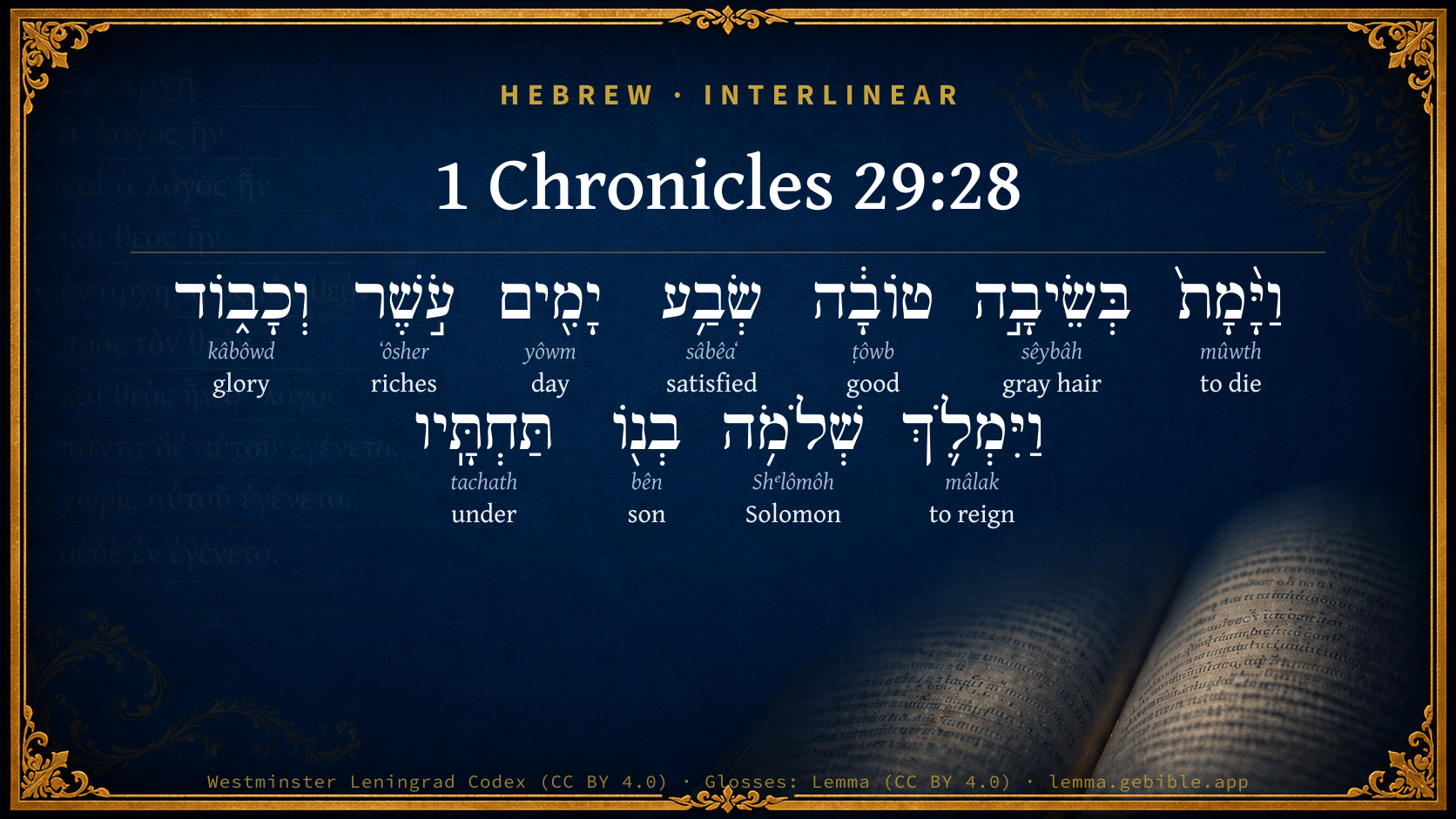
Hebrew (Westminster Leningrad Codex) 1 Chronicles 29:28 appears in the Hebrew Old Testament. The text above is from the Westminster Leningrad Codex. Each word links to its Strong’s number, a concise gloss, and parsing drawn from the Open Scriptures Hebrew Bible morphology. Click any word for its full Brown-Driver-Briggs (BDB) entry.
Download image
Cite this verse

1 Chronicles 29:28 (World English Bible). Public Domain. Lemma interlinear Bible study tool, https://lemma.gebible.app/v/1-chronicles/29/28.

Show BibTeX & RIS
BibTeX
RIS
English Translation
He died in a good old age, full of days, riches, and honor: and Solomon his son reigned in his place.
World English Bible · Public Domain
Download a study sheet

One document with this verse’s original text, its word-by-word gloss line, the meaning frame, cross-references with their text, attributed commentary, and full source and license credits — printable, and it pastes into notes with its structure intact.

This verse Autodidact and up

Study sheet (.html) Plain text (.txt)

A passage Seminary Student

Up to 50 verses in one chapter. A passage sheet keeps up to 6 commentary sources and 12 cross-references per verse, in the order this page ranks them, and says so on the sheet whenever that leaves anything out. Ask for a single verse and you get the Autodidact verse sheet above.

Everything on this page stays free to read, with no account — the sheet is a download of what is already on screen, not access to it.

Want to remove ads? Support Godless Engineer
Compare translations 3

The same verse in 3 English versions, stacked beneath the original-language interlinear above. Click any original word for its lexicon entry.

Each is an independent rendering of the whole verse — the interlinear is not word-aligned to these translations.

Highlighted words mark where these versions differ — a whole-verse word diff, not a word-by-word alignment.

  • World English Bible Public Domain
    He died in a good old age, full of days, riches, and honor: and Solomon his son reigned in his place.
  • King James Version Public Domain
    And he died in a good old age, full of days, riches, and honor: and Solomon his son reigned in his stead.
  • unfoldingWord Literal Text CC BY-SA 4.0
    And he died in good old age, full of days, wealth, and glory. And Solomon his son reigned in his place.

unfoldingWord Literal Text — © unfoldingWord, licensed CC BY-SA 4.0. Word-aligned USFM3 via Door43 (git.door43.org/unfoldingWord/en_ult).

Versions to compare (up to 4)

3 of 4 selected

Show all 18 translations

Every available English version of this verse, each an independent rendering of the whole verse.

  • World English Bible Public Domain
    He died in a good old age, full of days, riches, and honor: and Solomon his son reigned in his place.
  • Berean Standard Bible Public Domain
    He died at a ripe old age, full of years, riches, and honor, and his son Solomon reigned in his place.
  • Majority Standard Bible Public Domain
    He died at a ripe old age, full of years, riches, and honor, and his son Solomon reigned in his place.
  • King James Version Public Domain
    And he died in a good old age, full of days, riches, and honor: and Solomon his son reigned in his stead.
  • American Standard Version (1901) Public Domain
    And he died in a good old age, full of days, riches, and honor: and Solomon his son reigned in his stead.
  • Revised Version (1885) Public Domain
    And he died in a good old age, full of days, riches, and honour: and Solomon his son reigned in his stead.
  • Geneva Bible (1599) Public Domain
    And he dyed in a good age, full of dayes, riches and honour, and Salomon his sonne reigned in his steade.
  • Douay-Rheims (1899) Public Domain
    And he died in a good age, full of days, and riches, and glory. And Solomon his son reigned in his stead.
  • Young's Literal Translation Public Domain
    and he dieth in a good old age, satisfied with days, riches, and honour, and reign doth Solomon his son in his stead.
  • Literal Standard Version CC BY-SA 4.0
    and he dies in a good old age, satisfied with days, riches, and honor, and his son Solomon reigns in his stead.
  • Unlocked Literal Bible CC BY-SA 4.0
    He died at a good old age, after enjoying a long life, wealth and honor. Solomon his son succeeded him.
  • unfoldingWord Literal Text CC BY-SA 4.0
    And he died in good old age, full of days, wealth, and glory. And Solomon his son reigned in his place.
  • Darby Bible Public Domain
    And he died in a good old age, full of days, riches, and honour; and Solomon his son reigned in his stead.
  • World Messianic Bible Public Domain
    He died at a good old age, full of days, riches, and honor; and Solomon his son reigned in his place.
  • Webster's Bible Public Domain
    And he died in a good old age, full of days, riches, and honor: and Solomon his son reigned in his stead.
  • Free Bible Version CC BY-SA 4.0
    David died at a good old age, having lived a long life, blessed with wealth and honor. Then his son Solomon took over and ruled in his place.
  • Bible in Basic English Public Domain
    And he came to his end after a long life, full of days and great wealth and honour; and Solomon his son became king in his place.
  • JPS Tanakh (1917) Public Domain
    And he died in a good old age, full of days, riches, and honour; and Solomon his son reigned in his stead.

Literal Standard Version (2020), Covenant Press — licensed CC BY-SA 4.0. Text via the HelloAO Bible API (eBible.org). Unlocked Literal Bible (unfoldingWord) — licensed CC BY-SA 4.0. Text via the HelloAO Bible API (eBible.org). unfoldingWord Literal Text — © unfoldingWord, licensed CC BY-SA 4.0. Word-aligned USFM3 via Door43 (git.door43.org/unfoldingWord/en_ult). Free Bible Version, Dr. Jonathan Gallagher — licensed CC BY-SA 4.0. Text via the HelloAO Bible API (eBible.org).

Word by word

More ways to search: Search by grammar → Find every occurrence → Compare this word →

Practice this passage: Drill this verse → Learn its vocabulary →

שְׂבַ֥ע
sâbêaʻ
H7649
“satisfied of”
Adjective, Adjective, Masculine, Singular, Construct
Part of Speech
Adjective
Type
Adjective
Gender
Masculine
Number
Singular
State
Construct
Full BDB Definition

Origin: from H7646

TWOT: 2231d

sated, satisfied, surfeited - sated, abounding, satisfied - surfeited (bad sense)
  1. וַיָּ֨מָת֙ mûwth H4191 “and · to die” Conjunction + Verb, Qal, Sequential Imperfect, 3rd Person, Masculine, Singular
  2. בְּשֵׂיבָ֣ה sêybâh H7872 “in/at · gray hair” Preposition + Noun, Common, Feminine, Singular, Absolute
  3. טוֹבָ֔ה ṭôwb H2896 “good” Adjective, Adjective, Feminine, Singular, Absolute
  4. יָמִ֖ים yôwm H3117 “days” Noun, Common, Masculine, Plural, Absolute
  5. עֹ֣שֶׁר ʻôsher H6239 “riches” Noun, Common, Masculine, Singular, Absolute
  6. וְכָב֑וֹד kâbôwd H3519 “and · glory” Conjunction + Noun, Common, Both, Singular, Absolute
  7. וַיִּמְלֹ֛ךְ mâlak H4427 “and · to reign” Conjunction + Verb, Qal, Sequential Imperfect, 3rd Person, Masculine, Singular
  8. שְׁלֹמֹ֥ה Shᵉlômôh H8010 “Solomon” Noun, Proper
  9. בְנ֖וֹ bên H1121 “son · his” Noun, Common, Masculine, Singular, Construct + Suffix, Personal, 3rd Person, Masculine, Singular
  10. תַּחְתָּֽיו tachath H8478 “under · him” Preposition + Suffix, Personal, 3rd Person, Masculine, Singular

About this verse

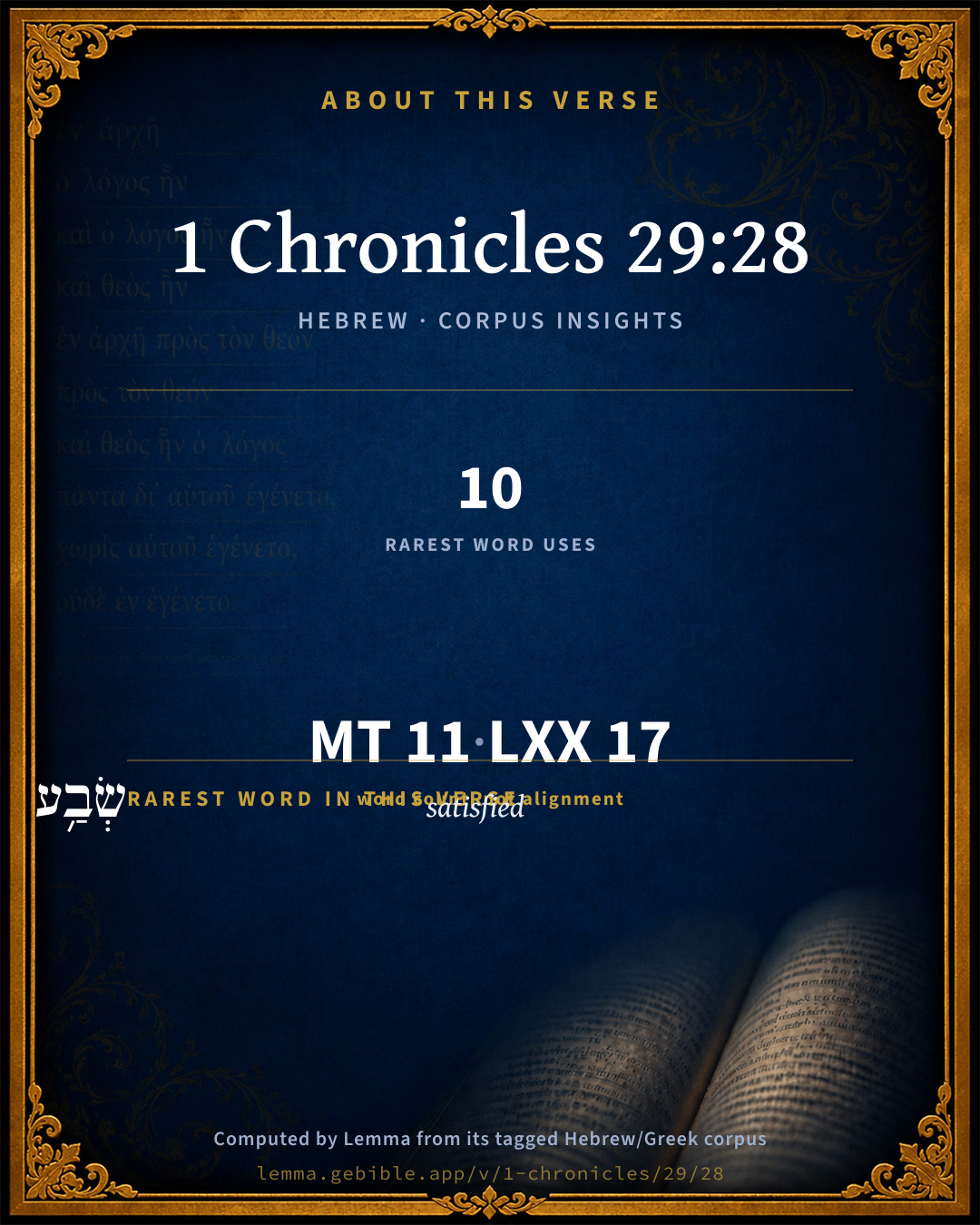
These counts appear in no published source. They are computed here, from the morphology-tagged text and Lemma’s own curated glosses. What Lemma adds →

11
words
11
distinct lemmas
Historical
section

Notable vocabulary

The rarest word here is שְׂבַ֥ע satisfied H7649 — appearing just 10 times in the whole Hebrew Bible.

Shared distinctive vocabulary

שְׂבַ֥ע satisfied H7649 occurs in 10 verses of the Hebrew Bible. Also found in:

Grammatical profile

  • 2 verbs
  • 6 nouns
  • 2 adjectives
  • 1 preposition

Verb forms

  • וַיָּ֨מָת֙ Qal · Sequential Imperfect
  • וַיִּמְלֹ֛ךְ Qal · Sequential Imperfect

Hebrew & Septuagint length

In English translation the verse runs 21 words from the Hebrew and 23 from the Septuagint (LXX English) — closely comparable.

A rough comparison of the two English renderings, which tokenize alike — not a word-level alignment.

Word counts can differ between the Hebrew and the Greek without any difference in meaning — e.g. the Hebrew direct-object marker אֵת has no separate Greek word, and Greek often adds the article ὁ.

In the original languages it is 11 Hebrew tokens and 17 Greek tokens — but the two are counted differently (Hebrew bundles its prefixes and suffixes into one token; the Greek is in lemma form), so that isn’t a like-for-like length.

Cross-references

7

Topical passages linked to 1 Chronicles 29:28 in the Treasury of Scripture Knowledge — connected by theme and wording, ordered by reader-vote popularity; previews shown in the World English Bible.

  • Genesis 15:15 But you will go to your fathers in peace. You will be buried in a good old age.
  • Acts 13:36 For David, after he had in his own generation served the counsel of God, fell asleep, and was laid with his fathers, and saw decay.
  • 1 Chronicles 23:1 Now David was old and full of days; and he made Solomon his son king over Israel.
  • Job 5:26 You shall come to your grave in a full age, Like a shock of grain comes in its season.
  • Genesis 25:8 Abraham gave up the spirit, and died in a good old age, an old man, and full of years, and was gathered to his people.
  • Genesis 35:29 Isaac gave up the spirit, and died, and was gathered to his people, old and full of days. Esau and Jacob, his sons, buried him.
  • Proverbs 16:31 Gray hair is a crown of glory. It is attained by a life of righteousness.

Cross-references courtesy of OpenBible.info (CC BY 4.0).

Hebrew and Greek witnesses Masoretic Hebrew ↔ Greek Septuagint

The same verse in the two great witnesses to the Old Testament, shown verse-for-verse.

These are two independent witnesses, not word-aligned to each other, and the Septuagint is shown in lemma (dictionary) form.

Hebrew 1 Chronicles 29:28 Masoretic · Westminster Leningrad Codex

וַיָּ֨מָת֙ בְּשֵׂיבָ֣ה טוֹבָ֔ה שְׂבַ֥ע יָמִ֖ים עֹ֣שֶׁר וְכָב֑וֹד וַיִּמְלֹ֛ךְ שְׁלֹמֹ֥ה בְנ֖וֹ תַּחְתָּֽיו

He died in a good old age, full of days, riches, and honor: and Solomon his son reigned in his place.

World English Bible · Public Domain

Greek LXX 1 Chronicles 29:28 Septuagint · lemma form

καί τελευτάω ἐν γῆρας καλός πλήρης ἡμέρα πλοῦτος καί δόξα καί βασιλεύω σαλωμών υἱός αὐτός ἀντί αὐτός

And he died in a good old age, full of days, in wealth, and glory: and Solomon his son reigned in his stead.

LXX2012 (modern English Septuagint) · Public Domain

On this verse, Ellicott's Commentary for English Readers discusses the Septuagint’s reading. Read the note in Commentary ↓

Hebrew: Westminster Leningrad Codex (CC BY 4.0). Greek: Septuagint (public domain); English from LXX2012 (modern English Septuagint) (Public Domain). How the Septuagint differs from the Hebrew →

Commentary

Notes on 1 Chronicles 29:28 from classic Christian and Jewish commentators (each source and its license shown beneath its notes). The classic Christian expositions comment on the surrounding passage and are grouped to its opening verse, so a note may address several verses; the Jewish commentaries on the Tanakh (Rashi and others) are per-verse, so they appear only where the commentator wrote on this verse.

Lemma curates 59 commentaries, every one of them public domain or Creative Commons licensed, each selected and text-cleaned for this edition rather than reprinted as found. About our sources →

Trapp's Complete Commentary

John Trapp

1Ch 29:28 And he died in a good old age, full of days, riches, and honour: and Solomon his son reigned in his stead.

Ver. 28. And he died in a good old age.] Heb., With a good gray head; εν τη ευγηρια; where met happily γηρας and γερας, old age and honour. Having lived a fruitful and gracious life, he closed up all with a happy and blessed death, having his faith at his finger ends, and an abundant entrance into heaven. {2Pe 1:10-11}

Full of days, riches, and honour.] So that, if he might have had more of these, and longer time to enjoy them, he would not. As willing he was to leave the world, as ever he was to rise from the board when he had well dined.

In the book of Samuel the seer, &c.] In the two books of Samuel composed by these three prophets.

John Trapp, A Commentary or Exposition upon All the Books of the Old and New Testament (1647–1656) — public domain. Text from a community e-Sword module.

Joseph Benson's Commentary

1Ch 29:28. Full of days — Fully satisfied with the days which God had given him, having had the happiness of seeing his beloved son Solomon settled in his throne. Riches and honour — He had enough of this world, and of the riches and honour of it; and he knew when he had enough. He was satisfied, and very willing to go to a better place.

Joseph Benson's Commentary on the Old and New Testaments (1811–1818) — public domain. Text from a community e-Sword module.

Adam Clarke's Commentary

Verse 28. And he died] David, at his death, had every thing that his heart could wish.

1. A good old age, having lived as long as living could be desirable, and having in the main enjoyed good health.

2. Full of days; having lived till he saw every thing that he lived for either accomplished or in a state of forwardness.

3. Full of riches; witness the immense sums left for the temple.

4. Full of honorer; having gained more renown than any crowned head ever did, either before his time or since-laurels that are fresh to the present hour.

Adam Clarke's Commentary on the Bible (1810–1826) — public domain. Text from a community e-Sword/MySword module.

Ellicott's Commentary for English Readers

(28) In a good old age.—Gen_15:15.

Full of days.—From LXX. and Vulg. (πλήρης ἡμερῶν —plenus dierum). Literally, satisfied with days. Syriac, “And he was satisfied with the days of his life.” (Comp. 1Ch_23:1; Gen_35:29.)

Riches and honour.—1Ch_29:12. Syriac, “And he was great in the riches of the world, and in the honour thereof.”

And Solomon his son reigned in his stead.—The regular formula, from 1Ki_11:43 to the end of the history of the kings.

A Bible Commentary for English Readers, edited by Charles John Ellicott (1878–1897) — public domain. Text from a community e-Sword module.

John Gill's Exposition

With all his reign and his might,.... The whole of it, and the mighty valiant acts done by him, the battles he fought, and the victories he obtained:

and the times that went over him, and over Israel, and all the kingdoms of the countries; things that were done in his time in Israel, and in the nations round about subdued by him, as Moab, Ammon, Syria, and Philistia.

Next: 2 Chronicles Introduction

John Gill's Exposition of the Whole Bible (1746–1763) — public domain (CC PDM 1.0). Text via the HelloAO Bible API.

Albert Barnes' Notes on the Bible

See 1Ki 1:1 note.

Albert Barnes' Notes on the Bible (1834–1885) — public domain. Text from a community e-Sword/MySword module.

Matthew Poole's English Annotations

Full of days; fully satisfied with the days which God had given him, having had the happiness to see his beloved Solomon settled in his throne, being now weary of this life, and desiring to be with God.

Matthew Poole's English Annotations on the Holy Bible (1683–1685) — public domain. Text from a community e-Sword/MySword module.

The Pulpit Commentary

We learn from 2Sa_5:4, 2Sa_5:5, that David was thirty years old when he began to reign in Hebron. He must, therefore, have died in his seventy-first year. That this is called here a good old age shows that the length of human life had now greatly subsided. In comparison of all his successors on the thrones of Judah and of Israel, his age was clearly a "good old age?

David"s death.

Aristotle quotes Solon"s saying that no man should be called happy until his end. One reason for this much-controverted dictum, no doubt, was this that a bureau life may be marked by prosperity up to a certain point, atwhich fortune may turn her wheel. This was, of course, not a Christian view of life; we have learned to look at the problem as one rather of character than of fortune, and to sympathize with the estimate of the all-seeing and heart-searching Lord and Judge. The circumstances mentioned in the text must be taken in conjunction with the rest of the narrative, if we would have a scriptural view of David"s prosperity and felicity.

I HIS AGE "A good old age" is not here what we should call such; for David"s life does not seem to have exceeded seventy years. Yet it was not cut short; and, as he was suffered to live for the appointed term of life, he had opportunity to carry out his plans and to see their success. He was, in the expressive Hebraism, "full of days.

II HIS RICHES. These were acquired by the industry of the population and by the spoils of war. They enabled him to adorn the metropolis which he had won by his sword, and to make preparation for building the temple of his God.

III HIS HONOUR. He had been raised from the sheepfold to the throne. He had been fortunate in his counsellors and his generals. His victories had given him a widespread renown. And in his spiritual lyrics he had laid, all unwittingly, the foundations of a far wider and more honourable fame. As "the sweet singer of Israel," and "the man after God"s heart," he is known throughout the Jewish and the Christian world.

PRACTICAL LESSONS.

1. The life of David is one fitted to encourage our confidence in Divineprovidence. The man himself felt, and the sacred historians felt, that there never was a more signal instance of an individual being called forth by God"s voice and qualified by Divine discipline for a great work in life. It gives peace and dignity to our life to be ever assured that "our times are in God"s hands," and that he will use us for his glory.

2. The life of David is a warning against yielding to temptation. He gaveway alike to sins of the flesh and to sins of the spirit, and again and again proved his fallibility and infirmity. Well may each reader of his biography lay to heart the lesson: "Let him that thinketh he standeth take heed lest he fall;" "Watch and pray that ye enter not into temptation.

3. The life of David shows how possible it is to serve God in differentways. He was a soldier, a poet, a king, a religious leader; and in all capacities he glorified God. We may have few gifts, but we may learn that the use of one gift is no excuse for the neglect of another.

4. The life of David reveals the true secret of happiness and usefulness. Hewas one whose fellowship was much with God; hence his strength. Read his psalms, and you will be convinced that this was so. It is thus that strength and fortitude are to be sustained.

5. The life of David shows us that, during this earthly existence, a goodman may begin a good work which shall continue after his death. David did not abide for ever, but he prepared a throne for his son; he did not build the temple, but he put all things in train with a view to the work. Let us live so that when we are no more here others may say, "He being dead yet speaketh. T.

Solomon"s accession.

The book which has been so largely occupied with the acts and the reign of David, closes with the accession of his son. It is an exemplification of the old saying, "One generation passeth away and another generation cometh." Each generation has its own work to do, and has then to make way for its successor. David"s part was to conquer by valour and power; Solomon"s part was to reign in magnificence. David prepared for the temple; Solomon built it. Everything that a father could do to facilitate a son"s work David certainly did for his successor, who entered upon a heritage of peace and power.

I THE FOUNDATION OF SOLOMON"S THRONE WAS LAID IS RELIGION. They "anointed him unto the Lord;" he "sat on the throne of the Lord." These expressions, taken in connection with the narrative of the events following Solomon"s accession, indicate that he began his reign in a truly religious spirit, with a desire to consecrate his position and influence to the glory of God.

II THE COMMENCEMENT OF SOLOMON"S REIGN WAS MARKED BY THE ALLEGIANCE OF THE PRINCES AND THE OBEDIENCE OF THE POPULATION GENERALLY. With conspicuous loyalty the ancient captains and chiefs of David transferred their allegiance to his youthful successor, and the people who had been dazzled into obedience by the exploits of the father, at once and cheerfully submitted to the sway of the son.

III THE PROGRESS OF SOLOMON"S REIGN WAS DISTINGUISHED BY PROSPERITY AND BY MAJESTY. This glory is by the chronicler justly attributed to the favour of the Lord. The "royal majesty" of the youthful occupant of the throne exceeded anything before known in Israel. The following Book of Chronicles is an abundant proof of this. During the first part, at all events, of this splendid reign, Solomon was faithful to his trust and to his God. He was a type of the Prince of peace, whose kingdom is an everlasting kingdom, and whose dominion endureth throughout all generations. T.

Honoured in death by God and man.

This was the case with King David. "He died in a good old age, full of days, riches, and honour." With the reverent love of a whole nation round him, they bore him to his royal tomb. "David died, according to Josephus, at the age of seventy. The general sentiment which forbade interment within the habitations of men, gave way in his case, as in that of Samuel He was "buried in the city of David," in the city which he had made his own, and which could only be honoured, not polluted, by containing his grave. It was, no doubt, hewn in the rocky side of the hill, and became the centre of the catacomb in which his descendants, the kings of Judah, were interred after him." "The only site which is actually consecrated by traditional sentiment as the tomb of David, is the vault underneath the Mussulman Mosque of David, on the southern side of modern Jerusalem. The vault professes to be built above the cavern, and contains only the cenotaph usual in the tombs of Mussulman saints, with the inscription in Arabic, "O David, whom God has made vicar, rule mankind in truth. Observing how honoured in death King David was, and how honoured in memory King David is, though his life was so checkered and so seriously marred with wilfulness, indulgence, and sin, we are reminded of the lines often quoted from our greatest national poet

The evil that men do lives after them; The good is oft interred with their bones;

and we ask Are these lines, in any large and important sense, true; and must we so invert our fixed notions as to admit that the good in our lives is temporary and fading, while the evil is permanent, and must go on, with its mischievous influences, when we have passed away? We cannot think this. What is true about men especially such public men as David may be stated under three headings.

I EVERY MAN"S LIFE, WHILE BEING LIVED, IS SUBJECT TO CRITICISM. We must all accept of this condition. We must not wonder if the criticism finds out and unduly magnifies the evil that may be in us. Though often a source of much bitterness and trouble, and often painfully depressing to the earnest man, it is, on the whole, healthy that public men should be thus exposed, and must take count of the fact that their fellows will never let their wrong-doings or wrong teachings hide away or work in secret. It is more true that the "evil of a man" lives while he lives.

II IN THE TIME OF A MAN"S DEATH CRITICISM IS DISARMED. Such a time has a strange calming and solemnizing influence even on political and theological opponents. The "other party" will write sketches of the dead man"s life without a trace of bitterness or reference to a disputed topic. Perhaps this was never more strikingly illustrated than at the death of the good Dean Stanley. Touchingly tender and beautiful were the references made to him, and all vied in saying good or saying nothing. The good, not the evil, lived after him. And so in David"s death-time, all the evil and the enmity were put aside, that the nation might do homage to its great and good king.

III AFTER DEATH CRITICISM IS KINDLY. By common consent men try to forget the evil, and fix their thoughts only on the good. Biographies scarcely even hint the natural weaknesses, the stumblings, or the stains. Nay, a kind of glory-halo gathers round the heroic dead, in which we even lose sight of their infirmities; and so it is the good in a man that lives after him.

Then comes the question Does our homage in death to a man necessarily imply approval of his career? Yes; it does of his career as a whole of the great features of it. Though this must be admitted, that the homage is far oftener rendered to genius than to character. R.T.

The Pulpit Commentary (1880–1919), ed. H.D.M. Spence-Jones & Joseph S. Exell — public domain. Text from a community e-Sword module.

John Wesley's Explanatory Notes

Riches and honour - That is, he had enough of this world, and of the riches of and honour of it; and he knew when he had enough. He was satisfied with it, and very willing to go to a better place.

John Wesley, Explanatory Notes Upon the Whole Bible (1754–1765) — public domain. Text via the GEBible commentary corpus.

Keil & Delitzsch

C. F. Keil & F. Delitzsch

With all his reign and his might,.... The whole of it, and the mighty valiant acts done by him, the battles he fought, and the victories he obtained:

and the times that went over him, and over Israel, and all the kingdoms of the countries; things that were done in his time in Israel, and in the nations round about subdued by him, as Moab, Ammon, Syria, and Philistia.

Next: 2 Chronicles Introduction

Keil & Delitzsch — Biblical Commentary on the Old Testament (1861–1891) — public domain (CC PDM 1.0). Text via the HelloAO Bible API. (Old Testament only.)

Lesson kit

Teaching starters — assembled from the data on this page, not authored interpretation. Every prompt links to the verse data it draws on. Edit before teaching.

1 Chronicles, in the Historical, opens this verse with 11 words (11 distinct Hebrew lemmas). Its most distinctive word is sâbêaʻ (“satisfied”). A historical commentator’s framing appears above. Read the whole chapter for the surrounding context.

Discussion questions

  1. The word sâbêaʻ carries the sense “satisfied.” How does it shape the verse?
  2. Genesis 25:8 shares the word «satisfied» with this verse. How do the two illuminate each other?
  3. These translations render this verse differently; the difference is in the English rendering, not the original. What questions does that raise?
  4. The verb «וַיָּ֨מָת֙» is Qal Sequential Imperfect. How does its form color the action?
  5. Reading how Trapp's Complete Commentary and Joseph Benson's Commentary read this verse, where do the two commentators agree and where do they part?

Things to notice

Reading settings

Reading text

Shown beneath each verse's original-language words.

Old Testament
Old Testament edition

Read the OT as the Masoretic Hebrew (MT) or the Greek Septuagint (LXX).

English shown for the Greek Septuagint (in the Hebrew ↔ Greek comparison).

Comparing translations? Open the Compare panel on any verse page to stack up to four side by side.