

Proverbs 19:22

Hebrew (Westminster Leningrad Codex) Proverbs 19:22 appears in the Hebrew Old Testament. The text above is from the Westminster Leningrad Codex. Each word links to its Strong’s number, a concise gloss, and parsing drawn from the Open Scriptures Hebrew Bible morphology. Click any word for its full Brown-Driver-Briggs (BDB) entry.
Download image
Cite this verse

Proverbs 19:22 (World English Bible). Public Domain. Lemma interlinear Bible study tool, https://lemma.gebible.app/v/proverbs/19/22.

Show BibTeX & RIS
BibTeX
RIS
English Translation
That which makes a man to be desired is his kindness. A poor man is better than a liar.
World English Bible · Public Domain
Download a study sheet

One document with this verse’s original text, its word-by-word gloss line, the meaning frame, cross-references with their text, attributed commentary, and full source and license credits — printable, and it pastes into notes with its structure intact.

This verse Autodidact and up

Study sheet (.html) Plain text (.txt)

A passage Seminary Student

Up to 50 verses in one chapter. A passage sheet keeps up to 6 commentary sources and 12 cross-references per verse, in the order this page ranks them, and says so on the sheet whenever that leaves anything out. Ask for a single verse and you get the Autodidact verse sheet above.

Everything on this page stays free to read, with no account — the sheet is a download of what is already on screen, not access to it.

Want to remove ads? Support Godless Engineer
Compare translations 3

The same verse in 3 English versions, stacked beneath the original-language interlinear above. Click any original word for its lexicon entry.

Each is an independent rendering of the whole verse — the interlinear is not word-aligned to these translations.

Highlighted words mark where these versions differ — a whole-verse word diff, not a word-by-word alignment.

  • World English Bible Public Domain
    That which makes a man to be desired is his kindness. A poor man is better than a liar.
  • King James Version Public Domain
    The desire of a man is his kindness: and a poor man is better than a liar.
  • unfoldingWord Literal Text CC BY-SA 4.0
    The desire of a man his covenant faithfulness, and better one who is poor than a man of lying.

unfoldingWord Literal Text — © unfoldingWord, licensed CC BY-SA 4.0. Word-aligned USFM3 via Door43 (git.door43.org/unfoldingWord/en_ult).

Versions to compare (up to 4)

3 of 4 selected

Show all 18 translations

Every available English version of this verse, each an independent rendering of the whole verse.

  • World English Bible Public Domain
    That which makes a man to be desired is his kindness. A poor man is better than a liar.
  • Berean Standard Bible Public Domain
    The desire of a man is loving devotion; better to be poor than a liar.
  • Majority Standard Bible Public Domain
    The desire of a man is loving devotion; better to be poor than a liar.
  • King James Version Public Domain
    The desire of a man is his kindness: and a poor man is better than a liar.
  • American Standard Version (1901) Public Domain
    That which maketh a man to be desired is his kindness; And a poor man is better than a liar.
  • Revised Version (1885) Public Domain
    The desire of a man is the measure of his kindness: and a poor man is better than a liar.
  • Geneva Bible (1599) Public Domain
    That that is to be desired of a man, is his goodnes, and a poore man is better then a lyer.
  • Douay-Rheims (1899) Public Domain
    A needy man is merciful: and better is the poor than the lying man.
  • Young's Literal Translation Public Domain
    The desirableness of a man `is' his kindness, And better `is' the poor than a liar.
  • Literal Standard Version CC BY-SA 4.0
    The desirableness of a man [is] his kindness, || And the poor [is] better than a liar.
  • Unlocked Literal Bible CC BY-SA 4.0
    Loyalty is what a person desires and a poor person is better than a liar.
  • unfoldingWord Literal Text CC BY-SA 4.0
    The desire of a man his covenant faithfulness, and better one who is poor than a man of lying.
  • Darby Bible Public Domain
    The charm of a man is his kindness; and a poor [man] is better than a liar.
  • World Messianic Bible Public Domain
    That which makes a man to be desired is his kindness. A poor man is better than a liar.
  • Webster's Bible Public Domain
    The desire of a man is his kindness: and a poor man is better than a liar.
  • Free Bible Version CC BY-SA 4.0
    The most desirable thing in anyone is trustworthy love; it is better to be poor than a liar.
  • Bible in Basic English Public Domain
    The ornament of a man is his mercy, and a poor man is better than one who is false.
  • JPS Tanakh (1917) Public Domain
    The lust of a man is his shame; and a poor man is better than a liar.

Literal Standard Version (2020), Covenant Press — licensed CC BY-SA 4.0. Text via the HelloAO Bible API (eBible.org). Unlocked Literal Bible (unfoldingWord) — licensed CC BY-SA 4.0. Text via the HelloAO Bible API (eBible.org). unfoldingWord Literal Text — © unfoldingWord, licensed CC BY-SA 4.0. Word-aligned USFM3 via Door43 (git.door43.org/unfoldingWord/en_ult). Free Bible Version, Dr. Jonathan Gallagher — licensed CC BY-SA 4.0. Text via the HelloAO Bible API (eBible.org).

Word by word

More ways to search: Search by grammar → Find every occurrence → Compare this word →

Practice this passage: Drill this verse → Learn its vocabulary →

About this verse

These counts appear in no published source. They are computed here, from the morphology-tagged text and Lemma’s own curated glosses. What Lemma adds →

7
words
7
distinct lemmas
Wisdom
section

Notable vocabulary

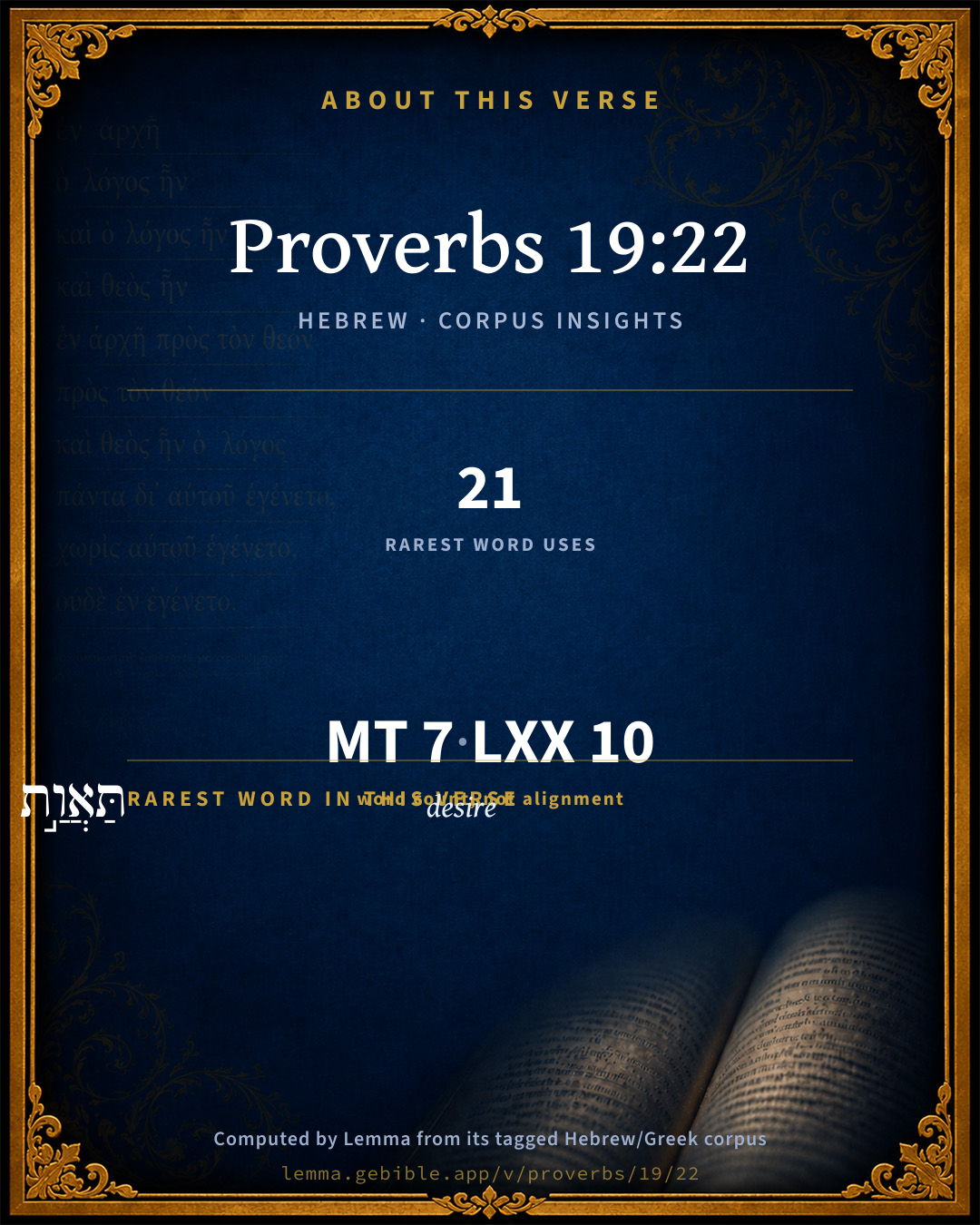
The rarest word here is תַּאֲוַ֣ת desire H8378 — appearing just 21 times in the whole Hebrew Bible.

Shared distinctive vocabulary

תַּאֲוַ֣ת desire H8378 occurs in 21 verses of the Hebrew Bible. Also found in:

Grammatical profile

  • 1 verb
  • 5 nouns
  • 1 adjective

Verb forms

  • רָ֝שׁ Qal · Participle Active

Hebrew & Septuagint length

In English translation the verse runs 19 words from the Hebrew and 17 from the Septuagint (LXX English) — closely comparable.

A rough comparison of the two English renderings, which tokenize alike — not a word-level alignment.

Word counts can differ between the Hebrew and the Greek without any difference in meaning — e.g. the Hebrew direct-object marker אֵת has no separate Greek word, and Greek often adds the article ὁ.

In the original languages it is 7 Hebrew tokens and 10 Greek tokens — but the two are counted differently (Hebrew bundles its prefixes and suffixes into one token; the Greek is in lemma form), so that isn’t a like-for-like length.

Cross-references

12

Topical passages linked to Proverbs 19:22 in the Treasury of Scripture Knowledge — connected by theme and wording, ordered by reader-vote popularity; previews shown in the World English Bible.

  • 2 Corinthians 8:12 For if the readiness is there, it is acceptable according to what you have, not according to what you don't have.
  • 2 Chronicles 6:8 But Yahweh said to David my father, Whereas it was in your heart to build a house for my name, you did well that it was in your heart:
  • Mark 14:6–8 But Jesus said, "Leave her alone. Why do you trouble her? She has done a good work for me.
  • Mark 12:41–44 Jesus sat down opposite the treasury, and saw how the multitude cast money into the treasury. Many who were rich cast in much.
  • Proverbs 19:1 Better is the poor who walks in his integrity Than he who is perverse in his lips and is a fool.
  • 2 Corinthians 8:2–3 how that in much proof of affliction the abundance of their joy and their deep poverty abounded to the riches of their liberality.
  • Titus 1:2 in hope of eternal life, which God, who can't lie, promised before eternal times;
  • 1 Chronicles 29:2–3 Now I have prepared with all my might for the house of my God the gold for the [things of] gold, and the silver for the [things of] silver, and the brass for the [things of] brass, the iron for the [things of] iron, and wood for the [things of] wood; onyx stones, and [stones] to be set, stones for inlaid work, and of various colors, and all manner of precious stones, and marble stones in abundance.
  • 1 Chronicles 29:17 I know also, my God, that you try the heart, and have pleasure in uprightness. As for me, in the uprightness of my heart I have willingly offered all these things: and now have I seen with joy your people, that are present here, offer willingly to you.
  • Job 6:15 My brothers have dealt deceitfully as a brook, As the channel of brooks that pass away;
  • Job 17:5 He who denounces his friends for a prey, Even the eyes of his children shall fail.
  • Psalms 62:9 Surely men of low degree are just a breath, And men of high degree are a lie. In the balances they will go up. They are together lighter than a breath.

Cross-references courtesy of OpenBible.info (CC BY 4.0).

Hebrew and Greek witnesses Masoretic Hebrew ↔ Greek Septuagint

The same verse in the two great witnesses to the Old Testament, shown verse-for-verse.

These are two independent witnesses, not word-aligned to each other, and the Septuagint is shown in lemma (dictionary) form.

Hebrew Proverbs 19:22 Masoretic · Westminster Leningrad Codex

תַּאֲוַ֣ת אָדָ֣ם חַסְדּ֑וֹ וְטֽוֹב רָ֝שׁ מֵאִ֥ישׁ כָּזָֽב

That which makes a man to be desired is his kindness. A poor man is better than a liar.

World English Bible · Public Domain

Greek LXX Proverbs 19:22 Septuagint · lemma form

καρπός ἀνήρ ἐλεημοσύνη κρείσσων δέ πτωχός δίκαιος ἤ πλούσιος ψεύστης

Mercy is a fruit to a man: and a poor man is better than a rich liar.

LXX2012 (modern English Septuagint) · Public Domain

On this verse, John Gill's Exposition discusses the Septuagint’s reading. Read the note in Commentary ↓

Hebrew: Westminster Leningrad Codex (CC BY 4.0). Greek: Septuagint (public domain); English from LXX2012 (modern English Septuagint) (Public Domain). How the Septuagint differs from the Hebrew →

Commentary

Notes on Proverbs 19:22 from classic Christian and Jewish commentators (each source and its license shown beneath its notes). The classic Christian expositions comment on the surrounding passage and are grouped to its opening verse, so a note may address several verses; the Jewish commentaries on the Tanakh (Rashi and others) are per-verse, so they appear only where the commentator wrote on this verse.

Lemma curates 59 commentaries, every one of them public domain or Creative Commons licensed, each selected and text-cleaned for this edition rather than reprinted as found. About our sources →

Trapp's Complete Commentary

John Trapp

Pro 19:22 The desire of a man [is] his kindness: and a poor man [is] better than a liar.

Ver. 22. The desire of a man is his kindness.] Or, His mercy. Many have a great mind to be held merciful men, and vainly give out what they would do, if they had wherewith; and perhaps they speak as they think too. This may be one of those many devices, those variae et vance cogitationes in the heart of a man. {Pro 19:21}

But the poor man is better than a liar.] For though he hath nothing to give, yet having a giving affection, he is better than a liar, that is, than such a rich man, who, before he was rich, would brag what he would do if he were rich, and yet now is a niggard.

John Trapp, A Commentary or Exposition upon All the Books of the Old and New Testament (1647–1656) — public domain. Text from a community e-Sword module.

The Biblical Illustrator

Joseph S. Exell

Pro_19:22

The desire of a man is his kindness: and a poor man is better than a liar.

Circumstances or character

The imperial standard of weights and measures has been sent by the King into the market-place of human life, where men are busy cheating themselves and each other. Public opinion greatly needs to be elevated and rectified in its judgments of men and things. Society is like a house after an earthquake. Everything is squeezed out of its place. A standard has been set up in the market-place to measure the pretences of men withal, and those who will not employ it, must take the consequences. According to that standard a poor man is better than a liar; if, in the face of that sure index, you despise an honest man because he is poor, and give your confidence to the substance or semblance of wealth, without respect to righteousness, you deserve no pity when the inevitable retribution comes. Error in this matter is not confined to any rank. Do not cheat is a needful and useful injunction in our day; and Do not be cheated is another. The trade of the swindler would fail if the raw material were not plentiful, and easily wrought. If the community would cease to value a man by the appearance of his wealth, and judge him according to the standard of the Scriptures, there would be fewer prodigies of dishonesty among us. In the Scriptures a dishonest man is called a liar, however high his position may be in the city. And the honest poor gets his patent of nobility from the Sovereigns hand. (W. Arnot, D. D.)

The desire of kindness

In the Revised Version this sentence reads, The desire of a man is the measure of his kindness. The Divine rule of weights and measures is the only true one in the sphere of mans duties and obligations. But a principle, however good, must not be strained. A mans kindness is in his heart, not in the measure of the gifts themselves. The hand may be liberal, whilst the heart is illiberal. A desire to do good is a Divine emanation. A desire must be content to go as far as it can, and to do as much as it can. When that limit is reached, we must not be ashamed of doing so little. The desire to be kind is worth cherishing, because it does not always survive the changes in our circumstances. The desire often diminishes in exact proportion to the increase of means and opportunities for doing good. Where our desire to be kind fails through incapacity to do more, God will add what is necessary. The desire to be kind sometimes needs educating. It is not so large as it should be, because it is narrowed by ignorance or want of thought about the responsibilities of wealth. When will men study as earnestly how to use what they have got together as they studied and toiled to get it together? (Thomas Wilde.)

The Biblical Illustrator, edited by Joseph S. Exell (c. 1880s–1900s) — public domain. Text from a community e-Sword module.

Joseph Benson's Commentary

Pro 19:22-23. The desire of a man is his kindness — This expression is obscure, and will admit of several interpretations. The Seventy render it, Καρπος ανδρι ελεημοσυνη, alms-giving, or charity, is fruit to a man. The meaning, Le Clerc thinks, is, that there is no virtue a man ought to be so desirous of as benignity, or a generous, charitable spirit, as it is the greatest ornament of human nature, and the strongest bond of human society; which if any one wants, however rich he may be, yet he is despised. Others think, that if it be considered as connected with the following clause, the most natural construction is, “A man shows his kindness by his will, or desire to do good; and in this respect a poor man, who would be beneficent if he could, is better than a liar, that is, than a rich man, who makes a profession of kindness, but does not perform it. The Seventy read this latter clause, A poor righteous man is better than a rich man who is a liar: and the Syriac renders it, A poor man is better than a deceitful rich one. The fear of the Lord tendeth to life — To holiness and happiness here and hereafter; in other words, nothing makes a man so comfortable to himself, and so useful to others, as a religious care to please God in all things; and he that hath it shall abide satisfied — Shall want nothing, and shall be fully contented with God’s favour and blessing; he shall not be visited with evil — With any destructive calamity. But the Hebrew text of the verse being obscure, interpreters have taken it in different senses. Houbigant renders it, The fear, &c., tendeth to life, and he who is filled with it shall sleep, or pass his nights, free from all evil. Schultens and Grey interpret it, The fear of Jehovah indeed is life; but he who sleeps in carnal security shall not be free from evil: see Deu 32:15. The Seventy read it, The fear of the Lord is to a man’s life; but he that is without fear (namely, of God) shall abide in places where there is no knowledge to govern him; that is, shall run blindly into all manner of mischief.

Joseph Benson's Commentary on the Old and New Testaments (1811–1818) — public domain. Text from a community e-Sword module.

The Preacher's Complete Homiletical Commentary

Joseph S. Exell (gen. ed.)

CRITICAL NOTES.—

Pro_19:22. The desire of a man, &c. Rather “A man’s delight (or glory) is his beneficence, or A man’s kindness is what makes him desirable, or is a desirable adornment.

Pro_19:24. In his bosom, rather, in the dish. This is of course a hyperbolic expression to set forth the inactivity of the slothful man. “Athenæns,” says Fausset, “describes (Pro_6:14) the slothful man as waiting until the roasted and seasoned thrushes fly into his mouth begging to be devoured.”

MAIN HOMILETICS OF Pro_19:22

POVERTY OF HEART AND POVERTY OF CIRCUMSTANCE

If we read the first clause of this proverb as it stands in our translation it sets forth—

I. The true measure of a man’s benevolence. It is not to be measured by the amount of money that he expends upon his fellow-creatures, but upon his desire to benefit them. His desire to help them may be very strong, and yet his circumstances may be such that he has little more than sympathy to give. “The heart may be full,” says Wardlaw, “when the hand is empty.” And many deeds of charity that earn for men the title of benevolent are not really performed from motives of goodwill to others but from selfish or vainglorious ends. If we take the reading given in the Critical Notes it teaches rather the truth—

II. That small deeds of kindness are far preferable to large professions of it. The liar of the second clause is evidently one who has it in his power largely to help others, and whose promises are in proportion to his power. But they are promises only. He does not hesitate by false words to raise hopes which he never intends to fulfil, and thus becomes like the deceitful mirage of the desert, which, after cheating the traveller with delusive hopes of water, disappears, and leaves him more despairing than before. On the other hand, the poor man is evidently one whose words never go beyond his deeds, and whose deeds, if not great, are up to his ability, and are so constantly performed and so evidently the outcome of real sympathy that they are like the little rill which follows the wayfarer all through his journey, and which, although it can give but a little water at a time, is always at hand with that little.

OUTLINES AND SUGGESTIVE COMMENTS

But let it be observed and remembered—“the desires of a man are not his kindness,” when he has the ability to be practically kind, and confines himself to desires. No. In that case, there is the clearest of all evidence that the desire is not sincere; mere profession, without reality—“love in word”—which is only another phrase for no love at all. While, therefore, there are cases in which we cheerfully, according to a common phrase, “take the will for the deed,” Knowing that there is a want of ability to do what the heart wishes; there are other cases in which we demand the deed as the only proof of the will—the gift as the only evidence of the charity.—Wardlaw.

The imperial standard of weights and measures has been sent by the King into the market place of human life, where men are busy cheating themselves and each other. Many of these merchantmen, guided by a false standard, have been all their days accustomed to call evil good and good evil. When the balance is set up by royal authority, and the proclamation issued that all transactions must be tested thereby, swindlers are dismayed, and honest men are glad. Such is the word of truth when it touches the transactions of men.… There is a most refreshing simplicity in the language of Scripture upon these points. This word speaks with authority. It is not tainted with the usual adulation of riches. A dishonest man is called a liar, however high his position may be in the city. And the honest poor gets his patent of nobility from the Sovereign’s hand. The honest rich are fully as much interested in reform in this matter as the honest poor. Make this short proverb the keynote of our commercial system, and epidemic panics will disappear.… After each catastrophe people go about shaking their heads and wringing their hands, asking, What will become of us? What shall we do? We venture to propose an answer to the inquiry. From the Bible first engrave on your hearts, then translate in your lives, and last emblazon aloft on the pediment of your trade temple this short and simple legend: “A poor man is better than a liar.”

For Homiletics on the subject of Pro_19:23 see on chapter Pro_10:27; Pro_14:26, and Pro_18:10, pages 179 and 542. Pro_19:24 will be treated in chap. Pro_26:13-15. For the subject of Pro_19:25; Pro_19:29 see chap. Pro_17:10, page 509.

The Preacher's Complete Homiletical Commentary (gen. ed. Joseph S. Exell; Funk & Wagnalls, c. 1892) — public domain (pre-1929). A full-Bible homiletical/sermon-outline anthology covering 65 of 66 books (2 John is absent from the source module). Text from a community e-Sword module.

Geneva Bible (1599)

Geneva Bible translators

That is, that he be honest: for the poor man that is honest, is to be esteemed above the rich which is not virtuous.

Geneva Bible (1599) marginal notes — public domain. Text via Bolls.life.

Matthew Henry's Commentary

Note, 1. The honour of doing good is what we may laudably be ambitious of. It cannot but be the desire of man, if he have any spark of virtue in him, to be kind; one would not covet an estate for any thing so much as thereby to be put into a capacity of relieving the poor and obliging our friends. 2. It is far better to have a heart to do good and want ability for it than have ability for it and want a heart to it: The desire of a man to be kind, and charitable, and generous, is his kindness, and shall be so construed; both God and man will accept his good-will, according to what he has, and will not expect more. A poor man, who wishes you well, but can promise you nothing, because he has nothing to be kind with, is better than a liar, than a rich man who makes you believe he will do mighty things, but, when it comes to the setting to, will do nothing. the character of the men of low degree, that they are vanity, from whom nothing is expected, is better than that of men of high degree, that they are a lie, they deceive those whose expectations they raised.

Matthew Henry's Commentary on the Whole Bible (1708–1710) — public domain (CC PDM 1.0). Text via the HelloAO Bible API.

Jamieson, Fausset & Brown

Robert Jamieson, A. R. Fausset & David Brown

desire--that is, to do good, indicates a kind disposition (Pro 11:23); and the poor thus affected are better than liars, who say and do not.

Jamieson, Fausset & Brown — Commentary Critical and Explanatory on the Whole Bible (1871) — public domain (CC PDM 1.0). Text via the HelloAO Bible API.

Ellicott's Commentary for English Readers

(22) The desire of a man is his kindness—i.e., what makes a man desired or beloved is his kindness. Or, the kindness of a man consists in—is shewn by—his good-will, even though he cannot carry it out.

And a poor man (who would do a kindness if he could) is better than a liar.—Than a rich man who could help another, but professes to be unable to do so.

A Bible Commentary for English Readers, edited by Charles John Ellicott (1878–1897) — public domain. Text from a community e-Sword module.

The Cambridge Bible for Schools and Colleges

gen. ed. J. J. S. Perowne

22. is his kindness] The R.V. renders, is the measure of his kindness, in order to make the meaning clearer. The “kindness,” or “benevolence” of a man is to be measured, not by what he does, but by what he desires to do (2Co_8:12).

a liar] A poor man who would help but cannot is better than one whose circumstances or promises warrant expectations which are not fulfilled.

The proverb holds together better and is more forcible thus than if rendered, with R.V. marg., that which maketh a man to be desired is his kindness.

The Cambridge Bible for Schools and Colleges (gen. ed. J. J. S. Perowne; Cambridge University Press, 1878–1918) — public domain. Text from a community e-Sword module.

John Gill's Exposition

The desire of a man is his kindness,.... Either the grace and kindness of God, which is, desirable by every sensible man, as being most excellent, and better than life and anything in it; or it is his desire to show kindness. A good man is desirous of riches, that he might have it in the power of his hands to do good to others; and a beneficent man, who has it in his power, is desirous of an opportunity of showing kindness to his fellow creatures and friends; and such a disposition and conduct render a man very desirable and amiable; it is the beauty of a man, as Ben Melech; yea, a man that is not able to do a kindness to another, yet has a desire to do it, his good will is his kindness, and the will is taken for the deed. Gersom takes the word in the sense of "reproach", as it is sometimes used; and understands it of the sinful desires of the heart, the imaginations of the thoughts of the heart, which are evil continually, and so matter of reproach;

and a poor man is better than a liar; who is a rich man, as the Septuagint and Syriac versions add; who denies that he has ability to relieve the poor, when he has; or promises to do it, and does it not; such men of high degree are a lie indeed! and the poor man, whom he should relieve, is a better man than he; or that would relieve another, but it is not in his power to do it.

John Gill's Exposition of the Whole Bible (1746–1763) — public domain (CC PDM 1.0). Text via the HelloAO Bible API.

Albert Barnes' Notes on the Bible

The “liar” is probably the man, who makes false excuses for not giving, and so is inferior to the poor man, whose “desire,” the wish to do good, is taken, in the absence of means to carry it into effect, for the act of kindness itself.

Albert Barnes' Notes on the Bible (1834–1885) — public domain. Text from a community e-Sword/MySword module.

Haydock's Catholic Bible Commentary

Merciful. Hebrews ii. 17. Non ignara mali miseris succurrere disco. (Virgil, Æneid 4.) --- Hebrew, "the desire of a man is his mercy," (Montanus; Haydock) or "shame," (R. Levi) as it leads to sin, Genesis vi. 5. All wish to be esteemed merciful. --- Man of quality. Hebrew meish, "prœ viro." (Montanus) --- "Rich man." (Septuagint) (Haydock)

George Leo Haydock (1774–1849), Haydock's Catholic Family Bible and Commentary, 1859 edition — public domain. Excludes Psalms (Douay-Rheims chapter numbering differs from Protestant) and Deuterocanonical books (Catholic canon only).

Matthew Poole's English Annotations

The desire of a man; either,

1. Of any or every man. All men desire, and it is desirable, to be in a capacity of being kind and bountiful to others, whereby they gain love and honour, and many other great advantages. Or,

2. Of the poor man, expressed in the next clause. The hearty will or desire of being kind or liberal to others in necessity is all the kindness which a poor man can show, and is accepted by God, and should be owned by men as a real kindness. Compare 2Co 8:12. Or,

3. Of the rich man, as may be gathered from the opposition of this man to the poor man in the following clause; such ellipses being very common in this book, as hath been noted again and again. So the sense may be this, There be a sort of rich men all whose kindness and charity consists in good desires and well wishes to persons in misery, saying to them, Depart in peace, be ye warmed and filled, but not giving them those things which are needful, as it is expressed, Jas 2:16. And this sense seems to agree very well with the following clause. But being singular in this exposition, I submit it to the judicious reader.

A poor man, who is not able to give what he desires to do,

is better than a liar; than a rich man, who feeds the poor with good words and fair promises, but doth not perform what he pretends and is able to do.

Matthew Poole's English Annotations on the Holy Bible (1683–1685) — public domain. Text from a community e-Sword/MySword module.

Whedon's Commentary on the Bible

Daniel D. Whedon

22. The desire of a man — The good wishes; “the charm” — Conant. “Pleasure.” — Miller. Conant gives a good sense: The charm of a man is his kindness; that which makes him the delight of others, which causes them to delight in him. His kindness means his sincere goodwill, not the mere profession of it; for the poor man who has nothing is better than a man of false profession. The Geneva Bible renders the first clause: “That that is desired of a man is his goodness,” which means here his honesty.

Daniel D. Whedon (gen. ed.), Commentary on the Old and New Testaments (1874–1909) — public domain. Text from a community e-Sword module.

The Pulpit Commentary

The desire of a man is his kind. nose. The Revised Version rather paraphrases the clause, The desire of a man is the measure of his kindness; i.e. the wish and intention to do good is that which gives its real value to an act. The word for "kindness" is chesed, "mercy;" and, looking to the context, we see the meaning of the maxim to be that a poor man"s desire of aiding a distressed neighbour, even if he is unable to carry out his intention, is taken for the act of mercy. "The desire of a man" may signify a man"s desirableness, that which makes him to be desired or loved; this is found in his liberality. But the former explanation is most suitable. Septuagint, "Mercifulness is a gain unto a man," which is like ver. 17; Vulgate, Homo indigens misericors est, taking a man"s desire as evidencing his need and poverty, and introducing the idea that the experience of misery conduces to pity, as says Dido (Virgil, "AEn.," 1:630)"Non ignara mali miseris succurrere disco.

A poor man is better than a liar. A poor man who gives to one in distress his sympathy and good wishes, even if he can afford no substantial aid, is better than a rich man who promises much and does nothing, or who falsely professes that he is unable to help. (comp. Pro_3:27, Pro_3:28) Septuagint, "A poor righteous man is better than a rich liar." A Buddhist maxim says, "Like a beautiful flower, full of colours, but without scent, are the fine but fruitless words of him who does not act accordingly" (Max Muller).

The Pulpit Commentary (1880–1919), ed. H.D.M. Spence-Jones & Joseph S. Exell — public domain. Text from a community e-Sword module.

John Wesley's Explanatory Notes

The desire - The hearty desire of being kind is accepted by God, and should be owned by men as a real kindness. A poor man - Who is not able to give what he desires to do. A liar - Than a rich man who feeds the poor with fair promises, but doth not perform what he pretends.

John Wesley, Explanatory Notes Upon the Whole Bible (1754–1765) — public domain. Text via the GEBible commentary corpus.

Keil & Delitzsch

C. F. Keil & F. Delitzsch

The series makes a new departure with a proverb regarding the poor (cf. Pro 19:17):

A man's delight is his beneficence;

And better is a poor man than a liar.

The right interpretation will be that which presses upon תּאות no strange meaning, and which places the two parts of the verse in an inner mutual relation ethically right. In any case it lies nearer to interpret תאות, in relation to man, actively than passively: that which makes man worthy of desire (Rashi), adorns and distinguishes him (Kimchi, Aben-Ezra); or, that which is desired by man, is above all things sought for (Luzzatto); and, in like manner, the Heb. meaning for חסדּו lies nearer than the Aram. (vid., Pro 14:34): the pleasure of a man is his disgrace (Ralbag). Thus Bertheau's translation: the desire of a man is his charitas, must mean: that which brings to a man true joy is to act amiably. But is that, thus generally expressed, true? And if this were the thought, how much more correctly and distinctly would it be expressed by שׂמחה לאדם עשׂות חסד (cf. Pro 21:15)! Hitzig so rightly reminded by חסדו of the Pharisee who thanks God that he is not as other men; the word ought to have been חסד to remove every trace of self-satisfaction. Hitzig therefore proposes from the lxx and the Vulgate the text-correction מתּבוּאת no, and translates, "from the revenue of a man is his kind gift;" and Ewald, who is satisfied with תּבוּאת, "the gain of a man is his pious love." The latter is more judicious: חסד (love) distributed is in reality gain (according to Pro 19:17); but 22b corresponds rather with the former: "better is he who from want does not give תבואה, than he who could give and says he has nothing." But was there then need for that καρπός of the lxx? If a poor man is better than a lord given to lying - for אישׁ with רשׁ is a man of means and position - i.e., a poor man who would give willingly, but has nothing, than that man who will not give, and therefore lies, saying that he has nothing; then 22a means that the will of a man (cf. תאות, Pro 11:23) is his doing good (vid., regarding חסד, ad Pro 3:3), i.e., is its soul and very essence. Euchel, who accordingly translates: the philanthropy of a man consists properly in his goodwill, rightly compares the Rabbinical proverb, אחד המרבה ואחד הממעיט ובלבד שׁיתבוון, i.e., one may give more or less, it all depends on the intention, the disposition.

Keil & Delitzsch — Biblical Commentary on the Old Testament (1861–1891) — public domain (CC PDM 1.0). Text via the HelloAO Bible API. (Old Testament only.)

Bridges on Proverbs

Charles Bridges

The privilege of doing good is within the reach of all. For when the power fails, the desire of a man is his kindness, as acceptable as the most expensive proof of love. If there be a willing mind, it is accepted, according to that a man hath, and not according to that he hath not. (2Co 8:12 .) The dealings of God with his people are grounded on this principle. David’s desire to build the temple was as fully accepted and honoured, as the act itself was appointed for his son.†1 Such also was our Savior’s estimate of the value of the widow’s mite,†2 — of the box of ointment poured upon himself,†3 — of the "cup of cold water given to a disciple."†4 The desire was the kindness, more rich and fruitful than the offerings of self-pleasing abundance.†5 ’It is the comfort of poverty, that our affections are valued, not our presents.’†6

Yet the desire must be active; not indolent excitement, but "the communication of faith effectual" according to the power given to us.†7 Such a desire is far better in the sight of God, in the heart of one of his poor people, than a man with large opportunities and hollow professions, who proves himself to be a liar. (Pro 19:1 . Psa 62:9 .) The poor gives readily. The rich cannot afford. He denies that he has the ability. He promises, and does nothing. The poor man is better than the liar. Only take heed to the motive. Men know not the heart. "The LORD weigheth the spirit" (Pro 16:2 ); and "the fire will try every man’s work of what sort it is." (1Co 3:13 .)

Footnotes:

†1 2Ch 6:8 . 2Ch 7:12-17 .

†2 Mar 12:41-44.

†3 Mar 14:8-9.

†4 Mat 10:42.

†5 Luk 21:4.

†6 Bp. Hall. ’Rich men’s presents,’ said the Venerable Bede when dying — ’are gold and silver, or other costly things. Mine must be recommended by the affectionate pleasure with which I give them.’

†7 Phm 1:6. 2Co 8:11 .

Charles Bridges, An Exposition of the Book of Proverbs (1846) — public domain. Text from a community e-Sword module.

Kretzmann's Popular Commentary

Paul E. Kretzmann

v. 22. The desire of a man is his kindness, that is, the worth of his show of liberality depends upon his good will, upon the genuineness of his beneficence or altruism; and a poor man is better than a liar, one who is unable to help, but is sincere in desiring to do so, is better than one who, with riches at his command, professes to be unable to help.

Paul E. Kretzmann, Popular Commentary of the Bible (1921–1924) — public domain. Text from a community e-Sword module.

Rashi

Rabbi Shlomo Yitzchaki (Rashi)

The attraction to a man is his kindness The main reason why people are attracted to a person is because of his kindness.

and a poor man is better than a liar And if he is a liar, who promises but does not perform, a poor man is better than he.

Rashi on the Tanakh — English translations: “The Judaica Press complete Tanach with Rashi, translated by A. J. Rosenberg” (CC BY 4.0); “Pentateuch with Rashi's commentary by M. Rosenbaum and A.M. Silbermann, 1929-1934” (public domain); “The Metsudah Tanach series, Lakewood, N.J” (CC BY 4.0); and “The Book of Joshua, Metsudah Publications, 1997” (CC BY 4.0). Text via Sefaria.

Lesson kit

Teaching starters — assembled from the data on this page, not authored interpretation. Every prompt links to the verse data it draws on. Edit before teaching.

Proverbs, in the Wisdom, opens this verse with 7 words (7 distinct Hebrew lemmas). Its most distinctive word is taʼăvâh (“desire”). A historical commentator’s framing appears above. Read the whole chapter for the surrounding context.

Discussion questions

  1. The word taʼăvâh carries the sense “desire.” How does it shape the verse?
  2. How does Genesis 3:6, which shares the word «desire», read alongside this verse?
  3. These translations render this verse differently. What is at stake in choosing one wording over another?
  4. «רָ֝שׁ» is a Qal Participle Active verb. How does that grammatical form shape the action described?
  5. Compare how Trapp's Complete Commentary and The Biblical Illustrator read this verse. Where do they agree or differ?

Things to notice

Reading settings

Reading text

Shown beneath each verse's original-language words.

Old Testament
Old Testament edition

Read the OT as the Masoretic Hebrew (MT) or the Greek Septuagint (LXX).

English shown for the Greek Septuagint (in the Hebrew ↔ Greek comparison).

Comparing translations? Open the Compare panel on any verse page to stack up to four side by side.