
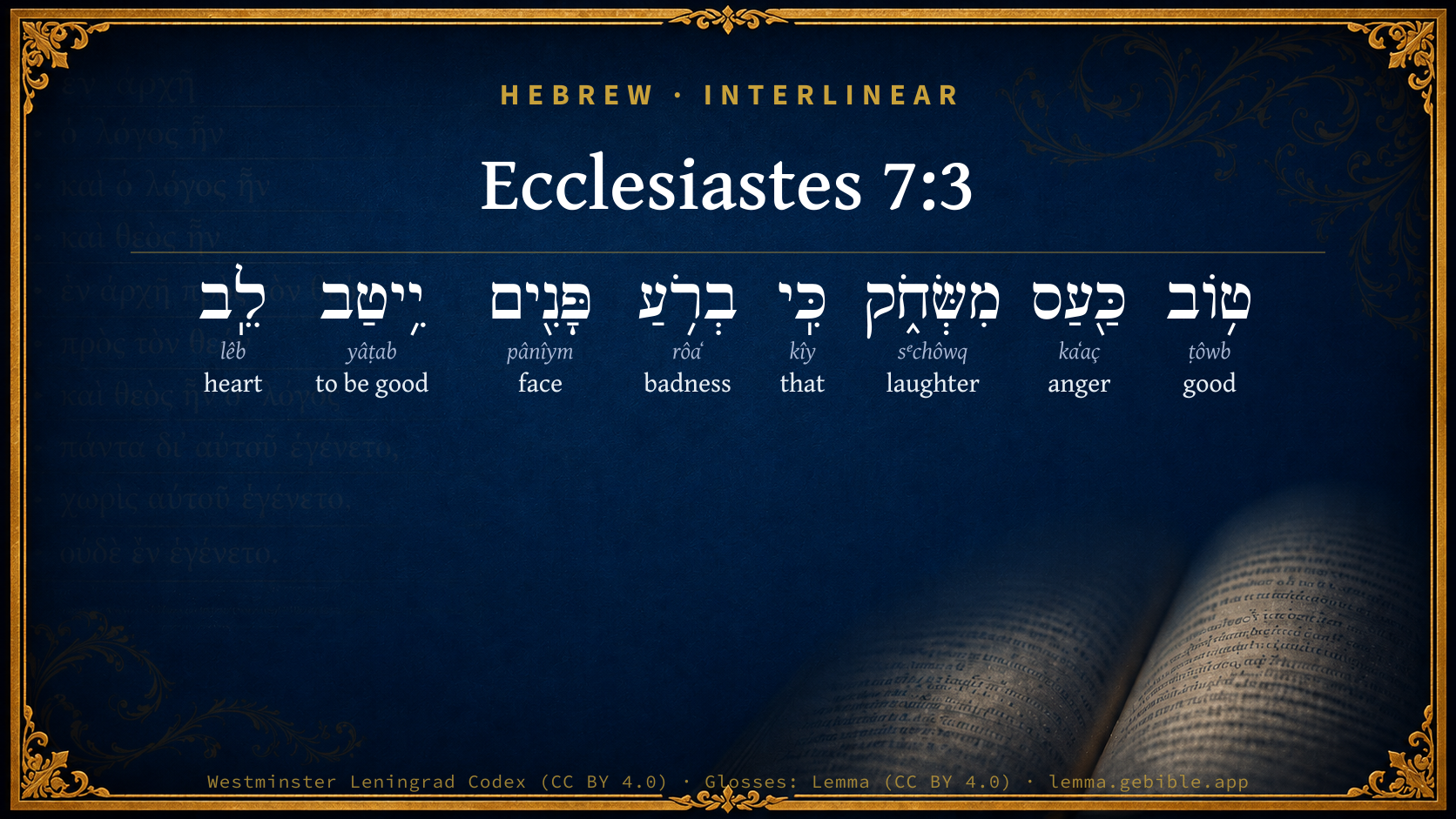
Ecclesiastes 7:3

Hebrew (Westminster Leningrad Codex) Ecclesiastes 7:3 appears in the Hebrew Old Testament. The text above is from the Westminster Leningrad Codex. Each word links to its Strong’s number, a concise gloss, and parsing drawn from the Open Scriptures Hebrew Bible morphology. Click any word for its full Brown-Driver-Briggs (BDB) entry.
Download image
Cite this verse

Ecclesiastes 7:3 (World English Bible). Public Domain. Lemma interlinear Bible study tool, https://lemma.gebible.app/v/ecclesiastes/7/3.

Show BibTeX & RIS
BibTeX
RIS
English Translation
Sorrow is better than laughter; for by the sadness of the face the heart is made good.
World English Bible · Public Domain
Download a study sheet

One document with this verse’s original text, its word-by-word gloss line, the meaning frame, cross-references with their text, attributed commentary, and full source and license credits — printable, and it pastes into notes with its structure intact.

This verse Autodidact and up

Study sheet (.html) Plain text (.txt)

A passage Seminary Student

Up to 50 verses in one chapter. A passage sheet keeps up to 6 commentary sources and 12 cross-references per verse, in the order this page ranks them, and says so on the sheet whenever that leaves anything out. Ask for a single verse and you get the Autodidact verse sheet above.

Everything on this page stays free to read, with no account — the sheet is a download of what is already on screen, not access to it.

Want to remove ads? Support Godless Engineer
Compare translations 3

The same verse in 3 English versions, stacked beneath the original-language interlinear above. Click any original word for its lexicon entry.

Each is an independent rendering of the whole verse — the interlinear is not word-aligned to these translations.

Highlighted words mark where these versions differ — a whole-verse word diff, not a word-by-word alignment.

  • World English Bible Public Domain
    Sorrow is better than laughter; for by the sadness of the face the heart is made good.
  • King James Version Public Domain
    Sorrow is better than laughter: for by the sadness of the countenance the heart is made better.
  • unfoldingWord Literal Text CC BY-SA 4.0
    Better grief than laughter, for with a bad face a heart may be well.

unfoldingWord Literal Text — © unfoldingWord, licensed CC BY-SA 4.0. Word-aligned USFM3 via Door43 (git.door43.org/unfoldingWord/en_ult).

Versions to compare (up to 4)

3 of 4 selected

Show all 18 translations

Every available English version of this verse, each an independent rendering of the whole verse.

  • World English Bible Public Domain
    Sorrow is better than laughter; for by the sadness of the face the heart is made good.
  • Berean Standard Bible Public Domain
    Sorrow is better than laughter, for a sad countenance is good for the heart.
  • Majority Standard Bible Public Domain
    Sorrow is better than laughter, for a sad countenance is good for the heart.
  • King James Version Public Domain
    Sorrow is better than laughter: for by the sadness of the countenance the heart is made better.
  • American Standard Version (1901) Public Domain
    Sorrow is better than laughter; for by the sadness of the countenance the heart is made glad.
  • Revised Version (1885) Public Domain
    Sorrow is better than laughter: for by the sadness of the countenance the heart is made glad.
  • Geneva Bible (1599) Public Domain
    A good name is better then a good oyntment, and the day of death, then the day that one is borne.
  • Douay-Rheims (1899) Public Domain
    It is better to go to the house of mourning, than to the house of feasting: for in that we are put in mind of the end of all, and the living thinketh what is to come.
  • Young's Literal Translation Public Domain
    Better `is' sorrow than laughter, For by the sadness of the face the heart becometh better.
  • Literal Standard Version CC BY-SA 4.0
    Better [is] sorrow than laughter, || For by the sadness of the face the heart becomes better.
  • Unlocked Literal Bible CC BY-SA 4.0
    Grief is better than laughter, for after sadness of face comes gladness of heart.
  • unfoldingWord Literal Text CC BY-SA 4.0
    Better grief than laughter, for with a bad face a heart may be well.
  • Darby Bible Public Domain
    Vexation is better than laughter; for by the sadness of the countenance the heart is made better.
  • World Messianic Bible Public Domain
    Sorrow is better than laughter; for by the sadness of the face the heart is made good.
  • Webster's Bible Public Domain
    Sorrow is better than laughter: for by the sadness of the countenance the heart is made better.
  • Free Bible Version CC BY-SA 4.0
    Sorrow is better than laughter, for tragedy helps us by making us think.
  • Bible in Basic English Public Domain
    Sorrow is better than joy; when the face is sad the mind gets better.
  • JPS Tanakh (1917) Public Domain
    Vexation is better than laughter; for by the sadness of the countenance the heart may be gladdened.

Literal Standard Version (2020), Covenant Press — licensed CC BY-SA 4.0. Text via the HelloAO Bible API (eBible.org). Unlocked Literal Bible (unfoldingWord) — licensed CC BY-SA 4.0. Text via the HelloAO Bible API (eBible.org). unfoldingWord Literal Text — © unfoldingWord, licensed CC BY-SA 4.0. Word-aligned USFM3 via Door43 (git.door43.org/unfoldingWord/en_ult). Free Bible Version, Dr. Jonathan Gallagher — licensed CC BY-SA 4.0. Text via the HelloAO Bible API (eBible.org).

Word by word

More ways to search: Search by grammar → Find every occurrence → Compare this word →

Practice this passage: Drill this verse → Learn its vocabulary →

About this verse

These counts appear in no published source. They are computed here, from the morphology-tagged text and Lemma’s own curated glosses. What Lemma adds →

8
words
8
distinct lemmas
Wisdom
section

Notable vocabulary

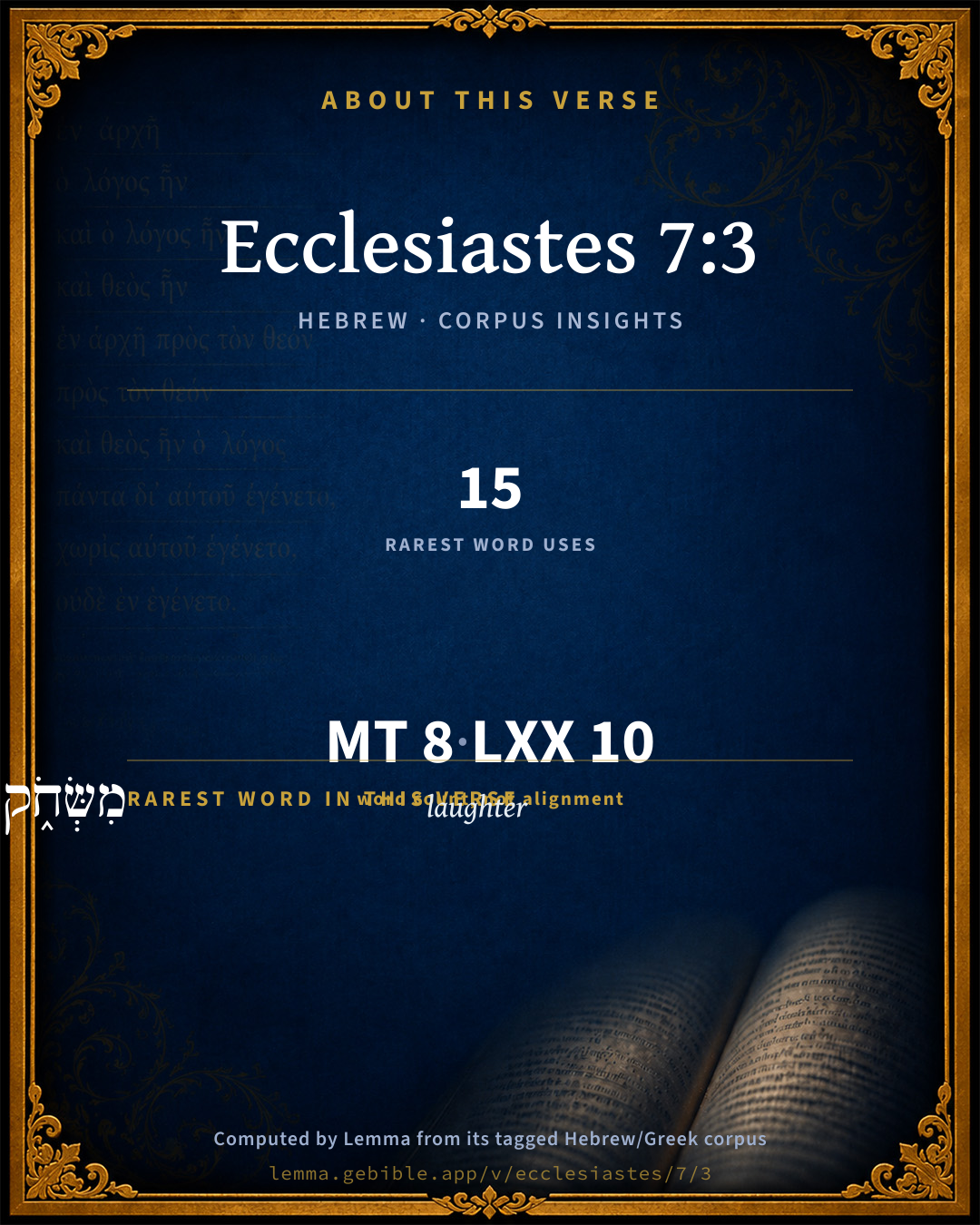
The rarest word here is מִשְּׂחֹ֑ק laughter H7814 — appearing just 15 times in the whole Hebrew Bible.

Shared distinctive vocabulary

מִשְּׂחֹ֑ק laughter H7814 occurs in 14 verses of the Hebrew Bible. Also found in:

Grammatical profile

  • 1 verb
  • 5 nouns
  • 1 adjective
  • 1 conjunction

Verb forms

  • יִ֥יטַב Qal · Imperfect

Hebrew & Septuagint length

In English translation the verse runs 17 words from the Hebrew and 36 from the Septuagint (LXX English) — the Septuagint runs noticeably longer here. See the side-by-side →

A rough comparison of the two English renderings, which tokenize alike — not a word-level alignment.

Word counts can differ between the Hebrew and the Greek without any difference in meaning — e.g. the Hebrew direct-object marker אֵת has no separate Greek word, and Greek often adds the article ὁ.

In the original languages it is 8 Hebrew tokens and 10 Greek tokens — but the two are counted differently (Hebrew bundles its prefixes and suffixes into one token; the Greek is in lemma form), so that isn’t a like-for-like length.

Cross-references

19

Topical passages linked to Ecclesiastes 7:3 in the Treasury of Scripture Knowledge — connected by theme and wording, ordered by reader-vote popularity; previews shown in the World English Bible.

  • 2 Corinthians 7:9–11 I now rejoice, not that you were made sorry, but that you were made sorry to repentance. For you were made sorry in a godly way, that you might suffer loss by us in nothing.
  • Romans 5:3–4 Not only this, but we also rejoice in our sufferings, knowing that suffering works perseverance;
  • James 4:8–10 Draw near to God, and he will draw near to you. Cleanse your hands, you sinners; and purify your hearts, you double-minded.
  • Jeremiah 31:15–20 Thus says Yahweh: A voice is heard in Ramah, lamentation, and bitter weeping, Rachel weeping for her children; she refuses to be comforted for her children, because they are no more.
  • John 16:20–22 Most assuredly I tell you, that you will weep and lament, but the world will rejoice. You will be sorrowful, but your sorrow will be turned into joy.
  • 2 Corinthians 4:17 For our light affliction, which is for the moment, works for us more and more exceedingly an eternal weight of glory;
  • Hebrews 12:10–11 For they indeed, for a few days, punished us as seemed good to them; but he for our profit, that we may be partakers of his holiness.
  • James 1:2–4 Count it all joy, my brothers, when you fall into various temptations,
  • Psalms 119:67 Before I was afflicted, I went astray; But now I observe your word.
  • Psalms 119:71 It is good for me that I have been afflicted, That I may learn your statutes.
  • Jeremiah 31:8–9 Behold, I will bring them from the north country, and gather them from the uttermost parts of the earth, [and] with them the blind and the lame, the woman with child and her who travails with child together: a great company shall they return here.
  • Daniel 10:19 He said, "Greatly beloved man, don't be afraid: peace be to you, be strong, yes, be strong." When he spoke to me, I was strengthened, and said, "Let my lord speak; for you have strengthened me."
  • Zechariah 12:10–14 I will pour on the house of David, and on the inhabitants of Jerusalem, the spirit of grace and of supplication; and they will look to me whom they have pierced; and they shall mourn for him, as one mourns for his only son, and will grieve bitterly for him, as one grieves for his firstborn.
  • Luke 6:21 Blessed are you who hunger now, For you will be filled. Blessed are you who weep now, For you will laugh.
  • Luke 6:25 Woe to you, you who are full now! For you will be hungry. Woe to you who laugh now! For you will mourn and weep.
  • Psalms 126:5–6 Those who sow in tears will reap in joy.
  • Jeremiah 50:4–5 In those days, and in that time, says Yahweh, the children of Israel shall come, they and the children of Judah together; they shall go on their way weeping, and shall seek Yahweh their God.
  • Daniel 9:3–19 I set my face to the Lord God, to seek by prayer and petitions, with fasting and sackcloth and ashes.
  • Daniel 10:2–3 In those days I, Daniel, was mourning three whole weeks.

Cross-references courtesy of OpenBible.info (CC BY 4.0).

Hebrew and Greek witnesses Masoretic Hebrew ↔ Greek Septuagint

The same verse in the two great witnesses to the Old Testament, shown verse-for-verse.

Here the Septuagint runs noticeably longer than the Hebrew — LXX2012 (modern English Septuagint) 36 words vs World English Bible 17. A rough length comparison of the two English translations, not a word-level alignment — read both below.

These are two independent witnesses, not word-aligned to each other, and the Septuagint is shown in lemma (dictionary) form.

Hebrew Ecclesiastes 7:3 Masoretic · Westminster Leningrad Codex

ט֥וֹב כַּ֖עַס מִשְּׂחֹ֑ק כִּֽי בְרֹ֥עַ פָּנִ֖ים יִ֥יטַב לֵֽב

Sorrow is better than laughter; for by the sadness of the face the heart is made good.

World English Bible · Public Domain

Greek LXX Ecclesiastes 7:3 Septuagint · lemma form

ἀγαθός θυμός ὑπέρ γέλως ὅτι ἐν κακία πρόσωπον ἀγαθύνω καρδία

It is better to go to the house of mourning, than to go to the banquet house: since this is the end of every man; and the living man will apply good warning to his heart.

LXX2012 (modern English Septuagint) · Public Domain

On this verse, The Pulpit Commentary discusses the Septuagint’s reading. Read the note in Commentary ↓

Hebrew: Westminster Leningrad Codex (CC BY 4.0). Greek: Septuagint (public domain); English from LXX2012 (modern English Septuagint) (Public Domain). How the Septuagint differs from the Hebrew →

Commentary

Notes on Ecclesiastes 7:3 from classic Christian and Jewish commentators (each source and its license shown beneath its notes). The classic Christian expositions comment on the surrounding passage and are grouped to its opening verse, so a note may address several verses; the Jewish commentaries on the Tanakh (Rashi and others) are per-verse, so they appear only where the commentator wrote on this verse.

Lemma curates 59 commentaries, every one of them public domain or Creative Commons licensed, each selected and text-cleaned for this edition rather than reprinted as found. About our sources →

Trapp's Complete Commentary

John Trapp

Ecc 7:3 Sorrow [is] better than laughter: for by the sadness of the countenance the heart is made better.

Ver. 3. Sorrow is better than laughter.] Here, as likewise in the two former verses, is a collation and prelation; "Sorrow," or indignation conceived for sin, "is better than laughter," - i.e., carnal and profane mirth. This is παραδοξον αλλ ου παραλογον, as Nazianzen speaks in another case, a paradox to the world, but such as may sooner and better be proven than those paradoxes of the ancient Stoics. The world is a perfect stranger to the truth of this sacred position, as being all set upon the merry pin, and having so far banished sadness, as that they are no less enemies to seriousness, than the old Romans were to the name of the Tarquins. These Philistines cannot see how "out of this eater can come meat, and out of this strong, sweet"; how any man should reasonably persuade them to "turn their laughter into mourning, and joy into heaviness." {Jas 4:9} A pound of grief, say they, will not pay an ounce of debt; a little mirth is worth a great deal of sorrow; there is nothing better than for a man to eat and drink and laugh himself fat: spiritus Calvinianus, spiritus melancholicus - a Popish proverb - to be precise and godly is to bid adieu to all mirth and jollity, and to spend his days in heaviness and horror. This is the judgment of the mad world, ever beside itself in point of salvation. But what saith our Preacher, who had the experience of both, and could best tell? Sorrow is better, for it makes the heart better; it betters the better part, and is therefore compared to fire, that purgeth out the dross of sin, to water, that washeth out the dregs of sin, yea, to eye water, sharp, but sovereign. By washing in these troubled waters the conscience is cured, and God’s Naamans cleansed. By feeding upon this bitter sweet root, God’s penitentiaries are fenced against the temptations of Satan, the corruption of their own hearts, and the allurements of this present evil world. These tears drive away the devil much better than holy water, as they call it; they quench hell flames, and as April showers, they bring on in full force the May flowers both of grace {1Pe 5:5} and of glory. {Jer 4:14} What an ill match therefore make our mirthmongers, that purchase laughter many times with shame, loss, misery, beggary, rottenness of body, distress, damnation, that hunt after it to hell, and light a candle at the devil for lightsomeness of heart, by haunting ale houses, brothel houses, conventicles of good fellowship, sinful and unseasonable sports, and other vain fooleries, in the froth whereof is bred and fed that worm that never dies? A man is nearest danger when he is most merry, said Mr Greenham. And God cast not man out of paradise, saith another reverend man, that he might here build him another, but that, as that bird of paradise, he might always be upon the wing, and if at any time taken, never leave groaning and grieving till he be delivered. This will bring him a paradise of sweetest peace, and make much for the lengthening of his tranquillity and consolation. {Dan 4:27} Oh, how sweet a thing is it at the feet of Jesus to stand weeping, to water them with tears, to dry them with sighs, and to kiss them with our mouths! Only those that have made their eyes a fountain to wash Christ’s feet in, may look to have Christ’s heart a fountain to bathe their souls in.

John Trapp, A Commentary or Exposition upon All the Books of the Old and New Testament (1647–1656) — public domain. Text from a community e-Sword module.

The Biblical Illustrator

Joseph S. Exell

Ecc_7:3

Sorrow is better than laughter.

Sorrow better than laughter

Sorrow is set over against laughter; the house of mourning over against the house of mirth; the rebuke of the wise over against the music of fools; the day of death over against the day of birth: all tending, however, to this, that trouble and grief have their bright side, and that giddy indulgence and merriment carry a sting.

I. Sorrow is better than laughter, because a great part of worldly merriment is no better than folly. Here we take no extreme or ascetic ground. It would be morose and unchristian to scowl at the gambols of infancy, or to hush the laugh of youth, on fit occasions. Cheerfulness is nowhere forbidden, even in adult life; and we perhaps offend God oftener by our frowns than by our smiles. But you all know that there is a merriment which admits no rule, confines itself by no limit, shocks every maxim even of sober reason, absorbs the whole powers, wastes the time, and debilitates the intellect, even if it do not lead to supreme love of pleasure, profligacy, and general intemperance and voluptuousness.

II. Sorrow is better than laughter, because much of worldly merriment tends to no intellectual or moral good. Worldly pleasures, and the expressions of these, do nothing for the immaterial part. The utmost that can be pretended is that they amuse and recreate. In their very notion they are exceptions, and should be sparing. But there are a thousand recreative processes connected with healthful exercise, with knowledge, with the study of beautiful nature, with the practice and contemplation of art, and with the fellowship of friends, which unbend the tense nerve and refresh the wasted spirits, while at the same time they instruct the mind and soften or tranquillize the heart. Not so with the unbridled joys which find vent in redoubled peals of mirth and obstreperous carousal, or in the lighter play of chattered nonsense end never-ending giggle.

III. Sorrow is better than laughter, because worldly mirth is short. In the Eastern countries, where fuel is very scarce, every combustible shrub, brush, and bramble is seized upon for culinary fires. Of these the blaze is bright, hot, and soon extinct. Such is worldly mirth. For as the crackling of thorns under a pot, so is the laughter of the fool. It is noisy--more noisy than if there were anything in it. But it soon ceases. Physical limits are put to gay pleasures. The loudest laughter cannot laugh for ever. Lungs and diaphragm forbid and rebel. There is a time of life when such pleasures become as difficult as they are ungraceful; and there is not in society a more ridiculous object, even in its own circle, than a tottering, antiquated, bedizened devotee of fashion. Grief comes in and shortens the amusement. Losses and reverses shorten it. And, if there were nothing else, pleasure must be short, because it cannot be extended to judgment and eternity.

IV. Worldly mirth is unsatisfying. Vanity of vanities, all is vanity, i.e. emptiness and disappointment. The man wonders why the toys and rattles which pleased him once please him now no more. They are vanity, and all is vanity; and every day that he lives longer will make it more formidable vanity. Now, pray observe, the case is directly the reverse with regard to sound intellectual and spiritual enjoyments; for which the capacity is perpetually increasing with its indulgence.

V. Sorrow is better than laughter, because sorrow breeds reflection. There can be no contemplation amidst the riot of self-indulgence; but the house of mourning is a meditative abode. Before they were afflicted, a large proportion of Gods people went astray; and, if they live long enough, they can all declare that the solemn pauses of their bereavement, illness, poverty, shame, and fear, have been better to them than the dainties of the house of feasting.

VI. Sorrow is better than laughter, because sorrow brings lessons of wisdom. Sufferers not only think but learn. Many sermons could not record all the lessons of affliction. It tells us wherein we have offended. It takes us away from the flattering crowd, and from seducing charmers, and keenly reaches, with its probe, the hidden iniquity. This is less pleasing than worldly joy, but it is more profitable. The Bible is the chief book in the house of mourning--read by some there who have never read it elsewhere, and revealing to its most assiduous students new truths, shining forth in affliction like stars which hays been hidden in daylight.

VII. Sorrow is better than laughter, because sorrow amends the heart and life. Not by any efficiency of good; of such efficiency, pain, whether of body or mind, knows nothing; but by becoming the vehicle of Divine influences. The ways of Providence are such, that troubled spirits, bathed in tears, are repeatedly made to cry with a joy which swallows up all foregoing griefs, Before we were afflicted we went astray, but now have we kept Thy law!

VIII. Sorrow is better than laughter, because sorrow likens us to Him whom we love. You know His name. He is the Man of Sorrows--the companion or brother of grief. His great work, even our salvation, was not more by power or holiness than by sorrows. He took our flesh that He might bear our sorrows. If we suffer with Him, we shall also reign with Him.

IX. Sorrow is better than laughter, because sorrow ends in joy. The very resistance of a virtuous mind to adversity--the bracing of the frame--the breasting of the torrent--the patience, the resignation, the hope amidst the billows, the high resolve and courage that mount more boldly out of the surge of grief, the silent endurance of the timid and the frail, when out of weakness they are made strong--these, and such as these, increase the capacity for future holiness and heavenly bliss. These are they that have come out of great tribulation. (J. W. Alexander, D. D.)

The service of sorrow

I. Sorrow serves to promote individualism of soul.

1. A deep practical sense of self-responsibility is essential to the virtue, the power, and progress of the soul.

2. Social influences, especially in this age of combinations, tend to destroy this and absorb the individual in the mass.

3. Sorrow is one of the most individualizing of forces. Sorrow detaches man from all, isolates him, makes him feel his loneliness.

II. Sorrow serves to humanize our affections. It helps us go feel for others; to weep with those who weep, etc.

III. Sorrow serves to spiritualize our nature. There are tremendous forces ever at work to materialize. Sorrow takes us away into the spiritual; makes us feel alone with God, and view the world as but a passing show.

IV. Sorrow serves to prepare us to appreciate christianity. The Gospel is a system to heal broken hearts. Who appreciates pardon, but the sorrowing penitent? Who values the doctrine of a parental providence, but the tried? Who the doctrine of the resurrection, but the bereaved and the dying? (Homilist.)

The Biblical Illustrator, edited by Joseph S. Exell (c. 1880s–1900s) — public domain. Text from a community e-Sword module.

Joseph Benson's Commentary

Ecc 7:3-4. Sorrow is better than laughter — Either sorrow for sin, or even sorrow on other accounts; for by the sadness of the countenance — Sadness seated in the heart, but manifested in the countenance; the heart is made better — Is more weaned from the lusts and vanities of this world, by which most men are ensnared and destroyed; and more quickened to seek after and embrace that true and everlasting happiness which God offers to them in his word. The heart of the wise is in the house of mourning — Even when their bodies are absent. They are constantly, or very frequently, meditating upon serious things, such as death and judgment, the vanity of this life, and the reality and eternity of the next; because they know that these thoughts, though they be not grateful to man’s carnal mind, yet are absolutely necessary and highly profitable, and productive of great comfort in the end, which every wise man most regards. But the heart of fools is in the house of mirth — Their minds and affections are wholly set upon feasting, jollity, and merriment, because, like fools and irrational animals, they regard only their present delight, and mind not how dearly they must pay for it.

Joseph Benson's Commentary on the Old and New Testaments (1811–1818) — public domain. Text from a community e-Sword module.

Tyndale Open Study Notes

Tyndale Open Resources

7:3-4 refining influence: Thinking soberly about death leads us to see the severity of God’s curse on sin and convinces us of the need to enjoy life wisely (9:10).

Tyndale Open Study Notes — © Tyndale Open Resources, licensed CC BY-SA 4.0. Text via the HelloAO Bible API.

Geneva Bible (1599)

Geneva Bible translators

He speaketh thus after the judgment of the flesh, which thinketh death to be the end of all evils, or else, because that this corporal death is the entering into life everlasting.

Geneva Bible (1599) marginal notes — public domain. Text via Bolls.life.

Jamieson, Fausset & Brown

Robert Jamieson, A. R. Fausset & David Brown

Sorrow--such as arises from serious thoughts of eternity.

laughter--reckless mirth (Ecc 2:2).

by the sadness . . . better-- (Psa 126:5-6; Co2 4:17; Heb 12:10-11). MAURER translates: "In sadness of countenance there is (may be) a good (cheerful) heart." So Hebrew, for "good," equivalent to "cheerful" (Ecc 11:9); but the parallel clause supports English Version.

Jamieson, Fausset & Brown — Commentary Critical and Explanatory on the Whole Bible (1871) — public domain (CC PDM 1.0). Text via the HelloAO Bible API.

Adam Clarke's Commentary

Verse 3. Sorrow is better than laughter] The reason is immediately given; for by the sorrow of the countenance - the grief of heart that shows itself in the countenance -

The heart is made better.] In such cases, most men try themselves at the tribunal of their own consciences, and resolve on amendment of life.

Adam Clarke's Commentary on the Bible (1810–1826) — public domain. Text from a community e-Sword/MySword module.

Ellicott's Commentary for English Readers

(3) Sadness of the countenance.—Gen_40:7; Neh_3:3. “Anger” (margin). This is the usual meaning of the word, and so in Ecc_7:9. It is accordingly adopted here by the older translators, but the rendering of our version is required by the context.

A Bible Commentary for English Readers, edited by Charles John Ellicott (1878–1897) — public domain. Text from a community e-Sword module.

The Cambridge Bible for Schools and Colleges

gen. ed. J. J. S. Perowne

3. Sorrow is better than laughter] The thought is essentially the same as that of the preceding verse, but is somewhat more generalized. We are reminded of the Greek axiom, παθεῖν, μαθεῖν (“Pain is gain”), of the teaching of Æschylus.

Ζῆνα …

τὸν φρονεῖν βροτοὺς ὁδώ-

σαντα, τὸν πάθει μάθος

θέντα κυρίως ἔχειν.

“Yea, Zeus, who leadeth men in wisdom’s way

And fixeth fast the law

That pain is gain.”

Agam. 170.

There is a moral improvement rising out of sorrow which is not gained from enjoyment however blameless. The “Penseroso” is after all a character of nobler stamp than the “Allegro.”

The Cambridge Bible for Schools and Colleges (gen. ed. J. J. S. Perowne; Cambridge University Press, 1878–1918) — public domain. Text from a community e-Sword module.

John Gill's Exposition

Sorrow is better than laughter,.... Sorrow, expressed in the house of mourning, is better, more useful and commendable, than that foolish laughter, and those airs of levity, expressed in the house of feasting; or sorrow on account of affliction and troubles, even adversity itself, is oftentimes much more profitable, and conduces more to the good of men, than prosperity; or sorrow for sin, a godly sorrow, a sorrow after a godly sort, which works repentance unto salvation, that needeth not to be repented of, is to be preferred to all carnal mirth and jollity. It may be rendered, "anger is better than laughter" (h); which the Jews understand of the anger of God in correcting men for sin; which is much better than when he takes no notice of them, but suffers them to go on in sin, as if he was pleased with them; the Midrash gives instances of it in the generation of the flood and the Sodomites: and the Targum inclines to this sense,

"better is the anger, with which the Lord of that world is angry against the righteous in this world, than the laughter with which he derides the ungodly.''

Though it may be better, with others, to understand it of anger in them expressed against sin, in faithful though sharp rebukes for it; which, in the issue, is more beneficial than the flattery of such who encourage in it; see Pro 27:5;

for by the sadness of the countenance the heart is made better: when the sadness is not hypocritical, as in the Scribes and Pharisees, but serious and real, arising from proper reflections on things in the mind; whereby the heart is drawn off from vain, carnal, and sensual things; and is engaged in the contemplation of spiritual and heavenly ones, which is of great advantage to it: or by the severity of the countenance of a faithful friend, in correcting for faults, the heart is made better, which receives those corrections in love, and confesses its fault, and amends.

(h) "melior est ira risu", Pagninus, Mercerus; "melior est indigatio risu", Tigurine version, Junius & Tremellius.

John Gill's Exposition of the Whole Bible (1746–1763) — public domain (CC PDM 1.0). Text via the HelloAO Bible API.

Albert Barnes' Notes on the Bible

Sorrow - Rather, Seriousness.

The heart is made better - i. e., is made bright and joyful (compare 2Co 6:10). The mind which bears itself equally in human concerns, whether they be pleasant or sorrowful, must always be glad, free, and at peace.

Albert Barnes' Notes on the Bible (1834–1885) — public domain. Text from a community e-Sword/MySword module.

Haydock's Catholic Bible Commentary

Come. While at birth-day feasts (Genesis xl. 20., and Matthew xiv. 6.) people give themselves up to joy, and cherish the idea of living long. (Calmet)

George Leo Haydock (1774–1849), Haydock's Catholic Family Bible and Commentary, 1859 edition — public domain. Excludes Psalms (Douay-Rheims chapter numbering differs from Protestant) and Deuterocanonical books (Catholic canon only).

Matthew Poole's English Annotations

Sorrow; either for sin, or any outward troubles.

The sadness of the countenance; which is seated in the heart, but manifested in the countenance.

Made better; more weaned from the lusts and vanities of this world, by which most men are ensnared and destroyed, and more quickened to seek after and embrace that true and everlasting happiness which God offers to them in his word.

Matthew Poole's English Annotations on the Holy Bible (1683–1685) — public domain. Text from a community e-Sword/MySword module.

Whedon's Commentary on the Bible

Daniel D. Whedon

3. Sorrow, simply, does not present the Hebrew as well as sober reflection, that is, the laying to heart, as just mentioned. So, laughter means reckless mirth. Also, sadness of the countenance means a thoughtful aspect, indicative of serious consideration.

Daniel D. Whedon (gen. ed.), Commentary on the Old and New Testaments (1874–1909) — public domain. Text from a community e-Sword module.

The Pulpit Commentary

Sorrow is better than laughter. This is a further expansion of the previous maxim, sK (kaas), as contrasted with qwOhc, is rightly rendered "sorrow," "melancholy," or, as Ginsburg contends, "thoughtful sadness." The Septuagint has qumov, the Vulgate ira; but auger is not the feeling produced by a visit to the house of mourning. Such a scene produces saddening reflection, which is in itself a moral training, and is more wholesome and elevating than thoughtless mirth. For by the sadness of the countenance the heart is made better. The feeling which shows itself by the look of sadness (comp. Gen_40:7; Neh_2:2) has a purifying effect on the heart, gives a moral tone to the character. Professor Tayler Lewis renders the clause, "For in the sad. ness of the face the heart becometh fair;" i.e. sorrow beautifies the soul, producing, as it were, comeliness, spiritual beauty, and, in the end, serener happiness. The Vulgate translates the passage thus: Melter eat ira risu; quia per tristitiam vultus corrigitur animus deliquentis, "Better is anger than laughter, because through sadness of countenance the mind of the offender is corrected." The anger is that either of God or of good men which reproves sin; the laughter is that of sinners who thus show their connivance at or approval of evil. There can be no doubt that this is not the sense of the passage. For the general sentiment concerning the moral influence of grief and suffering, we may compare the Greek sayings, Tamata maqhmata, and Ti maqwn ti paqwn; which are almost equivalent in meaning (comp. Aeschyl., "Again.," 170; Herod., 1:207). The Latins would say, "Quaenocent, docent," and we, "Pain is gain."

The Pulpit Commentary (1880–1919), ed. H.D.M. Spence-Jones & Joseph S. Exell — public domain. Text from a community e-Sword module.

Keil & Delitzsch

C. F. Keil & F. Delitzsch

The joy of life must thus be not riot and tumult, but a joy tempered with seriousness: "Better is sorrow than laughter: for with a sad countenance it is well with the heart. The heart of the wise is in the house of mourning, and the heart of fools in the house of mirth." Grief and sorrow, כּעס, whether for ourselves or occasioned by others, is better, viz., morally better, than extravagant merriment; the heart is with רע פּ (inf. as רע, Jer 7:6; cf. פן ר, Gen 40:7; Neh 2:2), a sorrowful countenance, better than with laughter, which only masks the feeling of disquiet peculiar to man, Pro 14:13. Elsewhere לב ייטב = "the heart is (may be) of good cheer," e.g., Rut 3:7; Jdg 19:6; here also joyful experience is meant, but well becoming man as a religious moral being. With a sad countenance it may be far better as regards the heart than with a merry countenance in boisterous company. Luther, in the main correct, after Jerome, who on his part follows Symmachus: "The heart is made better by sorrow." The well-being is here meant as the reflex of a moral: bene se habere.

Sorrow penetrates the heart, draws the thought upwards, purifies, transforms. Therefore is the heart of the wise in the house of sorrow; and, on the other hand, the heart of fools is in the house of joy, i.e., the impulse of their heart goes thither, there they feel themselves at home; a house of joy is one where there are continual feasts, or where there is at the time a revelling in joy. That Ecc 7:4 is divided not by Athnach, but by Zakef, has its reason in this, that of the words following אבל, none consists of three syllables; cf. on the contrary, Ecc 7:7, חכם. From this point forward the internal relation of the contents is broken up, according to which this series of sayings as a concluding section hangs together with that containing the observations going before in Ecc 6:1-12.

Keil & Delitzsch — Biblical Commentary on the Old Testament (1861–1891) — public domain (CC PDM 1.0). Text via the HelloAO Bible API. (Old Testament only.)

unfoldingWord translationNotes

Door43 World Missions Community

sadness of face

This refers to being sad. AT: "an experience that makes a person sad" (See: Idiom)

gladness of heart

Here the word "heart" refers to a person's thoughts and emotions. "Gladness" describes either 1) the state of the emotions of being happy and peaceful or 2) the ability to understand the truth. AT: "right thinking" (See: Metonymy)

The heart of the wise is in the house of mourning

Here wise people are referred to by their "hearts." This speaks of the wise person mourning as being in a house of mourning. AT: "Wise people think deeply about death" (See: Synecdoche and Metaphor)

but the heart of fools is in the house of feasting

Here foolish people are referred to by their "hearts." This speaks of foolish people thinking only about what makes them happy as being in a house of feasting. AT: "but foolish people think only about enjoying themselves" (See: Synecdoche and Metaphor)

the house of mourning ... the house of feasting

These phrases refer to what happens in these places.

translationWords

face

wise

fool

unfoldingWord translationNotes — © Distant Shores Media and the Door43 World Missions Community, licensed CC BY-SA 4.0. Source: git.door43.org/Door43/en_tn.

Rashi

Rabbi Shlomo Yitzchaki (Rashi)

Vexation is better than laughter If one is pursued by the Divine Standard of Justice, let him not be distressed. It would have been better for the Generation of the Flood if the Holy One, blessed be He, had shown them an angry countenance because of the sins in their hands, rather than the laughter that He laughed with them, for had He shown them a slight expression of displeasure, they would have returned to do good (Ecc. Rabbah). It would have been better for Adonijah had his father caused him grief for every sin that he committed, rather than the laughter that he showed him, and for which he was ultimately slain (Ecc. Zuta).

the heart will rejoice It will turn over the heart of man to improve his ways.

Rashi on the Tanakh — English translations: “The Judaica Press complete Tanach with Rashi, translated by A. J. Rosenberg” (CC BY 4.0); “Pentateuch with Rashi's commentary by M. Rosenbaum and A.M. Silbermann, 1929-1934” (public domain); “The Metsudah Tanach series, Lakewood, N.J” (CC BY 4.0); and “The Book of Joshua, Metsudah Publications, 1997” (CC BY 4.0). Text via Sefaria.

Lesson kit

Teaching starters — assembled from the data on this page, not authored interpretation. Every prompt links to the verse data it draws on. Edit before teaching.

Ecclesiastes, in the Wisdom, opens this verse with 8 words (8 distinct Hebrew lemmas). Its most distinctive word is sᵉchôwq (“laughter”). The Greek Septuagint runs longer here. A historical commentator’s framing appears above. Read the whole chapter for the surrounding context.

Discussion questions

  1. How does “laughter” (sᵉchôwq) shape what this verse is saying?
  2. Job 8:21 shares the word «laughter» with this verse. How do the two illuminate each other?
  3. Compared with the Hebrew, the Septuagint runs longer here. What questions does that raise?
  4. These translations render this verse differently. What is at stake in choosing one wording over another?
  5. The verb «יִ֥יטַב» is Qal Imperfect. How does its form color the action?
  6. Reading how Trapp's Complete Commentary and The Biblical Illustrator read this verse, where do the two commentators agree and where do they part?

Things to notice

Reading settings

Reading text

Shown beneath each verse's original-language words.

Old Testament
Old Testament edition

Read the OT as the Masoretic Hebrew (MT) or the Greek Septuagint (LXX).

English shown for the Greek Septuagint (in the Hebrew ↔ Greek comparison).

Comparing translations? Open the Compare panel on any verse page to stack up to four side by side.