
2 Kings 20:3

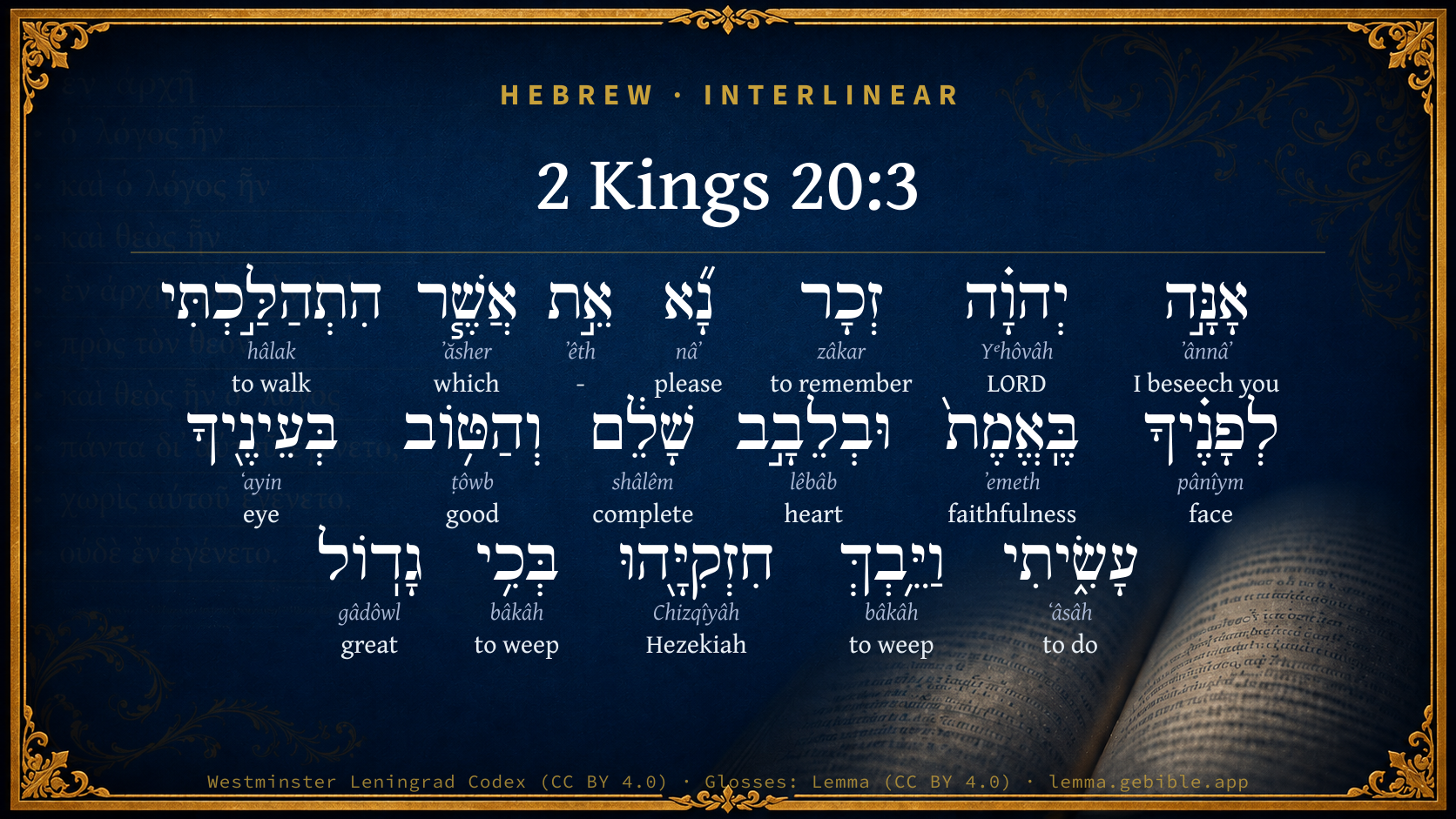
Hebrew (Westminster Leningrad Codex) 2 Kings 20:3 appears in the Hebrew Old Testament. The text above is from the Westminster Leningrad Codex. Each word links to its Strong’s number, a concise gloss, and parsing drawn from the Open Scriptures Hebrew Bible morphology. Click any word for its full Brown-Driver-Briggs (BDB) entry.
Download image
Cite this verse

2 Kings 20:3 (World English Bible). Public Domain. Lemma interlinear Bible study tool, https://lemma.gebible.app/v/2-kings/20/3.

Show BibTeX & RIS
BibTeX
RIS
English Translation
Remember now, Yahweh, I beg you, how I have walked before you in truth and with a perfect heart, and have done that which is good in your sight. Hezekiah wept sore.
World English Bible · Public Domain
Download a study sheet

One document with this verse’s original text, its word-by-word gloss line, the meaning frame, cross-references with their text, attributed commentary, and full source and license credits — printable, and it pastes into notes with its structure intact.

This verse Autodidact and up

Study sheet (.html) Plain text (.txt)

A passage Seminary Student

Up to 50 verses in one chapter. A passage sheet keeps up to 6 commentary sources and 12 cross-references per verse, in the order this page ranks them, and says so on the sheet whenever that leaves anything out. Ask for a single verse and you get the Autodidact verse sheet above.

Everything on this page stays free to read, with no account — the sheet is a download of what is already on screen, not access to it.

Want to remove ads? Support Godless Engineer
Compare translations 3

The same verse in 3 English versions, stacked beneath the original-language interlinear above. Click any original word for its lexicon entry.

Each is an independent rendering of the whole verse — the interlinear is not word-aligned to these translations.

Highlighted words mark where these versions differ — a whole-verse word diff, not a word-by-word alignment.

  • World English Bible Public Domain
    Remember now, Yahweh, I beg you, how I have walked before you in truth and with a perfect heart, and have done that which is good in your sight. Hezekiah wept sore.
  • King James Version Public Domain
    I beseech thee, O LORD, remember now how I have walked before thee in truth and with a perfect heart, and have done that which is good in thy sight. And Hezekiah wept sore.
  • unfoldingWord Literal Text CC BY-SA 4.0
    “Oh Yahweh, please remember that I have walked about to your face in faithfulness and with a whole heart, and I have done good in your eyes.” And Hezekiah wept a great weeping.

unfoldingWord Literal Text — © unfoldingWord, licensed CC BY-SA 4.0. Word-aligned USFM3 via Door43 (git.door43.org/unfoldingWord/en_ult).

Versions to compare (up to 4)

3 of 4 selected

Show all 18 translations

Every available English version of this verse, each an independent rendering of the whole verse.

  • World English Bible Public Domain
    Remember now, Yahweh, I beg you, how I have walked before you in truth and with a perfect heart, and have done that which is good in your sight. Hezekiah wept sore.
  • Berean Standard Bible Public Domain
    “Please, O LORD, remember how I have walked before You faithfully and with wholehearted devotion; I have done what was good in Your sight.” And Hezekiah wept bitterly.
  • Majority Standard Bible Public Domain
    “Please, O LORD, remember how I have walked before You faithfully and with wholehearted devotion; I have done what is good in Your sight.” And Hezekiah wept bitterly.
  • King James Version Public Domain
    I beseech thee, O LORD, remember now how I have walked before thee in truth and with a perfect heart, and have done that which is good in thy sight. And Hezekiah wept sore.
  • American Standard Version (1901) Public Domain
    Remember now, O Jehovah, I beseech thee, how I have walked before thee in truth and with a perfect heart, and have done that which is good in thy sight. And Hezekiah wept sore.
  • Revised Version (1885) Public Domain
    Remember now, O LORD, I beseech thee, how I have walked before thee in truth and with a perfect heart, and have done that which is good in thy sight. And Hezekiah wept sore.
  • Geneva Bible (1599) Public Domain
    I beseech thee, O Lord, remember nowe, howe I haue walked before thee in trueth and with a perfite heart, and haue done that which is good in thy sight: and Hezekiah wept sore.
  • Douay-Rheims (1899) Public Domain
    I beseech thee, O Lord, remember how I have walked before thee in truth, and with a perfect heart, and have done that which is pleasing before thee. And Ezechias wept with much weeping.
  • Young's Literal Translation Public Domain
    `I pray Thee, O Jehovah, remember, I pray Thee, how I have walked habitually before Thee in truth, and with a perfect heart, and that which `is' good in Thine eyes I have done;' and Hezekiah weepeth -- a great weeping.
  • Literal Standard Version CC BY-SA 4.0
    “Ah, now, O YHWH, please remember how I have habitually walked before You in truth and with a perfect heart, and I have done that which [is] good in Your eyes”; and Hezekiah weeps [with] a great weeping.
  • Unlocked Literal Bible CC BY-SA 4.0
    “Please, Yahweh, call to mind how I have faithfully walked before you with my whole heart, and how I have done what was good in your sight.” Then Hezekiah wept loudly.
  • unfoldingWord Literal Text CC BY-SA 4.0
    “Oh Yahweh, please remember that I have walked about to your face in faithfulness and with a whole heart, and I have done good in your eyes.” And Hezekiah wept a great weeping.
  • Darby Bible Public Domain
    Ah! Jehovah, remember, I beseech thee, how I have walked before thee in truth and with a perfect heart, and have done what is good in thy sight. And Hezekiah wept much.
  • World Messianic Bible Public Domain
    “Remember now, LORD, I beg you, how I have walked before you in truth and with a perfect heart, and have done that which is good in your sight.” And Hezekiah wept bitterly.
  • Webster's Bible Public Domain
    I beseech thee, O LORD, remember now how I have walked before thee in truth and with a perfect heart, and have done that which is good in thy sight. And Hezekiah wept grievously.
  • Free Bible Version CC BY-SA 4.0
    “Please remember Lord how I have followed you faithfully with all my heart. I have done what is good in your sight.” Then Hezekiah cried and cried.
  • Bible in Basic English Public Domain
    O Lord, keep in mind how I have been true to you with all my heart, and have done what is good in your eyes. And Hezekiah gave way to bitter weeping.
  • JPS Tanakh (1917) Public Domain
    'Remember now, O LORD, I beseech Thee, how I have walked before Thee in truth and with a whole heart, and have done that which is good in Thy sight.' And Hezekiah wept sore.

Literal Standard Version (2020), Covenant Press — licensed CC BY-SA 4.0. Text via the HelloAO Bible API (eBible.org). Unlocked Literal Bible (unfoldingWord) — licensed CC BY-SA 4.0. Text via the HelloAO Bible API (eBible.org). unfoldingWord Literal Text — © unfoldingWord, licensed CC BY-SA 4.0. Word-aligned USFM3 via Door43 (git.door43.org/unfoldingWord/en_ult). Free Bible Version, Dr. Jonathan Gallagher — licensed CC BY-SA 4.0. Text via the HelloAO Bible API (eBible.org).

Word by word

More ways to search: Search by grammar → Find every occurrence → Compare this word →

Practice this passage: Drill this verse → Learn its vocabulary →

אָנָּ֣ה
ʼânnâʼ
H577
“I beseech you”
Particle, Interjection
Part of Speech
Particle
Type
Interjection
Full BDB Definition

Origin: apparent contracted from H160 and H4994

TWOT: 122

ah now! I/we beseech you, oh now!, pray now! (participle of entreaty usually followed by the imperative verb)
  1. יְהוָ֗ה Yᵉhôvâh H3068 “LORD” Noun, Proper
  2. זְכָר zâkar H2142 “remember” Verb, Qal, Imperative, 2nd Person, Masculine, Singular
  3. נָ֞א nâʼ H4994 “please” Particle, Exhortation
  4. אֵ֣ת ʼêth H853 “-” Particle, Direct Object
  5. אֲשֶׁ֧ר ʼăsher H834 “which” Particle, Relative
  6. הִתְהַלַּ֣כְתִּי hâlak H1980 “to walk” Verb, Hithpael, Perfect, 1st Person, Common, Singular
  7. לְפָנֶ֗יךָ pânîym H6440 “to/for · face(s) · your” Preposition + Noun, Common, Both, Plural, Construct + Suffix, Personal, 2nd Person, Masculine, Singular
  8. בֶּֽאֱמֶת֙ ʼemeth H571 “in/at · faithfulness” Preposition + Noun, Common, Feminine, Singular, Absolute
  9. וּבְלֵבָ֣ב lêbâb H3824 “and · in/at · heart” Conjunction + Preposition + Noun, Common, Masculine, Singular, Absolute
  10. שָׁלֵ֔ם shâlêm H8003 “complete” Adjective, Adjective, Masculine, Singular, Absolute
  11. וְהַטּ֥וֹב ṭôwb H2896 “and · the · good” Conjunction + Particle, Definite Article + Adjective, Adjective, Masculine, Singular, Absolute
  12. בְּעֵינֶ֖יךָ ʻayin H5869 “in/at · eyes · your” Preposition + Noun, Common, Both, Dual, Construct + Suffix, Personal, 2nd Person, Masculine, Singular
  13. עָשִׂ֑יתִי ʻâsâh H6213 “to do” Verb, Qal, Perfect, 1st Person, Common, Singular
  14. וַיֵּ֥בְךְּ bâkâh H1058 “and · to weep” Conjunction + Verb, Qal, Sequential Imperfect, 3rd Person, Masculine, Singular
  15. חִזְקִיָּ֖הוּ Chizqîyâh H2396 “Hezekiah” Noun, Proper
  16. בְּכִ֥י bâkâh H1058 “weeping” Noun, Common, Masculine, Singular, Absolute
  17. גָדֽוֹל gâdôwl H1419 “great” Adjective, Adjective, Masculine, Singular, Absolute

About this verse

These counts appear in no published source. They are computed here, from the morphology-tagged text and Lemma’s own curated glosses. What Lemma adds →

18
words
17
distinct lemmas
Historical
section

Notable vocabulary

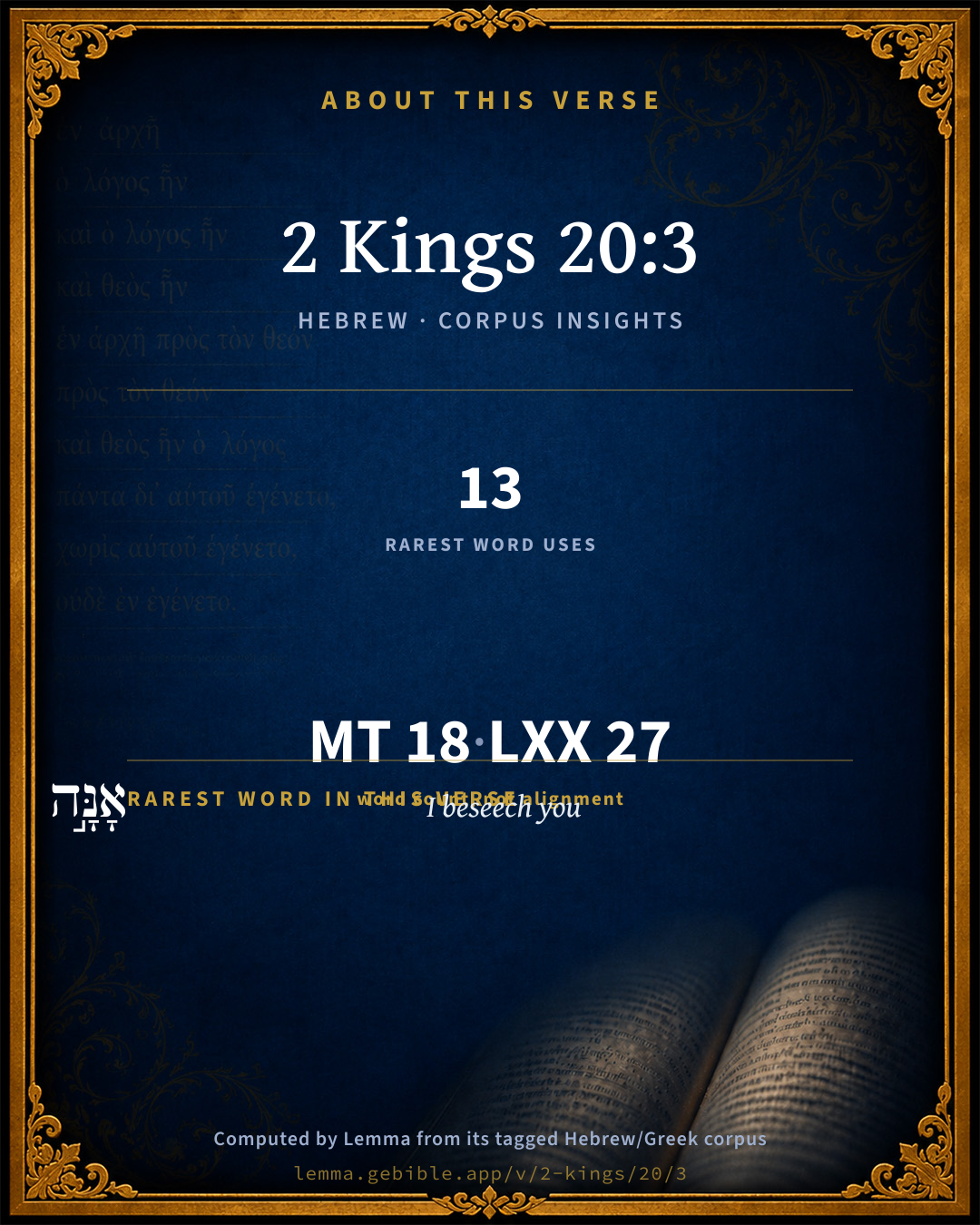
The rarest word here is אָנָּ֣ה I beseech you H577 — appearing just 13 times in the whole Hebrew Bible.

Shared distinctive vocabulary

אָנָּ֣ה I beseech you H577 occurs in 12 verses of the Hebrew Bible. Also found in:

Grammatical profile

  • 4 verbs
  • 7 nouns
  • 3 adjectives
  • 4 particles

Verb forms

  • זְכָר Qal · Imperative
  • הִתְהַלַּ֣כְתִּי Hithpael · Perfect
  • עָשִׂ֑יתִי Qal · Perfect
  • וַיֵּ֥בְךְּ Qal · Sequential Imperfect

Repetition

A word recurs within this verse — often emphatic in Hebrew:

  • וַיֵּ֥בְךְּ to weep H1058 ×2

Hebrew & Septuagint length

In English translation the verse runs 32 words from the Hebrew and 35 from the Septuagint (LXX English) — closely comparable.

A rough comparison of the two English renderings, which tokenize alike — not a word-level alignment.

Word counts can differ between the Hebrew and the Greek without any difference in meaning — e.g. the Hebrew direct-object marker אֵת has no separate Greek word, and Greek often adds the article ὁ.

In the original languages it is 18 Hebrew tokens and 27 Greek tokens — but the two are counted differently (Hebrew bundles its prefixes and suffixes into one token; the Greek is in lemma form), so that isn’t a like-for-like length.

Cross-references

35

Topical passages linked to 2 Kings 20:3 in the Treasury of Scripture Knowledge — connected by theme and wording, ordered by reader-vote popularity; previews shown in the World English Bible.

  • Nehemiah 13:14 Remember me, my God, concerning this, and don't wipe out my good deeds that I have done for the house of my God, and for the observances of it.
  • Nehemiah 13:22 I commanded the Levites that they should purify themselves, and that they should come and keep the gates, to sanctify the Sabbath day. Remember to me, my God, this also, and spare me according to the greatness of your loving kindness.
  • 2 Kings 18:3–6 He did that which was right in the eyes of Yahweh, according to all that David his father had done.
  • Nehemiah 5:19 Remember to me, my God, for good, all that I have done for this people.
  • Nehemiah 13:31 and for the wood-offering, at times appointed, and for the first fruits. Remember me, my God, for good.
  • 1 John 3:21–22 Beloved, if our hearts don't condemn us, we have boldness toward God;
  • Luke 1:6 They were both righteous before God, walking blamelessly in all the commandments and ordinances of the Lord.
  • 2 Samuel 12:21–22 Then said his servants to him, What thing is this that you have done? you did fast and weep for the child, while it was alive; but when the child was dead, you did rise and eat bread.
  • 1 Kings 8:61 Let your heart therefore be perfect with Yahweh our God, to walk in his statutes, and to keep his commandments, as at this day.
  • Psalms 145:18 Yahweh is near to all those who call on him, To all who call on him in truth.
  • Isaiah 38:14 Like a swallow [or] a crane, so did I chatter; I did moan as a dove; my eyes fail [with looking] upward: Lord, I am oppressed, be my collateral.
  • Genesis 5:22 Enoch walked with God after he became the father of Methuselah three hundred years, and became the father of sons and daughters.
  • Genesis 5:24 Enoch walked with God, and he was not, for God took him.
  • Genesis 8:1 God remembered Noah, all the animals, and all the cattle that were with him in the ark; and God made a wind to pass over the earth. The waters subsided.
  • Genesis 17:1 When Abram was ninety-nine years old, Yahweh appeared to Abram, and said to him, "I am God Almighty. Walk before me, and be blameless.
  • 1 Kings 2:4 That Yahweh may establish his word which he spoke concerning me, saying, If your children take heed to their way, to walk before me in truth with all their heart and with all their soul, there shall not fail you (said he) a man on the throne of Israel.
  • 1 Kings 3:6 Solomon said, You have shown to your servant David my father great loving kindness, according as he walked before you in truth, and in righteousness, and in uprightness of heart with you; and you have kept for him this great loving kindness, that you have given him a son to sit on his throne, as it is this day.
  • 1 Kings 11:4 For it happened, when Solomon was old, that his wives turned away his heart after other gods; and his heart was not perfect with Yahweh his God, as was the heart of David his father.
  • 1 Kings 15:14 But the high places were not taken away: nevertheless the heart of Asa was perfect with Yahweh all his days.
  • 2 Chronicles 16:9 For the eyes of Yahweh run back and forth throughout the whole earth, to show himself strong in the behalf of them whose heart is perfect toward him. Herein you have done foolishly; for from henceforth you shall have wars.
  • 2 Chronicles 31:20–21 Thus did Hezekiah throughout all Judah; and he worked that which was good and right and faithful before Yahweh his God.
  • Job 1:1 There was a man in the land of Uz, whose name was Job. That man was blameless and upright, and one who feared God, and turned away from evil.
  • Job 1:8 Yahweh said to Satan, "Have you considered my servant, Job? For there is none like him in the earth, a blameless and an upright man, one who fears God, and turns away from evil."
  • Psalms 6:6 I am weary with my groaning; Every night I flood my bed; I drench my couch with my tears.
  • Psalms 25:7 Don't remember the sins of my youth, nor my transgressions. Remember me according to your loving kindness, For your goodness' sake, Yahweh.
  • Psalms 32:2 Blessed is the man to whom Yahweh doesn't impute iniquity, In whose spirit there is no deceit.
  • Psalms 89:47 Remember how short my time is! For what vanity have you created all the children of men!
  • Psalms 89:50 Remember, Lord, the reproach of your servants, How I bear in my heart the taunts of all the mighty peoples,
  • Psalms 102:9 For I have eaten ashes like bread, And mixed my drink with tears,
  • Psalms 119:49 Remember your word to your servant, Because you gave me hope.
  • Isaiah 63:11 Then he remembered the days of old, Moses [and] his people, [saying], Where is he who brought them up out of the sea with the shepherds of his flock? where is he who put his holy Spirit in the midst of them?
  • Jeremiah 4:2 and you shall swear, As Yahweh lives, in truth, in justice, and in righteousness; and the nations shall bless themselves in him, and in him shall they glory.
  • John 1:47 Jesus saw Nathanael coming to him, and said about him, "Behold, an Israelite indeed, in whom is no deceit!"
  • 2 Corinthians 1:12 For our boasting is this: the testimony of our conscience, that in holiness and sincerity of God, not in fleshly wisdom but in the grace of God we behaved ourselves in the world, and more abundantly toward you.
  • Hebrews 5:7 He, in the days of his flesh, having offered up prayers and petitions with strong crying and tears to him who was able to save him from death, and having been heard for his godly fear,

Cross-references courtesy of OpenBible.info (CC BY 4.0).

Hebrew and Greek witnesses Masoretic Hebrew ↔ Greek Septuagint

The same verse in the two great witnesses to the Old Testament, shown verse-for-verse.

These are two independent witnesses, not word-aligned to each other, and the Septuagint is shown in lemma (dictionary) form.

Hebrew 2 Kings 20:3 Masoretic · Westminster Leningrad Codex

אָנָּ֣ה יְהוָ֗ה זְכָר נָ֞א אֵ֣ת אֲשֶׁ֧ר הִתְהַלַּ֣כְתִּי לְפָנֶ֗יךָ בֶּֽאֱמֶת֙ וּבְלֵבָ֣ב שָׁלֵ֔ם וְהַטּ֥וֹב בְּעֵינֶ֖יךָ עָשִׂ֑יתִי וַיֵּ֥בְךְּ חִזְקִיָּ֖הוּ בְּכִ֥י גָדֽוֹל

Remember now, Yahweh, I beg you, how I have walked before you in truth and with a perfect heart, and have done that which is good in your sight. Hezekiah wept sore.

World English Bible · Public Domain

Greek LXX 2 Kings 20:3 Septuagint · lemma form

ὦ δή κύριος μιμνήσκω δή ὅσος περιπατέω ἐνώπιον σύ ἐν ἀλήθεια καί ἐν καρδία πλήρης καί ὁ ἀγαθός ἐν ὀφθαλμός σύ ποιέω καί κλαίω εζεκιας κλαυθμός μέγας

Lord, remember, I pray you, how I have walked before you in truth and with a perfect heart, and have done that which is good in your eyes. And Ezekias wept with a great weeping.

LXX2012 (modern English Septuagint) · Public Domain

Hebrew: Westminster Leningrad Codex (CC BY 4.0). Greek: Septuagint (public domain); English from LXX2012 (modern English Septuagint) (Public Domain). How the Septuagint differs from the Hebrew →

Targum (Aramaic paraphrase)

1

The Targum is the ancient Jewish Aramaic paraphrase of the Hebrew Scriptures — an interpretive translation, not the Hebrew text itself. Onkelos (literal) and Pseudo-Jonathan (expansive) render the Torah, and Jonathan the Prophets. Coverage is partial: where no permissively-licensed English translation exists for a verse, only the Aramaic is shown. This is verse-level text, not a word-by-word alignment to the Hebrew.

  1. Targum Jonathan Prophets (Joshua–Malachi)
    קַבֵּל בְּעוּתִי יְיָ אַדְכַּר כְּעַן יַת דִפְלָחִית קֳדָמָךְ בִּקְשׁוֹט וּבְלֵבָב שְׁלִים וּדְתַקִין קֳדָמָךְ עַבְדֵית וּבְכָא חִזְקִיָה בִּכְיָא סַגִיאָה:

    (no public-domain English translation for this verse)

    Targum Jonathan — Aramaic: “Mikraot Gedolot” (public domain). English: “Sefaria Community Translation” (CC0 1.0 (public-domain dedication)); “London "Chaldee Paraphrase," 1871” (public domain). Text via Sefaria.

Commentary

Notes on 2 Kings 20:3 from classic Christian and Jewish commentators (each source and its license shown beneath its notes). The classic Christian expositions comment on the surrounding passage and are grouped to its opening verse, so a note may address several verses; the Jewish commentaries on the Tanakh (Rashi and others) are per-verse, so they appear only where the commentator wrote on this verse.

Lemma curates 59 commentaries, every one of them public domain or Creative Commons licensed, each selected and text-cleaned for this edition rather than reprinted as found. About our sources →

Trapp's Complete Commentary

John Trapp

2Ki 20:3 I beseech thee, O LORD, remember now how I have walked before thee in truth and with a perfect heart, and have done [that which is] good in thy sight. And Hezekiah wept sore.

Ver. 3. I beseech thee, O Lord, remember now.] Obsecro Domine, memento quaeso. Words full of incitation. The first word Ana - affectum significat et impetum - is very affectionate and forcible.

How I have walked before thee.] Indesinenter ambulavi, I have constantly walked before thee, and not by fits, or for a few turns. One interpreter noteth that the word here used signifieth, I have made myself to walk; implying his own dulness, sluggishness, averseness to that duty.

In truth, and with a perfect heart,] i.e., In sincerity and integrity. Uprightness hath boldness; Subeo bona (per gratiam Dei) conscientia tribunal Christi, said dying Oeeolampadius, I go before Christ’s tribunal with a good conscience. This is my comfort, said Mr Deering, that I have faithfully served my Lord God, and with an upright conscience. I am neither ashamed to live, nor afraid to die, said another saint. Let him fear death who is passing from this death to the second death. {a}

And have done that which is good.] For matter, manner, and motive. I have known, said a worthy doctor, {b} now with God, some godly men, whose comfort upon their deathbeds hath been, not from the inward acts of their mind - which apart considered, might be subject to misapprehensions, - but from the course of obedience in their lives issuing from there.

And Hezekiah wept sore.] Heb., With a great weeping. See on 2Ki 20:2. Now if the message of death made this good man weep sore, and the approach of it was mar mar, bitter bitterness, {Isa 38:17} what marvel if such a one as Saul swoon quite away at it, and fall to the earth in his full length, as in 1Sa 28:20? Death is dreadful in his best looks, as is the lion, though his teeth and claws be beaten out; or as the hawk to the partridge; or as a serpent’s skin, though but stuffed with straw. To the wicked, death is a trap door to hell: they may say of it, as once Elisha did, {2Ki 6:32} Behold, the murderer is at hand; and is not the sound of his master’s feet - the devil - behind him? hence their loath to depart, &c. But why should a saint be fond of life, or afraid of death, since to him it is but as his father’s horse, to carry him to his father’s house, or as Joseph’s chariot rattling with its wheels, to carry old Jacob to his son Joseph, so him to Christ?

{a} Mori timeat qui ad secundam mortem de hac morte transibit. - Cyprian.

{b} Church’s Carriage, by Dr Preston.

John Trapp, A Commentary or Exposition upon All the Books of the Old and New Testament (1647–1656) — public domain. Text from a community e-Sword module.

Joseph Benson's Commentary

2Ki 20:3. Remember how I have walked before thee in truth — Sincerely, with an honest mind. I am not conscious to myself of any exorbitances, for which thou art wont to shorten men’s days. And Hezekiah wept sore — “Under the law, long life and uninterrupted health were promised as the rewards of obedience, and premature death was denounced as a punishment; see Exo 20:12; Deu 5:33; and Deu 30:16. When we reflect on this, we need not be surprised at the sorrow which this good king expressed at his approaching dissolution. He looked upon it as a punishment, and consequently as a mark of the divine displeasure. Other reasons too might strongly operate upon a good mind. The suddenness of this terrible and unexpected denunciation; the unsettled state both of his public and domestic affairs; and the natural dread of death inherent in the human mind, which might in this case possibly be augmented from a sense of his own defects, and from a thorough persuasion that God was displeased at him, by cutting him off in such a manner, in the very flower of his age, and when his kingdom and family particularly required his best assistance. However, be the reasons what they might, it behooves us certainly to judge with great candour of a prince, whose character is so good as that of Hezekiah: and, perhaps, blessed as we are, with a clearer knowledge of a future state than Hezekiah enjoyed, there are but few who can look upon death, awful as it is even to the best, without some degree of very serious concern.” — Dodd.

Joseph Benson's Commentary on the Old and New Testaments (1811–1818) — public domain. Text from a community e-Sword module.

Geneva Bible (1599)

Geneva Bible translators

Meaning, without all hypocrisy.

Not so much for his own death, as for fear that idolatry should be restored, which he had destroyed, and so God’s Name be dishonored.

Geneva Bible (1599) marginal notes — public domain. Text via Bolls.life.

Jamieson, Fausset & Brown

Robert Jamieson, A. R. Fausset & David Brown

remember now how I have walked before thee, &c.--The course of Hezekiah's thoughts was evidently directed to the promise made to David and his successors on the throne (Kg1 8:25). He had kept the conditions as faithfully as human infirmity admitted; and as he had been all along free from any of those great crimes by which, through the judgment of God, human life was often suddenly cut short, his great grief might arise partly from the love of life, partly from the obscurity of the Mosaic dispensation, where life and immortality had not been fully brought to light, and partly from his plans for the reformation of his kingdom being frustrated by his death. He pleaded the fulfilment of the promise.

Jamieson, Fausset & Brown — Commentary Critical and Explanatory on the Whole Bible (1871) — public domain (CC PDM 1.0). Text via the HelloAO Bible API.

Adam Clarke's Commentary

Verse 3. I beseech thee, O Lord] Hezekiah knew that, although the words of Isaiah were delivered to him in an absolute form, yet they were to be conditionally understood, else he could not have prayed to God to reverse a purpose which he knew to be irrevocable. Even this passage is a key to many prophecies and Divine declarations: see chap. 18 of Jeremiah.

Hezekiah pleads his uprightness and holy conduct in his own behalf. Was it impious to do so? No; but it certainly did not savour much either of humility or of a due sense of his own weakness. If he had a perfect heart, who made it such?-God. If he did good in God's sights who enabled him to do so?-God. Could he therefore plead in his behalf dispositions and actions which he could neither have felt nor practiced but by the power of the grace of God? I trow not. But the times of this ignorance God winked at. The Gospel teaches us a different lesson.

Wept sore.] How clouded must his prospects of another world have been! But it is said that, as he saw the nation in danger from the Assyrian army, which was then invading it, and threatened to destroy the religion of the true God, he was greatly affected at the news of his death, as he wished to live to see the enemies of God overthrown. And therefore God promises that he will deliver the city out of the hands of the king of Assyria, at the same time that he promises him a respite of fifteen years, 2Kg 20:6. His lamentation on this occasion may be seen in Isaiah, Isa 38:9-22.

Adam Clarke's Commentary on the Bible (1810–1826) — public domain. Text from a community e-Sword/MySword module.

Ellicott's Commentary for English Readers

(3) Remember now how I have walked . . .—Hezekiah deprecates an untimely death—the punishment of the wicked (Pro_10:27)—on account of his zeal for Jehovah and against the idols. As Thenius remarks, there is nothing surprising in his apparent self-praise if we remember such passages as Psa_18:20; Psa_7:8; Neh_13:14. Josephus sets down the poignancy of his sorrow to childlessness, and makes him pray to be spared until he get a son; but this is merely an instance of that “midrashitic” enlargement of the narrative which we find elsewhere in that historian.

A Bible Commentary for English Readers, edited by Charles John Ellicott (1878–1897) — public domain. Text from a community e-Sword module.

The Cambridge Bible for Schools and Colleges

gen. ed. J. J. S. Perowne

3. I beseech thee, O Lord, remember now] R.V. Remember now, O Lord, I beseech thee. The R.V. adopts the order of the words in Isaiah.

It was only at a moment of great elation and prosperity that Hezekiah forgat God. The testimony which he himself bears to his own character appears to be generally true. He must have lived as a God-fearing son under an idolatrous father. When he came to the throne, while he had the work of purifying God’s worship in hand, and the Philistines were not driven out of Judah, he did all things well. But after some prosperous years he had himself to own to Sennacherib ‘I have offended’. During the war with Assyria he set a noble example. When the pressure was removed he gave way for a short time to pride and a boastful spirit. Moreover his care for his son’s training, if we may judge by Manasseh’s life when he became king, can hardly have been so zealous as we might expect from a father whose youth had been passed amid the difficulties of an idolatrous court. Altogether Hezekiah is one of those characters which shine brightest in adversity.

The Cambridge Bible for Schools and Colleges (gen. ed. J. J. S. Perowne; Cambridge University Press, 1878–1918) — public domain. Text from a community e-Sword module.

Albert Barnes' Notes on the Bible

Remember now - The old covenant promised temporal prosperity, including length of days, to the righteous. Hezekiah, conscious of his faithfulness and integrity 2Ki 18:3-6, ventures to expostulate (compare also 2Ki 21:1 note). According to the highest standard of morality revealed up to this time, there was nothing unseemly in the self vindication of the monarch, which has many parallels in the Psalms of David (Psa 7:3-10; Psa 18:19-26; Psa 26:1-8, etc.).

Albert Barnes' Notes on the Bible (1834–1885) — public domain. Text from a community e-Sword/MySword module.

Haydock's Catholic Bible Commentary

Before thee. The saints of the old law frequently mention their good works, (Psalm vii. 9., &c., and 2 Esdras xiii. 14.) which is less common in those of the new. When God rewards our good works, he only crowns his own gifts. (Calmet) --- Ezechias had sincerely desired to please God, though he might have given way to some imperfections, ver. 1. (Haydock) --- Weeping; because he thought that the Messias would not be one of his posterity, as he had yet no children, chap. xxi. 1. (St. Jerome) --- The saints of the Old Testament could only be received into Abraham’s bosom. We may be with Christ immediately after death; so that it is far less terrible, Philippians i. 23. (Haydock)

George Leo Haydock (1774–1849), Haydock's Catholic Family Bible and Commentary, 1859 edition — public domain. Excludes Psalms (Douay-Rheims chapter numbering differs from Protestant) and Deuterocanonical books (Catholic canon only).

Matthew Poole's English Annotations

In truth, i.e. sincerely, with an honest mind, as the following words explain it. I have in some measure (human frailty excepted) kept the condition which thou didst require, 1Ki 8:25, and therefore do humbly beg of thee that the promise made to David and to his posterity upon that condition may not fail in my person, for as yet thou hast not given me a son. See Poole "2Ki 20:1". I am not conscious to myself of any gross exorbitances in the course of my life, for which thou usest to shorten men’s days, and cut off my life in thy displeasure, which by this sharp message thou threatenest to do.

Hezekiah wept sore; partly for that horror of death which is and was common to men, especially in the times of the Old Testament, when the grace of God in Christ was not so fully manifested as now it is; and principally for the distracted and miserable condition in which the church and state were then likely to be left, through the uncertainty of the succession to the crown, and the great proneness of the people to backslide to their false worship and evil practices; which he easily perceived, and which he knew would bring far worse calamities upon them if he were removed, as afterwards it came to pass.

Matthew Poole's English Annotations on the Holy Bible (1683–1685) — public domain. Text from a community e-Sword/MySword module.

Whedon's Commentary on the Bible

Daniel D. Whedon

3. I have walked before thee in truth — He appeals to his piety and zeal for Jehovah, as evinced by his destruction of idolatry and trust in God, which were matters of record. Compare 2Ki_18:3-7. This language of the king is not to be regarded as self-praise. “Hezekiah stood in the economy of the Old Testament, that is, in the economy of legal righteousness; the entire revelation of the Old Testament is concentrated in the Law of Moses, as that of the New Testament is concentrated in the Gospel; so that to walk according to this law is not to be morally pure and free from sin, but to serve Jehovah as the only God, to fear him, to trust him, and to love him with all the heart. Hezekiah could say all this without pharisaical self-praise, just as well as Paul could say, without self-righteousness, ‘I have fought a good fight; I have kept the faith.’” — Bahr.

Wept sore — Wept greatly, or violently. Josephus says, he was afflicted because he had no heir to succeed him in the kingdom. Such a fact may have increased his grief, for it appears from 2Ki_20:6, compared with 2Ki_21:1, that his son and successor, Manasseh, was born three years after this; but his chief agony seems to have been that he was about to be cut off in the midst of life, and such a calamity was looked upon as a stroke of Divine anger, and evidence of great wickedness. See Job_15:32; Job_22:16; Psa_55:23; Pro_10:27; Ecc_7:17. It is easy to see, then, why Hezekiah appeals so earnestly to his righteous acts. It is not in self-praise, but in self-vindication.

Daniel D. Whedon (gen. ed.), Commentary on the Old and New Testaments (1874–1909) — public domain. Text from a community e-Sword module.

The Pulpit Commentary

I beseech thee, O Lord, remember now how I have walked before thee in truth and with a perfect heart. There is no Pharisaical self-righteousness here. Hezekiah is conscious that he has honestly endeavored to serve God, and to do his will that, whatever may have been his shortcomings, his heart has been right towards God. He ventures, therefore, on something like expostulation. Why is he to be cut off in the midst of his days, at the age of thirty-nine, when such a wicked king as Uzziah has lived to be sixty-eight, (2Ki_15:2) and Rehoboam to be fifty-eight? (1Ki_14:21) It is to be remembered that, under the old covenant, length of days was expressly promised to the righteous, (Pro_3:2 Pro_9:11 Pro_10:27, etc.) and that a shortened life was the proclaimed penalty of wicked-doing (Job_15:32, 33 22:16; Pro_10:27) Hezekiah"s self-assertion is thus a sort of laying hold of God"s promises. And have done that which is flood in thy sight; comp. 2Ki_18:3-6; and note the similar pleadings of David, With my whole heart have I sought thee"; (Psa_119:10) "I have remembered thy Name, O Lord, and have kept thy Law. This I had because I kept thy commandments", (Psa_119:55, Psa_119:56) and the like. And Hezekiah wept sore. Human nature shrinks from death instinctively, and it requires a very vivid imagination for even the Christian in middle life to feel with St. Paul, that "it is better for him to depart and to be with Christ." The Hebrew of Hezekiah"s time had far mere reason to regard death as an evil. His hopes of a life beyond the grave were feeble his conceptions of the life, if life there were, faint and unattractive. Sheol, like Hades, was a vague, awful, terrible thing. If we consider Hezekiah"s words, "The grave cannot praise thee, death cannot celebrate thee: they that go down into the pit cannot hope for thy truth. The living, the living, he shall praise thee", (Isa_38:18, Isa_38:19) we may understand how the Hebrew shrank from the fearful change. And in Hezekiah"s case there was a yet further reason for grief Hezekiah had as yet no male offspring (Josephus, "Ant. Jud:," 10:2. Manasseh was as yet unborn. (comp. ver. 6 with 2Ki_21:1) If he died now, his house would be cut off, he would be without posterity a sore grief to every Hebrew. Ewald"s references to Isa_38:19 and Isa_39:7, as indicative of Hezekiah having sons at the time, are absolutely without value.

The Pulpit Commentary (1880–1919), ed. H.D.M. Spence-Jones & Joseph S. Exell — public domain. Text from a community e-Sword module.

John Wesley's Explanatory Notes

In truth - Sincerely with an honest mind. I am not conscious to myself of any gross exorbitances, for which thou usest to shorten mens days. Wept - For that horror of death which is and was common to men, especially, in the times of the Old Testament, when the grace of God in Christ was not so fully manifested, as now it is: and, for the distracted condition in which the church and state were then likely to be left, through the uncertainty of the succession to the crown.

John Wesley, Explanatory Notes Upon the Whole Bible (1754–1765) — public domain. Text via the GEBible commentary corpus.

Lesson kit

Teaching starters — assembled from the data on this page, not authored interpretation. Every prompt links to the verse data it draws on. Edit before teaching.

2 Kings, in the Historical, opens this verse with 18 words (17 distinct Hebrew lemmas). Its most distinctive word is ʼânnâʼ (“I beseech you”). A historical commentator’s framing appears above. Read the whole chapter for the surrounding context.

Discussion questions

  1. How does “I beseech you” (ʼânnâʼ) shape what this verse is saying?
  2. How does Genesis 50:17, which shares the word «I beseech you», read alongside this verse?
  3. What does the repetition of “to weep” (2× in this one verse) do in this verse?
  4. These translations render this verse differently. What is at stake in choosing one wording over another?
  5. «זְכָר» is a Qal Imperative verb. How does that grammatical form shape the action described?
  6. Compare how Trapp's Complete Commentary and Joseph Benson's Commentary read this verse. Where do they agree or differ?

Things to notice

Reading settings

Reading text

Shown beneath each verse's original-language words.

Old Testament
Old Testament edition

Read the OT as the Masoretic Hebrew (MT) or the Greek Septuagint (LXX).

English shown for the Greek Septuagint (in the Hebrew ↔ Greek comparison).

Comparing translations? Open the Compare panel on any verse page to stack up to four side by side.