Ecclesiastes 9:16

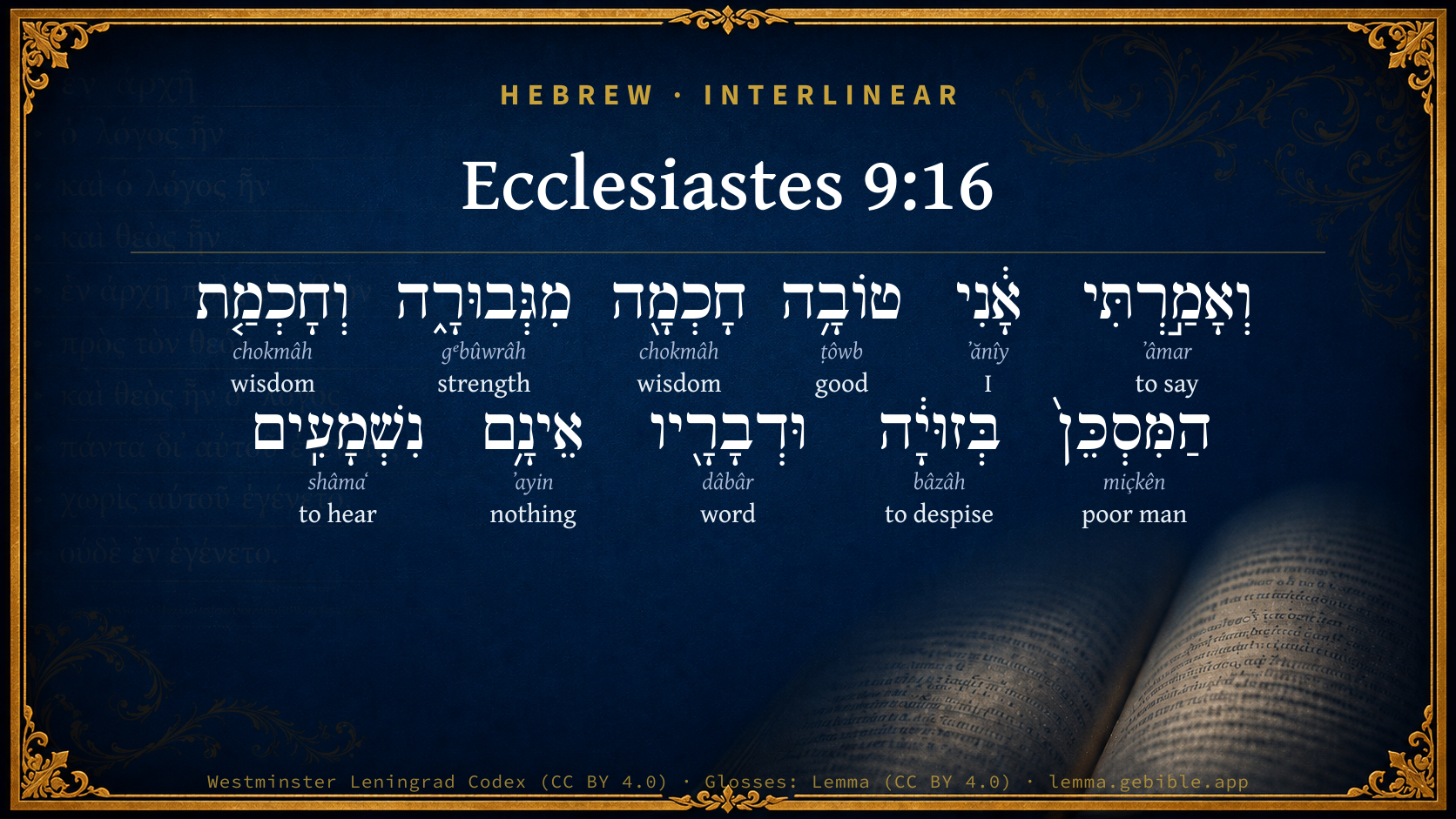
Hebrew (Westminster Leningrad Codex) Ecclesiastes 9:16 appears in the Hebrew Old Testament. The text above is from the Westminster Leningrad Codex. Each word links to its Strong’s number, a concise gloss, and parsing drawn from the Open Scriptures Hebrew Bible morphology. Click any word for its full Brown-Driver-Briggs (BDB) entry.
Download image
Cite this verse

Ecclesiastes 9:16 (World English Bible). Public Domain. Lemma interlinear Bible study tool, https://lemma.gebible.app/v/ecclesiastes/9/16.

Show BibTeX & RIS
BibTeX
RIS
English Translation
Then said I, Wisdom is better than strength. Nevertheless the poor man's wisdom is despised, and his words are not heard.
World English Bible · Public Domain
Download a study sheet

One document with this verse’s original text, its word-by-word gloss line, the meaning frame, cross-references with their text, attributed commentary, and full source and license credits — printable, and it pastes into notes with its structure intact.

This verse Autodidact and up

Study sheet (.html) Plain text (.txt)

A passage Seminary Student

Up to 50 verses in one chapter. A passage sheet keeps up to 6 commentary sources and 12 cross-references per verse, in the order this page ranks them, and says so on the sheet whenever that leaves anything out. Ask for a single verse and you get the Autodidact verse sheet above.

Everything on this page stays free to read, with no account — the sheet is a download of what is already on screen, not access to it.

Want to remove ads? Support Godless Engineer
Compare translations 3

The same verse in 3 English versions, stacked beneath the original-language interlinear above. Click any original word for its lexicon entry.

Each is an independent rendering of the whole verse — the interlinear is not word-aligned to these translations.

Highlighted words mark where these versions differ — a whole-verse word diff, not a word-by-word alignment.

  • World English Bible Public Domain
    Then said I, Wisdom is better than strength. Nevertheless the poor man's wisdom is despised, and his words are not heard.
  • King James Version Public Domain
    Then said I, Wisdom is better than strength: nevertheless the poor man's wisdom is despised, and his words are not heard.
  • unfoldingWord Literal Text CC BY-SA 4.0
    And I said, I, “Better wisdom than might, but the wisdom of the poor person despised, and his words—they are not heard.” q1

unfoldingWord Literal Text — © unfoldingWord, licensed CC BY-SA 4.0. Word-aligned USFM3 via Door43 (git.door43.org/unfoldingWord/en_ult).

Versions to compare (up to 4)

3 of 4 selected

Show all 18 translations

Every available English version of this verse, each an independent rendering of the whole verse.

  • World English Bible Public Domain
    Then said I, Wisdom is better than strength. Nevertheless the poor man's wisdom is despised, and his words are not heard.
  • Berean Standard Bible Public Domain
    And I said, “Wisdom is better than strength, but the wisdom of the poor man is despised, and his words are not heeded.”
  • Majority Standard Bible Public Domain
    And I said, “Wisdom is better than strength, but the wisdom of the poor man is despised, and his words are not heeded.”
  • King James Version Public Domain
    Then said I, Wisdom is better than strength: nevertheless the poor man's wisdom is despised, and his words are not heard.
  • American Standard Version (1901) Public Domain
    Then said I, Wisdom is better than strength: nevertheless the poor man's wisdom is despised, and his words are not heard.
  • Revised Version (1885) Public Domain
    Then said I, Wisdom is better than strength: nevertheless the poor man’s wisdom is despised, and his words are not heard.
  • Geneva Bible (1599) Public Domain
    Then said I, Better is wisdome then strength: yet the wisedome of the poore is despised, and his wordes are not heard.
  • Douay-Rheims (1899) Public Domain
    And I said that wisdom is better than strength: how then is the wisdom of the poor man slighted, and his words not heard?
  • Young's Literal Translation Public Domain
    And I said, `Better `is' wisdom than might, and the wisdom of the poor is despised, and his words are not heard.' --
  • Literal Standard Version CC BY-SA 4.0
    And I said, “Better [is] wisdom than might, and the wisdom of the poor is despised, and his words are not heard.”
  • Unlocked Literal Bible CC BY-SA 4.0
    So I concluded, “Wisdom is better than strength, but the poor man's wisdom is despised, and his words are not heard.”
  • unfoldingWord Literal Text CC BY-SA 4.0
    And I said, I, “Better wisdom than might, but the wisdom of the poor person despised, and his words—they are not heard.” q1
  • Darby Bible Public Domain
    Then said I, Wisdom is better than strength; but the poor man's wisdom is despised, and his words are not heard.
  • World Messianic Bible Public Domain
    Then I said, “Wisdom is better than strength.” Nevertheless the poor man’s wisdom is despised, and his words are not heard.
  • Webster's Bible Public Domain
    Then said I, wisdom is better than strength: nevertheless the poor man's wisdom is despised, and his words are not heard.
  • Free Bible Version CC BY-SA 4.0
    As I've always said, “Wisdom is better than strength.” Yet the wisdom of that poor man was dismissed—people didn't pay attention to what he said.
  • Bible in Basic English Public Domain
    Then I said, Wisdom is better than strength, but the poor man's wisdom is not respected, and his words are not given a hearing.
  • JPS Tanakh (1917) Public Domain
    Then said I: 'Wisdom is better than strength; nevertheless the poor man's wisdom is despised, and his words are not heard.'

Literal Standard Version (2020), Covenant Press — licensed CC BY-SA 4.0. Text via the HelloAO Bible API (eBible.org). Unlocked Literal Bible (unfoldingWord) — licensed CC BY-SA 4.0. Text via the HelloAO Bible API (eBible.org). unfoldingWord Literal Text — © unfoldingWord, licensed CC BY-SA 4.0. Word-aligned USFM3 via Door43 (git.door43.org/unfoldingWord/en_ult). Free Bible Version, Dr. Jonathan Gallagher — licensed CC BY-SA 4.0. Text via the HelloAO Bible API (eBible.org).

Word by word

More ways to search: Search by grammar → Find every occurrence → Compare this word →

Practice this passage: Drill this verse → Learn its vocabulary →

הַמִּסְכֵּן֙
miçkên
H4542
“the · poor man”
Particle, Definite Article + Adjective, Adjective, Masculine, Singular, Absolute
Part of Speech
Particle + Adjective
Type
Adjective
Gender
Masculine
Number
Singular
State
Absolute
Full BDB Definition

Origin: from H5531

TWOT: 1221

poor, poor man
  1. וְאָמַ֣רְתִּי ʼâmar H559 “and · to say” Conjunction + Verb, Qal, Perfect, 1st Person, Common, Singular
  2. אָ֔נִי ʼănîy H589 “I” Pronoun, Personal, 1st Person, Common, Singular
  3. טוֹבָ֥ה ṭôwb H2896 “good” Adjective, Adjective, Feminine, Singular, Absolute
  4. חָכְמָ֖ה chokmâh H2451 “wisdom” Noun, Common, Feminine, Singular, Absolute
  5. מִגְּבוּרָ֑ה gᵉbûwrâh H1369 “from · strength” Preposition + Noun, Common, Feminine, Singular, Absolute
  6. וְחָכְמַ֤ת chokmâh H2451 “and · wisdom of” Conjunction + Noun, Common, Feminine, Singular, Construct
  7. בְּזוּיָ֔ה bâzâh H959 “despised” Verb, Qal, Participle Passive, Feminine, Singular, Absolute
  8. וּדְבָרָ֖יו dâbâr H1697 “and · words · his” Conjunction + Noun, Common, Masculine, Plural, Construct + Suffix, Personal, 3rd Person, Masculine, Singular
  9. אֵינָ֥ם ʼayin H369 “nothing · them” Particle, Negative + Suffix, Personal, 3rd Person, Masculine, Plural
  10. נִשְׁמָעִֽים shâmaʻ H8085 “heard” Verb, Niphal, Participle Passive, Masculine, Plural, Absolute

About this verse

These counts appear in no published source. They are computed here, from the morphology-tagged text and Lemma’s own curated glosses. What Lemma adds →

11
words
10
distinct lemmas
Wisdom
section

Notable vocabulary

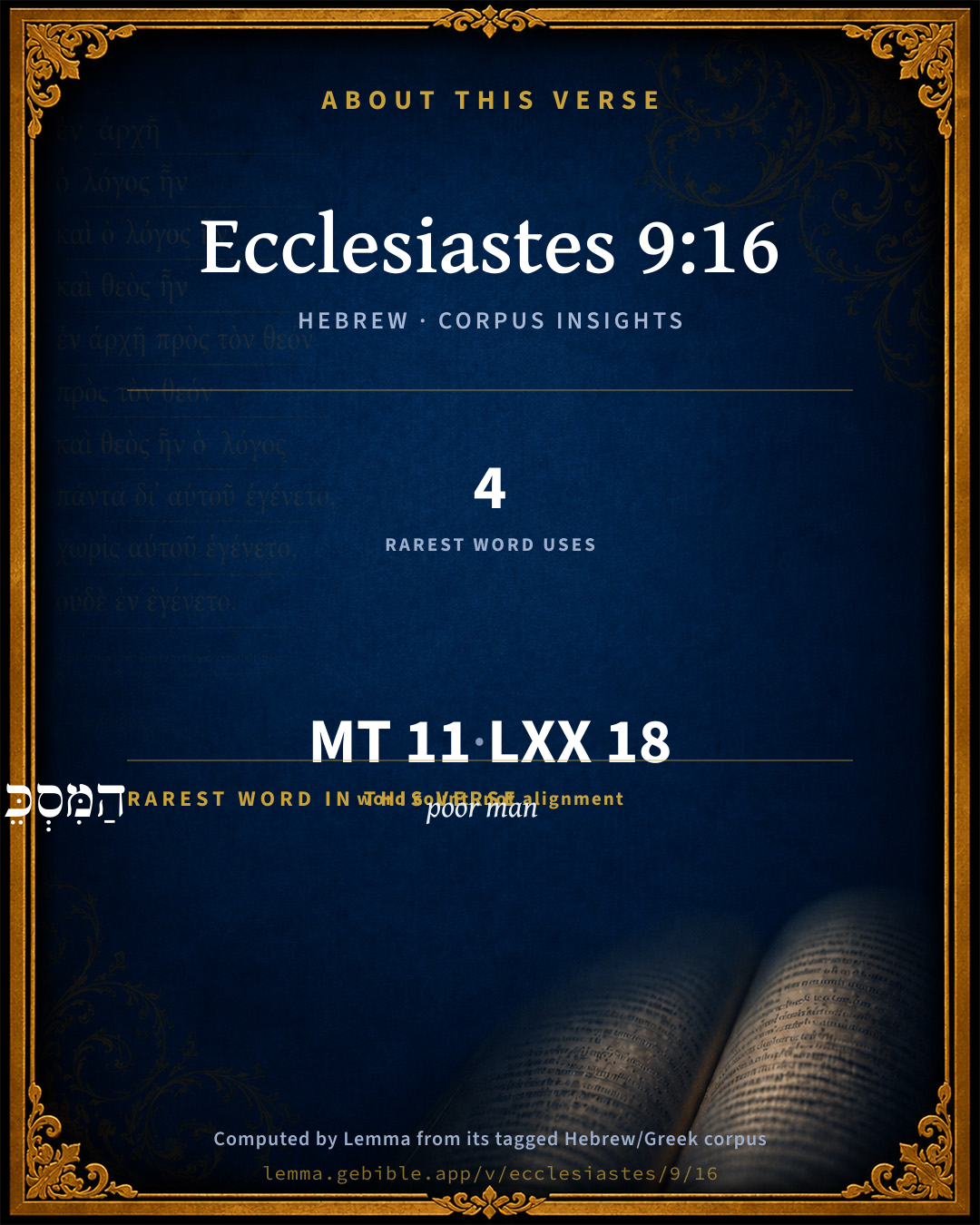
The rarest word here is הַמִּסְכֵּן֙ poor man H4542 — appearing just 4 times in the whole Hebrew Bible.

Shared distinctive vocabulary

הַמִּסְכֵּן֙ poor man H4542 occurs in 3 verses of the Hebrew Bible. Also found in:

Grammatical profile

  • 3 verbs
  • 4 nouns
  • 2 adjectives
  • 1 pronoun
  • 1 particle

Verb forms

  • וְאָמַ֣רְתִּי Qal · Perfect
  • בְּזוּיָ֔ה Qal · Participle Passive
  • נִשְׁמָעִֽים Niphal · Participle Passive

Repetition

A word recurs within this verse — often emphatic in Hebrew:

  • חָכְמָ֖ה wisdom H2451 ×2

Hebrew & Septuagint length

In English translation the verse runs 21 words from the Hebrew and 25 from the Septuagint (LXX English) — closely comparable.

A rough comparison of the two English renderings, which tokenize alike — not a word-level alignment.

Word counts can differ between the Hebrew and the Greek without any difference in meaning — e.g. the Hebrew direct-object marker אֵת has no separate Greek word, and Greek often adds the article ὁ.

In the original languages it is 11 Hebrew tokens and 18 Greek tokens — but the two are counted differently (Hebrew bundles its prefixes and suffixes into one token; the Greek is in lemma form), so that isn’t a like-for-like length.

Cross-references

10

Topical passages linked to Ecclesiastes 9:16 in the Treasury of Scripture Knowledge — connected by theme and wording, ordered by reader-vote popularity; previews shown in the World English Bible.

  • Ecclesiastes 7:19 Wisdom is a strength to the wise man more than ten rulers who are in a city.
  • Proverbs 24:5 A wise man has great power; And a knowledgeable man increases strength;
  • Proverbs 21:22 A wise man scales the city of the mighty, And brings down the strength of its confidence.
  • Mark 6:2–3 When the Sabbath had come, he began to teach in the synagogue, and many hearing him were astonished, saying, "Where did this man get these things?" and, "What is the wisdom that is given to this man, that such mighty works come about by his hands?
  • 1 Corinthians 1:26–29 For you see your calling, brothers, that not many are wise according to the flesh, not many mighty, and not many noble;
  • James 2:2–6 For if a man with a gold ring, in fine clothing, comes into your assembly, and a poor man in filthy clothing also comes in;
  • Proverbs 10:15 The rich man's wealth is his strong city. The destruction of the poor is their poverty.
  • Ecclesiastes 9:18 Wisdom is better than weapons of war; but one sinner destroys much good.
  • John 7:47–49 The Pharisees therefore answered them, "You aren't also led astray, are you?
  • John 9:24–34 So they called the man who was blind a second time, and said to him, "Give glory to God. We know that this man is a sinner."

Cross-references courtesy of OpenBible.info (CC BY 4.0).

Hebrew and Greek witnesses Masoretic Hebrew ↔ Greek Septuagint

The same verse in the two great witnesses to the Old Testament, shown verse-for-verse.

These are two independent witnesses, not word-aligned to each other, and the Septuagint is shown in lemma (dictionary) form.

Hebrew Ecclesiastes 9:16 Masoretic · Westminster Leningrad Codex

וְאָמַ֣רְתִּי אָ֔נִי טוֹבָ֥ה חָכְמָ֖ה מִגְּבוּרָ֑ה וְחָכְמַ֤ת הַמִּסְכֵּן֙ בְּזוּיָ֔ה וּדְבָרָ֖יו אֵינָ֥ם נִשְׁמָעִֽים

Then said I, Wisdom is better than strength. Nevertheless the poor man's wisdom is despised, and his words are not heard.

World English Bible · Public Domain

Greek LXX Ecclesiastes 9:16 Septuagint · lemma form

καί εἶπον ἐγώ ἀγαθός σοφία ὑπέρ δύναμις καί σοφία ὁ πένης ἐκοὐδενόω καί λόγος αὐτός οὐ εἰμί ἀκούω

And I said Wisdom is better than power: yet the wisdom of the poor man is set at nothing, and his words not listened to.

LXX2012 (modern English Septuagint) · Public Domain

On this verse, Trapp's Complete Commentary discusses the Septuagint’s reading. Read the note in Commentary ↓

Hebrew: Westminster Leningrad Codex (CC BY 4.0). Greek: Septuagint (public domain); English from LXX2012 (modern English Septuagint) (Public Domain). How the Septuagint differs from the Hebrew →

Commentary

Notes on Ecclesiastes 9:16 from classic Christian and Jewish commentators (each source and its license shown beneath its notes). The classic Christian expositions comment on the surrounding passage and are grouped to its opening verse, so a note may address several verses; the Jewish commentaries on the Tanakh (Rashi and others) are per-verse, so they appear only where the commentator wrote on this verse.

Lemma curates 59 commentaries, every one of them public domain or Creative Commons licensed, each selected and text-cleaned for this edition rather than reprinted as found. About our sources →

Trapp's Complete Commentary

John Trapp

Ecc 9:16 Then said I, Wisdom [is] better than strength: nevertheless the poor man’s wisdom [is] despised, and his words are not heard.

Ver. 16. Then said I, Wisdom is better, &c.] This he had said before, {Ecc 7:19 Pro 21:22} {See Trapp on "Ecc 7:19"} {See Trapp on "Pro 21:22"} but now upon this new occasion. Nunquam satis dicitur, quod nunquam satis discitur. {a}

Nevertheless the poor man’s wisdom is despised.] Jerome reads it thus, Et sapientia pauperis quae despecta est, et verba eius quae non sunt audita; that is, And the wisdom of the poor man which is despised, and his words which are not heard. According to which reading, the sense is, wisdom is better than strength, yea, even the despised wisdom of the poor man, &c. The Septuagint and Vulgate read it, Quomodo ergo sapientia pauperis contempta est et verba eius non audita! How therefore is the wisdom of the wise man despised, and his words not heard! As making a wonder and a strange thing of it. Too often it befalls God’s poor ministers, either to be rejected with scorn, or if heard, yet not regarded, much less rewarded, unless it be as Micaiah was by Ahab, and Jeremiah by his countrymen of Anathoth, Jesus Christ by the proud Pharisees, {Joh 7:14-15; Joh 7:27} St Paul by the ungrateful Corinthians; {1Co 4:7} "His bodily presence," said they, "is weak," his sermons without philosophy and rhetoric. {2Co 10:10}

{a} Seneca.

John Trapp, A Commentary or Exposition upon All the Books of the Old and New Testament (1647–1656) — public domain. Text from a community e-Sword module.

Jamieson, Fausset & Brown

Robert Jamieson, A. R. Fausset & David Brown

Resuming the sentiment (Ecc 7:19; Pro 21:22; Pro 24:5).

poor man's wisdom is despised--not the poor man mentioned in Ecc 9:15; for his wisdom could not have saved the city, had "his words not been heard"; but poor men in general. So Paul (Act 27:11).

Jamieson, Fausset & Brown — Commentary Critical and Explanatory on the Whole Bible (1871) — public domain (CC PDM 1.0). Text via the HelloAO Bible API.

Adam Clarke's Commentary

Verse 16. The poor man's wisdom is despised, and his words are not heard.] I cannot help pursuing this illustration a little farther. The soldier who found Archimedes busily employed in drawing figures upon the sand, put to him some impertinent question, withal rudely obtruding himself on his operations. To whom this wonderful mathematician replied, "Stand off, soldier, and do not spoil my diagram;" on which the bloody savage struck him dead!

Adam Clarke's Commentary on the Bible (1810–1826) — public domain. Text from a community e-Sword/MySword module.

The Cambridge Bible for Schools and Colleges

gen. ed. J. J. S. Perowne

16. Wisdom is better than strength] The maxim of ch. Ecc_7:19 is reproduced, but it is traversed by the fact that the wisdom must often be content to remain unrecognised. The power of the purse too often prevails against the wisdom of the poor. At the best, often, in words already quoted (Ecc_9:11),

“Probitas laudatur et alget.”

“Virtue is praised, and left out in the cold.”

Juvenal, Sat. i. 74.

The marginal reference in the A. V. to Mar_6:2-3 is not without significance as indicating the highest illustration of the maxim, in the question which asked “Is not this the carpenter’s son? Is he not himself a carpenter?” The chief butler’s forgetfulness of Joseph (Gen_40:23) supplies another obvious parallel.

The Cambridge Bible for Schools and Colleges (gen. ed. J. J. S. Perowne; Cambridge University Press, 1878–1918) — public domain. Text from a community e-Sword module.

John Gill's Exposition

Then said I, wisdom is better than strength,.... Wisdom of mind, even in a poor man, is better than strength of body, even of the, most potent prince and powerful army, as may be concluded from the above instance; since the poor wise man could do more by his wisdom than the great king with his mighty army; who was obliged to break up the siege, in consequence of the counsel given, or the methods directed to, or taken, by the poor man;

nevertheless, the poor man's wisdom is despised, and his words are not heard; notwithstanding such a flagrant instance and example as this just mentioned; yet men still retain their prejudices against a poor man, and despise his wise counsels and advice, for no other reason but because he is poor, and will not attend to what he says: or, "though the poor man's wisdom", &c. (k), as Aben Ezra; Solomon drew the above conclusion from that instance; though this is usually the case, that men despise the wisdom of a poor man, and will not listen to his advice, this did not lessen the wise man's opinion of it. The words may be rendered, "even the poor man's wisdom despised, and his words not heard" (l); these are better than outward force and strength, and more serviceable and useful; which the Septuagint version favours: the Vulgate Latin version renders it, "how is the poor man's wisdom despised!" &c. as wondering at it that so it should be, when so much profit and advantage arose to the city from it.

(k) "quamvis sapientia", Junius & Tremellius, Piscator, Mercerus, Gejerus, Amama; "etsi", Drusius. (l) "Et pauperis sapientiam contemptam", &c. Tigurine version.

John Gill's Exposition of the Whole Bible (1746–1763) — public domain (CC PDM 1.0). Text via the HelloAO Bible API.

Haydock's Catholic Bible Commentary

Heard? Ecclesiasticus xiii. 28. Men are so unjust as to despise wisdom, if it be in a poor man. The prudence of an individual has often saved cities, as was the case at Abela, and Bethulia; (2 Kings xx. 22.; Calmet) and Syracuse was defended a long time by Archimedes against the whole Roman army. (Plut.[Plutarch?] in Marcel.)

George Leo Haydock (1774–1849), Haydock's Catholic Family Bible and Commentary, 1859 edition — public domain. Excludes Psalms (Douay-Rheims chapter numbering differs from Protestant) and Deuterocanonical books (Catholic canon only).

Matthew Poole's English Annotations

Wisdom is better than strength, as was manifest in the foregoing instance.

The poor man’s wisdom is despised, because men are generally vain and foolish, and have a greater value for outward ornaments than for true worth.

Matthew Poole's English Annotations on the Holy Bible (1683–1685) — public domain. Text from a community e-Sword/MySword module.

Whedon's Commentary on the Bible

Daniel D. Whedon

16. Wisdom is despised — In this instance, favour did not come to the man of skill. One can hardly avoid adding, though it is foreign to Koheleth’s present line of thought, that wisdom is largely its own conscious reward. even while it ministers, and is not ministered to.

Daniel D. Whedon (gen. ed.), Commentary on the Old and New Testaments (1874–1909) — public domain. Text from a community e-Sword module.

The Pulpit Commentary

Then said I, Wisdom is better than strength. The latter part of the verse is not a correction of the former, but the whole comes under the observation introduced by "I said." The story just related leads to this assertion, which reproduces the gnome of Ecc_7:19, wherein it is asserted that wisdom effects more than mere physical strength. There is an interpolation in the Old Latin Version of Wisd. 6. I which seems to have been compiled from this passage and Pro_16:13, "Melter est sapientia quam vires, et vir prudens quam fortis." Nevertheless the poor man"s wisdom is despised, etc. In the instance above mentioned the poor man"s wisdom was not despised and his words were heard and attended to; but this was an abnormal case, occasioned by the extremity of the peril. Koheleth states the result which usually attends wisdom emanating from a disesteemed source. The experience of Ben-Sire pointed to the same issue (see Ecc 13:22, Ecc 13:23). Horace, "Epist.," 1:1.57

Est animus tibi, sunt mores et lingua fidesque, Sed quadringentis sex septem millia desunt; Plebs erie.

In wit, worth, honor, one in vain abounds; If of the knight"s estate he lack ten pounds, He"s low, quite low! (Howes. )

"Is not this the carpenter"s Son?" asked the people who were offended at Christ. (Mar_6:2, 3)

The Pulpit Commentary (1880–1919), ed. H.D.M. Spence-Jones & Joseph S. Exell — public domain. Text from a community e-Sword module.

Keil & Delitzsch

C. F. Keil & F. Delitzsch

"And I said: Better is wisdom than strength; but the wisdom of the poor is despised, and his words are not heard." With the words, "I saw," the author introduces his observations, and with "I said" his reflections. Wisdom is better than strength, since it does more for the wise man, and through him for others, than physical force, - more, as expressed in Ecc 7:19, than ten mighty men. But the respect which wisdom otherwise secures for a man, if it is the wisdom of a poor man, sinks into despect, to which his poverty exposes him, - if necessity arises, his service, as the above history shows, is valued; but as a rule his words are unheeded, for the crowd estimate the worth of him whom they willingly hear according to the outward respect in which he is held.

To the lessons gathered from experience, are now added instructive proverbs of kindred contents.

Keil & Delitzsch — Biblical Commentary on the Old Testament (1861–1891) — public domain (CC PDM 1.0). Text via the HelloAO Bible API. (Old Testament only.)

unfoldingWord translationNotes

Door43 World Missions Community

the poor man's wisdom is despised

This can be stated in active form. AT: "people despise the poor man's wisdom" (See: Active or Passive)

his words are not heard

this can be stated in active form. AT: "they do not listen to what he says" or "they do not take his advice" (See: Active or Passive)

translationWords

wise

strength

word

unfoldingWord translationNotes — © Distant Shores Media and the Door43 World Missions Community, licensed CC BY-SA 4.0. Source: git.door43.org/Door43/en_tn.

Rashi

Rabbi Shlomo Yitzchaki (Rashi)

And I said when I saw this, “Wisdom is better than might,” for this one’s wisdom was despised by all, but now, they were all rescued through him. The Midrash Aggadah, [however, explains the verses as follows]:

[14] [There was] a small city This is the body.

with few people in it These are the limbs of a person.

a great king This is the evil inclination, which all his limbs feel.

[15] a poor man This is the good inclination.

Rashi on the Tanakh — English translations: “The Judaica Press complete Tanach with Rashi, translated by A. J. Rosenberg” (CC BY 4.0); “Pentateuch with Rashi's commentary by M. Rosenbaum and A.M. Silbermann, 1929-1934” (public domain); “The Metsudah Tanach series, Lakewood, N.J” (CC BY 4.0); and “The Book of Joshua, Metsudah Publications, 1997” (CC BY 4.0). Text via Sefaria.

Lesson kit

Teaching starters — assembled from the data on this page, not authored interpretation. Every prompt links to the verse data it draws on. Edit before teaching.

Ecclesiastes, in the Wisdom, opens this verse with 11 words (10 distinct Hebrew lemmas). Its most distinctive word is miçkên (“poor man”). A historical commentator’s framing appears above. Read the whole chapter for the surrounding context.

Discussion questions

  1. What does “poor man” (miçkên) contribute to the verse as a whole?
  2. Ecclesiastes 4:13 shares the word «poor man» with this verse. How do the two illuminate each other?
  3. “wisdom” occurs 2× in this one verse. What is the effect of the repetition?
  4. The translations on this page render this verse differently — a whole-verse word diff, not a word-by-word alignment. What might account for the different wordings?
  5. The verb «וְאָמַ֣רְתִּי» is Qal Perfect. How does its form color the action?
  6. Reading how Trapp's Complete Commentary and Jamieson, Fausset & Brown read this verse, where do the two commentators agree and where do they part?

Things to notice

Reading settings

Reading text

Shown beneath each verse's original-language words.

Old Testament
Old Testament edition

Read the OT as the Masoretic Hebrew (MT) or the Greek Septuagint (LXX).

English shown for the Greek Septuagint (in the Hebrew ↔ Greek comparison).

Comparing translations? Open the Compare panel on any verse page to stack up to four side by side.