
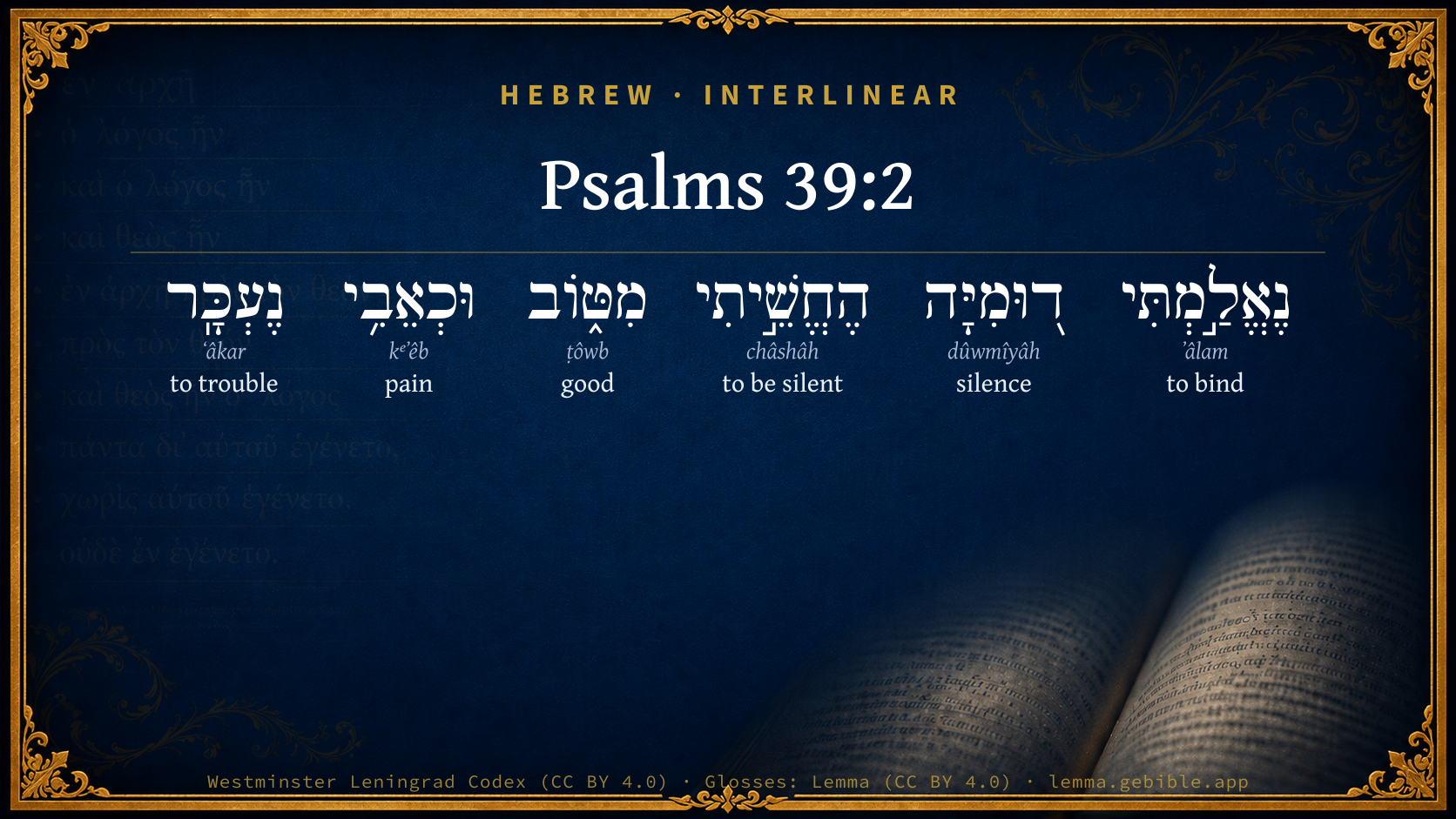
Psalms 39:2

Hebrew (Westminster Leningrad Codex) Psalms 39:2 appears in the Hebrew Old Testament. The text above is from the Westminster Leningrad Codex. Each word links to its Strong’s number, a concise gloss, and parsing drawn from the Open Scriptures Hebrew Bible morphology. Click any word for its full Brown-Driver-Briggs (BDB) entry.
Download image
Cite this verse

Psalms 39:2 (World English Bible). Public Domain. Lemma interlinear Bible study tool, https://lemma.gebible.app/v/psalms/39/2.

Show BibTeX & RIS
BibTeX
RIS
English Translation
I was mute with silence. I held my peace, even from good. My sorrow was stirred.
World English Bible · Public Domain
Download a study sheet

One document with this verse’s original text, its word-by-word gloss line, the meaning frame, cross-references with their text, attributed commentary, and full source and license credits — printable, and it pastes into notes with its structure intact.

This verse Autodidact and up

Study sheet (.html) Plain text (.txt)

A passage Seminary Student

Up to 50 verses in one chapter. A passage sheet keeps up to 6 commentary sources and 12 cross-references per verse, in the order this page ranks them, and says so on the sheet whenever that leaves anything out. Ask for a single verse and you get the Autodidact verse sheet above.

Everything on this page stays free to read, with no account — the sheet is a download of what is already on screen, not access to it.

Want to remove ads? Support Godless Engineer
Compare translations 3

The same verse in 3 English versions, stacked beneath the original-language interlinear above. Click any original word for its lexicon entry.

Each is an independent rendering of the whole verse — the interlinear is not word-aligned to these translations.

Highlighted words mark where these versions differ — a whole-verse word diff, not a word-by-word alignment.

  • World English Bible Public Domain
    I was mute with silence. I held my peace, even from good. My sorrow was stirred.
  • King James Version Public Domain
    I was dumb with silence, I held my peace, even from good; and my sorrow was stirred.
  • unfoldingWord Literal Text CC BY-SA 4.0
    I was mute silence; I was silent from good, and my pain was stirred up.

unfoldingWord Literal Text — © unfoldingWord, licensed CC BY-SA 4.0. Word-aligned USFM3 via Door43 (git.door43.org/unfoldingWord/en_ult).

Versions to compare (up to 4)

3 of 4 selected

Show all 18 translations

Every available English version of this verse, each an independent rendering of the whole verse.

  • World English Bible Public Domain
    I was mute with silence. I held my peace, even from good. My sorrow was stirred.
  • Berean Standard Bible Public Domain
    I was speechless and still; I remained silent, even from speaking good, and my sorrow was stirred.
  • Majority Standard Bible Public Domain
    I was speechless and still; I remained silent, even from speaking good, and my sorrow was stirred.
  • King James Version Public Domain
    I was dumb with silence, I held my peace, even from good; and my sorrow was stirred.
  • American Standard Version (1901) Public Domain
    I was dumb with silence, I held my peace, even from good; And my sorrow was stirred.
  • Revised Version (1885) Public Domain
    I was dumb with silence, I held my peace, even from good; and my sorrow was stirred.
  • Geneva Bible (1599) Public Domain
    I was dumme and spake nothing: I kept silece euen from good, and my sorow was more stirred.
  • Douay-Rheims (1899) Public Domain
    I said: I will take heed to my ways: that I sin not with my tongue. I have set guard to my mouth, when the sinner stood against me.
  • Young's Literal Translation Public Domain
    I was dumb `with' silence, I kept silent from good, and my pain is excited.
  • Literal Standard Version CC BY-SA 4.0
    I was mute [with] silence, || I kept silent from good, and my pain is excited.
  • Unlocked Literal Bible CC BY-SA 4.0
    I kept silent; I kept back my words even from saying anything good, and my pain grew worse.
  • unfoldingWord Literal Text CC BY-SA 4.0
    I was mute silence; I was silent from good, and my pain was stirred up.
  • Darby Bible Public Domain
    I was dumb with silence, I held my peace from good; and my sorrow was stirred.
  • World Messianic Bible Public Domain
    I was mute with silence. I held my peace, even from good. My sorrow was stirred.
  • Webster's Bible Public Domain
    \\39:1\\To the chief Musician, even to Jeduthun, A Psalm of David. I said, I will take heed to my ways, that I sin not with my tongue: I will keep my mouth with a bridle, while the wicked is before me.
  • Free Bible Version CC BY-SA 4.0
    So I was completely silent—I didn't even say anything good. But the pain inside only got worse.
  • Bible in Basic English Public Domain
    I made no sound, I said no word, even of good; and I was moved with sorrow.
  • JPS Tanakh (1917) Public Domain
    (39-3) I was dumb with silence; I held my peace, had no comfort; and my pain was held in check.

Literal Standard Version (2020), Covenant Press — licensed CC BY-SA 4.0. Text via the HelloAO Bible API (eBible.org). Unlocked Literal Bible (unfoldingWord) — licensed CC BY-SA 4.0. Text via the HelloAO Bible API (eBible.org). unfoldingWord Literal Text — © unfoldingWord, licensed CC BY-SA 4.0. Word-aligned USFM3 via Door43 (git.door43.org/unfoldingWord/en_ult). Free Bible Version, Dr. Jonathan Gallagher — licensed CC BY-SA 4.0. Text via the HelloAO Bible API (eBible.org).

Word by word

More ways to search: Search by grammar → Find every occurrence → Compare this word →

Practice this passage: Drill this verse → Learn its vocabulary →

About this verse

These counts appear in no published source. They are computed here, from the morphology-tagged text and Lemma’s own curated glosses. What Lemma adds →

6
words
6
distinct lemmas
Wisdom
section

Notable vocabulary

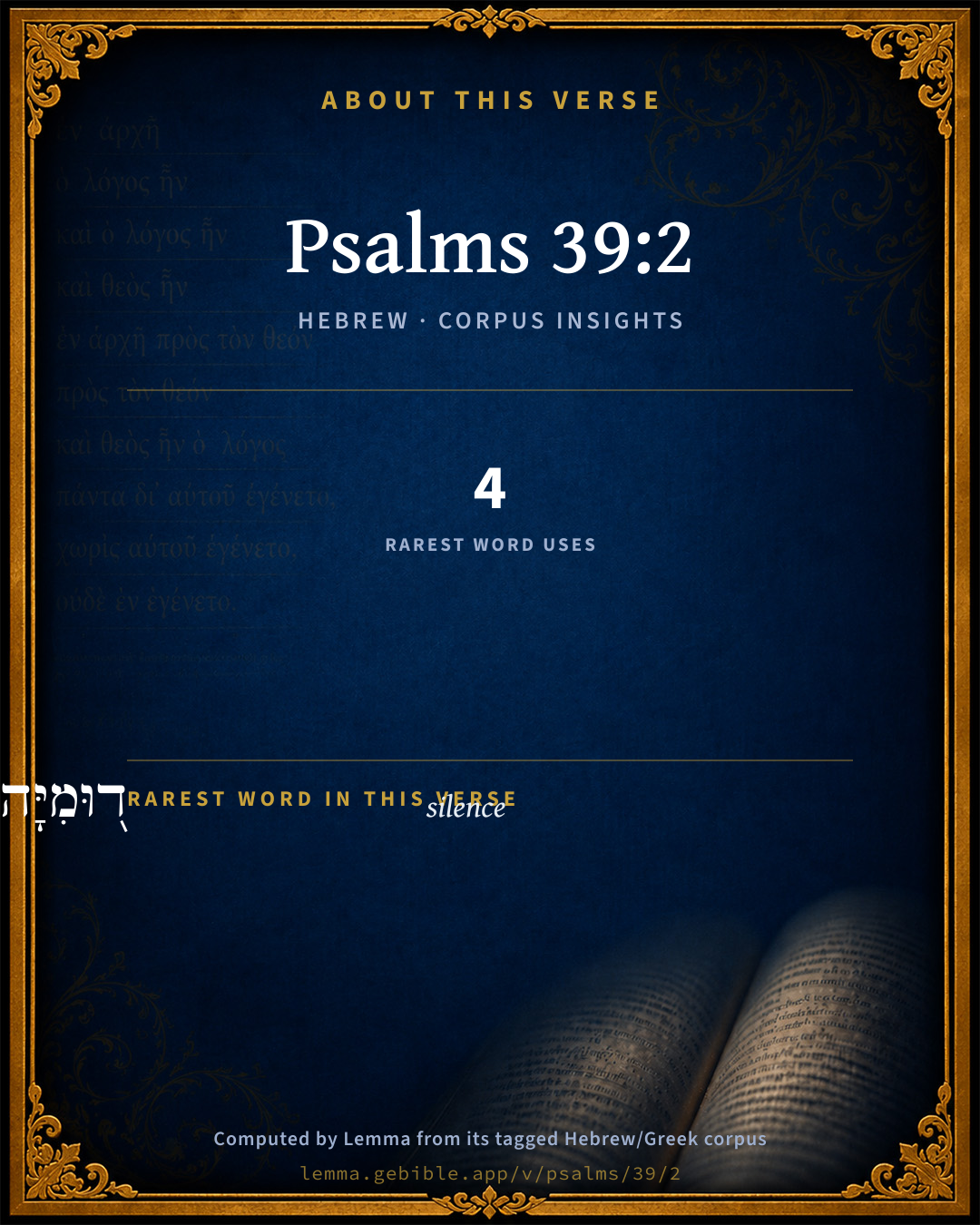
The rarest word here is ד֭וּמִיָּה silence H1747 — appearing just 4 times in the whole Hebrew Bible.

Shared distinctive vocabulary

ד֭וּמִיָּה silence H1747 occurs in 4 verses of the Hebrew Bible. Also found in:

Grammatical profile

  • 3 verbs
  • 2 nouns
  • 1 adjective

Verb forms

  • נֶאֱלַ֣מְתִּי Niphal · Perfect
  • הֶחֱשֵׁ֣יתִי Hiphil · Perfect
  • נֶעְכָּֽר Niphal · Perfect

Hebrew & Septuagint length

In English translation the verse runs 16 words from the Hebrew and 17 from the Septuagint (LXX English) — closely comparable.

A rough comparison of the two English renderings, which tokenize alike — not a word-level alignment.

Word counts can differ between the Hebrew and the Greek without any difference in meaning — e.g. the Hebrew direct-object marker אֵת has no separate Greek word, and Greek often adds the article ὁ.

Cross-references

6

Topical passages linked to Psalms 39:2 in the Treasury of Scripture Knowledge — connected by theme and wording, ordered by reader-vote popularity; previews shown in the World English Bible.

  • Acts 4:20 for we can't help telling the things which we saw and heard."
  • Psalms 38:13–14 But I, as a deaf man, don't hear. I am as a mute man who doesn't open his mouth.
  • Isaiah 53:7 He was oppressed, yet when he was afflicted he didn't open his mouth; as a lamb that is led to the slaughter, and as a sheep that before its shearers is mute, so he didn't open his mouth.
  • Matthew 27:12–14 When he was accused by the chief priests and elders, he answered nothing.
  • Job 32:19–20 Behold, my breast is as wine which has no vent; Like new wineskins it is ready to burst.
  • Matthew 7:6 "Don't give that which is holy to the dogs, neither throw your pearls before the pigs, lest perhaps they trample them under their feet, and turn and tear you to pieces.

Cross-references courtesy of OpenBible.info (CC BY 4.0).

Hebrew and Greek witnesses Masoretic Hebrew ↔ Greek Septuagint

The same verse in the two great witnesses to the Old Testament, shown verse-for-verse.

You’re reading Greek Psalm 38 (Hebrew Psalm 39). The Septuagint counts the superscription, so verse numbers can differ from the Hebrew — chapter-level alignment, not verse-by-verse. Numbering follows Rahlfs.

These are two independent witnesses, not word-aligned to each other, and the Septuagint is shown in lemma (dictionary) form.

Hebrew Psalms 39:2 Masoretic · Westminster Leningrad Codex

נֶאֱלַ֣מְתִּי ד֭וּמִיָּה הֶחֱשֵׁ֣יתִי מִטּ֑וֹב וּכְאֵבִ֥י נֶעְכָּֽר

I was mute with silence. I held my peace, even from good. My sorrow was stirred.

World English Bible · Public Domain

Greek LXX Greek Psalm 38:2 Septuagint · lemma form

εἶπον φυλάσσω ὁ ὁδός ἐγώ ὁ μή ἁμαρτάνω ἐν γλῶσσα ἐγώ τίθημι ὁ στόμα ἐγώ φυλακή ἐν ὁ συνἵστημι ὁ ἁμαρτωλός ἐναντίον ἐγώ

I was dumb, and humbled myself, and kept silence from good words; and my grief was renewed.

LXX2012 (modern English Septuagint) · Public Domain

On this verse, Ellicott's Commentary for English Readers discusses the Septuagint’s reading. Read the note in Commentary ↓

Hebrew: Westminster Leningrad Codex (CC BY 4.0). Greek: Septuagint (public domain); English from LXX2012 (modern English Septuagint) (Public Domain). How the Septuagint differs from the Hebrew →

Commentary

Notes on Psalms 39:2 from classic Christian and Jewish commentators (each source and its license shown beneath its notes). The classic Christian expositions comment on the surrounding passage and are grouped to its opening verse, so a note may address several verses; the Jewish commentaries on the Tanakh (Rashi and others) are per-verse, so they appear only where the commentator wrote on this verse.

Lemma curates 59 commentaries, every one of them public domain or Creative Commons licensed, each selected and text-cleaned for this edition rather than reprinted as found. About our sources →

Trapp's Complete Commentary

John Trapp

Psa 39:2 I was dumb with silence, I held my peace, [even] from good; and my sorrow was stirred.

Ver. 2. I was dumb with silence] As not willing either to open the mouths of those dead dogs or to cast pearls before those sensual swine.

I held my peace, even from good] That good which I might have spoken in mine own defence and their reproof, ne miscerem illud cum malo, saith one, lest some evil should be mingled with it; as mud and gravel is with the clear water that runs down a current. Intellige de bono licito, non de bono necessario et praecepto.

And my sorrow was stirred] Heb. troubled; though I had somewhat to do to do it. Corruption must be curbed and kept in by violence, Jas 1:26.

Hanc fraenis, hanc tu compesce catenis.

John Trapp, A Commentary or Exposition upon All the Books of the Old and New Testament (1647–1656) — public domain. Text from a community e-Sword module.

The Biblical Illustrator

Joseph S. Exell

Psa_39:2

I was dumb with silence.

Silence: sinful and sacred

Was David right in keeping silence even from good? Matthew Henry remarks, Was it his wisdom that he refrained from good discourse when the wicked were before him, because he would not cast pearls before swine? I rather think it was his weakness. The same law which forbids all corrupt communications requires that which is good to the use of edifying. Commendable virtues may be practised so eagerly as to degenerate into vices. Silence may indicate the greatest strength of character, or the greatest weakness.

I. To be dumb with silence may be a great sin. It often involves--

1. Neglect of duty. Our tongues and voices were given us quite as much for the purpose of making vocal the praises of God, as to hold converse with one another. Shall we be so indebted to God for all His mercies and never render to Him our praise? Nature is ever vocal with adorations to our King. His praise finds expression on every hand, The birds warble it, in deep bass the seas roar it, the stars shine it, the flowers with sweet perfume breathe it, mighty winds and gentle zephyrs chant it, spring, summer, autumn, winter, are four choristers from which ascend but four parts of one glad anthem. And yet how often man remains dumb with guilty silence amid the myriad harmonious voices around him. We are often silent, also, when we should speak for God. We fear to confess Him though He calls upon us to be His witnesses. Oh, that you could feel the sin of your reticence; the criminality of sealed lips! A silent religion, or a speaking religion, Christian professor, which shall it be?

2. The permission afforded us of speaking for Christ should be looked upon in the light of a high privilege as well as a solemn duty. We cannot but speak the things which we have seen and heard.

3. Our sinful silence often involves a loss of personal blessing.

II. But silence is often a virtue. When David was overwhelmed with a sense of Gods mercy as expressed in Nathans message (2Sa_7:18), his sense of obligation to God was so great, that he felt his soul big with emotions to which he could scarce give expression, so he sat before the Lord, overpowered with the weight of blessing. Have not we often felt our souls tremulous with an adoration our lips could not express? When we have sought fellowship with our Lord in His sufferings and mused upon His unknown agonies. The silent growth and secret development of character is most acceptable to God. Many Christians are yielding Him greater praise by the silent yet mighty influence of a sanctified character, than others who are loud in talk yet less circumspect in life. All growth is silent. The tree rises year by year without any noise. Contrast the building of the tower of Babel and that of the temple, which, Like some tall palm the noiseless fabric sprung. Think, too, of silent prayer; and of sweet and gracious submission. How exalted is that Christians attainment who can be silent while man persecutes. To me no portion of the story of our Saviours life on earth is more convincing in its proof of His Deity than His submission to His cruel persecutors--When reviled, He reviled not again; when buffeted, He threatened not. Here is Divinity indeed. Omnipotence restrains omnipotence. Let us seek grace to imitate Him. (W. Williams.)

The Biblical Illustrator, edited by Joseph S. Exell (c. 1880s–1900s) — public domain. Text from a community e-Sword module.

The Treasury of David

Charles H. Spurgeon

Ver. 2. I was dumb with silence. He was as strictly speechless as if he had been tonguelessnot a word escaped him. He was as silent as the dumb. I held my peace, even from good. Neither bad nor good escaped his lips. Perhaps he feared that if he began to talk at all, he would be sure to speak amiss, and, therefore, he totally abstained. It was an easy, safe, and effectual way of avoiding sin, if it did not involve a neglect of the duty which he owed to God to speak well of his name. Our divine Lord was silent before the wicked, but not altogether so, for before Pontius Pilate he witnessed a good confession, and asserted his kingdom. A sound course of action may be pushed to the extreme, and become a fault. And my sorrow was stirred. Inward grief was made to work and ferment by want of vent. The pent up floods are swollen and agitated. Utterance is the natural outlet for the heart's anguish, and silence is, therefore, both an aggravation of the evil and a barrier against its cure. In such a case the resolve to hold one's peace needs powerful backing, and even this is most likely to give way when grief rushes upon the soul. Before a flood gathering in force and foaming for outlet the strongest banks are likely to be swept away. Nature may do her best to silence the expression of discontent, but unless grace comes to her rescue, she will be sure to succumb.

Ver. 2. I was dumb with silence, etc. That is, for a while I did what I resolved; I was so long wholly silent, that I seemed in a manner to be dumb, and not able to speak. I held my peace, even from good; that is, I forbore to speak what I might well and lawfully enough have spoken, as from alleging anything that I might have said in mine own defence, from making my complaint to God, and desiring justice at his hands, and such like; to wit, lest by degrees I should have been brought to utter anything that was evil, and whilst I intended only to speak that which was good, some unseemly word might suddenly slip from me; or lest mine enemies should misconstrue anything I spake. Arthur Jackson.

Ver. 2. I was dumb with silence. We shall enquire what kind of dumbness or silence this of the psalmist was, which he is commended for, and which would so well beseem us when we smart under the rod of God, and then the doctrine will be, in a great measure, evident by its own light. We shall proceed to our inquiry, 1. Negatively, to prevent mistakes. 2. Positively, and show you what it doth import. First, negatively. 1. This dumbness doth not import any such thing, as if the prophet had been brought to that pass that he had nothing to say to God by way of prayer and supplication. He was not so dumb, but that he could pray and cry too. Ps 39:8, 10-11. 2. Nor was he so dumb, as that he could not frame to the confession and bewailing of his sins. 3. Nor was it a dumbness of stupidity and senselessness. It doth not imply any such thing, as if by degrees he grew to that pass, he cared not for, or made no matter of his affliction, but set, as the proverb is, an hard heart against his hard hap. No, he did make his moan to God, and as he smarted, so he did lament under the sense of his afflicting hand.

4. Neither was he so dumb as not to answer God's voice in the rod that was upon him. 5. Much less was he dumb, and kept silence in any such sort as they did of whom Amos speaks Am 6:10, that in their misery they took up a resolution to mention the name of God no more, in whom they had gloried formerly. Secondly, affirmatively.

1. He was dumb so as neither to complain of, nor quarrel with God's providence, nor to entertain any hard thoughts against him. Complain to God he did; but against him he durst not. 2. He neither did nor durst quarrel, or fall out with the ways of holiness for all his sufferings, a thing we are naturally prone unto. 3. He was dumb, so as not to defend himself, or justify his own ways before God, as if they were righteous, and he had not deserved what he suffered. 4. He was dumb, so as to hearken to the voice of the rod. "I will (saith he in another place) hear what God the Lord will speak." Ps 85:8. Now a man cannot listen to another while he will have all the talk and discourse to himself. 5. Lastly, the prophet was dumb, that is, he did acquiesce, and rest satisfied with God's dispensation; and that not only as good, but as best. Condensed from a Funeral Sermon by Thomas Burroughes, B.D., entitled, "A Sovereign Remedy for all kinds of Grief, "1657.

Ver. 2. I held my peace. A Christian being asked what fruit he had by Christ: Is not this fruit, said he, not to be moved at your reproaches? In cases of this nature, we must refer all to God; si tu tacueris, Deus loquitur; if thou hold thy peace, God speaks for thee; and if God speaks for us, it is better than we can speak for yourselves. David saith, Obmutui, quia tu fecisti. I held my peace, for it was thy doing. Christopher Sutton, B.D., 1629, in Disce Vicere.

Ver. 2-9. An invalid who had been ordered a couple of pills, took them very absurdly, for, in place of swallowing them at once, he rolled them about in his mouth, ground them to pieces, and so tasted their full bitterness. Gotthold was present, and thus mused. The insults and calumnies of a slanderer and adversary are bitter pills, and all do not understand the art of swallowing without chewing them. To the Christian, however, they are wholesome in many ways. They remind him of his guilt, they try his meekness and patience, they show him what he needs to guard against, and at last they redound to his honour and glory in the sight of him for whose sake they were endured. In respect of the pills of slander, however, as well as the others, it is advisable not to roll them about continually in our minds, or judge of them according to the flesh, and the world's opinion. This will only increase their bitterness, spread the savour of it to the tongue, and fill the heart with proportional enmity. The true way is to swallow, keep silence, and forget. We must inwardly devour our grief, and say, I will be dumb, and not open my mouth, because thou didst it. The best antidotes to the bitterness of slander, are the sweet promises and consolations of Scripture, of which not the least is this, "Blessed are ye, when men shall revile you, and persecute you, and shall say all manner of evil against you falsely, for my sake. Rejoice, and be exceeding glad: for great is your reward in heaven." Mt 5:11-12. Alas, my God! how hard it is to swallow the pills of obloquy, to bless them that curse me, to do good to them that hate me, and to pray for them that despitefully use me! But, Lord, as thou wilt have it so, give it as thou wilt have it, for it is a matter in which, without thy grace, I can do nothing! Christian Scriver.

Ver. 2. There is a sevenfold silence.

1. A stoical silence.

2. A politic silence.

3. A foolish silence.

4. A sullen silence.

5. A forced silence.

6. A despairing silence.

7. A prudent, a holy, a gracious silence.

Thomas Brooks' "Mute Christian."

Psalms 39:3*

Ver. 2-9. See Psalms on "Ps 39:2" for further information.

Ver. 2-9. See Psalms on "Ps 39:2" for further information.

Ver. 2-9. See Psalms on "Ps 39:2" for further information.

Ver. 2-9. See Psalms on "Ps 39:2" for further information.

Ver. 2-9. See Psalms on "Ps 39:2" for further information.

Ver. 2-9. See Psalms on "Ps 39:2" for further information.

Ver. 2-9. See Psalms on "Ps 39:2" for further information.

Charles H. Spurgeon's The Treasury of David (1869–1885) — public domain. Psalms only. Text from a community e-Sword/MySword module.

Joseph Benson's Commentary

Psa 39:2. I was dumb with silence — Or, I was dumb in silence; two words expressing the same thing with greater force. I held my peace even from good — I spake not a word, either good or bad, but remained, like a dumb man, in perfect silence. I refrained even from giving God the glory, with respect to my illness, by acknowledging his greatness and justice, and the nothingness and sinfulness of man. Perhaps the reason why he would not speak at all before his enemies was, because he was unwilling to give them an occasion of triumph, as he thought he should do if he acknowledged his weakness and sin. But he could not bear this restraint long; it became more and more grievous. My sorrow, he says, was stirred — My silence did not assuage my grief, but increased it, as it naturally and commonly does. “There is a time to keep silence,” says Dr. Horne, “because there are men who will not hear; there are tempers, savage and sensual, as those of swine, before whom evangelical pearls, or the treasures of heavenly wisdom, are not to be cast. This consideration stirreth up fresh grief and trouble in a pious and charitable heart.”

Joseph Benson's Commentary on the Old and New Testaments (1811–1818) — public domain. Text from a community e-Sword module.

J. A. Alexander on Psalms

Joseph Addison Alexander

3. (Psa 39:2). I was silenced (with) dumbness; I held my peace from good, and my sorrow was stirred. The first clause is highly idiomatic, but the sense is clear, to wit, that he enjoined the strictest silence on himself, in reference to the providential mysteries which excited his envious discontent. The silence meant is abstinence from murmurs and repining against God. The second clause is obscure. From good is understood by some to mean from every thing, because that idea is elsewhere expressed by the idiomatic combination, good or evil. See Gen 31:24; Gen 31:29, 2Sa 13:22. But the antithesis in all such cases is essential, and the omission of one term destroys the meaning. Others give from a negative or privative sense, away rom good, without good, i. e. without any good effect. But the simplest construction is the one given in the English Bible, even from good, or more fully in the Prayer-Book version, yea, even from good words. The meaning then is, that in his anxiety to avoid the language of complaint against God, lie was silent altogether, and suppressed even what he might have said without sin, or was in duty bound to say. The natural effect was that his inward grief, instead of being soothed, was roused, excited, and exasperated.

Joseph Addison Alexander, The Psalms Translated and Explained (1850) — public domain. Text from a community e-Sword module.

Geneva Bible (1599)

Geneva Bible translators

Though when the wicked ruled, he thought to have kept silence, yet his zeal caused him to change his mind.

Geneva Bible (1599) marginal notes — public domain. Text via Bolls.life.

Jamieson, Fausset & Brown

Robert Jamieson, A. R. Fausset & David Brown

even from good-- (Gen 31:24), everything.

Jamieson, Fausset & Brown — Commentary Critical and Explanatory on the Whole Bible (1871) — public domain (CC PDM 1.0). Text via the HelloAO Bible API.

Adam Clarke's Commentary

Verse 2. I held any peace, even from good] "I ceased from the words of the law," says the Chaldee. I spoke nothing, either good or bad. I did not even defend myself.

My sorrow was stirred.] My afflictions increased, and I had an exacerbation of pain. It is a hard thing to be denied the benefit of complaint in sufferings, as it has a tendency to relieve the mind, and indeed, in some sort, to call off the attention from the place of actual suffering: and yet undue and extravagant complaining enervates the mind, so that it becomes a double prey to its sufferings. On both sides there are extremes: David seems to have steered clear of them on the right hand and on the left.

Adam Clarke's Commentary on the Bible (1810–1826) — public domain. Text from a community e-Sword/MySword module.

John Calvin's Commentaries

2. I was dumb in silence. He now declares that this resolution of which he has spoken had not been a mere passing and momentary thought, but that he had shown by his conduct that it was indeed a resolution deeply fixed in his heart. He says, then, that he held his peace for a time, just as if he had been deaf, which was a singular manifestation of his patience. When he thus determined to be silent, it was not such a resolution as persons of a changeable disposition, who scarcely ever know their own mind, and who can with difficulty be brought to carry their desires into effect, often make: he had long and steadfastly inured himself to the exercise of patience; and this he had done, not only by keeping silence but by making himself utterly dumb, as if he had been deprived of the power of speech. The expression from good is expounded by some in the sense that he not only refrained from uttering sinful and unadvised words, but also that he abstained from speaking on any subject whatever. Others think that he held his peace from good, either because, being overwhelmed with miseries and afflictions, he found no relief to whatever side he turned, or else, because, by reason of the greatness of his sorrow, he was unable to sing the praises of God. But in my opinion the natural sense is, that although he was able adequately to defend himself, and it could not be shown that he wanted just and proper grounds of complaint, yet he refrained from speaking of his own mere will. He might have encountered the ungodly with a good defense of his own innocence, but he rather preferred to forego the prosecution of his righteous cause than indulge in any intemperate sorrow. He adds in the last clause of the verse, that although he thus restrained himself for a time, yet at length the violence of his grief broke through all the barriers which he had set to his tongue. If David, who was so valiant a champion, failed in the midst of his course, how much greater reason have we to be afraid lest we fall in like manner? He says that his sorrow was stirred, because, as we shall soon see, the ardor of his affections was inflamed so as to become tumultuous. Some render the phrase in this sense, that his sorrow was corrupted, as if his meaning were, that it became worse; just as we know that a wound becomes worse when it happens to putrify or fester: but this sense is forced.

John Calvin's Commentaries (1540-1563) — public domain. Text from the Calvin Translation Society English edition (1840s-50s) via the Christian Classics Ethereal Library (ccel.org). Calvin's coverage is partial (roughly two-thirds of the Bible); uncommented books and verses are honest gaps, never fabricated. The 19th-century editor's footnotes and remarks are omitted so the notes are faithfully Calvin's own voice.

Ellicott's Commentary for English Readers

(2) Even from good.—This interpretation, while following the LXX., Vulg., and most ancient versions, is suspicious, since the particle, rendered from, is not generally used in this sense after a verb expressing silence. Indeed there is only one instance which at all supports this rendering (1Ki_22:3, margin). Nor does the context require or even admit it. If the bright side of things had been so evident that he could speak of it the Psalmist would not have feared reproach for doing so, nor was there cause for his silence “as to the law,” the rabbinical mode of explaining the passage. The obvious translation makes the clause parallel with that which follows: “I held my peace without profit. My sorrow was increased,” i.e., instead of lessening my grief by silence, I only increased it.

Stirred.—The LXX. and Vulg. “renewed,” which is nearer the meaning than either the Authorised Version or margin.

A Bible Commentary for English Readers, edited by Charles John Ellicott (1878–1897) — public domain. Text from a community e-Sword module.

The Cambridge Bible for Schools and Colleges

gen. ed. J. J. S. Perowne

2. silence] The word carries with it the idea of mute submission. Cp. Psa_62:1; Psa_37:7; Lam_3:26.

even from good] I kept absolute silence, speaking neither good nor bad (Gen_31:24). Less probably as R.V. marg., and had no comfort.

my sorrow was stirred] The effort to suppress his feelings only aggravated the pain. Cp. Psa_32:3. So Ovid, Trist. v. 1. 63, ‘Strangulat inclusus dolor atque exaestuat intus.’

The Cambridge Bible for Schools and Colleges (gen. ed. J. J. S. Perowne; Cambridge University Press, 1878–1918) — public domain. Text from a community e-Sword module.

John Gill's Exposition

I was dumb with silence,.... Quite silent, as if he had been a dumb man, and could not speak; so he was before men, especially wicked men, and under the afflicting hand of God; see Psa 39:9; thus he put his resolution into practice;

I held my peace, even from good; that is, he said neither good nor bad: this expresses the greatness of his silence: he did not choose to open his lips, and say anything that was good, lest evil should come out along with it; though this may be considered as carrying the matter too far, even to a criminal silence; saying nothing of the affliction he laboured under as coming from the hand of God, and of his own desert of it; nor praying to God for the removal of it, nor giving him thanks for his divine goodness in supporting him under it, and making it useful to him; though it seems rather to have respect to his silence concerning the goodness of his cause before men; he said not one word in the vindication of himself; but committed his cause to him that judgeth righteously. The Targum and Jarchi interpret it of his silence and cessation "from the words of the law": he said nothing concerning the good word of God; which sense, could it be admitted, the words in Jer 20:9; might be compared with these and the following;

and my sorrow was stirred; this was the issue and effect of his silence; his sorrow being pent up, and not let out and eased by words, swelled and increased the more; or the sorrow of his heart was stirred up at the insults and reproaches of his enemies, as Paul's spirit was stirred up by the superstition and idolatry of the city of Athens, Act 17:16.

John Gill's Exposition of the Whole Bible (1746–1763) — public domain (CC PDM 1.0). Text via the HelloAO Bible API.

Albert Barnes' Notes on the Bible

I was dumb with silence - Compare Psa 38:13. The addition of the words “with silence,” means that he was entirely or absolutely mute; he said nothing at all. The idea is, that he did not allow himself to give utterance to the thoughts which were passing in his mind in regard to the divine dealings. He kept his thoughts to himself, and endeavored to suppress them in his own bosom.

I held my peace, even from good - I said nothing. I did not even say what I might have said in vindication of the ways of God. I did not even endeavor to defend the divine character, or to explain the reasons of the divine dealings, or to suggest any considerations which would tend to calm down the feelings of complaint and dissatisfaction which might be rising in the minds of other men as well as my own.

And my sorrow was stirred - The anguish of my mind; my trouble. The word “stirred” here, rendered in the margin “troubled,” means that the very fact of attempting to suppress his feelings - the purpose to say nothing in the case - was the means of increased anguish. His trouble on the subject found no vent for itself in words, and at length it became so insupportable that he sought relief by giving utterance to his thoughts, and by coming to God to obtain relief. The state of mind referred to here is that which often occurs when a man broods over his own troubled thoughts, and dwells upon things which are in themselves improper and rebellious. We are under no necessity of endeavoring to vindicate the psalmist in what he here did; nor should we take his conduct in this respect as our example. He evidently himself, on reflection, regarded this as wrong; and recorded it not as a pattern for others, but as a faithful transcript of what was passing at the time through his own mind. Yet, wrong as it was, it was what often occurs even in the minds of good men. Even they, as in the cases referred to above, often have thoughts about God and his dealings which they do not dare to express, and which it would do harm to express. They, therefore, hide them in their own bosom, and often experience just what the psalmist did - increased trouble and perplexity from the very purpose to suppress them. They should go at once to God. They may say to him what it would not be proper to say to men. They may pour out all their feelings before him in prayer, with the hope that in such acts of praying, and in the answers which they will receive to their prayers, they may find relief.

Albert Barnes' Notes on the Bible (1834–1885) — public domain. Text from a community e-Sword/MySword module.

Matthew Poole's English Annotations

I was dumb with silence; I was so long and so obstinately silent, that I seemed to myself and to others to be dumb. Two words put together expressing the same thing, to aggravate or increase it. Or, I was dumb with quietness, i.e. not out of sullenness, but with submissiveness to God’s dispensations, which is oft noted by silence.

I held my peace, even from good; I forbore to speak what I justly might upon that occasion, lest the flood-gates of speech being once opened, and speech stirring up my passion, I should by degrees break forth into some indecent and sinful expressions, to the dishonour of God, the wounding of mine own conscience, and the offence of others. or this may be a proverbial speech, signifying strict silence; like that Gen 31:29, speak to him neither good nor bad, i.e. nothing at all, to wit, about that matter, to persuade him to return.

My sorrow was stirred; my silence did not assuage my grief, but increase it, as it naturally and commonly doth.

Matthew Poole's English Annotations on the Holy Bible (1683–1685) — public domain. Text from a community e-Sword/MySword module.

The Pulpit Commentary

I was dumb with silence, I held my peace, even from good. Some explain, "I held my peace, but it did me no good I was none the better for it" (Hupfeld, Hengstenberg, Canon Cook); others adopt the Prayer-book Version, I kept silence even from good words" (Kay, Alexander, Revised Version). And my sorrow was stirred. The pain at my heart was not quieted thereby, nor even lessened; rather, it was roused up, quickened, and aggravated. This is the natural result of repressing any strong feeling.

The Pulpit Commentary (1880–1919), ed. H.D.M. Spence-Jones & Joseph S. Exell — public domain. Text from a community e-Sword module.

John Wesley's Explanatory Notes

Dumb - Two words put together, expressing the same thing, to aggravate or increase it. I held - I forbear to speak, what I justly might, lest I should break forth into some indecent expressions. Stirred - My silence did not assuage my grief, but increase it.

John Wesley, Explanatory Notes Upon the Whole Bible (1754–1765) — public domain. Text via the GEBible commentary corpus.

unfoldingWord translationNotes

Door43 World Missions Community

I kept silent; I kept back my words

These two phrases mean the same thing and emphasize that the writer did not speak at all. AT: "I was completely silent" (See: Doublet)

I kept back my words

"I did not speak"

My heart became hot ... it burned like a fire

Here "heart" represents the whole person. The anxious thoughts of the writer are spoken of as if they were a fire burning inside him. AT: "I became very anxious when I thought about these things" (See: Synecdoche and Metaphor)

translationWords

word

heart

fire

unfoldingWord translationNotes — © Distant Shores Media and the Door43 World Missions Community, licensed CC BY-SA 4.0. Source: git.door43.org/Door43/en_tn.

Rashi

Rabbi Shlomo Yitzchaki (Rashi)

I said, “I will guard my ways, etc.” As for us—we had in mind to watch ourselves with all the troubles that come upon us, neither to criticize nor speak harshly of the Divine Attribute of Justice although the wicked who oppress us are before us.

a muzzle Heb. מחסם, as (in Deut. 25:4): “You shall not muzzle (תחסם) an ox, amuzelment in Old French. And I made myself mute in silence many days. We also were silent from “good,” even from words of Torah, because of their fear of them, our pain was so intense and frightening. When we were silent, our heart was hot within us and in the thought of our heart it burns in us like fire. That causes us to speak with our tongue (in silence—not in all editions) before You, and this is what we say, “O Lord, let us know our end.” How long will we be in distress, and let us know when we will be over it.

Rashi on the Tanakh — English translations: “The Judaica Press complete Tanach with Rashi, translated by A. J. Rosenberg” (CC BY 4.0); “Pentateuch with Rashi's commentary by M. Rosenbaum and A.M. Silbermann, 1929-1934” (public domain); “The Metsudah Tanach series, Lakewood, N.J” (CC BY 4.0); and “The Book of Joshua, Metsudah Publications, 1997” (CC BY 4.0). Text via Sefaria.

Lesson kit

Teaching starters — assembled from the data on this page, not authored interpretation. Every prompt links to the verse data it draws on. Edit before teaching.

Psalms, in the Wisdom, opens this verse with 6 words (6 distinct Hebrew lemmas). Its most distinctive word is dûwmîyâh (“silence”). A historical commentator’s framing appears above. Read the whole chapter for the surrounding context.

Discussion questions

  1. The word dûwmîyâh carries the sense “silence.” How does it shape the verse?
  2. Psalms 22:2 shares the word «silence» with this verse. How do the two illuminate each other?
  3. The translations on this page render this verse differently — a whole-verse word diff, not a word-by-word alignment. What might account for the different wordings?
  4. The verb «נֶאֱלַ֣מְתִּי» is Niphal Perfect. How does its form color the action?
  5. Reading how Trapp's Complete Commentary and The Biblical Illustrator read this verse, where do the two commentators agree and where do they part?

Things to notice

Reading settings

Reading text

Shown beneath each verse's original-language words.

Old Testament
Old Testament edition

Read the OT as the Masoretic Hebrew (MT) or the Greek Septuagint (LXX).

English shown for the Greek Septuagint (in the Hebrew ↔ Greek comparison).

Comparing translations? Open the Compare panel on any verse page to stack up to four side by side.