
Psalms 21:4

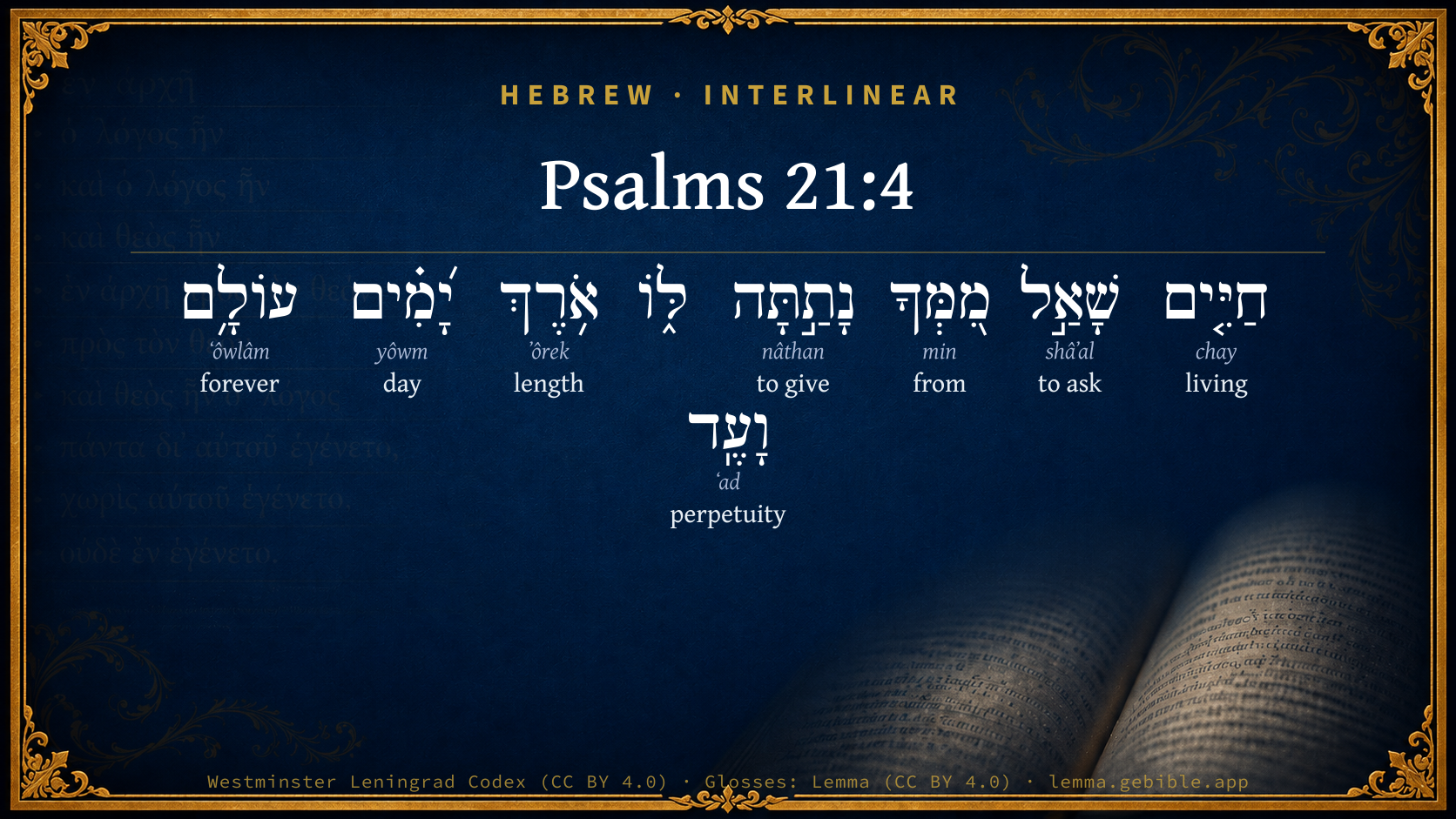
Hebrew (Westminster Leningrad Codex) Psalms 21:4 appears in the Hebrew Old Testament. The text above is from the Westminster Leningrad Codex. Each word links to its Strong’s number, a concise gloss, and parsing drawn from the Open Scriptures Hebrew Bible morphology. Click any word for its full Brown-Driver-Briggs (BDB) entry.
Download image
Cite this verse

Psalms 21:4 (World English Bible). Public Domain. Lemma interlinear Bible study tool, https://lemma.gebible.app/v/psalms/21/4.

Show BibTeX & RIS
BibTeX
RIS
English Translation
He asked life of you, you gave it to him, Even length of days forever and ever.
World English Bible · Public Domain
Download a study sheet

One document with this verse’s original text, its word-by-word gloss line, the meaning frame, cross-references with their text, attributed commentary, and full source and license credits — printable, and it pastes into notes with its structure intact.

This verse Autodidact and up

Study sheet (.html) Plain text (.txt)

A passage Seminary Student

Up to 50 verses in one chapter. A passage sheet keeps up to 6 commentary sources and 12 cross-references per verse, in the order this page ranks them, and says so on the sheet whenever that leaves anything out. Ask for a single verse and you get the Autodidact verse sheet above.

Everything on this page stays free to read, with no account — the sheet is a download of what is already on screen, not access to it.

Want to remove ads? Support Godless Engineer
Compare translations 3

The same verse in 3 English versions, stacked beneath the original-language interlinear above. Click any original word for its lexicon entry.

Each is an independent rendering of the whole verse — the interlinear is not word-aligned to these translations.

Highlighted words mark where these versions differ — a whole-verse word diff, not a word-by-word alignment.

  • World English Bible Public Domain
    He asked life of you, you gave it to him, Even length of days forever and ever.
  • King James Version Public Domain
    He asked life of thee, and thou gavest it him, even length of days for ever and ever.
  • unfoldingWord Literal Text CC BY-SA 4.0
    He asked life from you; you gave to him, length of days, forever and ever.

unfoldingWord Literal Text — © unfoldingWord, licensed CC BY-SA 4.0. Word-aligned USFM3 via Door43 (git.door43.org/unfoldingWord/en_ult).

Versions to compare (up to 4)

3 of 4 selected

Show all 18 translations

Every available English version of this verse, each an independent rendering of the whole verse.

  • World English Bible Public Domain
    He asked life of you, you gave it to him, Even length of days forever and ever.
  • Berean Standard Bible Public Domain
    He asked You for life, and You granted it—length of days, forever and ever.
  • Majority Standard Bible Public Domain
    He asked You for life, and You granted it—length of days, forever and ever.
  • King James Version Public Domain
    He asked life of thee, and thou gavest it him, even length of days for ever and ever.
  • American Standard Version (1901) Public Domain
    He asked life of thee, thou gavest it him, Even length of days for ever and ever.
  • Revised Version (1885) Public Domain
    He asked life of thee, thou gavest it him; even length of days for ever and ever.
  • Geneva Bible (1599) Public Domain
    He asked life of thee, and thou gauest him a long life for euer and euer.
  • Douay-Rheims (1899) Public Domain
    For thou hast prevented him with blessings of sweetness: thou hast set on his head a crown of precious stones.
  • Young's Literal Translation Public Domain
    Life he hath asked from Thee, Thou hast given to him -- length of days, Age-during -- and for ever.
  • Literal Standard Version CC BY-SA 4.0
    He has asked for life from You, || You have given length of days to him, || For all time and forever.
  • Unlocked Literal Bible CC BY-SA 4.0
    He asked you for life; you gave it to him; you gave him long days forever and ever.
  • unfoldingWord Literal Text CC BY-SA 4.0
    He asked life from you; you gave to him, length of days, forever and ever.
  • Darby Bible Public Domain
    He asked life of thee; thou gavest [it] him, length of days for ever and ever.
  • World Messianic Bible Public Domain
    He asked life of you and you gave it to him, even length of days forever and ever.
  • Webster's Bible Public Domain
    \\21:3\\For thou hast met him with the blessings of goodness: thou hast set a crown of pure gold on his head.
  • Free Bible Version CC BY-SA 4.0
    He asked you to give him a good life, and you gave him a long life, forever and ever.
  • Bible in Basic English Public Domain
    He made request to you for life, and you gave it to him, long life for ever and ever.
  • JPS Tanakh (1917) Public Domain
    (21-5) He asked life of Thee, Thou gavest it him; even length of days for ever and ever.

Literal Standard Version (2020), Covenant Press — licensed CC BY-SA 4.0. Text via the HelloAO Bible API (eBible.org). Unlocked Literal Bible (unfoldingWord) — licensed CC BY-SA 4.0. Text via the HelloAO Bible API (eBible.org). unfoldingWord Literal Text — © unfoldingWord, licensed CC BY-SA 4.0. Word-aligned USFM3 via Door43 (git.door43.org/unfoldingWord/en_ult). Free Bible Version, Dr. Jonathan Gallagher — licensed CC BY-SA 4.0. Text via the HelloAO Bible API (eBible.org).

Word by word

More ways to search: Search by grammar → Find every occurrence → Compare this word →

Practice this passage: Drill this verse → Learn its vocabulary →

וָעֶֽד
ʻad
H5703
“and · perpetuity”
Conjunction + Noun, Common, Masculine, Singular, Absolute
Part of Speech
Conjunction + Noun
Type
Common
Gender
Masculine
Number
Singular
State
Absolute
Full BDB Definition

Origin: from H5710

TWOT: 1565a

perpetuity, for ever, continuing future - ancient (of past time) - for ever (of future time) - of continuous existence - for ever (of God's existence)
  1. חַיִּ֤ים chay H2416 “living things” Noun, Common, Masculine, Plural, Absolute
  2. שָׁאַ֣ל shâʼal H7592 “to ask” Verb, Qal, Perfect, 3rd Person, Masculine, Singular
  3. מִ֭מְּךָ min H4480 “from · you” Preposition + Suffix, Personal, 2nd Person, Masculine, Singular
  4. נָתַ֣תָּה nâthan H5414 “to give” Verb, Qal, Perfect, 2nd Person, Masculine, Singular
  5. אֹ֥רֶךְ ʼôrek H753 “length of” Noun, Common, Masculine, Singular, Construct
  6. יָ֝מִ֗ים yôwm H3117 “days” Noun, Common, Masculine, Plural, Absolute
  7. עוֹלָ֥ם ʻôwlâm H5769 “forever” Noun, Common, Masculine, Singular, Absolute

About this verse

These counts appear in no published source. They are computed here, from the morphology-tagged text and Lemma’s own curated glosses. What Lemma adds →

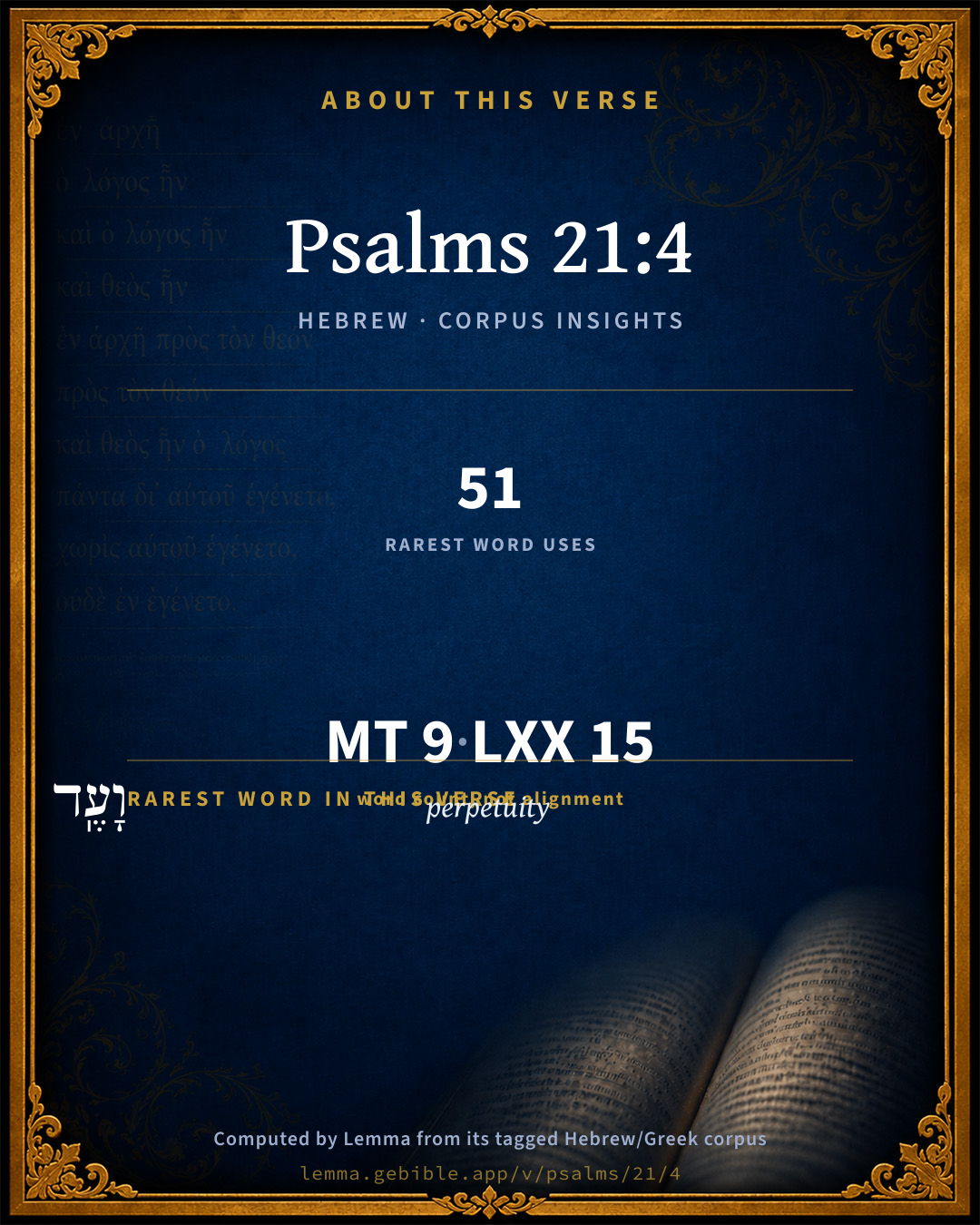
9
words
8
distinct lemmas
Wisdom
section

Shared distinctive vocabulary

וָעֶֽד perpetuity H5703 occurs in 49 verses of the Hebrew Bible. Also found in:

Grammatical profile

  • 2 verbs
  • 5 nouns
  • 2 prepositions

Verb forms

  • שָׁאַ֣ל Qal · Perfect
  • נָתַ֣תָּה Qal · Perfect

Hebrew & Septuagint length

In English translation the verse runs 17 words from the Hebrew and 16 from the Septuagint (LXX English) — closely comparable.

A rough comparison of the two English renderings, which tokenize alike — not a word-level alignment.

Word counts can differ between the Hebrew and the Greek without any difference in meaning — e.g. the Hebrew direct-object marker אֵת has no separate Greek word, and Greek often adds the article ὁ.

In the original languages it is 9 Hebrew tokens and 15 Greek tokens — but the two are counted differently (Hebrew bundles its prefixes and suffixes into one token; the Greek is in lemma form), so that isn’t a like-for-like length.

Cross-references

11

Topical passages linked to Psalms 21:4 in the Treasury of Scripture Knowledge — connected by theme and wording, ordered by reader-vote popularity; previews shown in the World English Bible.

  • Psalms 91:16 I will satisfy him with long life, And show him my salvation."
  • Revelation 1:18 and the Living one. I was dead, and behold, I am alive forevermore. Amen. I have the keys of Death and of Hades.
  • Psalms 119:77 Let your tender mercies come to me, that I may live; For your law is my delight.
  • Psalms 61:5–6 For you, God, have heard my vows. You have given me the heritage of those who fear your name.
  • Psalms 133:3 Like the dew of Hermon, That comes down on the hills of Zion: For there Yahweh gives the blessing, Even life forevermore.
  • Psalms 89:29 I will also make his seed endure forever, And his throne as the days of heaven.
  • Psalms 89:36–37 His seed will endure forever, His throne like the sun before me.
  • Psalms 119:175 Let my soul live, that I may praise you. Let your ordinances help me.
  • Psalms 13:3 Behold, and answer me, Yahweh, my God. Give light to my eyes, lest I sleep in death;
  • Psalms 16:10–11 For you will not leave my soul in Sheol, Neither will you allow your holy one to see corruption.
  • Psalms 72:17 His name endures forever. His name continues as long as the sun. Men shall be blessed by him. All nations will call him blessed.

Cross-references courtesy of OpenBible.info (CC BY 4.0).

Hebrew and Greek witnesses Masoretic Hebrew ↔ Greek Septuagint

The same verse in the two great witnesses to the Old Testament, shown verse-for-verse.

You’re reading Greek Psalm 20 (Hebrew Psalm 21). The Septuagint counts the superscription, so verse numbers can differ from the Hebrew — chapter-level alignment, not verse-by-verse. Numbering follows Rahlfs.

These are two independent witnesses, not word-aligned to each other, and the Septuagint is shown in lemma (dictionary) form.

Hebrew Psalms 21:4 Masoretic · Westminster Leningrad Codex

חַיִּ֤ים שָׁאַ֣ל מִ֭מְּךָ נָתַ֣תָּה לּ֑וֹ אֹ֥רֶךְ יָ֝מִ֗ים עוֹלָ֥ם וָעֶֽד

He asked life of you, you gave it to him, Even length of days forever and ever.

World English Bible · Public Domain

Greek LXX Greek Psalm 20:4 Septuagint · lemma form

ὅτι προφθάνω αὐτός ἐν εὐλογία χρηστότης τίθημι ἐπί ὁ κεφαλή αὐτός στέφανος ἐκ λίθος τίμιος

He asked life of you, and you gave him length of days for ever and ever.

LXX2012 (modern English Septuagint) · Public Domain

Hebrew: Westminster Leningrad Codex (CC BY 4.0). Greek: Septuagint (public domain); English from LXX2012 (modern English Septuagint) (Public Domain). How the Septuagint differs from the Hebrew →

Commentary

Notes on Psalms 21:4 from classic Christian and Jewish commentators (each source and its license shown beneath its notes). The classic Christian expositions comment on the surrounding passage and are grouped to its opening verse, so a note may address several verses; the Jewish commentaries on the Tanakh (Rashi and others) are per-verse, so they appear only where the commentator wrote on this verse.

Lemma curates 59 commentaries, every one of them public domain or Creative Commons licensed, each selected and text-cleaned for this edition rather than reprinted as found. About our sources →

Trapp's Complete Commentary

John Trapp

Psa 21:4 He asked life of thee, [and] thou gavest [it] him, [even] length of days for ever and ever.

Ver. 4. He asked life of thee] Quando fugiebat a Saule, saith R. Solomon, when he fled from Saul; rather when he went into the field against his enemies, carrying his life in his hand. His life we begged, Psa 20:1-2, and thou hast not only given him his life, but a long continued series of lives in his successors, 2Sa 7:13 Psa 72:15, yea, life everlasting in Christ, his Son according to the flesh. See Psa 61:6. Thus God is better to his people than their prayers; and when they ask but one blessing he answereth them, as Naaman did Gehazi, with, Nay, take two. Hezekiah asked but one life, and God gave him fifteen years, which we reckon at two lives, and more. He giveth liberally, and like himself; as Great Alexander did when he gave the poor beggar a city; and when he sent his schoolmaster a ship full of frankincense, and bade him sacrifice freely.

John Trapp, A Commentary or Exposition upon All the Books of the Old and New Testament (1647–1656) — public domain. Text from a community e-Sword module.

The Biblical Illustrator

Joseph S. Exell

Psa_21:4

He asked life of Thee, and Thou gavest him a long life, even forever and ever.

Religion a life

In Christ these words are true of all who love our Lord Jesus Christ, as they are supremely true of Him who is the fountain of life. He asked life of Thee. Is thin true of us? That depends upon what meaning we attach to the petition, asking life. What we should ask for is life given to God here, in the hope of life to be received from God hereafter. We may put out of all hope of this life eternal all who openly reject it. It is the heart given to God which God requires. Religion may only too easily be in any man like the clothes which he so regularly takes off at night and puts on in the morning. It must be the life, the heart, the will, the whole inner man given to God here, through faith and hope of that eternal life which He will bestow upon His true people in the world beyond the grave. Our life in this world must be, as far as we can make it, a resemblance of His pure and blessed life while He was on earth, the perfect example of what every man ought to be who is made in the image and likeness of God. What He was perfectly and altogether, that we must be in part. Then shall we have life from His life. Do not suppose that any Christian can obtain that life without communion with Christ. It is as we live in and for Christ in this world that we shall find life--life from Him here, life with Him hereafter. (W. J. Stracey, M. A.)

Life and life eternal

There is an evident distinction drawn here between what we may term natural life and eternal life; between that life which we are now living outwardly in the flesh, and that life which is of inward consciousness, of spiritual experience. No one would contend that by life eternal is meant the indefinite extension and prolonging of this present mode of existence. The very term or condition eternal precludes the idea of transitoriness and uncertainty. In what does the distinction between life and life eternal consist? The origin of life is, in a philosophic point of view, involved in inscrutable mystery. Life is that invisible, inscrutable, mysterious, subtle essence which not only animates solid matter, but from the moment of our birth to the day of our death is definitely apportioned us by God. We have each one of us a life rent of this world, and no more. And this life is very dear to us. It is very precious, because of its fond affections, close friendships, many interests, enjoyments, opportunities, and, to some minds, certainties. Say what men will of life in their more sad and desponding moods, we do cling tenaciously to life. The passion for life is the strongest of all our instincts. To ask to die is unnatural. Physical death is not the punishment of sin. The death to which Adam was sentenced was banishment from the presence of God. Viewing life as it really is, immortality here on earth, and an immortality of this life present, would be a curse and not a boon. What, then, is life eternal, and how is it to be obtained? It is that hidden, inward, spiritual reality which, as in the ease of natural life, finds its best definition in the language of Scripture--This is life eternal, that they may know Thee, the only true God, and Jesus Christ whom Thou hast sent. Eternal life is to believe in Jesus, and that eternal life is given us as soon as we do believe. Eternal life is the gift of God in Christ, given for the asking, as much, as truly, as consciously, as natural life is given or restored. It comes by faith, and that faith is a spiritual gift. I do not know that language can describe what eternal life is, any more than it can define natural life. In either case it is a matter of vivid consciousness, not of verbal definition or analysis. But eternal life is of present experience. He that hath the Son hath life. There is a present pardon of sin, a present sense of forgiveness, a present joy and peace in believing. Possessed of this eternal life, enjoyed as it may be together with your natural life, it will sweeten its bitter waters with its own healing. It will ennoble, it will sanctify. It will make a life consecrated to God. (Francis Pigou, M. A.)

The Gospel promise of long life

Though it be true that every man is fond of life, yet it is certain that very few appear much concerned about life eternal. The covetous man will not give, though it be but a small portion of what he has, to make his chance better of coaling to everlasting life. Persons thus fond of life would have their expectations raised very high by the beginning of the promise in the text. Thou gavest him a long life. But when these persons discovered that the promised life was eternal they would feel disappointed. This sort of message would, indeed, be disappointing to most people; and yet this would be only granting them what they asked, life, in much greater perfection and excellency than they asked for it. Men have got such a liking for the pleasures and profits of this bad world that, without them, the thought even of eternal happiness seems dull and tiresome. How many are there among ourselves who, if they should speak the truth, must needs confess that they care more for the shadows of enjoyment on earth than for the substance of it in heaven! No man in good earnest cares for heaven--has any taste or desire for it--except so far as he has a taste for devotion, and can delight in the thought that he is with God, and God with him. Now, this is what no one can do whose heart is set upon either such pleasure or such profit as are to be had on this side the grave. (Plain Sermons by Contributors to Tracts for the Times. )

Future life.

When Carlyle and Tennyson were once together the talk turned upon the immortality of the soul, and Carlyle said, Eh, old Jewish rags; you must clear your mind of all that, and likened mans sojourn on earth to a travellers rest at an inn; whereupon Tennyson rejoined that the traveller knew whither he was bound and where he would sleep on the night following. The future life was a most interesting and most firmly held article of faith with Tennyson. (Christian Commonwealth.)

The Biblical Illustrator, edited by Joseph S. Exell (c. 1880s–1900s) — public domain. Text from a community e-Sword module.

The Treasury of David

Charles H. Spurgeon

Ver. 4. He asked life of thee, and thou gavest it him, even length of days for ever and ever. The first words may suit King David, but the length of days for ever and ever can only refer to the King Messiah. Jesus, as man, prayed for resurrection and he received it, and now possesses it in immortality. He died once, but being raised from the dead he dieth no more. "Because I live, ye shall live also, " is the delightful intimation which the Saviour gives us, that we are partakers of his eternal life. We had never found this jewel, if he had not rolled away the stone which covered it.

Ver. 4. He asked life of thee, and thou gavest it him, even length of days for ever and ever. The glory of God is concerned in Christ's living for ever1. The glory of his faithfulness: for eternal life and blessedness were pledged to Immanuel in covenant as the reward of his work (Ps 110:1-4 Isa 9:6-7, etc.); and it was in the anticipation and confident hope of this, that he "endured the cross, despising the shame." Heb 12:2 Ps 16:8-11. 2. The glory of his justice. The justice of God was honoured and fully satisfied in all its righteous demands by the death of Christ. His subsequent life is the expression on the part of God of that satisfaction. His perpetual life is a permanent declaration that in him and his finished work the everlasting righteousness of Jehovah rests for ever satisfied. Death can "never more have dominion over him:" for to inflict the penalty again would be a violation of justice. 3. The glory of his grace. The glory of this grace he now lives actively to promote. Joh 17:2. By living "ever" at God's right hand, he appears as an eternal memorial of God's love in making him our Mediator and Substituteour Saviour from sin and wrath; and his permanent appearance there will keep all heaven perpetually in mind that "by the grace of God they are what they are", owing all to the sovereign mercy of God through Jesus Christ. He shall appear as the blessed medium through which all the gifts and joys of salvation shall flow to the guilty for evermore. Thus the power of God and all his moral attributes secure the perpetuity of the life of the risen and exalted Saviour. Ralph Wardlaw, D.D.

Ver. 4. He asked life of thee, and thou gavest it him. He asked a resurrection, saying, "Father, glorify thy Son; "and thou gavest it him. Length of days for ever and ever. The prolonged ages of this world which the church was to have, and after them an eternity, world without end. Augustine.

Ver. 4. He asked life of thee, etc. Thus God is better to his people than their prayers; and when they ask but one blessing, he answereth them as Naaman did Gehazi, with, Nay, take two. Hezekiah asked but one life, and God gave him fifteen years, which we reckon at two lives and more. He giveth liberally and like himself; as great Alexander did when he gave the poor beggar a city; and when he sent his schoolmaster a ship full of frankincense, and bade him sacrifice freely. John Trapp.

Ver. 4-8. If David had before been without the symbol of his royal dignity, namely, the diadem, he was the more justified in praising the goodness of God, which had now transferred it from the head of an enemy to his own. Augustus F. Tholuck.

Ver. 4. Jesus ever living.

Psalms 21:5*

Ver. 4-8. If David had before been without the symbol of his royal dignity, namely, the diadem, he was the more justified in praising the goodness of God, which had now transferred it from the head of an enemy to his own. Augustus F. Tholuck.

Ver. 4-8. If David had before been without the symbol of his royal dignity, namely, the diadem, he was the more justified in praising the goodness of God, which had now transferred it from the head of an enemy to his own. Augustus F. Tholuck.

Ver. 4-8. See Psalms on "Ps 21:4" for further information.

Charles H. Spurgeon's The Treasury of David (1869–1885) — public domain. Psalms only. Text from a community e-Sword/MySword module.

Joseph Benson's Commentary

Psa 21:4. He asked life of thee — Applied to David it means, He asked only the preservation of his short and mortal life, which was often exposed to the utmost perils. And thou gavest him length of days for ever and ever — Thou gavest him a long life and reign here, and after that didst translate him to live with thee for ever. But this was far more eminently fulfilled in Christ, who asked of his Father life, or to be saved from death, (Heb 5:7,) though with submission to his will: but his Father, though he saw it necessary to take away his temporal life, yet instantly gave him another, and that far more noble, instead of it, even the perfect possession of an everlasting and most glorious life, both in his soul and body, at his right hand.

Joseph Benson's Commentary on the Old and New Testaments (1811–1818) — public domain. Text from a community e-Sword module.

J. A. Alexander on Psalms

Joseph Addison Alexander

5. (Psa 21:4). Life he asked of thee, thou hast given (it) to him, length of days, perpetuity and eternity. By disregarding the masoretic interpunction, the construction may be simplified without a change of sense. "Life he asked of thee, thou hast given him length of days," etc. The last words of the verse are often used adverbially to mean for ever and ever; but as they are both nouns, it is best to put them here in apposition with the same part of speech which immediately precedes. This last clause shews that the life which David prayed for was not personal longevity, but the indefinite continuation of his race, an honour which was granted to him, even beyond his hopes and wishes, in the person of our Saviour. Compare 2Sa 7:13; 2Sa 7:16, Psa 89:5 (4), Psa 132:12.

Joseph Addison Alexander, The Psalms Translated and Explained (1850) — public domain. Text from a community e-Sword module.

Tyndale Open Study Notes

Tyndale Open Resources

21:4 God offers a rich quality of life (61:6-7; 91:14-16; 128:4-6) characterized by his presence (16:11; 23:6; 27:4; 36:9), joy (16:11), goodness (23:6; 34:14-15), and protection (41:2; 61:7).

Tyndale Open Study Notes — © Tyndale Open Resources, licensed CC BY-SA 4.0. Text via the HelloAO Bible API.

Geneva Bible (1599)

Geneva Bible translators

David did not only obtain life, but also assurance that his posterity should reign forever.

Geneva Bible (1599) marginal notes — public domain. Text via Bolls.life.

Jamieson, Fausset & Brown

Robert Jamieson, A. R. Fausset & David Brown

(Compare Sa2 7:13-16). The glory and blessedness of the king as head of his line, including Christ, as well as in being God's specially selected servant, exceeded that of all others.

Jamieson, Fausset & Brown — Commentary Critical and Explanatory on the Whole Bible (1871) — public domain (CC PDM 1.0). Text via the HelloAO Bible API.

Adam Clarke's Commentary

Verse 4. He asked life of thee] This verse has caused some interpreters to understand the Psalm of Hezekiah's sickness, recovery, and the promised addition to his life of fifteen years; but it may be more literally understood of the Messiah, of whom David was the type, and in several respects the representative.

Adam Clarke's Commentary on the Bible (1810–1826) — public domain. Text from a community e-Sword/MySword module.

John Calvin's Commentaries

4. He asked life from thee. This verse confirms what I have formerly said, that this psalm is not to be limited to the person of any one man. David’s life, it is true, was prolonged to an advanced period, so that, when he departed from this world, he was an old man, and full of days; but the course of his life was too short to be compared to this length of days, which is said to consist of many ages. Even if we reckon the time from the commencement of David’s reign to the captivity of Babylon, this length of days will not be made up and completed in all David’s successors. David, therefore, without doubt, comprehends the Eternal King. There is here a tacit comparison between the beginnings of this kingdom, which were obscure and contemptible, or rather which were fraught with the most grievous perils, and which bordered on despair; and the incredible glory which followed, when God, exempting it from the common lot of other kingdoms, elevated it almost above the heavens. For it is no ordinary commendation of this kingdom, when it is said, that it shall endure as long as the sun and moon shall shine in the heavens, (Psalm 72:1.) David, therefore, in saying that he asked life, tacitly points to the distressed circumstances to which he had often been reduced; and the meaning is, Lord, since the time thou hast called thy servant to the hope of the kingdom by thy holy anointing, his condition has been such that he has accounted it a singular blessing to be rescued from the jaws of death; but now, he has not only, by thy grace, escaped in safety the dangers which threatened his life: thou hast also promised that his kingdom will be continued for many ages in his successors. And it serves not a little to magnify the grace of God, that he vouchsafed to confer on a poor and miserable man, who was almost at the point of death, not only his life, - when, amidst the dangers which threatened it, he tremblingly asked merely its preservations — but also the inestimable honor of elevating him to the royal dignity, and of transmitting the kingdom to his posterity for ever. Some expound the verse thus:— Thou hast given him the life which he asked, even to the prolonging of his days for ever and ever. But this seems to me a cold and strained interpretation. We must keep in view the contrast which, as I have said, is here made between the weak and contemptible beginnings of the kingdom, and the unexpected honor which God conferred upon his servant, in calling the moon to witness that his seed should never fail. The same has been exemplified in Christ, who, from contempt, ignominy, death, the grave, and despair, was raised up by his Father to the sovereignty of heaven, to sit at the Father’s right hand for ever, and at length to be the judge of the world.

John Calvin's Commentaries (1540-1563) — public domain. Text from the Calvin Translation Society English edition (1840s-50s) via the Christian Classics Ethereal Library (ccel.org). Calvin's coverage is partial (roughly two-thirds of the Bible); uncommented books and verses are honest gaps, never fabricated. The 19th-century editor's footnotes and remarks are omitted so the notes are faithfully Calvin's own voice.

Ellicott's Commentary for English Readers

(4) For ever and ever.—This is merely a term for indefinite length. (Comp. the common salutation of a king: 1Ki_1:31; Neh_2:3; Dan_3:9.) An allusion to the eternal kingdom of the Messiah is not to be forced on the passage.

A Bible Commentary for English Readers, edited by Charles John Ellicott (1878–1897) — public domain. Text from a community e-Sword module.

The Cambridge Bible for Schools and Colleges

gen. ed. J. J. S. Perowne

4. He asked … thou gavest] Cp. Psa_2:8. Long life was one of Jehovah’s special blessings under the old covenant. It was a natural object of desire when the hope of a future life was all but a blank. See Exo_23:26; 1Ki_3:11; Pro_3:2. But how can length of days for ever and ever be said of a mortal king? Partly in the same way as the salutation “Let the king live for ever” was used (1Ki_1:31; Neh_2:3); partly because he was regarded as living on in his posterity (2Sa_7:29). Cp. Psa_45:2; Psa_45:6; Psa_61:6; Psa_72:5; Psa_72:17.

The Cambridge Bible for Schools and Colleges (gen. ed. J. J. S. Perowne; Cambridge University Press, 1878–1918) — public domain. Text from a community e-Sword module.

John Gill's Exposition

He asked life of thee, and thou gavest it him,.... Both for himself, as man, when he was about to die, that he might be raised to life again, which was granted him; and for his people, that they might live spiritually and eternally, and accordingly life is given to him for them; and he has power to give it to as many as the Father has given him, Joh 17:2;

even length of days for ever and ever; the life he has for himself as man is what will ever continue; he will die no more, death will have no more dominion over him; he will live for evermore, and that to make intercession for his members, Rom 6:9; and the life which is granted them at his request is an everlasting one, both as to body and soul; for though they die as other men, they shall live again in the resurrection of the just, and never die more, but shall be like the angels in heaven; and as for the second death, that shall not harm them, nor have any power over them; they will live and reign with Christ for ever.

John Gill's Exposition of the Whole Bible (1746–1763) — public domain (CC PDM 1.0). Text via the HelloAO Bible API.

Albert Barnes' Notes on the Bible

He asked life of thee - An expression similar to this occurs in Psa 61:5-6, “For thou, O God, hast heard my vows;...Thou wilt prolong the king’s life, and his years to many generations.” The expression in both cases implies that there had been a prayer for “life,” as if life were in danger. The expression itself would be applicable to a time of sickness, or to danger of any kind, and here it is used doubtless in reference to the exposure of life in going into battle, or in going forth to war. In this apprehended peril he prayed that God would defend him. He earnestly sought protection as he went forth to the perils of war.

And thou gavest it him - Thou didst hear and answer his prayer. He was saved from danger.

Even length of days forever and ever - Thou didst grant him more than he asked. He sought life for himself; thou bast not only granted that, but hast granted to him the assurance that he should live in his posterity to all generations. The idea is, that there would be an indefinite contination of his race. His posterity would occupy his throne, and there would be no end to his reign thus prolonged. Beyond all his petitions and his hopes, God bad given the assurance that his reign would be permanent and enduring. We cannot suppose that he understood this as if it were a promise made to him personally, that “he” would live and would occupy the throne forever; but the natural interpretation is that which would refer it to his posterity, and to the perpetuity of the reign of his family or descendants. A similar promise occurs elsewhere: 2Sa 7:13, 2Sa 7:16; compare the notes at Psa 18:50. It is by no means an uncommon thing that God gives us more than we asked in our prayers. The offering of prayer is not only the means of securing the blessing which we asked, but also often of securing much more important blessings which we did not ask. If the expression were allowable it might be said that the prayer “suggested” to the divine mind the conferring of all needed blessings, or it indicates such a state of mind on the part of him who prays that God “takes occasion” to confer blessings which were not asked; as a request made by a child to a parent for a specific favor is followed not only by granting “that” favor, but by bestowing others of which the child did not think. The state of mind on the part of the child was such as to “dispose” the parent to grant much larger blessings.

Albert Barnes' Notes on the Bible (1834–1885) — public domain. Text from a community e-Sword/MySword module.

Matthew Poole's English Annotations

He asked only the preservation of that short and mortal life, which was oft exposed to utmost perils.

For ever and ever; either,

1. In his posterity, in whom parents are commonly said to live. Thou gavest the kingdom not only to himself for a season, as thou didst to Saul; but to him and to his seed for ever. Or rather,

2. In his person; for this giving answers to David’s asking. And the thing which David asked of God was not the kingdom, (wherein God had prevented his prayers, and granted what David durst not have presumed to ask,) but only life, or the saving and prolonging of his life, which his enemies designed to take away. Thou gavest him a long life and reign here, and after that thou didst translate him to thy heavenly kingdom, to live with thee for ever. But this was more eminently fulfilled in Christ, who asked of his Father life, or to be saved from death, Heb 5:7, though with submission to his will. But his Father, though he saw it fit and necessary to take away his temporal life, yet he instantly gave him another, and that far more noble, instead of it, even the perfect possession of an everlasting and most glorious life, both in his soul and body, at his right hand.

Matthew Poole's English Annotations on the Holy Bible (1683–1685) — public domain. Text from a community e-Sword/MySword module.

Whedon's Commentary on the Bible

Daniel D. Whedon

4. He asked life—A reference to David’s sickness after his great sin. See Psalm 6:38, 39, 41. He had repented, (Psalms 51) and had been forgiven. Psalms 32, 40, 103. All this had transpired during the two years that Joab was with the army besieging Rabbah. 2Sa_11:1; 2Sa_12:26. David was now again restored to national peace and divine favour.

Length of days for ever and ever—Literally, to eternal and perpetual age—realized only in “David’s seed,” Messiah. See Isa_53:10; Rom_6:9; and “Behold, I am alive for evermore,” Rev_1:18

Daniel D. Whedon (gen. ed.), Commentary on the Old and New Testaments (1874–1909) — public domain. Text from a community e-Sword module.

The Pulpit Commentary

He asked life of thee, and thou gavest it him, even length of days for ever and ever. The "life" intended cannot be ordinary human life, since in David"s case this certainly did not continue "for ever and ever." We must understand the psalmist to have asked for continuance in his posterity, and this was guaranteed him in the message which God sent him by Nathan. (2Sa_7:13, 2Sa_7:16) In the full sense the promise was, of course, Messianic, being fulfilled only in Christ, the God-Man, who alone of David"s posterity "liveth for ever.

Prayer.

What is true of Christ is true, in a sense, of his people. Here we learn

I THE TRUE NATURE OF PRAYER. It is the desire of the heart (ver. 2). This is frequently taught by doctrine and fact in Holy Scripture. Words are of the mouth, thoughts are of the heart. "Words without thoughts never to heaven go." It is asking of God for things agreeable to his will. While there is real "asking," there is also loving trust and acquiescence. God"s will is aye the best will.

II SOME LIGHT AS TO THE MANNER IN WHICH GOD ANSWERS PRAYER.

1. By giving what is good. "Life.

2. In a higher sense than we thought of. "For ever.

3. In such a way as shall be for the greatest benefit to others as well as to ourselves. "Blessings". (cf. Paul, "more needful for you," Php_1:24) Hence faith is confirmed. Our hopes as to the future are sustained. Our hearts are soothed amidst the disappointments and trials of life, by the assurance that all is well. We ask "life" for ourselves; and God gives what he sees best. We ask "life" for our friends. Some child or loved one is in peril of death. We plead for him. We entreat that he may be spared. We continue with "strong crying and tears" to pray that his life, so precious and so dear, may be prolonged. But in vain. He dies. We are troubled. We mourn in bitterness of soul, as if God had forgotten to be gracious. But when we look at things aright, we find comfort. God has answered us in his own way. He knows what is best. Your little one has gone quickly to heaven. Your darling boy has been taken to a nobler field of service than earth. The "desire of your eyes" has been caught up into the glory of God. There they await us. Love never faileth. The fellowship in Christ endures for ever. W.F.

The Pulpit Commentary (1880–1919), ed. H.D.M. Spence-Jones & Joseph S. Exell — public domain. Text from a community e-Sword module.

John Wesley's Explanatory Notes

For ever - Thou gavest him a long life and reign here, and after that didst translate him to live with thee forever. But this was more eminently fulfilled in Christ, who asked of his father, life, or to be saved from death, Heb. v, 7, though with submission to his will: but his father, though he saw it necessary to take away his temporal life, yet instantly gave him another, far more noble, even the perfect possession of an everlasting life both in his soul and body, at his right hand.

John Wesley, Explanatory Notes Upon the Whole Bible (1754–1765) — public domain. Text via the GEBible commentary corpus.

Rashi

Rabbi Shlomo Yitzchaki (Rashi)

For You have preceded him with the blessings of the good man Before I asked You, You preceded me with Your blessing through Nathan the prophet (in II Sam. 7:12f.): “then I will raise up your seed...and I will establish the throne of his kingdom forever.”

You have placed a gold crown on his head (As in II Sam. 12:30): “And he took the crown of Malkam...and it was [set] upon David’s head.”

Rashi on the Tanakh — English translations: “The Judaica Press complete Tanach with Rashi, translated by A. J. Rosenberg” (CC BY 4.0); “Pentateuch with Rashi's commentary by M. Rosenbaum and A.M. Silbermann, 1929-1934” (public domain); “The Metsudah Tanach series, Lakewood, N.J” (CC BY 4.0); and “The Book of Joshua, Metsudah Publications, 1997” (CC BY 4.0). Text via Sefaria.

Lesson kit

Teaching starters — assembled from the data on this page, not authored interpretation. Every prompt links to the verse data it draws on. Edit before teaching.

Psalms, in the Wisdom, opens this verse with 9 words (8 distinct Hebrew lemmas). Its most distinctive word is ʻad (“perpetuity”). A historical commentator’s framing appears above. Read the whole chapter for the surrounding context.

Discussion questions

  1. What does “perpetuity” (ʻad) contribute to the verse as a whole?
  2. How does Exodus 15:18, which shares the word «perpetuity», read alongside this verse?
  3. These translations render this verse differently. What is at stake in choosing one wording over another?
  4. «שָׁאַ֣ל» is a Qal Perfect verb. How does that grammatical form shape the action described?
  5. Compare how Trapp's Complete Commentary and The Biblical Illustrator read this verse. Where do they agree or differ?

Things to notice

Reading settings

Reading text

Shown beneath each verse's original-language words.

Old Testament
Old Testament edition

Read the OT as the Masoretic Hebrew (MT) or the Greek Septuagint (LXX).

English shown for the Greek Septuagint (in the Hebrew ↔ Greek comparison).

Comparing translations? Open the Compare panel on any verse page to stack up to four side by side.