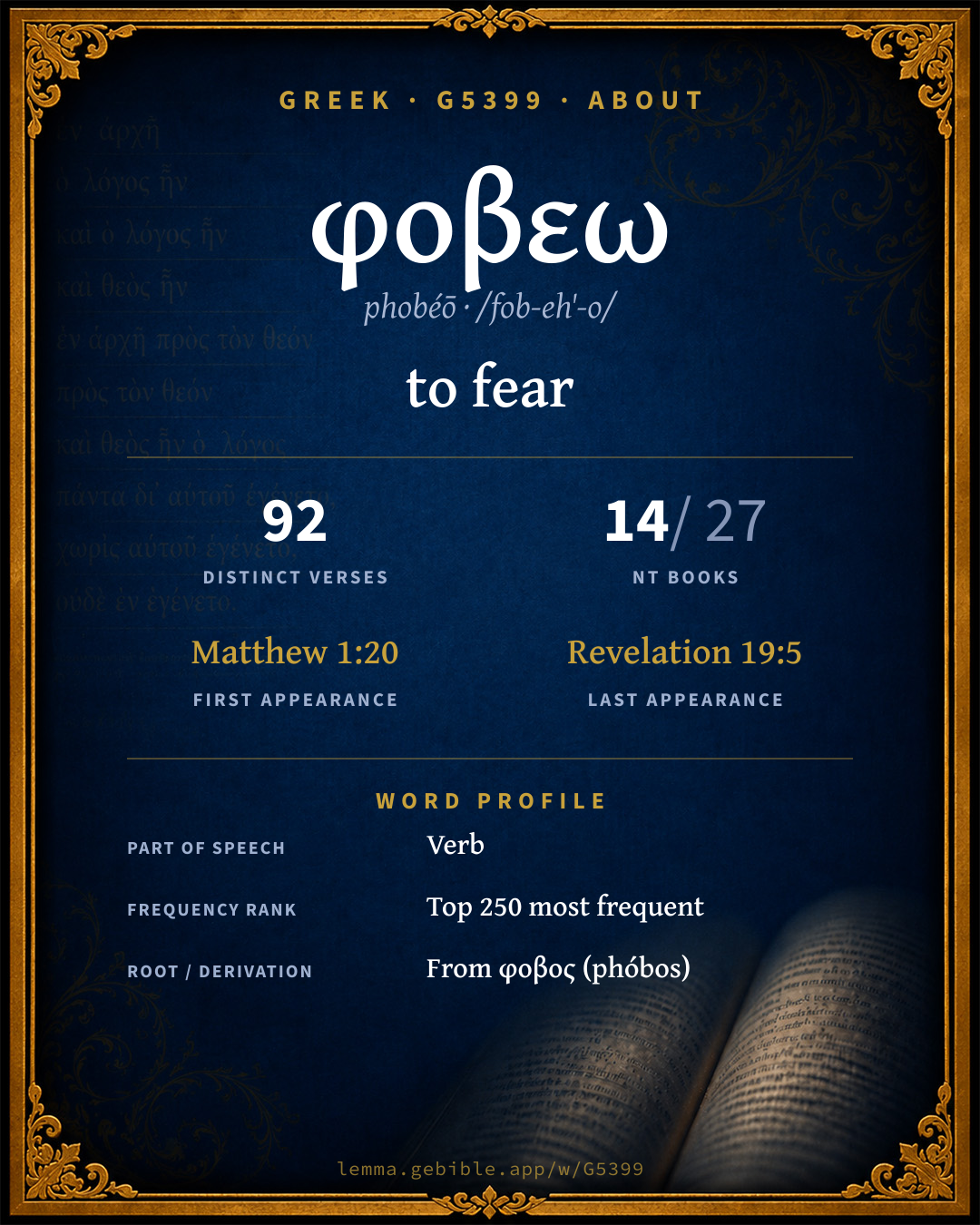
φοβέω
to fear
Full lexicon entry — Thayer's Greek Lexicon
From Thayer's Greek Lexicon
Where this word appears
See every Present-tense verb in the Greek New Testament →
Grammar key — what these labels mean
Part of speech
- Verb
- An action or state-of-being word.
Tense
- Aorist
- Action viewed as a simple whole, without regard to duration — often past (perfective aspect).
- Present
- Ongoing or general action in present time (imperfective aspect).
- Imperfect
- Continuous or repeated action in past time (“was writing”).
- Future
- Action expected in future time.
Voice
- Passive deponent
- Passive in form but active in meaning.
- Middle or Passive deponent
- Middle/passive in form but active in meaning.
Mood
- Indicative
- States a fact or asks a factual question (the mood of reality).
- Imperative
- Expresses a command or request.
- Participle
- A verbal adjective (“writing,” “having written”).
- Subjunctive
- Expresses probability, purpose, or possibility (the mood of contingency).
- Infinitive
- A verbal noun (“to write”), unmarked for person or number.
Case
- Nominative
- The case of the subject (and the predicate nominative).
- Dative
- The case of the indirect object, means, or location — “to / for / with / in.”
Person
- 3rd person
- The one spoken about (“he / she / it / they”).
- 2nd person
- The one addressed (“you”).
- 1st person
- The speaker (“I / we”).
Gender
- Masculine
- Grammatically masculine.
- Feminine
- Grammatically feminine.
Number
- Plural
- More than one.
- Singular
- One.
Grammatical forms 25 distinct
- Verb, Aorist, Passive deponent, Indicative, 3rd person, Plural 14 times (15%)
- Verb, Present, Middle or Passive deponent, Imperative, 2nd person, Singular 13 times (14%)
- Verb, Present, Middle or Passive deponent, Imperative, 2nd person, Plural 12 times (13%)
- Verb, Imperfect, Middle or Passive deponent, Indicative, 3rd person, Plural 10 times (11%)
- Verb, Aorist, Passive deponent, Imperative, 2nd person, Plural 6 times (6%)
- Verb, Present, Middle or Passive deponent, Participle, Nominative, Plural, Masculine 6 times (6%)
- Verb, Present, Middle or Passive deponent, Participle, Nominative, Singular, Masculine 6 times (6%)
- Verb, Aorist, Passive deponent, Indicative, 3rd person, Singular 5 times (5%)
+17 more forms (23 occurrences)
Parsed forms decoded from the imported morphology (Robinson–Tischendorf, public domain), counted across 95 parsed occurrences — not distinct verses.
Every verse where G5399 appears — 92 distinct verses across 14 books. Click any verse to open its interlinear word-by-word view. Verse text shown in the World English Bible for context — . Each verse’s Greek form is shown with its reference; the English is not keyword-highlighted, since the data carries no word-level English alignment. Use “Compare translations” on any verse to read it across multiple English versions. This concordance covers the Greek New Testament; Septuagint (Greek Old Testament) occurrences of this word are not indexed here.
Matthew 17 verses
- Matthew 1:20 φοβηθῇς aor pass.dep subj 2sg But when he thought about these things, behold, an angel of the Lord appeared to him in a dream, saying, "Joseph, son of David, don't be afraid to take to yourself Mary, your wife, for that which is conceived in her is of the Holy Spirit.
- Matthew 2:22 ἐφοβήθη aor pass.dep ind 3sg But when he heard that Archelaus was reigning over Judea in the place of his father, Herod, he was afraid to go there. Being warned in a dream, he withdrew into the region of Galilee,
- Matthew 9:8 ἐφοβήθησαν aor pass.dep ind 3pl But when the multitudes saw it, they marveled and glorified God, who had given such authority to men.
- Matthew 10:26 φοβηθῆτε aor pass.dep impv 2pl Therefore don't be afraid of them, for there is nothing covered that will not be revealed; and hidden that will not be known.
- Matthew 10:28 φοβεῖσθε φοβεῖσθε pres mid/pass.dep impv 2pl pres mid/pass.dep impv 2pl Don't be afraid of those who kill the body, but are not able to kill the soul. Rather, fear him who is able to destroy both soul and body in Gehenna.
- Matthew 10:31 φοβεῖσθε pres mid/pass.dep impv 2pl Therefore don't be afraid. You are of more value than many sparrows.
- Matthew 14:5 ἐφοβήθη aor pass.dep ind 3sg When he would have put him to death, he feared the multitude, because they counted him as a prophet.
- Matthew 14:27 φοβεῖσθε pres mid/pass.dep impv 2pl But immediately Jesus spoke to them, saying "Cheer up! I AM! Don't be afraid."
- Matthew 14:30 ἐφοβήθη aor pass.dep ind 3sg But when he saw that the wind was strong, he was afraid, and beginning to sink, he cried out, saying, "Lord, save me!"
- Matthew 17:6 ἐφοβήθησαν aor pass.dep ind 3pl When the disciples heard it, they fell on their faces, and were very afraid.
- Matthew 17:7 φοβεῖσθε pres mid/pass.dep impv 2pl Jesus came and touched them and said, "Get up, and don't be afraid."
- Matthew 21:26 φοβούμεθα pres mid/pass.dep ind 1pl But if we say, 'From men,' we fear the multitude, for all hold John as a prophet."
- Matthew 21:46 ἐφοβήθησαν aor pass.dep ind 3pl When they sought to seize him, they feared the multitudes, because they considered him to be a prophet.
- Matthew 25:25 φοβηθεὶς aor pass.dep ptcp nom sg masc I was afraid, and went away and hid your talent in the earth. Behold, you have what is yours.'
- Matthew 27:54 ἐφοβήθησαν aor pass.dep ind 3pl Now the centurion, and those who were with him watching Jesus, when they saw the earthquake, and the things that were done, feared exceedingly, saying, "Truly this was the Son of God."
- Matthew 28:5 φοβεῖσθε pres mid/pass.dep impv 2pl The angel answered the women, "Don't be afraid, for I know that you seek Jesus, who has been crucified.
- Matthew 28:10 φοβεῖσθε pres mid/pass.dep impv 2pl Then Jesus said to them, "Don't be afraid. Go tell my brothers that they should go into Galilee, and there they will see me."
Mark 12 verses
- Mark 4:41 ἐφοβήθησαν aor pass.dep ind 3pl They were greatly afraid, and said to one another, "Who then is this, that even the wind and the sea obey him?"
- Mark 5:15 ἐφοβήθησαν aor pass.dep ind 3pl They came to Jesus, and saw him who had been possessed by demons sitting, clothed, and in his right mind, even him who had the legion; and they were afraid.
- Mark 5:33 φοβηθεῖσα aor pass.dep ptcp nom sg fem But the woman, fearing and trembling, knowing what had been done to her, came and fell down before him, and told him all the truth.
- Mark 5:36 φοβοῦ pres mid/pass.dep impv 2sg But Jesus, when he heard the message spoken, immediately said to the ruler of the synagogue, "Don't be afraid, only believe."
- Mark 6:20 ἐφοβεῖτο impf mid/pass.dep ind 3sg for Herod feared John, knowing that he was a righteous and holy man, and kept him safe. When he heard him, he did many things, and he heard him gladly.
- Mark 6:50 φοβεῖσθε pres mid/pass.dep impv 2pl for they all saw him, and were troubled. But he immediately spoke with them, and said to them, "Cheer up! It is I! Don't be afraid."
- Mark 9:32 ἐφοβοῦντο impf mid/pass.dep ind 3pl But they didn't understand the saying, and were afraid to ask him.
- Mark 10:32 ἐφοβοῦντο impf mid/pass.dep ind 3pl They were on the way, going up to Jerusalem; and Jesus was going in front of them, and they were amazed; and those who followed were afraid. He again took the twelve, and began to tell them the things that were going to happen to him.
- Mark 11:18 ἐφοβοῦντο impf mid/pass.dep ind 3pl The chief priests and the scribes heard it, and sought how they might destroy him. For they feared him, because all the multitude was astonished at his teaching.
- Mark 11:32 ἐφοβοῦντο impf mid/pass.dep ind 3pl If we should say, 'From men'"--they feared the people, for all held John to really be a prophet.
- Mark 12:12 ἐφοβήθησαν aor pass.dep ind 3pl They tried to seize him, but they feared the multitude; for they perceived that he spoke the parable against them. They left him, and went away.
- Mark 16:8 ἐφοβοῦντο impf mid/pass.dep ind 3pl They went out, and fled from the tomb, for trembling and astonishment had come on them. They said nothing to anyone; for they were afraid.
Luke 21 verses
- Luke 1:13 φοβοῦ pres mid/pass.dep impv 2sg But the angel said to him, "Don't be afraid, Zacharias, because your request has been heard, and your wife, Elizabeth, will bear you a son, and you shall call his name John.
- Luke 1:30 φοβοῦ pres mid/pass.dep impv 2sg The angel said to her, "Don't be afraid, Mary, for you have found favor with God.
- Luke 1:50 φοβουμένοις pres mid/pass.dep ptcp dat pl masc His mercy is for generations of generations on those who fear him.
- Luke 2:9 ἐφοβήθησαν aor pass.dep ind 3pl Behold, an angel of the Lord stood by them, and the glory of the Lord shone around them, and they were terrified.
- Luke 2:10 φοβεῖσθε pres mid/pass.dep impv 2pl The angel said to them, "Don't be afraid, for behold, I bring you good news of great joy which will be to all the people.
- Luke 5:10 φοβοῦ pres mid/pass.dep impv 2sg and so also were James and John, sons of Zebedee, who were partners with Simon. Jesus said to Simon, "Don't be afraid. From now on you will be catching people alive."
- Luke 8:25 φοβηθέντες aor pass.dep ptcp nom pl masc He said to them, "Where is your faith?" Being afraid they marveled, saying one to another, "Who is this, then, that he commands even the winds and the water, and they obey him?"
- Luke 8:35 ἐφοβήθησαν aor pass.dep ind 3pl People went out to see what had happened. They came to Jesus, and found the man from whom the demons had gone out, sitting at Jesus' feet, clothed and in his right mind; and they were afraid.
- Luke 8:50 φοβοῦ pres mid/pass.dep impv 2sg But Jesus hearing it, answered him, "Don't be afraid. Only believe, and she will be healed."
- Luke 9:34 ἐφοβήθησαν aor pass.dep ind 3pl While he said these things, a cloud came and overshadowed them, and they were afraid as they entered into the cloud.
- Luke 9:45 ἐφοβοῦντο impf mid/pass.dep ind 3pl But they didn't understand this saying. It was concealed from them, that they should not perceive it, and they were afraid to ask him about this saying.
- Luke 12:4 φοβηθῆτε aor pass.dep impv 2pl "I tell you, my friends, don't be afraid of those who kill the body, and after that have no more that they can do.
- Luke 12:5 φοβηθῆτε φοβήθητε φοβήθητε aor pass.dep subj 2pl aor pass.dep impv 2pl aor pass.dep impv 2pl But I will warn you whom you should fear. Fear him, who after he has killed, has power to cast into Gehenna. Yes, I tell you, fear him.
- Luke 12:7 φοβεῖσθε pres mid/pass.dep impv 2pl But the very hairs of your head are all numbered. Therefore don't be afraid. You are of more value than many sparrows.
- Luke 12:32 φοβοῦ pres mid/pass.dep impv 2sg Don't be afraid, little flock, for it is your Father's good pleasure to give you the Kingdom.
- Luke 18:2 φοβούμενος pres mid/pass.dep ptcp nom sg masc saying, "There was a judge in a certain city who didn't fear God, and didn't respect man.
- Luke 18:4 φοβοῦμαι pres mid/pass.dep ind 1sg He wouldn't for a while, but afterward he said to himself, 'Though I neither fear God, nor respect man,
- Luke 19:21 ἐφοβούμην impf mid/pass.dep ind 1sg for I feared you, because you are an exacting man. You take up that which you didn't lay down, and reap that which you didn't sow.'
- Luke 20:19 ἐφοβήθησαν aor pass.dep ind 3pl The chief priests and the scribes sought to lay hands on Him that very hour, but they feared the people--for they knew He had spoken this parable against them.
- Luke 22:2 ἐφοβοῦντο impf mid/pass.dep ind 3pl The chief priests and the scribes sought how they might put him to death, for they feared the people.
- Luke 23:40 φοβῇ pres mid/pass.dep ind 2sg But the other answered, and rebuking him said, "Don't you even fear God, seeing you are under the same condemnation?
John 5 verses
- John 6:19 ἐφοβήθησαν aor pass.dep ind 3pl When therefore they had rowed about twenty-five or thirty stadia, they saw Jesus walking on the sea, and drawing near to the boat; and they were afraid.
- John 6:20 φοβεῖσθε pres mid/pass.dep impv 2pl But he said to them, "I AM. Don't be afraid."
- John 9:22 ἐφοβοῦντο impf mid/pass.dep ind 3pl His parents said these things because they feared the Jews; for the Jews had already agreed that if any man would confess him as Christ, he would be put out of the synagogue.
- John 12:15 φοβοῦ pres mid/pass.dep impv 2sg "Don't be afraid, daughter of Zion. Behold, your King comes, sitting on a donkey's colt."
- John 19:8 ἐφοβήθη aor pass.dep ind 3sg When therefore Pilate heard this saying, he was more afraid.
Acts 14 verses
- Acts 5:26 ἐφοβοῦντο impf mid/pass.dep ind 3pl Then the captain went with the officers, and brought them without violence, for they were afraid that the people might stone them.
- Acts 9:26 ἐφοβοῦντο impf mid/pass.dep ind 3pl When Saul had come to Jerusalem, he tried to join himself to the disciples; but they were all afraid of him, not believing that he was a disciple.
- Acts 10:2 φοβούμενος pres mid/pass.dep ptcp nom sg masc a devout man, and one who feared God with all his house, who gave gifts for the needy generously to the people, and always prayed to God.
- Acts 10:22 φοβούμενος pres mid/pass.dep ptcp nom sg masc They said, "Cornelius, a centurion, a righteous man and one who fears God, and well spoken of by all the nation of the Jews, was directed by a holy angel to invite you to his house, and to listen to what you say."
- Acts 10:35 φοβούμενος pres mid/pass.dep ptcp nom sg masc but in every nation he who fears him and works righteousness is acceptable to him.
- Acts 13:16 φοβούμενοι pres mid/pass.dep ptcp nom pl masc Paul stood up, and beckoning with his hand said, "Men of Israel, and you who fear God, listen.
- Acts 13:26 φοβούμενοι pres mid/pass.dep ptcp nom pl masc Brothers, children of the stock of Abraham, and those among you who fear God, the word of this salvation is sent out to you.
- Acts 16:38 ἐφοβήθησαν aor pass.dep ind 3pl The sergeants reported these words to the magistrates, and they were afraid when they heard that they were Romans,
- Acts 18:9 φοβοῦ pres mid/pass.dep impv 2sg The Lord said to Paul in the night by a vision, "Don't be afraid, but speak and don't be silent;
- Acts 22:29 ἐφοβήθη aor pass.dep ind 3sg Immediately those who were about to examine him departed from him, and the commanding officer also was afraid when he realized that he was a Roman, because he had bound him.
- Acts 23:10 φοβηθεὶς aor pass.dep ptcp nom sg masc When a great argument arose, the commanding officer, fearing that Paul would be torn in pieces by them, commanded the soldiers to go down and take him by force from among them, and bring him into the barracks.
- Acts 27:17 φοβούμενοί pres mid/pass.dep ptcp nom pl masc After they had hoisted it up, they used cables to help reinforce the ship. Fearing that they would run aground on the Syrtis sand bars, they lowered the sea anchor, and so were driven along.
- Acts 27:24 φοβοῦ pres mid/pass.dep impv 2sg saying, 'Don't be afraid, Paul. You must stand before Caesar. Behold, God has granted you all those who sail with you.'
- Acts 27:29 φοβούμενοί pres mid/pass.dep ptcp nom pl masc Fearing that we would run aground on rocky ground, they let go four anchors from the stern, and wished for daylight.
Romans 3 verses
- Romans 11:20 φοβοῦ pres mid/pass.dep impv 2sg True; by their unbelief they were broken off, and you stand by your faith. Don't be conceited, but fear;
- Romans 13:3 φοβεῖσθαι pres mid/pass.dep inf For rulers are not a terror to the good work, but to the evil. Do you desire to have no fear of the authority? Do that which is good, and you will have praise from the same,
- Romans 13:4 φοβοῦ pres mid/pass.dep impv 2sg for he is a servant of God to you for good. But if you do that which is evil, be afraid, for he doesn't bear the sword in vain; for he is a minister of God, an avenger for wrath to him who does evil.
2 Corinthians 2 verses
- 2 Corinthians 11:3 φοβοῦμαι pres mid/pass.dep ind 1sg But I am afraid that somehow, as the serpent deceived Eve in his craftiness, so your minds might be corrupted from the simplicity that is in Christ.
- 2 Corinthians 12:20 φοβοῦμαι pres mid/pass.dep ind 1sg For I am afraid that by any means, when I come, I might find you not the way I want to, and that I might be found by you as you don't desire; that by any means there would be strife, jealousy, outbursts of anger, factions, slander, whisperings, proud thoughts, riots;
Galatians 2 verses
- Galatians 2:12 φοβούμενος pres mid/pass.dep ptcp nom sg masc For before some people came from James, he ate with the Gentiles. But when they came, he drew back and separated himself, fearing those who were of the circumcision.
- Galatians 4:11 φοβοῦμαι pres mid/pass.dep ind 1sg I am afraid for you, that I might have wasted my labor for you.
Ephesians 1 verse
Colossians 1 verse
Hebrews 4 verses
- Hebrews 4:1 Φοβηθῶμεν aor pass.dep subj 1pl Let us fear therefore, lest perhaps a promise being left of entering into his rest, anyone of you should seem to have come short of it.
- Hebrews 11:23 ἐφοβήθησαν aor pass.dep ind 3pl By faith, Moses, when he was born, was hidden for three months by his parents, because they saw that he was a beautiful child, and they were not afraid of the king's commandment.
- Hebrews 11:27 φοβηθεὶς aor pass.dep ptcp nom sg masc By faith, he left Egypt, not fearing the wrath of the king; for he endured, as seeing him who is invisible.
- Hebrews 13:6 φοβηθήσομαι fut pass.dep ind 1sg So that with good courage we say, "The Lord is my helper. I will not fear. What can man do to me?"
1 Peter 3 verses
- 1 Peter 2:17 φοβεῖσθε pres mid/pass.dep impv 2pl Honor all men. Love the brotherhood. Fear God. Honor the king.
- 1 Peter 3:6 φοβούμεναι pres mid/pass.dep ptcp nom pl fem as Sarah obeyed Abraham, calling him lord, whose children you now are, if you do well, and are not put in fear by any terror.
- 1 Peter 3:14 φοβηθῆτε aor pass.dep impv 2pl But even if you should suffer for righteousness' sake, you are blessed. "Don't fear what they fear, neither be troubled."
1 John 1 verse
Revelation 6 verses
- Revelation 1:17 φοβοῦ pres mid/pass.dep impv 2sg When I saw him, I fell at his feet like a dead man. He laid his right hand on me, saying, "Don't be afraid. I am the first and the last,
- Revelation 2:10 φοβοῦ pres mid/pass.dep impv 2sg Don't be afraid of the things which you are about to suffer. Behold, the devil is about to throw some of you into prison, that you may be tested; and you will have oppression for ten days. Be faithful to death, and I will give you the crown of life.
- Revelation 11:18 φοβουμένοις pres mid/pass.dep ptcp dat pl masc The nations were angry, and your wrath came, as did the time for the dead to be judged, and to give your bondservants the prophets, their reward, as well as to the saints, and those who fear your name, to the small and the great; and to destroy those who destroy the earth."
- Revelation 14:7 φοβήθητε aor pass.dep impv 2pl He said with a loud voice, "Fear the Lord, and give him glory; for the hour of his judgment has come. Worship him who made the heaven, the earth, the sea, and the springs of waters!"
- Revelation 15:4 φοβηθῇ aor pass.dep subj 3sg Who wouldn't fear you, Lord, And glorify your name? For you only are holy. For all the nations will come and worship before you. For your righteous acts have been revealed."
- Revelation 19:5 φοβούμενοι pres mid/pass.dep ptcp nom pl masc A voice came forth from the throne, saying, "Give praise to our God, all you his servants, you who fear him, the small and the great!"
About this entry
At a glance — auto-summarized from this page’s data, not written by a person. Every figure links to its source below. This summary describes the numbers; it doesn’t interpret them.
The Greek verb φοβεω centers on the idea of “to fear.” Debuting at Matthew 1:20, it then recurs through the corpus. Spanning 92 verses in 14 books, it ranks among the moderately common words of the Greek New Testament. Sharing its root, it stands alongside φοβος, φοβερος and φοβητρον. Dig into 92-verse concordance and the renderings breakdown below.
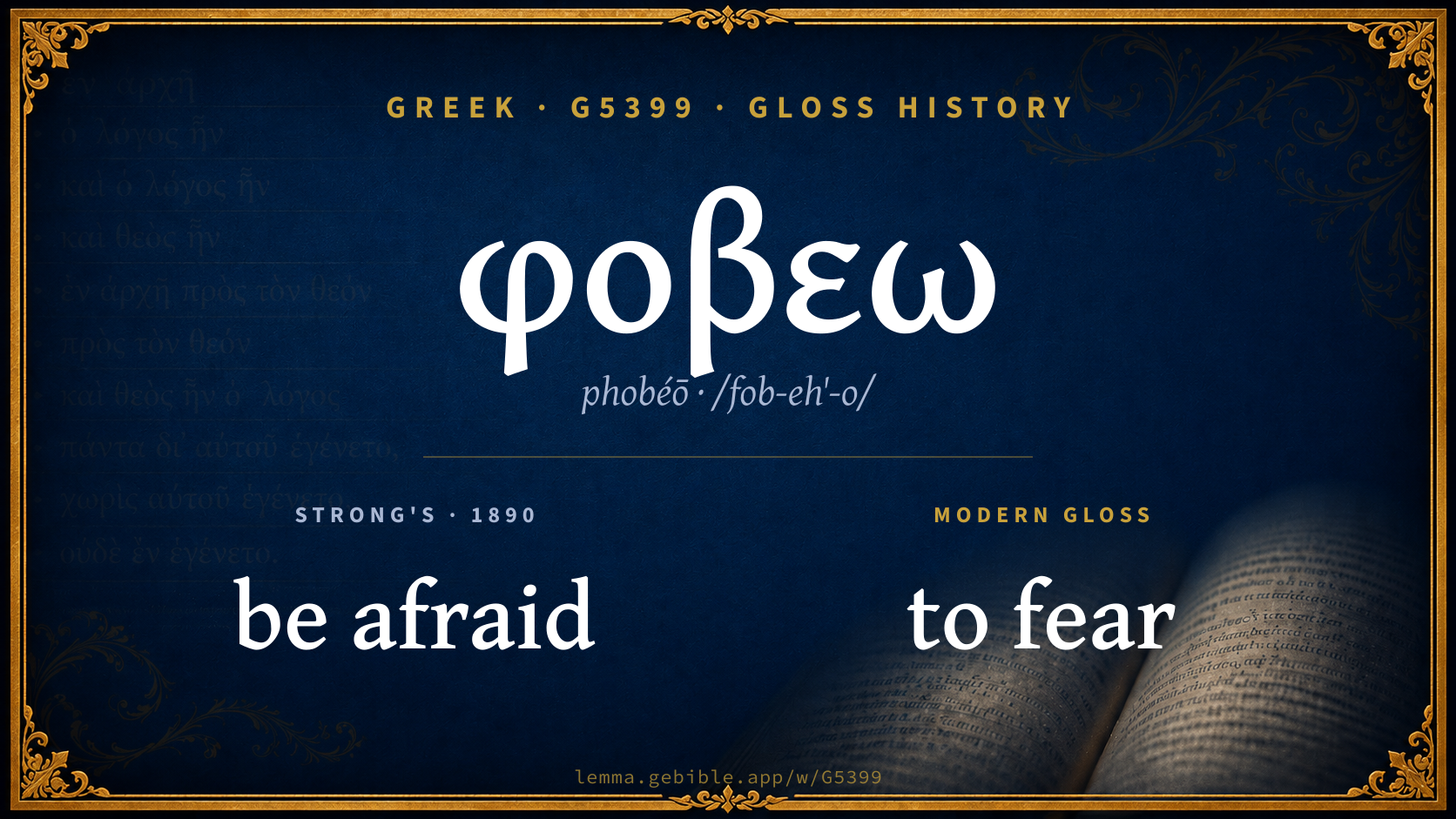
Gloss history
Strong's 1890 vs modern scholarship
About this word
Strong's G5399 catalogs a Greek word from the Greek New Testament.
These counts are not copied from any lexicon or concordance. They are computed here, from the morphology-tagged Greek New Testament. What Lemma adds →
- 92
- distinct verses
- The word appears in 92 distinct verses.
- 14 / 27
- NT books
- The word appears in 14 of 27 New Testament books.
- #179
- by frequency
- Top 250 most frequent Greek words (rank 179 of 5,347 Greek words by occurrence).
View all 92 occurrences in the concordance →
By section of the New Testament
By traditional corpus
Conventional, traditional groupings — biblical authorship is debated, so this is a traditional corpus grouping, not an authorship claim. Some books belong to more than one corpus (Luke is in both the Gospels and the Lukan corpus, and so on), so these shares overlap and need not total 100%. Each figure is a share of the word’s 92 distinct verses.
- Gospels 55 verses · 60%
- Lukan (Luke–Acts) 35 verses · 38%
- Johannine 12 verses · 13%
- Pauline corpus 9 verses · 10%
- Revelation 6 verses · 7%
- Hebrews 4 verses · 4%
- General (Catholic) Epistles 4 verses · 4%
How translations render this word
Counts come from each version’s own published word-to-Strong’s tagging or interlinear alignment — an approximate guide to how each version renders this word, not a word-level alignment the data otherwise carries. Because each total is that version’s own tagged count, the per-version totals vary from one another and need not match the appearance or distinct-verse counts above. These counts may also differ from a printed concordance because Lemma counts each distinctly tagged rendering and does not collapse phrase taggings into a single head-word total. This is a fixed set of word-tagged versions (KJV, ASV, BSB, ULT) and does not change with the reading translation you choose elsewhere. Each version’s license is shown beside its name below (and on Sources).
- King James Version: Fear 26×, Afraid 15×, They feared 12×
- American Standard Version: Fear 31×, Afraid 13×, They feared 11×
- Berean Standard Bible: Fear 18×, Be afraid 17×, They were afraid 9×
- unfoldingWord Literal Text: Fear 23×, Do 22×, Be afraid 14×
King James Version Public Domain
Renders G5399 across 110 tagged occurrences — most commonly:
Plus other, less common renderings. Plus 21 renderings that appear only once — usually multi-word phrases or single function words the recovered tagging swept in, not distinct renderings.
American Standard Version Public Domain
Renders G5399 across 109 tagged occurrences — most commonly:
Plus 25 renderings that appear only once — usually multi-word phrases or single function words the recovered tagging swept in, not distinct renderings. Not rendered by a distinct English word in 1 further occurrence.
Berean Standard Bible Public Domain
Renders G5399 across 94 tagged occurrences — most commonly:
Plus 29 renderings that appear only once — usually multi-word phrases or single function words the recovered tagging swept in, not distinct renderings. Not rendered by a distinct English word in 1 further occurrence.
unfoldingWord Literal Text CC BY-SA 4.0
Renders G5399 across 131 tagged occurrences — most commonly:
Plus other, less common renderings. Plus 22 renderings that appear only once — usually multi-word phrases or single function words the recovered tagging swept in, not distinct renderings.
Senses in Thayer's
The 1 sense Thayer's distinguishes for this word, in lexicon order (not ranked by frequency or importance). The full entry — with sub-senses — is in the Lexicon Entry tab.
- to put to flight by terrifying (to scare away)
Word origin
Derived from φοβος (phóbos) (G5401) — fear.
From G5401 ; to frighten that is (passively) to be alarmed ; by analogy to be in awe of that is revere : - be (+ sore) afraid fear (exceedingly) reverence.
— Strong’s Exhaustive Concordance (1890), public domain.
Forms in the corpus
The 26 distinct written forms G5399 takes in the Greek New Testament, most frequent first — each parse links to that tense’s occurrences in the concordance.
Same root — word family
Other Thayer's entries built from the same root as G5399, grouped by Strong’s listed origin. These share a root / origin per the lexicon — not necessarily a shared meaning. Each links to that word’s own entry.
Derives from
Shares the same root
Derived from this word
Compare all same-root words → They share a root, not necessarily a meaning.
Septuagint usage
The same Greek word φοβεω appears 343 times in the Greek Old Testament (Septuagint), across 327 verses in 34 books.
- 343
- LXX occurrences
- Tagged occurrences of this Greek word in the Septuagint.
- 327
- verses
- Distinct Septuagint verses containing this word.
- 34 / 39
- OT books
- The word appears in 34 of the 39 Old Testament books.
Sample Septuagint occurrences
- Genesis 3:10 φοβέω
- Exodus 1:17 φοβέω
- Leviticus 19:3 φοβέω
- Numbers 12:8 φοβέω
- Deuteronomy 1:21 φοβέω
- Joshua 1:9 φοβέω
- Judges 4:18 φοβέω
- Ruth 3:11 φοβέω
- 1 Samuel 3:15 φοβέω
- 2 Samuel 1:14 φοβέω
- 1 Kings 1:50 φοβέω
- 2 Kings 1:15 φοβέω
Septuagint occurrences (same lexeme)
Every verse where the same Strong’s number (G5399) appears in the Greek Septuagint — showing the first 50 of 327. Verse text shown in the World English Bible for context; the Greek form is the matched word — the English is not keyword-highlighted.
- Genesis 3:10 φοβέω The man said, "I heard your voice in the garden, and I was afraid, because I was naked; and I hid myself."
- Genesis 15:1 φοβέω After these things the word of Yahweh came to Abram in a vision, saying, "Don't be afraid, Abram. I am your shield, your exceedingly great reward."
- Genesis 18:15 φοβέω Then Sarah denied, saying, "I didn't laugh," for she was afraid." He said, "No, but you did laugh."
- Genesis 19:30 φοβέω Lot went up out of Zoar, and lived in the mountain, and his two daughters with him; for he was afraid to live in Zoar. He lived in a cave with his two daughters.
- Genesis 20:2 φοβέω Abraham said about Sarah his wife, "She is my sister." Abimelech king of Gerar sent, and took Sarah.
- Genesis 20:8 φοβέω Abimelech rose early in the morning, and called all his servants, and told all these things in their ear. The men were very scared.
- Genesis 21:17 φοβέω God heard the voice of the boy. The angel of God called to Hagar out of the sky, and said to her, "What ails you, Hagar? Don't be afraid. For God has heard the voice of the boy where he is.
- Genesis 22:12 φοβέω He said, "Don't lay your hand on the boy, neither do anything to him. For now I know that you fear God, seeing you have not withheld your son, your only son, from me."
- Genesis 26:7 φοβέω The men of the place asked him about his wife. He said, "She is my sister," for he was afraid to say, "My wife," lest, he thought, the men of the place might kill me for Rebekah, because she was beautiful to look on.
- Genesis 26:24 φοβέω Yahweh appeared to him the same night, and said, "I am the God of Abraham your father. Don't be afraid, for I am with you, and will bless you, and multiply your seed for my servant Abraham's sake."
- Genesis 28:13 φοβέω Behold, Yahweh stood above it, and said, "I am Yahweh, the God of Abraham your father, and the God of Isaac. The land whereon you lie, to you will I give it, and to your seed.
- Genesis 28:17 φοβέω He was afraid, and said, "How dreadful is this place! This is none other than God's house, and this is the gate of heaven."
- Genesis 32:8 φοβέω and he said, "If Esau comes to the one company, and strikes it, then the company which is left will escape."
- Genesis 32:12 φοβέω You said, 'I will surely do you good, and make your seed as the sand of the sea, which can't be numbered because there are so many.'"
- Genesis 42:18 φοβέω Joseph said to them the third day, "Do this, and live, for I fear God.
- Genesis 42:35 φοβέω It happened as they emptied their sacks, that behold, every man's bundle of money was in his sack. When they and their father saw their bundles of money, they were afraid.
- Genesis 43:23 φοβέω He said, "Peace be to you. Don't be afraid. Your God, and the God of your father, has given you treasure in your sacks. I received your money." He brought Simeon out to them.
- Genesis 46:3 φοβέω He said, "I am God, the God of your father. Don't be afraid to go down into Egypt; for there I will make of you a great nation.
- Genesis 50:19 φοβέω Joseph said to them, "Don't be afraid, for am I in the place of God?
- Genesis 50:21 φοβέω Now therefore don't be afraid. I will nourish you and your little ones." He comforted them, and spoke kindly to them.
- Exodus 1:17 φοβέω But the midwives feared God, and didn't do what the king of Egypt commanded them, but saved the baby boys alive.
- Exodus 1:21 φοβέω It happened, because the midwives feared God, that he gave them families.
- Exodus 2:14 φοβέω He said, "Who made you a prince and a judge over us? Do you plan to kill me, as you killed the Egyptian?" Moses was afraid, and said, "Surely this thing is known."
- Exodus 9:20 φοβέω Those who feared the word of Yahweh among the servants of Pharaoh made their servants and their cattle flee into the houses.
- Exodus 9:30 φοβέω But as for you and your servants, I know that you don't yet fear Yahweh God."
- Exodus 14:10 φοβέω When Pharaoh drew near, the children of Israel lifted up their eyes, and behold, the Egyptians were marching after them; and they were very afraid. The children of Israel cried out to Yahweh.
- Exodus 14:31 φοβέω Israel saw the great work which Yahweh did to the Egyptians, and the people feared Yahweh; and they believed in Yahweh, and in his servant Moses.
- Exodus 20:18 φοβέω All the people perceived the thunderings, the lightnings, the sound of the trumpet, and the mountain smoking. When the people saw it, they trembled, and stayed at a distance.
- Exodus 34:30 φοβέω When Aaron and all the children of Israel saw Moses, behold, the skin of his face shone; and they were afraid to come near him.
- Leviticus 19:3 φοβέω "'Each one of you shall respect his mother and his father. You shall keep my Sabbaths. I am Yahweh your God.
- Leviticus 19:14 φοβέω "'You shall not curse the deaf, nor put a stumbling block before the blind; but you shall fear your God. I am Yahweh.
- Leviticus 19:30 φοβέω "'You shall keep my Sabbaths, and reverence my sanctuary; I am Yahweh.
- Leviticus 19:32 φοβέω You shall rise up before the gray head, and honor the face of an old man, and you shall fear your God. I am Yahweh.
- Leviticus 25:17 φοβέω You shall not wrong one another; but you shall fear your God: for I am Yahweh your God.
- Leviticus 25:36 φοβέω Take no interest from him or profit, but fear your God; that your brother may live among you.
- Leviticus 25:43 φοβέω You shall not rule over him with harshness, but shall fear your God.
- Leviticus 26:2 φοβέω "'You shall keep my Sabbaths, and have reverence for my sanctuary. I am Yahweh.
- Numbers 12:8 φοβέω with him will I speak mouth to mouth, even manifestly, and not in dark speeches; and the form of Yahweh shall he see: why then were you not afraid to speak against my servant, against Moses?
- Numbers 14:9 φοβέω Only don't rebel against Yahweh, neither fear the people of the land; for they are bread for us: their defense is removed from over them, and Yahweh is with us: don't fear them.
- Numbers 21:34 φοβέω Yahweh said to Moses, Don't fear him: for I have delivered him into your hand, and all his people, and his land; and you shall do to him as you did to Sihon king of the Amorites, who lived at Heshbon.
- Numbers 22:3 φοβέω Moab was sore afraid of the people, because they were many: and Moab was distressed because of the children of Israel.
- Deuteronomy 1:21 φοβέω Behold, Yahweh your God has set the land before you: go up, take possession, as Yahweh, the God of your fathers, has spoken to you; don't be afraid, neither be dismayed.
- Deuteronomy 1:29 φοβέω Then I said to you, Don't dread, neither be afraid of them.
- Deuteronomy 2:4 φοβέω Command you the people, saying, You are to pass through the border of your brothers the children of Esau, who dwell in Seir; and they will be afraid of you: take good heed to yourselves therefore;
- Deuteronomy 3:2 φοβέω Yahweh said to me, Don't fear him; for I have delivered him, and all his people, and his land, into your hand; and you shall do to him as you did to Sihon king of the Amorites, who lived at Heshbon.
- Deuteronomy 3:22 φοβέω You shall not fear them; for Yahweh your God, he it is who fights for you.
- Deuteronomy 4:10 φοβέω the day that you stood before Yahweh your God in Horeb, when Yahweh said to me, Assemble me the people, and I will make them hear my words, that they may learn to fear me all the days that they live on the earth, and that they may teach their children.
- Deuteronomy 5:5 φοβέω (I stood between Yahweh and you at that time, to show you the word of Yahweh: for you were afraid because of the fire, and didn't go up onto the mountain;) saying,
- Deuteronomy 5:29 φοβέω Oh that there were such a heart in them, that they would fear me, and keep all my commandments always, that it might be well with them, and with their children forever!
- Deuteronomy 6:2 φοβέω that you might fear Yahweh your God, to keep all his statutes and his commandments, which I command you, you, and your son, and your son's son, all the days of your life; and that your days may be prolonged.
These are occurrences of the same Greek lexeme (G5399) in the Septuagint — not a translation of any one Hebrew word. The store carries no word-level Hebrew↔Greek alignment, so no Hebrew original is asserted here. Counts come from the recovered LXX Strong's tagging — high-frequency vocabulary is well covered, while rare or late forms may be untagged — so they reflect tagged occurrences and may slightly undercount.