Hebrews 13:6

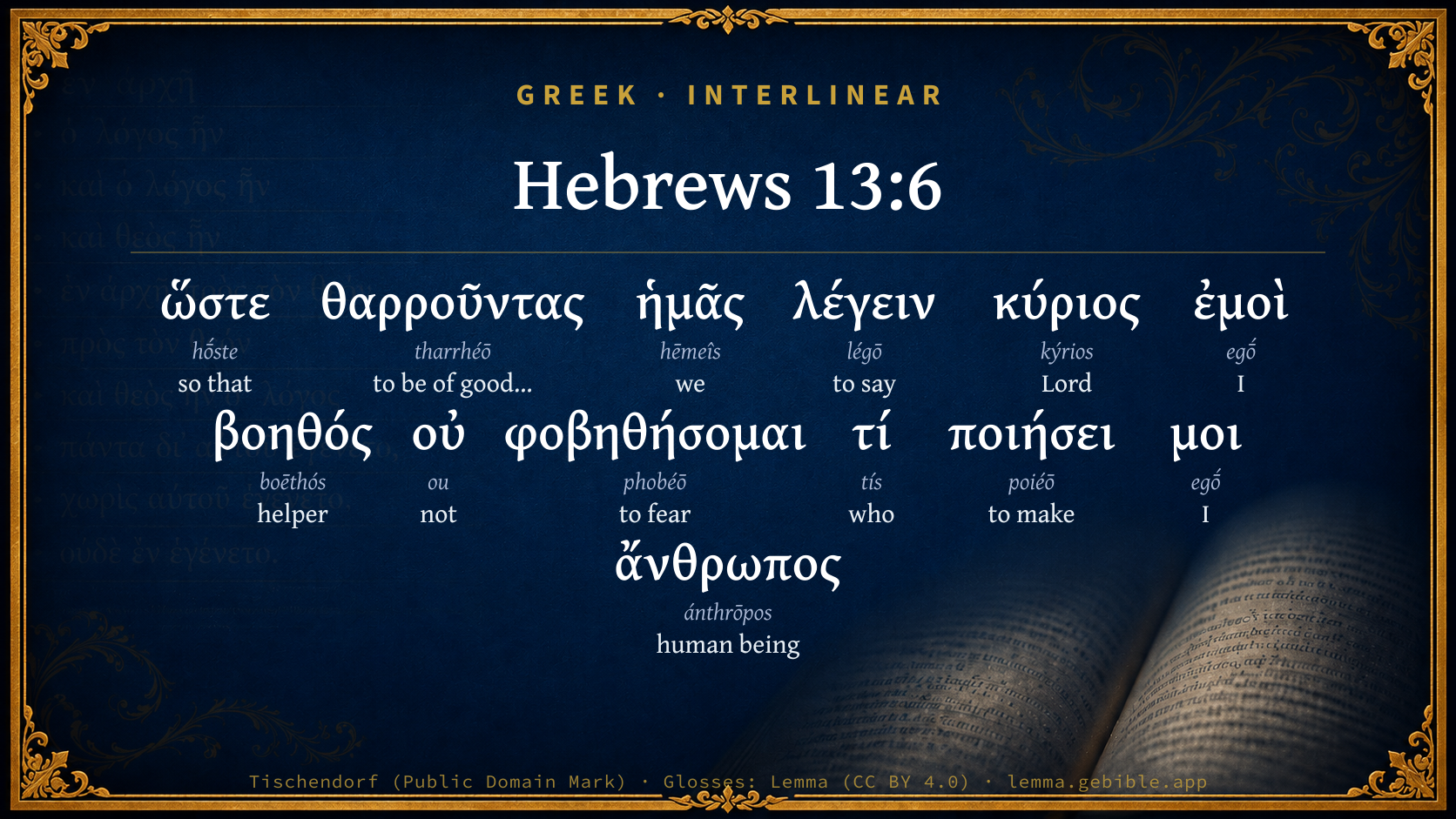
Greek (Tischendorf 8th ed.) Hebrews 13:6 appears in the Greek New Testament. The text above is from the Tischendorf 8th edition. Each word links to its Strong’s number and a concise gloss. Click any word for its full Thayer’s Greek Lexicon entry.
Download image
Cite this verse

Hebrews 13:6 (World English Bible). Public Domain. Lemma interlinear Bible study tool, https://lemma.gebible.app/v/hebrews/13/6.

Show BibTeX & RIS
BibTeX
RIS
English Translation
So that with good courage we say, "The Lord is my helper. I will not fear. What can man do to me?"
World English Bible · Public Domain
Highlights
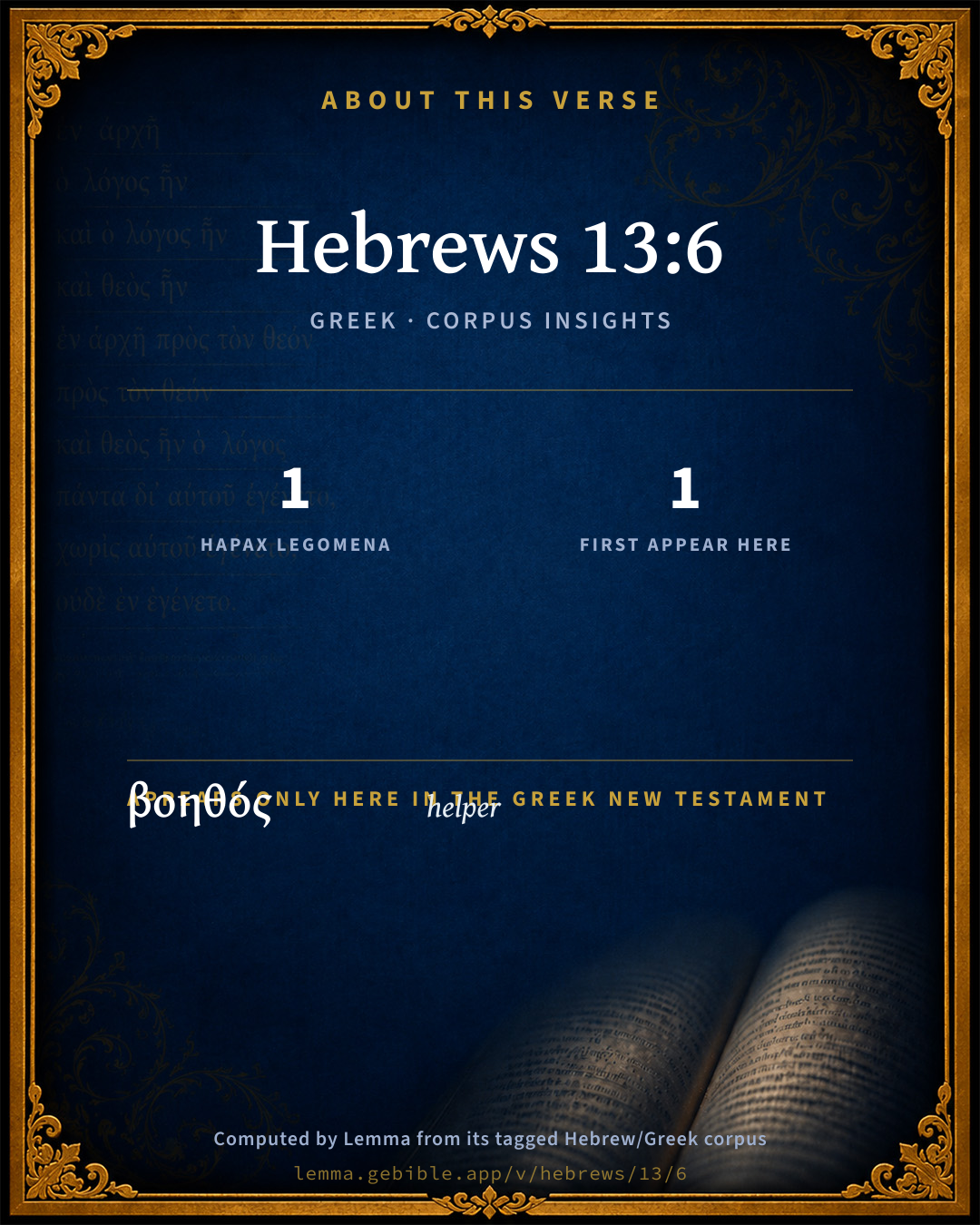
  • 1 hapax legomenon — only here in the Greek New Testament
  • 1 first appearance in the Greek New Testament
Full analysis ↓
Download a study sheet

One document with this verse’s original text, its word-by-word gloss line, the meaning frame, cross-references with their text, attributed commentary, and full source and license credits — printable, and it pastes into notes with its structure intact.

This verse Autodidact and up

Study sheet (.html) Plain text (.txt)

A passage Seminary Student

Up to 50 verses in one chapter. A passage sheet keeps up to 6 commentary sources and 12 cross-references per verse, in the order this page ranks them, and says so on the sheet whenever that leaves anything out. Ask for a single verse and you get the Autodidact verse sheet above.

Everything on this page stays free to read, with no account — the sheet is a download of what is already on screen, not access to it.

Want to remove ads? Support Godless Engineer
Compare translations 3

The same verse in 3 English versions, stacked beneath the original-language interlinear above. Click any original word for its lexicon entry.

Each is an independent rendering of the whole verse — the interlinear is not word-aligned to these translations.

Highlighted words mark where these versions differ — a whole-verse word diff, not a word-by-word alignment.

  • World English Bible Public Domain
    So that with good courage we say, "The Lord is my helper. I will not fear. What can man do to me?"
  • King James Version Public Domain
    So that we may boldly say, The Lord is my helper, and I will not fear what man shall do unto me.
  • unfoldingWord Literal Text CC BY-SA 4.0
    so that, being confident, we say, “The Lord my helper, and I will not become afraid. What will a man do to me?”

unfoldingWord Literal Text — © unfoldingWord, licensed CC BY-SA 4.0. Word-aligned USFM3 via Door43 (git.door43.org/unfoldingWord/en_ult).

Versions to compare (up to 4)

3 of 4 selected

Show all 19 translations

Every available English version of this verse, each an independent rendering of the whole verse.

  • World English Bible Public Domain
    So that with good courage we say, "The Lord is my helper. I will not fear. What can man do to me?"
  • Berean Standard Bible Public Domain
    So we say with confidence: “The Lord is my helper; I will not be afraid. What can man do to me?”
  • Majority Standard Bible Public Domain
    So we say with confidence: “The Lord is my helper; I will not be afraid. What can man do to me?”
  • King James Version Public Domain
    So that we may boldly say, The Lord is my helper, and I will not fear what man shall do unto me.
  • American Standard Version (1901) Public Domain
    So that with good courage we say, The Lord is my helper; I will not fear: What shall man do unto me?
  • Revised Version (1885) Public Domain
    So that with good courage we say, The Lord is my helper; I will not fear: What shall man do unto me?
  • Geneva Bible (1599) Public Domain
    I will not faile thee, neither forsake thee:
  • Douay-Rheims (1899) Public Domain
    So that we may confidently say: The Lord is my helper: I will not fear what man shall do to me.
  • Young's Literal Translation Public Domain
    so that we do boldly say, `The Lord `is' to me a helper, and I will not fear what man shall do to me.'
  • Literal Standard Version CC BY-SA 4.0
    so that we boldly say, “The LORD [is] to me a helper, and I will not fear what man will do to me.”
  • Unlocked Literal Bible CC BY-SA 4.0
    Let us be content so that we may have courage to say, “The Lord is my helper; I will not be afraid. What can a man do to me?”
  • unfoldingWord Literal Text CC BY-SA 4.0
    so that, being confident, we say, “The Lord my helper, and I will not become afraid. What will a man do to me?”
  • Darby Bible Public Domain
    So that, taking courage, we may say, The Lord [is] my helper, and I will not be afraid: what will man do unto me?
  • World Messianic Bible Public Domain
    So that with good courage we say, “The Lord is my helper. I will not fear. What can man do to me?”
  • Webster's Bible Public Domain
    So that we may boldly say, The Lord is my helper, and I will not fear what man shall do to me.
  • Free Bible Version CC BY-SA 4.0
    That's why we can confidently say, “The Lord is the one who helps me, so I won't be afraid. What can anyone do to me?”
  • Bible in Basic English Public Domain
    So that we say with a good heart, The Lord is my helper; I will have no fear: what is man able to do to me?
  • Text-Critical English NT CC BY 4.0
    So we can say with confidence, “The Lord is my helper, so I will not fear anything that man might do to me.”
  • Tyndale New Testament (1534) Public Domain
    that we maye boldly saye: the lorde is my helper and I will not feare what man doeth vnto me.

Literal Standard Version (2020), Covenant Press — licensed CC BY-SA 4.0. Text via the HelloAO Bible API (eBible.org). Unlocked Literal Bible (unfoldingWord) — licensed CC BY-SA 4.0. Text via the HelloAO Bible API (eBible.org). unfoldingWord Literal Text — © unfoldingWord, licensed CC BY-SA 4.0. Word-aligned USFM3 via Door43 (git.door43.org/unfoldingWord/en_ult). Free Bible Version, Dr. Jonathan Gallagher — licensed CC BY-SA 4.0. Text via the HelloAO Bible API (eBible.org).

Word by word

More ways to search: Search by grammar → Find every occurrence → Compare this word →

Practice this passage: Drill this verse → Learn its vocabulary →

βοηθός
boēthós
G998
“helper”
Noun, Nominative, Singular, Masculine
Part of Speech
Noun
Case
Nominative
Number
Singular
Gender
Masculine
Full Thayer's Definition

Origin: from G995 and theo (to run)

TDNT: 11:28,1

1. a helper
  1. ὥστε hṓste G5620 “so that” Conjunction
  2. θαρροῦντας tharrhéō G2292 “to be of good courage” Verb, Present, Active, Participle, Accusative, Plural, Masculine
  3. ἡμᾶς hēmeîs G2249 “we” Personal pronoun, 1st person, Accusative, Plural
  4. λέγειν légō G3004 “to say” Verb, Present, Active, Infinitive
  5. κύριος kýrios G2962 “Lord” Noun, Nominative, Singular, Masculine
  6. ἐμοὶ egṓ G1473 “I” Personal pronoun, 1st person, Dative, Singular
  7. οὐ ou G3756 “not” Particle, Negative
  8. φοβηθήσομαι phobéō G5399 “to fear” Verb, Future, Passive deponent, Indicative, 1st person, Singular
  9. τί tís G5101 “who” Interrogative pronoun, Accusative, Singular, Neuter
  10. ποιήσει poiéō G4160 “to make” Verb, Future, Active, Indicative, 3rd person, Singular
  11. μοι egṓ G1473 “I” Personal pronoun, 1st person, Dative, Singular
  12. ἄνθρωπος ánthrōpos G444 “human being” Noun, Nominative, Singular, Masculine

About this verse

These counts appear in no published source. They are computed here, from the morphology-tagged text and Lemma’s own curated glosses. What Lemma adds →

13
words
12
distinct lemmas
General Epistles
section

Notable vocabulary

1 hapax legomenon — a word that appears only here in the entire Greek New Testament:

  • βοηθός helper G998

First appearance in Scripture

This word makes its first canonical appearance in the Greek New Testament here:

  • βοηθός helper G998

Shared distinctive vocabulary

θαρροῦντας to be of good courage G2292 occurs in 6 verses of the Greek New Testament. Also found in:

Repetition

A word recurs within this verse:

Cross-references

27

Topical passages linked to Hebrews 13:6 in the Treasury of Scripture Knowledge — connected by theme and wording, ordered by reader-vote popularity; previews shown in the World English Bible.

  • Psalms 118:6–9 Yahweh is on my side. I will not be afraid. What can man do to me?
  • Isaiah 41:10 Don't you be afraid, for I am with you; don't be dismayed, for I am your God; I will strengthen you; yes, I will help you; yes, I will uphold you with the right hand of my righteousness.
  • Romans 8:31 What then shall we say about these things? If God is for us, who can be against us?
  • Psalms 27:1–3 Yahweh is my light and my salvation. Whom shall I fear? Yahweh is the strength of my life. Of whom shall I be afraid?
  • Psalms 124:8 Our help is in the name of Yahweh, Who made heaven and earth.
  • Hebrews 4:16 Let us therefore draw near with boldness to the throne of grace, that we may receive mercy, and may find grace for help in time of need.
  • Psalms 56:4 In God, I praise his word. In God, I put my trust. I will not be afraid. What can flesh do to me?
  • Psalms 56:11–12 I have put my trust in God. I will not be afraid. What can man do to me?
  • Psalms 54:4 Behold, God is my helper. The Lord is the one who sustains my soul.
  • Matthew 10:28 Don't be afraid of those who kill the body, but are not able to kill the soul. Rather, fear him who is able to destroy both soul and body in Gehenna.
  • Psalms 33:20 Our soul has waited for Yahweh. He is our help and our shield.
  • Psalms 63:7 For you have been my help. I will rejoice in the shadow of your wings.
  • Daniel 3:16–18 Shadrach, Meshach, and Abednego answered the king, Nebuchadnezzar, we have no need to answer you in this matter.
  • Psalms 94:17 Unless Yahweh had been my help, My soul would have soon lived in silence.
  • Psalms 40:17 But I am poor and needy; May the Lord think about me. You are my help and my deliverer. Don't delay, my God.
  • Luke 12:4–5 "I tell you, my friends, don't be afraid of those who kill the body, and after that have no more that they can do.
  • Genesis 15:1 After these things the word of Yahweh came to Abram in a vision, saying, "Don't be afraid, Abram. I am your shield, your exceedingly great reward."
  • Ephesians 3:12 in whom we have boldness and access in confidence through our faith in him.
  • Deuteronomy 33:29 Happy are you, Israel: Who is like you, a people saved by Yahweh, The shield of your help, The sword of your excellency! Your enemies shall submit themselves to you; You shall tread on their high places.
  • Psalms 27:9 Don't hide your face from me. Don't put your servant away in anger. You have been my help. Don't abandon me, Neither forsake me, God of my salvation.
  • Isaiah 41:14 Don't be afraid, you worm Jacob, and you men of Israel; I will help you, says Yahweh, and your Redeemer is the Holy One of Israel.
  • Psalms 115:9–11 Israel, trust in Yahweh! He is their help and their shield.
  • Exodus 18:4 The name of the other was Eliezer, for he said, "My father's God was my help and delivered me from Pharaoh's sword."
  • Psalms 146:3 Don't put your trust in princes, Each a son of man in whom there is no help.
  • Deuteronomy 33:26 There is none like God, Jeshurun, Who rides on the heavens for your help, In his excellency on the skies.
  • Hebrews 10:19 Having therefore, brothers, boldness to enter into the holy place by the blood of Jesus,
  • Psalms 18:1–2 I love you, Yahweh, my strength.

Cross-references courtesy of OpenBible.info (CC BY 4.0).

Commentary

Notes on Hebrews 13:6 from classic Christian and Jewish commentators (each source and its license shown beneath its notes). The classic Christian expositions comment on the surrounding passage and are grouped to its opening verse, so a note may address several verses; the Jewish commentaries on the Tanakh (Rashi and others) are per-verse, so they appear only where the commentator wrote on this verse.

Lemma curates 59 commentaries, every one of them public domain or Creative Commons licensed, each selected and text-cleaned for this edition rather than reprinted as found. About our sources →

The Biblical Illustrator

Joseph S. Exell

Heb_13:6

The Lord is my helper.

A cheerful confidence in God

I. THE CHEERFUL PROFESSION OF CONFIDENCE IN GOD AGAINST ALL OPPOSITION, AND IN THE MIDST OF ALL DISTRESSES, IS THAT WHICH BELIEVERS HAVE A WARRANT FOR IN THE PROMISES THAT ARE MADE UNTO THEM.

II. AS THE USE OF THIS CONFIDENCE IS OUR DUTY, SO IT IS A DUTY HIGHLY HONOURABLE UNTO THE PROFESSION OF THE GOSPEL.

III. BELIEVERS MAY USE THE SAME CONFIDENCE THAT DAVID USED, SEEING THEY HAVE THE SAME GROUNDS OF IT THAT DAVID HAD. For outward circumstances alter not the state of things as unto faith or duty.

IV. THAT ALL BELIEVERS, IN THEIR SUFFERINGS, AND UNDER THEIR PERSECUTIONS, HAVE A REFRESHING SUPPORTING INTEREST IN DIVINE AID AND ASSISTANCE. For the promises hereof are made unto them all equally in their suffering state, even as they were unto the prophets and apostles of old.

V. IT IS THEIR DUTY TO EXPRESS WITH CONFIDENCE AND BOLDNESS, AT ALL TIMES, THEIR ASSURANCE OF THE DIVINE ASSISTANCE DECLARED IN THE

PROMISES, TO THEIR OWN ENCOURAGEMENT, THE EDIFICATION OF THE CHURCH, AND THE TERROR OF THEIR ADVERSARIES (Php_1:28).

VI. FAITH DULY FIXED ON THE POWER OF GOD, AS ENGAGED FOR THE ASSISTANCE OF BELIEVERS IN THEIR SUFFERINGS, WILL GIVE THEM A CONTEMPT OF ALL THAT MEN CAN DO UNTO THEM.

VII. THE MOST EFFECTUAL MEANS TO ENCOURAGE OUR SOULS IN ALL OUR SUFFERINGS, IS TO COMPARE THE POWER OF GOD WHO WILL ASSIST US, AND THAT OF MAN WHO DOTH OPPRESS US (Mat_10:28).

VIII. THAT WHICH IN OUR SUFFERINGS DELIVERETH US FROM THE FEAR OF MEN, TAKES OUT ALL THAT IS EVIL IN THEM, AND SECURES OUR SUCCESS. (John Owen, D. D.)

Gods people protected from enemies

1. These have their enemies, signified by the word Man, what man may do against me.

2. These men being enemies do much against them, or at least attempt to do much; for wicked men together with the devil are great enemies to Christs kingdom and His subjects. The devil designs their spiritual, the wicked their temporal ruin; and the design of the one is subservient to the other. The devil makes use of temporal persecutions to shake their faith; both hate the Church and thrust sore at it.

3. Yet God is with them, stands for them, helps them, strengthens and protects them, and gives them safety in the midst of danger, joy in the midst of sorrow, bread in the midst of famine.

4. If God be with them, for them, and their help, they need not fear anything, no, not the worst that man can do unto them, but may be confident of safety and deliverance; they need not much desire the best things of the world, nor fear the worst.

5. They may think, believe, say, and be assured, that God is their help. And so much the rather, because God hath promised that He will not leave or forsake them at any time, and why should they be covetous or fearful, there is no cause of either. (G. Lawson.)

Man not to be feared:

When Dr. Rowland Taylor was brought before Gardiner, Bishop of Winchester, the bishop asked him how he durst look him in the face, and if he knew who he was. Yes, replied the doctor, I know who you are--Dr. Stephen Gardiner, Bishop of Winchester, and Lord Chancellor, and yet but a mortal man, I trow. But if I should be afraid of your lordly looks, why fear you not God, the Lord of us all? How dare you look any Christian man in the face, since you have forsaken the truth, denied Christ, and done contrary to your oath and writing? With what face will you appear before Christs judgment-seat and answer to your oath against popery in King Henry VIII.s time and in the reign of King Edward VI., when you both spoke and wrote against it? (W. Whitecross.)

A right to the promises of God cleared up:

Let it be thy chief concern to have thy interest in and right to the promises cleared up. This is the hinge on which the great dispute between thee and Satan will move in the day of trouble. Oh, it is sad for a poor Christian to stand at the door of the promise, in the dark night of affliction, afraid to lift the latch, whereas he should then come as boldly for shelter as a child into his fathers house. (W. Gurnall.)

The Biblical Illustrator, edited by Joseph S. Exell (c. 1880s–1900s) — public domain. Text from a community e-Sword module.

Tyndale Open Study Notes

Tyndale Open Resources

13:6 This quotation from Ps 118:6 offers the response of faith: The Lord is my helper, so we can have no fear of what people might do.

Tyndale Open Study Notes — © Tyndale Open Resources, licensed CC BY-SA 4.0. Text via the HelloAO Bible API.

Bengel's Gnomon

Johann Albrecht Bengel

Heb 13:6. Κύριος ἐμοὶ, κ.τ.λ.) So the LXX., Psa 118:6, and so for the most part Psa 56:5; Psa 56:12.

Bengel's Gnomon of the New Testament — English translation (T&T Clark, Edinburgh, 1860) — public domain. Text from a community e-Sword module.

Meyer's Critical & Exegetical Commentary

Heinrich August Wilhelm Meyer

Heb_13:6. Ὥστε θαῤῥοῦντας ἡμᾶς λέγειν κ.τ.λ.] so that we boldly say (namely, in the words of Psa_118:6): the Lord is my helper, and I will not fear; what can a man do to me?

τί ποιήσει μοι ἄνθρωπος;] is an independent direct question. Grammatically false is the construction of the Vulgate (so also Jac. Cappellus and others), which takes the words as dependent on οὐ φοβηθήσομαι: non timebo, quid faciat mihi homo.

Meyer — Critical and Exegetical Commentary on the New Testament — English translation by Peter Christie, edited by Frederick Crombie (T&T Clark, 1880) — public domain. Text from a community e-Sword module.

Jamieson, Fausset & Brown

Robert Jamieson, A. R. Fausset & David Brown

may--rather as Greek, expressing confidence actually realized, "So that we boldly (confidently) say" (Psa 56:4, Psa 56:11; Psa 118:6). Punctuate as both the Hebrew and the Greek require, "And (so) I will not fear: what (then) shall man do unto me?"

Jamieson, Fausset & Brown — Commentary Critical and Explanatory on the Whole Bible (1871) — public domain (CC PDM 1.0). Text via the HelloAO Bible API.

Adam Clarke's Commentary

Verse 6. So that we may boldly say] We, in such circumstances, while cleaving to the Lord, may confidently apply to ourselves what God spake to Joshua and to Solomon; and what he spake to David, "The Lord is my helper, I will not fear what man can do." God is omnipotent, man's power is limited; howsoever strong he may be, he can do nothing against the Almighty.

Adam Clarke's Commentary on the Bible (1810–1826) — public domain. Text from a community e-Sword/MySword module.

Ellicott's Commentary for English Readers

(6) We may boldly say.—Rather, so that we say with courage. The words of the quotation (Psa_118:6) should be arranged thus: “The Lord is my helper; I will not fear: what shall man do unto me?”

A Bible Commentary for English Readers, edited by Charles John Ellicott (1878–1897) — public domain. Text from a community e-Sword module.

The Cambridge Bible for Schools and Colleges

gen. ed. J. J. S. Perowne

6. we may boldly say] Rather, “we boldly say.”

The Lord is my helper] Psa_118:6.

I will not fear what man …] Rather, “I will not fear. What shall man do unto me?”

The Cambridge Bible for Schools and Colleges (gen. ed. J. J. S. Perowne; Cambridge University Press, 1878–1918) — public domain. Text from a community e-Sword module.

John Gill's Exposition

So that we may boldly say,.... Or confidently assert; for nothing is more true than this,

the Lord is my helper; he is able to help, and does help, when none else can; he has promised to be the helper of his people; he has laid help for them on Christ, who is mighty; and he has helped him as man, that he might help them; he has set up a throne of grace for them to come to, where they may find help; and experience confirms the truth of this assertion; every believer can set up an Ebenezer, and say, hitherto hath the Lord helped me: the people of God are of themselves helpless ones; there is no help for them in man; their help is only in the Lord; who helps them out of the pit of sin and misery; out of the hands of all their enemies; out of all their afflictions, and "out" of all the dangers they are exposed unto by Satan and his temptations, by reason of a body of sin and death, and no account of the world, and the men of it: he helps them "in" the exercise of grace, and in the discharge of duty; in bearing the cross; in fighting the Lord's battles; and in their journeying through the wilderness: he helps them "to" temporal blessings, and spiritual ones; to spiritual food and raiment, and to all needful supplies of grace, and, at last, to eternal glory and happiness: and the help he now affords is quick and present, suitable and seasonable, and is what is sufficient; and is sometimes with, and sometimes without means.

And I will not fear what man shall do unto me. There is a becoming fear and reverence which is due to men that are our superiors, whether in civil or religious affairs; but men are not to be feared, when opposed to God; not a single man only is not to be feared, but even all men; and not they only, but all that they can do; the utmost of which is to kill the body; the ground of this fearlessness in believers are the infinite power, grace, and goodness of God. The words seem to be taken out of Psa 54:4.

John Gill's Exposition of the Whole Bible (1746–1763) — public domain (CC PDM 1.0). Text via the HelloAO Bible API.

Trapp's Complete Commentary

John Trapp

6 So that we may boldly say, The Lord is my helper, and I will not fear what man shall do unto me.

Ver. 6. So that we may boldly say] Having such a promise to build and found our faith upon, we may well proceed to this holy gloriation against all opposition.

John Trapp, A Commentary or Exposition upon All the Books of the Old and New Testament (1647–1656) — public domain. Text from a community e-Sword module.

Albert Barnes' Notes on the Bible

So that we may boldly say - Without any hesitation or doubt, In all times of perplexity and threatening want; in all times when we scarcely know whence the supplies for our necessities are to come, we may put our trust in God, and be assured that he will not leave us to suffer. In the facts which occur under the providential dealings, there is a ground for confidence on this subject which is not always exercised even by good people. It remains yet to be shown that they who exercise simple trust in God for the supply of their wants are ever forsaken; compare Psa 37:25.

The Lord is my helper - Substantially this sentiment is found in Psa 27:1, and Psa 118:6. The apostle does not adduce it as a quotation, but as language which a true Christian may employ. The sentiment is beautiful and full of consolation. What can we fear if we have the assurance that the Lord is on our side, and that he will help us? Man can do no more to us than he permits, and of course no more than will be for our own good; and under whatever trials we may be placed, we need be under no painful apprehensions, for God will be our protector and our friend.

Albert Barnes' Notes on the Bible (1834–1885) — public domain. Text from a community e-Sword/MySword module.

Matthew Poole's English Annotations

So that we may boldly say; upon the account of which promise of God all the true subjects of Christ’s kingdom, together with the apostle, may with an undaunted boldness of heart, above all fears and doubtings, and with a daring confidence, professing that which they believe, nor staggering, nor shrinking, nor being ashamed of their faith, but openly owning it to all the world, own that

The Lord is my helper; the Lord in the infiniteness of his power, wisdom, and goodness, is a real, present, universal, and permanent help against all trouble, and for all supplies in all cases, and at all times, to every one of them. They may say as Moses, Exo 18:4; as David, Psa 27:9; 40:17; 56:4,11; 118:6.

And I will not fear what man shall do unto me: and therefore faith expelleth fearfulness of, and introduceth fearlessness of, any created evils incident to a believer; and of which man may be an instrument inflicting, Psa 46:2,3. Implying in it an unshaken settledness of mind, judgment, and thoughts on God’s help, a fixed frame of heart, without tumultuous passions or perturbations, with an unmovable resolution to keep close to God and his word both in word and deed, amidst all oppositions and persecutions of men for it.

Matthew Poole's English Annotations on the Holy Bible (1683–1685) — public domain. Text from a community e-Sword/MySword module.

Whedon's Commentary on the Bible

Daniel D. Whedon

6. Boldly—Based on the primitive rock of God’s own promise, how bold may we not be!

Helper—Psa_118:6.

What man—More properly, a direct question: What can man do?

Daniel D. Whedon (gen. ed.), Commentary on the Old and New Testaments (1874–1909) — public domain. Text from a community e-Sword module.

The Pulpit Commentary

So that we may boldly say, The Lord is my Helper, and I will not fear what man shall do unto me; rather, I will act fear: what shall man do unto me? The quotation is from Psa_118:6. The memory of their former pastors who had finished their course is next urged upon the readers as an encouragement to perseverance in the life of faith.

A triumphant assurance. "So that we may boldly say, The Lord is my Helper, etc. The writer in our text adopts the language of Psa_118:6. Three distinct, yet closely related topics for meditation are suggested.

I MAN"S NEED OF HELP. What a dependent creature is man! Mark this in the different stages of his life.

1. How utterly helpless in infancy!

2. How needy in youth! Instruction, direction, counsel, support, are indispensable to youthful life, if it is to grow into usefulness unto men and acceptability unto God.

3. How dependent in manhood! No one is independent. Even the wealthiest, the wisest, the mightiest, cannot stand alone. We need help

(1) from each other. "We are members one of another." "The members should have the same care one for another" (cf. 1Co 13) We need help

(2) from God. "He giveth to all life, and breath, and all things... for in him we live, and move, and have our being." It was truly said by Fenelon, "God has but to withdraw his hand which bears us, to plunge us back into the abyss of our nothingness, as a stone suspended in the air fails by its own weight the moment it ceases to be held.

1. How imbecile in old age! This is often a "second childhood," a season of almost complete dependence upon others both physically and mentally.

2. There are times, when man specially feels his need of help. In affliction we feel our need of patience; in sorrow, of consolation; in perplexity, of guidance, etc.

II GOD"S PROVISION OF HELP. God has put it into our hearts to help each other. Many are the ways in which this is done; e.g. by sympathy, by counsel, by gifts, etc. But God himself is the great Helper. A helper does not do everything for us. He supplements our weakness with his strength; our ignorance and inexperience with his wisdom. We must do our part, and he will not fail in his. Consider what a glorious Helper God is.

1. He is all-sufficient. His wisdom is infinite. The treasures of his grace are inexhaustible. It is conceivable that the sun, after the lapse of many and vast ages, may become dark and cold, or that the waters of old ocean may be drank up; but it is impossible and inconceivable that the infinite resources of our Divine Helper should ever fail.

2. He is ever-available. We cannot seek him and discover that he is inaccessible to us. We cannot approach him inopportunely. He is "a very present Help in trouble." "Call upon me in the day of trouble: I will deliver thee, and thou shalt glorify me.

3. He is ever-gracious. His willingness to help is as great and as constant as his ability. Man varies in his moods: today he is genial and kind, tomorrow he is cold and harsh. But God is ever merciful, ever disposed to help and bless his creatures.

III THE BELIEVER"S ASSURANCE OF THE HELP OF GOD. "So that we may boldly say, The Lord is my Helper; I will not fear: what shall man do unto me?

1. This confidence rests upon the promise of God. "He hath said, I will never leave thee, nor forsake thee" (ver. 5). His promises are perfectly reliable. "God is not a man, that he should lie; neither the son of man," etc. (Num_23:19) "Heaven and earth shall pass away, but my words shall not pass away" "The Scripture cannot be broken." "He abideth faithful; for he cannot deny himself." His promise, then, is an immovable basis for our confidence.

2. This confidence inspires the courage of the believer. "The Lord is my Helper; I will not fear: what shall man do unto me?" The man over whom God casts his shield is invulnerable. "If God be for us, who can be against us?" "Who is he that will harm you, if ye be followers of that which is good?" No crafty foe can elude the vigilance of his eye; no subtle scheme can surprise his infinite mind; no strong antagonist can cope with his almighty arm. If he is our Helper, man cannot injure us. If he is our Helper, our resources cannot fail. If he is our Helper, we may pursue our life-path chanting cheerfully, "God is our Refuge and Strength, a very present Help in trouble," etc.. (Ps 46) W.J.

The Pulpit Commentary (1880–1919), ed. H.D.M. Spence-Jones & Joseph S. Exell — public domain. Text from a community e-Sword module.

John Wesley's Explanatory Notes

Psalm cxviii, 6.

John Wesley, Explanatory Notes Upon the Whole Bible (1754–1765) — public domain. Text via the GEBible commentary corpus.

The People's New Testament

B. W. Johnson

6. So that we may boldly say. The words which follow are quoted from Psalm 118:6.

B. W. Johnson's The People's New Testament with Notes (1889–1891) — public domain. Electronic text from the Christian Classics Ethereal Library (CCEL) ThML edition.

Cambridge Greek Testament for Schools and Colleges

6. θαρροῦντας. “We boldly say,” not as in A.V. “we may boldly say.”

Κύριος. Psa 118:6.

οὐ φοβηθήσομαι. “I will not fear. What shall man do unto me?” The rendering of the A.V. “I will not fear what man shall do unto me” is ungrammatical, as is that of the Vulg., “Non timebo quid faciat mihi homo.”

Cambridge Greek Testament for Schools and Colleges (Cambridge University Press, 1896; 21 vols, various authors incl. Carr, Maclear, Plummer, Farrar, Lumby, Moule, M. R. James, Simcox) — public domain. Text from a community e-Sword module.

Alford’s Greek Testament

Henry Alford

6.] St. Paul usually couples with filthy desire, filthy lucre, as both of them incompatible with the kingdom of God: e. g. 1Co 5:10, 1Co 5:11; 1Co 6:9 f.: Eph 5:3, Eph 5:5: Col 3:5.

6.] so that we say (not ‘can say’ nor ‘may say,’ both which weaken the confidence expressed) with confidence, The Lord (יהוה in the Psalm, and probably used of the Father, as in other citations in this Epistle, e. g. ch. 7:21; 8:8-11; 10:16, 30; 12:5 al., and without a citation ch. 8:2) is my helper (in the Heb. only יְהֹוָה לִי), [and (not in Heb., see also digest)], I will not be afraid: what shall man do unto me (such is the connexion, both in the Heb. and here: not, “I will not be afraid what man shall do unto me,” as the English Prayer Book after the vulg., “non timebo quid faciat mihi homo,” which is ungrammatical (τί ἂν ποιῇ or ποιήσῃ))?

Henry Alford, The Greek Testament (1849–1861) — public domain. Text from a community e-Sword module.

Vincent's Word Studies in the New Testament

Marvin R. Vincent

Let your conversation be without covetousness [αφιλαργυρος ο τροπος] . Tropov originally turn or direction. Hence ways manner, fashion; way or manner of life. In this sense N. T. o. Elsewhere often in the phrase on tropon or kaq' on tropon in or according to the way in which. See Mt 23:37; Luk 13:34; Act 1:11; Act 14:11; Act 27:25. The meaning here is character or moral disposition. Afilargurov without covetousness, only here and 1Ti 3:3, see note.

Be content with such things as ye have (ajrkoumenoi toiv parousin). Lit. being contented with the things which are at hand. For ajrkein to suffice, see Luk 3:14; Joh 6:7; 1Ti 6:8. On the compounds aujtarkhv self - sufficient and aujtarkeia self - sufficiency, see on 2Co 9:8; Phi 4:11.

For he hath said [αυτος γαρ ειρηκεν] . Rend. for "he himself." God himself. For eirhken hath said, see ch. Heb 1:13; Heb 4:3, 4; Heb 10:9.

I will never leave nor forsake thee [ου μη σε ανω ουδ ου μη σε εγκαταλιπω] . Comp. Gen 28:15; Jos 1:5; Deu 31:6. None of these, however, give the saying in the form in which it appears here. This appears to be a combination or general adaptation of those passages. For "never," rend. "by no means" or "in no wise." 'Anw from ajnihmi. In Act 16:26; Act 27:40, to loosen : Eph 6:9, to give up or forbear. Somewhat in this last sense here : "I will in no wise give thee up, or let thee go." I will not relax my hold on thee. For ejgkatalipw forsake, see on 2Ti 4:10.

So that we may boldly say [ωστε θαρρουντας ημας λεγειν] . Lit. so that, being of good courage, we say. Qarrein to be confident or bold, only here in Hebrews. Elsewere only in Paul. The kindred form qarsein is used in N. T. only in the imperative qarsei or qarseite take courage. See Mt 9:2; Mr 6:50; Joh 16:33; Act 23:11.

The Lord is my helper, etc. From LXX, Psa 107:6 with slight alteration. Here, what shall man do unto me is an independent clause. LXX inserts and : "my helper and I will not fear," and connects the last clause with "fear" : "I will not fear what man will do."

7 - 15. The following passage presents many difficulties of detail, but its general sense is clear. It sums up in a striking way the main topics of the epistle, bringing them all to bear upon the conclusion that Judaism and Christianity are mutually exclusive, and thus enforcing the warning against a relapse into Judaism. It goes to show, in connection with other features of the epistle, the absurdity of the hypothesis that the epistle was intended as a warning to Gentile Christians against a relapse into Paganism. 246

Marvin R. Vincent, Word Studies in the New Testament (1887–1900) — public domain. Text from a community e-Sword/MySword module.

Westcott on Hebrews & the Epistles of John

Brooke Foss Westcott

6. ὥστε Oapp. ἡ. r.] Pa. exviii. 6 (comp. Is, evi, 12). Tho uxx. by insorting καί has lod to an alteration in tho original division of the words. Thero can bo no doubt that tho last clause should be takon as xn indepondent question.

We Christians—such is tho writor’s meaning—can use with confidence the most joyful expression of thanksgiving used in the Church of old times. Ps. cxviii. formed an important part of the Jewish Festival services, and is quoted sevoral times in the N. T. Tho key-word given here would call up at once to the mind of the readers the thought of ‘ the chief corner-stone’ (Matt. xxi. 42) and of Him ‘that came in the name of the Lord’ (Matt. xxi.

Ww. H!

9) In the triumph of the Lord through suffering they would see the imago of the triumph of ITis people. Tho word θαρρεῖν occurs elsewhere in the N. T. only 2 Cor. (v. 6, 8; é&c.). The imperative θάρσει (-cire) is found only as a divine voice (Gospp., Acts). (2) Personal religious duties (7—

The mode in which religious duties are presented indicates the presence of a separatist spirit among those who are addrossed. They are charged to remember (a) the example of their first rulers (7); and, following on this, they are (5) bidden to render complete devotion to Christ, and to. men in and through Him (8—16); and practically (c) to obey their present rulers (17).

1 Remember them that had the rule over you, which spake unto you the word of God ; and considering the teane of their life, imitate their faith.

“Jesus Christ is the same yesterday and to-day, yea and for ever. % Be not carried away by manifold and strange teachings; for it is good that the heart be stablished by grace, not by meats; for they that occupied themselves therein were not profited. τ We hare an altar wheredf they have no right to eat who serve the tabernacle, " For the bodies of those animals whose blood ts brought into the Holy place by the High-priest as an offering for sin, are burned withoul the camp. "" Wherefore Jesus also, that He might sanctify the people through His own blood, suffered without the gate. "5 Let us therefore go forth unto Him without the camp,

carrying Hise reproach. ‘For we have not here an abiding city, but we seck after that which ts to come. S Through Him let us offer up α sucryice of praise to God continually, that ts, the fruit of lips which make confession to His Name. "6 But to do good and to communicate forget not ; Sor with auch sacrifices God is well

u Obey them that have the rule over you, and submit to them, for they watch in behalf of your souls, as men that shall give account, that they may do this with joy and not with grief; for thie were unprofitable for you.

(a) The writer has spoken of the help of God generally. He now appeals to examples in which it had been conspicuously shewn before he passes on to enforce religious dutics.

Brooke Foss Westcott (1825–1901), The Epistle to the Hebrews (1889) and The Epistles of St John (1883) — public domain (pre-1929). Text recovered from Internet Archive / Google Books OCR scans. Westcott’s Gospel of John commentary is not included (its OCR lost the chapter running-heads required for reliable verse-keying). Some Greek quoted in the Hebrews volume is imperfectly rendered by the OCR.

Lesson kit

Teaching starters — assembled from the data on this page, not authored interpretation. Every prompt links to the verse data it draws on. Edit before teaching.

Hebrews, in the General Epistles, opens this verse with 13 words (12 distinct Greek lemmas). Its most distinctive word is boēthós (“helper”). A historical commentator’s framing appears above. Read the whole chapter for the surrounding context.

Discussion questions

  1. The word boēthós carries the sense “helper.” How does it shape the verse?
  2. This verse holds 1 word here found nowhere else in the Greek New Testament. What might the rare word draw attention to?
  3. The word “helper” first appears here in Scripture. What is being introduced at this debut?
  4. 2 Corinthians 5:6 shares the word «to be of good courage» with this verse. How do the two illuminate each other?
  5. “I” occurs 2× in this one verse. What is the effect of the repetition?
  6. These translations render this verse differently; the difference is in the English rendering, not the original. What questions does that raise?
  7. Reading how The Biblical Illustrator and Tyndale Open Study Notes read this verse, where do the two commentators agree and where do they part?

Things to notice

  • 1 word in this verse appears nowhere else in the Greek New Testament.
  • 1 word makes its first canonical appearance in Scripture here.
  • These translations choose different wording for 11 words in this verse.
  • “I” occurs 2× in this single verse.
  • 12 distinct Greek lemmas span 13 words in this verse.

Reading settings

Reading text

Shown beneath each verse's original-language words.

Old Testament
Old Testament edition

Read the OT as the Masoretic Hebrew (MT) or the Greek Septuagint (LXX).

English shown for the Greek Septuagint (in the Hebrew ↔ Greek comparison).

Comparing translations? Open the Compare panel on any verse page to stack up to four side by side.