

2 Corinthians 11:3
Greek (Tischendorf 8th ed.) 2 Corinthians 11:3 appears in the Greek New Testament. The text above is from the Tischendorf 8th edition. Each word links to its Strong’s number and a concise gloss. Click any word for its full Thayer’s Greek Lexicon entry.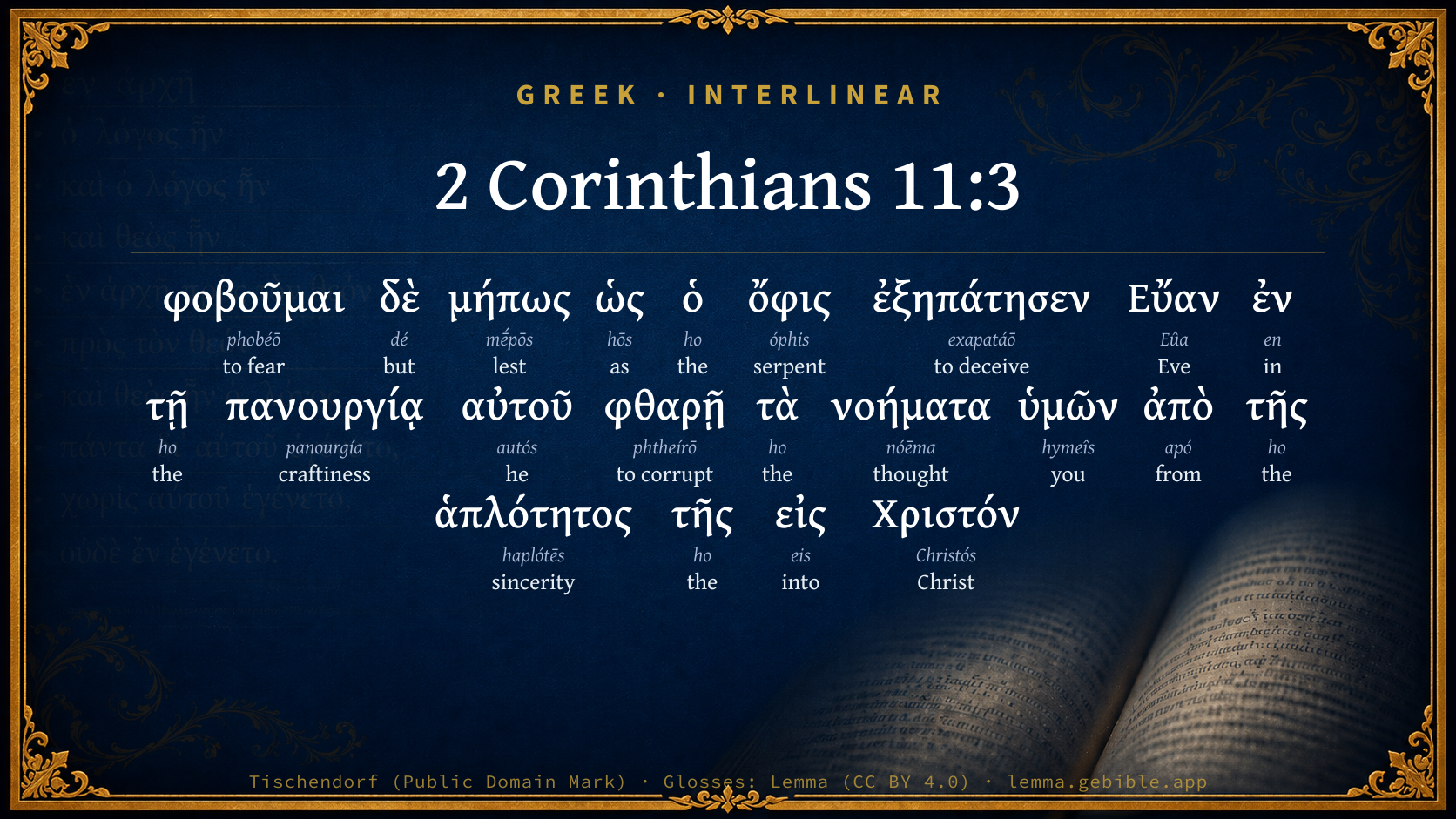
But I am afraid that somehow, as the serpent deceived Eve in his craftiness, so your minds might be corrupted from the simplicity that is in Christ.
Download a study sheet
One document with this verse’s original text, its word-by-word gloss line, the meaning frame, cross-references with their text, attributed commentary, and full source and license credits — printable, and it pastes into notes with its structure intact.
This verse Autodidact and up
A passage Seminary Student
Up to 50 verses in one chapter. A passage sheet keeps up to 6 commentary sources and 12 cross-references per verse, in the order this page ranks them, and says so on the sheet whenever that leaves anything out. Ask for a single verse and you get the Autodidact verse sheet above.
Everything on this page stays free to read, with no account — the sheet is a download of what is already on screen, not access to it.
Compare translations 3
The same verse in 3 English versions, stacked beneath the original-language interlinear above. Click any original word for its lexicon entry.
Each is an independent rendering of the whole verse — the interlinear is not word-aligned to these translations.
Highlighted words mark where these versions differ — a whole-verse word diff, not a word-by-word alignment.
-
World English Bible Public Domain
But I am afraid that somehow, as the serpent deceived Eve in his craftiness, so your minds might be corrupted from the simplicity that is in Christ.
-
King James Version Public Domain
But I fear, lest by any means, as the serpent beguiled Eve through his subtilty, so your minds should be corrupted from the simplicity that is in Christ.
-
unfoldingWord Literal Text CC BY-SA 4.0
But I am afraid that somehow, as the serpent deceived Eve by his craftiness, your minds might be corrupted from the sincerity and the purity to Christ.
unfoldingWord Literal Text — © unfoldingWord, licensed CC BY-SA 4.0. Word-aligned USFM3 via Door43 (git.door43.org/unfoldingWord/en_ult).
Show all 19 translations
Every available English version of this verse, each an independent rendering of the whole verse.
-
World English Bible Public Domain
But I am afraid that somehow, as the serpent deceived Eve in his craftiness, so your minds might be corrupted from the simplicity that is in Christ.
-
Berean Standard Bible Public Domain
I am afraid, however, that just as Eve was deceived by the serpent’s cunning, your minds may be led astray from your simple and pure devotion to Christ.
-
Majority Standard Bible Public Domain
I am afraid, however, that just as Eve was deceived by the serpent’s cunning, your minds may be led astray from the simplicity that is in Christ.
-
King James Version Public Domain
But I fear, lest by any means, as the serpent beguiled Eve through his subtilty, so your minds should be corrupted from the simplicity that is in Christ.
-
American Standard Version (1901) Public Domain
But I fear, lest by any means, as the serpent beguiled Eve in his craftiness, your minds should be corrupted from the simplicity and the purity that is toward Christ.
-
Revised Version (1885) Public Domain
But I fear, lest by any means, as the serpent beguiled Eve in his craftiness, your minds should be corrupted from the simplicity and the purity that is toward Christ.
-
Geneva Bible (1599) Public Domain
But I feare least as the serpent beguiled Eue through his subtiltie, so your mindes shoulde be corrupt from the simplicitie that is in Christ.
-
Douay-Rheims (1899) Public Domain
But I fear lest, as the serpent seduced Eve by his subtilty, so your minds should be corrupted, and fall from the simplicity that is in Christ.
-
Young's Literal Translation Public Domain
and I fear, lest, as the serpent did beguile Eve in his subtilty, so your minds may be corrupted from the simplicity that `is' in the Christ;
-
Literal Standard Version CC BY-SA 4.0
and I fear, lest, as the serpent deceived Eve in his subtlety, so your minds may be corrupted from the simplicity that [is] in the Christ;
-
Unlocked Literal Bible CC BY-SA 4.0
But I am afraid that somehow, as the serpent deceived Eve by his craftiness, your thoughts might be led astray away from a sincere and pure devotion to Christ.
-
unfoldingWord Literal Text CC BY-SA 4.0
But I am afraid that somehow, as the serpent deceived Eve by his craftiness, your minds might be corrupted from the sincerity and the purity to Christ.
-
Darby Bible Public Domain
But I fear lest by any means, as the serpent deceived Eve by his craft, [so] your thoughts should be corrupted from simplicity as to the Christ.
-
World Messianic Bible Public Domain
But I am afraid that somehow, as the serpent deceived Havah in his craftiness, so your minds might be corrupted from the simplicity that is in Messiah.
-
Webster's Bible Public Domain
But I fear, lest by any means, as the serpent beguiled Eve through his subtilty, so your minds should be corrupted from the simplicity that is in Christ.
-
Free Bible Version CC BY-SA 4.0
I worry that in some way, just as the serpent deceived Eve with his devious cunning, that you might be led astray in your thinking from your sincere and pure commitment to Christ.
-
Bible in Basic English Public Domain
But I have a fear, that in some way, as Eve was tricked by the deceit of the snake, your minds may be turned away from their simple and holy love for Christ.
-
Text-Critical English NT CC BY 4.0
But I am afraid that just as the serpent deceived Eve by his craftiness, so your minds will be led astray from simple devotion to Christ.
-
Tyndale New Testament (1534) Public Domain
But I feare lest as the serpent begyled Eve thorow his sutteltie even so youre wittes shuld be corrupte from the singlenes that is in Christ.
Literal Standard Version (2020), Covenant Press — licensed CC BY-SA 4.0. Text via the HelloAO Bible API (eBible.org). Unlocked Literal Bible (unfoldingWord) — licensed CC BY-SA 4.0. Text via the HelloAO Bible API (eBible.org). unfoldingWord Literal Text — © unfoldingWord, licensed CC BY-SA 4.0. Word-aligned USFM3 via Door43 (git.door43.org/unfoldingWord/en_ult). Free Bible Version, Dr. Jonathan Gallagher — licensed CC BY-SA 4.0. Text via the HelloAO Bible API (eBible.org).
Word by word
More ways to search: Search by grammar → Find every occurrence → Compare this word →
Practice this passage: Drill this verse → Learn its vocabulary →
- Appears 2× in the Greek New Testament
- First appears here
- Part of Speech
- Noun
- Case
- Accusative
- Number
- Singular
- Gender
- Feminine
Full Thayer's Definition
- φοβοῦμαι phobéō G5399 “to fear” Verb, Present, Middle or Passive deponent, Indicative, 1st person, Singular
- δὲ dé G1161 “but” Conjunction
- μήπως mḗpōs G3381 “lest” Conjunction, Negative
- ὡς hōs G5613 “as” Adverb
- ὁ ho G3588 “the” Article, Nominative, Singular, Masculine
- ὄφις óphis G3789 “serpent” Noun, Nominative, Singular, Masculine
- ἐξηπάτησεν exapatáō G1818 “to deceive” Verb, Aorist, Active, Indicative, 3rd person, Singular
- Εὔαν Eûa G2096 “Eve” Noun, Accusative, Singular, Feminine
- ἐν en G1722 “in” Preposition
- τῇ ho G3588 “the” Article, Dative, Singular, Feminine
- πανουργίᾳ panourgía G3834 “craftiness” Noun, Dative, Singular, Feminine
- αὐτοῦ autós G846 “he” Personal pronoun, Genitive, Singular, Masculine
- φθαρῇ phtheírō G5351 “to corrupt” Verb, Aorist, Passive, Subjunctive, 3rd person, Singular
- τὰ ho G3588 “the” Article, Nominative, Plural, Neuter
- νοήματα nóēma G3540 “thought” Noun, Nominative, Plural, Neuter
- ὑμῶν hymeîs G5210 “you” Personal pronoun, 2nd person, Genitive, Plural
- ἀπὸ apó G575 “from” Preposition
- τῆς ho G3588 “the” Article, Genitive, Singular, Feminine
- ἁπλότητος haplótēs G572 “sincerity” Noun, Genitive, Singular, Feminine
- τῆς ho G3588 “the” Article, Genitive, Singular, Feminine
- εἰς eis G1519 “into” Preposition
- Χριστόν Christós G5547 “Christ” Noun, Accusative, Singular, Masculine
About this verse
These counts appear in no published source. They are computed here, from the morphology-tagged text and Lemma’s own curated glosses. What Lemma adds →
- 22
- words
- 18
- distinct lemmas
- Pauline Epistles
- section
Notable vocabulary
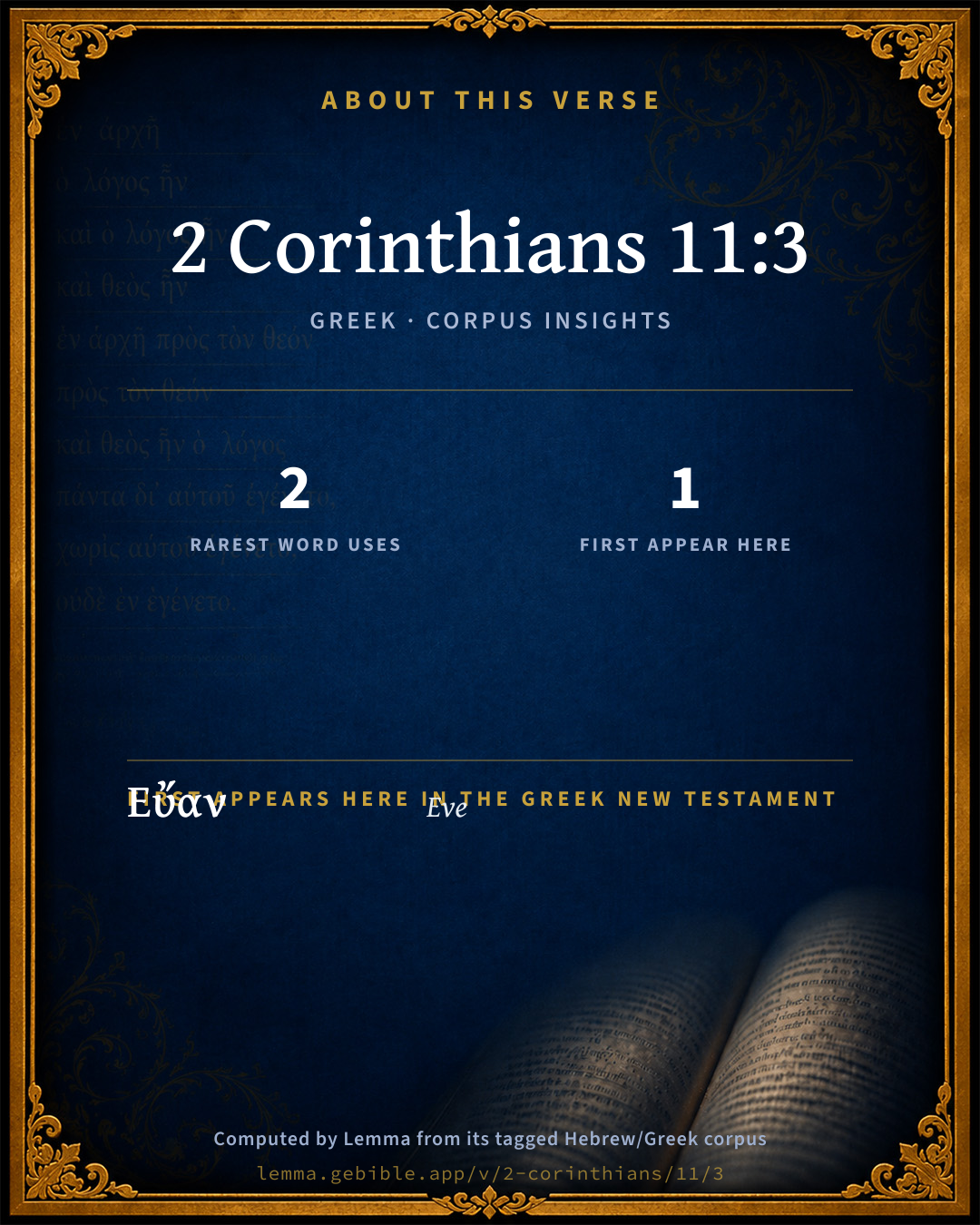
The rarest word here is Εὔαν Eve G2096 — appearing just 2 times in the whole Greek New Testament.
First appearance in Scripture
This word makes its first canonical appearance in the Greek New Testament here:
- Εὔαν Eve G2096
Shared distinctive vocabulary
Εὔαν Eve G2096 occurs in 2 verses of the Greek New Testament. Also found in:
Repetition
A word recurs within this verse:
- ὁ the G3588 ×5
Cross-references
42Topical passages linked to 2 Corinthians 11:3 in the Treasury of Scripture Knowledge — connected by theme and wording, ordered by reader-vote popularity; previews shown in the World English Bible.
- Colossians 2:8 Be careful that you don't let anyone rob you through his philosophy and vain deceit, after the tradition of men, after the elements of the world, and not after Christ.
- Galatians 1:6 I marvel that you are so quickly deserting him who called you in the grace of Christ to a different gospel;
- Ephesians 4:14 that we may no longer be children, tossed back and forth and carried about with every wind of doctrine, by the trickery of men, in craftiness, after the wiles of error;
- 1 John 4:1 Beloved, don't believe every spirit, but test the spirits, whether they are of God, because many false prophets have gone out into the world.
- Colossians 2:4 Now this I say that no one may delude you with persuasiveness of speech.
- Hebrews 13:9 Don't be carried away by various and strange teachings, for it is good that the heart be established by grace, not by food, through which those who were so occupied were not benefited.
- 1 Timothy 2:14 Adam wasn't deceived, but the woman, being deceived, has fallen into disobedience;
- Revelation 12:9 The great dragon was thrown down, the old serpent, he who is called the devil and Satan, the deceiver of the whole world. He was thrown down to the earth, and his angels were thrown down with him.
- Genesis 3:13 Yahweh God said to the woman, "What is this you have done?" The woman said, "The serpent deceived me, and I ate."
- 2 Corinthians 11:13–15 For such men are false apostles, deceitful workers, masquerading as Christ's apostles.
- John 8:44 You are of your Father, the devil, and you want to do the desires of your father. He was a murderer from the beginning, and doesn't stand in the truth, because there is no truth in him. When he speaks a lie, he speaks on his own; for he is a liar, and the father of it.
- Genesis 3:4 The serpent said to the woman, "You won't surely die,
- 2 Corinthians 1:12 For our boasting is this: the testimony of our conscience, that in holiness and sincerity of God, not in fleshly wisdom but in the grace of God we behaved ourselves in the world, and more abundantly toward you.
- Galatians 3:1 Foolish Galatians, who has bewitched you not to obey the truth, before whose eyes Jesus Christ was openly set forth among you as crucified?
- 1 John 2:18 Little children, these are the end times, and as you heard that the Antichrist is coming, even now many antichrists have arisen. By this we know that it is the end times.
- Galatians 4:11 I am afraid for you, that I might have wasted my labor for you.
- 2 Peter 3:17 You therefore, beloved, knowing these things beforehand, beware lest, being carried away with the error of the wicked, you fall from your own steadfastness.
- 2 Corinthians 12:20–21 For I am afraid that by any means, when I come, I might find you not the way I want to, and that I might be found by you as you don't desire; that by any means there would be strife, jealousy, outbursts of anger, factions, slander, whisperings, proud thoughts, riots;
- Matthew 24:24 For there will arise false christs, and false prophets, and they will show great signs and wonders, so as to lead astray, if possible, even the chosen ones.
- Romans 16:18–19 For those who are such don't serve our Lord, Jesus Christ, but their own belly; and by their smooth and flattering speech, they deceive the hearts of the innocent.
- 2 Corinthians 2:17 For we are not as so many, peddling the word of God. But as of sincerity, but as of God, in the sight of God, we speak in Christ.
- Galatians 2:4 This was because of the false brothers secretly brought in, who stole in to spy out our liberty which we have in Christ Jesus, that they might bring us into bondage;
- Ephesians 6:24 Grace be with all those who love our Lord Jesus Christ with incorruptible love. Amen.
- Philippians 3:18–19 For many walk, of whom I told you often, and now tell you even weeping, as the enemies of the cross of Christ,
- 1 Thessalonians 3:5 For this cause I also, when I couldn't stand it any longer, sent that I might know your faith, for fear that by any means the tempter had tempted you, and our labor would have been in vain.
- 2 Thessalonians 2:3–11 Let no one deceive you in any way. For it will not be, unless the departure comes first, and the man of sin is revealed, the son of destruction,
- 1 Timothy 4:1–4 But the Spirit says expressly that in later times some will fall away from the faith, paying attention to seducing spirits and doctrines of demons,
- 2 Timothy 3:13 But evil men and impostors will grow worse and worse, deceiving and being deceived.
- 2 Timothy 4:3–4 For the time will come when they will not listen to the sound doctrine, but, having itching ears, will heap up for themselves teachers after their own lusts;
- 2 Peter 3:3 knowing this first, that in the last days mockers will come, walking after their own lusts,
- Acts 20:30–31 Men will arise from among your own selves, speaking perverse things, to draw away the disciples after them.
- 2 Corinthians 4:2 But we have renounced the hidden things of shame, not walking in craftiness, nor handling the word of God deceitfully; but by the manifestation of the truth commending ourselves to every man's conscience in the sight of God.
- 2 Timothy 3:1–9 But know this, that in the last days, grievous times will come.
- Titus 1:10 For there are also many unruly men, vain talkers and deceivers, especially those of the circumcision,
- Jude 1:4 For there are certain men who crept in secretly, even those who were long ago written about for this condemnation: ungodly men, turning the grace of our God into lasciviousness, and denying our only Master, God, and Lord, Jesus Christ.
- Romans 12:8 or he who exhorts, to his exhorting: he who gives, let him do it with liberality; he who rules, with diligence; he who shows mercy, with cheerfulness.
- 2 Corinthians 11:29 Who is weak, and I am not weak? Who is caused to stumble, and I don't burn with indignation?
- Colossians 2:18 Let no one rob you of your prize by a voluntary humility and worshipping of the angels, dwelling in the things which he has not seen, vainly puffed up by his fleshly mind,
- 1 Timothy 1:3 As I exhorted you to stay at Ephesus when I was going into Macedonia, that you might charge certain men not to teach a different doctrine,
- 2 Peter 2:1–14 But there also arose false prophets among the people, as among you also there will be false teachers, who will secretly bring in destructive heresies, denying even the Master who bought them, bringing on themselves swift destruction.
- Revelation 20:2 He seized the dragon, the old serpent, which is the devil and Satan, who deceives the whole inhabited earth, and bound him for a thousand years,
- Psalms 119:53 Indignation has taken hold on me, Because of the wicked who forsake your law.
Cross-references courtesy of OpenBible.info (CC BY 4.0).
Where the printed editions differ
1 variantPlaces in this verse where the major printed Greek editions disagree on the wording in a way that affects the translation — a comparison of editions, not a manuscript-by-manuscript collation. The editions are the modern critical texts (Nestlé-Aland 28/27, SBL, Westcott-Hort, Tregelles, Tyndale House) and the traditional texts behind the KJV (the Textus Receptus and the Byzantine/Majority text). It is not a claim about which reading is original.
-
Extra text
καὶ τῆς ἁγνότητος
“and the purity”
In NA28NA27TynSBLWHTreg Not in TRByzκαὶ τῆς ἁγνότητος (kai tēs hagnotētos) 'and the purity' is only in older manuscripts (NA28+NA27+Tyn+SBL+WH+Treg)
Textual data: Translators Amalgamated Greek New Testament (STEPBible TAGNT) · CC BY 4.0.
Lesson kit
Teaching starters — assembled from the data on this page, not authored interpretation. Every prompt links to the verse data it draws on. Edit before teaching.
2 Corinthians, in the Pauline Epistles, opens this verse with 22 words (18 distinct Greek lemmas). Its most distinctive word is Eûa (“Eve”). A historical commentator’s framing appears above. Read the whole chapter for the surrounding context.
Discussion questions
- How does “Eve” (Eûa) shape what this verse is saying?
- This is the first place “Eve” appears in Scripture (first appears here). What does its debut here establish?
- How does 1 Timothy 2:13, which shares the word «Eve», read alongside this verse?
- What does the repetition of “the” (5× in this one verse) do in this verse?
- These translations render this verse differently. What is at stake in choosing one wording over another?
- Compare how The Biblical Illustrator and Joseph Benson's Commentary read this verse. Where do they agree or differ?
Things to notice
- 1 word makes its first canonical appearance in Scripture here.
- These translations choose different wording for 17 words in this verse.
- “the” occurs 5× in this single verse.
- 18 distinct Greek lemmas span 22 words in this verse.
Commentary
Notes on 2 Corinthians 11:3 from classic Christian and Jewish commentators (each source and its license shown beneath its notes). The classic Christian expositions comment on the surrounding passage and are grouped to its opening verse, so a note may address several verses; the Jewish commentaries on the Tanakh (Rashi and others) are per-verse, so they appear only where the commentator wrote on this verse.
Lemma curates 59 commentaries, every one of them public domain or Creative Commons licensed, each selected and text-cleaned for this edition rather than reprinted as found. About our sources →
The Biblical Illustrator
Joseph S. Exell
The Biblical Illustrator, edited by Joseph S. Exell (c. 1880s–1900s) — public domain. Text from a community e-Sword module.
Joseph Benson's Commentary
Joseph Benson's Commentary on the Old and New Testaments (1811–1818) — public domain. Text from a community e-Sword module.
MacLaren's Expositions of Holy Scripture
Alexander MacLaren
Alexander MacLaren, Expositions of Holy Scripture (1904–1910) — public domain. Text from a community e-Sword module.
Tyndale Open Study Notes
Tyndale Open Resources
Tyndale Open Study Notes — © Tyndale Open Resources, licensed CC BY-SA 4.0. Text via the HelloAO Bible API.
Bengel's Gnomon
Johann Albrecht Bengel
Bengel's Gnomon of the New Testament — English translation (T&T Clark, Edinburgh, 1860) — public domain. Text from a community e-Sword module.
Meyer's Critical & Exegetical Commentary
Heinrich August Wilhelm Meyer
Meyer — Critical and Exegetical Commentary on the New Testament — English translation by Peter Christie, edited by Frederick Crombie (T&T Clark, 1880) — public domain. Text from a community e-Sword module.
Expositor's Greek Testament
ed. W. Robertson Nicoll
The Expositor's Greek Testament, edited by W. Robertson Nicoll (1897–1910) — public domain. Text from a community e-Sword module.
Geneva Bible (1599)
Geneva Bible translators
Geneva Bible (1599) marginal notes — public domain. Text via Bolls.life.
Jamieson, Fausset & Brown
Robert Jamieson, A. R. Fausset & David Brown
Jamieson, Fausset & Brown — Commentary Critical and Explanatory on the Whole Bible (1871) — public domain (CC PDM 1.0). Text via the HelloAO Bible API.
Adam Clarke's Commentary
Adam Clarke's Commentary on the Bible (1810–1826) — public domain. Text from a community e-Sword/MySword module.
John Calvin's Commentaries
John Calvin's Commentaries (1540-1563) — public domain. Text from the Calvin Translation Society English edition (1840s-50s) via the Christian Classics Ethereal Library (ccel.org). Calvin's coverage is partial (roughly two-thirds of the Bible); uncommented books and verses are honest gaps, never fabricated. The 19th-century editor's footnotes and remarks are omitted so the notes are faithfully Calvin's own voice.
Ellicott's Commentary for English Readers
A Bible Commentary for English Readers, edited by Charles John Ellicott (1878–1897) — public domain. Text from a community e-Sword module.
The Cambridge Bible for Schools and Colleges
gen. ed. J. J. S. Perowne
The Cambridge Bible for Schools and Colleges (gen. ed. J. J. S. Perowne; Cambridge University Press, 1878–1918) — public domain. Text from a community e-Sword module.
John Gill's Exposition
John Gill's Exposition of the Whole Bible (1746–1763) — public domain (CC PDM 1.0). Text via the HelloAO Bible API.
Trapp's Complete Commentary
John Trapp
John Trapp, A Commentary or Exposition upon All the Books of the Old and New Testament (1647–1656) — public domain. Text from a community e-Sword module.
Albert Barnes' Notes on the Bible
Albert Barnes' Notes on the Bible (1834–1885) — public domain. Text from a community e-Sword/MySword module.
Haydock's Catholic Bible Commentary
George Leo Haydock (1774–1849), Haydock's Catholic Family Bible and Commentary, 1859 edition — public domain. Excludes Psalms (Douay-Rheims chapter numbering differs from Protestant) and Deuterocanonical books (Catholic canon only).
Matthew Poole's English Annotations
Matthew Poole's English Annotations on the Holy Bible (1683–1685) — public domain. Text from a community e-Sword/MySword module.
Whedon's Commentary on the Bible
Daniel D. Whedon
Daniel D. Whedon (gen. ed.), Commentary on the Old and New Testaments (1874–1909) — public domain. Text from a community e-Sword module.
The Pulpit Commentary
The Pulpit Commentary (1880–1919), ed. H.D.M. Spence-Jones & Joseph S. Exell — public domain. Text from a community e-Sword module.
John Wesley's Explanatory Notes
John Wesley, Explanatory Notes Upon the Whole Bible (1754–1765) — public domain. Text via the GEBible commentary corpus.
Burkitt's Expository Notes on the New Testament
William Burkitt
William Burkitt's Expository Notes on the New Testament (1700–1703) — public domain. Text from a community e-Sword module.
McGarvey & Pendleton's Commentaries
J. W. McGarvey
J. W. McGarvey (with Philip Y. Pendleton), Commentaries on the New Testament (The Fourfold Gospel, 1914; Acts; and the epistles) — public domain. Text from a community e-Sword/MySword module.
The People's New Testament
B. W. Johnson
B. W. Johnson's The People's New Testament with Notes (1889–1891) — public domain. Electronic text from the Christian Classics Ethereal Library (CCEL) ThML edition.
unfoldingWord translationNotes
Door43 World Missions Community
unfoldingWord translationNotes — © Distant Shores Media and the Door43 World Missions Community, licensed CC BY-SA 4.0. Source: git.door43.org/Door43/en_tn.
Cambridge Greek Testament for Schools and Colleges
Cambridge Greek Testament for Schools and Colleges (Cambridge University Press, 1896; 21 vols, various authors incl. Carr, Maclear, Plummer, Farrar, Lumby, Moule, M. R. James, Simcox) — public domain. Text from a community e-Sword module.
Alford’s Greek Testament
Henry Alford
Henry Alford, The Greek Testament (1849–1861) — public domain. Text from a community e-Sword module.
International Critical Commentary
International Critical Commentary — older volumes (1896–1929), various authors — public domain. Text from a community e-Sword module.
Vincent's Word Studies in the New Testament
Marvin R. Vincent
Marvin R. Vincent, Word Studies in the New Testament (1887–1900) — public domain. Text from a community e-Sword/MySword module.