Galatians 4:11

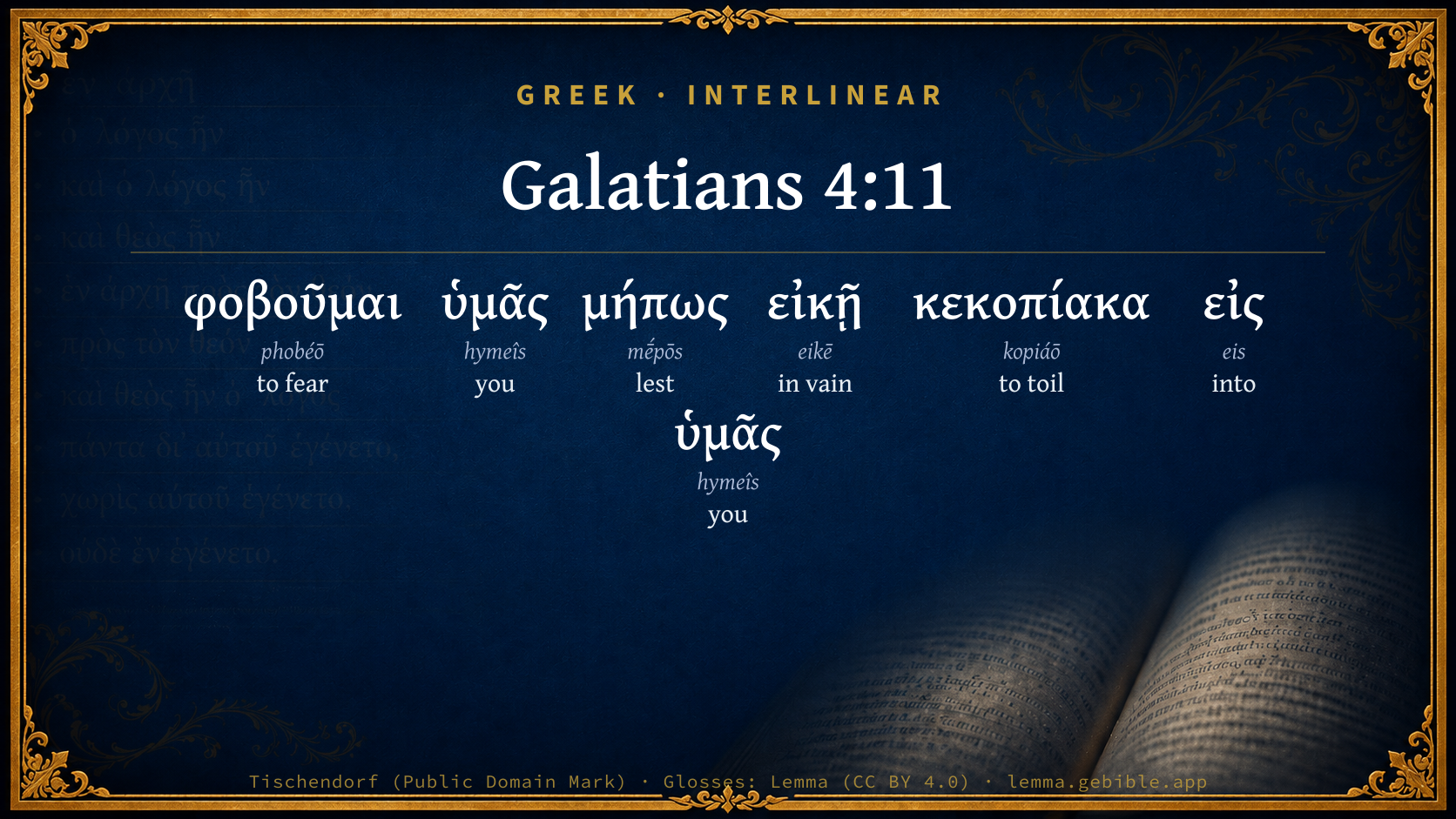
Greek (Tischendorf 8th ed.) Galatians 4:11 appears in the Greek New Testament. The text above is from the Tischendorf 8th edition. Each word links to its Strong’s number and a concise gloss. Click any word for its full Thayer’s Greek Lexicon entry.
Download image
Cite this verse

Galatians 4:11 (World English Bible). Public Domain. Lemma interlinear Bible study tool, https://lemma.gebible.app/v/galatians/4/11.

Show BibTeX & RIS
BibTeX
RIS
English Translation
I am afraid for you, that I might have wasted my labor for you.
World English Bible · Public Domain
Download a study sheet

One document with this verse’s original text, its word-by-word gloss line, the meaning frame, cross-references with their text, attributed commentary, and full source and license credits — printable, and it pastes into notes with its structure intact.

This verse Autodidact and up

Study sheet (.html) Plain text (.txt)

A passage Seminary Student

Up to 50 verses in one chapter. A passage sheet keeps up to 6 commentary sources and 12 cross-references per verse, in the order this page ranks them, and says so on the sheet whenever that leaves anything out. Ask for a single verse and you get the Autodidact verse sheet above.

Everything on this page stays free to read, with no account — the sheet is a download of what is already on screen, not access to it.

Want to remove ads? Support Godless Engineer
Compare translations 3

The same verse in 3 English versions, stacked beneath the original-language interlinear above. Click any original word for its lexicon entry.

Each is an independent rendering of the whole verse — the interlinear is not word-aligned to these translations.

Highlighted words mark where these versions differ — a whole-verse word diff, not a word-by-word alignment.

  • World English Bible Public Domain
    I am afraid for you, that I might have wasted my labor for you.
  • King James Version Public Domain
    I am afraid of you, lest I have bestowed upon you labour in vain.
  • unfoldingWord Literal Text CC BY-SA 4.0
    I am afraid for you lest I have labored among you for nothing.

unfoldingWord Literal Text — © unfoldingWord, licensed CC BY-SA 4.0. Word-aligned USFM3 via Door43 (git.door43.org/unfoldingWord/en_ult).

Versions to compare (up to 4)

3 of 4 selected

Show all 19 translations

Every available English version of this verse, each an independent rendering of the whole verse.

  • World English Bible Public Domain
    I am afraid for you, that I might have wasted my labor for you.
  • Berean Standard Bible Public Domain
    I fear for you, that my efforts for you may have been in vain.
  • Majority Standard Bible Public Domain
    I fear for you, that my efforts for you may have been in vain.
  • King James Version Public Domain
    I am afraid of you, lest I have bestowed upon you labour in vain.
  • American Standard Version (1901) Public Domain
    I am afraid of you, lest by any means I have bestowed labor upon you in vain.
  • Revised Version (1885) Public Domain
    I am afraid of you, lest by any means I have bestowed labour upon you in vain.
  • Geneva Bible (1599) Public Domain
    I am in feare of you, lest I haue bestowed on you labour in vaine.
  • Douay-Rheims (1899) Public Domain
    I am afraid of you, lest perhaps I have laboured in vain among you.
  • Young's Literal Translation Public Domain
    I am afraid of you, lest in vain I did labour toward you.
  • Literal Standard Version CC BY-SA 4.0
    I am afraid for you, lest I labored in vain for you.
  • Unlocked Literal Bible CC BY-SA 4.0
    I am afraid for you that somehow my work with you may have been for nothing.
  • unfoldingWord Literal Text CC BY-SA 4.0
    I am afraid for you lest I have labored among you for nothing.
  • Darby Bible Public Domain
    I am afraid of you, lest indeed I have laboured in vain as to you.
  • World Messianic Bible Public Domain
    I am afraid for you, that I might have wasted my labor for you.
  • Webster's Bible Public Domain
    I am afraid of you, lest I have bestowed upon you labor in vain.
  • Free Bible Version CC BY-SA 4.0
    I'm concerned that all I did for you has been wasted!
  • Bible in Basic English Public Domain
    I am in fear of you, that I may have been working for you to no purpose.
  • Text-Critical English NT CC BY 4.0
    I am afraid for you, lest somehow I have labored for you in vain.
  • Tyndale New Testament (1534) Public Domain
    I am in feare of you lest I have bestowed on you laboure in vayne.

Literal Standard Version (2020), Covenant Press — licensed CC BY-SA 4.0. Text via the HelloAO Bible API (eBible.org). Unlocked Literal Bible (unfoldingWord) — licensed CC BY-SA 4.0. Text via the HelloAO Bible API (eBible.org). unfoldingWord Literal Text — © unfoldingWord, licensed CC BY-SA 4.0. Word-aligned USFM3 via Door43 (git.door43.org/unfoldingWord/en_ult). Free Bible Version, Dr. Jonathan Gallagher — licensed CC BY-SA 4.0. Text via the HelloAO Bible API (eBible.org).

Word by word

More ways to search: Search by grammar → Find every occurrence → Compare this word →

Practice this passage: Drill this verse → Learn its vocabulary →

About this verse

These counts appear in no published source. They are computed here, from the morphology-tagged text and Lemma’s own curated glosses. What Lemma adds →

7
words
6
distinct lemmas
Pauline Epistles
section

Notable vocabulary

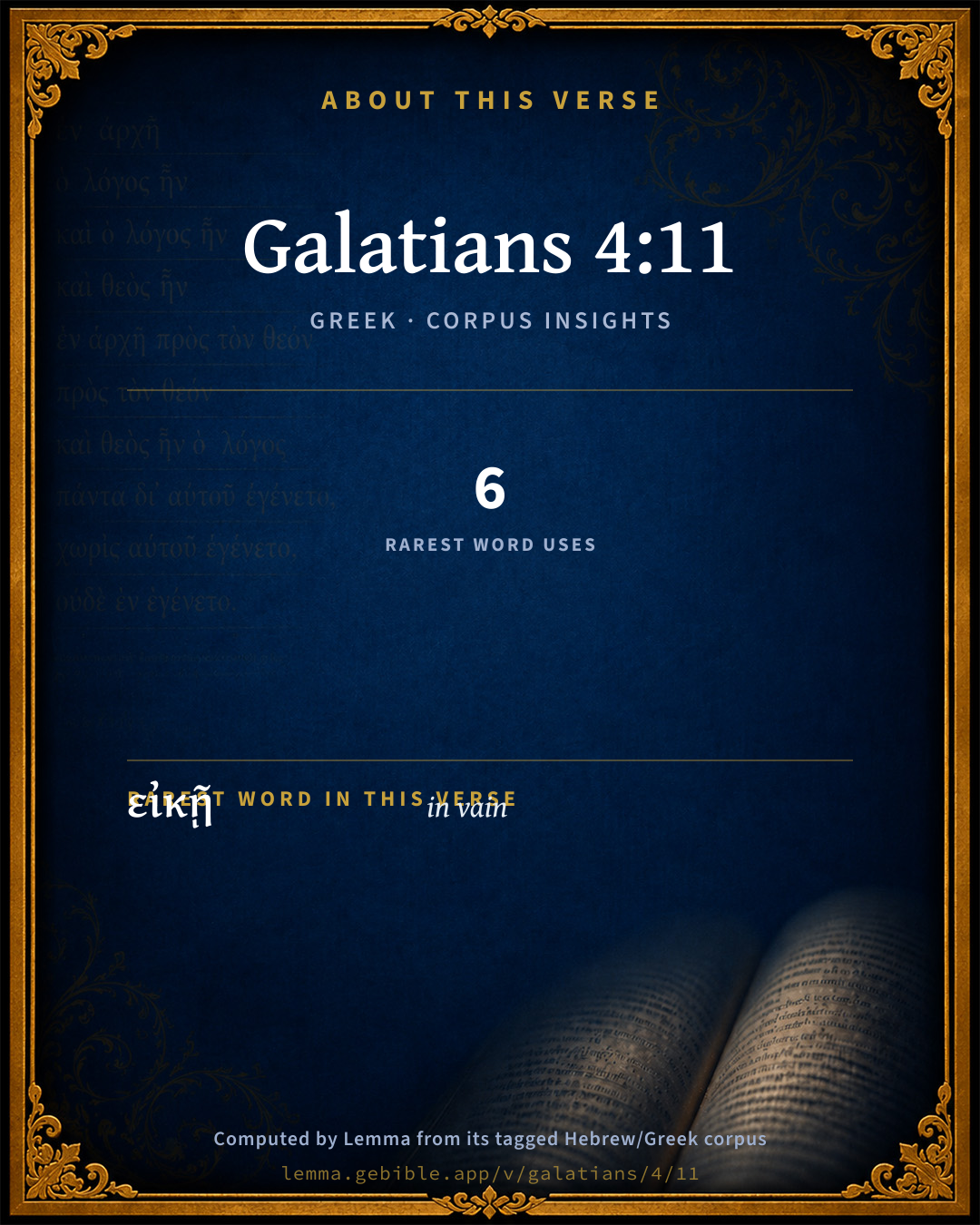
The rarest word here is εἰκῇ in vain G1500 — appearing just 6 times in the whole Greek New Testament.

Shared distinctive vocabulary

εἰκῇ in vain G1500 occurs in 5 verses of the Greek New Testament. Also found in:

Repetition

A word recurs within this verse:

  • ὑμᾶς you G5210 ×2

Cross-references

11

Topical passages linked to Galatians 4:11 in the Treasury of Scripture Knowledge — connected by theme and wording, ordered by reader-vote popularity; previews shown in the World English Bible.

  • 1 Thessalonians 3:5 For this cause I also, when I couldn't stand it any longer, sent that I might know your faith, for fear that by any means the tempter had tempted you, and our labor would have been in vain.
  • Galatians 2:2 I went up by revelation, and I laid before them the Gospel which I preach among the Gentiles, but privately before those who were respected, for fear that I might be running, or had run, in vain.
  • Philippians 2:16 holding up the word of life; that I may have something to boast in the day of Christ, that I didn't run in vain nor labor in vain.
  • 2 John 1:8 Watch yourselves, that we don't lose the things which we have accomplished, but that we receive a full reward.
  • Isaiah 49:4 But I said, I have labored in vain, I have spent my strength for nothing and vanity; yet surely the justice [due] to me is with Yahweh, and my recompense with my God.
  • Acts 16:6 When they had gone through the region of Phrygia and Galatia, they were forbidden by the Holy Spirit to speak the word in Asia.
  • 1 Corinthians 15:58 Therefore, my beloved brothers, be steadfast, immovable, always abounding in the Lord's work, because you know that your labor is not in vain in the Lord.
  • 2 Corinthians 11:2–3 For I am jealous over you with a godly jealousy. For I married you to one husband, that I might present you as a pure virgin to Christ.
  • 2 Corinthians 12:20–21 For I am afraid that by any means, when I come, I might find you not the way I want to, and that I might be found by you as you don't desire; that by any means there would be strife, jealousy, outbursts of anger, factions, slander, whisperings, proud thoughts, riots;
  • Galatians 4:20 but I could wish to be present with you now, and to change my tone, for I am perplexed about you.
  • Galatians 5:2–4 Behold, I, Paul, tell you that if you receive circumcision, Christ will profit you nothing.

Cross-references courtesy of OpenBible.info (CC BY 4.0).

Commentary

Notes on Galatians 4:11 from classic Christian and Jewish commentators (each source and its license shown beneath its notes). The classic Christian expositions comment on the surrounding passage and are grouped to its opening verse, so a note may address several verses; the Jewish commentaries on the Tanakh (Rashi and others) are per-verse, so they appear only where the commentator wrote on this verse.

Lemma curates 59 commentaries, every one of them public domain or Creative Commons licensed, each selected and text-cleaned for this edition rather than reprinted as found. About our sources →

The Biblical Illustrator

Joseph S. Exell

Gal_4:11

I am afraid of you.

A ministers fears

I. What are those fears?

1. Lest his word should not issue in conversions.

2. Lest the converted members of his flock should not adorn their profession.

3. Lest his converts should apostatise.

II. What is his duty in the presence of these fears?

1. To labour on in spite of them.

(1) They may be groundless,

(2) or if only too well grounded, he is not responsible.

2. Not to allow them to generate despair. The worst sinner may yet be converted and the worst backslider reclaimed.

3. To do all he can, with Gods help, to prevent failure.

III. What are his encouragements in the face of these fears?

1. That he has been working for Gods glory.

2. That God is responsible for results.

3. That in spite of appearances to the contrary Gods word will not return unto Him void.

Conclusion: How sad to be the subject of these fears.

1. Unconverted.

2. Inconsistent.

3. Backsliding.

At one point in Dr. Bangs ministry he became greatly discouraged, and attempted to leave his work. A significant dream relieved him. He thought he was working with a pickaxe, on the top of a basaltic rock. His muscular arm brought down stroke after stroke for hours, but the rock was hardly indented. He said to himself at last, It is useless; I will pick no more. Suddenly a stranger of dignified mien stood by his side, and said, You will pick no more? No. Were you not set to do this task? Yes. Why then abandon it? My work is in vain; I make no impression. Solemnly the stranger replied, What is that to you? Your duty is to pick, whether the rock yields or not. Your work is in your own hands; the result is not. Work on. He resumed his task. The first blow was given with almost superhuman force, and the rock flew into a thousand pieces. He awoke, returned to his work, and a great revival followed. (A. Stevens, LL. D.)

Pain of fruitless labour

Dr. Talmage says, I remember visiting a military prison where they punish men by making them carry cannon-balls from one end of the yard to the other, and the sergeant who accompanied me said: When we made the men carry the balls from this end of the yard to the other to make a pyramid at the other end there was a kind of amusement in it, because they were building up this pyramid; and so we made an alteration, and the man has to carry the ball from this end of the yard to the other and back again, and his toil seems to be so altogether fruitless, that it becomes a double punishment to him. Even so it is a source of bitter pain to an earnest minister to feel that his laborious efforts for the good of his hearers are after all in vain.

The Biblical Illustrator, edited by Joseph S. Exell (c. 1880s–1900s) — public domain. Text from a community e-Sword module.

Tyndale Open Study Notes

Tyndale Open Resources

4:11 I fear for you: The Galatians were in danger of turning away from Christ by relying upon the law. If they did, Paul’s hard work would have been for nothing. The Good News would have done them no good (cp. Heb 6:4-6; 2 Pet 2:20-22). See Acts 13:44–14:24 for a description of Paul’s work for the sake of the Christians in that region.

Tyndale Open Study Notes — © Tyndale Open Resources, licensed CC BY-SA 4.0. Text via the HelloAO Bible API.

Bengel's Gnomon

Johann Albrecht Bengel

Gal 4:11. Ὑμᾶς you) I do not fear this for my own sake, but for yours.—εἰς ὑμᾶς) on you; an emphatic expression.

Bengel's Gnomon of the New Testament — English translation (T&T Clark, Edinburgh, 1860) — public domain. Text from a community e-Sword module.

Meyer's Critical & Exegetical Commentary

Heinrich August Wilhelm Meyer

Gal_4:11. Φοβοῦμαι ὑμᾶς, μήπως κ.τ.λ.] not attraction (Winer, Usteri, Olshausen, Hilgenfeld, Wieseler, Buttmann), because, if this had been the case, ὑμεῖς must have been the subject of μήπως κ.τ.λ. (Plat. Legg. x. p. 886 A: φοβοῦμαί γε τοὺς μοχθηροὺς … μή πως ὑμῶν καταφρονήσωσιν. Phaedr. p. 232 C, φοβούμενοι τοὺς μὲν οὐσίαν κεκτημένους, μὴ χρήμασιν αὐτοὺς ὑπερβάλωνται. Diod. Sic. iv. 40; Thuc. iv. 1. 1; Xen. Anab. iii. 5. 18, vii. 1. 2; Soph. Trach. 547): see the passages in Winer, p. 581 ff. [E. T. 781 f.]; Krüger, gramm. Unters. III. p. 162 ff.; Kühner, II. p. 611. On the contrary, φοβοῦμαι ὑμᾶς is to be taken by itself, and μήπως κ.τ.λ. as a more precise definition of it: I am afraid about you, lest perhaps I, etc. Comp. Plat. Phaedr. p. 239 D: τοιοῦτον σῶμα οἱ φίλοι … φοβοῦνται (are apprehensive about it). Soph. O. R. 767: δέδοικʼ ἐμαυτὸν …, μὴ πολλʼ ἄγαν εἰρημένʼ ᾖ μοι. It is not without cause that Paul has added ὑμᾶς, but in the consciousness that his apprehension had reference not to his own interests (his possibly fruitless labour, taken by itself), but to his readers; they themselves were the object of his anxiety, their deliverance, their salvation. The mode of expression is analogous also in a hostile sense, e.g. Xen. Hell. ii. 3. 18: ἐφοβοῦντο τὸν Θηραμένην, μὴ συῤῥυείησαν πρὸς αὐτὸν οἱ πολῖται. Thuc. iv. 8. Galatians 5 : τὴν δὲ νῆσον ταύτην φοβούμενοι, μὴ ἐξ αὐτῆς τὸν πόλεμον σφίσι ποιῶνται.

εἰκῆ] without saving result (Gal_4:11; 1Co_15:2), because ye are in the course of falling away from the life of Christian faith, which through my labours was instituted among you.

κεκοπίακα] Perfect indicative; for the thought was before the apostles mind, that this case had actually occurred. Hermann, ad Eur. Med. 310, Elmsl.; Winer, p. 469 [E. T. 631]; Stallbaum, ad Plat. Phaed. p. 84 E.

εἰς ὑμᾶς] for you; εἰς denotes the reference of the toilsome labour which he had undergone to the Galatians. Comp. Rom_16:6

Luther (1524), moreover, aptly remarks on Gal_4:11 : Lacrymas Pauli haec verba spirant.

Meyer — Critical and Exegetical Commentary on the New Testament — English translation by Peter Christie, edited by Frederick Crombie (T&T Clark, 1880) — public domain. Text from a community e-Sword module.

Expositor's Greek Testament

ed. W. Robertson Nicoll

Gal 4:11-20 . DISAPPOINTMENT OF THE APOSTLE AT THE CHANGED FEELING OF HIS CONVERTS; REMINISCENCES OF THE PAST; PATHETIC APPEAL TO OLD AFFECTION; PROTEST AGAINST PRESENT ESTRANGEMENT.

The Expositor's Greek Testament, edited by W. Robertson Nicoll (1897–1910) — public domain. Text from a community e-Sword module.

Jamieson, Fausset & Brown

Robert Jamieson, A. R. Fausset & David Brown

lest--Greek, "lest haply." My fear is not for my own sake, but for yours.

Jamieson, Fausset & Brown — Commentary Critical and Explanatory on the Whole Bible (1871) — public domain (CC PDM 1.0). Text via the HelloAO Bible API.

Adam Clarke's Commentary

Verse 11. I am afraid of you] I begin now to be seriously alarmed for you, and think you are so thoroughly perverted from the Gospel of Christ, that all my pains and labour in your conversion have been thrown away.

Adam Clarke's Commentary on the Bible (1810–1826) — public domain. Text from a community e-Sword/MySword module.

John Calvin's Commentaries

11. Lest I have bestowed upon you labor in vain. The expression is harsh, and must have filled the Galatians with alarm; for what hope was left to them, if Paul’s labor had been in vain? Some have expressed astonishment that Paul should be so powerfully affected by the observance of days, as almost to designate it a subversion of the whole gospel. But if we carefully weigh the whole, we shall see that there was just reason; and that the false apostles not only attempted to lay the yoke of Jewish bondage on the neck of the church, but filled their minds with wicked superstitions. To bring back Christianity to Judaism, was in itself no light evil; but far more serious mischief was done, when, in opposition to the grace of Christ, they set up holidays as meritorious performances, and pretended that this mode of worship would propitiate the divine favor. When such doctrines were received, the worship of God was corrupted, the grace of Christ made void, and the freedom of conscience oppressed.

Do we wonder that Paul should be afraid that he had labored in vain, that the gospel would henceforth be of no service? And since that very description of impiety is now supported by Popery, what sort of Christ or what sort of gospel does it retain? So far as respects the binding of consciences, they enforce the observance of days with not less severity than was done by Moses. They consider holidays, not less than the false apostles did, to be a part of the worship of God, and even connect with them the diabolical notion of merit. The Papists must therefore be held equally censurable with the false apostles; and with this addition in aggravation, that, while the former proposed to keep those days which had been appointed by the law of God, the latter enjoin days, rashly stamped with their own seal, to be observed as most holy.

John Calvin's Commentaries (1540-1563) — public domain. Text from the Calvin Translation Society English edition (1840s-50s) via the Christian Classics Ethereal Library (ccel.org). Calvin's coverage is partial (roughly two-thirds of the Bible); uncommented books and verses are honest gaps, never fabricated. The 19th-century editor's footnotes and remarks are omitted so the notes are faithfully Calvin's own voice.

The Cambridge Bible for Schools and Colleges

gen. ed. J. J. S. Perowne

11. I am afraid of you] Sad thought, that all the toil which he had undergone on their behalf might prove to have been in vain! The possibility of such a result softens his tone, and as he thinks of his own labours, he will appeal to them by their memory of the past—of their reception of him and of his message ‘at the first’.

The thought of having bestowed labour in vain has always been one of the trials of the faithful messenger of God. It was so in the case of Elijah (1Ki_19:10; 1Ki_19:14), of Isaiah, (Isa_53:1). It finds frequent expression in the Epistles of St Paul (1Co_15:14; Gal_2:2; Php_2:16; 1Th_3:5). The assurance given long ago (Isa_55:11) is still needed and still in force.

The Cambridge Bible for Schools and Colleges (gen. ed. J. J. S. Perowne; Cambridge University Press, 1878–1918) — public domain. Text from a community e-Sword module.

John Gill's Exposition

Brethren, I beseech you, be as I am,.... Though they had gone so far backwards, yet still hoping well of them that they would he reclaimed, he styles them "brethren": not in a carnal but spiritual relation, as being born of God, and belonging to his family; and out of his sincere and hearty love for them as his brethren in Christ, he exhorts them to be as he was; which some understand of affection, as desiring them to show the same love to him as to themselves, that he might be to them as another I, as a part of themselves; so true friendship makes, and true friends look upon each other to be, as Jonathan and David, and the first Christians were, of one heart and soul. But this phrase rather seems to have regard to likeness and imitation; and the sense is, that he would have them to be as he was, and do as he did; to be as free from the law, and the servitude and bondage of it, as he was; to reckon themselves dead unto it, as he did; and to relinquish the observance of days, and months, and times, and years, and any and every part of the ceremonial law, and to account all these things, as he had done, loss and dung for Christ; and this he presses, not in an authoritative way, laying his commands as an apostle upon them, but in a kind and gentle manner entreating them: and which he backs with the following reason or argument,

for I am as ye are; as your very selves; I have the same love for you, you have for yourselves; I love you as I do myself; this way go such interpreters that understand the exhortation to regard love and affection: but rather the meaning is, be as I am, and do as I do, "because I was as you are"; so the Syriac and Arabic versions read the words. Some think that the apostle particularly addresses the Jews in these churches; and that his sense is, that he was born a Jew, as they were, was brought up in the Jewish religion, and in the observance of these things, as they had been, and yet he had relinquished them, therefore would have them do so likewise: or rather his intention is, that he had been as zealous for the observation of the ceremonial law, and all the rituals of it, as they now were; and though he was a Jew by birth, and had had a Jewish education, and so had been prejudiced in favour of these things, yet he had renounced them all; and therefore they who were Gentiles, and were never under obligation to them, should never think of coming into bondage by them; and since he had accommodated himself to them, and had become all things to all, that he might gain some, whether Jews or Gentiles, so he hoped they would condescend to him, and follow his example: or this may have respect, not to his former but present state, according to our version; and the sense be, I am as you are, and you are as I am with respect to things spiritual; we are both alike in Christ, chosen in him, and redeemed by him; are equally regenerated by his Spirit, and are all the children of God by faith in him, and no more servants; are all equally Christ's free men, and have a right to the same privileges and immunities; and therefore be as I am, as free from observing the ceremonies of the law, and so from the bondage of it, since we are upon an equal foot, and upon the same foundation in Christ.

Ye have not injured me at all; what injury they had done was to God, whose will it was that these things should be abolished; and to Christ, who had broken down the middle wall of partition; and to the Gospel, which proclaimed liberty to the captives; and to their own souls, by entangling themselves with the yoke of bondage; but no personal private injury was done to the apostle by their compliance with the law. This he says, lest they should think that he spoke out of anger and resentment, and on account of any personal affront offered to him; which leads him to take notice of their former kindness and respect to him, and which he designs as a reason why they should pay the same deference to him now as then.

John Gill's Exposition of the Whole Bible (1746–1763) — public domain (CC PDM 1.0). Text via the HelloAO Bible API.

Trapp's Complete Commentary

John Trapp

11 I am afraid of you, lest I have bestowed upon you labour in vain.

Ver. 11. Lest I have bestowed labour] Gr. κεκοπιακα, even to lassitude, as a day labourer. Other work folks find their work as they left it; but a minister hath all marred many times between sabbath and sabbath, or if but awhile absent, as Moses was in the mount.

John Trapp, A Commentary or Exposition upon All the Books of the Old and New Testament (1647–1656) — public domain. Text from a community e-Sword module.

Albert Barnes' Notes on the Bible

I am afraid of you ... - I have fears respecting you. His fears were that they had no genuine Christian principle. They had been so easily perverted and turned back to the servitude of ceremonies and rites, that he was apprehensive that there could be no real Christian principle in the case. What pastor has not often had such fears of his people, when he sees them turn to the weak and beggarly elements of the world, or when, after having “run well,” he sees them become the slaves of fashion, or of some habit inconsistent with the simplicity of the gospel?

Albert Barnes' Notes on the Bible (1834–1885) — public domain. Text from a community e-Sword/MySword module.

Matthew Poole's English Annotations

Paul knew that, with reference to himself, he had not laboured in vain; he might say with Isaiah, Isa 49:5; Though Israel be not gathered, yet shall I be glorified. He had told the Corinthians, that he knew he should be a sweet savour to God, as well in them that perished as in them that should be saved, 2Co 2:15. But he speaks with reference to them. A faithful minister accounteth his labour lost when he seeth no fruits of it upon the souls of his people. Nor was Paul afraid of this as to the sincerer part of this church, who truly believed, and were justified, but he speaketh this with reference to the whole body of this church. That which he feared, was their falling back from their profession of Christianity to Judaism; as judging the observation of the Jewish days necessary by Divine precept to Christians. Nor doth he speak of the observation of such days, as it was their duty in obedience to the moral law to observe, which commandeth the observation of a seventh day for the weekly sabbath, and gives a liberty for setting apart other days, and the commanding the observation of them, to take notice of and acknowledge God in emergent providences. But he only speaks of days imposed by the ceremonial law, and men’s religious observation of them, as being tied to it by a Divine precept, by which they made them a part of worship. We have a liberty to set apart any day for God’s worship, and magistrates have a liberty to set apart particular days for the acknowledgment of God in emergent providences whether of mercy or judgment; but none hath a power to make a day holy, so as that it shall be a sin against God for all to labour therein, much less hath any a liberty to keep Jewish holy-days.

Matthew Poole's English Annotations on the Holy Bible (1683–1685) — public domain. Text from a community e-Sword/MySword module.

Whedon's Commentary on the Bible

Daniel D. Whedon

11. I am afraid of you, lest—The Greek indicative implies that he assumes that which he fears was an accomplished fact.

Daniel D. Whedon (gen. ed.), Commentary on the Old and New Testaments (1874–1909) — public domain. Text from a community e-Sword module.

The Pulpit Commentary

I am afraid of you, lest I have bestowed upon you labour in vain (foboumai uJmav mhpwv eijkh kepopiaka eijv uJmav) I am afraid of you, lest by any means 1 have bestowed labour upon you in vain. That is, this behaviour of yours makes me fear whether I may not have bestowed labour upon you fruitlessly. A similar construction of mh pwv with an indicative occurs in 1Th_3:5, Mh pwv ejpeirasen uJmav oJ peirazwn, "Fearing, whether the tempter may not have tempted you;" followed by the subjunctive, Kainon genhtai oJ kopov hJmwn, "And lest our labour should in the as yet future result prove to be for no good." This passage in the Thessalonians serves to illustrate the nature of the mischief, which, in the present case, the apostle feared might result. For one thing, there was the hurt, the perhaps fatal hurt, which the Galatian believers might themselves receive from that virtual renouncement of their spiritual inheritance which they now seemed to be foolishly making. But there was also the disappointment which would accrue to himself through the failure of his work among them: "For what," as he wrote to the 1Th_2:19, "is our hope, or crown of glorying? Are not even ye, before our Lord Jesus at his coming?" The same anticipated joy he speaks of in writing to the Philippians, as about to accrue to himself from the steadfastness of his converts: "That I may have whereof to glory in the day of Christ, that I did not run in vain, neither labour in vain." This anticipation was a joy which he would fain not have wrested from him.

The apostle"s apprehensions for his converts.

am apprehensive of you, lest I have bestowed upon you labour in vain.

I THE GALATIANS COST THE APOSTLE MUCH LABOUR. He was their spiritual father; he had paid them a second visit which was full of effort and anxiety; and this Epistle represented effort and anxiety in a very extreme form. The apostle never spared himself. He laboured more abundantly than all the apostles.

II HIS UNCERTAINTY AND CONCERN FOR THEM. It was doubtful whether he would succeed after all in repelling the attack of the Judaists and rescuing his converts from their injurious influences. But, though he labours in uncertainty, he works in hope. "Other work-folks find their work as they left it, but a minister hath all marred many times between sabbath and sabbath" (Trapp). Yet it is manifest that it is not his own interest, but that of his converts, which is his supreme anxiety at this moment of crisis in Galatia.

Labour bestowed in vain.

I AN APOSTLE MAY BESTOW LABOUR IN VAIN. If St. Paul might thus fail, we are not to be surprised when we do not meet with success. We are not responsible for the results of our work, but only for the faithfulness of our efforts.

II A TRUE WORKMAN WILL BE ANXIOUS NOT TO BESTOW LABOUR IN VAIN. Christian work is not mere treadmill drudgery. It is labour of interest, of sympathy, of love. The servant of Christ will be anxious, not only that he may be saved, though, perhaps, "so as by fire," but that his work may be preserved

(1) for the honour of Christ;

(2) for the welfare of men;

(3) for the personal interest occasioned by self-sacrificing toil.

If we care nothing for the results of our work, this is a manifest proof that our heart is not in it, and therefore that the work will be ill done. We must earnestly desire a good harvest if ever we are to be rewarded with the sight of the ripe golden ears.

III THE PROSPECT OF FAILURE IN WORK WILL LEAD AN EARNEST MAN TO DO ALL HE CAN TO PREVENT IT. It was the dread of such failure that called forth the whole Epistle to the Galatians from St. Paul.

1. Failure, though in prospect, may often be obviated by improved methods, for we may be ourselves to blame for the want of success that we attribute to the stubbornness of the soil. It is a mistake to be wedded to any one method. The slavery of routine is fatal to success. New emergencies demand new plans. Beware of sacrificing the work to the machinery.

2. Failure may be avoided by more earnest efforts. St. Paul expostulates with the Galatians. He exhibits something of the long-suffering of God. It is foolish and weak and wrong to despair at the first lack of success. God despairs of no soul. If we were more hopeful and more patient we should be more fruitful.

IV IT IS LAMENTABLE TO BE IN THE CONDITION OF THOSE UPON WHOM LABOUR HAS BEEN BESTOWED IN VAIN. They who thus fail are without excuse. All that has been done for them will rise up in judgment against them. How terrible to have been privileged with the ministry of an apostle, of a St. Paul, and, in spite of all his eloquence, his zeal, his self-sacrificing devotion, his inspiration, to make shipwreck at last! We who have the New Testament in our hands have that ministry for our benefit. If after enjoying the privileges of living in a Christian country and receiving Christian teaching we fail of entering into the Christian life, all the labour spent in vain upon us will condemn us. The responsibility rests on each individual soul. It is a delusion to throw the blame on the preachers. The highest influences, even up to the preaching of a St. Paul, will fail, unless we yield our own hearts in obedience to the truth. W.F.A.

The Pulpit Commentary (1880–1919), ed. H.D.M. Spence-Jones & Joseph S. Exell — public domain. Text from a community e-Sword module.

John Wesley's Explanatory Notes

The apostle here, dropping the argument, applies to the affections, ver. 11-20, and humbles himself to the Galatians, with an inexpressible tenderness.

John Wesley, Explanatory Notes Upon the Whole Bible (1754–1765) — public domain. Text via the GEBible commentary corpus.

Luther on Galatians

Martin Luther

VERSE 11. I am afraid of you, lest I have bestowed upon you labor in vain.

It grieves the Apostle to think that he might have preached the Gospel to the Galatians in vain. But this statement expresses more than grief. Behind his apparent disappointment at their failure lurks the sharp reprimand that they had forsaken Christ and that they were proving themselves to be obstinate unbelievers. But he does not openly condemn them for fear that oversharp criticism might alienate them altogether. He therefore changes the tone of his voice and speaks kindly to them.

Martin Luther — Commentary on the Epistle to the Galatians (1535), English translation by Theodore Graebner (Zondervan, 1939) — public domain (U.S. copyright not renewed). Text from a community e-Sword module.

McGarvey & Pendleton's Commentaries

J. W. McGarvey

I am afraid of you, lest by any means I have bestowed labor upon you in vain . [This paragraph is addressed especially to the Gentile Christians. He reminds them that at the time of their wardship their condition differed from that of the Jews; for, having no true copy of the will or law, they were in the more severe bondage of idolatry. Having come from this low, degraded, poverty-stricken bondage into the joyous estate of sonship, where they knew and were known of God the Father, they should have been more impressed by the contrast even than were the Jews, and so should have been more reluctant to return to bondage again. They, therefore, had less excuse than the Jews, who had not been so far removed from God. The bondage is forcefully described, and the points of description are thus aptly defined by Johnson: "Weak, because they have no spiritual power to strengthen us; beggarly, because they have no rich promise like the gospel; rudiments, because they belong to a rudimentary condition, to an undeveloped state, to the childhood of the race." In proof of the unquestioned relapse of the Galatians, Paul cites their observance of days, etc., set apart by the terms of the bondage, or law. It is not stated whether these were Sabbaths and festivals of Judaism, or the ritual days of paganism, but as they were observed at the instance and through the urgency of the Judaizers, there can be little doubt that they were the former; and the Jewish calendar corresponds to Paul's list, for they had Sabbath days, and new moon festivals each month, the great feasts in their seasons, and Sabbatical years. This passage, and that in Colossians ( Col_2:16 ), if taken together, show very clearly that the Christians are not required to keep the Jewish Sabbath, and Paul's closing words, expressing fear as to the results of his labors, is a forcible warning, indicating that salvation itself may be forfeited by a return to legalism.]

J. W. McGarvey (with Philip Y. Pendleton), Commentaries on the New Testament (The Fourfold Gospel, 1914; Acts; and the epistles) — public domain. Text from a community e-Sword/MySword module.

The People's New Testament

B. W. Johnson

11. In vain. See notes on 2:2.

B. W. Johnson's The People's New Testament with Notes (1889–1891) — public domain. Electronic text from the Christian Classics Ethereal Library (CCEL) ThML edition.

Cambridge Greek Testament for Schools and Colleges

11. φοβοῦμαι ὑμᾶς. Not “I fear for you,” for φοβ. with an accusative of the person never has this meaning in the Greek Bible, and very seldom if ever (cf. Soph. Oed. R. 760 [767]) elsewhere; but “I fear you,” i.e. you cause me dread from the effect that your action will have on my work.

μή πως, “lest by any means,” cf. Gal 2:2 with similar context. Moulton (Proleg., 1906, p. 193) translates “perhaps I have toiled in vain,” cf. Col 2:8 note.

εἰκῇ, “in vain”; i.e. “without due result,” Gal 3:4.

κεκοπίακα, Col 1:29 note. There also as here St Paul uses the verb of himself when turning to speak in detail of his interest in those to whom he is writing.

εἰς ὑμᾶς. κοπ. εἰς, with an accusative of the person, Rom 16:6[123]. Cf. Isa 30:5 (πρός). Contrast the inscription of a wife referring to her husband, τείς [= ὅστις] μοι πολλὰ ἐκοπίασεν (Deissmann, Licht vom Osten, p. 227).

[123] Is affixed it means that all the passages are mentioned where the word occurs in the Greek Bible.

Cambridge Greek Testament for Schools and Colleges (Cambridge University Press, 1896; 21 vols, various authors incl. Carr, Maclear, Plummer, Farrar, Lumby, Moule, M. R. James, Simcox) — public domain. Text from a community e-Sword module.

Alford’s Greek Testament

Henry Alford

11.] There is no attraction in the construction (φοβ. ὑμᾶς, μή πως …), as Winer (comm. in loc.) holds: in that case ὑμεῖς must be the subject of the next clause (so in Diod. Sic. iv. 40 (Meyer), τὸν ἀδελφὸν εὐλαβεῖσθαι, μή ποτε … ἐπίθηται τῇ βασιλείᾳ): but φοβ. ὑμᾶς stands alone, and the following clause explains it. So Soph. Œd. Tyr. 760, δέδοικʼ ἐμαυτὸν … μὴ πόλλʼ ἄγαν εἰρημένʼ ᾖ μοι. The indicative assumes the fact which μή πως deprecates:—see reff.

Henry Alford, The Greek Testament (1849–1861) — public domain. Text from a community e-Sword module.

International Critical Commentary

11. φοβοῦμαι ὑμᾶς μή πως εἰκῇ κεκοπίακα εἰς ὑμᾶς. “I fear that in vain have I spent my labour upon you,” i. e., that the labour which I bestowed on you is to result in nothing. A paratactically added expression of the apostle’s feeling in view of the tendency of the Galatians to adopt legalistic practices, which clearly indicates his estimate of the deadly character of legalism. Should they really come under its dominion, his labour would have been for naught. For the expression of the more hopeful feeling, between which and that of fear of the outcome expressed here the letter swings, see 5:10.

Γ̔μᾶς is best regarded as proleptically employed, not properly an object of φοβοῦμαι, but anticipating the ὑμᾶς in the subordinate clause. Cf. W. LXVI 5, and such N. T. examples as Mar 12:34, Act 13:32, Gal 1:11. It is true that as a rule the object accusative anticipates the subject of the subordinate clause. But that this is not uniformly the case, see Krüger, Gr. Sprachl. 61. 6:6, and the example there cited: τὴν νῆσον ταύτην ἐφοβοῦντο μὴ ἐξ αὐτῆς τὸν πόλεμον σφίσι ποιῶνται, Thuc. 4. 8:5. μὴ κεκοπίακα is then an object clause after a verb of fearing. The indicative is employed because the fact spoken of is, as an event, already past, though the result is undecided or not yet known to the writer. See BMT 227, and cf. on chap. 2:2. On εἰκῇ cf. 3:4. The meaning here is evidently “without effect.” The perfect κεκοπίακα, referring to a past action and its existing result, is appropriately employed, since it is precisely the result of his action that the apostle has chiefly in mind. εἰς ὑμᾶς is equivalent to a strengthened dative of advantage, “for you.”

International Critical Commentary — older volumes (1896–1929), various authors — public domain. Text from a community e-Sword module.

Vincent's Word Studies in the New Testament

Marvin R. Vincent

I am afraid of you [φοβουμαι υμας] . Not a felicitous translation, though retained by Rev. Rather, "I am afraid for you or concerning you." The second uJmav is not attracted into the principal clause so as to read, "I am afraid lest I have bestowed labor," etc. The two clauses are distinct. I am afraid about you : then the reason for the fear is added, lest I have bestowed, etc.

Upon you [εις υμας] . Lit. into you. The labor, though in vain, had born directly upon its object. See the same phrase Rom 16:6.

In vain [εικη] . Comp. chapter Gal 3:4; 1Co 14:2, and eijv to no purpose, Phi 2:16; 2Co 6:1; Gal 2:2; 1Th 3:5. After all my labor, you may return to Judaism. Luther says : "These words of Paul breathe tears."

Marvin R. Vincent, Word Studies in the New Testament (1887–1900) — public domain. Text from a community e-Sword/MySword module.

Lesson kit

Teaching starters — assembled from the data on this page, not authored interpretation. Every prompt links to the verse data it draws on. Edit before teaching.

Galatians, in the Pauline Epistles, opens this verse with 7 words (6 distinct Greek lemmas). Its most distinctive word is eikē (“in vain”). A historical commentator’s framing appears above. Read the whole chapter for the surrounding context.

Discussion questions

  1. The word eikē carries the sense “in vain.” How does it shape the verse?
  2. Romans 13:4 shares the word «in vain» with this verse. How do the two illuminate each other?
  3. “you” occurs 2× in this one verse. What is the effect of the repetition?
  4. These translations render this verse differently; the difference is in the English rendering, not the original. What questions does that raise?
  5. Reading how The Biblical Illustrator and Tyndale Open Study Notes read this verse, where do the two commentators agree and where do they part?

Things to notice

Reading settings

Reading text

Shown beneath each verse's original-language words.

Old Testament
Old Testament edition

Read the OT as the Masoretic Hebrew (MT) or the Greek Septuagint (LXX).

English shown for the Greek Septuagint (in the Hebrew ↔ Greek comparison).

Comparing translations? Open the Compare panel on any verse page to stack up to four side by side.