Revelation 19:5

Greek (Tischendorf 8th ed.) Revelation 19:5 appears in the Greek New Testament. The text above is from the Tischendorf 8th edition. Each word links to its Strong’s number and a concise gloss. Click any word for its full Thayer’s Greek Lexicon entry.
Download image
Cite this verse

Revelation 19:5 (World English Bible). Public Domain. Lemma interlinear Bible study tool, https://lemma.gebible.app/v/revelation/19/5.

Show BibTeX & RIS
BibTeX
RIS
English Translation
A voice came forth from the throne, saying, "Give praise to our God, all you his servants, you who fear him, the small and the great!"
World English Bible · Public Domain
Download a study sheet

One document with this verse’s original text, its word-by-word gloss line, the meaning frame, cross-references with their text, attributed commentary, and full source and license credits — printable, and it pastes into notes with its structure intact.

This verse Autodidact and up

Study sheet (.html) Plain text (.txt)

A passage Seminary Student

Up to 50 verses in one chapter. A passage sheet keeps up to 6 commentary sources and 12 cross-references per verse, in the order this page ranks them, and says so on the sheet whenever that leaves anything out. Ask for a single verse and you get the Autodidact verse sheet above.

Everything on this page stays free to read, with no account — the sheet is a download of what is already on screen, not access to it.

Want to remove ads? Support Godless Engineer
Compare translations 3

The same verse in 3 English versions, stacked beneath the original-language interlinear above. Click any original word for its lexicon entry.

Each is an independent rendering of the whole verse — the interlinear is not word-aligned to these translations.

Highlighted words mark where these versions differ — a whole-verse word diff, not a word-by-word alignment.

  • World English Bible Public Domain
    A voice came forth from the throne, saying, "Give praise to our God, all you his servants, you who fear him, the small and the great!"
  • King James Version Public Domain
    And a voice came out of the throne, saying, Praise our God, all ye his servants, and ye that fear him, both small and great.
  • unfoldingWord Literal Text CC BY-SA 4.0
    And a voice came out from the throne, saying, “Praise our God, all his servants and the ones fearing him, the small and the great.”

unfoldingWord Literal Text — © unfoldingWord, licensed CC BY-SA 4.0. Word-aligned USFM3 via Door43 (git.door43.org/unfoldingWord/en_ult).

Versions to compare (up to 4)

3 of 4 selected

Show all 19 translations

Every available English version of this verse, each an independent rendering of the whole verse.

  • World English Bible Public Domain
    A voice came forth from the throne, saying, "Give praise to our God, all you his servants, you who fear him, the small and the great!"
  • Berean Standard Bible Public Domain
    Then a voice came from the throne, saying: “Praise our God, all you who serve Him, and those who fear Him, small and great alike!”
  • Majority Standard Bible Public Domain
    Then a voice came from the throne, saying: “Praise our God, all you who serve Him, and those who fear Him, small and great alike!”
  • King James Version Public Domain
    And a voice came out of the throne, saying, Praise our God, all ye his servants, and ye that fear him, both small and great.
  • American Standard Version (1901) Public Domain
    And a voice came forth from the throne, saying, Give praise to our God, all ye his servants, ye that fear him, the small and the great.
  • Revised Version (1885) Public Domain
    And a voice came forth from the throne, saying, Give praise to our God, all ye his servants, ye that fear him, the small and the great.
  • Geneva Bible (1599) Public Domain
    Then a voyce came out of the throne, saying, Prayse our God, all ye his seruants, and ye that feare him, both small and great.
  • Douay-Rheims (1899) Public Domain
    And a voice came out from the throne, saying: Give praise to our God, all ye his servants; and you that fear him, little and great.
  • Young's Literal Translation Public Domain
    And a voice out of the throne did come forth, saying, `Praise our God, all ye His servants, and those fearing Him, both the small and the great;'
  • Literal Standard Version CC BY-SA 4.0
    And a voice out of the throne came forth, saying, “Praise our God, all you His servants, and those fearing Him, both the small and the great”;
  • Unlocked Literal Bible CC BY-SA 4.0
    Then a voice came out from the throne, saying, “Praise our God, all you his servants, you who fear him, both the unimportant and the powerful.”
  • unfoldingWord Literal Text CC BY-SA 4.0
    And a voice came out from the throne, saying, “Praise our God, all his servants and the ones fearing him, the small and the great.”
  • Darby Bible Public Domain
    And a voice came out of the throne, saying, Praise our God, all ye his bondmen, [and] ye that fear him, small and great.
  • World Messianic Bible Public Domain
    A voice came from the throne, saying, “Give praise to our God, all you his servants, you who fear him, the small and the great!”
  • Webster's Bible Public Domain
    And a voice came out of the throne, saying, Praise our God, all ye his servants, and ye that fear him, both small and great.
  • Free Bible Version CC BY-SA 4.0
    A voice spoke from the throne that said, “Praise our God, everyone who serves him and respects him, from the smallest to the greatest.”
  • Bible in Basic English Public Domain
    And a voice came from the high seat, saying, Give praise to our God, all you his servants, small and great, in whom is the fear of him.
  • Text-Critical English NT CC BY 4.0
    And a voice came out from the throne, saying, “Praise our God, all you his servants, and you who fear him, both small and great.”
  • Tyndale New Testament (1534) Public Domain
    And a voyce cam out of the seate saying: prayse oure lorde god all ye that are his servauntes and ye that feare him both small and grett.

Literal Standard Version (2020), Covenant Press — licensed CC BY-SA 4.0. Text via the HelloAO Bible API (eBible.org). Unlocked Literal Bible (unfoldingWord) — licensed CC BY-SA 4.0. Text via the HelloAO Bible API (eBible.org). unfoldingWord Literal Text — © unfoldingWord, licensed CC BY-SA 4.0. Word-aligned USFM3 via Door43 (git.door43.org/unfoldingWord/en_ult). Free Bible Version, Dr. Jonathan Gallagher — licensed CC BY-SA 4.0. Text via the HelloAO Bible API (eBible.org).

Word by word

More ways to search: Search by grammar → Find every occurrence → Compare this word →

Practice this passage: Drill this verse → Learn its vocabulary →

αἰνεῖτε
ainéō
G134
“to praise”
Verb, Present, Active, Imperative, 2nd person, Plural
Part of Speech
Verb
Tense
Present
Voice
Active
Mood
Imperative
Person
2nd person
Number
Plural
Full Thayer's Definition

Origin: from G136

TDNT: 03:57,3

1. to praise, extol, to sing praises in honour to God 2. to allow, recommend 3. to promise or vow
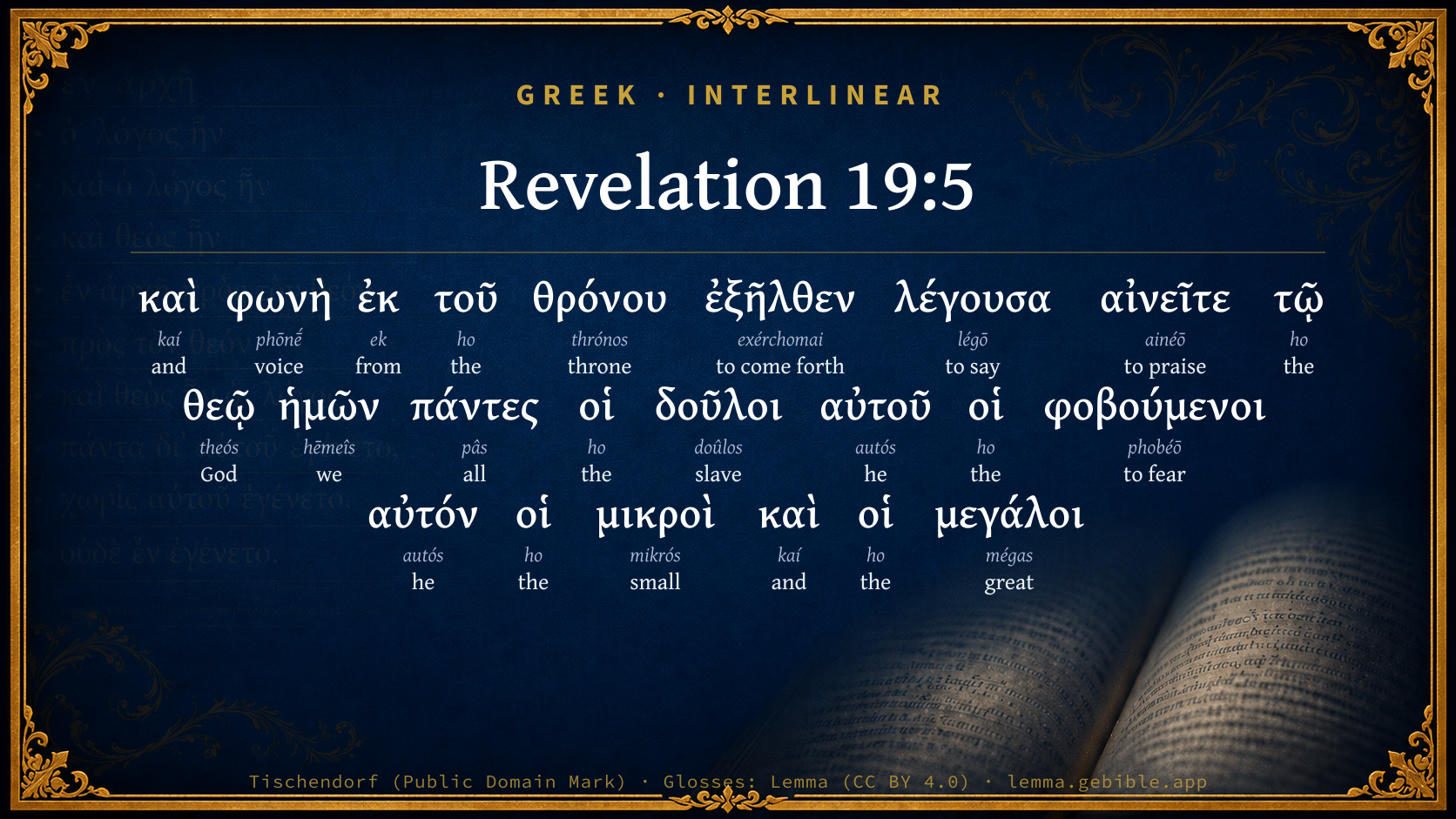
  1. καὶ kaí G2532 “and” Conjunction
  2. φωνὴ phōnḗ G5456 “voice” Noun, Nominative, Singular, Feminine
  3. ἐκ ek G1537 “from” Preposition
  4. τοῦ ho G3588 “the” Article, Genitive, Singular, Masculine
  5. θρόνου thrónos G2362 “throne” Noun, Genitive, Singular, Masculine
  6. ἐξῆλθεν exérchomai G1831 “to come forth” Verb, Aorist, Active, Indicative, 3rd person, Singular
  7. λέγουσα légō G3004 “to say” Verb, Present, Active, Participle, Nominative, Singular, Feminine
  8. τῷ ho G3588 “the” Article, Dative, Singular, Masculine
  9. θεῷ theós G2316 “God” Noun, Dative, Singular, Masculine
  10. ἡμῶν hēmeîs G2249 “we” Personal pronoun, 1st person, Genitive, Plural
  11. πάντες pâs G3956 “all” Adjective, Nominative, Plural, Masculine
  12. οἱ ho G3588 “the” Article, Nominative, Plural, Masculine
  13. δοῦλοι doûlos G1401 “slave” Noun, Nominative, Plural, Masculine
  14. αὐτοῦ autós G846 “he” Personal pronoun, Genitive, Singular, Masculine
  15. οἱ ho G3588 “the” Article, Nominative, Plural, Masculine
  16. φοβούμενοι phobéō G5399 “to fear” Verb, Present, Middle or Passive deponent, Participle, Nominative, Plural, Masculine
  17. αὐτόν autós G846 “he” Personal pronoun, Accusative, Singular, Masculine
  18. οἱ ho G3588 “the” Article, Nominative, Plural, Masculine
  19. μικροὶ mikrós G3398 “small” Adjective, Nominative, Plural, Masculine
  20. καὶ kaí G2532 “and” Conjunction
  21. οἱ ho G3588 “the” Article, Nominative, Plural, Masculine
  22. μεγάλοι mégas G3173 “great” Adjective, Nominative, Plural, Masculine

About this verse

These counts appear in no published source. They are computed here, from the morphology-tagged text and Lemma’s own curated glosses. What Lemma adds →

23
words
16
distinct lemmas
Revelation
section

Notable vocabulary

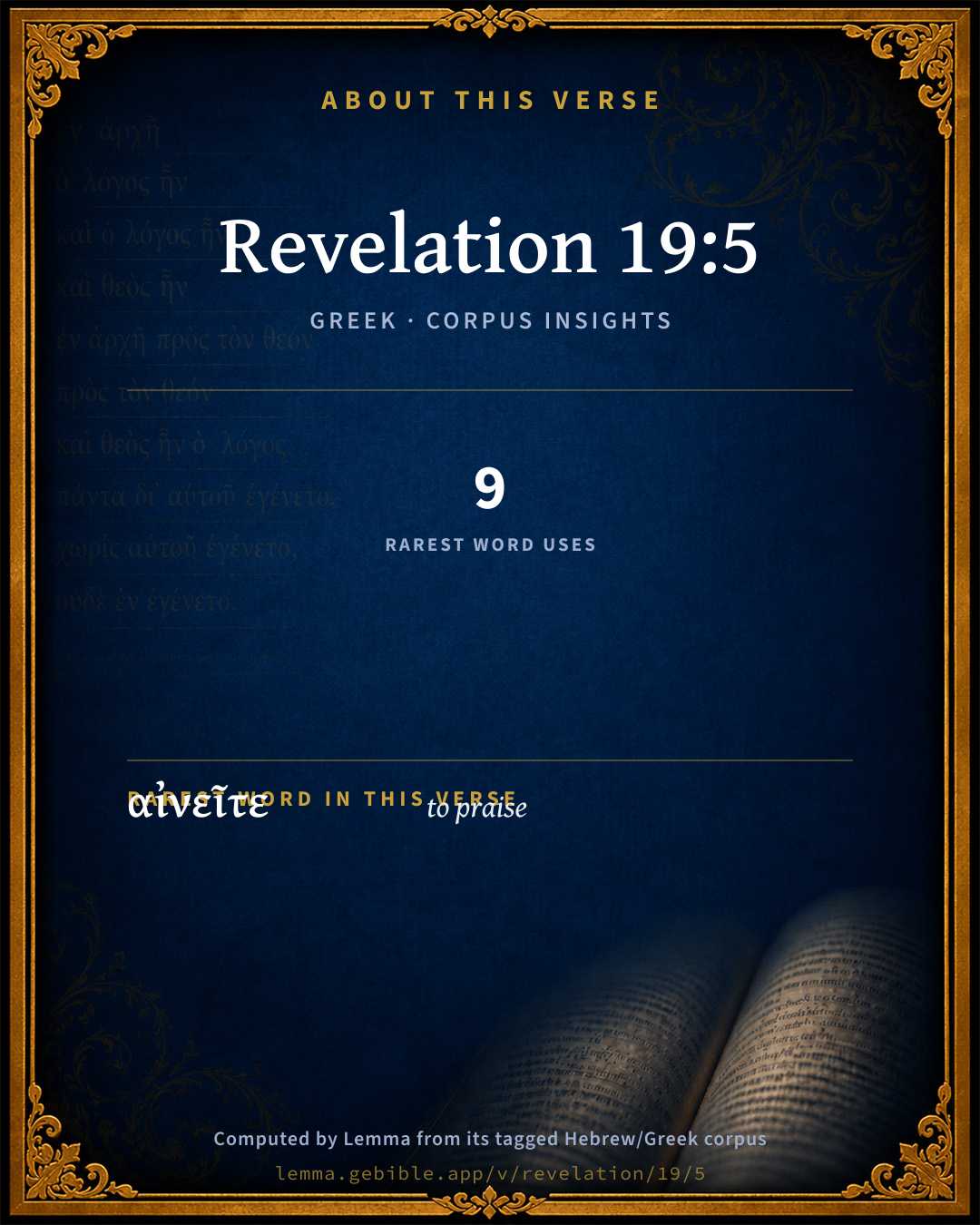
The rarest word here is αἰνεῖτε to praise G134 — appearing just 9 times in the whole Greek New Testament.

Shared distinctive vocabulary

αἰνεῖτε to praise G134 occurs in 9 verses of the Greek New Testament. Also found in:

Repetition

Words recur within this verse:

  • τοῦ the G3588 ×6
  • καὶ and G2532 ×2
  • αὐτοῦ he G846 ×2

Cross-references

11

Topical passages linked to Revelation 19:5 in the Treasury of Scripture Knowledge — connected by theme and wording, ordered by reader-vote popularity; previews shown in the World English Bible.

  • Psalms 134:1 Look! Praise Yahweh, all you servants of Yahweh, Who stand by night in Yahweh's house!
  • Psalms 148:11–13 Kings of the earth and all peoples; Princes and all judges of the earth;
  • Psalms 150:6 Let everything that has breath praise Yah! Praise Yah!
  • Psalms 135:1 Praise Yah! Praise the name of Yahweh! Praise him, you servants of Yahweh,
  • Revelation 7:15 Therefore they are before the throne of God, they serve him day and night in his temple. He who sits on the throne will spread his tent over them.
  • Revelation 11:18–19 The nations were angry, and your wrath came, as did the time for the dead to be judged, and to give your bondservants the prophets, their reward, as well as to the saints, and those who fear your name, to the small and the great; and to destroy those who destroy the earth."
  • Psalms 22:23 You who fear Yahweh, praise him! All you descendants of Jacob, glorify him! Stand in awe of him, all you descendants of Israel!
  • Psalms 103:20–22 Praise Yahweh, you angels of his, Who are mighty in strength, who fulfill his word, Obeying the voice of his word.
  • Psalms 135:19–20 House of Israel, praise Yahweh! House of Aaron, praise Yahweh!
  • Revelation 20:12 I saw the dead, the great and the small, standing before the throne, and they opened books. Another book was opened, which is the book of life. The dead were judged out of the things which were written in the books, according to their works.
  • Revelation 16:17 The seventh poured out his bowl into the air. A loud voice came forth out of the temple of heaven, from the throne, saying, "It is done!"

Cross-references courtesy of OpenBible.info (CC BY 4.0).

Commentary

Notes on Revelation 19:5 from classic Christian and Jewish commentators (each source and its license shown beneath its notes). The classic Christian expositions comment on the surrounding passage and are grouped to its opening verse, so a note may address several verses; the Jewish commentaries on the Tanakh (Rashi and others) are per-verse, so they appear only where the commentator wrote on this verse.

Lemma curates 59 commentaries, every one of them public domain or Creative Commons licensed, each selected and text-cleaned for this edition rather than reprinted as found. About our sources →

Bengel's Gnomon

Johann Albrecht Bengel

Rev 19:5. [208] ΑἸΝΕῖΤΕ Τῷ ΘΕῷ ἩΜῶΝ) The LXX., ΚΑῚ ᾜΝΕΣΑΝ Τῷ ΚΥΡΊῼ, 1Ch 16:36; ΑἸΝΕῖΝ Τῷ ΚΥΡΊῼ, ch. 1Ch 23:5; also 2Ch 5:13; 2Ch 20:19, Hebr. הלל ליהוה. That solemn act of praise which was accustomed to be offered to the Lord by the Levites is described in these places. Add the passage of Ezr 3:11, respecting all the people, in the same phrase in Hebrew and Greek. How much greater solemnity is there in the Apocalypse! All His servants, and they that fear Him, small and great, are stirred up to a solemn proclaiming of His praise. They perform this in Rev 19:6. [Comp. Psa 115:13.]

[208] 2. ἀληθιναὶ, true) The words which, ch. Rev 6:10, are related in the form of prayer, the same are now expressly repeated, and transposed into a doxology.—V. g.

Bengel's Gnomon of the New Testament — English translation (T&T Clark, Edinburgh, 1860) — public domain. Text from a community e-Sword module.

Meyer's Critical & Exegetical Commentary

Heinrich August Wilhelm Meyer

Rev_19:5. ἀπὸ τοῦ θρόνου. Out of the throne. It does not follow that the voice is that of Christ who sits upon the throne.[4033] Beng. writes that it belongs to the four beasts; Züll. and De Wette, to one of them. It may be referred also to the elders, because of the form of the summons (Τ. Θ. ἩΜῶΝ).[4034]

Τῷ ΘΕῷ. The dat. with ΑἸΝΕῖΝ, which is regarded as though it were ΔΙΔΌΝΑΙ ΑῚΝΟΝ,[4035] occurs also in the LXX.[4036] Comparison with the Hebrew text shows not only that the expression ΑἸΝΕῖΤΕ Τῷ ΘΕῷ says precisely the same as the ἉΛΛΗΛΟΥΪΆ retained in the Hebrew form,[4037] but also that the construction of αἰνεῖν with the dat. has occurred where the הַלֵּל was combined with כְ. In Jer_20:13, a clause so construed at any rate precedes.

πἀντες οἱ δοῦλοι αὐτοῦ. Cf. Psa_135:1.

οἱ φοβούμενοι, κ.τ.λ. Cf. Psa_115:13.

[4033] Against Ewald, Hengstenb.

[4034] Cf. also Rev_5:9.

[4035] Luk_18:43.

[4036] 1Ch_16:36; 1Ch_23:5; 2Ch_20:19; Jer_20:13.

[4037] Cf. Hesych., who very accurately explains ἀλληλ.: αἶνος τῷ ὅντι θεῷ, αἰνεῖτε τὸν κυριον [Praise to him that is God, praise ye the Lord].

Meyer — Critical and Exegetical Commentary on the New Testament — English translation by Peter Christie, edited by Frederick Crombie (T&T Clark, 1880) — public domain. Text from a community e-Sword module.

Expositor's Greek Testament

ed. W. Robertson Nicoll

Rev 19:5 . The O.T. expression servants of God implied ( R. S. 69 f.) not simply membership in a community of which God is king, but special devotion to his service and worship. It was not associated with any idea of “slavery to a divine despot,” but was originally confined in the main to royal and priestly families ( cf. Rev 1:5 ) which had a special interest in primitive religion and which were near to the god of the tribe or nation. Hence, in the broader and later sense of the term, the “servants of God” are all those who live in pious fear of him, i.e. , yielding him honour and obedience. John, pre-occupied with judgment, views the faith of the Lord as equivalent practically to his fear; unlike most early Christian writers, who (1Pe 1:17-18 , etc.) carefully bring forward the complementary element of love. Lowly confidence rather than warm intimacy is this prophet’s ideal of the Christian life towards God. See Did. 3, 4.; Barn. Rev 4:11 ; Herm. Mand. x. 1, xii. 4, 6.

The Expositor's Greek Testament, edited by W. Robertson Nicoll (1897–1910) — public domain. Text from a community e-Sword module.

Geneva Bible (1599)

Geneva Bible translators

Out of the temple from God, as Rev. 11:19.

The second place of praise as I said verse 1, which first is commanded from God in this verse: and then is in most ample manner pronounced of the creatures, both because they see that kingdom of Christ to come, which most they desire, verse 6, also because they see that the Church is called forth to be brought home: into the house of her husband by holy marriage unto the fellowship of his kingdom, verses 7, 8. Wherefore S. John is commanded to write in a book the Epiphonema , or acclamation joined with a divine testimony, verse 9.

Geneva Bible (1599) marginal notes — public domain. Text via Bolls.life.

Matthew Henry's Commentary

The triumphant song being ended, and epithalamium, or marriage-song, begins, Rev 19:6. Here observe,

I. The concert of heavenly music. The chorus was large and loud, as the voice of many waters and of mighty thunderings. God is fearful in praises. There is no discord in heaven; the morning stars sing together; no jarring string, nor key untuned, but pure and perfect melody.

II. The occasion of this song; and that is the reign and dominion of that omnipotent God who has redeemed his church by his own blood, and is now in a more public manner betrothing her to himself: The marriage of the Lamb has come, Rev 19:7. Some think this refers to the conversion of the Jews, which they suppose will succeed the fall of Babylon; others, to the general resurrection: the former seems more probable. Now, 1. You have here a description of the bride, how she appeared; not in the gay and gaudy dress of the mother of harlots, but in fine linen, clean and white, which is the righteousness of saints; in the robes of Christ's righteousness, both imputed for justification and imparted for sanctification - the stola, the white robe of absolution, adoption, and enfranchisement, and the white robe of purity and universal holiness. She had washed her robes and made them white in the blood of the Lamb; and these her nuptial ornaments she did not purchase by any price of her own, but received them as the gift and grant of her blessed Lord. 2. The marriage-feast, which, though not particularly described (as Mat 22:4), yet is declared to be such as would make all those happy who were called to it, so called as to accept the invitation, a feast made up of the promises of the gospel, the true sayings of God, Rev 19:9. These promises, opened, applied, sealed, and earnested by the Spirit of God, in holy eucharistical ordinances, are the marriage-feast; and the whole collective body of all those who partake of this feast is the bride, the Lamb's wife; they eat into one body, and drink into one Spirit, and are not mere spectators or guests, but coalesce into the espoused party, the mystical body of Christ. 3. The transport of joy which the apostle felt in himself at this vision. He fell down at the feet of the angel, to worship him, supposing him to be more than a creature, or having his thoughts at the present overpowered by the vehemency of his affections. Here observe, (1.) What honour he offered to the angel: He fell at his feet, to worship him; this prostration was a part of external worship, it was a posture of proper adoration. (2.) How the angel refused it, and this was with some resentment: "See thou do it not; have a care what thou doest, thou art doing a wrong thing." (3.) He gave a very good reason for his refusal: "I am thy fellow-servant, and of thy brethren which have the testimony of Jesus - I am a creature, thine equal in office, though not in nature; I, as an angel and messenger of God, have the testimony of Jesus, a charge to be a witness for him and to testify concerning him, and thou, as an apostle, having the Spirit of prophecy, hast the same testimony to give in; and therefore we are in this brethren and fellow-servants." (4.) He directs him to the true and only object of religious worship; namely, God: "Worship God, and him alone." This fully condemns both the practice of the papists in worshipping the elements of bread and wine, and saints, and angels, and the practice of those Socinians and Arians who do not believe that Christ is truly and by nature God, and yet pay him religious worship; and this shows what wretched fig-leaves all their evasions and excuses are which they offer in their own vindication: they stand hereby convicted of idolatry by a messenger from heaven.

Matthew Henry's Commentary on the Whole Bible (1708–1710) — public domain (CC PDM 1.0). Text via the HelloAO Bible API.

Jamieson, Fausset & Brown

Robert Jamieson, A. R. Fausset & David Brown

out of--Greek, "out from the throne" in A, B, C.

Praise our God--Compare the solemn act of praise performed by the Levites, Ch1 16:36; Ch1 23:5, especially when the house of God was filled with the divine glory (Ch2 5:13).

both--omitted in A, B, C, Vulgate, Coptic, and Syriac. Translate as Greek, "the small and the great."

Jamieson, Fausset & Brown — Commentary Critical and Explanatory on the Whole Bible (1871) — public domain (CC PDM 1.0). Text via the HelloAO Bible API.

Adam Clarke's Commentary

Verse 5. Praise our God, &c.] Let all, whether redeemed from among Jews or Gentiles, give glory to God.

Adam Clarke's Commentary on the Bible (1810–1826) — public domain. Text from a community e-Sword/MySword module.

Ellicott's Commentary for English Readers

(5-7) And a voice came.—From the direction of the throne there came a voice bidding all God’s servants rejoice. We are not told whose voice it is. Some have assumed that it is Christ’s: it is better to leave it indefinite. In response to the bidding, the voice of praise is heard (like the voice spoken of in Rev_14:2), as it were, the voice of a great multitude; and, as it were, the voice of many waters; and, as it were, the voice of mighty thunders. All nature’s tones seem mingled in this voice of praise: it is human, it is majestic as the sea, and glorious as the thunder.

The Anthem.

Alleluia!

For the Lord reigned,

The God, the Almighty.

Let us rejoice and exult,

And we will give the glory to Him,

Because the marriage of the Lamb is come,

And His wife hath made herself ready.

In this anthem the word for “reigneth” is not in the present tense, as in the English version; but, though it is translated here “reigned,” we must not understand it of the past only: it expresses the exultation of the servants of God that the Kingship of their God is manifested, and vindicated against those who denied, or hated His rule. His reign never ceased; and He has showed that His was a real sovereignty. Their joy rises also from the prospect of the nearer union between the Lamb and His Bride. This close union is more fully spoken of later: here the glorious close is for a moment anticipated: the morning glow announces the coming day: it is near even at the doors. The image of the marriage is familiar. It entered into our Lord’s parable (Mat_22:2-10; Mat_25:1-10): we catch it in the Psalms and in the Epistles (Psalms 45, and Eph_5:23; Eph_5:30; 2Co_11:2.)

A Bible Commentary for English Readers, edited by Charles John Ellicott (1878–1897) — public domain. Text from a community e-Sword module.

The Cambridge Bible for Schools and Colleges

gen. ed. J. J. S. Perowne

5. Praise our God &c.] Compare the opening of Psalms 134, 135.

both small and great] Psa_115:13. “Both” should perhaps be omitted.

The Cambridge Bible for Schools and Colleges (gen. ed. J. J. S. Perowne; Cambridge University Press, 1878–1918) — public domain. Text from a community e-Sword module.

John Gill's Exposition

And a voice came out of the throne,.... Not from God the Father, that sat upon it, for the phrase,

praise our God, could not be said by him with propriety and pertinence; but rather from Christ, the Lamb, in the midst of the throne, who as Mediator could say of him to his people, my God and your God, and my Father and your Father, Joh 20:17 though it seems best to understand it of the voice of one of the angels about the throne, since one of these is afterwards spoken of, whom John would have worshipped, but was forbid, Rev 19:9 and which may design either one of the ministering spirits, or a preacher of the Gospel, and a set of such, calling upon the saints to the discharge of their duty, or to return to it on this occasion:

saying, praise our God, all ye his servants; meaning not the ministers of the Gospel only, who serve in the Gospel of Christ, by preaching and defending it, and in the administration of Gospel ordinances to the comfort of the saints, but all the people of God; for though they are sons, and no more servants to sin and Satan, and the world, yet they are servants of God and of righteousness, and serve him willingly and cheerfully in a way of duty, and without slavish fear, and with a godly one, and from principles of love and gratitude, and without mercenary views and selfish ends; and these are called upon, as a part of their service, to say hallelujah, or to sing the praises of God for his judgments on antichrist; see Psa 134:1.

and ye that fear him, both small and great; who fear the Lord, not with a servile, but filial fear, with the new covenant grace of fear, which springs from, and is increased by, the goodness and grace of God; whether greater or lesser believers, fathers, young men, or children; whether Jews or Gentiles, or of whatsoever nation, kindred, or people; see Psa 115:13.

John Gill's Exposition of the Whole Bible (1746–1763) — public domain (CC PDM 1.0). Text via the HelloAO Bible API.

Trapp's Complete Commentary

John Trapp

5 And a voice came out of the throne, saying, Praise our God, all ye his servants, and ye that fear him, both small and great.

Ver. 5. And a voice came out] This is the Lamb’s voice, his all quickening voice, which shall rouse and raise the dead and dedolent Jews; powerfully pulling the veil from their hard hearts, which yet were somewhat moved and mollified by the former Alleluiahs, so that now all the servants of God, small and great, Jew and Gentile, shall praise him with one consent.

John Trapp, A Commentary or Exposition upon All the Books of the Old and New Testament (1647–1656) — public domain. Text from a community e-Sword module.

Albert Barnes' Notes on the Bible

And a voice came out of the throne - A voice seemed to come from the very midst of the throne. It is not said by whom this voice was uttered. It cannot be supposed, however, that it was uttered by God himself, for the command which it gave was this: “Praise our God,” etc. For the same reason it seems hardly probable that it was the voice of the Messiah, unless it be supposed that he here identifies himself with the redeemed church, and speaks of God as his God and hers. It would seem rather that it was a responsive voice that came from those nearest the throne, calling on all to unite in praising God in view of what was done. The meaning then will be, that all heaven was interested in the triumph of the church, and that one portion of the dwellers there called on the others to unite in offering thanksgiving.

Praise our God - The God that we worship.

All ye his servants - All in heaven and earth; all have occasion for thankfulness.

And ye that fear him - That reverence and obey him. The fear of the Lord is a common expression in the Scriptures to denote true piety.

Both small and great - All of every class and condition - poor and rich - young and old; those of humble and those of exalted rank. Compare Psa 148:7-13.

Albert Barnes' Notes on the Bible (1834–1885) — public domain. Text from a community e-Sword/MySword module.

Matthew Poole's English Annotations

And a voice came out of the throne, from Christ, declaring it the will of God, that all holy ones should praise him upon this account.

Matthew Poole's English Annotations on the Holy Bible (1683–1685) — public domain. Text from a community e-Sword/MySword module.

Whedon's Commentary on the Bible

Daniel D. Whedon

5. Voice came out of the throne—Commentators differ as to whose was this voice, the throne. Stuart thinks it was the Messiah; and for the words our God, as from him, Stuart quotes as precedents Joh_20:17; Heb_2:11, and Rev_18:4. Against this view Alford protests. We venture to ask, Why was it not the voice of the throne itself? In Rev_7:13, we have, “A voice from the four horns of the altar;” and in Rev_16:7 there is a voice from the altar, which Alford rightly interprets as the altar itself becoming vocal. This would add plausibility to Wordsworth’s attributing the words in Rev_11:1, to the “reed,” which the literal wording of the Greek requires.

Daniel D. Whedon (gen. ed.), Commentary on the Old and New Testaments (1874–1909) — public domain. Text from a community e-Sword module.

The Pulpit Commentary

And a voice came out of the throne, saying. Ek "out of," is found in a, P, 1, 34, etc.; apo , "forth from," is supported by A, B, C, etc.; while B reads ouranou , "heaven," instead of yronou , "throne." Alford suggests that the direction rather than the source of the voice is intended. It is impossible to say to whom the voice should be attributed. (cf. Rev_10:4, Rev_10:8, etc.) As an invitation to the Church to praise God, we might expect the voice to be that of one of the elders. Praise our God, all ye his servants, and ye that fear him, both small and great, a, C, P, omit the first "and," thus reading: "ye his servants, ye that fear him," etc. The first words are a repetition of the "Hallelujah" of ver. 1. The following phrases are found in Psa_134:1 Psa_115:13.

The Pulpit Commentary (1880–1919), ed. H.D.M. Spence-Jones & Joseph S. Exell — public domain. Text from a community e-Sword module.

John Wesley's Explanatory Notes

And a voice came forth from the throne - Probably from the four living creatures, saying, Praise our God - The occasion and matter of this song of praise follow immediately after, verses 6, &c.; God was praised before, for his judgment of the great whore, verses 1-4. chap. xix, 1-4 Now for that which follows it: for that the Lord God, the Almighty, takes the kingdom to himself, and avenges himself on the rest of his enemies. Were all these inhabitants of heaven mistaken? If not, there is real, yea, and terrible anger in God.

John Wesley, Explanatory Notes Upon the Whole Bible (1754–1765) — public domain. Text via the GEBible commentary corpus.

Kretzmann's Popular Commentary

Paul E. Kretzmann

The voice out of the throne:

v. 5. And a voice came out of the throne, saying, Praise our God, all ye His servants, and ye that fear Him, both small and great.

v. 6. And I heard as it were the voice of a great multitude and as the voice of many waters and as the voice of mighty thunderings, saying, Alleluia; for the Lord God omnipotent reigneth.

v. 7. Let us be glad and rejoice, and give honor to Him; for the marriage of the Lamb is come, and His wife hath made herself ready.

v. 8. And to her was granted that she should be arrayed in fine linen, clean and white; for the fine linen is the righteousness of saints.

v. 9. And he saith unto me, Write, Blessed are they which are called unto the marriage-supper of the Lamb. And he saith unto me, These are the true sayings of God.

v. 10. And I fell at his feet to worship him. And he said unto me, See thou do it not; I am thy fellow-servant, and of thy brethren that have the testimony of Jesus; worship God; for the testimony of Jesus is the Spirit of Prophecy.

The chorus of praise at the destruction of the great harlot is given in the form of antiphonal singing: And a voice came out of the throne, saying, Extol our God, all His servants, those that fear Him, both small and great. That was the one strophe addressed to the servants of the Lord, to those that are not merely members in His community, but whose special devotion to His interests, to His service and worship, has given them the closest fellowship with Him. That is their glorious privilege throughout eternity, to praise and extol the Lord of their salvation. Therefore they, in an antiphonal chant, respond to the urgent invitation: And I heard what resembled the voice of a great multitude and the rushing of many waters and the muttering of mighty thunders, saying, Hallelujah, for the Lord God, the Almighty, is King. Like the shouting of uncounted masses of people, like the irresistible rushing of mighty streams, like the grumblings and mutterings of a strong thunder, the song of the elect breaks forth at the Lord’s word, giving all praise to Him, the Lord, the almighty God, the King of the ages. The omnipotent God has conquered the portals of all His enemies, and revealed Himself as King over all.

To this fact there is added another cause for rejoicing: Let us he glad and exult, and give glory to Him, for the marriage of the Lamb has come, and His wife has made herself ready; and to her was given to be clothed in shining white fine linen (for the fine linen was the righteous deeds of the saints). What had been foretold by the prophets and spoken of time and again by Christ and the apostles is here represented as being consummated in heaven. The bride of Christ, the holy Christian Church, the communion of saints, the whole number of those that have come to faith and remained faithful to the Lord unto the end, is celebrating her marriage with the Lamb, with the Savior, with Christ. That, indeed, is a reason for the greatest rejoicing, for the highest exultation, to know that all the hopes of the centuries have now been realized, that all the believers are now united with their Savior throughout eternity. The bride, moreover, is clothed in the most gorgeous wedding-garment, all pure white and shining with brilliancy. It is a pure, precious dress of honor, the dress of salvation. For whereas without Christ all our righteousnesses are as filthy rags, in Him, through faith, even our smallest works, all the acts of our every-day life, are acceptable to the heavenly Father. Thus we shall be ornamented in heaven with the garment which the heavenly Bridegroom has merited through His perfect obedience to the commandment of God, through the shedding of His blood, through His death and resurrection.

The importance of this incident is heightened through an additional factor which is here recorded: And he says to me, Write, Blessed are they that are called to the marriage-feast of the Lamb. And he says to me, These are true words of God. So the Bride, the perfected saints, the believers that have been faithful to the end, are also invited to the marriage-feast of the Lamb, the union which He had planned before the beginning of the world. Truly, those people are blessed with a happiness which transcends all human conception, and there cannot be the slightest doubt as to their being heirs of all these joys, because He who is the Faithful, the True One, has given the promise, and He makes no mistake. The scene which John had witnessed so overwhelmed him that he relates: And I fell before his feet to worship him. He was ready to give divine honor to this messenger from heaven that unfolded the final triumph to him in such a singular manner, But the angel interposed: And he says to me, Not that: thy fellow-servant I am and one of thy brethren that have the testimony of Jesus; worship God (for the testimony of Jesus is the Spirit of Prophecy). The testimony of Jesus, to which the angel referred, is that Spirit of Prophecy by whose power all the prophets and apostles, including John himself, had testified of Jesus and of His kingdom. Although the angels are heavenly spirits, powerful and blessed, yet they are but servants and witnesses of Christ, and should therefore not be given divine honor; for that belongs to God alone.

Paul E. Kretzmann, Popular Commentary of the Bible (1921–1924) — public domain. Text from a community e-Sword module.

The People's New Testament

B. W. Johnson

5. And a voice came forth from the throne. Not “out of the throne,” as in the Common Version. The speaker is not indicated. It is a call to praise the Lord.

B. W. Johnson's The People's New Testament with Notes (1889–1891) — public domain. Electronic text from the Christian Classics Ethereal Library (CCEL) ThML edition.

unfoldingWord translationNotes

Door43 World Missions Community

a voice came out from the throne

Here John speaks of the "voice" as if it were a person. AT: "someone spoke from the throne" (See: Personification)

Praise our God

Here "our" refers to the speaker and all God's servants. (See: Inclusive "We")

you who fear him

Here "fear" does not mean to be afraid of God, but to honor him. AT: "all you who honor him" (See: Assumed Knowledge and Implicit Information)

both the unimportant and the powerful

The speaker uses these words together to mean all of God's people. (See: Merism)

translationWords

voice

throne

praise

God

servant

fear

power

unfoldingWord translationNotes — © Distant Shores Media and the Door43 World Missions Community, licensed CC BY-SA 4.0. Source: git.door43.org/Door43/en_tn.

Cambridge Greek Testament for Schools and Colleges

5. φωνὴ … λέγουσα. א* has φωναὶ … ἐξῆλθον λέγουσαι.

ἡμῶν. Primas reads vestrum.

5. ἐκ τοῦ θρόνου. Possibly the voice of Christ, cf. Rev 3:21. αἰνεῖτε. Compare the opening of Psalms 134, 135.

Cambridge Greek Testament for Schools and Colleges (Cambridge University Press, 1896; 21 vols, various authors incl. Carr, Maclear, Plummer, Farrar, Lumby, Moule, M. R. James, Simcox) — public domain. Text from a community e-Sword module.

Vincent's Word Studies in the New Testament

Marvin R. Vincent

All ye His servants - small and great. Compare Psa 114:13; Psa 134:1.

Marvin R. Vincent, Word Studies in the New Testament (1887–1900) — public domain. Text from a community e-Sword/MySword module.

Lesson kit

Teaching starters — assembled from the data on this page, not authored interpretation. Every prompt links to the verse data it draws on. Edit before teaching.

Revelation, in the Revelation, opens this verse with 23 words (16 distinct Greek lemmas). Its most distinctive word is ainéō (“to praise”). A historical commentator’s framing appears above. Read the whole chapter for the surrounding context.

Discussion questions

  1. The word ainéō carries the sense “to praise.” How does it shape the verse?
  2. Luke 2:13 shares the word «to praise» with this verse. How do the two illuminate each other?
  3. “the” occurs 6× in this one verse. What is the effect of the repetition?
  4. The translations on this page render this verse differently — a whole-verse word diff, not a word-by-word alignment. What might account for the different wordings?
  5. Reading how Bengel's Gnomon and Meyer's Critical & Exegetical Commentary read this verse, where do the two commentators agree and where do they part?

Things to notice

Reading settings

Reading text

Shown beneath each verse's original-language words.

Old Testament
Old Testament edition

Read the OT as the Masoretic Hebrew (MT) or the Greek Septuagint (LXX).

English shown for the Greek Septuagint (in the Hebrew ↔ Greek comparison).

Comparing translations? Open the Compare panel on any verse page to stack up to four side by side.