

Romans 11:20
Greek (Tischendorf 8th ed.) Romans 11:20 appears in the Greek New Testament. The text above is from the Tischendorf 8th edition. Each word links to its Strong’s number and a concise gloss. Click any word for its full Thayer’s Greek Lexicon entry.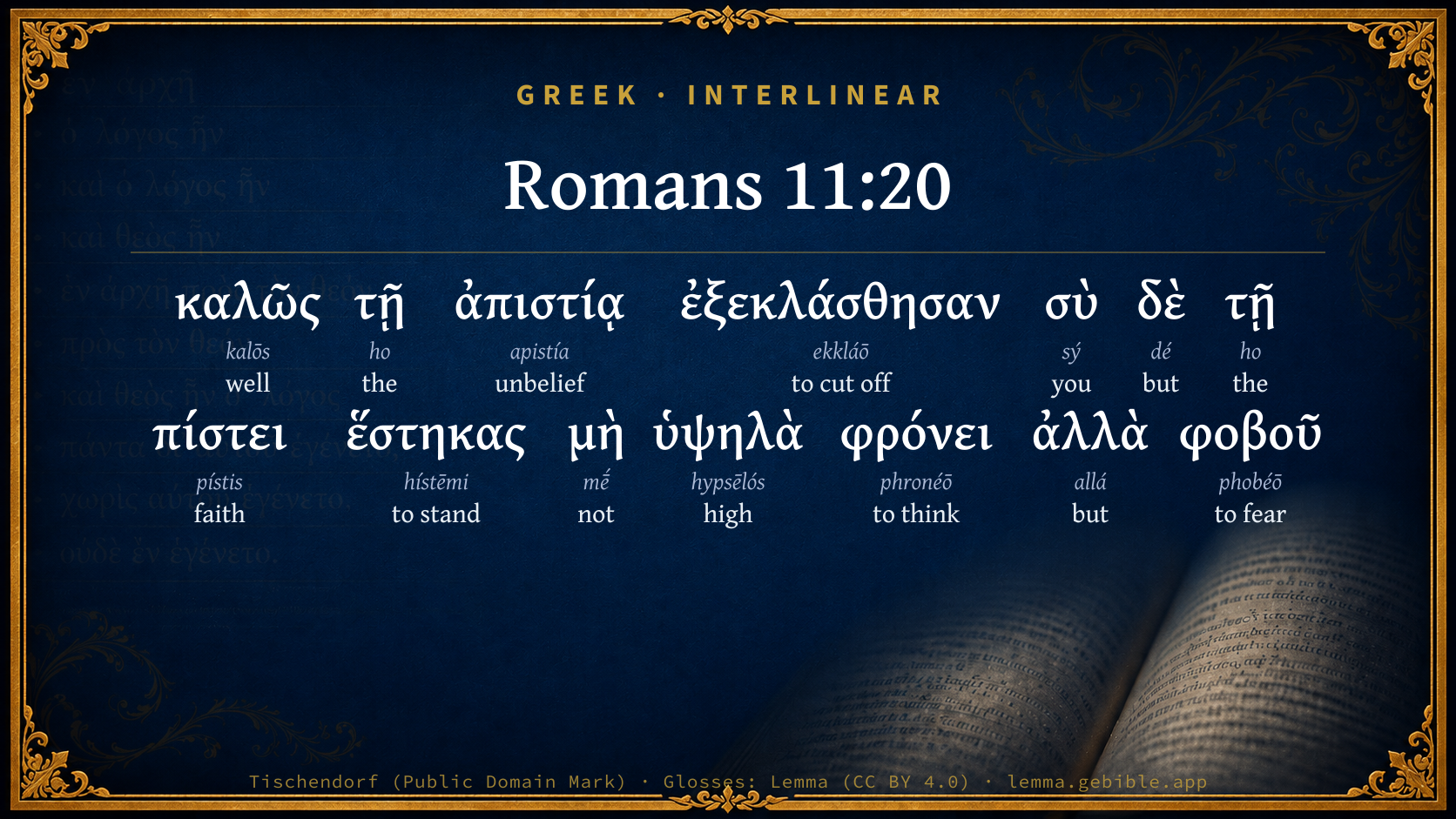
True; by their unbelief they were broken off, and you stand by your faith. Don't be conceited, but fear;
Download a study sheet
One document with this verse’s original text, its word-by-word gloss line, the meaning frame, cross-references with their text, attributed commentary, and full source and license credits — printable, and it pastes into notes with its structure intact.
This verse Autodidact and up
A passage Seminary Student
Up to 50 verses in one chapter. A passage sheet keeps up to 6 commentary sources and 12 cross-references per verse, in the order this page ranks them, and says so on the sheet whenever that leaves anything out. Ask for a single verse and you get the Autodidact verse sheet above.
Everything on this page stays free to read, with no account — the sheet is a download of what is already on screen, not access to it.
Compare translations 3
The same verse in 3 English versions, stacked beneath the original-language interlinear above. Click any original word for its lexicon entry.
Each is an independent rendering of the whole verse — the interlinear is not word-aligned to these translations.
Highlighted words mark where these versions differ — a whole-verse word diff, not a word-by-word alignment.
-
World English Bible Public Domain
True; by their unbelief they were broken off, and you stand by your faith. Don't be conceited, but fear;
-
King James Version Public Domain
Well; because of unbelief they were broken off, and thou standest by faith. Be not highminded, but fear:
-
unfoldingWord Literal Text CC BY-SA 4.0
true. They were broken off in unbelief, but you yourself stand firm in faith. Do not think arrogant things, but fear!
unfoldingWord Literal Text — © unfoldingWord, licensed CC BY-SA 4.0. Word-aligned USFM3 via Door43 (git.door43.org/unfoldingWord/en_ult).
Show all 19 translations
Every available English version of this verse, each an independent rendering of the whole verse.
-
World English Bible Public Domain
True; by their unbelief they were broken off, and you stand by your faith. Don't be conceited, but fear;
-
Berean Standard Bible Public Domain
That is correct: They were broken off because of unbelief, but you stand by faith. Do not be arrogant, but be afraid.
-
Majority Standard Bible Public Domain
That is correct: They were broken off because of unbelief, but you stand by faith. Do not be arrogant, but be afraid.
-
King James Version Public Domain
Well; because of unbelief they were broken off, and thou standest by faith. Be not highminded, but fear:
-
American Standard Version (1901) Public Domain
Well; by their unbelief they were broken off, and thou standest by thy faith. Be not highminded, but fear:
-
Revised Version (1885) Public Domain
Well; by their unbelief they were broken off, and thou standest by thy faith. Be not highminded, but fear:
-
Geneva Bible (1599) Public Domain
Well: through vnbeliefe they are broken off, and thou standest by faith: bee not hie minded, but feare.
-
Douay-Rheims (1899) Public Domain
Well: because of unbelief they were broken off. But thou standest by faith: be not highminded, but fear.
-
Young's Literal Translation Public Domain
by unbelief they were broken off, and thou hast stood by faith; be not high-minded, but be fearing;
-
Literal Standard Version CC BY-SA 4.0
By unbelief they were broken off, and you have stood by faith; do not be high-minded, but be fearing;
-
Unlocked Literal Bible CC BY-SA 4.0
That is true. Because of their unbelief they were broken off, but you stand firm because of your faith. Do not think too highly of yourself, but fear.
-
unfoldingWord Literal Text CC BY-SA 4.0
true. They were broken off in unbelief, but you yourself stand firm in faith. Do not think arrogant things, but fear!
-
Darby Bible Public Domain
Right: they have been broken out through unbelief, and *thou* standest through faith. Be not high-minded, but fear:
-
World Messianic Bible Public Domain
True; by their unbelief they were broken off, and you stand by your faith. Don’t be conceited, but fear;
-
Webster's Bible Public Domain
Well; because of unbelief they were broken off, and thou standest by faith. Be not high-minded, but fear:
-
Free Bible Version CC BY-SA 4.0
All well and good—but they were broken off because of their failure to trust in God, and you stay there because you trust in God. So don't think highly of yourselves, but be respectful,
-
Bible in Basic English Public Domain
Truly, because they had no faith they were broken off, and you have your place by reason of your faith. Do not be lifted up in pride, but have fear;
-
Text-Critical English NT CC BY 4.0
Right! They were broken off because of unbelief, but yoʋ stand because of faith. So do not be arrogant, but be afraid.
-
Tyndale New Testament (1534) Public Domain
Thou sayest well: because of vnbeleve they are broken of and thou stondest stedfast in fayth. Be not hye mynded but feare
Literal Standard Version (2020), Covenant Press — licensed CC BY-SA 4.0. Text via the HelloAO Bible API (eBible.org). Unlocked Literal Bible (unfoldingWord) — licensed CC BY-SA 4.0. Text via the HelloAO Bible API (eBible.org). unfoldingWord Literal Text — © unfoldingWord, licensed CC BY-SA 4.0. Word-aligned USFM3 via Door43 (git.door43.org/unfoldingWord/en_ult). Free Bible Version, Dr. Jonathan Gallagher — licensed CC BY-SA 4.0. Text via the HelloAO Bible API (eBible.org).
Word by word
More ways to search: Search by grammar → Find every occurrence → Compare this word →
Practice this passage: Drill this verse → Learn its vocabulary →
- Appears 3× in the Greek New Testament
- First appears at Romans 11:17
- Part of Speech
- Verb
- Tense
- Aorist
- Voice
- Passive
- Mood
- Indicative
- Person
- 3rd person
- Number
- Plural
Full Thayer's Definition
- καλῶς kalōs G2573 “well” Adverb
- τῇ ho G3588 “the” Article, Dative, Singular, Feminine
- ἀπιστίᾳ apistía G570 “unbelief” Noun, Dative, Singular, Feminine
- ἐξεκλάσθησαν ekkláō G1575 “to cut off” Verb, Aorist, Passive, Indicative, 3rd person, Plural
- σὺ sý G4771 “you” Personal pronoun, 2nd person, Nominative, Singular
- δὲ dé G1161 “but” Conjunction
- τῇ ho G3588 “the” Article, Dative, Singular, Feminine
- πίστει pístis G4102 “faith” Noun, Dative, Singular, Feminine
- ἕστηκας hístēmi G2476 “to stand” Verb, Perfect, Active, Indicative, 2nd person, Singular
- μὴ mḗ G3361 “not” Particle, Negative
- ὑψηλὰ hypsēlós G5308 “high” Adjective, Accusative, Plural, Neuter
- φρόνει phronéō G5426 “to think” Verb, Present, Active, Imperative, 2nd person, Singular
- ἀλλὰ allá G235 “but” Conjunction
- φοβοῦ phobéō G5399 “to fear” Verb, Present, Middle or Passive deponent, Imperative, 2nd person, Singular
About this verse
These counts appear in no published source. They are computed here, from the morphology-tagged text and Lemma’s own curated glosses. What Lemma adds →
- 14
- words
- 13
- distinct lemmas
- Pauline Epistles
- section
Notable vocabulary
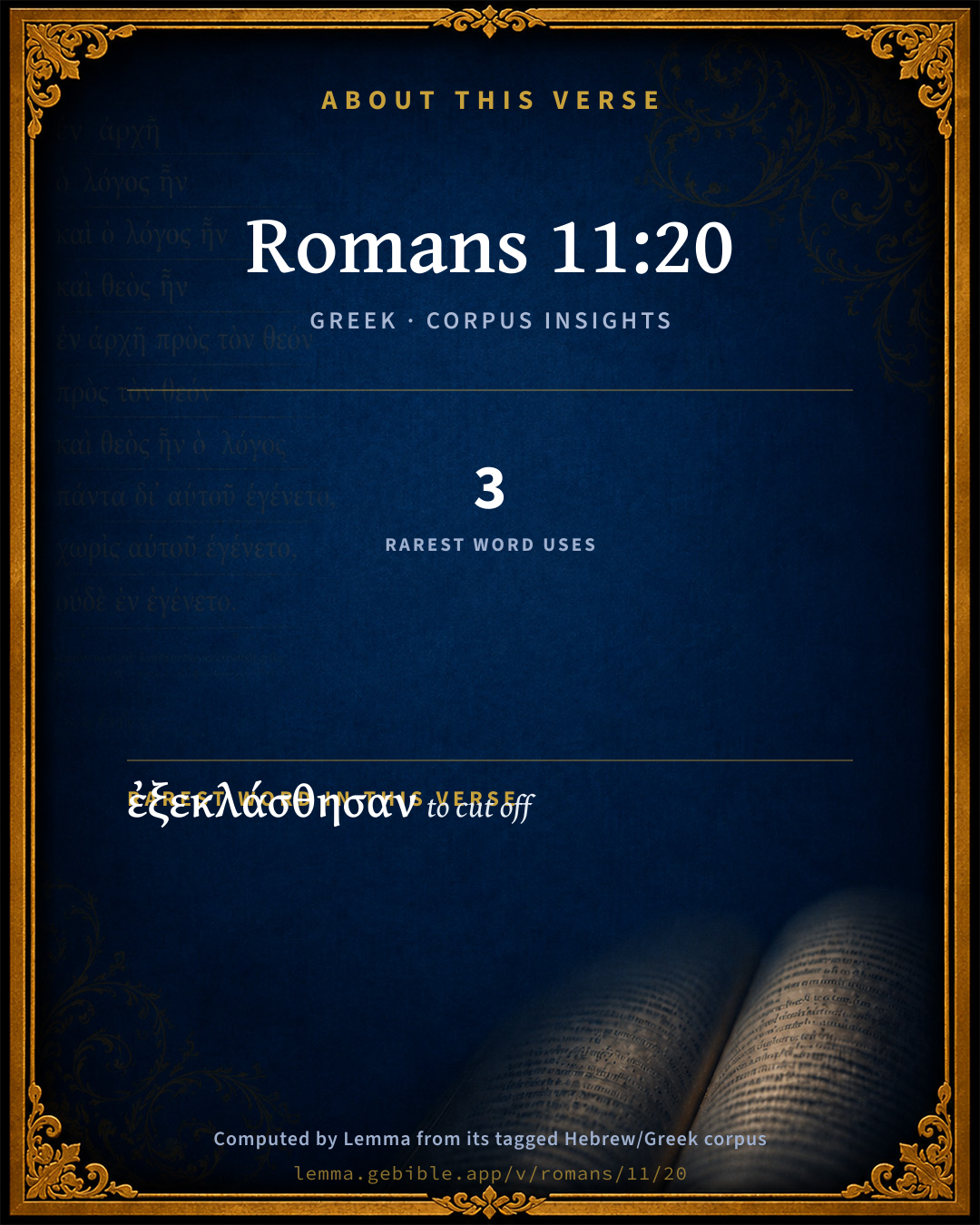
The rarest word here is ἐξεκλάσθησαν to cut off G1575 — appearing just 3 times in the whole Greek New Testament.
Shared distinctive vocabulary
ἐξεκλάσθησαν to cut off G1575 occurs in 3 verses of the Greek New Testament. Also found in:
Repetition
A word recurs within this verse:
- τῇ the G3588 ×2
Cross-references
39Topical passages linked to Romans 11:20 in the Treasury of Scripture Knowledge — connected by theme and wording, ordered by reader-vote popularity; previews shown in the World English Bible.
- Romans 12:16 Be of the same mind one toward another. Don't set your mind on high things, but associate with the humble. Don't be wise in your own conceits.
- 2 Corinthians 1:24 Not that we have lordship over your faith, but are fellow workers with you for your joy. For you stand firm in faith.
- 1 Corinthians 10:12 Therefore let him who thinks he stands be careful that he doesn't fall.
- Philippians 2:12 So then, my beloved, even as you have always obeyed, not only in my presence, but now much more in my absence, work out your own salvation with fear and trembling.
- 1 Peter 1:17 If you call on him as Father, who without respect of persons judges according to each man's work, pass the time of your living as strangers here in reverent fear:
- Habakkuk 2:4 Behold, his soul is puffed up. It is not upright in him, but the righteous will live by his faith.
- Romans 5:1–2 Being therefore justified by faith, we have peace with God through our Lord Jesus Christ;
- Romans 11:18 don't boast over the branches. But if you boast, it is not you who support the root, but the root supports you.
- Colossians 2:7 rooted and built up in him, and established in the faith, even as you were taught, abounding in it in thanksgiving.
- 1 Timothy 6:17 Charge those who are rich in this present world that they not be haughty, nor have their hope set on the uncertainty of riches, but on the living God, who richly provides us with everything to enjoy;
- Hebrews 3:12 Beware, brothers, lest perhaps there be in any one of you an evil heart of unbelief, in falling away from the living God;
- Proverbs 28:14 Blessed is the man who always fears; But one who hardens his heart falls into trouble.
- Isaiah 66:2 For all these things has my hand made, and [so] all these things came to be, says Yahweh: but to this man will I look, even to him who is poor and of a contrite spirit, and who trembles at my word.
- 2 Corinthians 10:5 throwing down imaginations and every high thing that is exalted against the knowledge of God, and bringing every thought into captivity to the obedience of Christ;
- 2 Timothy 3:3–5 without natural affection, unforgiving, slanderers, without self-control, fierce, no lovers of good,
- Psalms 138:6 For though Yahweh is high, yet he looks after the lowly; But the proud, he knows from afar.
- Proverbs 28:26 One who trusts in himself is a fool; But one who walks in wisdom, he is kept safe.
- Isaiah 2:11 The lofty looks of man will be brought low, The haughtiness of men will be bowed down, And Yahweh alone will be exalted in that day.
- Isaiah 2:17 The loftiness of man shall be bowed down, And the haughtiness of men shall be brought low; And Yahweh alone shall be exalted in that day.
- Isaiah 7:9 and the head of Ephraim is Samaria, and the head of Samaria is Remaliah's son. If you will not believe, surely you shall not be established.'"
- Zephaniah 3:11 In that day you will not be disappointed for all your doings, in which you have transgressed against me; for then I will take away out of the midst of you your proudly exulting ones, and you will no more be haughty in my holy mountain.
- Luke 18:14 I tell you, this man went down to his house justified rather than the other; for everyone who exalts himself will be humbled, but he who humbles himself will be exalted."
- John 4:17–18 The woman answered, "I have no husband." Jesus said to her, "You said well, 'I have no husband,'
- Acts 13:46–47 Paul and Barnabas spoke out boldly, and said, "It was necessary that God's word should be spoken to you first. Since indeed you thrust it from you, and judge yourselves unworthy of eternal life, behold, we turn to the Gentiles.
- Acts 18:6 When they opposed him and blasphemed, he shook out his clothing and said to them, "Your blood be on your own heads! I am clean. From now on, I will go to the Gentiles!"
- Romans 3:3 For what if some were without faith? Will their lack of faith nullify the faithfulness of God?
- 1 Corinthians 16:13 Watch! Stand firm in the faith! Be courageous! Be strong!
- 2 Thessalonians 2:4 he who opposes and exalts himself against all that is called God or that is worshiped; so that he sits as God in the temple of God, setting himself up as God.
- Hebrews 3:19–4:1 We see that they were not able to enter in because of unbelief.
- Hebrews 4:6 Seeing therefore it remains that some should enter therein, and they to whom the good news was before preached failed to enter in because of disobedience,
- Hebrews 4:11 Let us therefore give diligence to enter into that rest, lest anyone fall after the same example of disobedience.
- James 4:6 But he gives more grace. Therefore it says, "God resists the proud, but gives grace to the humble."
- 1 Peter 5:5–6 Likewise, you younger ones, be subject to the elder. Yes, all of you gird yourselves with humility, to subject yourselves to one another; for "God resists the proud, but gives grace to the humble."
- 1 Peter 5:9 Withstand him steadfast in your faith, knowing that your brothers who are in the world are undergoing the same sufferings.
- 1 Peter 5:12 Through Silvanus, our faithful brother, as I consider him, I have written to you briefly, exhorting, and testifying that this is the true grace of God in which you stand.
- Revelation 3:17 Because you say, 'I am rich, and have gotten riches, and have need of nothing;' and don't know that you are the wretched one, miserable, poor, blind, and naked;
- Revelation 18:7 However much she glorified herself, and grew wanton, so much give her of torment and mourning. For she says in her heart, 'I sit a queen, and am no widow, and will in no way see mourning.'
- 2 Chronicles 20:20 They rose early in the morning, and went forth into the wilderness of Tekoa: and as they went forth, Jehoshaphat stood and said, Hear me, Judah, and you inhabitants of Jerusalem: believe in Yahweh your God, so shall you be established; believe his prophets, so shall you prosper.
- James 2:19 You believe that God is one. You do well. The demons also believe, and shudder.
Cross-references courtesy of OpenBible.info (CC BY 4.0).
Lesson kit
Teaching starters — assembled from the data on this page, not authored interpretation. Every prompt links to the verse data it draws on. Edit before teaching.
Romans, in the Pauline Epistles, opens this verse with 14 words (13 distinct Greek lemmas). Its most distinctive word is ekkláō (“to cut off”). A historical commentator’s framing appears above. Read the whole chapter for the surrounding context.
Discussion questions
- What does “to cut off” (ekkláō) contribute to the verse as a whole?
- Romans 11:17 shares the word «to cut off» with this verse. How do the two illuminate each other?
- “the” occurs 2× in this one verse. What is the effect of the repetition?
- These translations render this verse differently. What is at stake in choosing one wording over another?
- Reading how Tyndale Open Study Notes and Bengel's Gnomon read this verse, where do the two commentators agree and where do they part?
Things to notice
- These translations choose different wording for 15 words in this verse.
- “the” occurs 2× in this single verse.
- 13 distinct Greek lemmas span 14 words in this verse.
Commentary
Notes on Romans 11:20 from classic Christian and Jewish commentators (each source and its license shown beneath its notes). The classic Christian expositions comment on the surrounding passage and are grouped to its opening verse, so a note may address several verses; the Jewish commentaries on the Tanakh (Rashi and others) are per-verse, so they appear only where the commentator wrote on this verse.
Lemma curates 59 commentaries, every one of them public domain or Creative Commons licensed, each selected and text-cleaned for this edition rather than reprinted as found. About our sources →
Tyndale Open Study Notes
Tyndale Open Resources
Tyndale Open Study Notes — © Tyndale Open Resources, licensed CC BY-SA 4.0. Text via the HelloAO Bible API.
Bengel's Gnomon
Johann Albrecht Bengel
Bengel's Gnomon of the New Testament — English translation (T&T Clark, Edinburgh, 1860) — public domain. Text from a community e-Sword module.
Meyer's Critical & Exegetical Commentary
Heinrich August Wilhelm Meyer
Meyer — Critical and Exegetical Commentary on the New Testament — English translation by Peter Christie, edited by Frederick Crombie (T&T Clark, 1880) — public domain. Text from a community e-Sword module.
Expositor's Greek Testament
ed. W. Robertson Nicoll
The Expositor's Greek Testament, edited by W. Robertson Nicoll (1897–1910) — public domain. Text from a community e-Sword module.
Hodge's Commentary on Romans, Ephesians & First Corinthians
Charles Hodge
Charles Hodge — Commentary on Romans (1835), First Corinthians (1857), and Ephesians (1856) — public domain. Text from a community e-Sword module.
Geneva Bible (1599)
Geneva Bible translators
Geneva Bible (1599) marginal notes — public domain. Text via Bolls.life.
Jamieson, Fausset & Brown
Robert Jamieson, A. R. Fausset & David Brown
Jamieson, Fausset & Brown — Commentary Critical and Explanatory on the Whole Bible (1871) — public domain (CC PDM 1.0). Text via the HelloAO Bible API.
Adam Clarke's Commentary
Adam Clarke's Commentary on the Bible (1810–1826) — public domain. Text from a community e-Sword/MySword module.
The Cambridge Bible for Schools and Colleges
gen. ed. J. J. S. Perowne
The Cambridge Bible for Schools and Colleges (gen. ed. J. J. S. Perowne; Cambridge University Press, 1878–1918) — public domain. Text from a community e-Sword module.
John Gill's Exposition
John Gill's Exposition of the Whole Bible (1746–1763) — public domain (CC PDM 1.0). Text via the HelloAO Bible API.
Trapp's Complete Commentary
John Trapp
John Trapp, A Commentary or Exposition upon All the Books of the Old and New Testament (1647–1656) — public domain. Text from a community e-Sword module.
Albert Barnes' Notes on the Bible
Albert Barnes' Notes on the Bible (1834–1885) — public domain. Text from a community e-Sword/MySword module.
Whedon's Commentary on the Bible
Daniel D. Whedon
Daniel D. Whedon (gen. ed.), Commentary on the Old and New Testaments (1874–1909) — public domain. Text from a community e-Sword module.
The Pulpit Commentary
The Pulpit Commentary (1880–1919), ed. H.D.M. Spence-Jones & Joseph S. Exell — public domain. Text from a community e-Sword module.
John Wesley's Explanatory Notes
John Wesley, Explanatory Notes Upon the Whole Bible (1754–1765) — public domain. Text via the GEBible commentary corpus.
McGarvey & Pendleton's Commentaries
J. W. McGarvey
J. W. McGarvey (with Philip Y. Pendleton), Commentaries on the New Testament (The Fourfold Gospel, 1914; Acts; and the epistles) — public domain. Text from a community e-Sword/MySword module.
The People's New Testament
B. W. Johnson
B. W. Johnson's The People's New Testament with Notes (1889–1891) — public domain. Electronic text from the Christian Classics Ethereal Library (CCEL) ThML edition.
Cambridge Greek Testament for Schools and Colleges
Cambridge Greek Testament for Schools and Colleges (Cambridge University Press, 1896; 21 vols, various authors incl. Carr, Maclear, Plummer, Farrar, Lumby, Moule, M. R. James, Simcox) — public domain. Text from a community e-Sword module.
Alford’s Greek Testament
Henry Alford
Henry Alford, The Greek Testament (1849–1861) — public domain. Text from a community e-Sword module.
International Critical Commentary
International Critical Commentary — older volumes (1896–1929), various authors — public domain. Text from a community e-Sword module.
Vincent's Word Studies in the New Testament
Marvin R. Vincent
Marvin R. Vincent, Word Studies in the New Testament (1887–1900) — public domain. Text from a community e-Sword/MySword module.
Godet's Commentaries
Frédéric Louis Godet
Frédéric Louis Godet — Commentaries on Luke, John, Romans, and 1 Corinthians — English translation (T&T Clark, Edinburgh, 1870s–1890s) — public domain. Text from a community e-Sword module.