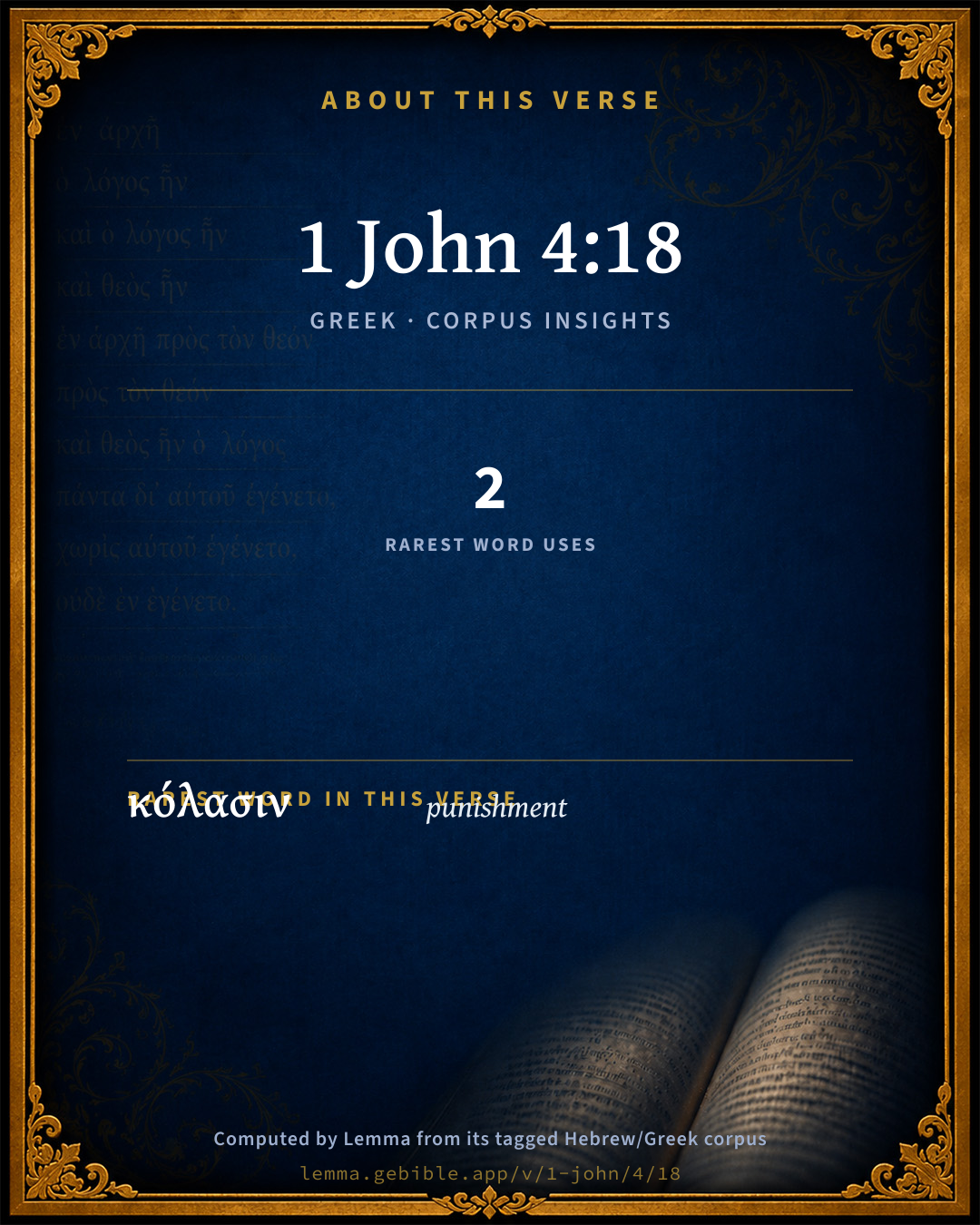
1 John 4:18

Greek (Tischendorf 8th ed.) 1 John 4:18 appears in the Greek New Testament. The text above is from the Tischendorf 8th edition. Each word links to its Strong’s number and a concise gloss. Click any word for its full Thayer’s Greek Lexicon entry.
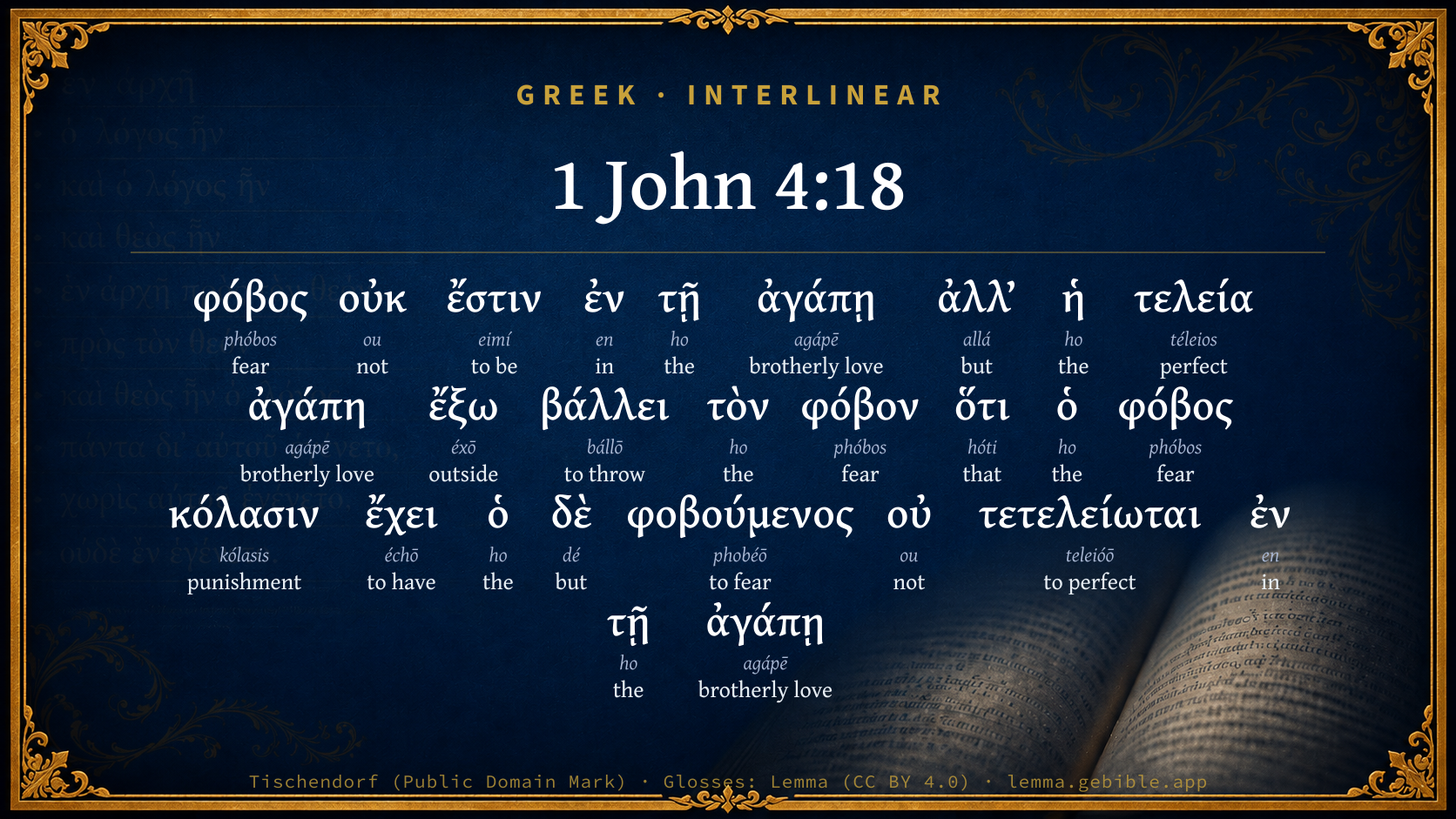
Download image
Cite this verse

1 John 4:18 (World English Bible). Public Domain. Lemma interlinear Bible study tool, https://lemma.gebible.app/v/1-john/4/18.

Show BibTeX & RIS
BibTeX
RIS
English Translation
There is no fear in love; but perfect love casts out fear, because fear has punishment. He who fears is not made perfect in love.
World English Bible · Public Domain
Download a study sheet

One document with this verse’s original text, its word-by-word gloss line, the meaning frame, cross-references with their text, attributed commentary, and full source and license credits — printable, and it pastes into notes with its structure intact.

This verse Autodidact and up

Study sheet (.html) Plain text (.txt)

A passage Seminary Student

Up to 50 verses in one chapter. A passage sheet keeps up to 6 commentary sources and 12 cross-references per verse, in the order this page ranks them, and says so on the sheet whenever that leaves anything out. Ask for a single verse and you get the Autodidact verse sheet above.

Everything on this page stays free to read, with no account — the sheet is a download of what is already on screen, not access to it.

Want to remove ads? Support Godless Engineer
Compare translations 3

The same verse in 3 English versions, stacked beneath the original-language interlinear above. Click any original word for its lexicon entry.

Each is an independent rendering of the whole verse — the interlinear is not word-aligned to these translations.

Highlighted words mark where these versions differ — a whole-verse word diff, not a word-by-word alignment.

  • World English Bible Public Domain
    There is no fear in love; but perfect love casts out fear, because fear has punishment. He who fears is not made perfect in love.
  • King James Version Public Domain
    There is no fear in love; but perfect love casteth out fear: because fear hath torment. He that feareth is not made perfect in love.
  • unfoldingWord Literal Text CC BY-SA 4.0
    Fear is not in love, but perfect love throws fear outside, because fear has punishment. So the one fearing has not been perfected in love.

unfoldingWord Literal Text — © unfoldingWord, licensed CC BY-SA 4.0. Word-aligned USFM3 via Door43 (git.door43.org/unfoldingWord/en_ult).

Versions to compare (up to 4)

3 of 4 selected

Show all 19 translations

Every available English version of this verse, each an independent rendering of the whole verse.

  • World English Bible Public Domain
    There is no fear in love; but perfect love casts out fear, because fear has punishment. He who fears is not made perfect in love.
  • Berean Standard Bible Public Domain
    There is no fear in love, but perfect love drives out fear, because fear involves punishment. The one who fears has not been perfected in love.
  • Majority Standard Bible Public Domain
    There is no fear in love, but perfect love drives out fear, because fear involves punishment. The one who fears has not been perfected in love.
  • King James Version Public Domain
    There is no fear in love; but perfect love casteth out fear: because fear hath torment. He that feareth is not made perfect in love.
  • American Standard Version (1901) Public Domain
    There is no fear in love: but perfect love casteth out fear, because fear hath punishment; and he that feareth is not made perfect in love.
  • Revised Version (1885) Public Domain
    There is no fear in love: but perfect love casteth out fear, because fear hath punishment; and he that feareth is not made perfect in love.
  • Geneva Bible (1599) Public Domain
    There is no feare in loue, but perfect loue casteth out feare: for feare hath painefulnesse: and he that feareth, is not perfect in loue.
  • Douay-Rheims (1899) Public Domain
    Fear is not in charity: but perfect charity casteth out fear, because fear hath pain. And he that feareth, is not perfected in charity.
  • Young's Literal Translation Public Domain
    fear is not in the love, but the perfect love doth cast out the fear, because the fear hath punishment, and he who is fearing hath not been made perfect in the love;
  • Literal Standard Version CC BY-SA 4.0
    There is no fear in love, but perfect love casts out fear, because fear involves punishment, and he who is fearing has not been made perfect in love;
  • Unlocked Literal Bible CC BY-SA 4.0
    There is no fear in love. Instead, perfect love throws out fear, because fear has to do with punishment. But the one who fears has not been made perfect in love.
  • unfoldingWord Literal Text CC BY-SA 4.0
    Fear is not in love, but perfect love throws fear outside, because fear has punishment. So the one fearing has not been perfected in love.
  • Darby Bible Public Domain
    There is no fear in love, but perfect love casts out fear; for fear has torment, and he that fears has not been made perfect in love.
  • World Messianic Bible Public Domain
    There is no fear in love; but perfect love casts out fear, because fear has punishment. He who fears is not made perfect in love.
  • Webster's Bible Public Domain
    There is no fear in love; but perfect love casteth out fear: because fear hath torment. He that feareth, is not made perfect in love.
  • Free Bible Version CC BY-SA 4.0
    Where there is love there can be no fear. God loves us completely, and this love drives all our fears away. If we do fear, it's because we fear being punished, and this shows that we have not been fully remade by the completeness of God's love.
  • Bible in Basic English Public Domain
    There is no fear in love: true love has no room for fear, because where fear is, there is pain; and he who is not free from fear is not complete in love.
  • Text-Critical English NT CC BY 4.0
    There is no fear in love, but perfect love casts out fear, because fear has to do with punishment. Whoever fears has not been perfected in love.
  • Tyndale New Testament (1534) Public Domain
    Ther is no feare in love but parfect love casteth out all feare for feare hath paynfulnes. He that feareth is not parfect in love.

Literal Standard Version (2020), Covenant Press — licensed CC BY-SA 4.0. Text via the HelloAO Bible API (eBible.org). Unlocked Literal Bible (unfoldingWord) — licensed CC BY-SA 4.0. Text via the HelloAO Bible API (eBible.org). unfoldingWord Literal Text — © unfoldingWord, licensed CC BY-SA 4.0. Word-aligned USFM3 via Door43 (git.door43.org/unfoldingWord/en_ult). Free Bible Version, Dr. Jonathan Gallagher — licensed CC BY-SA 4.0. Text via the HelloAO Bible API (eBible.org).

Word by word

More ways to search: Search by grammar → Find every occurrence → Compare this word →

Practice this passage: Drill this verse → Learn its vocabulary →

κόλασιν
kólasis
G2851
“punishment”
Noun, Accusative, Singular, Feminine
Part of Speech
Noun
Case
Accusative
Number
Singular
Gender
Feminine
Full Thayer's Definition

Origin: from G2849

TDNT: 16:36,5

1. correction, punishment, penalty
  1. φόβος phóbos G5401 “fear” Noun, Nominative, Singular, Masculine
  2. οὐκ ou G3756 “not” Particle, Negative
  3. ἔστιν eimí G1510 “to be” Verb, Present, Active, Indicative, 3rd person, Singular
  4. ἐν en G1722 “in” Preposition
  5. τῇ ho G3588 “the” Article, Dative, Singular, Feminine
  6. ἀγάπῃ agápē G26 “brotherly love” Noun, Dative, Singular, Feminine
  7. ἀλλ’ allá G235 “but” Conjunction
  8. ἡ ho G3588 “the” Article, Nominative, Singular, Feminine
  9. τελεία téleios G5046 “perfect” Adjective, Nominative, Singular, Feminine
  10. ἀγάπη agápē G26 “brotherly love” Noun, Nominative, Singular, Feminine
  11. ἔξω éxō G1854 “outside” Adverb
  12. βάλλει bállō G906 “to throw” Verb, Present, Active, Indicative, 3rd person, Singular
  13. τὸν ho G3588 “the” Article, Accusative, Singular, Masculine
  14. φόβον phóbos G5401 “fear” Noun, Accusative, Singular, Masculine
  15. ὅτι hóti G3754 “that” Conjunction
  16. ὁ ho G3588 “the” Article, Nominative, Singular, Masculine
  17. φόβος phóbos G5401 “fear” Noun, Nominative, Singular, Masculine
  18. ἔχει échō G2192 “to have” Verb, Present, Active, Indicative, 3rd person, Singular
  19. ὁ ho G3588 “the” Article, Nominative, Singular, Masculine
  20. δὲ dé G1161 “but” Conjunction
  21. φοβούμενος phobéō G5399 “to fear” Verb, Present, Middle or Passive deponent, Participle, Nominative, Singular, Masculine
  22. οὐ ou G3756 “not” Particle, Negative
  23. τετελείωται teleióō G5048 “to perfect” Verb, Perfect, Passive, Indicative, 3rd person, Singular
  24. ἐν en G1722 “in” Preposition
  25. τῇ ho G3588 “the” Article, Dative, Singular, Feminine
  26. ἀγάπῃ agápē G26 “brotherly love” Noun, Dative, Singular, Feminine

About this verse

These counts appear in no published source. They are computed here, from the morphology-tagged text and Lemma’s own curated glosses. What Lemma adds →

27
words
16
distinct lemmas
General Epistles
section

Notable vocabulary

The rarest word here is κόλασιν punishment G2851 — appearing just 2 times in the whole Greek New Testament.

Shared distinctive vocabulary

κόλασιν punishment G2851 occurs in 2 verses of the Greek New Testament. Also found in:

Repetition

Words recur within this verse:

  • φόβος fear G5401 ×3
  • ἀγάπῃ brotherly love G26 ×3
  • τῇ the G3588 ×6
  • οὐκ not G3756 ×2
  • ἐν in G1722 ×2

Cross-references

10

Topical passages linked to 1 John 4:18 in the Treasury of Scripture Knowledge — connected by theme and wording, ordered by reader-vote popularity; previews shown in the World English Bible.

  • 2 Timothy 1:7 For God didn't give us a spirit of fear, but of power, love, and self-control.
  • Romans 8:15 For you didn't receive the spirit of bondage again to fear, but you received the Spirit of adoption, by whom we cry, "Abba! Father!"
  • 1 John 4:12 No one has seen God at any time. If we love one another, God remains in us, and his love has been perfected in us.
  • Luke 1:74–75 To grant to us that we, being delivered out of the hand of our enemies, should serve him without fear,
  • Hebrews 12:28 Therefore, receiving a Kingdom that can't be shaken, let us have grace, through which we serve God acceptably, with reverence and awe,
  • James 2:19 You believe that God is one. You do well. The demons also believe, and shudder.
  • Psalms 119:120 My flesh trembles for fear of you. I am afraid of your judgments.
  • Job 15:21 A sound of terrors is in his ears; In prosperity the destroyer shall come on him.
  • Psalms 73:19 How they are suddenly destroyed! They are completely swept away with terrors.
  • Psalms 88:15–16 I am afflicted and ready to die from my youth up. While I suffer your terrors, I am distracted.

Cross-references courtesy of OpenBible.info (CC BY 4.0).

Commentary

Notes on 1 John 4:18 from classic Christian and Jewish commentators (each source and its license shown beneath its notes). The classic Christian expositions comment on the surrounding passage and are grouped to its opening verse, so a note may address several verses; the Jewish commentaries on the Tanakh (Rashi and others) are per-verse, so they appear only where the commentator wrote on this verse.

Lemma curates 59 commentaries, every one of them public domain or Creative Commons licensed, each selected and text-cleaned for this edition rather than reprinted as found. About our sources →

The Biblical Illustrator

Joseph S. Exell

1Jn_4:18

There is no fear in love; but perfect love casteth out fear: because fear hath torment

The place of fear in the gospel

Some readers of the Bible, some preachers of the gospel, have thought that fear was a dangerous, was even a forbidden principle, under the dispensation of the fulness of times.

This is a hasty inference. Our Lord says, Fear Him which, after He hath killed, hath power to cast into hell. St. Paul says, Work out their own salvation with fear and trembling; and St. Peter commends a chaste conversation coupled with fear; and even St. John, who speaks of perfect love casting out fear, yet uses this, in the Revelation, as a description of the faithful--them that fear Thy name. Fear has a place in the gospel, may we but find it. Indeed it is an old remark, that every natural principle of our mind has an object assigned to it--is not to be crushed, only to be redirected. Fear is not the whole of religion. Some Christian people have made it so, and suffered greatly in consequence. But in these cases we may hope that there is a blessed surprise of love in store for souls which here lived too much in the darkness of mistrust and self-suspicion. As they emerge out of that thick gloom which we call life into a world where there is neither puzzle of intellect, nor oppression of the world, nor assault of the devil, they learn, as in a moment, how much better God was to them than they felt or saw. How shall it be with another class--with those who have banished fear altogether from their religion, not by that perfecting of love which St. John speaks of, but by a refusal to read anything in their gospel but that which was instantly bright, indiscriminately alluring? If now we try to grapple closely with the very question itself, What is the place of fear in the gospel? we must begin by guarding ourselves against one great confusion. The object of fear may be either a thing or a person.

1. We fear a thing which, being possible, is also undesirable or dreadful. Our own Prayer Book, commenting in the catechism upon the Lords Prayer, bids us call three things evil:

(1) Sin and wickedness;

(2) Our ghostly enemy;

(3) Everlasting death.

2. There is a fear also of persons. In some respects nearly allied to the other--as where we dread the arrival of a judge who is to try us, and whose sentence must certainly bring after it imprisonment or execution. There it is scarcely the person--it is simply the instrument of the thing--which is really the object of the fear. The fear of God as a Person is essentially of a higher order. To feel that there is One above me, to whom I am accountable, if it be but as my Judge, there is something elevating in the very conception. But this, if it stop here, is the religion of fallen nature; it is scarcely the religion even of law--for the law itself gave many glimpses of a Divine heart that could feel and a Divine grace that could comfort. This mere dread, though it is a higher thing than indifference, is no part of the gospel. From this kind of fear the convinced man, if he yields himself to Christs teaching, will pass on into a higher. And it is in reference to this step that there is the greatest need of Christian guidance. We do not speak of a spirit of bondage, making a man crouch before God as his stern taskmaster. Not of a life of toilsome, unloving labour, which hopes in the end to make God its debtor. There is no trace of gospel fear in all this. But that humble, filial reverence, which never forgets or slights the distance between the Creator and the creature which exercises itself day by day to have always a conscience void of offence both toward God and toward man--this is a Christian grace: if there be yet one higher, it must be sought, not in the abandonment, but in the strengthening of this. When a man has lived for long years in the pursuit of God--when he has brought his life by daily self-discipline into a condition of habitual watchfulness--then, as the fear of falling away becomes less predominant, there takes its place, by little and little, that absolute oneness of will with the will of God, of which it has been boldly yet beautifully written that then, then at length, self-indulgence itself may become a virtue. In that man fear has indeed been cast out, not by carelessness, but by love; in him, at last, as Gods free gift to a life of godly reverence, in him verily is the love of God perfected. (Dean Vaughan.)

Love and fear

I. The apostle here contemplates a universal dominion of fear, wherever there is not the presence of active love. Of course, he is speaking about the emotions which men cherish with regard to God. All men everywhere have some more or less faint or clear conviction of the existence of a God. All men everywhere have some more or less active or torpid working of conscience. Blend together these two things, and take into account that the fact of sin necessarily brings about much ignorance of the true character of Him whom the consciousness of sin arrays in awful attributes of holiness and justice; and there follows inevitably, universally, though not always with equal strength and prominence, this feeling towards God, I knew Thee that thou wert austere, and I was afraid. The truth of this representation of the universal dominion of fear is not made in the least degree doubtful by the fact that the ordinary condition of men is not one of active dread of God. There is nothing more striking than that strange power that a man has of refusing to think of a subject because he knows that to think of it would be torture and terror. Heathenism is, to a large extent, the offspring of fear. All thoughts of sacrifice as propitiating an offended God come from that dark and coiling fear which lurks in the heart. And it affects so called Christianity too. There are plenty of people who call themselves Christians whose whole religion consists in deprecating the wrath of God, whom they dimly think of as angry with them, and who, their consciences tell them, might well be so! Sometimes, again, this same fear takes the understanding into its pay, and appears as enlightened disbelief in God and immortality. The brain is often bribed by the conscience, and the wish becomes the father of the thought. Sometimes it takes the shape of vehement efforts to get rid of unwelcome thought by fierce plunging into business, or into wild riot.

II. The fearlessness of love--how perfect love casts out fear. Love is no weak thing, no mere sentiment. It is the harvest of all human emotions. It makes heroes as its natural work. The love of God is declared in this text to be the victorious antagonist of that fear of sin which has torment in it. In general we can see, I think, without difficulty, how the two, love and fear, do exclude one another. Fear is entirely based on a consideration of some possible personal evil consequence coming down upon me from that clear sky above me. Love is based upon the forgetfulness of self altogether. The very essence of love is, that it looks away from itself, and to another. Fill the heart with love, and there is an end to the dominion of fear!

1. But, more specifically, the love of God entering into a mans heart destroys all fear of Him of which we have been speaking. All the attributes of God come to be on our side. He that loves has the whole Godhead for him. We love Him, because He first loved us. There is no foundation for my love to God except only the old one, God loves me. There is no way of building on that foundation except only the old one, We believe and are sure that Thou art the Christ, the Saviour of the world! The love which casts out fear is not a vague emotion setting towards an unknown God; nor is it the result of a mans willing that he will put away from himself his hatred and his indifference, and will set himself in a new position towards God and His mercy; but it rises in the heart as a consequence of knowing and believing the love which God hath to us. Hence, again, it is the conqueror of fear. Whatever betide, nothing can separate us from the love of God. We are bound to Him by that everlasting loving kindness with which He has drawn us. There is lifted off the heart the whole burden of fearful looking for of judgment, the whole burden arising from the dark thought, God is mighty, God must be righteous, God may strike!--because we know He hath borne our griefs and carried our sorrows.

2. The love of God casts out all other fear! Every affection makes him who cherishes it, in some degree, braver than he would have been without it. It is not degrading to this subject to remind you of what we see away far down in the scale of living beings. Look at that strange maternal instinct that in the lowest animals--out of weakness makes them strong, and causes them to forget all terror of the most terrible at the bidding of the mighty and conquering affection. Look at the same thing on the higher level of our own human life. It is not self-reliance that makes the hero. It is having the heart filled with passionate enthusiasm born of love for some person or for some thing. Love is gentle, but it is omnipotent, victor over all. And when we rise to the highest form of it, namely, the love which is fixed upon God--oh! how that should, and if it be right, will, strengthen and brace, and make every man in whom it dwells, frank, fearless, careless of personal consequences! Cowardice and anxiety, perplexity about life, trembling about the future, the bowed head and the burdened heart--these are not the fruits of the Spirit. Perfect love casteth out fear, sets our faces as flints, if need be, before human opposition, lifts us up above being at the mercy of events and circumstances, rises coping with and mastering the fear of death, soars on lofty wing high above the darkness of the grave, and, as the apostle in the context tells us, is made perfect herein, that we have the boldness in the day of judgment.

III. Love, which destroys fear, heightens reverence, and deepens self-distrust.

1. A man who is trembling about personal consequences has no eye to appreciate the thing of which he is afraid. There is no reverence where there is desperate fear. He that is trembling lest the lightning should strike him, has no heart to feel the grandeur and to be moved by the solemn awfulness of the storm above his head. And a man to whom the whole thought, or the predominant thought, when God rises before him, is, How awful will be the incidence of His perfections on my head! does not and durst not think about them, and reverence Him. Perfect love takes out of the heart all that bitter sense of possible evil coming on me and leaves me at liberty, with thankful, humble heart, and clear eye, to look into the centre of the brightness and see there the light of His infinite mercy.

2. Love destroys fear, and perfects self-distrust. Work out your own salvation, is the apostles teaching, with fear and trembling. If you call Him Father (the name that breathes from the loving heart), pass the time of your sojourning here in fear. What sort of fear? The fear that is timid about self, because it is, and in order that it may be, confident of God; fear which means, I know I shall fall, unless Thou hold me up, and which then changes, by quick transition, into, I shall not fall, for the Lord is able to make me stand. (A. Maclaren, D. D.)

Love and fear

Love is pure; love is kind and tender; love is bold and confident. There is no fear in perfect love. Much of the would be unbelief of the day springs from terror. No doubt there is real honest unbelief--a failing to believe--inability to find truth. These deserve our tenderest pity. You should pity and pray for those out in the godless, hopeless gloom, as you pity and pray for the sailors at sea when the wind howls round your house, and you hear the loud boom of the storm driven waves on the shore. Much of the feverishness with which men plunge into business, and whirl in the eddies of pleasure, arises from their dread of God. But, worse still, many so called religious people never get beyond this state of dread. They only know God as the Terrible One. James Mill taught his son John Stuart to think of God as the Almighty Author of Hell, and to hate the idea of Him therefore. Of all that the New Testament says of God, James Mill chose to seize only on that. He said nothing of heaven, nor of Gods efforts to keep men from hell. And many people follow his example; they seem to know nothing of Gods love; they spend their lives deprecating Gods wrath. Now, if you live in this state, your religion is of the poorest, lowest possible description. Fear paralyses all the powers of the soul, and must be got rid of before progress can take place. The bird newly caught is afraid of everything and everybody--of the hand that feeds and caresses it: and you get no song while that fear lasts. A fresh boy in school, on the first day, is afraid of everything, and while that fear lasts he learns nothing. He cannot read or write, he can neither draw nor reckon, till the fear is gone. Now so has it ever been with men. As long as men dreaded nature they made no progress in knowledge or power. As long as men throughout the length and breadth of Europe believed that God the Father, and even Christ the Saviour, were so awful and implacable to men, that Mary, the gentle Virgin, must intercede with them for the sinful and the needy, so long could the priests make them believe whatever they chose to tell them, and make them do whatever they pleased to bid them. For fear is credulous. Everything startles it. Now those times, though called the ages of faith, were very barren of religion. Fear demoralised men. There was no joy in religion and no love. Now what is true of others is true of us. If you dread God, then you do not love Him--you cannot. In time, you are bound to hate what you dread. This fear must be got rid of it is the work of perfect love to cast it out of the soul. Perfect love casteth out fear. You must not be afraid to accept the broad statement that God is love. (J. M. Gibbon.)

The spirit of fear

(with 2Ti_1:7; Rom_8:15; Joh_14:27):--I have brought together several passages to show that the spirit of the gospel is not a spirit of fear, and that Jesus came to deliver us from all fear. There are some objections to be first considered. If life is full of danger and evil, ought we not to be afraid? it may be asked. And if the Bible Contains passages which teach us not to fear, does it not contain other passages which teach that we ought to fear? (Mat_10:28; Php_2:12; 1Pe_1:17; Pro_3:7). How are these facts and statements to be reconciled with the assertion that it is the duty of Christians not to fear? First, we may say that a distinction can be taken between fear as a subordinate motive and fear as a ruling motive of human action. Fear as the ruling motive of conduct is degrading, because it is essentially selfish. But fear, when controlled by reason, subordinate to hope, joined with courage, becomes caution, watchfulness, modesty. The Christian fears, but is never governed by his fears. But, again, how much we need to fear and ought to fear depends upon the progress of our inward life and Christian experience. The work of Christ is to deliver us from all excessive fear, and to leave in its place calmness and sober watchfulness and a profound peace. But this work is not done suddenly; it is a progressive work. And how this is let us now consider. First, consider fear of sin and of its consequences. The main purpose of Christianity is to save us from sin, and thereby to save us from its consequences, which are moral and spiritual death. And it saves us, not by inspiring fear, but by inspiring faith and courage. It assures us that sin shall not have dominion over us. The law of God shows us what our duty is, but gives us no power to do it. The purer and higher the standard, the less ability we feel to reach it. And discouragement is moral death. What we need is the spirit of adoption, whereby we may cry, Abba, Father! Then there will be no more fear, neither fear of man nor fear of God, nor fear of sin, nor fear of death, nor fear of what follows death. But in order to be freed from fear, it is not enough to be told not to fear. In the midst of a battle tell the coward not to be afraid; in the midst of a thunderstorm tell the person who shrinks from the vivid flash arid the astounding peal that he need not fear. What good will it do? The source of fear is within, and that must be removed. So preach as much as we may the mercy of God, I tell you that men will still fear, will fear death, will fear hell, as long as unreconciled, unrepented sin is in their hearts. To cure our souls of fear, to fill them with hope and trust, there is but one way, and that is to look our sins in the face, to look Gods law in the face, to see the eternal connection between right and good, death and evil; and then, when we have had an experience of duty, of responsibility, of sin, of danger, we are ready to enter into the deeper experience of pardon, of hope, of entire, present joyous salvation. Thus delivered from the fear of sin by the power of the gospel, we are also delivered from the fear of God. This statement also requires some consideration. There is a fear of God which is always right, and which we shall always need to cherish. Heathenism is a religion of fear; Judaism is the religion of conscience; Christianity is the religion of grateful affection. Where God is regarded essentially as an Almighty Ruler, the chief duty of man is implicit, unquestioning obedience. Where God is regarded chiefly as a judge, the principal duty of man is righteous conduct. Where He is regarded as a father, the chief duty of man is childlike trust and love. So that there is a gradual progress in the conception which men have had of the Deity. Beginning with power, they ascend to justice, and terminate in love. And when perfect love is attained, it casts out all fear. (James Freeman Clarke.)

Perfect love

I. Its properties.

1. Supreme. Love to God cannot exist as a subordinate principle.

2. Pure. Before love can reign sole monarch in the soul, the old man must be destroyed.

3. Entire. It will not only admit of no rival, allowing neither the allurements of the world nor the charms of the creature to alienate it from the object that has engrossed it; but it admits of no comparison.

4. Constant. It is not a spark emitted from the blaze of worldly prosperity and fanned by the softness of worldly pleasure, but a flame enkindled by the Sun of Righteousness, and like the fire on the altar it never goes out.

5. Practical.

6. Progressive. For though perfect, it does not preclude the possibility of increase or enlargement.

II. Its operation--casteth out fear.

1. What kind of fear?

(1) Not--

(a) A reverential fear of God.

(b) A cautionary fear of the holiness, justice, and power of God.

(c) Natural fear, which is necessary to the preservation of life.

(2) But--

(a) Servile fear.

(b) Fear of meeting the necessaries of life.

(c) The fear of man, which bringeth a snare.

(d) The fear of the last enemy.

(e) The fear of the judgment.

(f) The fear of hell.

2. How does it do this?

(1) By removing sin.

(2) By transforming us into Gods image.

(3) By perfecting all the other graces of Christianity.

Faith is perfected by love. Distrust is the offspring of suspicion, and want of confidence is want of love. Where there is perfect love there is true tranquillity, the sweetest harmony: all is peace--perfect, perpetual, eternal peace. (Samuel Dunn.)

Love and fear

John has been speaking of boldness, and that naturally suggests its opposite--fear. He has been saying that perfect love produces courage in the day of judgment, because it produces likeness to Christ, who is the judge. In my text he explains and enlarges that statement. For there is another way in which love produces boldness, and that is by its casting out fear. These two are mutually exclusive.

I. The empire of fear. Fear is a shrinking apprehension of evil as befalling us, from the person or thing which we dread. God is righteous; God righteously administers His universe. God enters into relations of approval or disapproval with His responsible creature. Therefore there lies, dormant for the most part, but present in every heart, and active in the measure in which that heart is informed as to itself, the slumbering cold dread that between it and God things are not as they ought to be. I believe, for my part, that such a dumb, dim consciousness of discord attaches to all men, though it is often smothered, often ignored, and often denied. But there it is; the snake hybernates, but it is coiled in the heart all the same, and warmth will awake it. Arising from that discomforting consciousness of discord there come, likewise, other forms and objects of dread. For if I am out of harmony with Him, what will be my fate in the midst of a universe administered by Him, and in which all are His servants? Whilst all things serve the soul that serves Him, all are embattled against the man that is against, or not for, God and His will. Then there rises up another object of dread, which, in like manner, derives all its power to terrify and to hurt from the fact of our discordance with God, and that is, the shadow feared of man, that stands shrouded by the path, and waits for each of us. God; Gods universe; Gods messenger, Death--these are facts with which we stand in relation, and if our relations with Him are out of gear, then He and all of these are legitimate objects of dread to us. But now there is something else that casts out fear than perfect love, and that is--perfect levity. For it is the explanation of the fact that so many of us know nothing about what I am talking about, and fancy that I am exaggerating or putting forward false views.

II. That brings me to the second point--viz., the mission of fear. John uses a rare word in my text when he says, fear hath torment. Torment does not convey the whole idea of the word. It means suffering, but suffering for a purpose; suffering which is correction; suffering which is disciplinary; suffering which is intended to lead to something beyond itself. Fear, the apprehension of personal evil, has the same function in the moral world as pain has in the physical, It is a symptom of disease, and is intended to bid us look for the remedy and the Physician. What is an alarm bell for, but to rouse the sleepers and to hurry them to the refuge! And so this wholesome, manly dread of the certain issue of discord with God is meant to do for us what the angels did for Lot--lay a mercifully violent hand on the shoulder of the sleeper, and shake him into aroused wakefulness, and hasten him out of Sodom. The intention of fear is to lead to that which shall annihilate it, and take away its cause. There is nothing more ridiculous, nothing more likely to betray a man, than the indulgence in an idle fear which does nothing to prevent its own fulfilment. Horses in a burning stable are so paralysed by dread that they cannot stir, and get burnt to death. I fear; then what do I do? Nothing! And that is true about hosts of us. What ought I to do? Let the dread direct me to its source--my own sinfulness. Let the discovery of my own sinfulness direct me to its remedy--the righteousness and the Cross of Jesus Christ. He, and He alone, can deal with the disturbing element in my relation to God. So my fear should proclaim to me the merciful name that is above every name, and drive me as well as draw me to Christ, the Conqueror of sin and the Antagonist of all dread. I think we shall scarcely understand the religion of love unless we recognise that dread is a legitimate part of an unforgiven mans attitude towards God. My fear should be to me like the misshapen guide that may lead me to the fortress where I shall be safe. Oh! do not tamper with the wholesome sense of dread. Do not let it lie, generally sleeping, and now and then awaking in your hearts and bringing about nothing.

III. Lastly, the expulsion of fear. My text points out the natural antagonism and mutual exclusiveness of these two emotions. If I go to Jesus Christ as a sinful man, and get His love bestowed upon me, then, as the next verse to my text says, my love springs in response to His to me, and in the measure in which that love rises in my heart will it frustrate its antagonistic dread. As I said, you cannot love and fear the same person, unless the love is of a very rudimentary and imperfect character. But just as when you pour pure water into a bladder, the poisonous gases that it may have contained will be driven out before it, so when love comes in dread goes out. But remember that it is perfect love which casts out fear. Inconsistent as the two emotions are in themselves, in practice, they may be united by reason of the imperfection of the nobler. And in the Christian life they are united with terrible frequency. There are many professing Christian people who live all their days with a burden of shivering dread upon their shoulders and an icy cold fear in their hearts, just because they have not got close enough to Jesus Christ, and kept their hearts with sufficient steadfastness under the quickening influences of His love, to have shaken off their dread as a sick mans distempered fancies. A little love has not mass enough in it to drive out thick, clustering fears. See that you resort only to the sane, sound way of getting rid of the wholesome, rational dread of which I have been speaking. (A. Maclaren, D. D.)

A soul-tormenting fear and a fear-expelling love

I. A soul-tormenting fear.

1. This slavish fear is co extensive with the unregenerate race. A slavish fear of--

(1) Poverty.

(2) Death.

(3) Retribution.

(4) God.

2. This slavish fear is ever associated with mental suffering. It makes the present miserable by its horrid forebodings of the future.

II. A fear-expelling love. This includes--

1. A consciousness that God loves us.

2. A settled confidence in Gods fatherly regard for us.

3. The influential dwelling of God within us.

4. The extinction by God of all selfishness within us.

Conclusion: This subject--

1. Supplies the test of true religion.

2. Indicates the criterion of true preaching.

3. Shows the philosophy of the gospel. (D. Thomas, D. D.)

Fear and love

The words of St. John as to fear and love would probably startle us if they were less familiar. What they say is, in effect, that fear and love are, as such, in antagonism; that in proportion as love gains strength, it tends to oust fear; that to be, in a religious sense, under the influence of fear, is to be in an imperfect condition with regard to love. And yet Scripture assigns to fear a considerable place in the apparatus, so to speak, of religious motives and forces (Luk_12:5; 2Co_5:10-11; Php_2:12-13; 1Pe_1:17). In such passages the underlying purport is obvious: Do this, avoid that, or it will be the worse for you: obey, on peril of the consequences of disobedience. How, then, will the text stand when confronted with a line of address at once so authoritative, so luminous, and so stern? The answer is, that our Lord and St. Peter and St. Paul are urging men to fear the penal consequence of sin, considered in their whole length and breadth, and concentrated into that one supremely terrible, consequence--perpetual exclusion from the presence of God; whereas St. John is looking at fear of penal suffering considered in itself--the dread of hell, pure and simple. This is the fear which, he says, hath torment, or rather punishment; it carries punishment in its bosom. It regards God not as the all holy and all-good Father, who has every right to filial obedience, but as an irresistible Power, not to be trifled with or escaped from, who can and will inflict tremendous penalties on those who venture to defy His authority. Fear of punishment, either as imminent or as distant, is not a false or bad principle of action in its own place and for its own time. It is appropriate for the earlier stage of spiritual training; it marks a stage in the moral progress through which the Supreme Educator, Divinely equitable and patient, conducts His children by slow steps, in consideration of hearts not fully softened and consciences not thoroughly enlightened, which, as yet, are unfit for a high religious standard. Is not this fear worth something? Bishop Andrewes, alluding to it, observes that it is as the base court to the temple, and adds that a man must do his duty for fear of punishment, if he cannot get himself to do it for love of righteousness. As St. Augustine says, this is not the fear that is clean--it arises not out of love of God, but out of the terror of suffering; yet it may make the whole difference to a persons moral future whether, at a particular critical time, he has it, or has it not. If he has it, he resists the temptation, he does not commit the sin; and that is to gain much. The perilous hour is got through safely; the conscience escapes a defilement and a burden; the ground so far, is clear for the further operations of grace. And these will, by degrees, absorb the fear of punishment, simply as such--into what? Into such a love for God as excludes all fear whatsoever? No, rather into a fear which is so absolutely compatible with love that it may even be said to grow out of love, to be contained in loves very heart. For what is the love here intended, but a closer and closer adhesion to the will of God as the supreme good, an ever growing desire to please Him and to be right with Him, because He is what He is to us? But as long as we live, failure is possible; there must be the possibility of ultimate failure, even on the part of the gray-haired saint, as Bunyan in his dream saw that there was a way to hell from the gates of heaven as well as from the city of destruction; as, before now, men have fallen from God at their very lust hour. And that possibility involves a fear which dwells not on the mere pain of future punishment, but on that which is the essential and misery of hell--the forfeiture of the life giving love of God. This fear may be called filial, and not servile; for in proportion as a child loves heartily a good parent, the more solicitous will he be not to grieve, displease, disappoint that parent by an exhibition of thankless perversity. (W. Bright, D. D.)

Fear has many eyes. Fear hath punishment

(R.V.):--This is true in two ways--

(1) Fear involves the idea of punishment;

(2) fear is a foretaste of punishment. (Cambridge Bible for Schools.)

Fear

by anticipating punishment has it even now. (Dean Alford.)

Perfect Love

Love is like honey, but perfect love is like the honey with all the comb and wax strained out. Love is like fire, but pure love is like the same fire free from all smoke and soot. Love is like water, but unmixed love is like the same water freed from all earthy matter. Love is like light, but simple and perfect love is like the same light freed from all cloud, and fog, and smoke. (G. D. Watson.)

The Biblical Illustrator, edited by Joseph S. Exell (c. 1880s–1900s) — public domain. Text from a community e-Sword module.

Joseph Benson's Commentary

1Jn 4:18-19. There is no fear in love — No slavish or tormenting fear, diffidence, or distrust, can be where love reigns; but perfect, mature love casteth out such fear, because such fear hath torment — And so is inconsistent with the happiness of love. He that feareth is not made perfect in love — In the sense above explained. Study therefore to increase more and more in that noble affection of love to God, and you will find your happiness increasing in proportion to it. Observe, reader, a mere natural man has neither the fear nor love of God; one that is awakened and convinced of sin, has fear without love; a babe in Christ, love and fear; a father in Christ, love without fear. We love him, because he first loved us — This is the sum of all religion, the genuine model of Christianity. None can say more; why should any one say less, or speak less intelligibly?

Joseph Benson's Commentary on the Old and New Testaments (1811–1818) — public domain. Text from a community e-Sword module.

MacLaren's Expositions of Holy Scripture

Alexander MacLaren

1 John

LOVE AND FEAR

1Jn 4:18.

John has been speaking of boldness, and that naturally suggests its opposite--fear. He has been saying that perfect love produces courage in the day of judgment, because it produces likeness to Christ, who is the Judge. In my text he explains and enlarges that statement. For there is another way in which love produces boldness, and that is by its casting out fear. These two are mutually exclusive. The entrance of the one is for the other a notice to quit. We cannot both love and fear the same person or thing, and where love comes in, the darker form slips out at the door; and where Love comes in, it brings hand in hand with itself Courage with her radiant face. But boldness is the companion of love, only when love is perfect. For, inconsistent as the two emotions are, love, in its earlier stages and lower degrees, is often perturbed and dashed by apprehension and dread.

Now John is speaking about the two emotions in themselves, irrespective, so far as his language goes, of the objects to which they are directed. What he is saying is true about love and fear, whatever or whosoever may be loved or dreaded. But the context suggests the application in his mind, for it is ‘boldness before him’ about which he has been speaking; and so it is love and fear directed towards God which are meant in my text. The experience of hosts of professing Christians is only too forcible a comment upon the possibility of a partial Love lodging in the heart side by side with a fellow-lodger, Fear, whom it ought to have expelled. So there are three things here that I wish to notice--the empire of fear, the mission of fear, and the expulsion of fear.

I. The empire of fear.

Fear is a shrinking apprehension of evil as befalling us, from the person or thing which we dread. My text brings us face to face with that solemn thought that there are conditions of human nature, in which the God who ought to be our dearest joy and most ardent desire becomes our ghastliest dread. The root of such an unnatural perversion of all that a creature ought to feel towards its loving Creator lies in the simple consciousness of discordance between God and man, which is the shadow cast over the heart by the fact of sin. God is righteous; God righteously administers His universe. God enters into relations of approval or disapproval with His responsible creature. Therefore there lies, dormant for the most part, but present in every heart, and active in the measure in which that heart is informed as to itself, the slumbering, cold dread that between it and God things are not as they ought to be.

I believe, for my part, that such a dumb, dim consciousness of discord attaches to all men, though it is often smothered, often ignored, and often denied. But there it is; the snake hibernates, but it is coiled in the heart all the same; and warmth will awake it. Then it lifts its crested head, and shoots out its forked tongue, and venom passes into the veins. A dread of God is the ghastliest thing in the world, the most unnatural, but universal, unless expelled by perfect love.

Arising from that discomforting consciousness of discord there come, likewise, other forms and objects of dread. For if I am out of harmony with Him, what will be my fate in the midst of a universe administered by Him, and in which all are His servants? Oh! I sometimes wonder how it is that godless men front the facts of human life and do not go mad. For here are we, naked, feeble, alone, plunged into a whirlpool, from the awful vortices of which we cannot extricate ourselves. There foam and swirl all manner of evils, some of them certain, some of them probable, any of them possible, since we are at discord with Him who wields all the forces of the universe, and wields them all with a righteous hand. ‘The stars in their courses fight against’ the man that does not fight for God. Whilst all things serve the soul that serve Him, all are embattled against the man that is against, or not for, God and His will.

Then there arises up another object of dread, which, in like manner, derives all its power to terrify and to hurt from the fact of our discordance with God; and that is ‘the shadow feared of man,’ that stands shrouded by the path, and waits for each of us.

God; God’s universe; God’s messenger, Death--these are facts with which we stand in relation, and if our relations with Him are out of gear, then He and all of these are legitimate objects of dread to us.

But now there is something else that casts out fear than perfect love, and that is--perfect levity. For it is the explanation of the fact that so many of us know nothing of this fear of which I speak, and fancy that I am exaggerating, or putting forward false views. There is a type of man, and I have no doubt there are some of its representatives among my hearers, who are below both fear and love as directed towards God; for they never think about Him, or trouble their heads concerning either Him or their relations to Him or anything that flows therefrom. It is a strange faculty that we all have, of forgetting unwelcome thoughts and shutting our eyes to the things that we do not want to see, like Nelson when he puts the telescope to his blind eye at Copenhagen, because he would not obey the signal of recall. But surely it is an ignoble thing that men should ignore or shuffle out of sight with inconsiderateness the real facts of their condition, like boys whistling in a churchyard to keep their spirits up, and saying, ‘Who’s afraid?’ just because they are so very much afraid. Ah, dear friends, do not rest until you face the facts, and having faced them, have found the way to reverse them! Surely, surely it is not worthy of men to turn away from anything so certain as that between a sin-loving man and God there must exist such a relation as will bring evil and sorrow to that man, as surely as God is and he is. I beseech you, take to heart these things, and do not turn away from them with a shake of your shoulders, and say, ‘He is preaching the narrow, old-fashioned doctrine of a religion of fear.’ No! I am not. But I am preaching this plain fact, that a man who is in discord with God has reason to be afraid, and I come to you with the old exhortation of the prophet, ‘Be troubled, ye careless ones.’ For there is nothing more ignoble or irrational than security which is only made possible by covering over unwelcome facts. ‘Be troubled’; and let the trouble lead you to the Refuge.

II. That brings me to the second point--viz., the mission of fear.

John uses a rare word in my text when he says ‘fear hath torment.’ ‘Torment’ does not convey the whole idea of the word. It means suffering, but suffering for a purpose; suffering which is correction; suffering which is disciplinary; suffering which is intended to lead to something beyond itself. Fear, the apprehension of personal evil, has the same function in the moral world as pain has in the physical. It is a symptom of disease, and is intended to bid us look for the remedy and the Physician. What is an alarm bell for but to rouse the sleepers, and to hurry them to the refuge? And so this wholesome, manly dread of the certain issue of discord with God is meant to do for us what the angels did for Lot--to lay a mercifully violent hand on the shoulder of the sleeper, and shake him into aroused wakefulness, and hasten him out of Sodom, before the fire bursts through the ground, and is met by the fire from above. The intention of fear is to lead to that which shall annihilate it by taking away its cause.

There is nothing more ridiculous, nothing more likely to destroy a man, than the indulgence in an idle fear which does nothing to prevent its own fulfilment. Horses in a burning stable are so paralysed by dread that they cannot stir, and get burnt to death. And for a man to be afraid--as every one ought to be who is conscious of unforgiven sin--for a man to be afraid and there an end, is absolute insanity. I fear; then what do I do? Nothing. That is true about hosts of us.

What ought I to do? Let the dread direct me to its source, my own sinfulness. Let the discovery of my own sinfulness direct me to its remedy, the righteousness and the Cross of Jesus Christ. He, and He alone, can deal with the disturbing element in my relation to God. He can ‘deliver me from my enemies, for they are too strong for me.’ It is Christ and His work, Christ and His sacrifice, Christ and His indwelling Spirit that will grapple with and overcome sin and all its consequences, in any man and in every man; taking away its penalty, lightening the heart of the burden of its guilt, delivering from its love and dominion--all three of which things are the barbs of the arrows with which fear riddles heart and conscience. So my fear should proclaim to me the merciful ‘Name that is above every name,’ and drive me as well as draw me to Christ, the Conqueror of sin, and the Antagonist of all dread.

Brethren, I said I was not preaching the religion of Fear. But I think we shall scarcely understand the religion of Love unless we recognise that dread is a legitimate part of an unforgiven man’s attitude towards God. My fear should be to me like the misshapen guide that may lead me to the fortress where I shall be safe. Oh, do not tamper with the wholesome sense of dread! Do not let it lie, generally sleeping, and now and then waking in your hearts, and bringing about nothing. Sailors that crash on with all sails set--stunsails and all--whilst the barometer is rapidly falling, and boding clouds are on the horizon, and the line of the approaching gale is ruffling the sea yonder, have themselves to blame if they founder. Look to the falling barometer, and make ready for the coming storm, and remember that the mission of fear is to lead you to the Christ who will take it away.

III. Lastly, the expulsion of fear.

My text points out the natural antagonism, and mutual exclusiveness, of these two emotions. If I go to Jesus Christ as a sinful man, and get His love bestowed upon me, then, as the next verse to my text says, my love springs in response to His to me, and in the measure in which that love rises in my heart will it frustrate its antagonistic dread.

As I said, you cannot love and fear the same person, unless the love is of a very rudimentary and imperfect character. But just as when you pour pure water into a bladder, the poisonous gases that it may have contained will be driven out before it, so when love comes in, dread goes out. The river, turned into the foul Augean stables of the heart, will sweep out all the filth and leave everything clean. The black, greasy smoke-wreath, touched by the fire of Christ’s love, will flash out into ruddy flames, like that which has kindled them; and Christ’s love will kindle in your hearts, if you accept it and apprehend it aright, a love which shall burn up and turn into fuel for itself the now useless dread.

But, brethren, remember that it is ‘perfect love’ which ‘casts out fear.’

Inconsistent as the two emotions are in themselves, in practice, they may be united, by reason of the imperfection of the nobler. And in the Christian life they are united with terrible frequency. There are many professing Christian people who live all their days with a burden of shivering dread upon their shoulders, and an icy cold fear in their hearts, just because they have not got close enough to Jesus Christ, nor kept their hearts with sufficient steadfastness under the quickening influences of His love, to have shaken off their dread as a sick man’s distempered fancies. A little love has not mass enough in it to drive out thick, clustering fears. There are hundreds of professing Christians who know very little indeed of that joyous love of God which swallows up and makes impossible all dread, who, because they have not a loving present consciousness of a loving Father’s loving will, tremble when they front in imagination, and still more when they meet in reality, the evils that must come, and who cannot face the thought of death with anything but shrinking apprehension. There is far too much of the old leaven of selfish dread left in the experiences of many Christians. ‘I feared thee, because thou wert an austere man, and so, because I was afraid, I went and hid my talent, and did nothing for thee’ is a transcript of the experience of far too many of us. The one way to get deliverance is to go to Jesus Christ and keep close by Him.

And my last word to you is, see that you resort only to the sane, sound way of getting rid of the wholesome, rational dread of which I have been speaking. You can ignore it; and buy immunity at the price of leaving in full operation the causes of your dread--and that is stupid. There is only one wise thing to do, and that is, to make sure work of getting rid of the occasion of dread, which is the fact of sin. Take all your sin to Jesus Christ; He will--and He only can--deal with it. He will lay His hand on you, as He did of old, with the characteristic word that was so often upon His lips, and which He alone is competent to speak in its deepest meaning. ‘Fear not, it is I,’ and He will give you the courage that He commands.

‘God hath not given us the spirit of fear, but of power, and of love, and of a sound mind.’ ‘Ye have not received the spirit of bondage again to fear, but ye have received the spirit of adoption, whereby we cry Abba, Father,’ and cling to Him, as a child who knows his father’s heart too well to be afraid of anything in his father, or of anything that his father’s hand can send.

Alexander MacLaren, Expositions of Holy Scripture (1904–1910) — public domain. Text from a community e-Sword module.

Tyndale Open Study Notes

Tyndale Open Resources

4:18 perfect love expels all fear: As we live with Christ and grow more mature and complete in God’s love, we have confidence in facing the day of judgment, which will be terrifying for those who don’t know God (Acts 24:25; Rom 2:16). • Based on consciousness of guilt, fear anticipates a deserved punishment, producing dread that is itself a foretaste of that punishment. Christ died to set us free from this dread (Heb 2:14-15).

Tyndale Open Study Notes — © Tyndale Open Resources, licensed CC BY-SA 4.0. Text via the HelloAO Bible API.

Bengel's Gnomon

Johann Albrecht Bengel

1Jn 4:18. Φόβος, fear) which shrinks from God and the day of judgment. The condition of men is varied: without fear and love; with fear without love; with fear and love; without fear with love.—ἀγάπῃ, love) towards God.—τελεία, perfect) To this refers, is brought to its consummation.—κόλασιν ἔχει, has torment) For it distrusts: it imagines to itself and sets forth all things as unfriendly and opposed to it; it flees from and hates them.

Bengel's Gnomon of the New Testament — English translation (T&T Clark, Edinburgh, 1860) — public domain. Text from a community e-Sword module.

Meyer's Critical & Exegetical Commentary

Heinrich August Wilhelm Meyer

1Jn_4:18 serves to establish the preceding thought, that love has its perfection in παῤῥησία.

φόβος οὐκ ἔστιν ἐν τῇ ἀγάπῃ] The thought is quite general in its character: where love is, there is no fear (Ebrard); φόβος is therefore not specially the fear of God, and by ἀγάπη we are not to understand specially love to God, but at the same time this general thought is certainly expressed here in reference to the relationship to God. It is quite erroneous to explain ἀγάπη here, with Calvin, Calovius, Flacius, Spener, etc., as the love of God to us;[280] but it is also incorrect, with Lücke and others, to understand by it, specially, brotherly love.[281]

The preposition ἐν is not = with (à Mons: ne se trouve avec la charité); Luther correctly: Fear is not in love; i.e. it is not an element in love, it is something utterly foreign to it, which only exists outside it. By the following words: ἀλλʼ ἡ τελεία ἀγάπη ἔξω βάλλει τὸν φόβον, the preceding thought is confirmed and expanded: love not only has no fear in it, but it does not even endure it; where it enters, there must fear completely vanish. Beza inadequately paraphrases the adjective τελεία by: sincera, opposita simulationi; it is not love in its first beginnings, love which is still feeble, but love in its perfection, that completely casts out fear. The reason why love does not suffer fear to be along with it is: ὅτι ὁ φόβος κόλασιν ἔχει. The word κόλασις (besides here, only in Mat_25:46; comp. Wis_11:14; Wis_16:2; Wis_16:24; Wis_19:4) has always the meaning of punishment (also LXX. Eze_14:3-4; Eze_14:7; Eze_18:30; Eze_44:12, as incorrect translation of מִכְשַׁוֹל); if we adhere to this meaning, that expression can only mean: fear has punishment, in which case that which it has to expect is regarded as inherent in it, just as on the other hand it could be said: Ἡ ἈΓΆΠΗ ἜΧΕΙ ΖΩῊΝ ΑἸΏΝΙΟΝ (this being considered as future happiness, as in Mat_25:46); this idea has nothing against it, for fear, as rooted in unbelief, is in itself deserving of punishment, and therein lies the reason (ὍΤΙ) why perfect love casteth out fear.[282] Several commentators, however, explain κόλασις by pain, thinking that here causa is put pro effectu (Ebrard), or, in more correspondence with the thought, by pain of punishment (Besser, Braune, so also previously in this comm.); similarly Lücke explains κόλασις = consciousness of punishment. The thought that then results is indeed right in itself, for certainly this having of κόλασις does actually show itself in the consciousness or the pain of the expectation of punishment (Brückner); but such a change in the meaning of the idea κόλασις cannot be grammatically justified. The following sentence: ὁ δὲ φοβούμενος οὐ τετελείωται ἐν τῇ ἀγάπῃ, which is not connected with the subordinate clause ὅτι ὁ φόβος κ.τ.λ., but with the preceding principal clause, does not contain a conclusion from this (δέ is not = οὖν), but (as Braune also thinks) expresses the same thought in negative form (hence the connection by δέ); only with this difference, that what was there expressed in an objective way, here receives a subjective aspect. It needs no proof that the apostle has in view in this verse no other fear than that of which Paul says, Rom_8:15 : οὐκ ἐλάβετε πνεῦμα δουλείας πάλιν εἰς φόβον, and therefore not the childlike awe of God arising from the consciousness of Gods glory, which forms an essential element of love to God.[283] The conjectures of Grotius, instead of κόλασιν: κόλουσιν (i.e. mutilationem; so that the sense is: metus amorem mutilat atque infringit, aut prohibet, ne se exserat), and instead of φοβούμενος: κολουόμενος (qui mutilatur aut impeditur in dilectione, is in ea perfectus non est); and that of Lamb. Bos: instead of κόλασιν, κώλυσιν, are not merely useless, but even rob the thought of the apostle of its peculiar force.

[280] Calovius interprets: charitas divina, quae apprehensa per fidem, omnem servilem timorem expellit, whereby a reference foreign to the context is plainly introduced.

[281] For justification of this interpretation Lücke refers to the words: ἔξω βάλλει τὸν φόβον, and remarks: it cannot be said of the love of God in its perfection, that it casts out fear of God, for it has not got any. But John does not say that love casts out fear out of itself; the idea rather is: it drives fear out of the heart in which it dwells before it (love) obtains its entrance. If ἀγάπη and φόβος ere meant to have different references, the apostle would certainly have indicated this.

[282] It is unnecessary to take the abstract (ὁ φόβος) for the concrete (ὁ φοβούμενος), as de Wette and Düsterdieck do; de Wette incorrectly interprets ἔχει by receives, and Baumgarten-Crusius by keeps, tenet, thinks of … punishment (so that the sense is: Fear knows nothing of mercy, of love).

[283] That the fear which the apostle means has its necessary place also in the development of the spiritual life, Augustine strikingly expresses thus: Timor quasi locum praeparat charitati. Si autem nullus timor, non est qua intret charitas. Timor Dei sic vulnerat quomodo mediei ferramentum. Timor medicamentum, charitas sanitas. Timor servus est charitatis. Timor est custos et paedagogus legis, donee veniat charitas.The different steps are thus stated by Bengel: varius hominum status: sine timore et amore; cum timore sine amore; cum timore et amore; sine timore cum amore.

Meyer — Critical and Exegetical Commentary on the New Testament — English translation by Peter Christie, edited by Frederick Crombie (T&T Clark, 1880) — public domain. Text from a community e-Sword module.

Expositor's Greek Testament

ed. W. Robertson Nicoll

1Jn 4:18 . Bern.: “Amor reverentiam nescit”. φόβος , the opposite of παρρησία . κόλασιν ἔχει , “implies punishment,” the portion of slaves. The portion of slaves is punishment ( κόλασις ) and their spirit fear; the portion of sons is chastisement ( παιδεία ) and their spirit boldness ( παρρησία ). Cf. Heb 12:7 , Clem. Alex.: “Perfectio fidelis hominis caritas est”. Aug.: “Major charitas, minor timor; minor charitas, major timor”. Bengel has here one of his untranslatable comments: “Varius hominum status: sine timore et amore; cum timore sine amore; cum timore et amore; sine timore cum amore”.

The Expositor's Greek Testament, edited by W. Robertson Nicoll (1897–1910) — public domain. Text from a community e-Sword module.

Geneva Bible (1599)

Geneva Bible translators

If we understand by love, that we are in God, and God in us, that we are sons, and that we know God, and that everlasting life is in us: he concludeth aright that we may well gather peace and quietness thereby.

Geneva Bible (1599) marginal notes — public domain. Text via Bolls.life.

Jamieson, Fausset & Brown

Robert Jamieson, A. R. Fausset & David Brown

Fear has no place in love. Bold confidence (Jo1 4:17), based on love, cannot coexist with fear. Love, which, when perfected, gives bold confidence, casts out fear (compare Heb 2:14-15). The design of Christ's propitiatory death was to deliver from this bondage of fear.

but--"nay" [ALFORD].

fear hath torment--Greek, "punishment." Fear is always revolving in the mind the punishment deserved [ESTIUS]. Fear, by anticipating punishment (through consciousness of deserving it), has it even now, that is, the foretaste of it. Perfect love is incompatible with such a self-punishing fear. Godly fear of offending God is quite distinct from slavish fear of consciously deserved punishment. The latter fear is natural to us all until love casts it out. "Men's states vary: one is without fear and love; another, with fear without love; another, with fear and love; another, without fear with love" [BENGEL].

Jamieson, Fausset & Brown — Commentary Critical and Explanatory on the Whole Bible (1871) — public domain (CC PDM 1.0). Text via the HelloAO Bible API.

Adam Clarke's Commentary

Verse 18. There is no fear in love] The man who feels that he loves God with all his heart can never dread him as his Judge. As he is now made a partaker of his Spirit, and carries a sense of the Divine approbation in his conscience, he has nothing of that fear that produces terror or brings torment. The perfect love-that fulness of love, which he has received, casteth out fear-removes all terror relative to this day of judgment, for it is of this that the apostle particularly speaks. And as it is inconsistent with the gracious design of God to have his followers miserable, and as he cannot be unhappy whose heart is full of the love of his God, this love must necessarily exclude this fear or terror; because that brings torment, and hence is inconsistent with that happiness which a man must have who continually enjoys the approbation of his God.

He that feareth] He who is still uncertain concerning his interest in Christ; who, although he has many heavenly drawings, and often sits with Christ some moments on a throne of love, yet feels from the evils of his heart a dread of the day of judgment; is not made perfect in love-has not yet received the abiding witness of the Spirit that he is begotten of God; nor that fulness of love to God and man which excludes the enmity of the carnal mind, and which it is his privilege to receive. But is the case of such a man desperate? No: it is neither desperate nor deplorable; he is in the way of salvation, and not far from the kingdom of heaven. Let such earnestly seek, and fervently believe on the Son of God; and he will soon give them another baptism of his Spirit, will purge out all the old leaven, and fill their whole souls with that love which is the fulfilling of the law. He who is not yet perfect in love may speedily become so, because God can say in a moment, I will, be thou clean; and immediately his leprosy will depart. Among men we find some that have neither love nor fear; others that have fear without love; others that have love and fear; and others that have love without fear.

1. Profligates, and worldly men in general, have neither the fear nor love of God.

2. Deeply awakened and distressed penitents have the fear or terror of God without his love.

3. Babes in Christ, or young converts, have often distressing fear mixed with their love.

4. Adult Christians have love without this fear; because fear hath torment, and they are ever happy, being filled with God. See Mr. Wesley's note on this place.

1. We must not suppose that the love of God shed abroad in the heart is ever imperfect in itself; it is only so in degree. There may be a less or greater degree of what is perfect in itself; so it is with respect to the love which the followers of God have; they may have measures or degrees of perfect love without its fulness. There is nothing imperfect in the love of God, whether it be considered as existing in himself, or as communicated to his followers.

2. We are not to suppose that the love of God casts out every kind of fear from the soul; it only casts out that which has torment. 1. A filial fear is consistent with the highest degrees of love; and even necessary to the preservation of that grace. This is properly its guardian; and, without this, love would soon degenerate into listlessness, or presumptive boldness. 2. Nor does it cast out that fear which is so necessary to the preservation of life; that fear which leads a man to flee from danger lest his life should be destroyed. 3. Nor does it cast out that fear which may be engendered by sudden alarm. All these are necessary to our well-being. But it destroys, 1. The fear of want; 2. The fear of death; and 3. The fear or terror of judgment. All these fears bring torment, and are inconsistent with this perfect love.

Adam Clarke's Commentary on the Bible (1810–1826) — public domain. Text from a community e-Sword/MySword module.

John Calvin's Commentaries

18 There is no fear He now commends the excellency of this blessing by stating the contrary effect, for he says that we are continually tormented until God delivers us from misery and anguish by the remedy of his own love towards us. The meaning is, that as there is nothing more miserable than to be harassed by continual inquietude, we obtain by knowing God’s love towards us the benefit of a peaceful calmness beyond the reach of fear. It hence appears what a singular gift of God it is to be favored with his love. Moreover from this doctrine, he will presently draw an exhortation; but before he exhorts us to duty, he commends to us this gift of God, which by faith removes our fear.

This passage, I know, is explained otherwise by many; but I regard what the Apostle means, not what others think. They say that there is no fear in love, because, when we voluntarily love God, we are not constrained by force and fear to serve him. Then according to them, servile fear is here set in opposition to voluntary reverence; and hence has arisen the distinction between servile and filial fear. I indeed allow it to be true, that when we willingly love God as a Father, we are no longer constrained by the fear of punishment; but this doctrine has nothing in common with this passage, for the Apostle only teaches us, that when the love of God is by us seen and known by faith, peace is given to our consciences, so that they no longer tremble and fear.

It may, however, be asked, when does perfect love expel fear, for since we are endued with some taste only of divine love towards us, we can never be wholly freed from fear? To this I answer, that, though fear is not wholly shaken off, yet when we flee to God as to a quiet harbor, safe and free from all danger of shipwreck and of tempests, fear is really expelled, for it gives way to faith. Then fear is not so expelled, but that it assails our minds, but it is so expelled that it does not torment us nor impede that peace which we obtain by faith.

Fear hath torment Here the Apostle amplifies still further the greatness of that grace of which he speaks; for as it is a most miserable condition to suffer continual torments, there is nothing more to be wished than to present ourselves before God with a quiet conscience and a calm mind. What some say, that servants fear, because they have before their eyes punishment and the rod, and that they do not their duty except when forced, has nothing to do, as it has been already stated, with what the Apostle says here. So in the next clause, the exposition given, that he who fears is not perfect in love, because he submits not willingly to God, but would rather free himself from his service, does not comport at all with the context. For the Apostle, on the contrary, reminds us, that it is owing to unbelief when any one fears, that is, has a disturbed mind; for the love of God, really known, tranquilizes the heart.

John Calvin's Commentaries (1540-1563) — public domain. Text from the Calvin Translation Society English edition (1840s-50s) via the Christian Classics Ethereal Library (ccel.org). Calvin's coverage is partial (roughly two-thirds of the Bible); uncommented books and verses are honest gaps, never fabricated. The 19th-century editor's footnotes and remarks are omitted so the notes are faithfully Calvin's own voice.

The Cambridge Bible for Schools and Colleges

gen. ed. J. J. S. Perowne

18. Proof of the preceding statement that perfect love will give us boldness, by shewing the mutually exclusive nature of love and fear. Love moves towards others in the spirit of self-sacrifice: fear shrinks from others in the spirit of self-preservation. The two are to be understood quite generally; neither love of God nor fear of God is specially meant. In all relations whatever, perfect love excludes fear, and fear prevents love from being perfect. And the two vary inversely: the more perfect the love, the less possibility of fear, and the more the fear, the less perfect the love. But, though as certain as any physical law, the principle, that perfect love excludes all fear, is an ideal that has never been verified in fact. Like the first law of motion, it is verified by the approximations made to it. No believer’s love has ever been so perfect as entirely to banish fear; but every believer experiences that as his love increases his fear diminishes. It is worthy of note that S. John here abandons his antithetic method. He does not go on to state anything about him that feareth not. And rightly, for the absence of fear proves nothing: it may be the result of ignorance, or presumption, or indifference, or unbelief, or inveterate wickedness.

Tertullian quotes this verse in insisting on the duty of suffering martyrdom, adding “What fear would it be better to understand than that which gives rise to denial (of Christ)? What love does he assert to be perfect, but that which puts fear to flight, and gives courage to confess (Christ)? What penalty will he appoint as the punishment of fear, but that which he who denies is to pay, who has to be slain, body and soul, in hell” (Scorp. xii.). Simon Magus is said to have “freed his disciples from the danger of death” by martyrdom, “by teaching them to regard idolatry as a matter of indifference” (Origen c. Celsum VI. xi).

because fear hath torment] Better, as R. V., because fear hath punishment. The word for ‘punishment’ (κόλασις) occurs nowhere else in N. T., excepting Mat_25:46, but it is not uncommon in LXX. nor in classical Greek. Its radical signification is ‘pruning’, and hence it gets the notions of ‘checking, correcting, punishing’. ‘Torment’ as distinct from ‘punishment’ is expressed by a different word (βάσανος), which occurs Mat_4:24; Luk_16:23; Luk_16:28. Both words are found together in Wis_19:4; ‘That they might fulfil the punishment which was wanting to their torments.’ Wiclif has ‘peyne’ representing poena in the Vulgate: other English Versions have ‘painfulness’. ‘Fear hath punishment’ is true in two ways; (1) fear involves the idea of punishment; (2) fear is a foretaste of punishment.

He that feareth] With Wiclif we must prefix ‘but’, or with Genevan, Rhemish, and R. V. ‘and’, to represent the Greek conjunction: and he that feareth (ὁ δὲ φοβούμενος). The main sentence is here resumed, ‘but perfect love … punishment’ being parenthetical. The present tense indicates a constant condition: the habitual fearer is necessarily imperfect in his love.

S. Paul teaches the same doctrine; ‘Ye received not the spirit of bondage again unto fear; but ye received the spirit of adoption, whereby we cry, Abba, Father’ (Rom_8:15). The servile fear, which perfect love excludes, is therefore altogether different from the childlike awe, which is a necessary element in the creature’s love for its Creator. Even servile fear is necessary as a preparation for perfect love. ‘The fear of the Lord is the beginning of wisdom’; and it is also the beginning of love. The sinner must begin by fearing the God against whom he has sinned. Bengel gives the various stages thus: ‘neither love nor fear; fear without love; both fear and love; love without fear’. Fear is the child of bondage; love of freedom. In this case also the bondwoman and her son must be cast out (Gal_4:30).

The Cambridge Bible for Schools and Colleges (gen. ed. J. J. S. Perowne; Cambridge University Press, 1878–1918) — public domain. Text from a community e-Sword module.

John Gill's Exposition

There is no fear in love,.... In the love of the brethren; where that is, there is no fear: so far as that prevails and gains ground, fear removes; not the filial fear of God, the new covenant grace of fear, which is the beginning of wisdom, and is consistent with faith, hope, love, and spiritual joy; but either the fear of men, which brings a snare: those that truly love Christ, his Gospel, and his people, they are not afraid of men; the spirit of power, love, and of a sound mind, is opposite to a spirit of fear, nor can they stand together; and such strength there is sometimes in brotherly love, that the saints are not afraid of death itself, but freely lay down their lives for one another; see Jo1 3:16; or it may be rather, that they are not afraid of the day of judgment, and of hell and damnation; where hatred of the brethren has place, there is a fear and dread of these things, as were in Cain; but those that love the brethren, they know they are passed from death to life, and shall not enter into condemnation, and therefore are in no fear of any of these things:

but perfect love casteth out fear; when love to the brethren appears to be perfect, that is, genuine and sincere, and a man knows that from the bottom of his heart he sincerely loves the saints, he concludes from hence, as he may, the truth of his faith, which works in this way; and this frees him from the fears of men and devils, and of the future judgment and wrath to come. The Jews have a saying (w),

"worthy is his portion that rules over the place of fear, for lo, there is nothing that rules over the degree of "fear" but "love".''

Because fear hath torment: it distresses a man, fills him with anguish, and makes him restless and uneasy, and keeps him in servitude; through the fear of men, of the devil, death, judgment, and hell, he is all his lifetime, or as long as this fear lasts, subject to bondage: or "fear has punishment", as it may be rendered, and is by the Vulgate Latin version; it is a punishment itself to a man; and its being criminal deserves punishment, and is punishable; see Rev 21:8;

he that feareth is not made perfect in love; or "by love"; that is, he that is possessed, and under the power of a servile fear of punishment, is one who is not, by the love to the brethren, made to appear to himself to be a sincere lover of God, and true believer in Christ; for was he, he would not be in fear of destruction and death, since whoever truly loves God, and believes in Christ, shall certainly be saved; though such persons, at times, may not be without their doubts and fears.

(w) Zohar in Exod. fol. 87. 1.

John Gill's Exposition of the Whole Bible (1746–1763) — public domain (CC PDM 1.0). Text via the HelloAO Bible API.

Trapp's Complete Commentary

John Trapp

18 There is no fear in love; but perfect love casteth out fear: because fear hath torment. He that feareth is not made perfect in love.

Ver. 18. There is no fear in love] But complacence and acquiescence in the person beloved.

Perfect love casteth out fear] Timorem scilicet servilem illum, non amicalem. (Beda in Pro 1:1-33)

Because fear hath torment] Quem metuunt, oderunt, Whomsoever men fear, they hate, saith the proverb. And odium timorem spirat, saith Tertullian. Hatred hath fear, which sets the soul on a rack, as it were, and renders it restless.

John Trapp, A Commentary or Exposition upon All the Books of the Old and New Testament (1647–1656) — public domain. Text from a community e-Sword module.

Albert Barnes' Notes on the Bible

There is no fear in love - Love is not an affection which produces fear. In the love which we have for a parent, a child, a friend, there is no fear. If a man had perfect love to God, he would have no fear of anything - for what would he have to dread? He would have no fear of death, for he would have nothing to dread beyond the grave. It is guilt that makes people fear what is to come; but he whose sins are pardoned, and whose heart is filled with the love of God, has nothing to dread in this world or the world to come. The angels in heaven, who have always loved God and one another, have no fear, for they have nothing to dread in the future; the redeemed in heaven, rescued from all danger, and filled with the love of God, have nothing to dread; and as far as that same loves operates on earth, it delivers the soul now from all apprehension of what is to come.

But perfect love casteth out fear - That is, love that is complete, or that is allowed to exert its proper influence on the soul. As far as it exists, its tendency is to deliver the mind from alarms. If it should exist in any soul in an absolutely perfect state, that soul would be entirely free from all dread in regard to the future.

Because fear hath torment - It is a painful and distressing emotion. Thus men suffer from the fear of poverty, of losses, of bereavement, of sickness, of death, and of future woe. From all these distressing apprehensions, that love of God which furnishes an evidence of true piety delivers us.

He that feareth, is not made perfect in love - He about whose mind there lingers the apprehension of future wrath, shows that love in his soul has not accomplished its full work. Perhaps it never will on any soul until we reach the heavenly world, though there are many minds so full of love to God, as to be prevailingly delivered from fear.

Albert Barnes' Notes on the Bible (1834–1885) — public domain. Text from a community e-Sword/MySword module.

Haydock's Catholic Bible Commentary

Fear is not in charity, &c. By the fear, which a perfect charity and love of God excludes, we may understand a fear of temporal losses in this world, of the loss of goods, of banishment, of torments, of death itself, which the love of God made so many glorious martyrs contemn; or an anxious servile fear of punishment in the next world, for the more perfect charity and the love of God is, so much the more doth it banish this imperfect and servile fear; but as perfect charity does not exclude a love, and constant desire of loving God as our last end, for whose enjoyment we were created, so it does not exclude a fear of displeasing, offending, and losing him by sin. (Witham) --- Perfect charity, or love, banisheth human fear, that is, the fear of men; as also all perplexing fear, which makes men mistrust or despair of God’s mercy; and that kind of servile fear, which makes them fear the punishment of sin more than the offence offered to God. But it no way excludes the wholesome fear of God’s judgments, so often recommended in holy writ, nor that fear and trembling with which we are told to work out our salvation. (Philippians ii. 12.) (Challoner)

George Leo Haydock (1774–1849), Haydock's Catholic Family Bible and Commentary, 1859 edition — public domain. Excludes Psalms (Douay-Rheims chapter numbering differs from Protestant) and Deuterocanonical books (Catholic canon only).

Matthew Poole's English Annotations

That he proveth from the contrary natures of fear and love. The fear which is of the baser kind, viz. that is servile, and depresses the spirit, hath no place with love, but is excluded by it, by the same degrees by which that love grows up to perfection, and shall be quite excluded by that love fully perfected: inasmuch as love is a pleasant, fear a tormenting, passion, which, as such, while it remains, shows the imperfection of love.

Matthew Poole's English Annotations on the Holy Bible (1683–1685) — public domain. Text from a community e-Sword/MySword module.

Whedon's Commentary on the Bible

Daniel D. Whedon

18. No fear in love—They are contrary affections. So far as love is perfected so far is fear dispersed. So Bengel strikingly gives the grades of our moral state: “Without fear or love; with fear, but without love: with both love and fear; with love without fear.”

Casteth out—The stronger and better affection expels the weaker and the worse.

Fear hath torment—And this shows that the exclusion of the apostle’s fear is not the exclusion of that reverential fear which “is the beginning of wisdom.”

Torment—Sense of guilt and dread of penalty.

Feareth—The dread of penalty arising from conscious guilt shows us to be not perfect in love. We have here, then, something of a subjective measure of what is sometimes called “Christian perfection.” When there exists within our hearts the consciousness of the full divine acceptance, so complete that we have no fear at the thought of meeting him at judgment, we may trust that our love is perfected. The maintenance of this consciousness, sustained and justified by the external life, is the highest aim of life.

Daniel D. Whedon (gen. ed.), Commentary on the Old and New Testaments (1874–1909) — public domain. Text from a community e-Sword module.

The Pulpit Commentary

Love implies attraction, fear repulsion; therefore fear exists not in love. Love here means the principle of love in general; it must not be limited to God"s love to us, or our love to God, or our love of the brethren. Love and fear coexist only where love is not yet perfect. Perfect love will absolutely exclude fear as surely as perfect union excludes all separation. It is self-interested love that fears; pure and unselfish love has no fear. Yet nothing but perfect love must be allowed to cast out fear. Otherwise this text might be made an excuse for taking the most unwarrantable liberties with Almighty God. To cease to fear without attaining to perfect love is to be irreverent and presumptuous. Hence the apostle is once more pointing out an ideal to which Christians must aspire, but to which no one attains in this life. There is a fear, as Bede points out, which prepares the way for love, and which comes only to depart again when its work is done. Because fear hath punishment. Kolasiv must not be rendered indefinitely "suffering" or "torment" (Mat_25:46; Eze_43:11 RAPC Wis 11:14 2Ma 4:38) But kolasin e]cei does not mean "deserves" or "will receive punishment," but quite literally "has it." It is the day of judgment and fear in reference to that day that is under consideration; and fear of punishment is in itself punishment by anticipation. Note the ajlla and the de, introducing a contrary and then a contrast back again: "There is no fear in love; nay, perfect love casteth out fear: but he that habitually feareth present participle is not made perfect in love." The dread of punishment may deter men from sin; but it cannot lead them to righteousness. For that we need either the sense of duty or the feeling of love.

The Pulpit Commentary (1880–1919), ed. H.D.M. Spence-Jones & Joseph S. Exell — public domain. Text from a community e-Sword module.

John Wesley's Explanatory Notes

There is no fear in love - No slavish fear can be where love reigns. But perfect, adult love casteth out slavish fear: because such fear hath torment - And so is inconsistent with the happiness of love. A natural man has neither fear nor love; one that is awakened, fear without love; a babe in Christ, love and fear; a father in Christ, love without fear.

John Wesley, Explanatory Notes Upon the Whole Bible (1754–1765) — public domain. Text via the GEBible commentary corpus.

Scofield Reference Notes

C. I. Scofield

perfect

(See Scofield "Mat 5:48").

The Scofield Reference Bible (1917 edition), notes by C. I. Scofield — public domain. Text from a community e-Sword module.

The People's New Testament

B. W. Johnson

18. There is no fear in love. There may be reverential fear, but there is no terror. Fear of God gives way to love. Fear hath torment. Because it fills us with forebodings.

B. W. Johnson's The People's New Testament with Notes (1889–1891) — public domain. Electronic text from the Christian Classics Ethereal Library (CCEL) ThML edition.

Cambridge Greek Testament for Schools and Colleges

18. Proof of the preceding statement that perfect love will give us boldness, by shewing the mutually exclusive nature of love and fear. Love moves towards others in the spirit of self-sacrifice: fear shrinks from others in the spirit of self-preservation. The two are to be understood quite generally; neither love of God nor fear of God is specially meant. In all relations whatever, perfect love excludes fear, and fear prevents love from being perfect. And the two vary inversely: the more perfect the love, the less possibility of fear; and the more the fear, the less perfect the love. But, though as certain as any physical law, the principle, that perfect love excludes all fear, is an ideal that has never been verified in fact. Like the first law of motion, it is verified by the approximations made to it. No believer’s love has ever been so perfect as entirely to banish fear; but every believer experiences that as his love increases his fear diminishes. It is worthy of note that S. John here abandons his antithetic method. He does not go on to state anything about him that feareth not. And rightly, for the absence of fear proves nothing: it may be the result of ignorance, or presumption, or indifference, or unbelief, or inveterate wickedness.

Tertullian quotes this verse in insisting on the duty of suffering martyrdom, adding “What fear would it be better to understand than that which gives rise to denial (of Christ)? What love does he assert to be perfect, but that which puts fear to flight, and gives courage to confess (Christ)? What penalty will He appoint as the punishment of fear, but that which he who denies is to pay, who has to be slain, body and soul, in hell” (Scorp. XII.). Simon Magus is said to have “freed his disciples from the danger of death” by martyrdom, “by teaching them to regard idolatry as a matter of indifference” (Origen c. Celsum VI. xi).

ὁ φόβος κόλασιν ἔχει. As R.V., fear hath punishment. ‘Torment’ would be βάσανος (Mat 4:24; Luk 16:23; Luk 16:28). Wiclif has ‘peyne’ representing poena in the Vulgate. Other Versions have ‘painfulness’, Luther Pein. Κόλασις, common in classical Greek and not rare in LXX., occurs only here and Mat 25:46 in N.T. Its primary meaning is ‘pruning’, and hence ‘checking, correcting, punishing’: whereas the primary meaning of βάσανος is ‘testing’, and hence ‘trying by torture, tormenting’. Comp. ἵνα τὴν λείπουσαν ταῖς βασάνοις προσαναπληρώσωσι κόλασιν (Wis 19:4).

ὁ δὲ φοβ. The δέ, omitted in A.V., connects this clause with the first one, ἀλλʼ … ἔχει being parenthetical. Wiclif has ‘forsothe’ and Purvey ‘but’, the Genevan, Rhemish, and R.V. have ‘and’. None are satisfactory, owing to the preceding ἀλλά. The passage is a good instance of the difference between ἀλλά and δέ (sed and autem, sondern and aber). The one introduces a sharp opposition, the other a qualification, objection, or contrast. Winer, 551, 552. The present participle indicates a constant condition: the habitual fearer is necessarily imperfect in his love.

S. Paul teaches the same doctrine; ‘Ye received not the spirit of bondage again unto fear; but ye received the spirit of adoption, whereby we cry, Abba, Father’ (Rom 8:15). The servile fear, which perfect love excludes, is therefore altogether different from the childlike awe, which is a necessary element in the creature’s love for its Creator. Even servile fear is necessary as a preparation for perfect love. ‘The fear of the Lord is the beginning of wisdom’; and it is also the beginning of love. The sinner must begin by fearing the God against whom he has sinned. Bengel gives the various stages thus: ‘Neither love nor fear; fear without love; both fear and love; love without fear’. Fear is the child of bondage; love of freedom. In this case also the bondwoman and her son must be cast out (Gal 4:30).

Cambridge Greek Testament for Schools and Colleges (Cambridge University Press, 1896; 21 vols, various authors incl. Carr, Maclear, Plummer, Farrar, Lumby, Moule, M. R. James, Simcox) — public domain. Text from a community e-Sword module.

Alford’s Greek Testament

Henry Alford

18.] These verses, which are parallel with ch. 3:19-21, set forth the confidence with which perfect love shall endow the believer in the great day of judgment. In this is love perfected with us (for ἐν τούτῳ, see below. ἡ ἀγάπη, not, as Luther, Calv., Spener, Grot., Calov., Bengel, Sander, al., God’s love to us: this is forbidden by the whole context: our verse is introduced by ὁ μένων ἐν τῇ ἀγάπῃ, and continued by φόβος οὐκ ἔστιν ἐν τῇ ἀγάπῃ: it is love dwelling and advancing to perfection in us. And again, not love to God merely, nor love to our brethren merely; these are concrete manifestations of It: but love itself in the abstract—the principle of love, as throughout this passage. This sense of ἀγάπη will point out that of μεθʼ ἡμῶν, which belongs not to ἡ ἀγάπη but to the verb, as in ver. 12. Love is considered as planted in us; its degrees of increase take place μεθʼ ἡμῶν—not merely “bei uns,” “chez nous,” πρὸς ἡμᾶς, but as concerned with us; in a sense somewhat similar to that in which ἐμεγάλυνεν κύριος τὸ ἔλεος αὐτοῦ μετʼ αὐτῆς, Luk 1:58. See 2Jn 1:2, where however the idea of dwelling with is more brought out than here), that we have confidence in the day of judgment (ἵνα gives not the purpose of the τετελείωται, but the apodosis to the ἐν τούτῳ, as in reff.: “in this love is perfected in us, viz. that we, &c.” So most, and nearly all the best Commentators. Beza (and E. V.), Socinus, Grot., Mayer, give ἵνα its telic force, regarding ὅτι as the apodosis (not so E. V.), and assuming a trajection: the objection to which is, not the transposition, but the sense so gained, as belonging to the context. On this view, the aim given by the ἵνα comes in altogether disjointed from the context, and the perfection of love in us is stated to be found in a fact which is objective, not subjective. It is only necessary to cite Grotius’s exegesis to shew the incongruity, even in his understanding of ἡ ἀγάπη. “Hic est summus gradus dilectionis Dei erga nos, si qualis in hoc mundo Christus fuit, i. e. mundi odiis et propterea plurimis malis expositus tales et nos simus (Joh 15:18; 1Pe 2:19, 1Pe 4:16). Ideo hoc Dens ita disponit, ut cum bona fiducia appareamus in die judicii. Nam constans perpessio malorum ad exemplum Christi efficit, ut a Christo optima exspectemus, quippe ipsi similes.” Can any thing be more broken and farfetched than such a connexion? to say nothing of its “si simus” for ὅτι ἐσμέν.

On the right interpretation, the confidence which we shall have in that day, and which we have even, now by anticipation of that day, is the perfection of our love; grounded on the consideration (ὅτι καθὼς κ.τ.λ.) which follows: casting out fear, which cannot consist with perfect love, ver. 18): because even as He (Christ, see below) is, we also are in this world (this is the reason or ground of our confidence: that we, as we now are in the world, are like Christ: and in the background lies the thought, He will not, in that day, condemn those who are like Himself. In these words, the sense must be gained by keeping strictly to the tenses and grammatical construction: not, as e. g. Œc. ὡς ἐκεῖνος ἦν ἐν τῷ κόσμῳ, by changing the tenses (so also Thl., Tirin., Corn.-a-Iap., Mayer, Grot., Luther, Calov., Rickli, al.), nor by referring the words ἐν τῷ κόσμῳ τούτῳ to Christ, as several of the above, and Socinus. And when we have adhered to tense and grammar, wherein is the likeness spoken of to be found? Clearly, by what has been above said, not in our trials and persecutions. Nor by our being not of the world as He is not of the world (Sander, who however adds, ‘clothed with His righteousness’): nor in that we, as sons of adoption through Him, are beloved of God, even as He is beloved (Tirinus, Neander); nor as Huther, in that we live in Love, as He lives in Love: but in that we are righteous as He is righteous, ch. 2:29, 3:3 ff., 10, 22: this being evinced by our abiding in Love. And so mainly (Œc., Thl., with the mistake pointed out above), Beza, Corn.-a-lap., Mayer, Socinus, Lücke, De Wette, Rickli, Düsterd., al. Many indeed of these approach to Huther’s view impugned above, and make it to be love in which we are like Christ: but Düsterd. brings rightly this logical objection,—that St. John does not say that Love is perfected in confidence in us, because we resemble Christ in Love; but he refers to the fundamental truth on which our Love itself rests, and says; because we are absolutely like Christ, because we are in Christ Himself, because He lives in us, for without this there cannot be likeness to Him; in a word, because we are, in that communion with Christ which we are assured of by our likeness to Him in righteousness, children of God, therefore our love brings with it also full confidence. Essentially, the reason here rendered for our confidence in the day of judgment is the same as that given ch. 3:21 f. for another kind of confidence, viz., that we keep His commandments. This also betokens the δικαιοσύνη, of which Christ is the essential exemplar and which is a necessary attribute of those who through Christ are children of God).

18.] Confidence in (or as understood, as to) that terrible day presupposes the absence of fear: and this casting out of fear is the very work of love, which in its perfect state cannot coexist with fear. Fear (φόβος, abstract and general: anarthrous, on account of the negative predication) existeth not in love (τῇ ἀγάπῃ, abstract and general also, as in ver. 17: not “God’s love to us,” as Calv., Calov., Spener, al.: nor “brotherly love,” as Lücke, al.), nay perfect (see on τετελείωται in ver. 17) love casteth out fear, because fear hath torment (see below): but he that feareth hath not been perfected in (his) love. The points here to be noticed are, 1) the emphatic οὐκ ἔστιν, which is better rendered as above, than “There is no fear in love,” in order to keep φόβος, which is the subject in the Greek, also the subject in the English:

2) ἀλλά, which is not here the mere adversative after a negative clause, in which case it would refer to something in which fear is, e. g. φόβος οὐκ ἔστιν ἐν τῇ ἀγάπῃ, ἀλλʼ (ἐστιν) ἐν τῷ μίσει: but it is the stronger adversative, implying “nay far otherwise:” “tantum abest ut … ut:”

3) the argument in ἀλλʼ … ἔχει, which is doubly enthymematic, having in it two assumptions or suppressed premisses, α) that nothing having κόλασις can consist with perfect love: β) that fear is in us by nature and needs casting out in order to its absence:

4) the meaning of κόλασιν ἔχει. There are two opinions: a) that κόλασις is merely pain or torment; so Aug. (“tormentum habet”), Erasmus (“punitionem seu potius cruciatum habet”), Tirinus (“parit animi perturbationem cruciatum et tormentum, ob impendens, quod metuit, malum seu pœnam”), Luther, Calvin, Schlichting, Beza (and E. V.), Piscator, Aretius, Episcopius, Rosenm., Bengel (“nam diffidit, omnia inimica et adversa sibi fingit ac proponit, fugit, odit”), Joach. Lange (who interprets it, compunction at the preaching of the law), Sander, al.:

b) that κόλασις is properly punishment. So Lyra (but mistaking κ. ἔχει; “debetur pœna timori servili”), Corn.-a-lap., Estius (well: “pœnam, quam commeruit, semper animo versat”), Mayer, Seb.-Schmidt, Calov., Spener, Benson, Whitby, Baumg.-Crus., Neander, Lücke (includes in itself punishment, i. e. consciousness of deserving it), De Wette, Düsterd., Huther. And this last is certainly the sense, both from the usage of the word (reff.), and from the context, in which the day of judgment is before us. Fear, by anticipating punishment, has it even now; bears about a foretaste of it and so partakes of it:

5) the last clause, ὁ δὲ φοβούμενος οὐ τετελείωται ἐν τῇ ἀγάπῃ, is intimately connected with what follows (see on ver. 14) as well as with what went before. The δέ is adversative to the whole preceding sentence, ἡ τελεία ἀγάπη κ.τ.λ., and mainly to the idea of τελεία ἀγάπη therein expressed.

As regards the absence of fear from the love of the Christian believer, it has been well observed by Œcum., that there are two kinds of godly fear, φόβος προκαταρκτικός, which afflicts men with a sense of their evil deeds and dread of God’s anger, and which is not abiding: and φόβος τελειωτικός, of which it is said, “The fear of the Lord is clean and endureth for ever,” Psa_19, and which δέους τοιούτου ἀπήλλακται. And Bengel says in his brief pointed manner, “Varius hominum status: sine timore et amore: cum timore sine amore: cum timore et amore: sine timore cum amore.” The difference is finely wrought out by Augustine, in loc. Tract. ix. 5-8, vol. iii. p. 2048 ff.

Henry Alford, The Greek Testament (1849–1861) — public domain. Text from a community e-Sword module.

International Critical Commentary

18. Fear, which is essentially self-centred, has no place in love, which in its perfection involves complete self-surrender. The two cannot exist side by side. The presence of fear is a sign that love is not yet perfect. “Love cannot be mingled with fear” (Seneca, Ep. Mor. 47:18).

κόλασιν ἔχει] not only “includes the punishment which it anticipates,” but is in itself of the nature of punishment. Till love is supreme, it is a necessary chastisement, a part of the divine discipline, which has its salutary office. κόλασις is used in the New Testament only here and in Mat 25:46; Mat 25:2 Mac. 4:38. (Contrast the use of τιμωρία, “requital.”) The expression must mean here more than “suffers punishment,” as in Hermas, S. 9:18. 1, ὁ μὴ γινώσκων θεὸν καὶ πονηρευόμενος ἔχεικόλασίν τινα τῆς πονηρίας αὐτοῦ.

ἔξω βάλλει] Cf. Mat 5:13, Mat 5:13:48; Joh 6:37, Joh 9:34, Joh 12:31, Joh 15:6. Love must altogether banish fear from the enclosure in which her work is done.

ὁ δὲ φοβούμενος κ.τ.λ.] Till fear has been “cast outside,” love has not been made perfect. Cf. Philo, quod Deus sit immut. 69 (Cohn, 2:72), τοῖς μὲν οὖν μήτε μέρος μήτε πάθος ἄνθρωπου περὶτὸ ὂν νομίζουσιν, ἀλλὰ θεοπρεπῶς αὐτὸ διʼ αὐτὸ μόνον τιμῶσι τὸἀγαπᾶν οἰκειότατον, φοβεῖσθαι δὲ τοῖς ἑτέροις, quoted by Windisch.

εν τη] η Ic 114 (335): om. τη Ib 253 (2).

φοβος (? 2:0)] φοβουμενος Ia δ157 (547) Ic 174 (252).

International Critical Commentary — older volumes (1896–1929), various authors — public domain. Text from a community e-Sword module.

Vincent's Word Studies in the New Testament

Marvin R. Vincent

There is no fear in love [φοβος ουκ εστιν εν τη αγαπη] . Lit., fear is not. It has no existence. The fear is that spoken of in 1Pe 1:17; Heb 12:28; godly fear; filial reverence; not slavish fear, as Rom 8:15. In love, lit., the love, that perfected love of which John has been speaking.

Perfect [τελεια] . Not perfected, as ver. 17 but perfect as the result of having been perfected. Compare Heb 5:14; Jas 1:4; Jas 3:2. Casteth out [εξω βαλλει] . A strong expression : turneth out of doors. Fear is cast out of the sphere of the fellowship of love. See the phrase in Joh 6:37; Joh 9:34, 35; Joh 12:31; Joh 14:6.

Hath torment [κολασιν εχει] . Torment is a faulty translation. The word means punishment, penalty. It occurs in the New Testament only here and Mt 25:46. The kindred verb, kolazomai to punish, is found Act 4:21; 2Pe 2:9. Note the present tense, hath. The punishment is present. Fear by anticipating punishment has it even now. The phrase hath punishment (see on Joh 16:22) indicates that the punishment is inherent in the fear. Fear carries its own punishment. Augustine, commenting on the expulsion of fear by love, says : "As in sewing, we see the thread passed through by the needle. The needle is first pushed in, but the thread cannot be introduced until the needle is brought out. So fear first occupies the mind, but does not remain permanently, because it entered for the purpose of introducing love." The words because fear hath punishment are parenthetical.

He that feareth The A. V. omits and [δε] , which is important as closely connecting this clause with there is no fear in love, etc. That is an abstract statement; this is personal; two modes of stating the same truth. Rev. "and he that feareth."

Is not made perfect. "Men's condition is varied; without fear and love; with fear without love; with fear and love; without fear with love" (Bengel).

Marvin R. Vincent, Word Studies in the New Testament (1887–1900) — public domain. Text from a community e-Sword/MySword module.

Lesson kit

Teaching starters — assembled from the data on this page, not authored interpretation. Every prompt links to the verse data it draws on. Edit before teaching.

1 John, in the General Epistles, opens this verse with 27 words (16 distinct Greek lemmas). Its most distinctive word is kólasis (“punishment”). A historical commentator’s framing appears above. Read the whole chapter for the surrounding context.

Discussion questions

  1. How does “punishment” (kólasis) shape what this verse is saying?
  2. How does Matthew 25:46, which shares the word «punishment», read alongside this verse?
  3. What does the repetition of “fear” (3× in this one verse) do in this verse?
  4. These translations render this verse differently. What is at stake in choosing one wording over another?
  5. Compare how The Biblical Illustrator and Joseph Benson's Commentary read this verse. Where do they agree or differ?

Things to notice

Reading settings

Reading text

Shown beneath each verse's original-language words.

Old Testament
Old Testament edition

Read the OT as the Masoretic Hebrew (MT) or the Greek Septuagint (LXX).

English shown for the Greek Septuagint (in the Hebrew ↔ Greek comparison).

Comparing translations? Open the Compare panel on any verse page to stack up to four side by side.