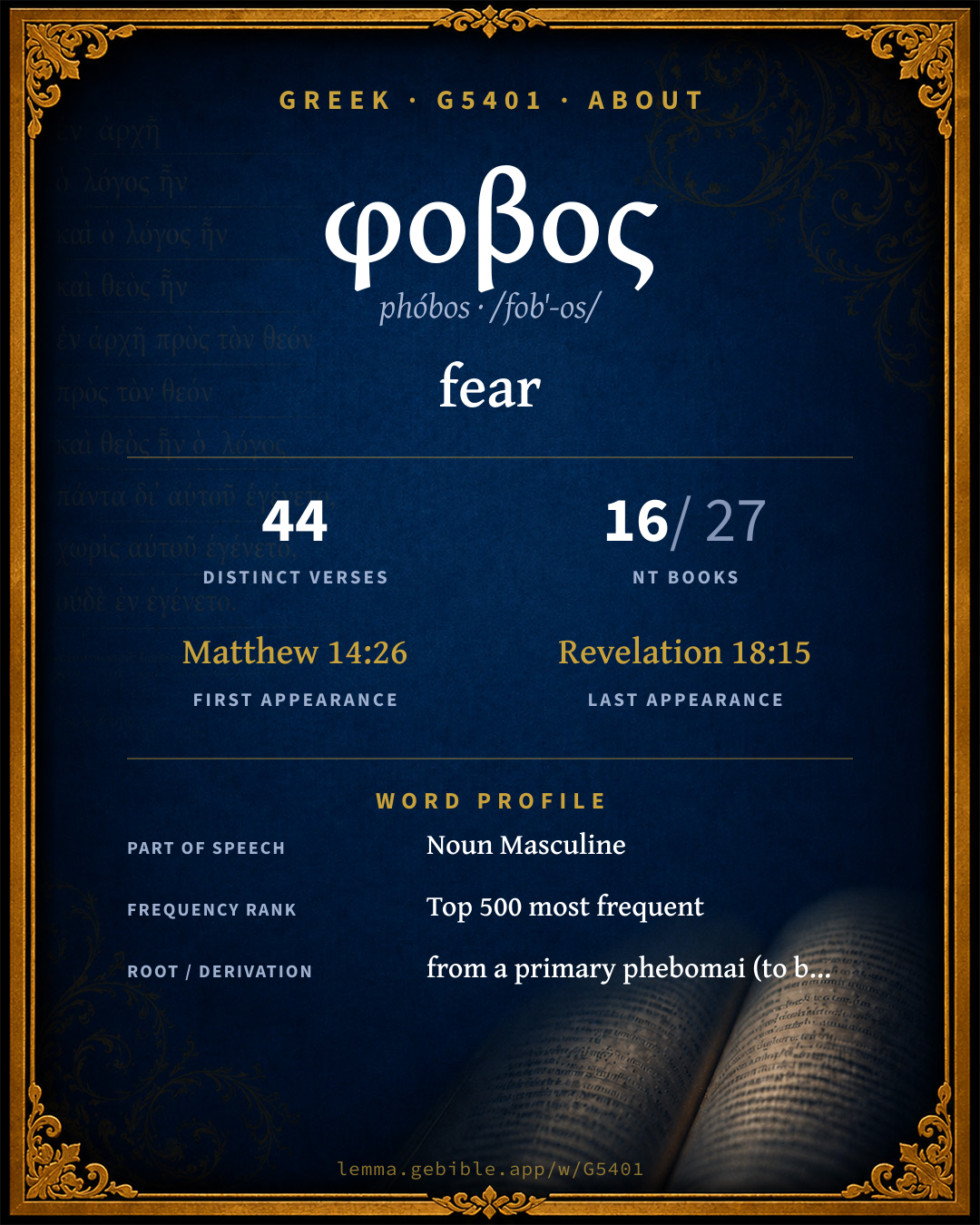
φόβος
fear
also: dread, terror fuller range ↓
Full lexicon entry — Thayer's Greek Lexicon
From Thayer's Greek Lexicon
Where this word appears
See every Accusative-case word in the Greek New Testament →
Grammar key — what these labels mean
Part of speech
- Noun
- A naming word — a person, place, thing, or idea.
Case
- Accusative
- The case of the direct object and of extent.
- Nominative
- The case of the subject (and the predicate nominative).
- Dative
- The case of the indirect object, means, or location — “to / for / with / in.”
- Genitive
- The case of source, possession, or “of” — answers “whose / from what.”
Gender
- Masculine
- Grammatically masculine.
Number
- Singular
- One.
- Plural
- More than one.
Grammatical forms
- Noun, Accusative, Singular, Masculine 15 times (31%)
- Noun, Nominative, Singular, Masculine 13 times (27%)
- Noun, Dative, Singular, Masculine 10 times (21%)
- Noun, Genitive, Singular, Masculine 9 times (19%)
- Noun, Nominative, Plural, Masculine 1 time (2%)
Parsed forms decoded from the imported morphology (Robinson–Tischendorf, public domain), counted across 48 parsed occurrences — not distinct verses.
Every verse where G5401 appears — 44 distinct verses across 16 books. Click any verse to open its interlinear word-by-word view. Verse text shown in the World English Bible for context — . Each verse’s Greek form is shown with its reference; the English is not keyword-highlighted, since the data carries no word-level English alignment. Use “Compare translations” on any verse to read it across multiple English versions. This concordance covers the Greek New Testament; Septuagint (Greek Old Testament) occurrences of this word are not indexed here.
Matthew 3 verses
- Matthew 14:26 φόβου n gen sg masc When the disciples saw him walking on the sea, they were troubled, saying, "It's a ghost!" and they cried out for fear.
- Matthew 28:4 φόβου n gen sg masc For fear of him, the guards shook, and became like dead men.
- Matthew 28:8 φόβου n gen sg masc They departed quickly from the tomb with fear and great joy, and ran to bring his disciples word.
Mark 1 verse
Luke 7 verses
- Luke 1:12 φόβος n nom sg masc Zacharias was troubled when he saw him, and fear fell upon him.
- Luke 1:65 φόβος n nom sg masc Fear came on all who lived around them, and all these sayings were talked about throughout all the hill country of Judea.
- Luke 2:9 φόβον n acc sg masc Behold, an angel of the Lord stood by them, and the glory of the Lord shone around them, and they were terrified.
- Luke 5:26 φόβου n gen sg masc Amazement took hold on all, and they glorified God. They were filled with fear, saying, "We have seen strange things today."
- Luke 7:16 φόβος n nom sg masc Fear took hold of all, and they glorified God, saying, "A great prophet has arisen among us!" and, "God has visited his people!"
- Luke 8:37 φόβῳ n dat sg masc All the people of the surrounding country of the Gadarenes asked him to depart from them, for they were very much afraid. He entered into the boat, and returned.
- Luke 21:26 φόβου n gen sg masc men fainting for fear, and for expectation of the things which are coming on the world: for the powers of the heavens will be shaken.
John 3 verses
- John 7:13 φόβον n acc sg masc Yet no one spoke openly of him for fear of the Jews.
- John 19:38 φόβον n acc sg masc After these things, Joseph of Arimathaea, being a disciple of Jesus, but secretly for fear of the Jews, asked of Pilate that he might take away Jesus' body. Pilate gave him permission. He came therefore and took away his body.
- John 20:19 φόβον n acc sg masc When therefore it was evening, on that day, the first day of the week, and when the doors were locked where the disciples were assembled, for fear of the Jews, Jesus came and stood in the midst, and said to them, "Peace be to you."
Acts 5 verses
- Acts 2:43 φόβος φόβος n nom sg masc n nom sg masc Fear came on every soul, and many wonders and signs were done through the apostles.
- Acts 5:5 φόβος n nom sg masc Ananias, hearing these words, fell down and died. Great fear came on all who heard these things.
- Acts 5:11 φόβος n nom sg masc Great fear came on the whole assembly, and on all who heard these things.
- Acts 9:31 φόβῳ n dat sg masc So the assemblies throughout all Judea and Galilee and Samaria had peace, and were built up. They were multiplied, walking in the fear of the Lord and in the comfort of the Holy Spirit.
- Acts 19:17 φόβος n nom sg masc This became known to all, both Jews and Greeks, who lived at Ephesus. Fear fell on them all, and the name of the Lord Jesus was magnified.
Romans 4 verses
- Romans 3:18 φόβος n nom sg masc "There is no fear of God before their eyes."
- Romans 8:15 φόβον n acc sg masc For you didn't receive the spirit of bondage again to fear, but you received the Spirit of adoption, by whom we cry, "Abba! Father!"
- Romans 13:3 φόβος n nom sg masc For rulers are not a terror to the good work, but to the evil. Do you desire to have no fear of the authority? Do that which is good, and you will have praise from the same,
- Romans 13:7 φόβον φόβον n acc sg masc n acc sg masc Give therefore to everyone what you owe: taxes to whom taxes are due; customs to whom customs; respect to whom respect; honor to whom honor.
1 Corinthians 1 verse
2 Corinthians 5 verses
- 2 Corinthians 5:11 φόβον n acc sg masc Knowing therefore the fear of the Lord, we persuade men, but we are revealed to God; and I hope that we are revealed also in your consciences.
- 2 Corinthians 7:1 φόβῳ n dat sg masc Having therefore these promises, beloved, let us cleanse ourselves from all defilement of flesh and spirit, perfecting holiness in the fear of God.
- 2 Corinthians 7:5 φόβοι n nom pl masc For even when we had come into Macedonia, our flesh had no relief, but we were afflicted on every side. Fightings were outside. Fear was inside.
- 2 Corinthians 7:11 φόβον n acc sg masc For behold, this same thing, that you were made sorry in a godly way, what earnest care it worked in you. Yes, what defense, indignation, fear, longing, zeal, and vengeance! In everything you demonstrated yourselves to be pure in the matter.
- 2 Corinthians 7:15 φόβου n gen sg masc His affection is more abundantly toward you, while he remembers all of your obedience, how with fear and trembling you received him.
Ephesians 2 verses
Philippians 1 verse
1 Timothy 1 verse
Hebrews 1 verse
1 Peter 5 verses
- 1 Peter 1:17 φόβῳ n dat sg masc If you call on him as Father, who without respect of persons judges according to each man's work, pass the time of your living as strangers here in reverent fear:
- 1 Peter 2:18 φόβῳ n dat sg masc Servants, be in subjection to your masters with all fear; not only to the good and gentle, but also to the wicked.
- 1 Peter 3:2 φόβῳ n dat sg masc seeing your pure behavior in fear.
- 1 Peter 3:14 φόβον n acc sg masc But even if you should suffer for righteousness' sake, you are blessed. "Don't fear what they fear, neither be troubled."
- 1 Peter 3:15 φόβου n gen sg masc But sanctify the Lord God in your hearts; and always be ready to give an answer to everyone who asks you a reason concerning the hope that is in you, with humility and fear:
1 John 1 verse
Jude 1 verse
Revelation 3 verses
- Revelation 11:11 φόβος n nom sg masc After the three and a half days, the breath of life from God entered into them, and they stood on their feet. Great fear fell on those who saw them.
- Revelation 18:10 φόβον n acc sg masc standing far away for the fear of her torment, saying, 'Woe, woe, the great city, Babylon, the strong city! For your judgment has come in one hour.'
- Revelation 18:15 φόβον n acc sg masc The merchants of these things, who were made rich by her, will stand far away for the fear of her torment, weeping and mourning;
About this entry
At a glance — auto-summarized from this page’s data, not written by a person. Every figure links to its source below. This summary describes the numbers; it doesn’t interpret them.
φοβος (phóbos) is a Greek noun most often rendered “fear.” Scripture first uses it in Matthew 14:26. It turns up in 44 verses across 16 books, a moderately common footprint. Ranging over 2 senses, its meaning includes “dread” and “terror”. It clusters with φοβερος and φοβεω under a shared root. See the sense tree, 44-verse concordance, and the renderings breakdown below.
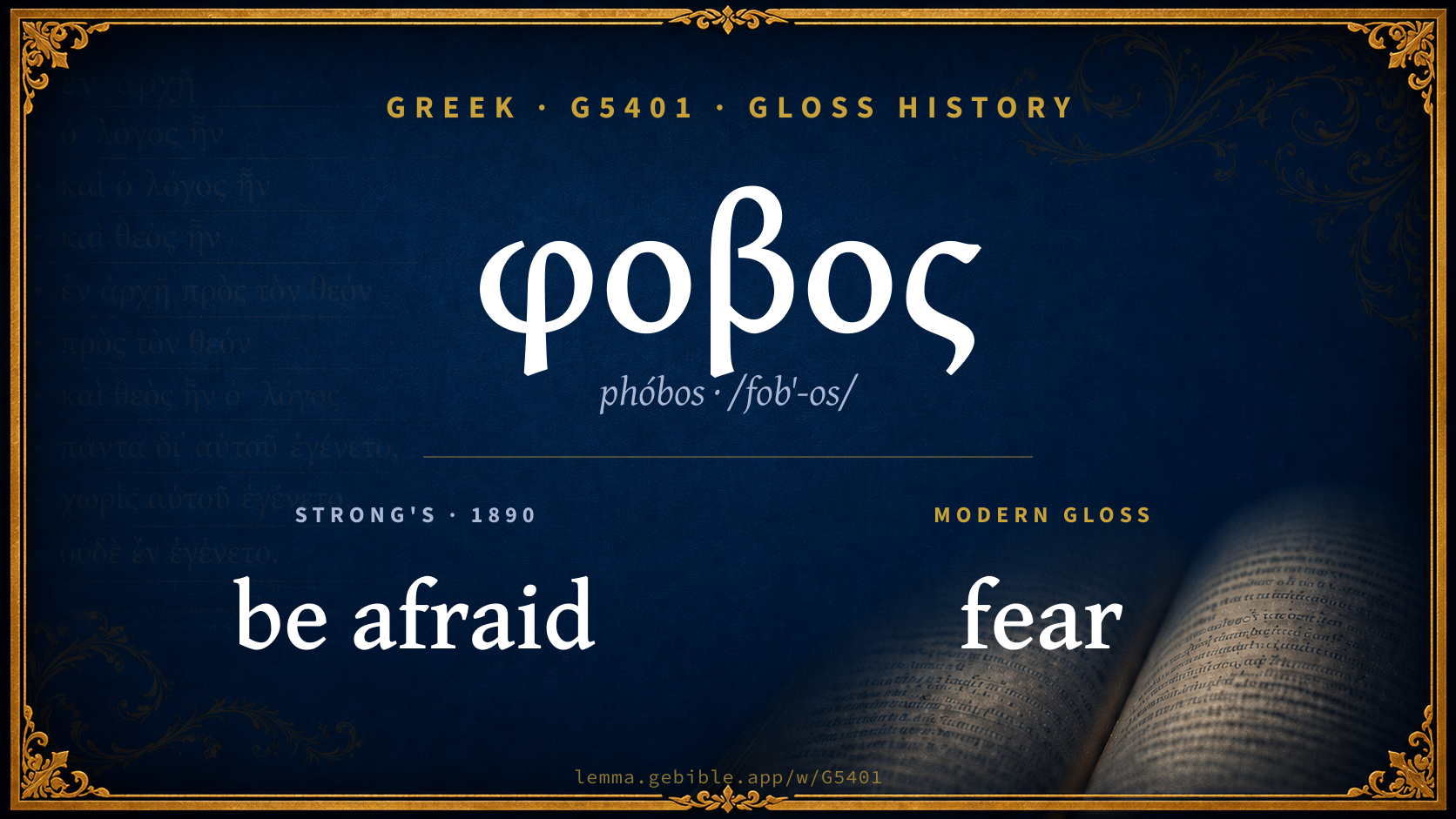
Gloss history
Strong's 1890 vs modern scholarship
About this word
Strong's G5401 catalogs a Greek word from the Greek New Testament.
These counts are not copied from any lexicon or concordance. They are computed here, from the morphology-tagged Greek New Testament. What Lemma adds →
- 44
- distinct verses
- The word appears in 44 distinct verses.
- 16 / 27
- NT books
- The word appears in 16 of 27 New Testament books.
- #322
- by frequency
- Top 500 most frequent Greek words (rank 322 of 5,347 Greek words by occurrence).
View all 44 occurrences in the concordance →
Most concentrated in
- Luke 7 verses 16%
- Acts 5 verses 11%
- 2 Corinthians 5 verses 11%
By section of the New Testament
By traditional corpus
Conventional, traditional groupings — biblical authorship is debated, so this is a traditional corpus grouping, not an authorship claim. Some books belong to more than one corpus (Luke is in both the Gospels and the Lukan corpus, and so on), so these shares overlap and need not total 100%. Each figure is a share of the word’s 44 distinct verses.
- Gospels 14 verses · 32%
- Pauline corpus 14 verses · 32%
- Lukan (Luke–Acts) 12 verses · 27%
- Johannine 7 verses · 16%
- General (Catholic) Epistles 7 verses · 16%
- Revelation 3 verses · 7%
- Hebrews 1 verse · 2%
How translations render this word
Counts come from each version’s own published word-to-Strong’s tagging or interlinear alignment — an approximate guide to how each version renders this word, not a word-level alignment the data otherwise carries. Because each total is that version’s own tagged count, the per-version totals vary from one another and need not match the appearance or distinct-verse counts above. These counts may also differ from a printed concordance because Lemma counts each distinctly tagged rendering and does not collapse phrase taggings into a single head-word total. This is a fixed set of word-tagged versions (KJV, ASV, BSB, ULT) and does not change with the reading translation you choose elsewhere. Each version’s license is shown beside its name below (and on Sources).
- King James Version: Fear 41×, Terror 3×
- American Standard Version: Fear 43×
- Berean Standard Bible: Fear 28×, Respect 5×, Awe 2×
- unfoldingWord Literal Text: Fear 44×, A 2×
King James Version Public Domain
Renders G5401 across 46 tagged occurrences — most commonly:
Plus 2 renderings that appear only once — usually multi-word phrases or single function words the recovered tagging swept in, not distinct renderings. Not rendered by a distinct English word in 1 further occurrence.
American Standard Version Public Domain
Renders G5401 across 46 tagged occurrences — most commonly:
Plus 3 renderings that appear only once — usually multi-word phrases or single function words the recovered tagging swept in, not distinct renderings.
Berean Standard Bible Public Domain
Renders G5401 across 45 tagged occurrences — most commonly:
Plus 8 renderings that appear only once — usually multi-word phrases or single function words the recovered tagging swept in, not distinct renderings. Not rendered by a distinct English word in 1 further occurrence.
unfoldingWord Literal Text CC BY-SA 4.0
Renders G5401 across 50 tagged occurrences — most commonly:
Plus 4 renderings that appear only once — usually multi-word phrases or single function words the recovered tagging swept in, not distinct renderings.
Senses in Thayer's
The 2 senses Thayer's distinguishes for this word, in lexicon order (not ranked by frequency or importance). The full entry — with sub-senses — is in the Lexicon Entry tab.
- fear, dread, terror
- reverence for one's husband
Word origin
Origin: from a primary phebomai (to be put in fear)
From a primary φέβομαι phebomai (to be put in fear ); alarm or fright : - be afraid + exceedingly fear terror.
— Strong’s Exhaustive Concordance (1890), public domain.
Forms in the corpus
The 5 distinct written forms G5401 takes in the Greek New Testament, most frequent first — each parse links to that case’s occurrences in the concordance.
| Form | Parsing | Example | Uses |
|---|---|---|---|
| φόβον phóbon | Noun, Accusative, Singular, Masculine | Mark 4:41 | 15 |
| φόβος phóbos | Noun, Nominative, Singular, Masculine | Luke 1:12 | 13 |
| φόβῳ phóbō | Noun, Dative, Singular, Masculine | Luke 8:37 | 10 |
| φόβου phóbou | Noun, Genitive, Singular, Masculine | Matthew 14:26 | 9 |
| φόβοι phóboi | Noun, Nominative, Plural, Masculine | 2 Corinthians 7:5 | 1 |
Same root — word family
Other Thayer's entries built from the same root as G5401, grouped by Strong’s listed origin. These share a root / origin per the lexicon — not necessarily a shared meaning. Each links to that word’s own entry.
Derived from this word
Compare all same-root words → They share a root, not necessarily a meaning.
Septuagint usage
The same Greek word φοβος appears 127 times in the Greek Old Testament (Septuagint), across 122 verses in 19 books.
- 127
- LXX occurrences
- Tagged occurrences of this Greek word in the Septuagint.
- 122
- verses
- Distinct Septuagint verses containing this word.
- 19 / 39
- OT books
- The word appears in 19 of the 39 Old Testament books.
Sample Septuagint occurrences
- Genesis 9:2 φόβος
- Exodus 15:16 φόβος
- Deuteronomy 2:25 φόβος
- Joshua 2:9 φόβος
- 2 Samuel 23:3 φόβος
- 1 Chronicles 14:17 φόβος
- 2 Chronicles 19:7 φόβος
- Ezra 15:9 φόβος
- Esther 1:22 φόβος
- Job 3:24 φόβος
- Psalms 2:11 φόβος
- Proverbs 1:7 φόβος
Septuagint occurrences (same lexeme)
Every verse where the same Strong’s number (G5401) appears in the Greek Septuagint — showing the first 50 of 122. Verse text shown in the World English Bible for context; the Greek form is the matched word — the English is not keyword-highlighted.
- Genesis 9:2 φόβος The fear of you and the dread of you will be on every animal of the earth, and on every bird of the sky. Everything that the ground teems with, and all the fish of the sea are delivered into your hand.
- Genesis 15:12 φόβος When the sun was going down, a deep sleep fell on Abram. Now terror and great darkness fell on him.
- Genesis 31:42 φόβος Unless the God of my father, the God of Abraham, and the fear of Isaac, had been with me, surely now you would have sent me away empty. God has seen my affliction and the labor of my hands, and rebuked you last night."
- Genesis 31:53 φόβος The God of Abraham, and the God of Nahor, the God of their father, judge between us." Then Jacob swore by the fear of his father, Isaac.
- Genesis 35:5 φόβος They traveled: and a terror of God was on the cities that were round about them, and they didn't pursue the sons of Jacob.
- Exodus 15:16 φόβος Terror and dread falls on them. By the greatness of your arm they are as still as a stone; Until your people pass over, Yahweh, Until the people pass over who you have purchased.
- Exodus 20:20 φόβος Moses said to the people, "Don't be afraid, for God has come to test you, and that his fear may be before you, that you won't sin."
- Exodus 23:27 φόβος I will send my terror before you, and will confuse all the people to whom you come, and I will make all your enemies turn their backs to you.
- Deuteronomy 2:25 φόβος This day will I begin to put the dread of you and the fear of you on the peoples who are under the whole sky, who shall hear the report of you, and shall tremble, and be in anguish because of you.
- Deuteronomy 11:25 φόβος There shall no man be able to stand before you: Yahweh your God shall lay the fear of you and the dread of you on all the land that you shall tread on, as he has spoken to you.
- Deuteronomy 28:67 φόβος In the morning you shall say, Would it were even! and at even you shall say, Would it were morning! for the fear of your heart which you shall fear, and for the sight of your eyes which you shall see.
- Deuteronomy 32:25 φόβος Outside shall the sword bereave, In the chambers terror; [It shall destroy] both young man and virgin, The suckling with the man of gray hairs.
- Joshua 2:9 φόβος and she said to the men, I know that Yahweh has given you the land, and that the fear of you is fallen on us, and that all the inhabitants of the land melt away before you.
- 2 Samuel 23:3 φόβος The God of Israel said, The Rock of Israel spoke to me: One who rules over men righteously, Who rules in the fear of God,
- 1 Chronicles 14:17 φόβος The fame of David went out into all lands; and Yahweh brought the fear of him on all nations.
- 2 Chronicles 19:7 φόβος Now therefore let the fear of Yahweh be on you; take heed and do it: for there is no iniquity with Yahweh our God, nor respect of persons, nor taking of bribes.
- 2 Chronicles 19:9 φόβος He charged them, saying, Thus shall you do in the fear of Yahweh, faithfully, and with a perfect heart.
- 2 Chronicles 26:5 φόβος He set himself to seek God in the days of Zechariah, who had understanding in the vision of God: and as long as he sought Yahweh, God made him to prosper.
- Ezra 15:9 φόβος
- Ezra 15:15 φόβος
- Ezra 16:16 φόβος
- Esther 1:22 φόβος for he sent letters into all the king's provinces, into every province according to the writing of it, and to every people after their language, that every man should bear rule in his own house, and should speak according to the language of his people.
- Esther 8:17 φόβος In every province, and in every city, wherever the king's commandment and his decree came, the Jews had gladness and joy, a feast and a good day. Many from among the peoples of the land became Jews; for the fear of the Jews was fallen on them.
- Esther 9:3 φόβος All the princes of the provinces, and the satraps, and the governors, and those who did the king's business, helped the Jews; because the fear of Mordecai was fallen on them.
- Job 3:24 φόβος For my sighing comes before I eat, My groanings are poured out like water.
- Job 3:25 φόβος For the thing which I fear comes on me, That which I am afraid of comes to me.
- Job 4:6 φόβος Isn't your piety your confidence, The integrity of your ways your hope?
- Job 4:13 φόβος In thoughts from the visions of the night, When deep sleep falls on men,
- Job 9:34 φόβος Let him take his rod away from me, Let his terror not make me afraid:
- Job 13:11 φόβος Shall not his majesty make you afraid, And his dread fall on you?
- Job 13:21 φόβος Withdraw your hand far from me; And don't let your terror make me afraid.
- Job 15:4 φόβος Yes, you do away with fear, And hinder devotion before God.
- Job 15:21 φόβος A sound of terrors is in his ears; In prosperity the destroyer shall come on him.
- Job 20:25 φόβος He draws it forth, and it comes out of his body. Yes, the glittering point comes out of his liver. Terrors are on him.
- Job 21:9 φόβος Their houses are safe from fear, Neither is the rod of God upon them.
- Job 25:2 φόβος "Dominion and fear are with him; He makes peace in his high places.
- Job 31:23 φόβος For calamity from God is a terror to me, By reason of his majesty I can do nothing.
- Job 33:7 φόβος Behold, my terror shall not make you afraid, Neither shall my pressure be heavy on you.
- Job 33:15 φόβος In a dream, in a vision of the night, When deep sleep falls on men, In slumbering on the bed;
- Job 33:16 φόβος Then he opens the ears of men, And seals their instruction,
- Job 38:17 φόβος Have the gates of death been revealed to you? Or have you seen the gates of the shadow of death?
- Job 39:3 φόβος They bow themselves, they bring forth their young, They end their labor pains.
- Job 39:16 φόβος She deals harshly with her young ones, as if they were not hers. Though her labor is in vain, she is without fear,
- Job 39:19 φόβος "Have you given the horse might? Have you clothed his neck with a quivering mane?
- Job 41:6 φόβος Will traders barter for him? Will they part him among the merchants?
- Job 41:17 φόβος They are joined one to another; They stick together, so that they can't be pulled apart.
- Psalms 2:11 φόβος Serve Yahweh with fear, And rejoice with trembling.
- Psalms 5:8 φόβος Lead me, Yahweh, in your righteousness because of my enemies. Make your way straight before my face.
- Psalms 13:3 φόβος Behold, and answer me, Yahweh, my God. Give light to my eyes, lest I sleep in death;
- Psalms 13:5 φόβος But I trust in your loving kindness. My heart rejoices in your salvation.
These are occurrences of the same Greek lexeme (G5401) in the Septuagint — not a translation of any one Hebrew word. The store carries no word-level Hebrew↔Greek alignment, so no Hebrew original is asserted here. Counts come from the recovered LXX Strong's tagging — high-frequency vocabulary is well covered, while rare or late forms may be untagged — so they reflect tagged occurrences and may slightly undercount.