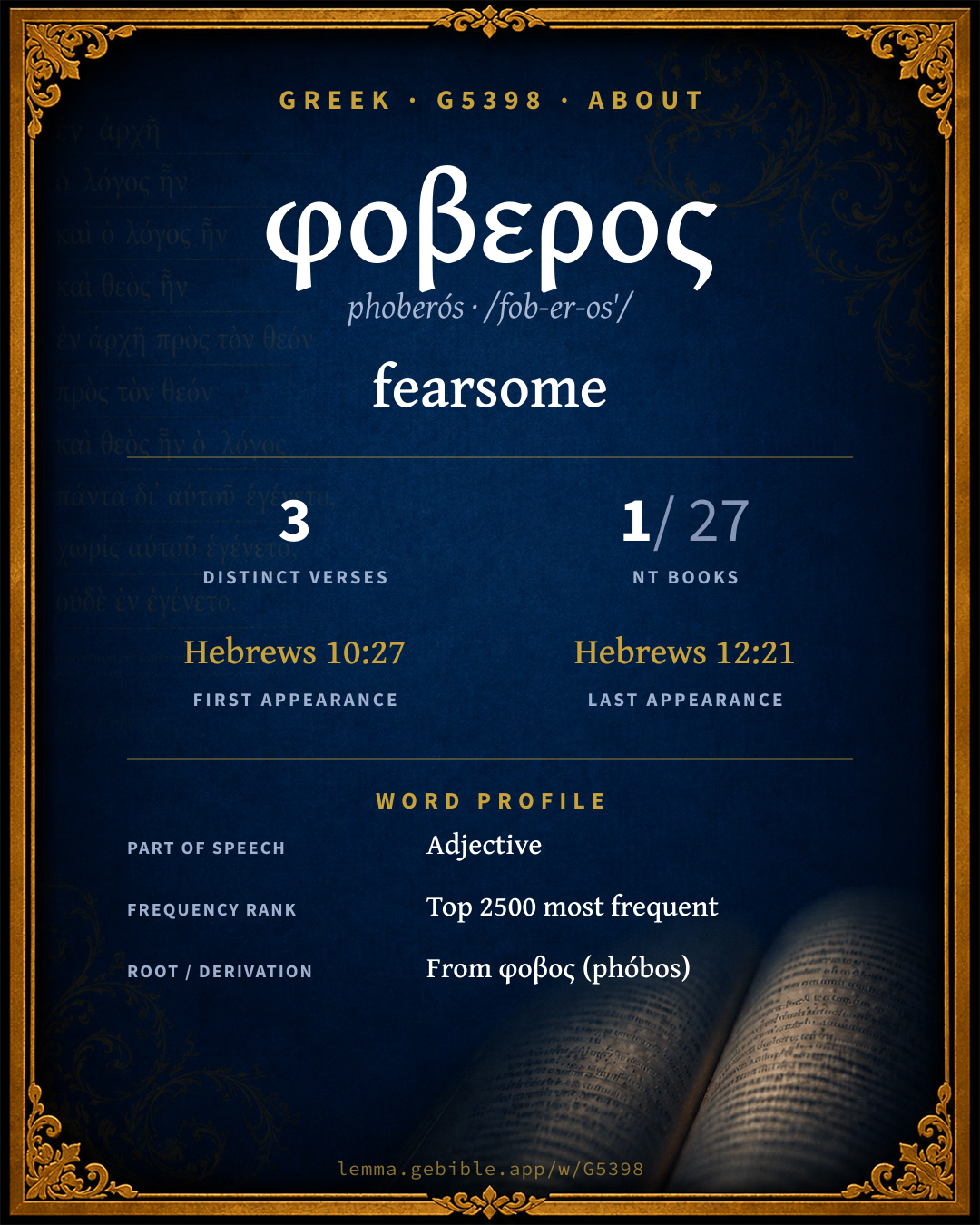
φοβερός
fearsome
‘fearsome’ is one of 2 main senses fuller range ↓
Full lexicon entry — Thayer's Greek Lexicon
From Thayer's Greek Lexicon
Where this word appears
Grammar key — what these labels mean
Part of speech
- Adjective
- A word that describes or qualifies a noun.
Case
- Nominative
- The case of the subject (and the predicate nominative).
Gender
- Neuter
- Grammatically neuter.
- Feminine
- Grammatically feminine.
Number
- Singular
- One.
Grammatical forms
- Adjective, Nominative, Singular, Neuter 2 times (67%)
- Adjective, Nominative, Singular, Feminine 1 time (33%)
Parsed forms decoded from the imported morphology (Robinson–Tischendorf, public domain), counted across 3 parsed occurrences — not distinct verses.
Every verse where G5398 appears — 3 distinct verses across 1 book. Click any verse to open its interlinear word-by-word view. Verse text shown in the World English Bible for context — . Each verse’s Greek form is shown with its reference; the English is not keyword-highlighted, since the data carries no word-level English alignment. Use “Compare translations” on any verse to read it across multiple English versions. This concordance covers the Greek New Testament; Septuagint (Greek Old Testament) occurrences of this word are not indexed here.
Hebrews 3 verses
- Hebrews 10:27 φοβερὰ adj nom sg fem but a certain fearful expectation of judgment, and a fierceness of fire which will devour the adversaries.
- Hebrews 10:31 φοβερὸν adj nom sg neut It is a fearful thing to fall into the hands of the living God.
- Hebrews 12:21 φοβερὸν adj nom sg neut and so fearful was the appearance, that Moses said, "I am terrified and trembling."
About this entry
At a glance — auto-summarized from this page’s data, not written by a person. Every figure links to its source below. This summary describes the numbers; it doesn’t interpret them.
“fearsome” is the headline sense of the Greek adjective φοβερος (phoberós). The Greek New Testament uses it only 3 verses. More than three-quarters of its appearances fall in Hebrews. Scripture first uses it in Hebrews 10:27. Catalogued under 2 senses, its meaning is not single-sense. See the sense tree, 3-verse concordance, and the renderings breakdown below.
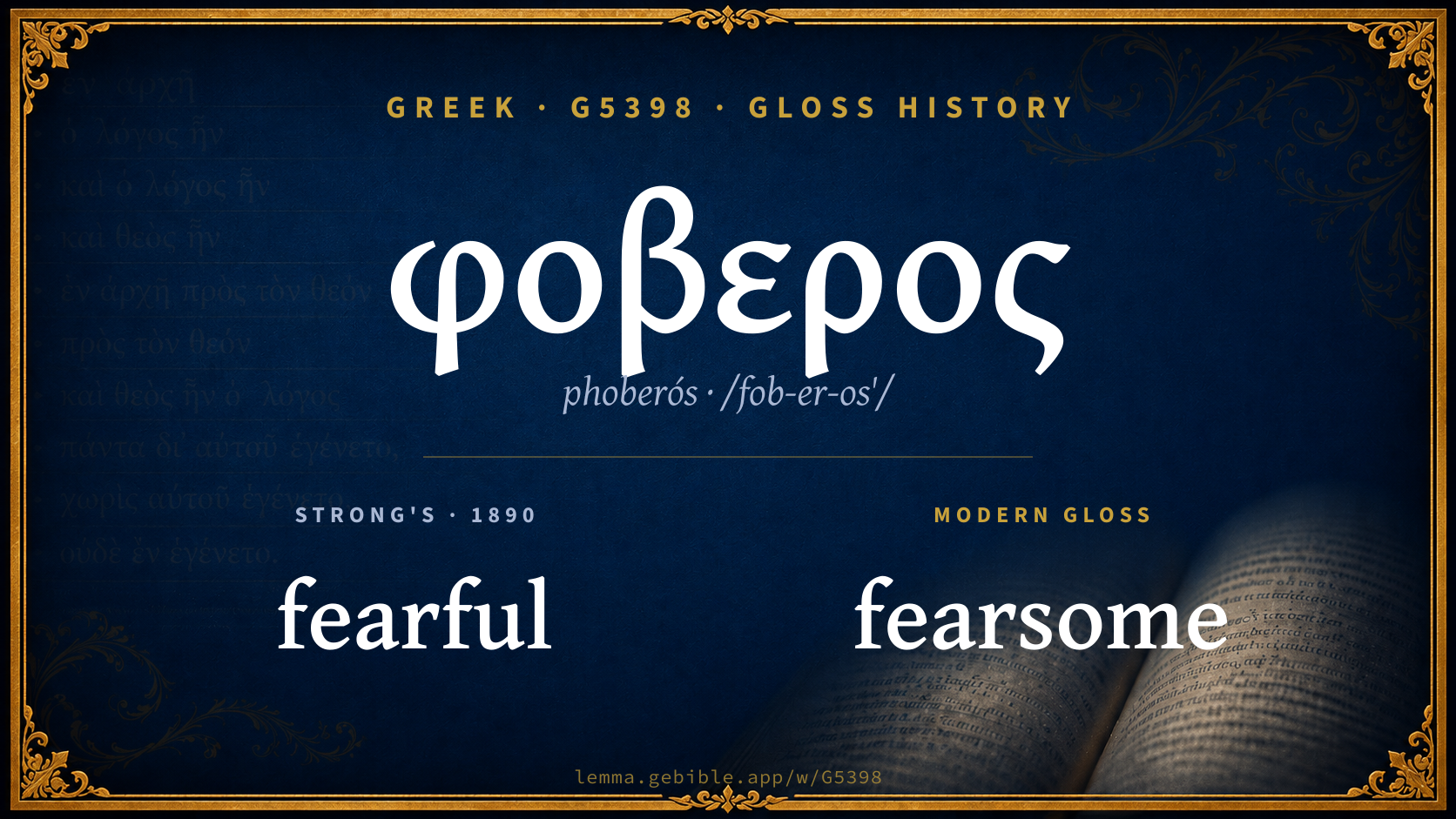
Gloss history
Strong's 1890 vs modern scholarship
About this word
Strong's G5398 catalogs a Greek word from the Greek New Testament.
These counts are not copied from any lexicon or concordance. They are computed here, from the morphology-tagged Greek New Testament. What Lemma adds →
- 3
- distinct verses
- The word appears in 3 distinct verses.
- 1 / 27
- NT books
- The word appears in 1 of 27 New Testament books.
- #2,203
- by frequency
- Top 2500 most frequent Greek words (rank 2,203 of 5,347 Greek words by occurrence).
View all 3 occurrences in the concordance →
Most concentrated in
- Hebrews 3 verses 100%
By section of the New Testament
By traditional corpus
Conventional, traditional groupings — biblical authorship is debated, so this is a traditional corpus grouping, not an authorship claim. Some books belong to more than one corpus (Luke is in both the Gospels and the Lukan corpus, and so on), so these shares overlap and need not total 100%. Each figure is a share of the word’s 3 distinct verses.
- Hebrews 3 verses · 100%
How translations render this word
Counts come from each version’s own published word-to-Strong’s tagging or interlinear alignment — an approximate guide to how each version renders this word, not a word-level alignment the data otherwise carries. Because each total is that version’s own tagged count, the per-version totals vary from one another and need not match the appearance or distinct-verse counts above. These counts may also differ from a printed concordance because Lemma counts each distinctly tagged rendering and does not collapse phrase taggings into a single head-word total. This is a fixed set of word-tagged versions (KJV, ASV, BSB, ULT) and does not change with the reading translation you choose elsewhere. Each version’s license is shown beside its name below (and on Sources).
- King James Version: Fearful 1×, Is a fearful thing 1×, Terrible 1×
- American Standard Version: Fearful 2×
- Berean Standard Bible: Fearful 1×, Fearful thing 1×, Terrifying 1×
- unfoldingWord Literal Text: Fearful 2×
King James Version Public Domain
Renders G5398 across 3 tagged occurrences — most commonly:
American Standard Version Public Domain
Renders G5398 across 3 tagged occurrences — most commonly:
Plus 1 rendering that appears only once — usually multi-word phrases or single function words the recovered tagging swept in, not distinct renderings.
Berean Standard Bible Public Domain
Renders G5398 across 3 tagged occurrences — most commonly:
unfoldingWord Literal Text CC BY-SA 4.0
Renders G5398 across 3 tagged occurrences — most commonly:
Plus 1 rendering that appears only once — usually multi-word phrases or single function words the recovered tagging swept in, not distinct renderings.
Senses in Thayer's
The 2 senses Thayer's distinguishes for this word, in lexicon order (not ranked by frequency or importance). The full entry — with sub-senses — is in the Lexicon Entry tab.
- inspiring fear, terrible, formidable
- affected with fear, timid
Word origin
Derived from φοβος (phóbos) (G5401) — fear.
From G5401 ; frightful that is (objectively) formidable : - fearful terrible.
— Strong’s Exhaustive Concordance (1890), public domain.
Forms in the corpus
The 2 distinct written forms G5398 takes in the Greek New Testament, most frequent first — each parse links to that case’s occurrences in the concordance.
| Form | Parsing | Example | Uses |
|---|---|---|---|
| φοβερὸν phoberòn | Adjective, Nominative, Singular, Neuter | Hebrews 10:31 | 2 |
| φοβερὰ phoberà | Adjective, Nominative, Singular, Feminine | Hebrews 10:27 | 1 |
Same root — word family
Other Thayer's entries built from the same root as G5398, grouped by Strong’s listed origin. These share a root / origin per the lexicon — not necessarily a shared meaning. Each links to that word’s own entry.
Derives from
Shares the same root
Compare all same-root words → They share a root, not necessarily a meaning.
Septuagint usage
The same Greek word φοβερος appears 29 times in the Greek Old Testament (Septuagint), across 28 verses in 10 books.
- 29
- LXX occurrences
- Tagged occurrences of this Greek word in the Septuagint.
- 28
- verses
- Distinct Septuagint verses containing this word.
- 10 / 39
- OT books
- The word appears in 10 of the 39 Old Testament books.
Sample Septuagint occurrences
- Genesis 28:17 φοβερός
- Deuteronomy 1:19 φοβερός
- Judges 13:6 φοβερός
- 1 Chronicles 16:25 φοβερός
- Ezra 11:5 φοβερός
- Psalms 46:3 φοβερός
- Proverbs 12:25 φοβερός
- Isaiah 21:1 φοβερός
- Daniel 2:31 φοβερός
- Habakkuk 1:7 φοβερός
Septuagint occurrences (same lexeme)
Every verse where the same Strong’s number (G5398) appears in the Greek Septuagint. Verse text shown in the World English Bible for context; the Greek form is the matched word — the English is not keyword-highlighted.
- Genesis 28:17 φοβερός He was afraid, and said, "How dreadful is this place! This is none other than God's house, and this is the gate of heaven."
- Deuteronomy 1:19 φοβερός We traveled from Horeb, and went through all that great and terrible wilderness which you saw, by the way to the hill-country of the Amorites, as Yahweh our God commanded us; and we came to Kadesh-barnea.
- Deuteronomy 2:7 φοβερός For Yahweh your God has blessed you in all the work of your hand; he has known your walking through this great wilderness: these forty years Yahweh your God has been with you; you have lacked nothing.
- Deuteronomy 8:15 φοβερός who led you through the great and terrible wilderness, [in which were] fiery serpents and scorpions, and thirsty ground where was no water; who brought you forth water out of the rock of flint;
- Deuteronomy 10:17 φοβερός For Yahweh your God, he is God of gods, and Lord of lords, the great God, the mighty, and the awesome, who doesn't regard persons, nor takes reward.
- Judges 13:6 φοβερός Then the woman came and told her husband, saying, A man of God came to me, and his face was like the face of the angel of God, very awesome; and I didn't ask him whence he was, neither did he tell me his name:
- 1 Chronicles 16:25 φοβερός For great is Yahweh, and greatly to be praised: He also is to be feared above all gods.
- Ezra 11:5 φοβερός
- Ezra 14:8 φοβερός
- Ezra 19:32 φοβερός
- Psalms 46:3 φοβερός Though the waters of it roar and are troubled, Though the mountains tremble with their swelling. Selah.
- Psalms 65:3 φοβερός Sins overwhelmed me, But you atoned for our transgressions.
- Psalms 65:5 φοβερός By awesome deeds of righteousness, you answer us, God of our salvation. You who are the hope of all the ends of the earth, Of those who are far away on the sea;
- Psalms 75:8 φοβερός For in the hand of Yahweh there is a cup, Full of foaming wine mixed with spices. He pours it out. Indeed the wicked of the earth drink and drink it to its very dregs.
- Psalms 75:13 φοβερός
- Psalms 88:8 φοβερός You have taken my friends from me. You have made me an abomination to them. I am confined, and I can't escape.
- Psalms 95:4 φοβερός In his hand are the deep places of the earth. The heights of the mountains are also his.
- Psalms 98:3 φοβερός He has remembered his loving kindness and his faithfulness toward the house of Israel. All the ends of the earth have seen the salvation of our God.
- Psalms 105:22 φοβερός To discipline his princes at his pleasure, And to teach his elders wisdom.
- Psalms 110:9 φοβερός
- Psalms 144:6 φοβερός Throw out lightning, and scatter them. Send out your arrows, and rout them.
- Proverbs 12:25 φοβερός Anxiety in a man's heart weighs it down, But a kind word makes it glad.
- Isaiah 21:1 φοβερός The burden of the wilderness of the sea. As whirlwinds in the South sweep through, it comes from the wilderness, from an awesome land.
- Daniel 2:31 φοβερός You, O king, saw, and, behold, a great image. This image, which was mighty, and whose brightness was excellent, stood before you; and the aspect of it was awesome.
- Daniel 4:29 φοβερός At the end of twelve months he was walking in the royal palace of Babylon.
- Daniel 7:7 φοβερός After this I saw in the night-visions, and, behold, a fourth animal, awesome and powerful, and strong exceedingly; and it had great iron teeth; it devoured and broke in pieces, and stamped the residue with its feet: and it was diverse from all the animals that were before it; and it had ten horns.
- Daniel 9:4 φοβερός I prayed to Yahweh my God, and made confession, and said, Oh, Lord, the great and dreadful God, who keeps covenant and loving kindness with those who love him and keep his commandments,
- Habakkuk 1:7 φοβερός They are feared and dreaded. Their judgment and their dignity proceed from themselves.
These are occurrences of the same Greek lexeme (G5398) in the Septuagint — not a translation of any one Hebrew word. The store carries no word-level Hebrew↔Greek alignment, so no Hebrew original is asserted here. Counts come from the recovered LXX Strong's tagging — high-frequency vocabulary is well covered, while rare or late forms may be untagged — so they reflect tagged occurrences and may slightly undercount.