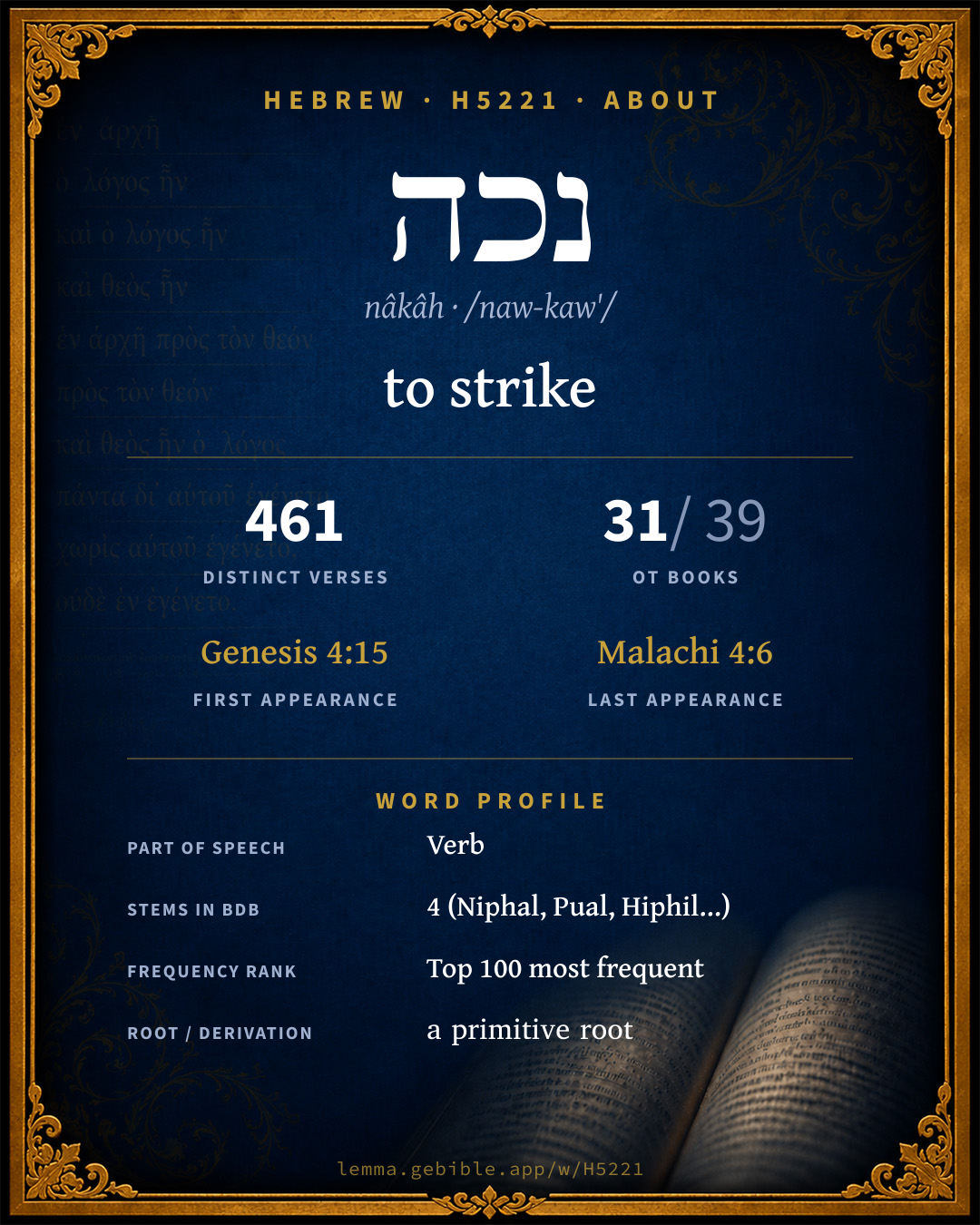
נָכָה
to strike
also: smite, hit, beat, slay fuller range ↓
Full lexicon entry — Brown-Driver-Briggs (BDB)
From Brown-Driver-Briggs (BDB)
Where this word appears
Grammar key — what these labels mean
Part of speech
- Verb
- An action or state-of-being word.
- Preposition
- A relational word (e.g. “in,” “to,” “from”) governing a noun.
Stem
- Hiphil
- The causative active stem (“he caused / brought about”). Here: ‘smite’
- Hophal
- The passive counterpart of the Hiphil (“he was caused to…”). Here: ‘receive a blow Is 1’
- Niphal
- Usually the simple passive or reflexive of the Qal (“he was written”).
- Pual
- The passive counterpart of the Piel.
Form
- Sequential Imperfect
- An imperfect with prefixed waw — the standard past-narrative form (waw-consecutive imperfect).
- Perfect
- A completed action or state — Hebrew marks aspect (completeness) more than strict tense (“he wrote”).
- Infinitive Construct
- A bound verbal noun, frequently with prepositions (“to write / in writing”).
- Imperfect
- An incomplete, ongoing, or future action (“he will / would write”).
- Participle Active
- A verbal adjective expressing ongoing or characteristic action (“writing / one who writes”).
- Sequential Perfect
- A perfect with prefixed waw continuing a preceding imperfect or command (waw-consecutive perfect).
- Imperative
- A direct command (“write!”).
- Infinitive Absolute
- An unbound verbal noun, often intensifying or standing in for a finite verb.
- Participle Passive
- A verbal adjective expressing action received (“written”).
- Cohortative
- A first-person volitional form expressing wish or resolve (“let me / let us write”).
- Jussive
- A third- or second-person volitional form expressing wish or command (“let him write”).
State
- Construct
- A noun bound to a following noun in a possessive / “of” relationship (the construct chain).
- Absolute
- The independent form of a noun, not bound to a following word.
Person
- 3rd Person
- The one spoken about (“he / she / it / they”).
- 2nd Person
- The one addressed (“you”).
- 1st Person
- The speaker (“I / we”).
Gender
- Masculine
- Grammatically masculine.
- Common
- Either gender — not distinguished for this form.
- Feminine
- Grammatically feminine.
Number
- Singular
- One.
- Plural
- More than one (in Hebrew, generally three or more).
Every verse where H5221 appears in the Book of Judges — 29 distinct verses. Click any verse to open its interlinear word-by-word view. Verse text shown in the World English Bible for context — . Each verse’s Hebrew form is shown with its reference; the English is not keyword-highlighted, since the data carries no word-level English alignment. Use “Compare translations” on any verse to read it across multiple English versions. This concordance covers the Hebrew Bible; Septuagint (Greek Old Testament) occurrences are not indexed here.
Judges
- Judges 1:4 וַ/יַּכּ֣וּ/ם conj + Hiphil wimpf 3mp + sfx pers 3mp Judah went up; and Yahweh delivered the Canaanites and the Perizzites into their hand: and they struck of them in Bezek ten thousand men.
- Judges 1:5 וַ/יַּכּ֕וּ conj + Hiphil wimpf 3mp They found Adoni-bezek in Bezek; and they fought against him, and they struck the Canaanites and the Perizzites.
- Judges 1:8 וַ/יַּכּ֖וּ/הָ conj + Hiphil wimpf 3mp + sfx pers 3fs The children of Judah fought against Jerusalem, and took it, and struck it with the edge of the sword, and set the city on fire.
- Judges 1:10 וַ/יַּכּ֛וּ conj + Hiphil wimpf 3mp Judah went against the Canaanites who lived in Hebron (now the name of Hebron before was Kiriath Arba); and they struck Sheshai, and Ahiman, and Talmai.
- Judges 1:12 יַכֶּ֥ה Hiphil impf 3ms Caleb said, He who strikes Kiriath Sepher, and takes it, to him will I give Achsah my daughter as wife.
- Judges 1:17 וַ/יַּכּ֕וּ conj + Hiphil wimpf 3mp Judah went with Simeon his brother, and they struck the Canaanites who inhabited Zephath, and utterly destroyed it. The name of the city was called Hormah.
- Judges 1:25 וַ/יַּכּ֥וּ conj + Hiphil wimpf 3mp He shown them the entrance into the city; and they struck the city with the edge of the sword; but they let the man go and all his family.
- Judges 3:13 וַ/יַּךְ֙ conj + Hiphil wimpf 3ms He gathered to him the children of Ammon and Amalek; and he went and struck Israel, and they possessed the city of palm trees.
- Judges 3:29 וַ/יַּכּ֨וּ conj + Hiphil wimpf 3mp They struck of Moab at that time about ten thousand men, every lusty man, and every man of valor; and there escaped not a man.
- Judges 3:31 וַ/יַּ֤ךְ conj + Hiphil wimpf 3ms After him was Shamgar the son of Anath, who struck of the Philistines six hundred men with an ox-goad: and he also saved Israel.
- Judges 6:16 וְ/הִכִּיתָ֥ conj + Hiphil wpf 2ms Yahweh said to him, Surely I will be with you, and you shall strike the Midianites as one man.
- Judges 7:13 וַ/יַּכֵּ֧/הוּ conj + Hiphil wimpf 3ms + sfx pers 3ms When Gideon had come, behold, there was a man telling a dream to his fellow; and he said, Behold, I dreamed a dream; and, behold, a cake of barley bread tumbled into the camp of Midian, and came to the tent, and struck it so that it fell, and turned it upside down, so that the tent lay flat.
- Judges 8:11 וַ/יַּךְ֙ conj + Hiphil wimpf 3ms Gideon went up by the way of those who lived in tents on the east of Nobah and Jogbehah, and struck the host; for the host was secure.
- Judges 9:43 וַ/יַּכֵּֽ/ם conj + Hiphil wimpf 3ms + sfx pers 3mp He took the people, and divided them into three companies, and laid wait in the field; and he looked, and, behold, the people came forth out of the city; He rose up against them, and struck them.
- Judges 9:44 וַ/יַּכּֽוּ/ם conj + Hiphil wimpf 3mp + sfx pers 3mp Abimelech, and the companies that were with him, rushed forward, and stood in the entrance of the gate of the city: and the two companies rushed on all who were in the field, and struck them.
- Judges 11:21 וַ/יַּכּ֑וּ/ם conj + Hiphil wimpf 3mp + sfx pers 3mp Yahweh, the God of Israel, delivered Sihon and all his people into the hand of Israel, and they struck them: so Israel possessed all the land of the Amorites, the inhabitants of that country.
- Judges 11:33 וַ/יַּכֵּ֡/ם conj + Hiphil wimpf 3ms + sfx pers 3mp He struck them from Aroer until you come to Minnith, even twenty cities, and to Abelcheramim, with a very great slaughter. So the children of Ammon were subdued before the children of Israel.
- Judges 12:4 וַ/יַּכּוּ֩ conj + Hiphil wimpf 3mp Then Jephthah gathered together all the men of Gilead, and fought with Ephraim; and the men of Gilead struck Ephraim, because they said, You are fugitives of Ephraim, you Gileadites, in the midst of Ephraim, [and] in the midst of Manasseh.
- Judges 14:19 וַ/יַּ֥ךְ conj + Hiphil wimpf 3ms The Spirit of Yahweh came mightily on him, and he went down to Ashkelon, and struck thirty men of them, and took their spoil, and gave the changes [of clothing] to those who declared the riddle. His anger was kindled, and he went up to his father's house.
- Judges 15:8 וַ/יַּ֨ךְ conj + Hiphil wimpf 3ms He struck them hip and thigh with a great slaughter: and he went down and lived in the cleft of the rock of Etam.
- Judges 15:15 וַ/יַּךְ conj + Hiphil wimpf 3ms He found a fresh jawbone of a donkey, and put forth his hand, and took it, and struck a thousand men therewith.
- Judges 15:16 הִכֵּ֖יתִי Hiphil pf 1cs Samson said, With the jawbone of a donkey, heaps on heaps, With the jawbone of a donkey I have struck a thousand men.
- Judges 18:27 וַ/יַּכּ֥וּ conj + Hiphil wimpf 3mp They took that which Micah had made, and the priest whom he had, and came to Laish, to a people quiet and secure, and struck them with the edge of the sword; and they burnt the city with fire.
- Judges 20:31 לְ/הַכּוֹת֩ prep + Hiphil inf.cs The children of Benjamin went out against the people, and were drawn away from the city; and they began to strike and kill of the people, as at other times, in the highways, of which one goes up to Bethel, and the other to Gibeah, in the field, about thirty men of Israel.
- Judges 20:37 וַ/יַּ֥ךְ conj + Hiphil wimpf 3ms The liers-in-wait hurried, and rushed on Gibeah; and the liers-in-wait drew themselves along, and struck all the city with the edge of the sword.
- Judges 20:39 לְ/הַכּ֨וֹת prep + Hiphil inf.cs The men of Israel turned in the battle, and Benjamin began to strike and kill of the men of Israel about thirty persons; for they said, Surely they are struck down before us, as in the first battle.
- Judges 20:45 וַ/יַּכּ֥וּ conj + Hiphil wimpf 3mp They turned and fled toward the wilderness to the rock of Rimmon: and they gleaned of them in the highways five thousand men, and followed hard after them to Gidom, and struck of them two thousand men.
- Judges 20:48 וַ/יַּכּ֣וּ/ם conj + Hiphil wimpf 3mp + sfx pers 3mp The men of Israel turned again on the children of Benjamin, and struck them with the edge of the sword, both the entire city, and the cattle, and all that they found: moreover all the cities which they found they set on fire.
- Judges 21:10 וְ/הִכִּיתֶ֞ם conj + Hiphil pf 2mp The congregation sent there twelve thousand men of the most valiant, and commanded them, saying, Go and strike the inhabitants of Jabesh Gilead with the edge of the sword, with the women and the little ones.
About this entry
At a glance — auto-summarized from this page’s data, not written by a person. Every figure links to its source below. This summary describes the numbers; it doesn’t interpret them.
At its core, נכה (nâkâh) means “to strike.” The King James Version usually renders it “smote,” while modern versions prefer “struck down” (Berean Standard Bible) and “struck” (unfoldingWord Literal Text) — see the renderings breakdown. Spanning 461 verses in 31 books, it ranks among the common words of the Hebrew Bible. Scripture first uses it in Genesis 4:15. The verb spans 4 stems, from Niphal to Pual. Dig into 461-verse concordance and the renderings breakdown below.
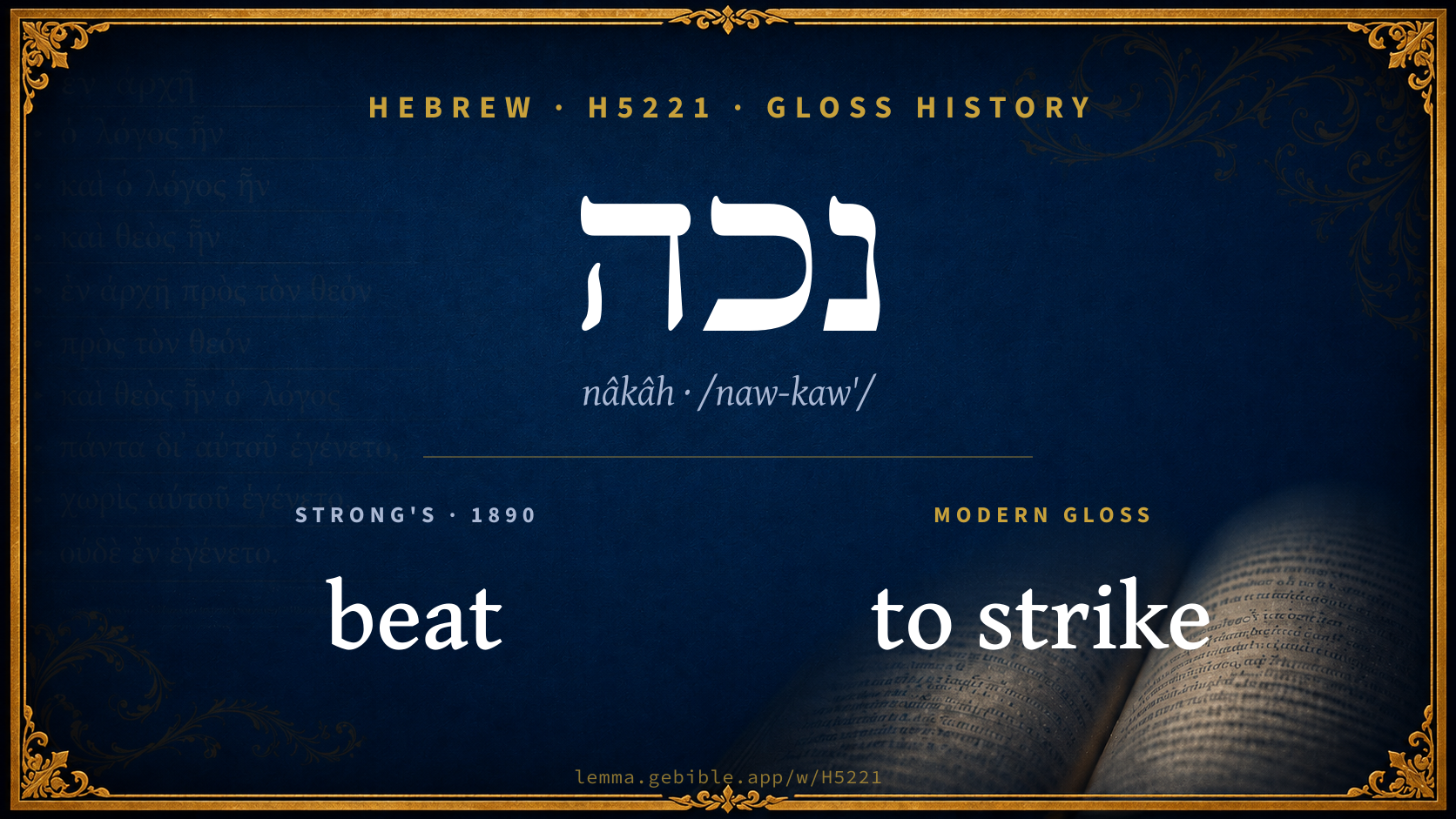
Gloss history
Strong's 1890 vs modern scholarship
About this word
Strong's H5221 catalogs a Hebrew word from the Hebrew Old Testament.
These counts are not copied from any lexicon or concordance. They are computed here, from the morphology-tagged Hebrew Old Testament. What Lemma adds →
- 461
- distinct verses
- The word appears in 461 distinct verses.
- 31 / 39
- OT books
- The word appears in 31 of 39 Old Testament books.
- #100
- by frequency
- Top 100 most frequent Hebrew words (rank 100 of 8,640 Hebrew words by occurrence).
View all 461 occurrences in the concordance →
By section of the Old Testament
By traditional corpus
Conventional, traditional groupings — biblical authorship is debated, so this is a traditional corpus grouping, not an authorship claim. Each share is this word’s portion of its verses in that division of the Hebrew canon. Each figure is a share of the word’s 461 distinct verses.
- Prophets (Nevi'im) 297 verses · 64%
- Torah (Pentateuch) 92 verses · 20%
- Writings (Ketuvim) 72 verses · 16%
How translations render this word
Counts come from each version’s own published word-to-Strong’s tagging or interlinear alignment — an approximate guide to how each version renders this word, not a word-level alignment the data otherwise carries. Because each total is that version’s own tagged count, the per-version totals vary from one another and need not match the appearance or distinct-verse counts above. These counts may also differ from a printed concordance because Lemma counts each distinctly tagged rendering and does not collapse phrase taggings into a single head-word total. This is a fixed set of word-tagged versions (KJV, ASV, BSB, ULT) and does not change with the reading translation you choose elsewhere. Each version’s license is shown beside its name below (and on Sources).
- King James Version: Smote 130×, Slew 41×, Smite 38×
- American Standard Version: Smote 124×, Smite 32×, He smote 25×
- Berean Standard Bible: Struck down 33×, Struck 22×, Strike 18×
- unfoldingWord Literal Text: Struck 68×, He struck 61×, And 50×
King James Version Public Domain
Renders H5221 across 501 tagged occurrences — most commonly:
Plus other, less common renderings. Plus 103 renderings that appear only once — usually multi-word phrases or single function words the recovered tagging swept in, not distinct renderings.
American Standard Version Public Domain
Renders H5221 across 498 tagged occurrences — most commonly:
Plus other, less common renderings. Plus 109 renderings that appear only once — usually multi-word phrases or single function words the recovered tagging swept in, not distinct renderings.
Berean Standard Bible Public Domain
Renders H5221 across 496 tagged occurrences — most commonly:
Plus other, less common renderings. Plus 166 renderings that appear only once — usually multi-word phrases or single function words the recovered tagging swept in, not distinct renderings. Not rendered by a distinct English word in 3 further occurrences.
unfoldingWord Literal Text CC BY-SA 4.0
Renders H5221 across 565 tagged occurrences — most commonly:
Plus other, less common renderings. Plus 105 renderings that appear only once — usually multi-word phrases or single function words the recovered tagging swept in, not distinct renderings.
26 senses and sub-senses in the full BDB
Hebrew verbs can shift meaning by stem (binyan): Qal is the basic action, Niphal is often passive or reflexive, Piel often intensifies or makes it factitive, and Hiphil is typically causative. The senses below are grouped under the stem BDB assigns to each. This entry also uses Pual (the passive of Piel) and Hophal (the passive of Hiphil).
What do BDB’s symbols mean?
BDB uses these scholarly abbreviations:
| Symbol | Meaning |
|---|---|
| 𝔊 | the Septuagint (the ancient Greek translation, LXX) |
| 𝔙 | the Vulgate (the Latin translation) |
| 𝔖 | the Syriac version (the Peshitta) |
| 𝔗 | the Targum (the Aramaic translation) |
| ψ | the Psalms |
| √ | root (the underlying root or stem) |
| ‖ | parallel passage (a synonymous or contrasted parallel) |
| † | the dagger: every passage where the word occurs is cited |
The 26 senses and sub-senses the full Brown-Driver-Briggs lexicon distinguishes for this word, in lexicon order (not ranked by frequency), with BDB’s own verbatim wording and sub-sense lettering. Shown in Hebrew script with BDB’s own scholarly abbreviations. The condensed entry is in the Lexicon Entry tab. See also the Forms in the corpus table below.
Niphal
- Pf. וְנִכָּה וָמֵת consec. 2 S 11:15 and he shall be smitten [struck by weapon in battle] and die. e.g. 2 Samuel 11:15
Pual
- Pf. 3 fs. נֻכָּ֑תָה Ex 9:31; 3 pl. נֻכּוּ v 32 (J), both be smitten down by the hail. e.g. Exodus 9:31
Hiphil
- Pf. 3 ms. הִכָּה Ex 9:25 +; sf. וְהִכַּ֫נִי consec. Gn 32:12, הִכָּם Je 5:6; 2 ms. הִכִּ֫יתָ Ex 17:5 +; 1 s. הִכֵּיתִי Ju 15:16 +, וְהִכֵּיתִ֫י Ex 3:20 +; 3 pl. הִכּוּ Gn 19:11 +; 2 mpl. הִכִּיתֶם Je 37:10 + 3 times consec.; etc.; Impf. 3 ms. יַכֶּה Ex 21:20 +, יַךְ Ho 6:1 (but read וַיַּךְ We Now GASm); וְיַךְ Ho 14:6 (v. infr.); וַיַּכֶּה Jos 10:40 +, usually וַיַּךְ Ex 2:12 +; sf. 2 ms. יַכֶּ֫כָּה Je 40:15 + 2 times, 3 ms. וַיַּכּוֹ 2 S 14:6 (but read וַיַּךְ 𝔊 𝔖 𝔙 Th We Dr Klo Kit Bu HPS), יַכֶּ֫נּוּ 1 S 17:25 + 2 times; usually וַיַּכֵּ֫הוּ Nu 21:24 +; 3 fs. וַתַּךְ Jon 4:7.8; 2 ms. תַּכֶּה Ex 2:13 +; sf. 3 ms. תַּכֶּ֫נּוּ Pr 23:13, 14; 1 s. אַכֶּה 1 S 18:11 +; וָאַכֶּה Ne 13:25, וָאַךְ Ex 9:15; 3 mpl. יַכּוּ Mi 4:14; usually וַיַּכּוּ Gn 14:5 + (1 S 4:2 read prob. Hoph. q.v.); 1 pl. נַכֶּה־ Nu 22:6; וַנַּךְ Dt 2:33, etc.; Imv. הַכֵּה Ez 6:11; הַךְ Am 9:1 +; mpl. הַכּוּ 2 S 13:28, etc.; Inf. abs. הַכֵּה Dt 3:16 +; הַכּוֹת 2 K 3:24 (Ges§ 75 ff); cstr. הַכּוֹת Gn 4:15 +, etc.; Pt. מַכֶּה Ex 2:11 +; cstr. מַכֵּת Ex 21:12 +; pl. מַכִּים 1 S 4:8 +, etc.;— e.g. Exodus 9:25
- 1.
- a. lit., smite (with a single, non-fatal, blow), strike, sq. acc., ass Nu 22:23, 25, 27 (בְּמַקֵּל), v 28, 32 (all J); man Ex 21:15, 19 (E); cheeks Jb 16:10; man (on) cheek (2 acc.) La 3:30 ψ 3:8; man עַל־לְחִי Mi 4:14 (ב instr.), 1 K 22:24 = 2 Ch 18:23; eye Ex 21:26 (E); שֵׁבֶט מַכֵּךְ Is 14:26; with ב obj. Ex 17:6; with (ב) stone or fist Ex 21:18 (E), cf. (fig.) Is 58:4 (abs.); smite lion or bear 1 S 17:35; strike river (with rod מַטֶּה) 7:17 (c. עַל obj., + ב instr.), v 20 Ex 17:5 (E; ב instr.), also (with mantle) 2 K 2:8, 14(×2), cf. י׳ smiting Euphrates into (ל) seven streams Is 11:15; dust Ex 8:12, 13 (P); rock 17:6 (E), Nu 20:11 (P; ב instr.), ψ 78:20; fig. smite earth בְּשֵׁבֶט פִּיו Is 11:4 (of future Davidic kg.); strike on ground (אַ֫רְצָה; with arrows) 2 K 13:18, also (abs.) v 18, 19; strike weapons out of (מִן) hands, Ez 39:3 (י׳; fig. of making powerless); lintel of door Am 9:1; barley-loaf strikes tent Ju 7:13 (in dream); in fig. of regret, remorse וַיַּךְ לֵב דָּוִד אֹתוֹ 2 S 24:10 and David’s heart smote him, so 1 S 24:6 (+ עַל־אֲשֶׁר because); of goat smiting (butting with horn) the ram, so as to break its horns Dn 8:7 (in vision); smite = hit with missile, sling-stone 1 S 17:49 (c. acc. pers. + אֶל־מִצְחוֹ), cf. 2 K 3:25 (but text perhaps corrupt, v. Benz); arrow, 1 K 22:34 = 2 Ch 18:33 (c. acc. pers. + בֵּין), 2 K 9:24 (c. id.); of piercing, הַכּוֹת בַּחֲנִית בְּדָוִד וּבַקִּיר 1 S 19:10 smite with the dart into D. and into the wall, pin D. to the wall, וַיַּךְ אֶת־הַח׳ בַּקִּיר v 10, cf. 18:11, אַכֶּנּוּ בַחֲנִית וּבָאָרֶץ 26:8. e.g. Numbers 22:23
- b. smite repeatedly, beat, a man Ex 2:11, 13 (E), 5:16 (J), Ne 13:25 (מִן partit.), cf. Dt 25:11; here prob. also 1 K 20:35(×2), 37(×2) (הַכֵּה וּפָצֹעַ beating and bruising him); of Assyrian under fig. of task-master Is 10:24; beat a woman so as to bruise her (פָּצַע) Ct 5:7; beat by authority, scourge Je 20:2; 37:15 Dt 25:2, 3 (c. acc. pers. + acc. cogn. מַכָּה רַבָּה), v 3 cf. בִּן הַכּוֹת v 2 i.e. worthy of scourging, bastinado, (cf. Dr); 2 Ch 25:16; Pr 17:10; 19:25; 23:13, 14 (ב instr.); cf. גֵּוִי נָתַתִּי לְמַכִּים Is 50:6; of hail, beat down herbage etc. Ex 9:25(×2) (cf. Pu.). e.g. Exodus 2:11
- c. וַיַּכּוּ כַף 2 K 11:12 and they clapped hands (in applause); elsewhere only Ezek., in mockery; כַּף אֶל־כַּף Ez 21:19, 22; בְּכַפְּךָ 6:11 (‖ רְקַע בְּרַגְלְךָ); acc. כַּפִּי 22:13. e.g. 2 Kings 11:12
- d. give a thrust (with fork) into (ב) pot 1 S 2:14; strike roots Ho 14:6 (in fig., but וַיֵּלְכוּ We Now). e.g. 1 Samuel 2:14
- e. rarely smite (in battle) so as (merely) to wound 2 K 8:28, so (+ acc. cogn. מַכָּה) v 29; 9:15 = 2 Ch 22:6; fig. of י׳’s wounding Isr. Ho 6:1 (opp. חָבַשׁ, bind up), Je 30:14 (c. acc. cogn.). Cf. smite with (ב) the tongue Je 18:18. e.g. 2 Kings 8:28
- f. smite, of sun, etc., c. acc. pers. Is 49:10 ψ 121:6; c. עַל Jon 4:8. e.g. Isaiah 49:10
- 2. Smite fatally:
- a. (subj. man) smite, c. acc., + word of killing (dying):—obj. lion and bear 1 S 17:35; man Ex 21:12, 20 (E), Jos 10:26 (JE), 11:17 (D), 1 S 17:50; 2 S 1:15; 2:31 (מִן partit. + ב among), 4:7; 14:6; 18:15; 21:17; 1 K 16:10; 2 K 12:22; 15:30; 25:21 = Je 52:27, 2 K 25:25 Je 41:2; Nu 35:16, 17, 18, 21 (P; all c. ב instr.); c. acc. + אֶל־חֹמֶשׁ + ב instr. 2 S 2:23 smote him (fatally) in the belly with (v. HPS), 20:10, cf. 3:27 (+ 2 acc.) 4:6 (but del. 𝔊 Ew Th We Dr Bu HPS); וְהִכָּהוּ נֶפֶשׁ Dt 19:11 and he smite him in his life (mortally), and he die, cf. (without word of dying) v 6 Gn 37:21 (J), Je 40:14, 15 [otherwise Lv 24:17.18 Nu 35:11, 15, 30; Dt 27:25; Jos 20:3, 9]; with prolepsis לְהַכּוֹת חֲלָלִים smite the slain Ju 20:31, 39; + אַ֫רְצָה smite to the ground i.e. kill 2 S 2:22; 18:11. e.g. 1 Samuel 17:35
- b. smite, of worm gnawing or boring so as to kill plant Jon 4:7. e.g. Jonah 4:7
- c. very often = kill, slay, man or beast (c. 150 times): Gn 4:15; 8:21 (exterminate; both J), Ex 2:12; Nu 21:35 (E), Jos 7:5 (מִן partit.), v 5 (JE), Dt 19:6; 21:1; 27:24, 25; Jos 11:10 (ב instr.; all D), Lv 24:17, 18, 21(×2) (H), Nu 35:11, 15, 21, 24, 30; Jos 9:18; 20:3, 9 (all P), Ju 15:16; 1 S 17:9(×2), 36; 2 S 12:9 (ב instr.), 2 K 9:7 (exterminate), etc.; c. ב among 1 S 6:19; 23:5, מִן partit. Ju 14:19; 20:45; c. ב partit. slay at, work slaughter among 2 S 23:10 (ins. also in ‖ 1 Ch 11:13 v Bead loc. Dr 2 S 23:10), but also ב of dir. obj. 1 S 18:7; 21:12 = 29:5; subj. lion 1 K 20:36(×2) cf. Je 5:6 (fig. of judgment); י׳ subj. 1 S 6:19b (ב among, + acc. cogn.; 1 S 6:19a וַיַּךְ crpt. v. 𝔊 Th We Dr Kl Kit Bu HPS); slay firstborn Ex 12:12 (J), v 29 Nu 3:13; 8:17; 33:4 (all P), ψ 78:51; 105:36; 135:8; God slays for (עַל) sin 2 S 6:7 = 1 Ch 13:10 (עַל־אֲשֶׁר); slay לְפִי־חֶרֶב Dt 13:16; 20:13 Jos 11:11, 12, 14 (all D), Ju 18:27; 21:10; 1 S 22:9; 2 K 10:25 Je 21:7 Jb 1:15, 17; kill, slay, c. acc. cogn. (מַכָּה) 1 S 14:14; 1 K 20:21 (ב among), 2 Ch 13:17 (בָּחֶם), 25:13 (מֵהֶם); c. acc. pers. + acc. cogn. Jos 10:20 (JE), Est 9:5, etc.; kill unwittingly, unintentionally הִכָּה בִבְלִי דַ֫עַת Dt 19:4; Jos 20:5 (both D). e.g. Genesis 4:15
- 3. Smite = attack, attack and destroy a company Gn 32:9, 12; 34:30; Jos 8:21 Ju 8:11; 9:43; 2 K 8:21; 2 Ch 21:9; attack and capture a city Ju 1:8 v 12 = Jos 15:16 (JE), Jos 7:3; 10:4 (JE), 1 S 30:1; 1 K 15:20 = 2 Ch 16:4, 2 K 15:16(×2) 1 Ch 20:1; 2 Ch 14:13; Je 47:1; tents 1 Ch 4:41; 2 Ch 14:14; = sack a city לְפִי־חֶרֶב (slaying inhab.), Jos 8:24; 19:47 (both JE), 10:28, 30, 32, 35, 37 cf. v 39 (all D), Ju 1:25; 20:37; 2 S 15:14; especially defeat kg. or army (involving often overthrow, pursuit and slaughter),—c. 95 times,—Gn 14:5, 15, 17; Nu 14:45; 21:24 (JE), Jos 8:12; 10:10 (+ acc. cogn.), v 10 (עַד loc.), 11:8(×2) (all JE), Dt 1:4; 2:33; 3:3; 4:46; 7:2; 29:6; Jos 10:33, 40 (ועד—מִן loc.), 12:1, 6, 12; 13:12 (all D); Ju 1:5, 17; 1 S 11:11 (עד temp.), 2 K 13:17 (עַד־כְּלֵּה), 2 K 3:24a + v 24b (where read וַיָּבֹאוּ בוֹא וְהַכּוֹת and they went on defeating), Is 10:20; Je 37:10, etc.; ins. וַיַּךְ or הִכָּה in 2 S 8:13 Th Ke Kit Bu cf. Dr, after 𝔊; c. ב obj. 1 S 14:31; 23:2(×2) (ה loc.—מִן); + לְפִי חֶרֶב Ju 20:48, etc.; of gods causing defeat 2 Ch 28:23; smite land = conquer, subjugate, sometimes ravage, Gn 14:7; Jos 10:40 (D), 1 S 27:9; Je 43:11; 46:13, cf. Is 14:6 (acc. cogn.); subj. י׳ Nu 32:4 (P); of י׳ smiting sea וְהִכָּה בַיָּם גַּלִּים Zc 10:11 (BevJPh. xviii. 35 (1889), 88 proposes גבלים). e.g. Genesis 32:9
- 4. Of God,
- a. smite with (ב) a plague, disease, etc.:—blindness Gn 19:11 (J), 2 K 6:18(×2) cf. Zc 12:4(×2) (symbol.); of Egyptian plagues Ex 3:20; 9:15 (both J), 1 S 4:8, without ב Ex 7:25 (J), 12:13 (P), ψ 136:10 (acc. + בִּבְכוֹרֵיהֶם); other plagues Nu 14:12 (JE), Dt 28:22, 27, 28, 35; 1 S 5:6; 2 S 24:17; Jb 2:7; Am 4:9; Hg 2:17; Mal 3:24; 1 S 5:6, 9; 2 K 19:35 = Is 37:36 (+ ב in); Nu 11:33 (JE; בָּעָם + acc. cogn.); smite vines with (ב) blight ψ 105:33. e.g. Genesis 19:11
- b. smite = chastise, or send judgment upon, usually c. acc., 1 K 14:15; 1 Ch 21:7; Is 5:25; 9:12; 27:7 (הַכְּמַכַּת מַכֵּהוּ הִכָּהוּ), 30:31 (ב instr.) 57:17; 60:10 (opp. רִחַם) Je 2:30; 5:3; 14:9; Ez 32:15 (𝔊 Co זֵרָה scatter); c. עַל punish for, (sin) Lv 26:24 (H). e.g. 1 Kings 14:15
- c. of God’s destroying palaces Am 3:15; 6:11 (2 acc.), cf. Zc 9:4. e.g. Amos 3:15
Hophal
- Pf. הֻכָּה Ho 9:16; Nu 25:14. הוּכָּה ψ 102:5; וְהֻכָּת consec. Ex 22:1; 3 fs. הֻכְּתָה Ez 33:21; 40:1; 1 s. הֻכֵּ֫יתִי Zc 13:6; 3 pl. הֻכּוּ 1 S 5:12; Impf. 3 mpl. וַיּכֻּוּ Ex 5:14; 2 mpl. תֻּכּוּ Is 1:5; Pt. מֻכֶּה Nu 25:14, cstr. מֻכֵּה Is 53:4; f. מֻכָּה Nu 25:15, 18; pl. מֻפִּים Ex 5:16, cstr. מֻכֵּי־ Je 18:21;—be smitten: e.g. Hosea 9:16
- 1. = receive a blow Is 1:5 (Judah under fig. of man). e.g. Isaiah 1:5
- 2. be wounded Zc 13:6. e.g. Zechariah 13:6
- 3. be beaten Ex 5:14, 16 (J). e.g. Exodus 5:14
- 4. be (fatally) smitten + vb. of dying Ex 22:1 (E); be killed, slain Nu 25:14(×2), 15, 18 (c. עַל, for), מֻכֵּי־חֶרֶב Je 18:21 (‖ הֲרֻגֵי מָ֑וֶת); so also (abs.) prob. 1 S 4:2 (read וַיֻּכּוּ 𝔊 𝔖 𝔙 Th Dr Klo Kit, for MT וַיַּכּוּ). e.g. Exodus 22:1
- 5. be attacked and captured, of city Ez 33:21; 40:1. e.g. Ezekiel 33:21
- 6. be smitten with disease (by God) 1 S 5:12; abs., of י׳’s servant Is 53:4. e.g. 1 Samuel 5:12
- 7. be blighted, of plant (in fig.) Ho 9:16 (Ephr.), ψ 102:5 (heart, כָּעֵשֶׂב; both + יָבַשׁ). e.g. Hosea 9:16
Senses from the full Brown-Driver-Briggs lexicon (Brown, Driver, Briggs; Oxford 1906 — public domain), digitized via Sefaria, supplemented by the OpenScriptures HebrewLexicon (CC BY 4.0). Full attribution on Sources.
Word origin
vb. smite (not in Qal) (NH Hiph. id.; Pf. 3 pl. הכו SI 4, Inf. להך[ת] ib. 2; Syriac ܢܟܳܐ, laesit, nocuit, repugnavit; Aph. laesit, vulneravit; Ethiopic ነከየ laesit, nocuit; cf. Arabic نَكَى be defeated, نِكَايَةٌ the inflicting of injury on an enemy Lane3038);—
— Brown-Driver-Briggs (Oxford 1906, public domain), digitized via Sefaria, supplemented by the OpenScriptures HebrewLexicon (CC BY 4.0). See Sources.
Origin: a primitive root
Jastrow Dictionary
A second Hebrew/Aramaic lexicon for comparison, covering Aramaic and post-biblical (Talmudic, Targumic, Midrashic) usage that the biblical-Hebrew BDB does not. Matched by lemma rather than by Strong’s number, so a lemma may carry more than one Jastrow headword (shown separately below), and the entries cover usage well beyond the Bible.
נָכָה
- , v. נכי
נֵכֶה
- crippled, נְכֵה רגלים paralyzed, lame. Yalk. Deut. 933. משל לנ׳ ר׳ וכ׳ like a lame person that disturbed the peace of &c., opp. שָׁלֵם.—Pl. נֵכִים. Pesik. R. s. 13, v. צָלַע.
נְכֹה
- (b. h.) pr. n. m. Pharaoh Necho (II), King of Egypt. Sot. 9ᵃ; a. e.
נכי
- (b. h.) to be lessened.—[Lev. R. s. 33 אלא נכה, some ed., v. אָנָךְ.]
- to deduct. Ḥull. X, 3 ואינו מְנַכֶּה לו וכ׳ and the seller is not bound to allow him a reduction for the priest’s share. B. Bath. VII, 2, sq. יְנַכֶּה he must make an allowance for what there is less than specified in the contract. Num. R. s. 20 (ref. to נכה, ib. XXII, 6) כמי שמְנַכֶּה אחד מכ"ד לסאה as one (purchasing grain) is prepared for a deficiency of one twenty-fourth for each S’ah (allowance for chaff, v. טִינֹּופֶת); Tanḥ. Balak 4 (not למאה); ed. Bub. 6; a. fr.—[Cant. R. to III, 4 שנכה מסנחריב some ed., read שנָכַת, v. נְכִיתָה.]
- 1. to injure, knock, strike. B. Kam. VIII, 1 הִכָּהוּ חייב וכ׳ if he hit him (created a sore), he must pay for curing him. Ib. 3 המַכֶּה את וכ׳ if a person strikes his father &c. Snh. IX, 2 נתכוין להַכֹּותוֹ וכ׳ if he intended to hit him on his loins. Y. Peah I, 16ᵃ bot. (ref. to Ps. CXX, 3, sq.) כל כלי זיין מַכִּין וכ׳ all weapons strike in their place, but this (calumny) strikes at a distance; a. v. fr.—Part. pass. מוּכֶּה; f. מוּכָּה; pl. מוּכִּים, מוּכִּין; מוּכֹּות. Keth. VII, 10, a. fr. מוּכֵּה שהין afflicted with leprosy. Ib. I, 3, a. fr. מוּכַּת עץ one who lost her hymen through an accidentallesion. Par. VIII, 9; Mikv. I, 8, v. מַיִם. e.g. Psalms 120:3
- 2. (trnsf.) to strike, produce sound, play. Yoma I, 7 מַכִּין לפניו באצבע וכ׳ snap their middle-fingers. Arakh. II, 3, v. חָלִיל; a. fr.
A Dictionary of the Targumim, the Talmud Babli and Yerushalmi, and the Midrashic Literature (Marcus Jastrow; London, Luzac, 1903) — Public Domain. Digitized via Sefaria. Digitized via Sefaria. Full attribution on Sources.
Forms in the corpus
The 289 distinct written forms H5221 takes in the Hebrew Bible, most frequent first — each parse links to that stem’s occurrences in the concordance. Hebrew forms include their vowel points and cantillation, so a single lemma takes many written forms.
The 60 most common forms are shown; 229 rarer forms follow in the full concordance.
Same root — word family
Other BDB entries built from the same root as H5221, grouped by Strong’s listed origin. These share a root / origin per the lexicon — not necessarily a shared meaning. Each links to that word’s own entry.
Derived from this word
Compare all same-root words → They share a root, not necessarily a meaning.
Septuagint verse parallels
This word appears in 431 verses that also exist in the Greek Old Testament (Septuagint), out of the 461 Hebrew verses it occurs in. You can read those verses in Greek by switching the Old Testament edition to the Septuagint.
Read these verses in the Septuagint
- Genesis 4:15
- Exodus 2:11
- Leviticus 24:17
- Numbers 3:13
- Deuteronomy 1:4
- Joshua 7:3
- Judges 1:4
- 1 Samuel 2:14
- 2 Samuel 1:1
- 1 Kings 11:15
- 2 Kings 2:8
- 1 Chronicles 4:41
This is a verse-level parallel only — the same verses exist in both the Hebrew and Greek Old Testaments. No word-level Hebrew↔Greek correspondence is claimed: the data carries no such alignment, so no Greek word is shown as this Hebrew word’s translation. Coverage is not total — the Septuagint omits the deuterocanon and renumbers the Psalms, so some Hebrew verses have no direct Greek parallel.