2 Kings 6:21

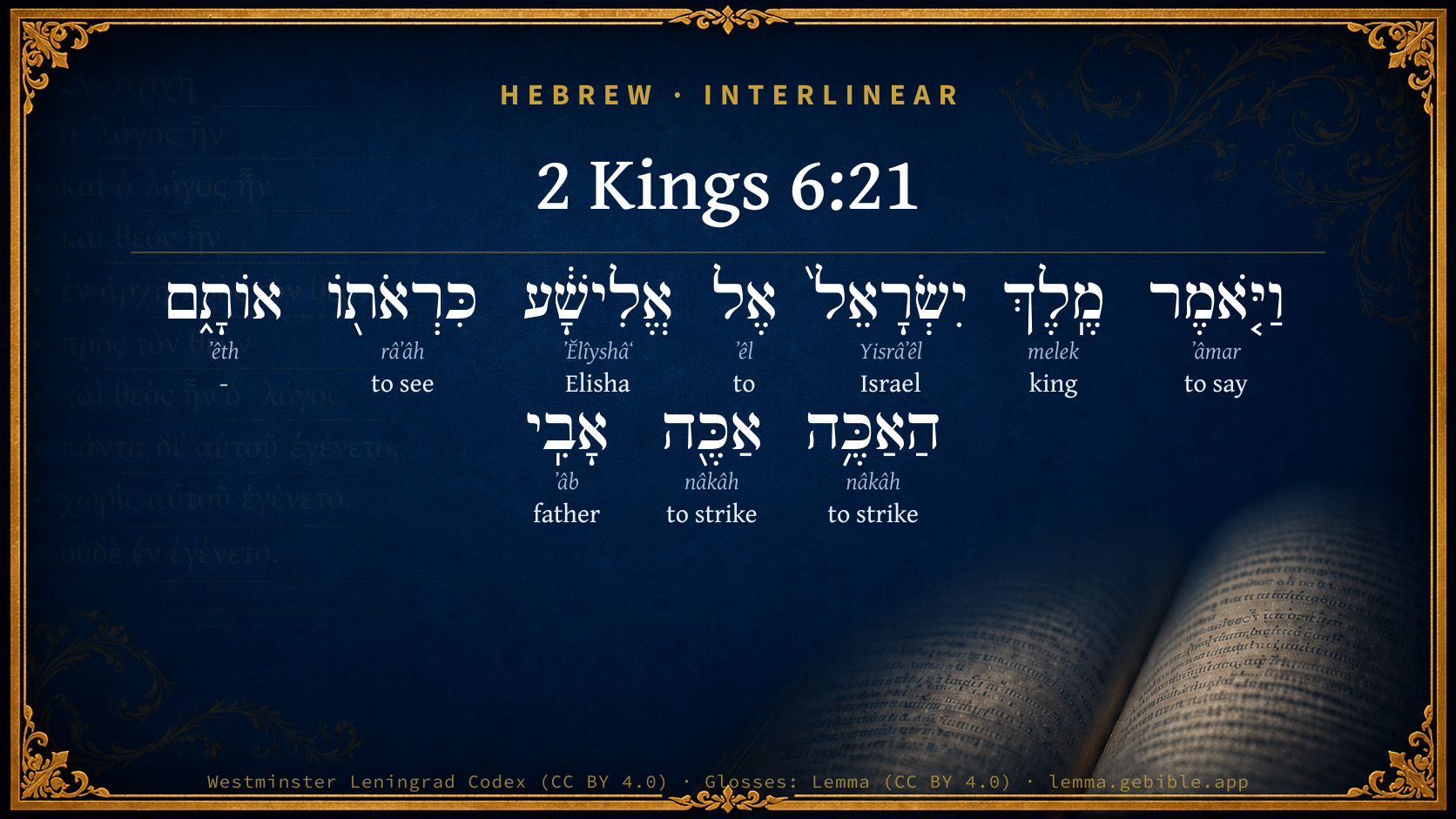
Hebrew (Westminster Leningrad Codex) 2 Kings 6:21 appears in the Hebrew Old Testament. The text above is from the Westminster Leningrad Codex. Each word links to its Strong’s number, a concise gloss, and parsing drawn from the Open Scriptures Hebrew Bible morphology. Click any word for its full Brown-Driver-Briggs (BDB) entry.
Download image
Cite this verse

2 Kings 6:21 (World English Bible). Public Domain. Lemma interlinear Bible study tool, https://lemma.gebible.app/v/2-kings/6/21.

Show BibTeX & RIS
BibTeX
RIS
English Translation
The king of Israel said to Elisha, when he saw them, My father, shall I strike them? shall I strike them?
World English Bible · Public Domain
Download a study sheet

One document with this verse’s original text, its word-by-word gloss line, the meaning frame, cross-references with their text, attributed commentary, and full source and license credits — printable, and it pastes into notes with its structure intact.

This verse Autodidact and up

Study sheet (.html) Plain text (.txt)

A passage Seminary Student

Up to 50 verses in one chapter. A passage sheet keeps up to 6 commentary sources and 12 cross-references per verse, in the order this page ranks them, and says so on the sheet whenever that leaves anything out. Ask for a single verse and you get the Autodidact verse sheet above.

Everything on this page stays free to read, with no account — the sheet is a download of what is already on screen, not access to it.

Want to remove ads? Support Godless Engineer
Compare translations 3

The same verse in 3 English versions, stacked beneath the original-language interlinear above. Click any original word for its lexicon entry.

Each is an independent rendering of the whole verse — the interlinear is not word-aligned to these translations.

Highlighted words mark where these versions differ — a whole-verse word diff, not a word-by-word alignment.

  • World English Bible Public Domain
    The king of Israel said to Elisha, when he saw them, My father, shall I strike them? shall I strike them?
  • King James Version Public Domain
    And the king of Israel said unto Elisha, when he saw them, My father, shall I smite them? shall I smite them?
  • unfoldingWord Literal Text CC BY-SA 4.0
    And the king of Israel said to Elisha when he saw them, “Shall I strike? Shall I strike, my father?”

unfoldingWord Literal Text — © unfoldingWord, licensed CC BY-SA 4.0. Word-aligned USFM3 via Door43 (git.door43.org/unfoldingWord/en_ult).

Versions to compare (up to 4)

3 of 4 selected

Show all 18 translations

Every available English version of this verse, each an independent rendering of the whole verse.

  • World English Bible Public Domain
    The king of Israel said to Elisha, when he saw them, My father, shall I strike them? shall I strike them?
  • Berean Standard Bible Public Domain
    And when the king of Israel saw them, he asked Elisha, “My father, shall I kill them? Shall I kill them?”
  • Majority Standard Bible Public Domain
    And when the king of Israel saw them, he asked Elisha, “My father, shall I kill them? Shall I kill them?”
  • King James Version Public Domain
    And the king of Israel said unto Elisha, when he saw them, My father, shall I smite them? shall I smite them?
  • American Standard Version (1901) Public Domain
    And the king of Israel said unto Elisha, when he saw them, My father, shall I smite them? shall I smite them?
  • Revised Version (1885) Public Domain
    And the king of Israel said unto Elisha, when he saw them, My father; shall I smite them? shall I smite them?
  • Geneva Bible (1599) Public Domain
    And the King of Israel sayde vnto Elisha when he sawe them, My father, shall I smite them, shall I smite them?
  • Douay-Rheims (1899) Public Domain
    And the king of Israel said to Eliseus, when he saw them: My father, shall I kill them?
  • Young's Literal Translation Public Domain
    And the king of Israel saith unto Elisha, at his seeing them, `Do I smite -- do I smite -- my father?'
  • Literal Standard Version CC BY-SA 4.0
    And the king of Israel says to Elisha at his seeing them, “My father, do I strike, do I strike?”
  • Unlocked Literal Bible CC BY-SA 4.0
    The king of Israel said to Elisha, when he saw them, “My father, should I kill them? Should I kill them?”
  • unfoldingWord Literal Text CC BY-SA 4.0
    And the king of Israel said to Elisha when he saw them, “Shall I strike? Shall I strike, my father?”
  • Darby Bible Public Domain
    And the king of Israel said to Elisha, when he saw them, My father, shall I smite? shall I smite [them]?
  • World Messianic Bible Public Domain
    The king of Israel said to Elisha, when he saw them, “My father, shall I strike them? Shall I strike them?”
  • Webster's Bible Public Domain
    And the king of Israel said to Elisha, when he saw them, My father, shall I smite them? shall I smite them?
  • Free Bible Version CC BY-SA 4.0
    When the king of Israel saw them, he asked Elisha, “My father, shall I kill them? Shall I kill them?”
  • Bible in Basic English Public Domain
    And the king of Israel, when he saw them, said to Elisha, My father, am I to put them to the sword?
  • JPS Tanakh (1917) Public Domain
    And the king of Israel said unto Elisha, when he saw them: 'My father, shall I smite them? shall I smite them?'

Literal Standard Version (2020), Covenant Press — licensed CC BY-SA 4.0. Text via the HelloAO Bible API (eBible.org). Unlocked Literal Bible (unfoldingWord) — licensed CC BY-SA 4.0. Text via the HelloAO Bible API (eBible.org). unfoldingWord Literal Text — © unfoldingWord, licensed CC BY-SA 4.0. Word-aligned USFM3 via Door43 (git.door43.org/unfoldingWord/en_ult). Free Bible Version, Dr. Jonathan Gallagher — licensed CC BY-SA 4.0. Text via the HelloAO Bible API (eBible.org).

Word by word

More ways to search: Search by grammar → Find every occurrence → Compare this word →

Practice this passage: Drill this verse → Learn its vocabulary →

About this verse

These counts appear in no published source. They are computed here, from the morphology-tagged text and Lemma’s own curated glosses. What Lemma adds →

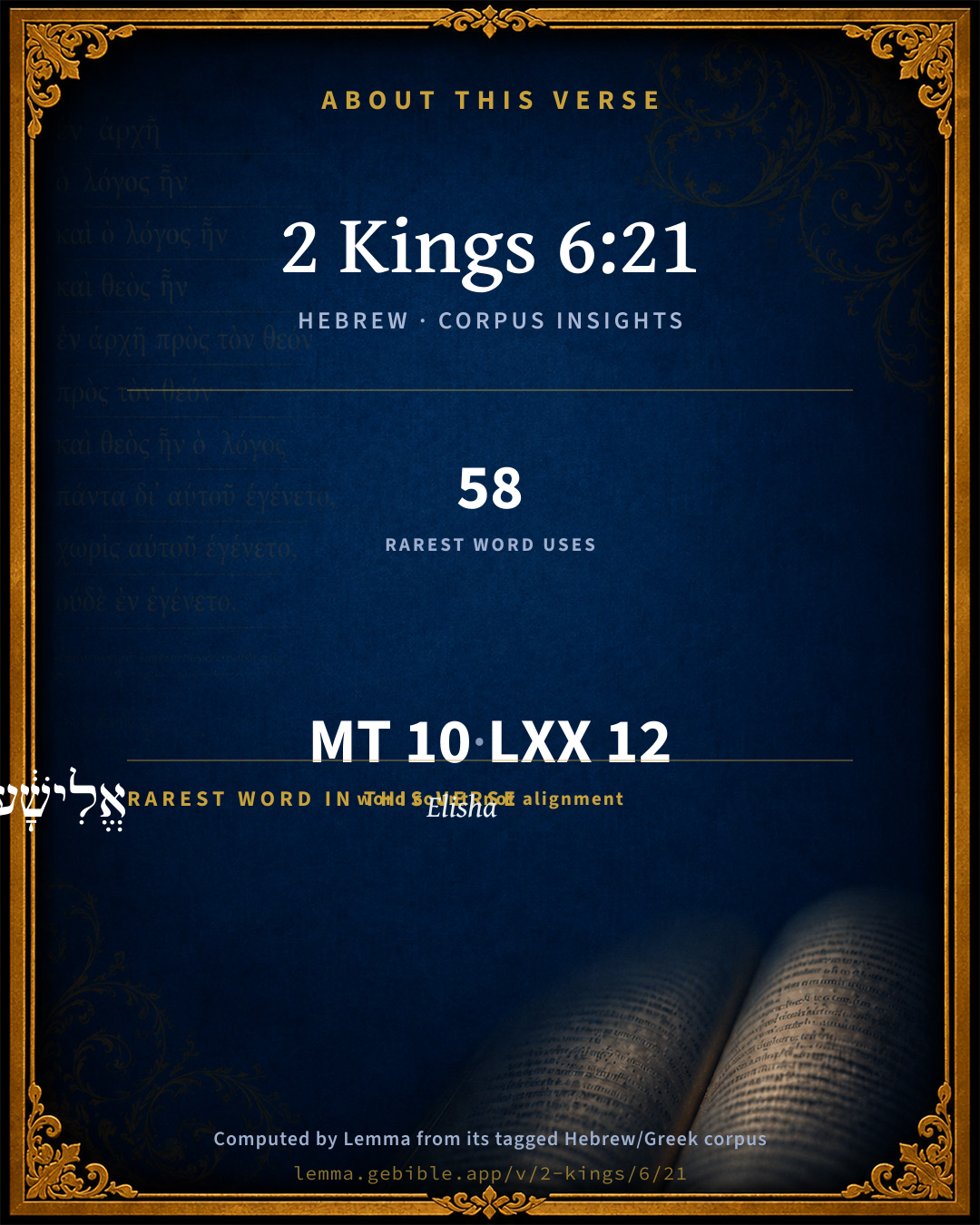
10
words
9
distinct lemmas
Historical
section

Shared distinctive vocabulary

אֱלִישָׁ֔ע Elisha H477 occurs in 52 verses of the Hebrew Bible. Also found in:

Grammatical profile

  • 4 verbs
  • 4 nouns
  • 1 preposition
  • 1 particle

Verb forms

  • וַיֹּ֤אמֶר Qal · Sequential Imperfect
  • כִּרְאֹת֖וֹ Qal · Infinitive Construct
  • הַאַכֶּ֥ה Hiphil · Imperfect
  • אַכֶּ֖ה Hiphil · Imperfect

Repetition

A word recurs within this verse — often emphatic in Hebrew:

  • הַאַכֶּ֥ה to strike H5221 ×2

Hebrew & Septuagint length

In English translation the verse runs 21 words from the Hebrew and 20 from the Septuagint (LXX English) — closely comparable.

A rough comparison of the two English renderings, which tokenize alike — not a word-level alignment.

Word counts can differ between the Hebrew and the Greek without any difference in meaning — e.g. the Hebrew direct-object marker אֵת has no separate Greek word, and Greek often adds the article ὁ.

In the original languages it is 10 Hebrew tokens and 12 Greek tokens — but the two are counted differently (Hebrew bundles its prefixes and suffixes into one token; the Greek is in lemma form), so that isn’t a like-for-like length.

Cross-references

9

Topical passages linked to 2 Kings 6:21 in the Treasury of Scripture Knowledge — connected by theme and wording, ordered by reader-vote popularity; previews shown in the World English Bible.

  • 2 Kings 5:13 His servants came near, and spoke to him, and said, My father, if the prophet had bid you do some great thing, wouldn't you have done it? how much rather then, when he says to you, Wash, and be clean?
  • 2 Kings 8:9 So Hazael went to meet him, and took a present with him, even of every good thing of Damascus, forty camels' burden, and came and stood before him, and said, Your son Benhadad king of Syria has sent me to you, saying, Shall I recover of this sickness?
  • 2 Kings 2:12 Elisha saw it, and he cried, My father, my father, the chariots of Israel and the horsemen of it! He saw him no more: and he took hold of his own clothes, and tore them in two pieces.
  • 1 Samuel 24:4 The men of David said to him, Behold, the day of which Yahweh said to you, Behold, I will deliver your enemy into your hand, and you shall do to him as it shall seem good to you. Then David arose, and cut off the skirt of Saul's robe secretly.
  • 1 Samuel 24:19 For if a man finds his enemy, will he let him go away unharmed? Therefore may Yahweh reward you good for that which you have done to me this day.
  • 1 Samuel 26:8 Then said Abishai to David, God has delivered up your enemy into your hand this day: now therefore please let me strike him with the spear to the earth at one stroke, and I will not strike him the second time.
  • 2 Kings 13:14 Now Elisha was fallen sick of his sickness of which he died: and Joash the king of Israel came down to him, and wept over him, and said, My father, my father, the chariots of Israel and the horsemen of it!
  • Luke 9:54–56 When his disciples, James and John, saw this, they said, "Lord, do you want us to command fire to come down from the sky, and destroy them, just as Elijah did?"
  • Luke 22:49 When those who were around him saw what was about to happen, they said to him, "Lord, shall we strike with the sword?"

Cross-references courtesy of OpenBible.info (CC BY 4.0).

Hebrew and Greek witnesses Masoretic Hebrew ↔ Greek Septuagint

The same verse in the two great witnesses to the Old Testament, shown verse-for-verse.

These are two independent witnesses, not word-aligned to each other, and the Septuagint is shown in lemma (dictionary) form.

Hebrew 2 Kings 6:21 Masoretic · Westminster Leningrad Codex

וַיֹּ֤אמֶר מֶֽלֶךְ יִשְׂרָאֵל֙ אֶל אֱלִישָׁ֔ע כִּרְאֹת֖וֹ אוֹתָ֑ם הַאַכֶּ֥ה אַכֶּ֖ה אָבִֽי

The king of Israel said to Elisha, when he saw them, My father, shall I strike them? shall I strike them?

World English Bible · Public Domain

Greek LXX 2 Kings 6:21 Septuagint · lemma form

καί εἶπον ὁ βασιλεύς ἰσραήλ ὡς ὁράω αὐτός εἰ πατάσσω πατάσσω πατήρ

And the king of Israel said to Elisaie, when he saw them, Shall I not verily strike them, my father?

LXX2012 (modern English Septuagint) · Public Domain

Hebrew: Westminster Leningrad Codex (CC BY 4.0). Greek: Septuagint (public domain); English from LXX2012 (modern English Septuagint) (Public Domain). How the Septuagint differs from the Hebrew →

Targum (Aramaic paraphrase)

1

The Targum is the ancient Jewish Aramaic paraphrase of the Hebrew Scriptures — an interpretive translation, not the Hebrew text itself. Onkelos (literal) and Pseudo-Jonathan (expansive) render the Torah, and Jonathan the Prophets. Coverage is partial: where no permissively-licensed English translation exists for a verse, only the Aramaic is shown. This is verse-level text, not a word-by-word alignment to the Hebrew.

  1. Targum Jonathan Prophets (Joshua–Malachi)
    וַאֲמַר מַלְכָּא דְיִשְׂרָאֵל לֶאֱלִישָׁע כַּד חֲזָא יַתְהוֹן הֲמִקְטוֹל אֶקְטוֹל רַבִּי:

    (no public-domain English translation for this verse)

    Targum Jonathan — Aramaic: “Mikraot Gedolot” (public domain). English: “Sefaria Community Translation” (CC0 1.0 (public-domain dedication)); “London "Chaldee Paraphrase," 1871” (public domain). Text via Sefaria.

Commentary

Notes on 2 Kings 6:21 from classic Christian and Jewish commentators (each source and its license shown beneath its notes). The classic Christian expositions comment on the surrounding passage and are grouped to its opening verse, so a note may address several verses; the Jewish commentaries on the Tanakh (Rashi and others) are per-verse, so they appear only where the commentator wrote on this verse.

Lemma curates 59 commentaries, every one of them public domain or Creative Commons licensed, each selected and text-cleaned for this edition rather than reprinted as found. About our sources →

Trapp's Complete Commentary

John Trapp

2Ki 6:21 And the king of Israel said unto Elisha, when he saw them, My father, shall I smite [them]? shall I smite [them]?

Ver. 21. My father, shall I smite them?] He calleth the prophet, "My father," either in a compliment, as Jer 3:4, or else in a sudden pang, which was soon over. See 2Ki 6:31.

John Trapp, A Commentary or Exposition upon All the Books of the Old and New Testament (1647–1656) — public domain. Text from a community e-Sword module.

Joseph Benson's Commentary

2Ki 6:21-22. Shall I smite them? shall I smite them? — This repetition of the question shows his eager desire to fall upon them and kill them. Perhaps he remembered how God was displeased at his father for dismissing out of his hands those whom he had put it into his power to destroy, and he would not offend in like manner: yet such reverence has he now for the prophet, that he will not lift a hand against them without his permission. He answered, Thou shall not smite them — It is against the laws of humanity to kill captives, though thou thyself hadst taken them with thy own sword and bow, which might seem to give thee some colour to destroy them; but much more unworthy will it be in cold blood to kill these, whom not thy arms, but God’s providence hath put into thy hands. Set bread before them — Give them meat and drink, which may refresh and strengthen them for their journey. This was an action of singular piety and charity, in doing good to their enemies, which was much to the honour of the true religion, and of no less prudence; that hereby the hearts of the Syrians might be mollified toward the Israelites. Elijah had given a specimen of divine justice, when he called for flames of fire on the heads of his persecutors to consume them: but Elisha here gave a specimen of divine mercy, in heaping coals of fire on the heads of his persecutors to melt them.

Joseph Benson's Commentary on the Old and New Testaments (1811–1818) — public domain. Text from a community e-Sword module.

Tyndale Open Study Notes

Tyndale Open Resources

6:21 My father: Elisha had used this term of respect when addressing Elijah (2:12), as had Naaman’s servant when speaking to his master (5:13).

Tyndale Open Study Notes — © Tyndale Open Resources, licensed CC BY-SA 4.0. Text via the HelloAO Bible API.

Geneva Bible (1599)

Geneva Bible translators

The wicked use reverent and grave words toward the servants of God, when they think to have any commodity by them, though in their heart they cannot abide them.

Geneva Bible (1599) marginal notes — public domain. Text via Bolls.life.

Adam Clarke's Commentary

Verse 21. My father, shall I smite] This was dastardly; the utmost he could have done with these men, when thus brought into his hand, was to make them prisoners of war.

Adam Clarke's Commentary on the Bible (1810–1826) — public domain. Text from a community e-Sword/MySword module.

Ellicott's Commentary for English Readers

(21) My father.—Comp. 2Ki_2:12; 2Ki_8:9 (“Thy son Ben-hadad”), 2Ki_13:14.

Shall I smite them,? shall I smite them?—Or, May I smite? may I smite, my father? The repetition expresses the king’s eagerness to slay his powerless enemies. He asks the prophet’s permission. (Comp. 2Ki_4:7.)

A Bible Commentary for English Readers, edited by Charles John Ellicott (1878–1897) — public domain. Text from a community e-Sword module.

The Cambridge Bible for Schools and Colleges

gen. ed. J. J. S. Perowne

21. My father] The form of address is strange from the mouth of the king even though he be described (2Ki_3:2) as better than his father and his mother. It is however one more token of the great influence exercised in Israel by the prophets Elijah and Elisha. In the present instance Jehoram could hardly undertake to smite the prisoners brought into his hands by the prophet without Elisha’s consent, though his repeated question ‘Shall I smite them? Shall I smite them?’ shews how eager he was to destroy them.

The Cambridge Bible for Schools and Colleges (gen. ed. J. J. S. Perowne; Cambridge University Press, 1878–1918) — public domain. Text from a community e-Sword module.

John Gill's Exposition

And he prepared great provision for them,.... Or a great feast, as the Targum; so obedient was he to the prophet's orders:

and when they had eaten and drank; and refreshed themselves, which they needed, having marched all night and that morning from place to place:

he sent them away; that is, the king of Israel dismissed them:

and they went to their master; the king of Syria, but without the prophet Elisha they were sent to fetch:

so the bands of Syria came no more into the land of Israel; not as yet, or for some time; or rather the sense is, that the Syrians came not any more in small bodies, as troops of robbers making excursions, and carrying off booty in a private manner, and by surprise; but afterwards came with a large army in an open hostile manner, as follows.

John Gill's Exposition of the Whole Bible (1746–1763) — public domain (CC PDM 1.0). Text via the HelloAO Bible API.

Albert Barnes' Notes on the Bible

My father - A term of respect used by Jehoram in his joy at seeing an army of Syrians delivered up to him by the prophet. That the king’s character was not changed appears from 2Ki 6:31-32.

Shall I smite them? shall I smite them? - The repetition of the words mean, “Shall I utterly smite them?” Compare similar repetitions with similar meanings in Gen 22:17; Luk 22:15.

Albert Barnes' Notes on the Bible (1834–1885) — public domain. Text from a community e-Sword/MySword module.

Matthew Poole's English Annotations

Elisha had doubtless sent notice of his intentions to

the king of Israel, that he might accordingly prepare himself.

My father: now he gives him this title of reverence and affection, because of a great and present benefit he received from him; though otherwise he hated him, and would not hearken to his counsel.

Shall I smite them? the repetition of the question shows his great desire to smite them, and that with utter destruction.

Matthew Poole's English Annotations on the Holy Bible (1683–1685) — public domain. Text from a community e-Sword/MySword module.

Whedon's Commentary on the Bible

Daniel D. Whedon

21. Shall I smite them — Perhaps this question was prompted by the remembrance of Ahab’s great mistake in not smiting the king of Syria when he had him in his power, and for which mistake he was so sternly rebuked by one of the prophets. 1Ki_20:35-43.

Daniel D. Whedon (gen. ed.), Commentary on the Old and New Testaments (1874–1909) — public domain. Text from a community e-Sword module.

The Pulpit Commentary

And the King of Israel said unto Elisha, when he saw them, My father. In his joy at the deliverance of so large a force of the enemy into his hands, Jehoram forgets the coldness and estrangement which have hitherto characterized the relations between himself and the prophet, (2Ki_3:11-14 2Ki_5:8) and salutes him by the honorable title of "father," which implied respect, deference, submission. Compare the use of the same expression by Joash, (2Ki_13:14) and the employment of the correlative term "son" (2Ki_8:9) by Berthadad. Shall I smite them? shall I smite them? The repetition marks extreme eagerness, while the interrogative form shows a certain amount of hesitation. It is certain that the Israelites were in the habit of putting to death their prisoners of war, not only when they were captured with arms in their hands, but even when they surrendered themselves. When a city or country was conquered, the whole male population of full age was commonly put to death (Num_31:7; 1Sa_15:8; 1Ki_11:15; 1Ch_20:3, etc.) When a third part was spared, it was from some consideration of relationship. (2Sa_8:2) The Law distinctly allowed, if it did not even enjoin, the practice. (Deu_20:13) Jehoram, therefore, no doubt, put his prisoners of war to death under ordinary circumstances. But he hesitates now. He feels that the ease is an extraordinary one, and that the prophet, who has made the capture, is entitled to be consulted on the subject. Hence his question.

The Pulpit Commentary (1880–1919), ed. H.D.M. Spence-Jones & Joseph S. Exell — public domain. Text from a community e-Sword module.

Keil & Delitzsch

C. F. Keil & F. Delitzsch

Elisha forbade king Joram to slay the enemy that he had brought to him, because he had not taken them prisoners in war, and recommended him to treat them hospitably and then let them return to their lord. The object of the miracle would have been frustrated if the Syrians had been slain. For the intention was to show the Syrians that they had to do with a prophet of the true God, against whom no human power could be of any avail, that they might learn to fear the almighty God. Even when regarded from a political point of view, the prophet's advice was more likely to ensure peace than the king's proposal, as the result of Kg2 6:23 clearly shows. The Syrians did not venture any more to invade the land of Israel with flying parties, from fear of the obvious protection of Israel by its God; though this did not preclude a regular war, like that related in the following account. For אבי see the Comm. on Kg2 5:13. וגו שׁבית האשׁר: "art thou accustomed to slay that which thou hast taken captive with sword and bow?" i.e., since thou dost not even slay those whom thou hast made prisoners in open battle, how wouldst thou venture to put these to death? כּרה להם יכרה, he prepared them a meal. כּרה is a denom. from כּרה, a meal, so called from the union of several persons, like coena from κοινή (vid., Dietr. on Ges. Lex. s. v. כרה).

Keil & Delitzsch — Biblical Commentary on the Old Testament (1861–1891) — public domain (CC PDM 1.0). Text via the HelloAO Bible API. (Old Testament only.)

Lesson kit

Teaching starters — assembled from the data on this page, not authored interpretation. Every prompt links to the verse data it draws on. Edit before teaching.

2 Kings, in the Historical, opens this verse with 10 words (9 distinct Hebrew lemmas). Its most distinctive word is ʼĔlîyshâʻ (“Elisha”). A historical commentator’s framing appears above. Read the whole chapter for the surrounding context.

Discussion questions

  1. What does “Elisha” (ʼĔlîyshâʻ) contribute to the verse as a whole?
  2. How does 1 Kings 19:16, which shares the word «Elisha», read alongside this verse?
  3. What does the repetition of “to strike” (2× in this one verse) do in this verse?
  4. These translations render this verse differently; the difference is in the English rendering, not the original. What questions does that raise?
  5. «וַיֹּ֤אמֶר» is a Qal Sequential Imperfect verb. How does that grammatical form shape the action described?
  6. Compare how Trapp's Complete Commentary and Joseph Benson's Commentary read this verse. Where do they agree or differ?

Things to notice

Reading settings

Reading text

Shown beneath each verse's original-language words.

Old Testament
Old Testament edition

Read the OT as the Masoretic Hebrew (MT) or the Greek Septuagint (LXX).

English shown for the Greek Septuagint (in the Hebrew ↔ Greek comparison).

Comparing translations? Open the Compare panel on any verse page to stack up to four side by side.