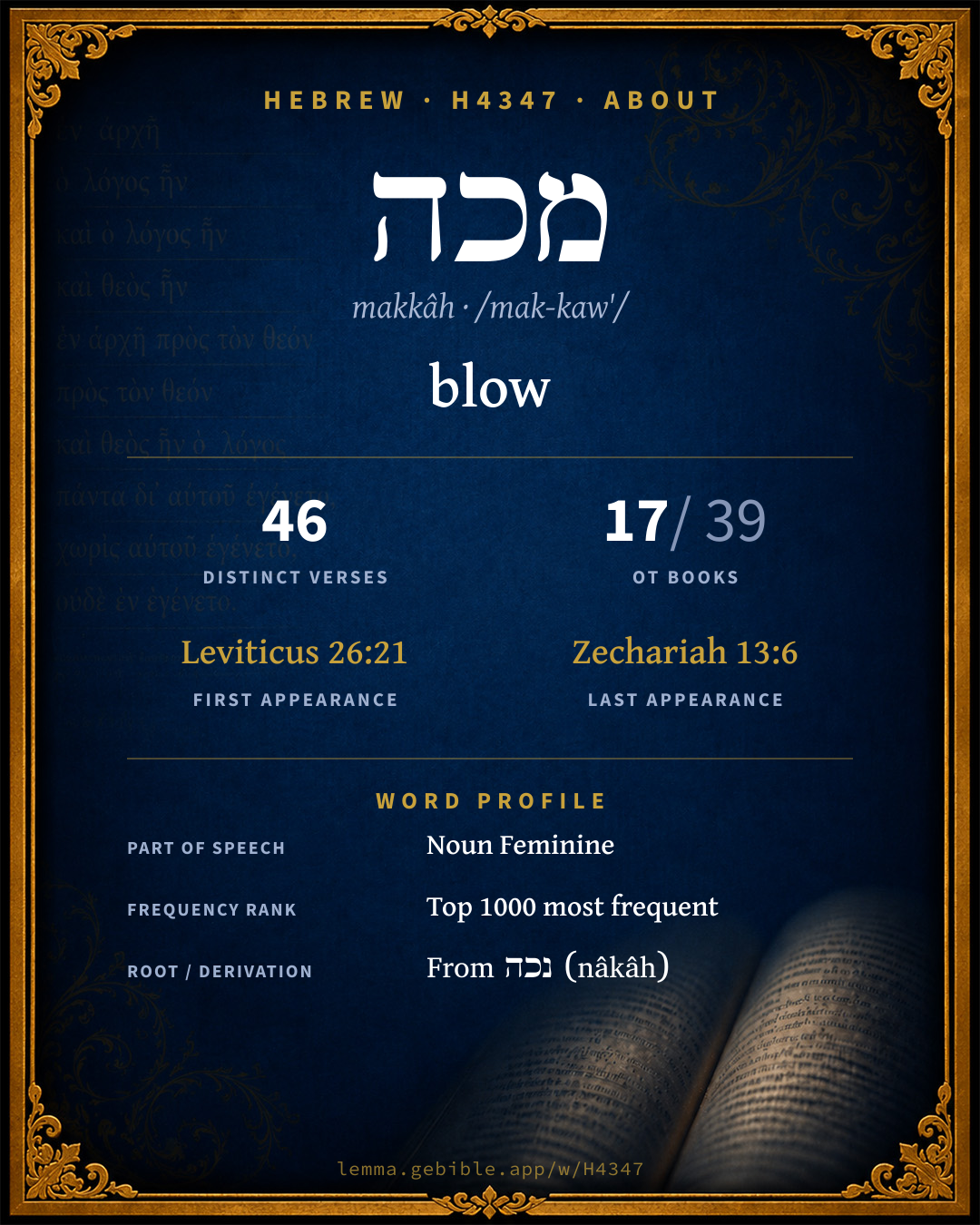
מַכָּה
blow
also: wound, slaughter fuller range ↓
Full lexicon entry — Brown-Driver-Briggs (BDB)
From Brown-Driver-Briggs (BDB)
Where this word appears
See every Absolute-state word in the Hebrew Bible →
Grammar key — what these labels mean
Part of speech
- Noun
- A naming word — a person, place, thing, or idea.
Noun type
- Common
- A common noun — a general class of person, place, or thing (“king,” “city,” “water”), not a specific name.
State
- Absolute
- The independent form of a noun, not bound to a following word.
- Construct
- A noun bound to a following noun in a possessive / “of” relationship (the construct chain).
Gender
- Feminine
- Grammatically feminine.
Number
- Singular
- One.
- Plural
- More than one (in Hebrew, generally three or more).
Grammatical forms
- Noun, Common, Feminine, Singular, Absolute 22 times (46%)
- Noun, Common, Feminine, Plural, Construct 10 times (21%)
- Noun, Common, Feminine, Singular, Construct 10 times (21%)
- Noun, Common, Feminine, Plural, Absolute 6 times (13%)
Parsed forms decoded from the imported morphology (morphhb / Westminster Leningrad Codex — WLC text public domain, morphhb tagging CC BY 4.0), counted across 48 parsed occurrences — not distinct verses.
Every verse where H4347 appears — 46 distinct verses across 17 books. Click any verse to open its interlinear word-by-word view. Verse text shown in the World English Bible for context — . Each verse’s Hebrew form is shown with its reference; the English is not keyword-highlighted, since the data carries no word-level English alignment. Use “Compare translations” on any verse to read it across multiple English versions. This concordance covers the Hebrew Bible; Septuagint (Greek Old Testament) occurrences are not indexed here.
Leviticus 1 verse
Numbers 1 verse
Deuteronomy 4 verses
- Deuteronomy 25:3 מַכָּ֣ה n c fs Forty stripes he may give him, he shall not exceed; lest, if he should exceed, and beat him above these with many stripes, then your brother should seem vile to you.
- Deuteronomy 28:59 מַכֹּ֣תְ/ךָ֔ מַכּ֣וֹת מַכּ֤וֹת n c fp cs + sfx pers 2ms n c fp cs n c fp then Yahweh will make your plagues wonderful, and the plagues of your seed, even great plagues, and of long continuance, and sore sicknesses, and of long continuance.
- Deuteronomy 28:61 מַכָּ֔ה n c fs Also every sickness, and every plague, which is not written in the book of this law, them will Yahweh bring on you, until you are destroyed.
- Deuteronomy 29:22 מַכּ֞וֹת n c fp cs The generation to come, your children who shall rise up after you, and the foreigner who shall come from a far land, shall say, when they see the plagues of that land, and the sicknesses with which Yahweh has made it sick;
Joshua 2 verses
- Joshua 10:10 מַכָּֽה n c fs Yahweh confused them before Israel, and he killed them with a great slaughter at Gibeon, and chased them by the way of the ascent of Beth Horon, and struck them to Azekah, and to Makkedah.
- Joshua 10:20 מַכָּ֥ה n c fs It happened, when Joshua and the children of Israel had made an end of killing them with a very great slaughter, until they were consumed, and the remnant which remained of them had entered into the fortified cities,
Judges 2 verses
- Judges 11:33 מַכָּ֖ה n c fs He struck them from Aroer until you come to Minnith, even twenty cities, and to Abelcheramim, with a very great slaughter. So the children of Ammon were subdued before the children of Israel.
- Judges 15:8 מַכָּ֣ה n c fs He struck them hip and thigh with a great slaughter: and he went down and lived in the cleft of the rock of Etam.
1 Samuel 7 verses
- 1 Samuel 4:8 מַכָּ֖ה n c fs Woe to us! who shall deliver us out of the hand of these mighty gods? these are the gods that struck the Egyptians with all manner of plagues in the wilderness.
- 1 Samuel 4:10 הַ/מַּכָּ֖ה ptcl def.art + n c fs The Philistines fought, and Israel was struck, and they fled every man to his tent: and there was a very great slaughter; for there fell of Israel thirty thousand footmen.
- 1 Samuel 6:19 מַכָּ֥ה n c fs He struck of the men of Beth-shemesh, because they had looked into the ark of Yahweh, he struck of the people fifty thousand seventy men; and the people mourned, because Yahweh had struck the people with a great slaughter.
- 1 Samuel 14:14 הַ/מַּכָּ֣ה ptcl def.art + n c fs That first slaughter, which Jonathan and his armor bearer made, was about twenty men, within as it were half a furrow's length in an acre of land.
- 1 Samuel 14:30 מַכָּ֖ה n c fs How much more, if haply the people had eaten freely today of the spoil of their enemies which they found? for now has there been no great slaughter among the Philistines.
- 1 Samuel 19:8 מַכָּ֣ה n c fs There was war again: and David went out, and fought with the Philistines, and killed them with a great slaughter; and they fled before him.
- 1 Samuel 23:5 מַכָּ֣ה n c fs David and his men went to Keilah, and fought with the Philistines, and brought away their cattle, and killed them with a great slaughter. So David saved the inhabitants of Keilah.
1 Kings 2 verses
- 1 Kings 20:21 מַכָּ֥ה n c fs The king of Israel went out, and struck the horses and chariots, and killed the Syrians with a great slaughter.
- 1 Kings 22:35 הַ/מַּכָּ֖ה ptcl def.art + n c fs The battle increased that day: and the king was stayed up in his chariot against the Syrians, and died at even; and the blood ran out of the wound into the bottom of the chariot.
2 Kings 2 verses
- 2 Kings 8:29 הַ/מַּכִּים֙ ptcl def.art + n c fp King Joram returned to be healed in Jezreel of the wounds which the Syrians had given him at Ramah, when he fought against Hazael king of Syria. Ahaziah the son of Jehoram king of Judah went down to see Joram the son of Ahab in Jezreel, because he was sick.
- 2 Kings 9:15 הַ/מַּכִּים֙ ptcl def.art + n c fp but king Joram was returned to be healed in Jezreel of the wounds which the Syrians had given him, when he fought with Hazael king of Syria.) Jehu said, If this be your mind, then let none escape and go forth out of the city, to go to tell it in Jezreel.
2 Chronicles 4 verses
- 2 Chronicles 2:10 מַכּ֜וֹת n c fp Behold, I will give to your servants, the cutters who cut timber, twenty thousand measures of beaten wheat, and twenty thousand measures of barley, and twenty thousand baths of wine, and twenty thousand baths of oil.
- 2 Chronicles 13:17 מַכָּ֣ה n c fs Abijah and his people killed them with a great slaughter: so there fell down slain of Israel five hundred thousand chosen men.
- 2 Chronicles 22:6 הַ/מַּכִּים֙ ptcl def.art + n c fp He returned to be healed in Jezreel of the wounds which they had given him at Ramah, when he fought against Hazael king of Syria. Azariah the son of Jehoram king of Judah went down to see Jehoram the son of Ahab in Jezreel, because he was sick.
- 2 Chronicles 28:5 מַכָּ֥ה n c fs Therefore Yahweh his God delivered him into the hand of the king of Syria; and they struck him, and carried away of his a great multitude of captives, and brought them to Damascus. He was also delivered into the hand of the king of Israel, who struck him with a great slaughter.
Esther 1 verse
Psalms 1 verse
Proverbs 1 verse
Isaiah 5 verses
- Isaiah 1:6 וּ/מַכָּ֣ה conj + n c fs From the sole of the foot even to the head there is no soundness in it: Wounds, welts, and open sores. They haven't been closed, neither bandaged, neither soothed with oil.
- Isaiah 10:26 כְּ/מַכַּ֥ת prep + n c fs cs Yahweh of Hosts will stir up against him a scourge, as in the slaughter of Midian at the rock of Oreb: and his rod will be over the sea, and he will lift it up after the manner of Egypt.
- Isaiah 14:6 מַכַּ֖ת n c fs cs who struck the peoples in wrath with a continual stroke, who ruled the nations in anger, with a persecution that none restrained.
- Isaiah 27:7 הַ/כְּ/מַכַּ֥ת ptcl inter + prep + n c fs cs Has he struck them as he struck those who struck them? or are they slain according to the slaughter of those who were slain by them?
- Isaiah 30:26 מַכָּת֖/וֹ n c fs cs + sfx pers 3ms Moreover the light of the moon shall be as the light of the sun, and the light of the sun shall be sevenfold, as the light of seven days, in the day that Yahweh binds up the hurt of his people, and heals the stroke of their wound.
Jeremiah 10 verses
- Jeremiah 6:7 וּ/מַכָּֽה conj + n c fs As a well casts forth its waters, so she casts forth her wickedness: violence and destruction is heard in her; before me continually is sickness and wounds.
- Jeremiah 10:19 מַכָּתִ֑/י n c fs cs + sfx pers 1cs Woe is me because of my hurt! my wound is grievous: but I said, Truly this is [my] grief, and I must bear it.
- Jeremiah 14:17 מַכָּ֖ה n c fs You shall say this word to them, Let my eyes run down with tears night and day, and let them not cease; for the virgin daughter of my people is broken with a great breach, with a very grievous wound.
- Jeremiah 15:18 וּ/מַכָּתִ֖/י conj + n c fs cs + sfx pers 1cs Why is my pain perpetual, and my wound incurable, which refuses to be healed? will you indeed be to me as a deceitful [brook], as waters that fail?
- Jeremiah 19:8 מַכֹּתֶֽ/הָ n c fp cs + sfx pers 3fs I will make this city an astonishment, and a hissing; everyone who passes thereby shall be astonished and hiss because of all the plagues of it.
- Jeremiah 30:12 מַכָּתֵֽ/ךְ n c fs cs + sfx pers 2fs For thus says Yahweh, Your hurt is incurable, and your wound grievous.
- Jeremiah 30:14 מַכַּ֨ת n c fs cs All your lovers have forgotten you; they don't seek you: for I have wounded you with the wound of an enemy, with the chastisement of a cruel one, for the greatness of your iniquity, because your sins were increased.
- Jeremiah 30:17 וּ/מִ/מַּכּוֹתַ֥יִ/ךְ conj + prep + n c fp cs + sfx pers 2fs For I will restore health to you, and I will heal you of your wounds, says Yahweh; because they have called you an outcast, [saying], It is Zion, whom no man seeks after.
- Jeremiah 49:17 מַכּוֹתֶֽ/הָ n c fp cs + sfx pers 3fs Edom shall become an astonishment: everyone who passes by it shall be astonished, and shall hiss at all the plagues of it.
- Jeremiah 50:13 מַכּוֹתֶֽי/הָ n c fp cs + sfx pers 3fs Because of the wrath of Yahweh she shall not be inhabited, but she shall be wholly desolate: everyone who goes by Babylon shall be astonished, and hiss at all her plagues.
Micah 1 verse
Nahum 1 verse
Zechariah 1 verse
About this entry
At a glance — auto-summarized from this page’s data, not written by a person. Every figure links to its source below. This summary describes the numbers; it doesn’t interpret them.
The Hebrew noun מכה centers on the idea of “blow.” Its English rendering has broadened — “slaughter” classically, “wounds” (Berean Standard Bible) and “striking” (unfoldingWord Literal Text) in modern versions; see the renderings breakdown. The Hebrew Bible uses it across 46 verses — moderately common. Its earliest occurrence is Leviticus 26:21. Alongside “blow” the lexicon also lists “wound” and “slaughter” — part of its full sense range. For the data behind this summary, explore the sense tree and the renderings breakdown below.
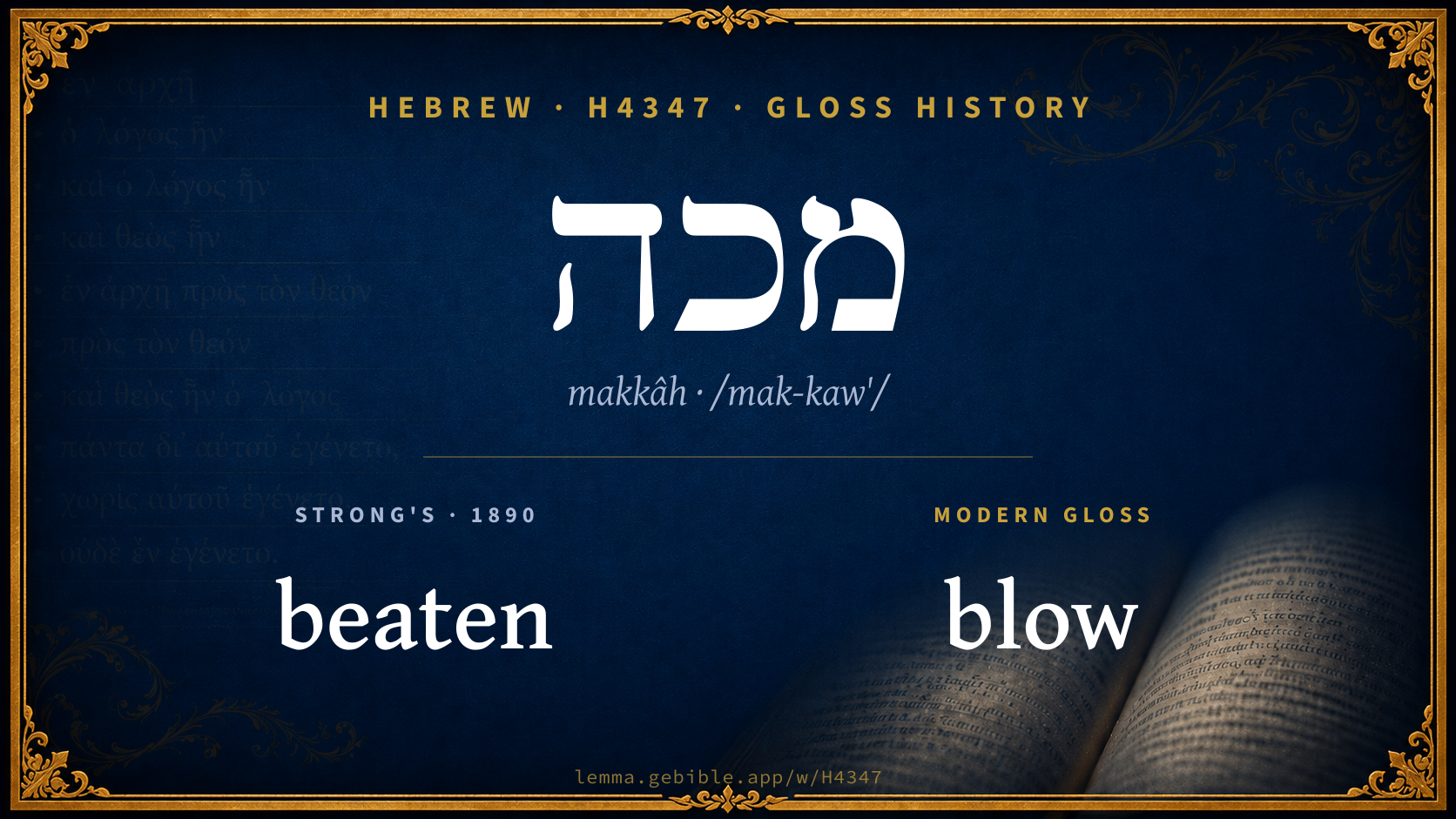
Gloss history
Strong's 1890 vs modern scholarship
About this word
Strong's H4347 catalogs a Hebrew word from the Hebrew Old Testament.
These counts are not copied from any lexicon or concordance. They are computed here, from the morphology-tagged Hebrew Old Testament. What Lemma adds →
- 46
- distinct verses
- The word appears in 46 distinct verses.
- 17 / 39
- OT books
- The word appears in 17 of 39 Old Testament books.
- #767
- by frequency
- Top 1000 most frequent Hebrew words (rank 767 of 8,640 Hebrew words by occurrence).
View all 46 occurrences in the concordance →
By section of the Old Testament
By traditional corpus
Conventional, traditional groupings — biblical authorship is debated, so this is a traditional corpus grouping, not an authorship claim. Each share is this word’s portion of its verses in that division of the Hebrew canon. Each figure is a share of the word’s 46 distinct verses.
- Prophets (Nevi'im) 33 verses · 72%
- Writings (Ketuvim) 7 verses · 15%
- Torah (Pentateuch) 6 verses · 13%
How translations render this word
Counts come from each version’s own published word-to-Strong’s tagging or interlinear alignment — an approximate guide to how each version renders this word, not a word-level alignment the data otherwise carries. Because each total is that version’s own tagged count, the per-version totals vary from one another and need not match the appearance or distinct-verse counts above. These counts may also differ from a printed concordance because Lemma counts each distinctly tagged rendering and does not collapse phrase taggings into a single head-word total. This is a fixed set of word-tagged versions (KJV, ASV, BSB, ULT) and does not change with the reading translation you choose elsewhere. Each version’s license is shown beside its name below (and on Sources).
- King James Version: Slaughter 13×, Wound 7×, Plagues 5×
- American Standard Version: Slaughter 14×, Wound 7×, Plagues 5×
- Berean Standard Bible: Wounds 9×, Slaughter 7×, Wound 7×
- unfoldingWord Literal Text: Striking 15×, A 12×, Wounds 5×
King James Version Public Domain
Renders H4347 across 48 tagged occurrences — most commonly:
Plus 14 renderings that appear only once — usually multi-word phrases or single function words the recovered tagging swept in, not distinct renderings.
American Standard Version Public Domain
Renders H4347 across 48 tagged occurrences — most commonly:
Plus 11 renderings that appear only once — usually multi-word phrases or single function words the recovered tagging swept in, not distinct renderings.
Berean Standard Bible Public Domain
Renders H4347 across 44 tagged occurrences — most commonly:
Plus 9 renderings that appear only once — usually multi-word phrases or single function words the recovered tagging swept in, not distinct renderings. Not rendered by a distinct English word in 4 further occurrences.
unfoldingWord Literal Text CC BY-SA 4.0
Renders H4347 across 61 tagged occurrences — most commonly:
Plus 17 renderings that appear only once — usually multi-word phrases or single function words the recovered tagging swept in, not distinct renderings.
6 senses and sub-senses in the full BDB
What do BDB’s symbols mean?
BDB uses these scholarly abbreviations:
| Symbol | Meaning |
|---|---|
| 𝔊 | the Septuagint (the ancient Greek translation, LXX) |
| 𝔙 | the Vulgate (the Latin translation) |
| 𝔖 | the Syriac version (the Peshitta) |
| 𝔗 | the Targum (the Aramaic translation) |
| ψ | the Psalms |
| √ | root (the underlying root or stem) |
| ‖ | parallel passage (a synonymous or contrasted parallel) |
| † | the dagger: every passage where the word occurs is cited |
The 6 senses and sub-senses the full Brown-Driver-Briggs lexicon distinguishes for this word, in lexicon order (not ranked by frequency), with BDB’s own verbatim wording and sub-sense lettering. Shown in Hebrew script with BDB’s own scholarly abbreviations. The condensed entry is in the Lexicon Entry tab. See also the Forms in the corpus table below.
- 1.
- a. blow, stripe, lit. of scourging, chastising Dt 25:3; Pr 20:30 (‖ חַבֻּרוֹת פֶּצַע); מַכַּת חֶרֶב Est 9:5 (as acc. cogn.). e.g. Deuteronomy 25:3
- b. beating, scourging, fig. of defeat of Midian Is 10:26 (‖ עוֹרֵר שׁוֹט). e.g. Isaiah 10:26
- c. often wound 1 K 22:35; 2 K 8:29; 9:15 = 2 Ch 22:6 (read מִן־הַמּ׳), Zc 13:6 (בֵּין יָדֶיךָ); symbol. of violence Je 6:7 (+ חֳלִי); פֶּצַע וְחַבּוּרָה וּמַכָּה טְרִיָּה Is 1:6 (of Judah, under fig. of maltreated man), cf. Mi 1:9 (מ׳אֲנוּשָׁה), Na 3:19 (‖ שֶׁבֶר; of Nineveh), especially in Je (of Judah): Je 10:19; 14:17; 30:12 (all + נַחֲלָה severe; ‖ שֶׁבֶר), 15:18 (מ׳ אֲנוּשָׁת), 19:8; 49:17; 50:13, as acc. cogn. 30:14, c. vb. רָפָא heal v 17; also מַחַץ מ׳ Is 30:26 (‖ שֶׁבֶר); of wounds made by י׳’s arrows ψ 64:8. e.g. 1 Kings 22:35
- 2. = slaughter 1 S 4:10; 14:30, usually as acc. cogn. c. הִכָּה Jos 10:20; 1 S 6:19; 14:14; 19:8; 23:5; 1 K 20:21; 2 Ch 13:17. e.g. 1 Samuel 4:10
- 3. = defeat, as acc. cogn. c. הִכָּה Jos 10:10; Ju 11:33; 15:8; 2 Ch 28:5; = conquest (of י׳) Is 14:6. e.g. Joshua 10:10
- 4. plague, especially disease, as punishment (of י׳), 1 S 4:8; Dt 28:59(×3) (‖ חֳלִי), v 61 (‖ id.), 29:21 (‖ תַּחֲלֻאִים), Lv 26:21 (H), as acc. cogn. Nu 11:33.—מַכּוֹת 2 Ch 2:9 read מַכֹּלֶת (v. אבל) as ‖ 1 K 5:25, so 𝔊 𝔙 Be Öt and Th 1 K 5:25. e.g. 1 Samuel 4:8
Senses from the full Brown-Driver-Briggs lexicon (Brown, Driver, Briggs; Oxford 1906 — public domain), digitized via Sefaria, supplemented by the OpenScriptures HebrewLexicon (CC BY 4.0). Full attribution on Sources.
Word origin
n.f. blow, wound, slaughter;—abs. מ׳ 1 S 4:8 +; cstr. מַכַּת Is 10:26 +; sf. מַכָּתִי Je 10:19; 15:18 etc.; pl. מַכִּים 2 K 8:29 = 9:15 = 2 Ch 22:6; מַכּוֹת abs. Zc 13:6 +, cstr., etc. pl. מַכּוֹת abs. 2 K 8:29 +; cstr. Dt 29:21 +; sf. מַכֹּתְךָ Dt 28:59, מַכּוֹתַיִךְ Je 30:17, etc.;—
— Brown-Driver-Briggs (Oxford 1906, public domain), digitized via Sefaria, supplemented by the OpenScriptures HebrewLexicon (CC BY 4.0). See Sources.
Derived from נכה (nâkâh) (H5221) — to strike.
Jastrow Dictionary
A second Hebrew/Aramaic lexicon for comparison, covering Aramaic and post-biblical (Talmudic, Targumic, Midrashic) usage that the biblical-Hebrew BDB does not. Matched by lemma rather than by Strong’s number, so a lemma may carry more than one Jastrow headword (shown separately below), and the entries cover usage well beyond the Bible.
מַכָּה
- wound, plague, stroke, blow. Sabb. 134ᵇ. Meg. 13ᵇ (ref. to Esth. III, 1) אחר שברא … רפואה למ׳ after the Lord had prepared the healing of the wound (the means of salvation); a. v. fr.—מַכַּת בצורת, מ׳ בכורות, מ׳ מרדות &c., v. respective determinants. Sot. III, 4 מכת פרושין Y. ed. (Bab. a. Mish. מַכּוֹת) the wound inflicted by the Pharisees, i.e. injury done under the pretext of strict adherence to the letter of the law, or of benevolence; Y. ib. 19ᵃ מ׳ פ׳ זה שהוא נותן עצה וכ׳ ‘the plague of the Pharisees’ is he who advises heirs to evade paying alimentation to the widow. Ib. זו מ׳ פ׳ נגעו בה (collect. pl.) the Pharisean plague has struck her; ib. זה מ׳ פ׳ נגעו בו his friends under the pretext of benevolence have deprived him of the benefit of the poor-law; Y. Peah VIII, 21ᵃ bot.—Sot. 10ᵇ (play on מ̇כ̇ת̇ם̇, v. מָךְ) שהיתה מ̇כ̇תו ת̇מ̇ה וכ׳ his defect was a perfection, for he was born circumcised; [Rashi: ‘the place where he was to be wounded’].—Pl. מַכּוֹת. Ex. R. s. 10; a. fr.—Snh. I, 2 מ׳ בשלשה corporal punishment (lashes, v. מַלְקוּת) must be decreed by a court of three. Ib. 10ᵃ מ׳ הראויות להשתלש a number of lashes which is divisible by three (39); a. fr.—Maccoth (Punishments), a treatise of the Mishnah, Tosefta, Talmud Babli a. Y’rushalmi, of the Order of N’zikin. e.g. Esther 3:1
A Dictionary of the Targumim, the Talmud Babli and Yerushalmi, and the Midrashic Literature (Marcus Jastrow; London, Luzac, 1903) — Public Domain. Digitized via Sefaria. Digitized via Sefaria. Full attribution on Sources.
Forms in the corpus
The 33 distinct written forms H4347 takes in the Hebrew Bible, most frequent first — each parse links to that state’s occurrences in the concordance. Hebrew forms include their vowel points and cantillation, so a single lemma takes many written forms.
Same root — word family
Other BDB entries built from the same root as H4347, grouped by Strong’s listed origin. These share a root / origin per the lexicon — not necessarily a shared meaning. Each links to that word’s own entry.
Derives from
Shares the same root
Compare all same-root words → They share a root, not necessarily a meaning.
Septuagint verse parallels
This word appears in 44 verses that also exist in the Greek Old Testament (Septuagint), out of the 46 Hebrew verses it occurs in. You can read those verses in Greek by switching the Old Testament edition to the Septuagint.
Read these verses in the Septuagint
- Leviticus 26:21
- Numbers 11:33
- Deuteronomy 25:3
- Joshua 10:10
- Judges 11:33
- 1 Samuel 4:8
- 1 Kings 20:21
- 2 Kings 8:29
- 2 Chronicles 2:10
- Psalms 64:7
- Isaiah 1:6
- Jeremiah 6:7
This is a verse-level parallel only — the same verses exist in both the Hebrew and Greek Old Testaments. No word-level Hebrew↔Greek correspondence is claimed: the data carries no such alignment, so no Greek word is shown as this Hebrew word’s translation. Coverage is not total — the Septuagint omits the deuterocanon and renumbers the Psalms, so some Hebrew verses have no direct Greek parallel.