
1 Chronicles 20:4

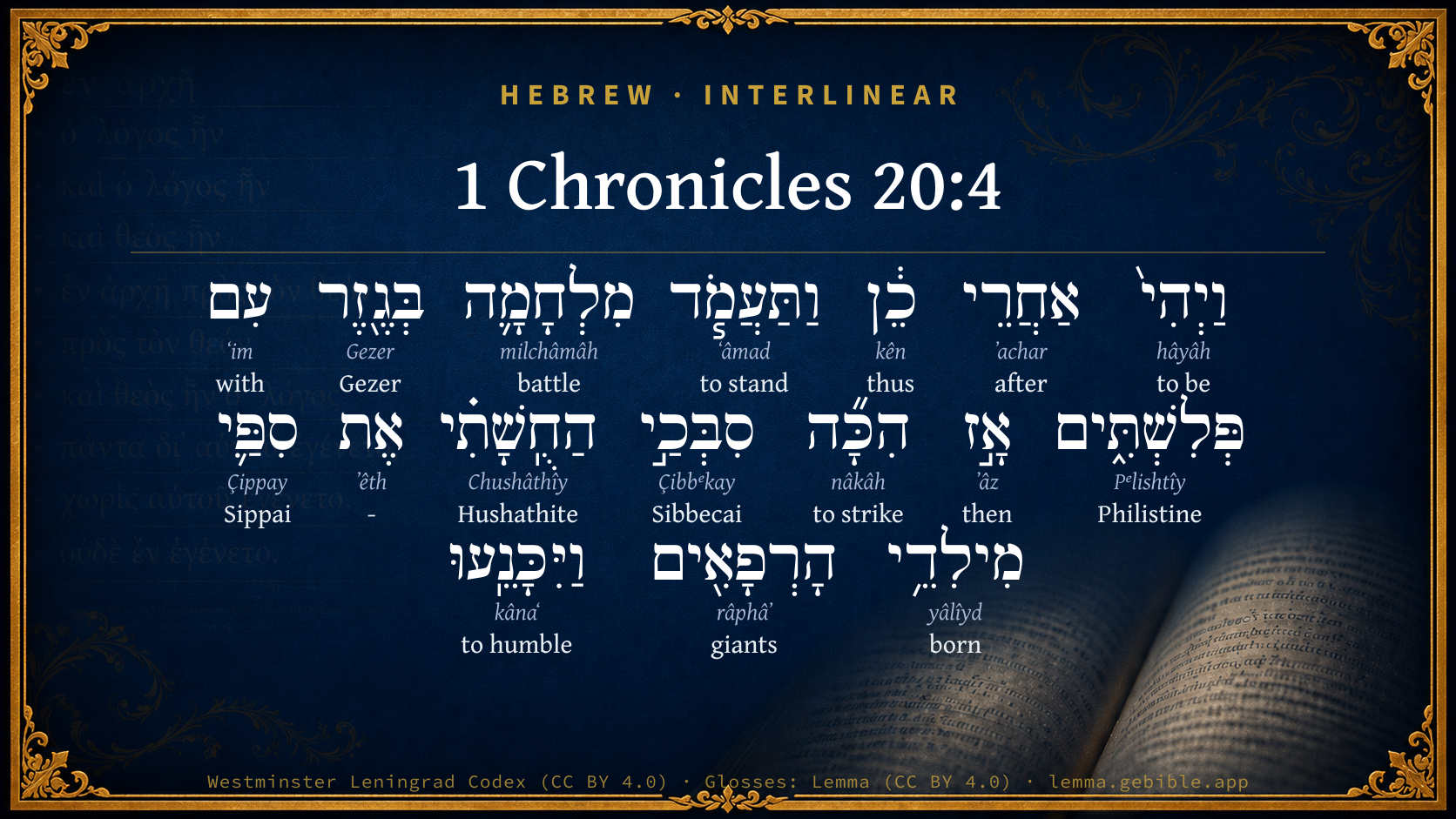
Hebrew (Westminster Leningrad Codex) 1 Chronicles 20:4 appears in the Hebrew Old Testament. The text above is from the Westminster Leningrad Codex. Each word links to its Strong’s number, a concise gloss, and parsing drawn from the Open Scriptures Hebrew Bible morphology. Click any word for its full Brown-Driver-Briggs (BDB) entry.
Download image
Cite this verse

1 Chronicles 20:4 (World English Bible). Public Domain. Lemma interlinear Bible study tool, https://lemma.gebible.app/v/1-chronicles/20/4.

Show BibTeX & RIS
BibTeX
RIS
English Translation
It happened after this, that there arose war at Gezer with the Philistines: then Sibbecai the Hushathite killed Sippai, of the sons of the giant; and they were subdued.
World English Bible · Public Domain
Highlights
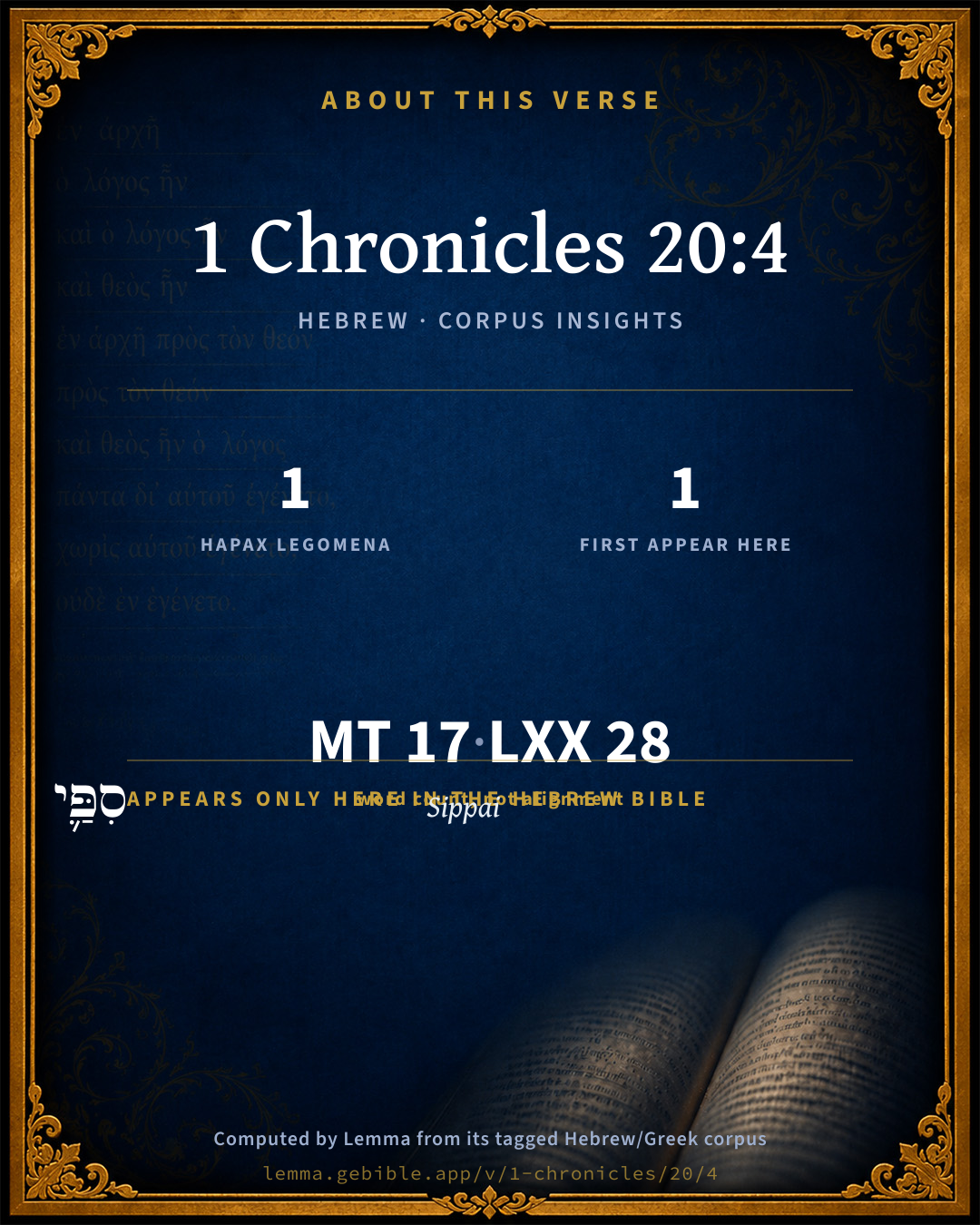
  • 1 hapax legomenon — only here in the Hebrew Bible
  • 1 first appearance in the Hebrew Bible
Full analysis ↓
Download a study sheet

One document with this verse’s original text, its word-by-word gloss line, the meaning frame, cross-references with their text, attributed commentary, and full source and license credits — printable, and it pastes into notes with its structure intact.

This verse Autodidact and up

Study sheet (.html) Plain text (.txt)

A passage Seminary Student

Up to 50 verses in one chapter. A passage sheet keeps up to 6 commentary sources and 12 cross-references per verse, in the order this page ranks them, and says so on the sheet whenever that leaves anything out. Ask for a single verse and you get the Autodidact verse sheet above.

Everything on this page stays free to read, with no account — the sheet is a download of what is already on screen, not access to it.

Want to remove ads? Support Godless Engineer
Compare translations 3

The same verse in 3 English versions, stacked beneath the original-language interlinear above. Click any original word for its lexicon entry.

Each is an independent rendering of the whole verse — the interlinear is not word-aligned to these translations.

Highlighted words mark where these versions differ — a whole-verse word diff, not a word-by-word alignment.

  • World English Bible Public Domain
    It happened after this, that there arose war at Gezer with the Philistines: then Sibbecai the Hushathite killed Sippai, of the sons of the giant; and they were subdued.
  • King James Version Public Domain
    And it came to pass after this, that there arose war at Gezer with the Philistines; at which time Sibbechai the Hushathite slew Sippai, that was of the children of the giant: and they were subdued.
  • unfoldingWord Literal Text CC BY-SA 4.0
    And it happened after this that battle arose at Gezer with the Philistines. Then Sibbecai the Hushathite struck Saph, from the children of the Raphaites, and they were subdued.

unfoldingWord Literal Text — © unfoldingWord, licensed CC BY-SA 4.0. Word-aligned USFM3 via Door43 (git.door43.org/unfoldingWord/en_ult).

Versions to compare (up to 4)

3 of 4 selected

Show all 18 translations

Every available English version of this verse, each an independent rendering of the whole verse.

  • World English Bible Public Domain
    It happened after this, that there arose war at Gezer with the Philistines: then Sibbecai the Hushathite killed Sippai, of the sons of the giant; and they were subdued.
  • Berean Standard Bible Public Domain
    Some time later, war broke out with the Philistines at Gezer. At that time Sibbecai the Hushathite killed Sippai, a descendant of the Rephaim, and the Philistines were subdued.
  • Majority Standard Bible Public Domain
    Some time later, war broke out with the Philistines at Gezer. At that time Sibbecai the Hushathite killed Sippai, a descendant of the Rephaim, and the Philistines were subdued.
  • King James Version Public Domain
    And it came to pass after this, that there arose war at Gezer with the Philistines; at which time Sibbechai the Hushathite slew Sippai, that was of the children of the giant: and they were subdued.
  • American Standard Version (1901) Public Domain
    And it came to pass after this, that there arose war at Gezer with the Philistines: then Sibbecai the Hushathite slew Sippai, of the sons of the giant; and they were subdued.
  • Revised Version (1885) Public Domain
    And it came to pass after this, that there arose war at Gezer with the Philistines: then Sibbecai the Hushathite slew Sippai, of the sons of the giant: and they were subdued.
  • Geneva Bible (1599) Public Domain
    And after this also there arose warre at Gezer with the Philistims: then Sibbechai the Hushathite slewe Sippai, of the children of Haraphah, and they were subdued.
  • Douay-Rheims (1899) Public Domain
    After this there arose a war at Gazer against the Philistines: in which Sabachai the Husathite slew Saphai of the race of Raphaim, and humbled them.
  • Young's Literal Translation Public Domain
    And it cometh to pass, after this, that there remaineth war in Gezer with the Philistines, then hath Sibbechai the Hushathite smitten Sippai, of the children of the giant, and they are humbled.
  • Literal Standard Version CC BY-SA 4.0
    And it comes to pass after this, that war remains in Gezer with the Philistines; then Sibbechai the Hushathite has struck Sippai, of the children of the giant, and they are humbled.
  • Unlocked Literal Bible CC BY-SA 4.0
    It came about after this that there was a battle at Gezer with the Philistines. Sibbekai the Hushathite killed Sippai, one of the descendants of the Rephaim, and the Philistines were subdued.
  • unfoldingWord Literal Text CC BY-SA 4.0
    And it happened after this that battle arose at Gezer with the Philistines. Then Sibbecai the Hushathite struck Saph, from the children of the Raphaites, and they were subdued.
  • Darby Bible Public Domain
    And it came to pass after this, that there arose war at Gezer with the Philistines; then Sibbechai the Hushathite smote Sippai, one of the children of Rapha; and they were subdued.
  • World Messianic Bible Public Domain
    After this, war arose at Gezer with the Philistines. Then Sibbecai the Hushathite killed Sippai, of the sons of the giant; and they were subdued.
  • Webster's Bible Public Domain
    And it came to pass after this, that there arose war at Gezer with the Philistines: at which time Sibbechai the Hushathite slew Sippai, that was of the children of the giant: and they were subdued.
  • Free Bible Version CC BY-SA 4.0
    Some time after this war broke out with the Philistines at Gezer. But then Sibbecai the Hushathite killed Sippai, a descendant of the Rephaim, and the Philistines were forced to submit.
  • Bible in Basic English Public Domain
    Now after this there was war with the Philistines at Gezer; then Sibbecai the Hushathite put to death Sippai, one of the offspring of the Rephaim; and they were overcome.
  • JPS Tanakh (1917) Public Domain
    And it came to pass after this, that there arose war at Gezer with the Philistines; then Sibbecai the Hushathite slew Sippai, of the sons of the giants; and they were subdued.

Literal Standard Version (2020), Covenant Press — licensed CC BY-SA 4.0. Text via the HelloAO Bible API (eBible.org). Unlocked Literal Bible (unfoldingWord) — licensed CC BY-SA 4.0. Text via the HelloAO Bible API (eBible.org). unfoldingWord Literal Text — © unfoldingWord, licensed CC BY-SA 4.0. Word-aligned USFM3 via Door43 (git.door43.org/unfoldingWord/en_ult). Free Bible Version, Dr. Jonathan Gallagher — licensed CC BY-SA 4.0. Text via the HelloAO Bible API (eBible.org).

Word by word

More ways to search: Search by grammar → Find every occurrence → Compare this word →

Practice this passage: Drill this verse → Learn its vocabulary →

סִפַּ֛י
Çippay
H5598
“Sippai”
Noun, Proper
Part of Speech
Noun
Type
Proper
Full BDB Definition

Origin: from H5592

TWOT: None

Sippai = "threshold" - one of the sons of the Philistine giant slain by Sibbechai the Hushathite
  1. וַיְהִי֙ hâyâh H1961 “and · to be” Conjunction + Verb, Qal, Sequential Imperfect, 3rd Person, Masculine, Singular
  2. אַחֲרֵי ʼachar H310 “after” Adverb
  3. כֵ֔ן kên H3651 “thus” Adverb
  4. וַתַּעֲמֹ֧ד ʻâmad H5975 “and · to stand” Conjunction + Verb, Qal, Sequential Imperfect, 3rd Person, Feminine, Singular
  5. מִלְחָמָ֛ה milchâmâh H4421 “battle” Noun, Common, Feminine, Singular, Absolute
  6. בְּגֶ֖זֶר Gezer H1507 “in/at · Gezer” Preposition + Noun, Proper
  7. עִם ʻim H5973 “with” Preposition
  8. פְּלִשְׁתִּ֑ים Pᵉlishtîy H6430 “Philistines” Noun, Gentilic, Masculine, Plural, Absolute
  9. אָ֣ז ʼâz H227 “then” Adverb
  10. הִכָּ֞ה nâkâh H5221 “to strike” Verb, Hiphil, Perfect, 3rd Person, Masculine, Singular
  11. סִבְּכַ֣י Çibbᵉkay H5444 “Sibbecai” Noun, Proper
  12. הַחֻֽשָׁתִ֗י Chushâthîy H2843 “the · Hushathite” Particle, Definite Article + Noun, Gentilic, Masculine, Singular, Absolute
  13. אֶת ʼêth H853 “-” Particle, Direct Object
  14. מִילִדֵ֥י yâlîyd H3211 “from · those born of” Preposition + Noun, Common, Masculine, Plural, Construct
  15. הָרְפָאִ֖ים râphâʼ H7497 “the · giants” Particle, Definite Article + Noun, Proper
  16. וַיִּכָּנֵֽעוּ kânaʻ H3665 “and · to humble” Conjunction + Verb, Niphal, Sequential Imperfect, 3rd Person, Masculine, Plural

About this verse

These counts appear in no published source. They are computed here, from the morphology-tagged text and Lemma’s own curated glosses. What Lemma adds →

17
words
17
distinct lemmas
Historical
section

Notable vocabulary

1 hapax legomenon — a word that appears only here in the entire Hebrew Bible:

  • סִפַּ֛י Sippai H5598

First appearance in Scripture

This word makes its first canonical appearance in the Hebrew Bible here:

  • סִפַּ֛י Sippai H5598

Shared distinctive vocabulary

סִבְּכַ֣י Sibbecai H5444 occurs in 4 verses of the Hebrew Bible. Also found in:

Grammatical profile

  • 4 verbs
  • 8 nouns
  • 1 preposition
  • 3 adverbs
  • 1 particle

Verb forms

  • וַיְהִי֙ Qal · Sequential Imperfect
  • וַתַּעֲמֹ֧ד Qal · Sequential Imperfect
  • הִכָּ֞ה Hiphil · Perfect
  • וַיִּכָּנֵֽעוּ Niphal · Sequential Imperfect

Hebrew & Septuagint length

In English translation the verse runs 29 words from the Hebrew and 32 from the Septuagint (LXX English) — closely comparable.

A rough comparison of the two English renderings, which tokenize alike — not a word-level alignment.

Word counts can differ between the Hebrew and the Greek without any difference in meaning — e.g. the Hebrew direct-object marker אֵת has no separate Greek word, and Greek often adds the article ὁ.

In the original languages it is 17 Hebrew tokens and 28 Greek tokens — but the two are counted differently (Hebrew bundles its prefixes and suffixes into one token; the Greek is in lemma form), so that isn’t a like-for-like length.

Cross-references

5

Topical passages linked to 1 Chronicles 20:4 in the Treasury of Scripture Knowledge — connected by theme and wording, ordered by reader-vote popularity; previews shown in the World English Bible.

  • 2 Samuel 21:18–22 It came to pass after this, that there was again war with the Philistines at Gob: then Sibbecai the Hushathite killed Saph, who was of the sons of the giant.
  • Joshua 12:12 the king of Eglon, one; the king of Gezer, one;
  • Joshua 16:3 and it went down westward to the border of the Japhletites, to the border of Beth Horon the lower, even to Gezer; and the goings out of it were at the sea.
  • 2 Samuel 21:15 The Philistines had war again with Israel; and David went down, and his servants with him, and fought against the Philistines. David grew faint;
  • 1 Chronicles 11:29 Sibbecai the Hushathite, Ilai the Ahohite,

Cross-references courtesy of OpenBible.info (CC BY 4.0).

Hebrew and Greek witnesses Masoretic Hebrew ↔ Greek Septuagint

The same verse in the two great witnesses to the Old Testament, shown verse-for-verse.

These are two independent witnesses, not word-aligned to each other, and the Septuagint is shown in lemma (dictionary) form.

Hebrew 1 Chronicles 20:4 Masoretic · Westminster Leningrad Codex

וַיְהִי֙ אַחֲרֵי כֵ֔ן וַתַּעֲמֹ֧ד מִלְחָמָ֛ה בְּגֶ֖זֶר עִם פְּלִשְׁתִּ֑ים אָ֣ז הִכָּ֞ה סִבְּכַ֣י הַחֻֽשָׁתִ֗י אֶת סִפַּ֛י מִילִדֵ֥י הָרְפָאִ֖ים וַיִּכָּנֵֽעוּ

It happened after this, that there arose war at Gezer with the Philistines: then Sibbecai the Hushathite killed Sippai, of the sons of the giant; and they were subdued.

World English Bible · Public Domain

Greek LXX 1 Chronicles 20:4 Septuagint · lemma form

καί γίγνομαι μετά οὗτος καί γίγνομαι ἔτι πόλεμος ἐν γαζερ μετά ὁ ἀλλόφυλος τότε πατάσσω σοβοχαι ὁ ουσαθι ὁ σαφου ἀπό ὁ υἱός ὁ γίγας καί ταπεινόω αὐτός

And it came to pass afterward that there was again war with the Philistines in Gazer: then Sobochai the Sosathite struck Saphut of the sons of the giants, and laid him low.

LXX2012 (modern English Septuagint) · Public Domain

On this verse, Ellicott's Commentary for English Readers discusses the Septuagint’s reading. Read the note in Commentary ↓

Hebrew: Westminster Leningrad Codex (CC BY 4.0). Greek: Septuagint (public domain); English from LXX2012 (modern English Septuagint) (Public Domain). How the Septuagint differs from the Hebrew →

Commentary

Notes on 1 Chronicles 20:4 from classic Christian and Jewish commentators (each source and its license shown beneath its notes). The classic Christian expositions comment on the surrounding passage and are grouped to its opening verse, so a note may address several verses; the Jewish commentaries on the Tanakh (Rashi and others) are per-verse, so they appear only where the commentator wrote on this verse.

Lemma curates 59 commentaries, every one of them public domain or Creative Commons licensed, each selected and text-cleaned for this edition rather than reprinted as found. About our sources →

Jamieson, Fausset & Brown

Robert Jamieson, A. R. Fausset & David Brown

THREE OVERTHROWS OF THE PHILISTINES AND THREE GIANTS SLAIN. (Ch1 20:4-8)

war at Gezer--or Gob (see Sa2 21:18-22).

Next: 1 Chronicles Chapter 21

Jamieson, Fausset & Brown — Commentary Critical and Explanatory on the Whole Bible (1871) — public domain (CC PDM 1.0). Text via the HelloAO Bible API.

Trapp's Complete Commentary

John Trapp

1Ch 20:4 And it came to pass after this, that there arose war at Gezer with the Philistines; at which time Sibbechai the Hushathite slew Sippai, [that was] of the children of the giant: and they were subdued.

Ver. 4. {See Trapp on "2Sa 21:18"} &c.

John Trapp, A Commentary or Exposition upon All the Books of the Old and New Testament (1647–1656) — public domain. Text from a community e-Sword module.

Geneva Bible (1599)

Geneva Bible translators

Or, Raphaim, or the giants.

Or, Gob, 2 Sam. 21:18.

Or, Saph.

Geneva Bible (1599) marginal notes — public domain. Text via Bolls.life.

Matthew Henry's Commentary

The Philistines were nearly subdued (Ch1 18:1); but, as in the destruction of the Canaanites by Joshua the sons of Anak were last subdued (Jos 11:21), so here in the conquest of the Philistines the giants of Gath were last brought down. In the conflicts between grace and corruption there are some sins which, like these giants, keep their ground a great while and are not mastered without much difficulty and a long struggle: but judgment will be brought forth unto victory at last. Observe, 1. We never read of giants among the Israelites as we do of the giants among the Philistines - giants of Gath, but not giants of Jerusalem. The growth of God's plants is in usefulness, not in bulk. Those who covet to have cubits added to their stature do not consider that it will but make then more unwieldy. In the balance of the sanctuary David far outweighs Goliath. 2. The servants of David, though men of ordinary stature, were too hard for the giants of Gath in every encounter, because they had God on their side, who takes pleasure in abasing lofty looks, and mortifying the giants that are in the earth, as he did of old by the deluge, though they were men of renown. Never let the church's friends be disheartened by the power and pride of the church's enemies. We need not fear great men against us while we have the great God for us. What will a finger more on each hand do, or a toe more on each foot, in contest with Omnipotence? 3. These giants defied Israel (Ch1 20:7) and were thus made to pay for their insolence. None are more visibly marked for ruin that those who reproach God and his Israel. God will do great things rather than suffer the enemy to behave themselves proudly, Deu 32:27. The victories of the Son of David, like those of David himself, are gradual. We see not yet all things put under him; but it will be seen shortly: and death itself, the last enemy, like these giants, will be triumphed over.

Matthew Henry's Commentary on the Whole Bible (1708–1710) — public domain (CC PDM 1.0). Text via the HelloAO Bible API.

Ellicott's Commentary for English Readers

II. This section corresponds to 2Sa_21:18-22. The chronicler has omitted the history of Absalom’s rebellion, with all the events which preceded and followed it, as recorded in 2 Samuel 13-20; and, further, the touching story of the sacrifice of seven sous of Saul at the demand of the Gibeonites (2Sa_21:1-14).

(4) And it came to pass after this.—Comp. Notes on 1Ch_18:1; 1Ch_19:1. The chronicler has omitted, whether by accident or design, the account with which, in 2Sa_21:15-17, this fragmentary section begins, and which tells how David was all but slain by the giant Ishbi-benob.

There arose war.—Literally, there stood, an unique phrase, which perhaps originated in a misreading of that which appears in 2Sa_21:18, “there became again.”

Gezer.—Samuel, “Gob,” an unknown place. Each word (spelling Gôb fully) has three consonants in Hebrew, of which the first is common to both, and the other two are similar enough to make corruption easy. For “Gezer,” see Jos_16:3. The Syriac and Arabic here read “Gaza”; but Gezer (so LXX. and Vulg.) seems right.

Sibbechai the Hushathite.—See 1Ch_11:29; 1Ch_27:11.

Sippai.—Samuel, “Saph.”

Of the children of the giant.—See margin. Render, Sippai, of the offspring (a special term—yĕlîdê—see Num_13:22; Jos_15:14) of the Rephaites. “Rapha” was doubtless the collective tribal designation of the gigantic Rephaim (Gen_14:5).

And they were subdued—Added by chronicler.

A Bible Commentary for English Readers, edited by Charles John Ellicott (1878–1897) — public domain. Text from a community e-Sword module.

The Cambridge Bible for Schools and Colleges

gen. ed. J. J. S. Perowne

4. at Gezer] See 1Ch_6:67, note. In 2Sa_5:25 it is said that David smote the Philistines “from Geba until thou come to Gezer.” In 2 Sam. at Gob, but no place called Gob is known.

Sippai] In 2 Sam. “Saph.”

giant] Heb. “Rapha”; the same Heb. word in the plu. “Rephaim” is translated “giants” in Deu_2:11, A.V. These Rephaim dwelt east of Jordan, but may have been akin to the Philistines.

The Cambridge Bible for Schools and Colleges (gen. ed. J. J. S. Perowne; Cambridge University Press, 1878–1918) — public domain. Text from a community e-Sword module.

Albert Barnes' Notes on the Bible

See the marginal reference and notes.

Albert Barnes' Notes on the Bible (1834–1885) — public domain. Text from a community e-Sword/MySword module.

Haydock's Catholic Bible Commentary

Gazer, which seems preferable to Gob, 2 Kings xxi. 18.

George Leo Haydock (1774–1849), Haydock's Catholic Family Bible and Commentary, 1859 edition — public domain. Excludes Psalms (Douay-Rheims chapter numbering differs from Protestant) and Deuterocanonical books (Catholic canon only).

The Pulpit Commentary

For the Gezer (rzg) of this verse, the parallel place (2Sa_21:18) shows Gob (bwOg), a name not known, but which careless transcription may have easily made out of the former. The Syriac Version, however, as well as the Septuagint, has Gath in that verse as well as in the two verses following, (2Sa_21:18-20) another name also easily interchangeable in Hebrew characters with Gezer. The "yet again" of our ver. 6 would well accord with the supposition that the conflict with the Philistines was at Gath, or at the same place, each of the three times. Gezer belonged to Ephraim, and was situated to the north of Philistia. (1Ch_7:28 1Ch_14:16) Sibbechai. (see also 1Ch_11:29 1Ch_27:11) Sippai. In the parallel place spelt Saph. It is remarkable that, in the Peshito Syriac, over Psalm 143, is found the inscription," Of David, when he slew Asaph, the brother of Gulyad, and thanksgiving that he had conquered." Of the children of the giant. The Hebrew word for "giant," rapha (always in these verses spelt with a final aleph , but in the parallel verses always with he final), is here (Authorized Version) translated. "The Rapha, a native of Gath, was the forefather of the Canaanitish Rephaim, mentioned as early as Gen_14:5 Gen_15:20; Deu_2:11; Jos_12:4 Jos_15:8 Jos_17:15. The slaying of Ishbi-benob (2Sa_21:16) is not here given. It is also to be observed that the lengthy account of Samuel, respecting Absalom and his rebellion (2Sa 13-21) is not found here.

Vers. 4-8.

Little things and great.

How small and insignificant in our esteem are the physical peculiarities of these "children of the giant"! How little we care to treasure their names and deeds in our memories! They probably thought much of themselves, and were made much of by their contemporaries; but they have sunk into entire insignificance now. We feel thatI DISTINCTION BASED ON BODILY PECULIARITY IS OF LITTLE WORTH. Great stature makes its possessor conspicuous among his fellows, if that be a desirable thing; great muscular strength serves in good stead on those rare occasions when a man has to resist by physical force. Unusual beauty of countenance attracts the eye and wins the admiration of the opposite sex. But these visible specialities have their drawbacks, if not their evils. The first of these often secures a most undesirable and even painful notoriety; the second tempts to acts of violence which are regrettable; the last exposes to peculiar perils of its own. And how speedily they perish! In this war with the Philistines these giants "were subdued" (ver. 4). Lahmi"s great spear did not save him from the skill of Elhanan (ver. 5); nor the immense stature of the giant with twenty-four fingers and toes, from the courage and capacity of Jonathan (vers. 6, 7). "They fell by the hand of David"s servants" (ver. 8). Mere size of body, mere power of muscle, mere skill of fence, and even beauty of face and charm of manner, all these are either overmatched with something that is stronger, or they soon fade and fall under the resistless ravages of time. And when they pass, how soon they are forgotten! We hardly recognize some of these names; or, if we remember them, we associate them with other men who bore them, but were distinguished by other and nobler features. The next generation will care little for those who have nothing better to claim than great strength, or commanding stature, or some other bodily peculiarity. On the other hand, we feel that

II DISTINCTION BASED ON SPIRITUAL WORTH IS A DESIRABLE EXCELLENCY.

1. Mental strength, when gained by diligent self-culture and devoted to useful ends, enjoys a more lasting honour and effects a far greater good.

1. But spiritual worth is the most valuable acquisition; that is the true greatness of man.

1. It raises him highest in the scale of being.

2. It renders nobler and truer service.

3. It yields a finer fragrance in grateful recollection. (Pro_10:7)

4. It lives on to distant generations in benignant influence.

The "good men do" is not "interred with their bones;" it lives and blossoms, and bears precious fruit in the hearts and lives of men. C.

The Pulpit Commentary (1880–1919), ed. H.D.M. Spence-Jones & Joseph S. Exell — public domain. Text from a community e-Sword module.

Kretzmann's Popular Commentary

Paul E. Kretzmann

Exploits of Individual Heroes

v. 4. And it came to pass after this that there arose war at Gezer, it was rekindled, like a fire that has been smoldering, with the Philistines, Gezer being on their northern boundary, in the tribe of Ephraim; at which time Sibbechai the Hushathite slew Sippai (or Saph), that was of the children of the giant, belonging to the Rephaim, the last remnant of the former giant race in this country; and they were subdued.

v. 5. And there was war again with the Philistines, another uprising; and Elhanan, the son of Jair (or Jaare-oregim), slew Lahmi, the brother of Goliath the Gittite, whose spear-staff was like a weaver’s beam.

v. 6. And yet again there was war at Gath, in the Philistine country proper, where was a man of great stature, whose fingers and toes were four and twenty, six on each hand and six on each foot; and he also was the son of the giant, he, too, belonged to this giant race.

v. 7. But when he defied Israel, reproached and challenged the host of the Lord, Jonathan, the son of Shimea, David’s brother, slew him.

v. 8. These were born unto the giant in Gath, the last of the giant family; and they fell by the hand of David, that is, while he was supreme military chief, although he personally slew Goliath, and by the hand of his servants. The story is typical of the fate which comes upon those who oppose the rule of the great Son of David, Jesus Christ, for they will, if not in this life, eventually receive their punishment, everlasting destruction, by their own fault.

Paul E. Kretzmann, Popular Commentary of the Bible (1921–1924) — public domain. Text from a community e-Sword module.

unfoldingWord translationNotes

Door43 World Missions Community

It came about

This phrase is used here to mark the beginning of a new part of the story. If your language has a way for doing this, you could consider using it here.

there was a battle at Gezer with the Philistines

"the Israelites battled the Philistines at Gezer"

Gezer ... Gob

These are the names of cities. (See: How to Translate Names)

Sibbekai ... Sippai ... Elhanan ... Jair ... Lahmi

These are the names of men. (See: How to Translate Names)

Hushathite ... Rephaim ... Bethlehemite ... Gittite

These are the names of people groups.

the Philistines were subdued

This can be stated in active form. AT: "they subdued the Philistines" (See: Active or Passive)

the Philistines were subdued

This can be translated in active form. AT: "the Israelites were able to subdue the Philistines" or "the Philistines were brought under the Israelites' control"

staff

a long and thin pole.

the staff of whose spear was like a weaver's beam

A weaver's beam was a very large piece of wood used to stretch strings as the threads of a rug are weaved together around them. This means the handle of Lahmi's spear was very large.

translationWords

Philistines

descend

Bethlehem

Goliath

spear

unfoldingWord translationNotes — © Distant Shores Media and the Door43 World Missions Community, licensed CC BY-SA 4.0. Source: git.door43.org/Door43/en_tn.

Rashi

Rabbi Shlomo Yitzchaki (Rashi)

Now it came to pass after this that a war arose in Gezer That which is missing here is written in Samuel (II 21:15): “And the Philistines waged war again with Israel, and David went down with his servants and they fought against the Philistines.” And this too was not written here because of David’s honor, for it is written there: “... and David became faint,” and it is written: (ibid. 16): “And Ishbi, who was one of the sons of Raphah, was in Nob, etc., and he was girded with new armor, and he thought to smite David,” and had it not been for the aid of Abishai the son of Zeruiah, he would have fallen into the hands of Ishbi in Nob and because of that disgrace, [the Chronicler] did not mention these things here.

then Sibbecai the Hushathite smote Sippai of the sons of Rapha But in Samuel (II 21:18), it is written: “Saph, who was one of the sons of Rashah,” who was the brother of Goliath the Philistine and Ishbi in Nob.

Rashi on the Tanakh — English translations: “The Judaica Press complete Tanach with Rashi, translated by A. J. Rosenberg” (CC BY 4.0); “Pentateuch with Rashi's commentary by M. Rosenbaum and A.M. Silbermann, 1929-1934” (public domain); “The Metsudah Tanach series, Lakewood, N.J” (CC BY 4.0); and “The Book of Joshua, Metsudah Publications, 1997” (CC BY 4.0). Text via Sefaria.

Lesson kit

Teaching starters — assembled from the data on this page, not authored interpretation. Every prompt links to the verse data it draws on. Edit before teaching.

1 Chronicles, in the Historical, opens this verse with 17 words (17 distinct Hebrew lemmas). Its most distinctive word is Çippay (“Sippai”). A historical commentator’s framing appears above. Read the whole chapter for the surrounding context.

Discussion questions

  1. How does “Sippai” (Çippay) shape what this verse is saying?
  2. 1 word here appears nowhere else in the Hebrew Bible. Why might the author reach for such rare wording?
  3. This is the first place “Sippai” appears in Scripture (first appears here). What does its debut here establish?
  4. How does 2 Samuel 21:18, which shares the word «Sibbecai», read alongside this verse?
  5. These translations render this verse differently. What is at stake in choosing one wording over another?
  6. «וַיְהִי֙» is a Qal Sequential Imperfect verb. How does that grammatical form shape the action described?
  7. Compare how Jamieson, Fausset & Brown and Trapp's Complete Commentary read this verse. Where do they agree or differ?

Things to notice

Reading settings

Reading text

Shown beneath each verse's original-language words.

Old Testament
Old Testament edition

Read the OT as the Masoretic Hebrew (MT) or the Greek Septuagint (LXX).

English shown for the Greek Septuagint (in the Hebrew ↔ Greek comparison).

Comparing translations? Open the Compare panel on any verse page to stack up to four side by side.