1 Samuel 5:12

Hebrew (Westminster Leningrad Codex) 1 Samuel 5:12 appears in the Hebrew Old Testament. The text above is from the Westminster Leningrad Codex. Each word links to its Strong’s number, a concise gloss, and parsing drawn from the Open Scriptures Hebrew Bible morphology. Click any word for its full Brown-Driver-Briggs (BDB) entry.
Download image
Cite this verse

1 Samuel 5:12 (World English Bible). Public Domain. Lemma interlinear Bible study tool, https://lemma.gebible.app/v/1-samuel/5/12.

Show BibTeX & RIS
BibTeX
RIS
English Translation
The men who didn't die were struck with the tumors; and the cry of the city went up to heaven.
World English Bible · Public Domain
Download a study sheet

One document with this verse’s original text, its word-by-word gloss line, the meaning frame, cross-references with their text, attributed commentary, and full source and license credits — printable, and it pastes into notes with its structure intact.

This verse Autodidact and up

Study sheet (.html) Plain text (.txt)

A passage Seminary Student

Up to 50 verses in one chapter. A passage sheet keeps up to 6 commentary sources and 12 cross-references per verse, in the order this page ranks them, and says so on the sheet whenever that leaves anything out. Ask for a single verse and you get the Autodidact verse sheet above.

Everything on this page stays free to read, with no account — the sheet is a download of what is already on screen, not access to it.

Want to remove ads? Support Godless Engineer
Compare translations 3

The same verse in 3 English versions, stacked beneath the original-language interlinear above. Click any original word for its lexicon entry.

Each is an independent rendering of the whole verse — the interlinear is not word-aligned to these translations.

Highlighted words mark where these versions differ — a whole-verse word diff, not a word-by-word alignment.

  • World English Bible Public Domain
    The men who didn't die were struck with the tumors; and the cry of the city went up to heaven.
  • King James Version Public Domain
    And the men that died not were smitten with the emerods: and the cry of the city went up to heaven.
  • unfoldingWord Literal Text CC BY-SA 4.0
    And the men who did not die were struck with tumors. And the cry of the city went up to the heavens.

unfoldingWord Literal Text — © unfoldingWord, licensed CC BY-SA 4.0. Word-aligned USFM3 via Door43 (git.door43.org/unfoldingWord/en_ult).

Versions to compare (up to 4)

3 of 4 selected

Show all 18 translations

Every available English version of this verse, each an independent rendering of the whole verse.

  • World English Bible Public Domain
    The men who didn't die were struck with the tumors; and the cry of the city went up to heaven.
  • Berean Standard Bible Public Domain
    Those who did not die were afflicted with tumors, and the outcry of the city went up to heaven.
  • Majority Standard Bible Public Domain
    Those who did not die were afflicted with tumors, and the outcry of the city went up to heaven.
  • King James Version Public Domain
    And the men that died not were smitten with the emerods: and the cry of the city went up to heaven.
  • American Standard Version (1901) Public Domain
    And the men that died not were smitten with the tumors; and the cry of the city went up to heaven.
  • Revised Version (1885) Public Domain
    And the men that died not were smitten with the tumours: and the cry of the city went up to heaven.
  • Geneva Bible (1599) Public Domain
    And the men that dyed not, were smitten with the emerods: and the cry of the citie went vp to heauen.
  • Douay-Rheims (1899) Public Domain
    For there was the fear of death in every city, and the hand of God was exceeding heavy. The men also that did not die, were afflicted with the emerods: and the cry of every city went up to heaven.
  • Young's Literal Translation Public Domain
    and the men who have not died have been smitten with emerods, and the cry of the city goeth up into the heavens.
  • Literal Standard Version CC BY-SA 4.0
    and the men who have not died have been struck with lumps, and the cry of the city goes up into the heavens.
  • Unlocked Literal Bible CC BY-SA 4.0
    The men who did not die were afflicted with the tumors, and the cry of the city went up to the heavens.
  • unfoldingWord Literal Text CC BY-SA 4.0
    And the men who did not die were struck with tumors. And the cry of the city went up to the heavens.
  • Darby Bible Public Domain
    and the men that died not were smitten with the hemorrhoids; and the cry of the city went up to heaven.
  • World Messianic Bible Public Domain
    The men who didn’t die were struck with the tumors; and the cry of the city went up to heaven.
  • Webster's Bible Public Domain
    And the men that died not, were smitten with the emerods: and the cry of the city went up to heaven.
  • Free Bible Version CC BY-SA 4.0
    Those who didn't die were plagued with swellings, and the cry for help from the town reached up to heaven.
  • Bible in Basic English Public Domain
    And those men who were not overtaken by death were cruelly diseased: and the cry of the town went up to heaven.
  • JPS Tanakh (1917) Public Domain
    And the men that died not were smitten with the emerods; and the cry of the city went up to heaven.

Literal Standard Version (2020), Covenant Press — licensed CC BY-SA 4.0. Text via the HelloAO Bible API (eBible.org). Unlocked Literal Bible (unfoldingWord) — licensed CC BY-SA 4.0. Text via the HelloAO Bible API (eBible.org). unfoldingWord Literal Text — © unfoldingWord, licensed CC BY-SA 4.0. Word-aligned USFM3 via Door43 (git.door43.org/unfoldingWord/en_ult). Free Bible Version, Dr. Jonathan Gallagher — licensed CC BY-SA 4.0. Text via the HelloAO Bible API (eBible.org).

Word by word

More ways to search: Search by grammar → Find every occurrence → Compare this word →

Practice this passage: Drill this verse → Learn its vocabulary →

בַּטְּחֹרִ֑ים
ṭᵉchôr
H2914
“in/at the · tumors”
Preposition, Determined + Noun, Common, Masculine, Plural, Absolute
Part of Speech
Preposition + Noun
Type
Common
Gender
Masculine
Number
Plural
State
Absolute
Full BDB Definition

Origin: from an unused root meaning to burn

TWOT: 803a

tumours, haemorrhoids
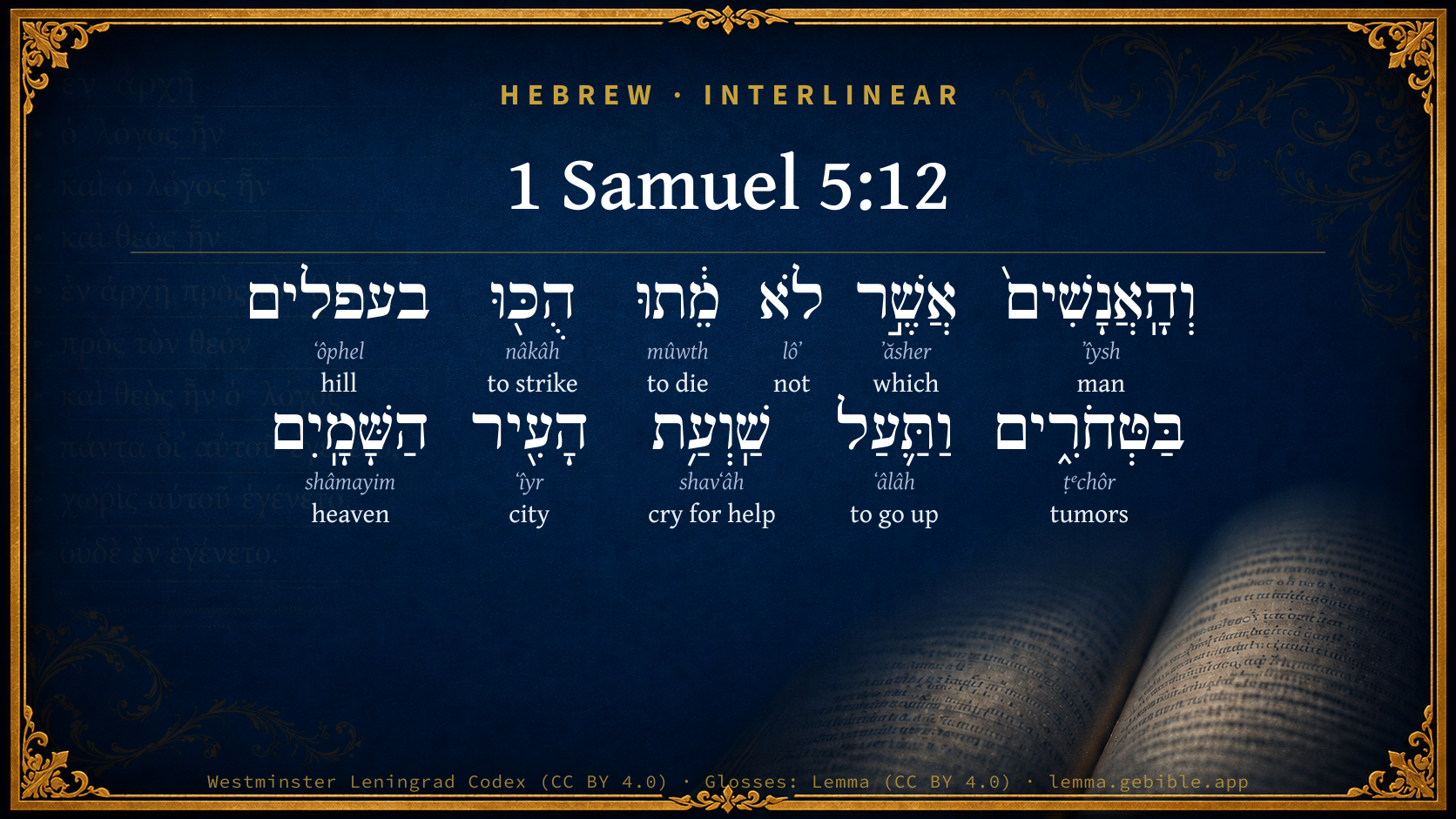
  1. וְהָֽאֲנָשִׁים֙ ʼîysh H376 “and · the · men” Conjunction + Particle, Definite Article + Noun, Common, Masculine, Plural, Absolute
  2. אֲשֶׁ֣ר ʼăsher H834 “which” Particle, Relative
  3. לֹא lôʼ H3808 “not” Particle, Negative
  4. מֵ֔תוּ mûwth H4191 “to die” Verb, Qal, Perfect, 3rd Person, Common, Plural
  5. הֻכּ֖וּ nâkâh H5221 “to strike” Verb, Hophal, Perfect, 3rd Person, Common, Plural
  6. בעפלים ʻôphel H6076 “in/at the · tumors” Preposition, Determined + Noun, Common, Masculine, Plural, Absolute
  7. וַתַּ֛עַל ʻâlâh H5927 “and · to go up” Conjunction + Verb, Qal, Sequential Imperfect, 3rd Person, Feminine, Singular
  8. שַֽׁוְעַ֥ת shavʻâh H7775 “cry for help of” Noun, Common, Feminine, Singular, Construct
  9. הָעִ֖יר ʻîyr H5892 “the · city” Particle, Definite Article + Noun, Common, Feminine, Singular, Absolute
  10. הַשָּׁמָֽיִם shâmayim H8064 “the · heaven(s)” Particle, Definite Article + Noun, Common, Masculine, Plural, Absolute

About this verse

These counts appear in no published source. They are computed here, from the morphology-tagged text and Lemma’s own curated glosses. What Lemma adds →

11
words
11
distinct lemmas
Historical
section

Notable vocabulary

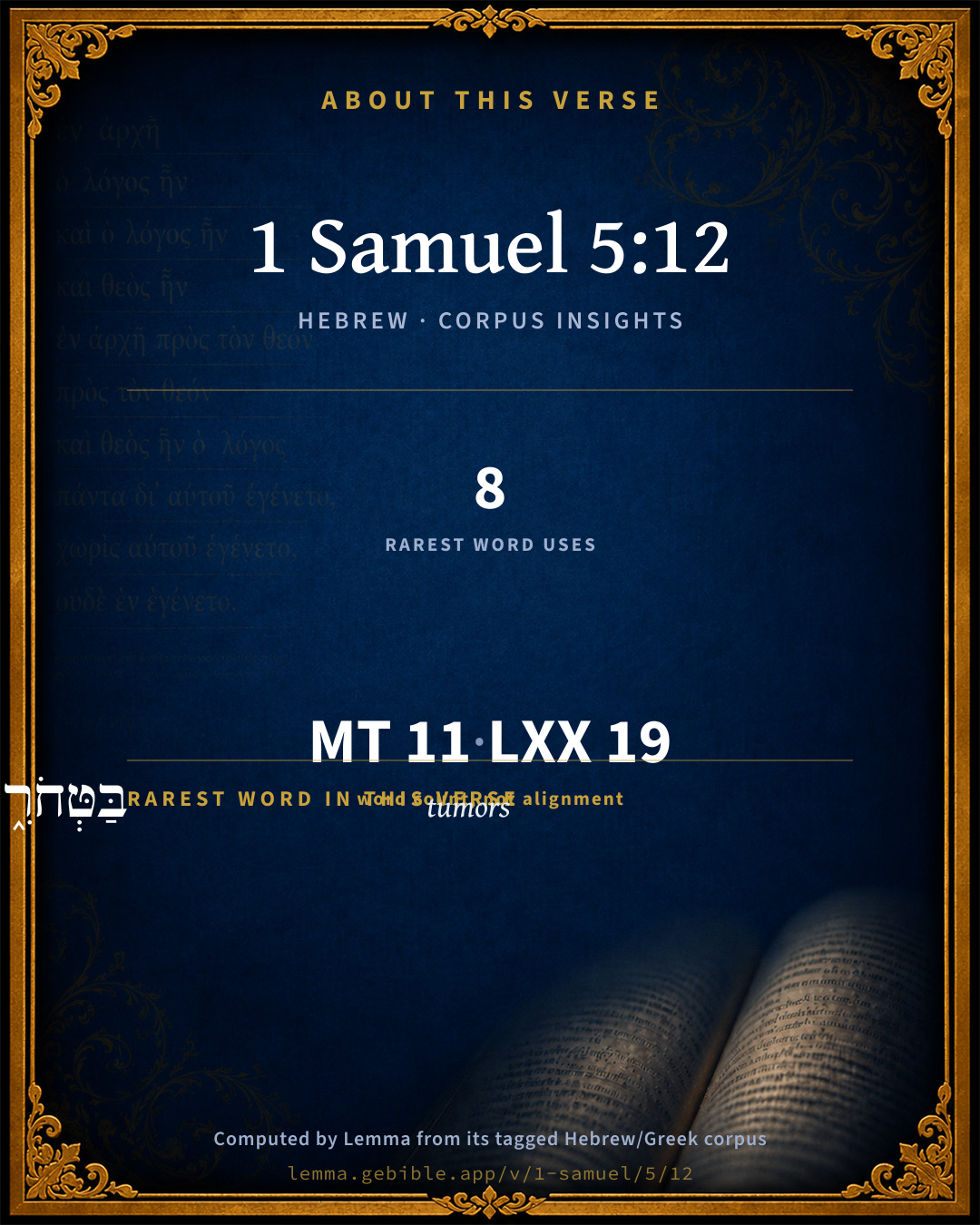
The rarest word here is בַּטְּחֹרִ֑ים tumors H2914 — appearing just 8 times in the whole Hebrew Bible.

Shared distinctive vocabulary

בַּטְּחֹרִ֑ים tumors H2914 occurs in 8 verses of the Hebrew Bible. Also found in:

Grammatical profile

  • 3 verbs
  • 6 nouns
  • 2 particles

Verb forms

  • מֵ֔תוּ Qal · Perfect
  • הֻכּ֖וּ Hophal · Perfect
  • וַתַּ֛עַל Qal · Sequential Imperfect

Hebrew & Septuagint length

In English translation the verse runs 20 words from the Hebrew and 42 from the Septuagint (LXX English) — the Septuagint runs noticeably longer here. See the side-by-side →

A rough comparison of the two English renderings, which tokenize alike — not a word-level alignment.

Word counts can differ between the Hebrew and the Greek without any difference in meaning — e.g. the Hebrew direct-object marker אֵת has no separate Greek word, and Greek often adds the article ὁ.

In the original languages it is 11 Hebrew tokens and 19 Greek tokens — but the two are counted differently (Hebrew bundles its prefixes and suffixes into one token; the Greek is in lemma form), so that isn’t a like-for-like length.

Cross-references

8

Topical passages linked to 1 Samuel 5:12 in the Treasury of Scripture Knowledge — connected by theme and wording, ordered by reader-vote popularity; previews shown in the World English Bible.

  • Exodus 12:30 Pharaoh rose up in the night, he, and all his servants, and all the Egyptians; and there was a great cry in Egypt, for there was not a house where there was not one dead.
  • Amos 5:19 As if a man fled from a lion, And a bear met him; Or he went into the house and leaned his hand on the wall, And a snake bit him.
  • 1 Samuel 9:16 Tomorrow about this time I will send you a man out of the land of Benjamin, and you shall anoint him to be prince over my people Israel; and he shall save my people out of the hand of the Philistines: for I have looked on my people, because their cry is come to me.
  • 1 Kings 19:17 It shall happen, that he who escapes from the sword of Hazael shall Jehu kill; and he who escapes from the sword of Jehu shall Elisha kill.
  • Isaiah 15:3–5 In their streets they gird themselves with sackcloth; on their housetops, and in their broad places, everyone wails, weeping abundantly.
  • Jeremiah 14:2 Judah mourns, and the gates of it languish, they sit in black on the ground; and the cry of Jerusalem is gone up.
  • Jeremiah 25:34 Wail, you shepherds, and cry; and wallow [in ashes], you principal of the flock; for the days of your slaughter and of your dispersions are fully come, and you shall fall like a goodly vessel.
  • Jeremiah 48:3 The sound of a cry from Horonaim, desolation and great destruction!

Cross-references courtesy of OpenBible.info (CC BY 4.0).

Hebrew and Greek witnesses Masoretic Hebrew ↔ Greek Septuagint

The same verse in the two great witnesses to the Old Testament, shown verse-for-verse.

Here the Septuagint runs noticeably longer than the Hebrew — LXX2012 (modern English Septuagint) 42 words vs World English Bible 20. A rough length comparison of the two English translations, not a word-level alignment — read both below.

These are two independent witnesses, not word-aligned to each other, and the Septuagint is shown in lemma (dictionary) form.

Hebrew 1 Samuel 5:12 Masoretic · Westminster Leningrad Codex

וְהָֽאֲנָשִׁים֙ אֲשֶׁ֣ר לֹא מֵ֔תוּ הֻכּ֖וּ בעפלים בַּטְּחֹרִ֑ים וַתַּ֛עַל שַֽׁוְעַ֥ת הָעִ֖יר הַשָּׁמָֽיִם

The men who didn't die were struck with the tumors; and the cry of the city went up to heaven.

World English Bible · Public Domain

Greek LXX 1 Samuel 5:12 Septuagint · lemma form

καί ὁ ζάω καί οὐ ἀποθνήσκω πλήσσω εἰς ὁ ἕδρα καί ἀναβαίνω ὁ κραυγή ὁ πόλις εἰς ὁ οὐρανός

For there was a very great confusion in all the city, when the ark of the God of Israel entered there; and those, who lived and died not were struck with tumors; and the cry of the city went up to heaven.

LXX2012 (modern English Septuagint) · Public Domain

Hebrew: Westminster Leningrad Codex (CC BY 4.0). Greek: Septuagint (public domain); English from LXX2012 (modern English Septuagint) (Public Domain). How the Septuagint differs from the Hebrew →

Targum (Aramaic paraphrase)

1

The Targum is the ancient Jewish Aramaic paraphrase of the Hebrew Scriptures — an interpretive translation, not the Hebrew text itself. Onkelos (literal) and Pseudo-Jonathan (expansive) render the Torah, and Jonathan the Prophets. Coverage is partial: where no permissively-licensed English translation exists for a verse, only the Aramaic is shown. This is verse-level text, not a word-by-word alignment to the Hebrew.

  1. Targum Jonathan Prophets (Joshua–Malachi)
    וְגַבְרַיָא דִי לָא מִיתוּ לָקוּ בַּטְחוֹרִין וּסְלִיקַת צִוְחַת קַרְתָּא לְצֵית שְׁמַיָא:

    (no public-domain English translation for this verse)

    Targum Jonathan — Aramaic: “Mikraot Gedolot” (public domain). English: “Sefaria Community Translation” (CC0 1.0 (public-domain dedication)); “London "Chaldee Paraphrase," 1871” (public domain). Text via Sefaria.

Commentary

Notes on 1 Samuel 5:12 from classic Christian and Jewish commentators (each source and its license shown beneath its notes). The classic Christian expositions comment on the surrounding passage and are grouped to its opening verse, so a note may address several verses; the Jewish commentaries on the Tanakh (Rashi and others) are per-verse, so they appear only where the commentator wrote on this verse.

Lemma curates 59 commentaries, every one of them public domain or Creative Commons licensed, each selected and text-cleaned for this edition rather than reprinted as found. About our sources →

Trapp's Complete Commentary

John Trapp

1Sa 5:12 And the men that died not were smitten with the emerods: and the cry of the city went up to heaven.

Ver. 12. And the men that died not were smitten, &c.] All that were smitten with emerods died not here, as they had done at the other cities, quod petiverant ut arca restitueretur, {a} because they had desired that the ark might be restored.

{a} Piscator.

John Trapp, A Commentary or Exposition upon All the Books of the Old and New Testament (1647–1656) — public domain. Text from a community e-Sword module.

The Biblical Illustrator

Joseph S. Exell

1Sa_5:12

The cry of the city.

The cry of the city

There is a hum of the city in its ceaseless activity, a shout in its occasional excitement, a song in its periodic mirth, but a cry in its constant want, distress, pain. Paul heard it at Athens and his heart was stirred; Jesus at Jerusalem and He wept. Do we not hear it in every city, and is not the cry somewhat thus?

I.

I am sensitive and might be touched with truth and love.

II.--I am restless and so always seeking some unattained good.

III.--I am strong and might be powerful for God and humanity.

IV.--I am sinful and must have religion or ruin. Does anyone fail to hear these cries, let him listen to The Bitter Cry of Outcast London, or gaze sadly at Horrible London, or pendent The Politics of the very Poor. (Homilist.)

.

The Biblical Illustrator, edited by Joseph S. Exell (c. 1880s–1900s) — public domain. Text from a community e-Sword module.

Jamieson, Fausset & Brown

Robert Jamieson, A. R. Fausset & David Brown

the cry of the city went up to heaven--The disease is attended with acute pain, and it is far from being a rare phenomenon in the Philistian plain [VAN DE VELDE].

Next: 1 Samuel Chapter 6

Jamieson, Fausset & Brown — Commentary Critical and Explanatory on the Whole Bible (1871) — public domain (CC PDM 1.0). Text via the HelloAO Bible API.

Adam Clarke's Commentary

Verse 12. The men that died not] Some it seems were smitten with instant death; others with the haemorrhoids, and there was a universal consternation; and the cry of the city went up to heaven-it was an exceeding great cry.

IT does not appear that the Philistines had any correct knowledge of the nature of Jehovah, though they seemed to acknowledge his supremacy. They imagined that every country, district, mountain, and valley, had its peculiar deity; who, in its place, was supreme over all others. They thought therefore to appease Jehovah by sending him back his ark or shrine: and, in order to be redeemed from their plagues, they send golden mice and emerods as telesms, probably made under some particular configurations of the planets. 1Sa 6:21.

Adam Clarke's Commentary on the Bible (1810–1826) — public domain. Text from a community e-Sword/MySword module.

The Cambridge Bible for Schools and Colleges

gen. ed. J. J. S. Perowne

12. the cry of the city went up to heaven] Cp. Exo_2:13. The word used always denotes a supplication, a cry for help.

Each city was visited with a heavier judgment than the preceding one. “The longer the Philistines resisted and refused to recognise the chastening hand of the living God in the plagues inflicted upon them, the more severely would they necessarily be punished.” So when Pharaoh hardened his heart and refused to let the Israelites go, the hand of the Lord grew heavier and heavier, till an unwilling consent was wrung from him.

The Cambridge Bible for Schools and Colleges (gen. ed. J. J. S. Perowne; Cambridge University Press, 1878–1918) — public domain. Text from a community e-Sword module.

John Gill's Exposition

And the men that died not were smitten with the emerods,.... As the inhabitants of Ashdod and Gath had been; this shows that those that died did not die of that disease, but of some other; very likely the pestilence:

and the cry of the city went up to heaven; not that it was heard and regarded there, but the phrase is used to denote the greatness of it, how exceeding loud and clamorous it was; partly on the account of the death of so many of the inhabitants, their relations and friends; and partly because of the intolerable pain they endured through the emerods. There is something of this history preserved in a story wrongly told by Herodotus (b), who relates that the Scythians returning from Egypt passed through Ashkelon, a city of Syria (one of the five principalities of the Philistines), and that some of them robbed the temple of Venus there; for which the goddess sent on them and their posterity the disease of emerods, and that the Scythians themselves acknowledged that they were troubled with it on that account.

(b) Clio, sive, l. 1. c. 105.

Next: 1 Samuel Chapter 6

John Gill's Exposition of the Whole Bible (1746–1763) — public domain (CC PDM 1.0). Text via the HelloAO Bible API.

Haydock's Catholic Bible Commentary

Die, at the sight of the ark, as the Bethsamites did afterwards. (Menochius)

George Leo Haydock (1774–1849), Haydock's Catholic Family Bible and Commentary, 1859 edition — public domain. Excludes Psalms (Douay-Rheims chapter numbering differs from Protestant) and Deuterocanonical books (Catholic canon only).

Matthew Poole's English Annotations

The men that died not; either of some other plague or ulcer, as may be thought from 1Sa 5:6, or of the emerods, which infested and tormented even those whom it did not kill.

The cry of the city, or, of that city where the ark was; and the city is put for the people inhabiting it.

Matthew Poole's English Annotations on the Holy Bible (1683–1685) — public domain. Text from a community e-Sword/MySword module.

The Pulpit Commentary

The cry of the city went up to heaven. Not the word used in ver. 10, where it is an outcry of indignation, but a cry for help, a cry of sorrow and distress. Though in ver. 10 Ekronites is in the plural, yet in all that follows the singular is used. "They have brought about the ark to me, to slay me and my people. That it slay me not and my people." It is the prince of Ekron who, as the representative of the people, expostulates with his fellow rulers for the wrong they are doing him. But finally all join in his lamentation, and the whole city, smitten by God"s band sends up its prayer to heaven for mercy.

The Pulpit Commentary (1880–1919), ed. H.D.M. Spence-Jones & Joseph S. Exell — public domain. Text from a community e-Sword module.

Lesson kit

Teaching starters — assembled from the data on this page, not authored interpretation. Every prompt links to the verse data it draws on. Edit before teaching.

1 Samuel, in the Historical, opens this verse with 11 words (11 distinct Hebrew lemmas). Its most distinctive word is ṭᵉchôr (“tumors”). The Greek Septuagint runs longer here. A historical commentator’s framing appears above. Read the whole chapter for the surrounding context.

Discussion questions

  1. The word ṭᵉchôr carries the sense “tumors.” How does it shape the verse?
  2. Deuteronomy 28:27 shares the word «tumors» with this verse. How do the two illuminate each other?
  3. Compared with the Hebrew, the Septuagint runs longer here. What questions does that raise?
  4. These translations render this verse differently; the difference is in the English rendering, not the original. What questions does that raise?
  5. The verb «מֵ֔תוּ» is Qal Perfect. How does its form color the action?
  6. Reading how Trapp's Complete Commentary and The Biblical Illustrator read this verse, where do the two commentators agree and where do they part?

Things to notice

Reading settings

Reading text

Shown beneath each verse's original-language words.

Old Testament
Old Testament edition

Read the OT as the Masoretic Hebrew (MT) or the Greek Septuagint (LXX).

English shown for the Greek Septuagint (in the Hebrew ↔ Greek comparison).

Comparing translations? Open the Compare panel on any verse page to stack up to four side by side.