Judges 8:11

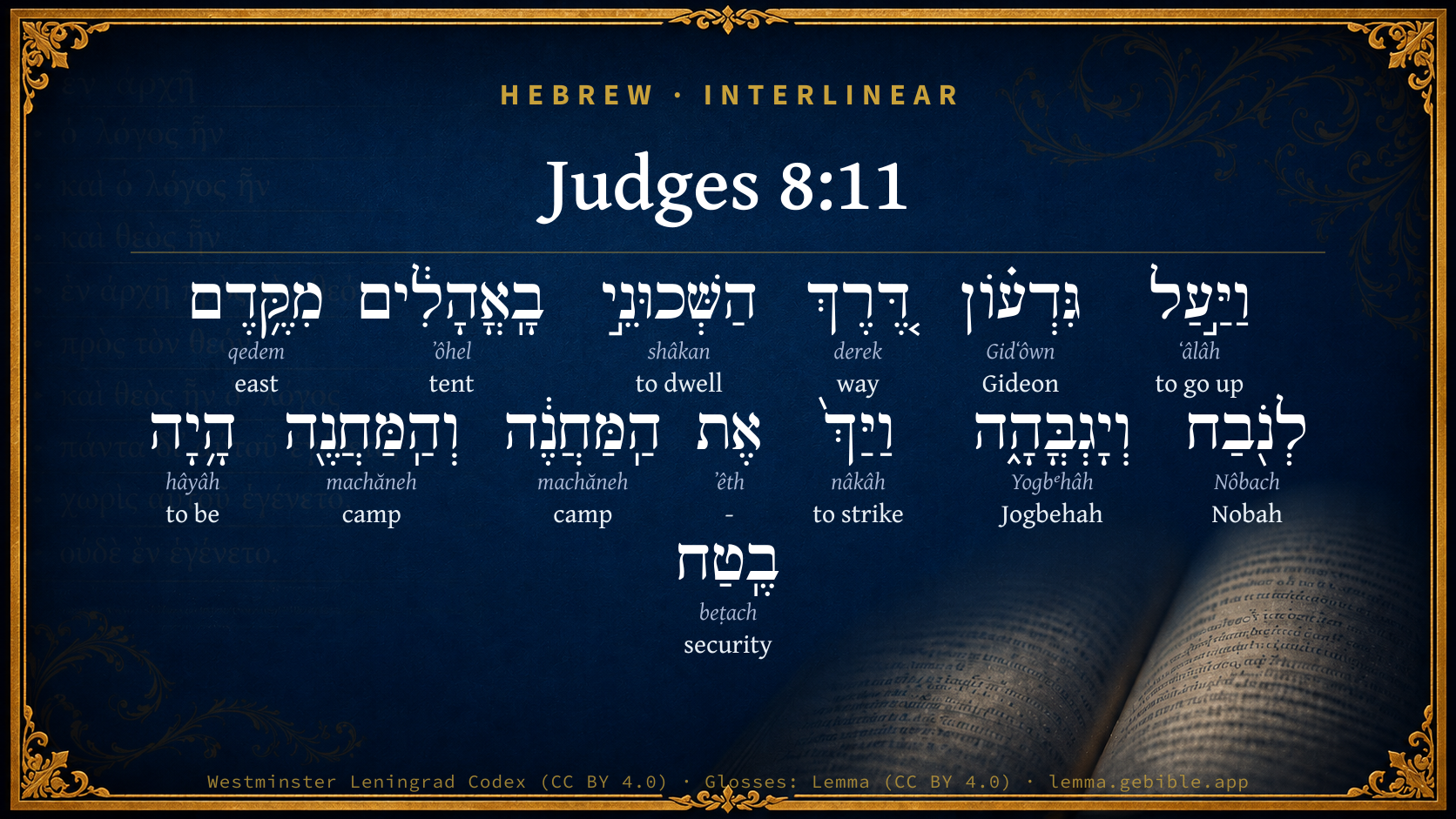
Hebrew (Westminster Leningrad Codex) Judges 8:11 appears in the Hebrew Old Testament. The text above is from the Westminster Leningrad Codex. Each word links to its Strong’s number, a concise gloss, and parsing drawn from the Open Scriptures Hebrew Bible morphology. Click any word for its full Brown-Driver-Briggs (BDB) entry.
Download image
Cite this verse

Judges 8:11 (World English Bible). Public Domain. Lemma interlinear Bible study tool, https://lemma.gebible.app/v/judges/8/11.

Show BibTeX & RIS
BibTeX
RIS
English Translation
Gideon went up by the way of those who lived in tents on the east of Nobah and Jogbehah, and struck the host; for the host was secure.
World English Bible · Public Domain
Download a study sheet

One document with this verse’s original text, its word-by-word gloss line, the meaning frame, cross-references with their text, attributed commentary, and full source and license credits — printable, and it pastes into notes with its structure intact.

This verse Autodidact and up

Study sheet (.html) Plain text (.txt)

A passage Seminary Student

Up to 50 verses in one chapter. A passage sheet keeps up to 6 commentary sources and 12 cross-references per verse, in the order this page ranks them, and says so on the sheet whenever that leaves anything out. Ask for a single verse and you get the Autodidact verse sheet above.

Everything on this page stays free to read, with no account — the sheet is a download of what is already on screen, not access to it.

Want to remove ads? Support Godless Engineer
Compare translations 3

The same verse in 3 English versions, stacked beneath the original-language interlinear above. Click any original word for its lexicon entry.

Each is an independent rendering of the whole verse — the interlinear is not word-aligned to these translations.

Highlighted words mark where these versions differ — a whole-verse word diff, not a word-by-word alignment.

  • World English Bible Public Domain
    Gideon went up by the way of those who lived in tents on the east of Nobah and Jogbehah, and struck the host; for the host was secure.
  • King James Version Public Domain
    And Gideon went up by the way of them that dwelt in tents on the east of Nobah and Jogbehah, and smote the host; for the host was secure.
  • unfoldingWord Literal Text CC BY-SA 4.0
    Then Gideon went up the road of the lodged in tents, from the east to Nobah and Jogbehah. And he struck the camp, and the camp was security.

unfoldingWord Literal Text — © unfoldingWord, licensed CC BY-SA 4.0. Word-aligned USFM3 via Door43 (git.door43.org/unfoldingWord/en_ult).

Versions to compare (up to 4)

3 of 4 selected

Show all 18 translations

Every available English version of this verse, each an independent rendering of the whole verse.

  • World English Bible Public Domain
    Gideon went up by the way of those who lived in tents on the east of Nobah and Jogbehah, and struck the host; for the host was secure.
  • Berean Standard Bible Public Domain
    And Gideon went up by way of the caravan route east of Nobah and Jogbehah, and he attacked their army, taking them by surprise.
  • Majority Standard Bible Public Domain
    And Gideon went up by way of the caravan route east of Nobah and Jogbehah, and he attacked their army, taking them by surprise.
  • King James Version Public Domain
    And Gideon went up by the way of them that dwelt in tents on the east of Nobah and Jogbehah, and smote the host; for the host was secure.
  • American Standard Version (1901) Public Domain
    And Gideon went up by the way of them that dwelt in tents on the east of Nobah and Jogbehah, and smote the host; for the host was secure.
  • Revised Version (1885) Public Domain
    And Gideon went up by the way of them that dwelt in tents on the east of Nobah and Jogbehah, and smote the host; for the host was secure.
  • Geneva Bible (1599) Public Domain
    And Gideon went through them that dwelt in Tabernacles on the East side of Nobah and Iogbehah, and smote the hoste: for the hoste was carelesse.
  • Douay-Rheims (1899) Public Domain
    And Gedeon went up by the way of them that dwelt in tents, on the east of Nobe and Jegbaa, and smote the camp of the enemies, who were secure, and suspected no hurt.
  • Young's Literal Translation Public Domain
    And Gideon goeth up the way of those who tabernacle in tents, on the east of Nobah and Jogbehah, and smiteth the camp, and the camp was confident;
  • Literal Standard Version CC BY-SA 4.0
    And Gideon goes up the way of those who dwell in tents, on the east of Nobah and Jogbehah, and strikes the camp, and the camp was confident;
  • Unlocked Literal Bible CC BY-SA 4.0
    Gideon went up the road taken by tent dwellers, past Nobah and Jogbehah. He defeated the enemy army, because they were not expecting an attack.
  • unfoldingWord Literal Text CC BY-SA 4.0
    Then Gideon went up the road of the lodged in tents, from the east to Nobah and Jogbehah. And he struck the camp, and the camp was security.
  • Darby Bible Public Domain
    And Gideon went up by the caravan route east of Nobah and Jog'behah, and attacked the army; for the army was off its guard.
  • World Messianic Bible Public Domain
    Gideon went up by the way of those who lived in tents on the east of Nobah and Jogbehah, and struck the army; for the army felt secure.
  • Webster's Bible Public Domain
    And Gideon went up by the way of them that dwelt in tents on the east of Nobah and Jogbehah, and smote the host: for the host was secure.
  • Free Bible Version CC BY-SA 4.0
    Gideon took the caravan route to the east of Nobah and Jogbehah, and he attacked their army, catching them offguard.
  • Bible in Basic English Public Domain
    And Gideon went up by the way used by the people living in tents on the east of Nobah and Jogbehah, and made an attack on the army when they had no thought of danger.
  • JPS Tanakh (1917) Public Domain
    And Gideon went up by the way of them that dwelt in tents on the east of Nobah and Jogbehah, and smote the host; for the host was secure.

Literal Standard Version (2020), Covenant Press — licensed CC BY-SA 4.0. Text via the HelloAO Bible API (eBible.org). Unlocked Literal Bible (unfoldingWord) — licensed CC BY-SA 4.0. Text via the HelloAO Bible API (eBible.org). unfoldingWord Literal Text — © unfoldingWord, licensed CC BY-SA 4.0. Word-aligned USFM3 via Door43 (git.door43.org/unfoldingWord/en_ult). Free Bible Version, Dr. Jonathan Gallagher — licensed CC BY-SA 4.0. Text via the HelloAO Bible API (eBible.org).

Word by word

More ways to search: Search by grammar → Find every occurrence → Compare this word →

Practice this passage: Drill this verse → Learn its vocabulary →

וְיָגְבֳּהָ֑ה
Yogbᵉhâh
H3011
“and · Jogbehah”
Conjunction + Noun, Proper
Part of Speech
Conjunction + Noun
Type
Proper
Full BDB Definition

Origin: from H1361

TWOT: None

Jogbehah = "lofty" - one of the cities east of the Jordan which was built and fortified by the tribe of Gad
  1. וַיַּ֣עַל ʻâlâh H5927 “and · to go up” Conjunction + Verb, Qal, Sequential Imperfect, 3rd Person, Masculine, Singular
  2. גִּדְע֗וֹן Gidʻôwn H1439 “Gideon” Noun, Proper
  3. דֶּ֚רֶךְ derek H1870 “way of” Noun, Common, Both, Singular, Construct
  4. הַשְּׁכוּנֵ֣י shâkan H7931 “the · dwelled” Particle, Definite Article + Verb, Qal, Participle Passive, Masculine, Plural, Construct
  5. בָֽאֳהָלִ֔ים ʼôhel H168 “in/at · tents” Preposition + Noun, Common, Masculine, Plural, Absolute
  6. מִקֶּ֥דֶם qedem H6924 “from · east” Preposition + Noun, Common, Masculine, Singular, Absolute
  7. לְנֹ֖בַח Nôbach H5025 “to/for · Nobah” Preposition + Noun, Proper
  8. וַיַּךְ֙ nâkâh H5221 “and · to strike” Conjunction + Verb, Hiphil, Sequential Imperfect, 3rd Person, Masculine, Singular
  9. אֶת ʼêth H853 “-” Particle, Direct Object
  10. הַֽמַּחֲנֶ֔ה machăneh H4264 “the · camp” Particle, Definite Article + Noun, Common, Both, Singular, Absolute
  11. וְהַֽמַּחֲנֶ֖ה machăneh H4264 “and · the · camp” Conjunction + Particle, Definite Article + Noun, Common, Both, Singular, Absolute
  12. הָ֥יָה hâyâh H1961 “to be” Verb, Qal, Perfect, 3rd Person, Masculine, Singular
  13. בֶֽטַח beṭach H983 “security” Noun, Common, Masculine, Singular, Absolute

About this verse

These counts appear in no published source. They are computed here, from the morphology-tagged text and Lemma’s own curated glosses. What Lemma adds →

14
words
13
distinct lemmas
Historical
section

Notable vocabulary

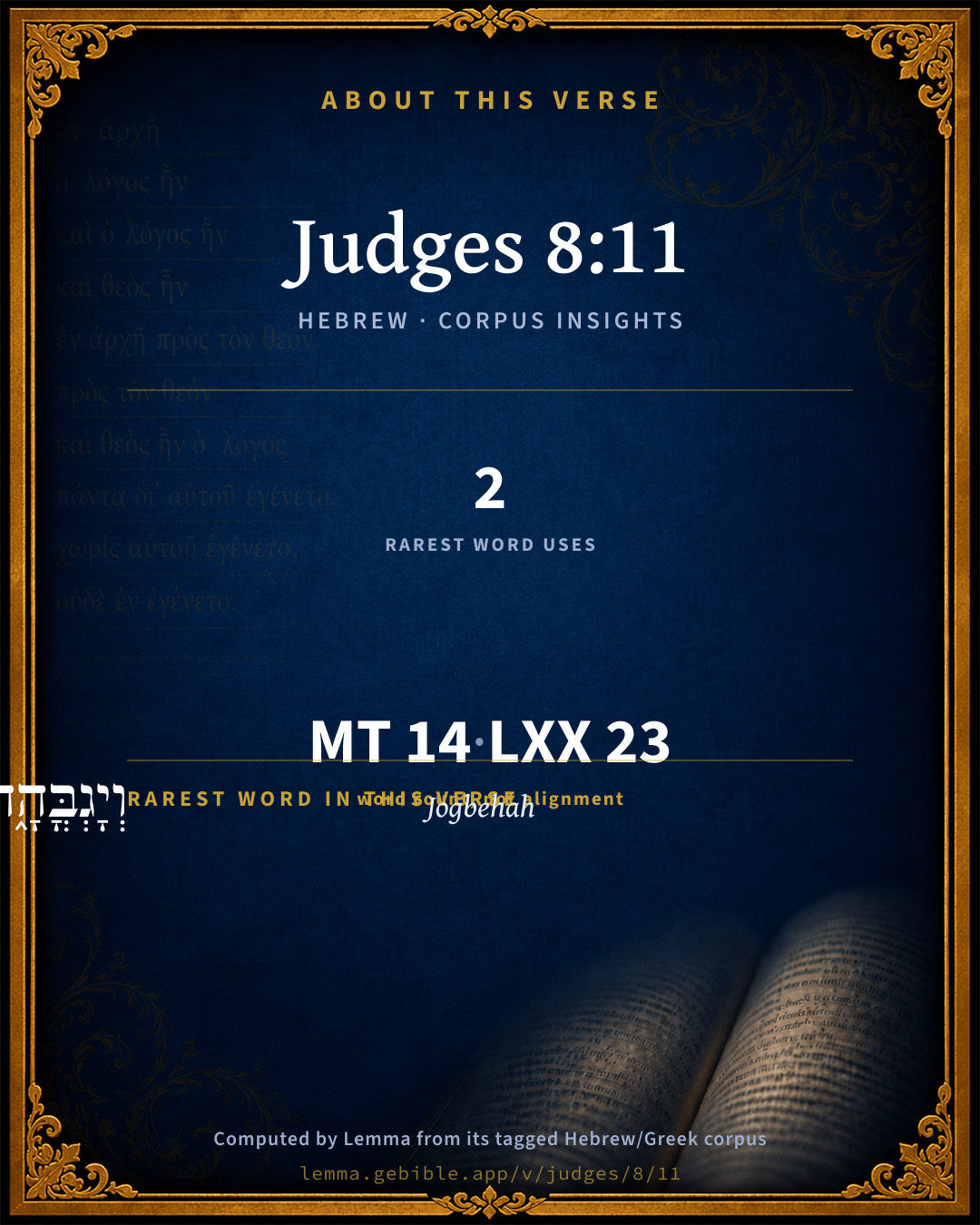
The rarest word here is וְיָגְבֳּהָ֑ה Jogbehah H3011 — appearing just 2 times in the whole Hebrew Bible.

Shared distinctive vocabulary

וְיָגְבֳּהָ֑ה Jogbehah H3011 occurs in 2 verses of the Hebrew Bible. Also found in:

Grammatical profile

  • 4 verbs
  • 9 nouns
  • 1 particle

Verb forms

  • וַיַּ֣עַל Qal · Sequential Imperfect
  • הַשְּׁכוּנֵ֣י Qal · Participle Passive
  • וַיַּךְ֙ Hiphil · Sequential Imperfect
  • הָ֥יָה Qal · Perfect

Repetition

A word recurs within this verse — often emphatic in Hebrew:

  • הַֽמַּחֲנֶ֔ה camp H4264 ×2

Hebrew & Septuagint length

In English translation the verse runs 28 words from the Hebrew and 28 from the Septuagint (LXX English) — the same length.

A rough comparison of the two English renderings, which tokenize alike — not a word-level alignment.

Word counts can differ between the Hebrew and the Greek without any difference in meaning — e.g. the Hebrew direct-object marker אֵת has no separate Greek word, and Greek often adds the article ὁ.

In the original languages it is 14 Hebrew tokens and 23 Greek tokens — but the two are counted differently (Hebrew bundles its prefixes and suffixes into one token; the Greek is in lemma form), so that isn’t a like-for-like length.

Cross-references

6

Topical passages linked to Judges 8:11 in the Treasury of Scripture Knowledge — connected by theme and wording, ordered by reader-vote popularity; previews shown in the World English Bible.

  • Numbers 32:35 and Atrothshophan, and Jazer, and Jogbehah,
  • Numbers 32:42 Nobah went and took Kenath, and the villages of it, and called it Nobah, after his own name.
  • Judges 18:27 They took that which Micah had made, and the priest whom he had, and came to Laish, to a people quiet and secure, and struck them with the edge of the sword; and they burnt the city with fire.
  • 1 Thessalonians 5:3 For when they are saying, "Peace and safety," then sudden destruction will come on them, like birth pains on a pregnant woman; and they will in no way escape.
  • 1 Samuel 15:32 Then said Samuel, Bring you here to me Agag the king of the Amalekites. Agag came to him cheerfully. Agag said, Surely the bitterness of death is past.
  • 1 Samuel 30:16 When he had brought him down, behold, they were spread abroad over all the ground, eating and drinking, and dancing, because of all the great spoil that they had taken out of the land of the Philistines, and out of the land of Judah.

Cross-references courtesy of OpenBible.info (CC BY 4.0).

Hebrew and Greek witnesses Masoretic Hebrew ↔ Greek Septuagint

The same verse in the two great witnesses to the Old Testament, shown verse-for-verse.

These are two independent witnesses, not word-aligned to each other, and the Septuagint is shown in lemma (dictionary) form.

Hebrew Judges 8:11 Masoretic · Westminster Leningrad Codex

וַיַּ֣עַל גִּדְע֗וֹן דֶּ֚רֶךְ הַשְּׁכוּנֵ֣י בָֽאֳהָלִ֔ים מִקֶּ֥דֶם לְנֹ֖בַח וְיָגְבֳּהָ֑ה וַיַּךְ֙ אֶת הַֽמַּחֲנֶ֔ה וְהַֽמַּחֲנֶ֖ה הָ֥יָה בֶֽטַח

Gideon went up by the way of those who lived in tents on the east of Nobah and Jogbehah, and struck the host; for the host was secure.

World English Bible · Public Domain

Greek LXX Judges 8:11 Septuagint · lemma form

καί ἀναβαίνω γεδεων ὁδός ὁ σκηνόω ἐν σκηνή ἀπό ἀνατολή ὁ ναβαι καί ιεγεβαλ καί πατάσσω ὁ παρεμβολή καί ὁ παρεμβολή εἰμί πείθω

And Gedeon went up by the way of them that lived in tents, eastward of Nabai and Jegebal; and he struck the host, and the host was secure.

LXX2012 (modern English Septuagint) · Public Domain

Hebrew: Westminster Leningrad Codex (CC BY 4.0). Greek: Septuagint (public domain); English from LXX2012 (modern English Septuagint) (Public Domain). How the Septuagint differs from the Hebrew →

Targum (Aramaic paraphrase)

1

The Targum is the ancient Jewish Aramaic paraphrase of the Hebrew Scriptures — an interpretive translation, not the Hebrew text itself. Onkelos (literal) and Pseudo-Jonathan (expansive) render the Torah, and Jonathan the Prophets. Coverage is partial: where no permissively-licensed English translation exists for a verse, only the Aramaic is shown. This is verse-level text, not a word-by-word alignment to the Hebrew.

  1. Targum Jonathan Prophets (Joshua–Malachi)
    וּסְלֵיק גִדְעוֹן בְּאוֹרַח מַשִׁרְיַת עֲרָבָאֵי דְשָׁרָן בִּשְׁכוּנִין בְּמַדְבְּרָא מִמַדִינְחָא לְנוֹבַח וְרָמָתָא וּמְחָא יַת מַשְׁרִיתָא וּמַשְׁרִיתָא שַׁרְיָא לְרוֹחְצָן:

    (no public-domain English translation for this verse)

    Targum Jonathan — Aramaic: “Mikraot Gedolot” (public domain). English: “Sefaria Community Translation” (CC0 1.0 (public-domain dedication)); “London "Chaldee Paraphrase," 1871” (public domain). Text via Sefaria.

Commentary

Notes on Judges 8:11 from classic Christian and Jewish commentators (each source and its license shown beneath its notes). The classic Christian expositions comment on the surrounding passage and are grouped to its opening verse, so a note may address several verses; the Jewish commentaries on the Tanakh (Rashi and others) are per-verse, so they appear only where the commentator wrote on this verse.

Lemma curates 59 commentaries, every one of them public domain or Creative Commons licensed, each selected and text-cleaned for this edition rather than reprinted as found. About our sources →

Trapp's Complete Commentary

John Trapp

Jdg 8:11 And Gideon went up by the way of them that dwelt in tents on the east of Nobah and Jogbehah, and smote the host: for the host was secure.

Ver. 11. And Gideon went up by the way of them that dwelt in tents.] The Arabian Nomades or Scenites, who dwelt not in houses or cities, but in movable tents, feeding their cattle, {Jer 49:29} taking up wheresoever night took them. So the Hamaxobii among the Scythians. They had their scouts abroad, doubtless; but he fetched a compass about and came upon the east side, where they never feared any enemy.

For the host was secure.] Security ushereth in destruction; as it did at Tyre, at Babylon, those Amalakites in 1Sa 30:16-17, the Pompeians at the Pharsalian field, {a} the French at the battle of Agincourt, {b} &c.

{a} Caes. Comment.

{b} Speed’s Chron.

John Trapp, A Commentary or Exposition upon All the Books of the Old and New Testament (1647–1656) — public domain. Text from a community e-Sword module.

Joseph Benson's Commentary

Jdg 8:11. By the way of them that dwelt in tents — That is, the Arabians, termed Scenitæ, from their dwelling in tents. He fetched a compass by their country, and so poured in upon the rear of Zebah and Zalmunna, where they suspected no danger. He smote the host; for the host was secure — Being now got safe over Jordan, and a great way from the place of battle. And as they had fled as fast as they could the day before, and part of the preceding night, and were therefore weary, and now thought themselves out of all danger, it is probable they were gone to take their rest, and that Gideon fell upon them when they were fast asleep, as he had done at first on their main army.

Joseph Benson's Commentary on the Old and New Testaments (1811–1818) — public domain. Text from a community e-Sword module.

Geneva Bible (1599)

Geneva Bible translators

He went by the wilderness where the Arabians dwelt in tents.

Geneva Bible (1599) marginal notes — public domain. Text via Bolls.life.

Jamieson, Fausset & Brown

Robert Jamieson, A. R. Fausset & David Brown

Gideon went up by the way of them that dwelt in tents on the east--He tracked the fugitives across the mountain range of Gilead to the northeast of the Jabbok, and there came upon them unexpectedly while they were resting secure among their own nomadic tribes. Jogbehah is supposed to be Ramoth-gilead; and, therefore, the Midianites must have found refuge at or near Abela, "Abel-cheramim," "the plain of the vineyards."

Jamieson, Fausset & Brown — Commentary Critical and Explanatory on the Whole Bible (1871) — public domain (CC PDM 1.0). Text via the HelloAO Bible API.

Ellicott's Commentary for English Readers

(11) By the way of them that dwelt in tents.—He seems to have taken a wide circuit, through some nomad district, leaving the main road, which runs through Nobah and Jogbehah, so as once more to make up for his inferior numbers (for there were still 15,000 left of these children of the East) by surprise and stratagem.

Nobah.—In Gilead, belonging to the half-tribe of Manasseh (Num_32:42). It was originally called Kenath, but the name was altered in honour of a Manassite hero, who is otherwise unrecorded. Jewish tradition says that he was born in Egypt, and died during the passage of the Jordan (Seder Olam Rabba). The original name displaced its rival, for the site is now called Kenâwat.

Jogbehah.—In Gad (Num_32:34). It is not mentioned elsewhere, and has not been identified.

The host was secure.—They would have thought it most unlikely that the Israelites, with their mere handful of men, would pursue so large an army for so long a distance. They fancied themselves beyond the reach of pursuit because they miscalculated the energy and powers of Gideon, who, not improbably, once more attacked them by night.

A Bible Commentary for English Readers, edited by Charles John Ellicott (1878–1897) — public domain. Text from a community e-Sword module.

The Cambridge Bible for Schools and Colleges

gen. ed. J. J. S. Perowne

11. Describes Gideon’s route going E. from Penuel. by the way of them that dwelt in tents is a doubtful rendering of a doubtful text. With slight corrections we may transl. towards the way of the tent-dwellers, i.e. the Bedouin route, such, for instance, as the present Haj road from Damascus to Mecca. The Targ. paraphrases, ‘by the way to the camp of the Arabs who encamp in tents in the desert east of Nobah.’ Strictly by the way of ought to be by the way to a place; hence Moore supposes that the tent-dwellers is a corruption of some place-name.

Nobah] has been identified, on the strength of Num_32:42 (Nobah = Kenath), with Ḳanawât on the west of the Ḥaurân mountains; but this is much too far north. Jogbehah (belonging to Gad, Num_32:35) has survived in the modern ‘Ajbçhât, a ruined site 6 m. N.N.W. of ‘Ammân.

secure] Not expecting an attack; cf. Jdg_18:7; Gen_34:25; Mic_2:8.

The Cambridge Bible for Schools and Colleges (gen. ed. J. J. S. Perowne; Cambridge University Press, 1878–1918) — public domain. Text from a community e-Sword module.

John Gill's Exposition

And Gideon went up by the way of them that dwell in tents,.... That is of the Arabians and Kedarenes, who dwelt in tents for the sake of feeding their flocks, as the Targum and Jarchi; he did not pursue them in the direct road, but went a roundabout way, where these people dwelt, that he might surprise the host of the kings of Midian at an unawares: and he came upon them:

on the east of Nobah and Jogbehah; the first was in the tribe of Manasseh, and the latter in the tribe of Gad, and both it seems were on the confines of those tribes; see Num 32:35 the Targum calls the latter Ramatha; both words have the signification of height in them, this city very probably being built on an eminence. According to Bunting (x) Penuel was two miles from Succoth, Nobah two miles from Penuel, and Jogbehah four miles from Nobah and Karkor four miles from Jogbehah, whither he pursued the kings, and took them, after he had discomfited the army:

and smote the host, for the host was secure: having got over Jordan, and at night very probably, they thought themselves safe from Gideon's army, who they could have no thought that they would come up with them so soon, on foot, weary, and fatigued.

(x) Travels of the Patriarchs, &c. p. 109.

John Gill's Exposition of the Whole Bible (1746–1763) — public domain (CC PDM 1.0). Text via the HelloAO Bible API.

Haydock's Catholic Bible Commentary

Tents. The Scenitæ, (Menochius) who inhabited part of the desert Arabia. (Calmet) --- Hurt. They had probably been mounted on camels, &c., (Haydock) and did not suspect that Gedeon would be so soon after them across the Jordan. (Menochius)

George Leo Haydock (1774–1849), Haydock's Catholic Family Bible and Commentary, 1859 edition — public domain. Excludes Psalms (Douay-Rheims chapter numbering differs from Protestant) and Deuterocanonical books (Catholic canon only).

Matthew Poole's English Annotations

Of them that dwelt in tents, i.e. of the Arabians; so fetching a compass, and falling upon them where they least expected it.

Nobah and Jogbehah; of which cities see Num 32:35,42.

The host was secure; being now got safe over Jordan, and a great way from the place of battle; and, probably, supposing Gideon’s men, to be so tired with their hard service, and the great slaughter which they had made, that they would have neither strength nor will to pursue them so far.

Matthew Poole's English Annotations on the Holy Bible (1683–1685) — public domain. Text from a community e-Sword/MySword module.

Whedon's Commentary on the Bible

Daniel D. Whedon

11. Way of them that dwelt in tents — A section of that eastern desert thickly dotted with the tents of resident shepherds.

Nobah — The more ancient name was Kenath, but, having been captured by the Mannasite Nobah, it was afterwards called by his name. See at Num_32:42. It has been identified with the modern Kunnawat, far to the east of the Sea of Galilee.

Jogbehah — No trace of this place has been found.

The host was secure — Supposed themselves beyond pursuit, and out of the way of danger.

Daniel D. Whedon (gen. ed.), Commentary on the Old and New Testaments (1874–1909) — public domain. Text from a community e-Sword module.

The Pulpit Commentary

Gideon went up. See ver. 8, note. Implying that his direction was eastward away from the Jordan valley. Nobah was in the half-tribe of Manasseh. Nobah, who gave his name to the city, which was before called Kenath, seems to have been of the family of Machir. (Num_32:42) Jogbehah was in the tribe of Gad. (Num_32:35) These two cities appear to have been on the eastern frontier of their respective tribes, but the exact site of them is utterly unknown. It is a conjecture that possibly Kunawat may be Nobah, retaining its ancient name of Kenath. East of these cities was the desert, inhabited by nomads dwelling in tents, where Karkor was, and where Zebah and Zalmunna had encamped out of reach, as they thought, of their pursuers. But Gideon, falling suddenly upon them, routed the host, and took the two kings prisoners. (see Psa_83:11)

The Pulpit Commentary (1880–1919), ed. H.D.M. Spence-Jones & Joseph S. Exell — public domain. Text from a community e-Sword module.

John Wesley's Explanatory Notes

That dwelt in tents - That is, of the Arabians, so fetching a compass, and falling upon them where they least expected it. Was secure - Being now got safe over Jordan, and a great way from the place of battle; and probably, supposing Gideon's men to be so tired with their hard service, that they would have neither strength nor will to pursue them so far.

John Wesley, Explanatory Notes Upon the Whole Bible (1754–1765) — public domain. Text via the GEBible commentary corpus.

unfoldingWord translationNotes

Door43 World Missions Community

Gideon went up

Here "Gideon" represents himself and all of his soldiers. AT: "Gideon and his soldiers went up" (See: Synecdoche)

He defeated

Here "He" refers to Gideon and represents himself and all of his soldiers. AT: "Gideon and his soldiers defeated" (See: Synecdoche)

Nobah and Jogbehah

These are names of towns. (See: How to Translate Names)

Zebah and Zalmunna

See how you translated these names in Judges 8:5.

panic

extreme fear or worry that makes someone unable to think or act normally

translationWords

Gideon

king

Midian

unfoldingWord translationNotes — © Distant Shores Media and the Door43 World Missions Community, licensed CC BY-SA 4.0. Source: git.door43.org/Door43/en_tn.

Rashi

Rabbi Shlomo Yitzchaki (Rashi)

By way of the tent dwellers. By way of the lands of Kedar and Arabia, whose inhabitants were wilderness tent dwellers. Since they were occupied exclusively as shepherds, they could not dwell in houses.

East of Novach and Yagbeha. These were Yisroelite cities. He chose not to pass through them, but rather travelled roundabout, so that they would remain undetected, and could overwhelm them by surprise.

Rashi on the Tanakh — English translations: “The Judaica Press complete Tanach with Rashi, translated by A. J. Rosenberg” (CC BY 4.0); “Pentateuch with Rashi's commentary by M. Rosenbaum and A.M. Silbermann, 1929-1934” (public domain); “The Metsudah Tanach series, Lakewood, N.J” (CC BY 4.0); and “The Book of Joshua, Metsudah Publications, 1997” (CC BY 4.0). Text via Sefaria.

Lesson kit

Teaching starters — assembled from the data on this page, not authored interpretation. Every prompt links to the verse data it draws on. Edit before teaching.

Judges, in the Historical, opens this verse with 14 words (13 distinct Hebrew lemmas). Its most distinctive word is Yogbᵉhâh (“Jogbehah”). A historical commentator’s framing appears above. Read the whole chapter for the surrounding context.

Discussion questions

  1. What does “Jogbehah” (Yogbᵉhâh) contribute to the verse as a whole?
  2. Numbers 32:35 shares the word «Jogbehah» with this verse. How do the two illuminate each other?
  3. “camp” occurs 2× in this one verse. What is the effect of the repetition?
  4. The translations on this page render this verse differently — a whole-verse word diff, not a word-by-word alignment. What might account for the different wordings?
  5. The verb «וַיַּ֣עַל» is Qal Sequential Imperfect. How does its form color the action?
  6. Reading how Trapp's Complete Commentary and Joseph Benson's Commentary read this verse, where do the two commentators agree and where do they part?

Things to notice

Reading settings

Reading text

Shown beneath each verse's original-language words.

Old Testament
Old Testament edition

Read the OT as the Masoretic Hebrew (MT) or the Greek Septuagint (LXX).

English shown for the Greek Septuagint (in the Hebrew ↔ Greek comparison).

Comparing translations? Open the Compare panel on any verse page to stack up to four side by side.