
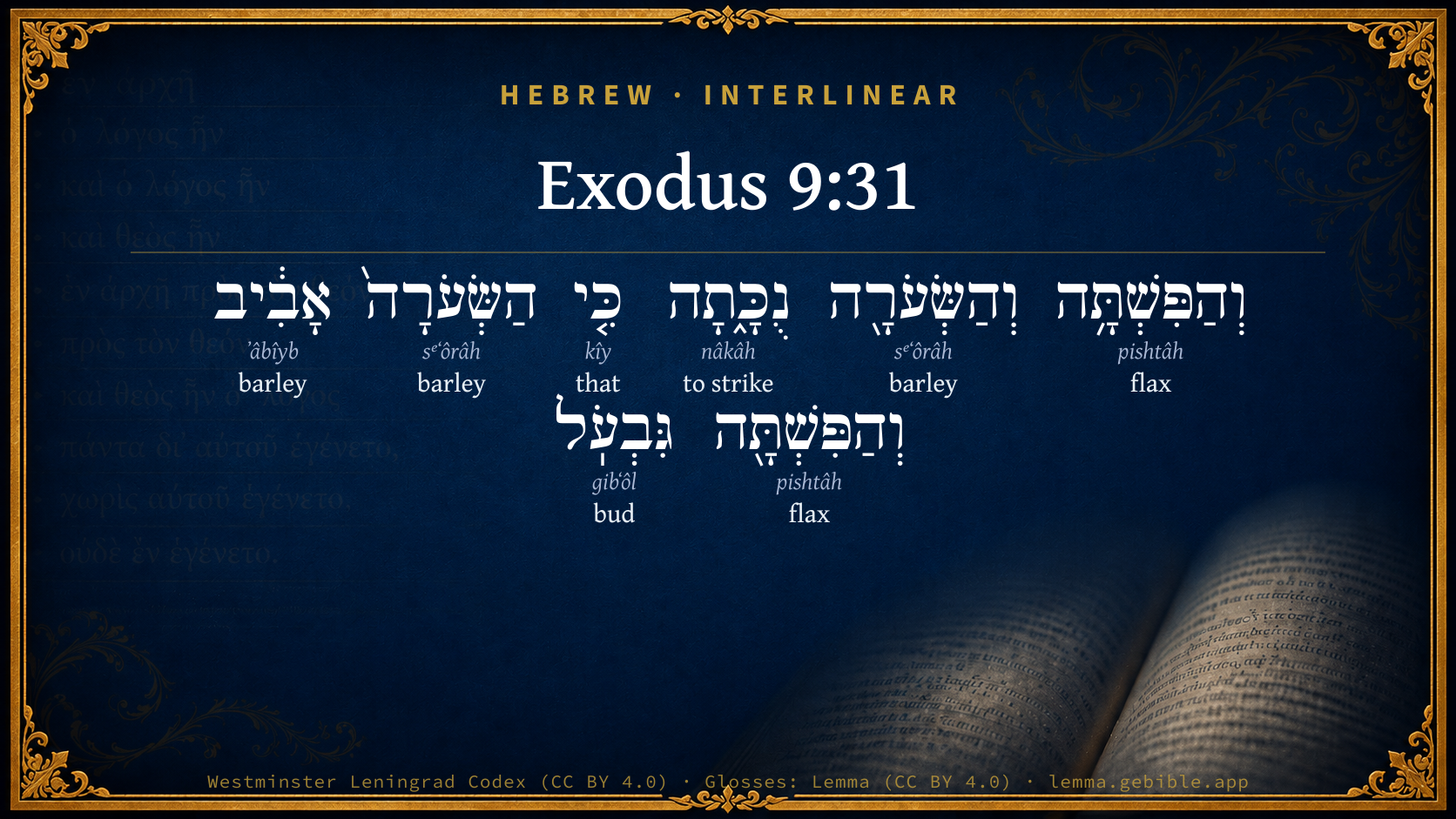
Exodus 9:31

Hebrew (Westminster Leningrad Codex) Exodus 9:31 appears in the Hebrew Old Testament. The text above is from the Westminster Leningrad Codex. Each word links to its Strong’s number, a concise gloss, and parsing drawn from the Open Scriptures Hebrew Bible morphology. Click any word for its full Brown-Driver-Briggs (BDB) entry.
Download image
Cite this verse

Exodus 9:31 (World English Bible). Public Domain. Lemma interlinear Bible study tool, https://lemma.gebible.app/v/exodus/9/31.

Show BibTeX & RIS
BibTeX
RIS
English Translation
The flax and the barley were struck, for the barley was in the ear, and the flax was in bloom.
World English Bible · Public Domain
Highlights
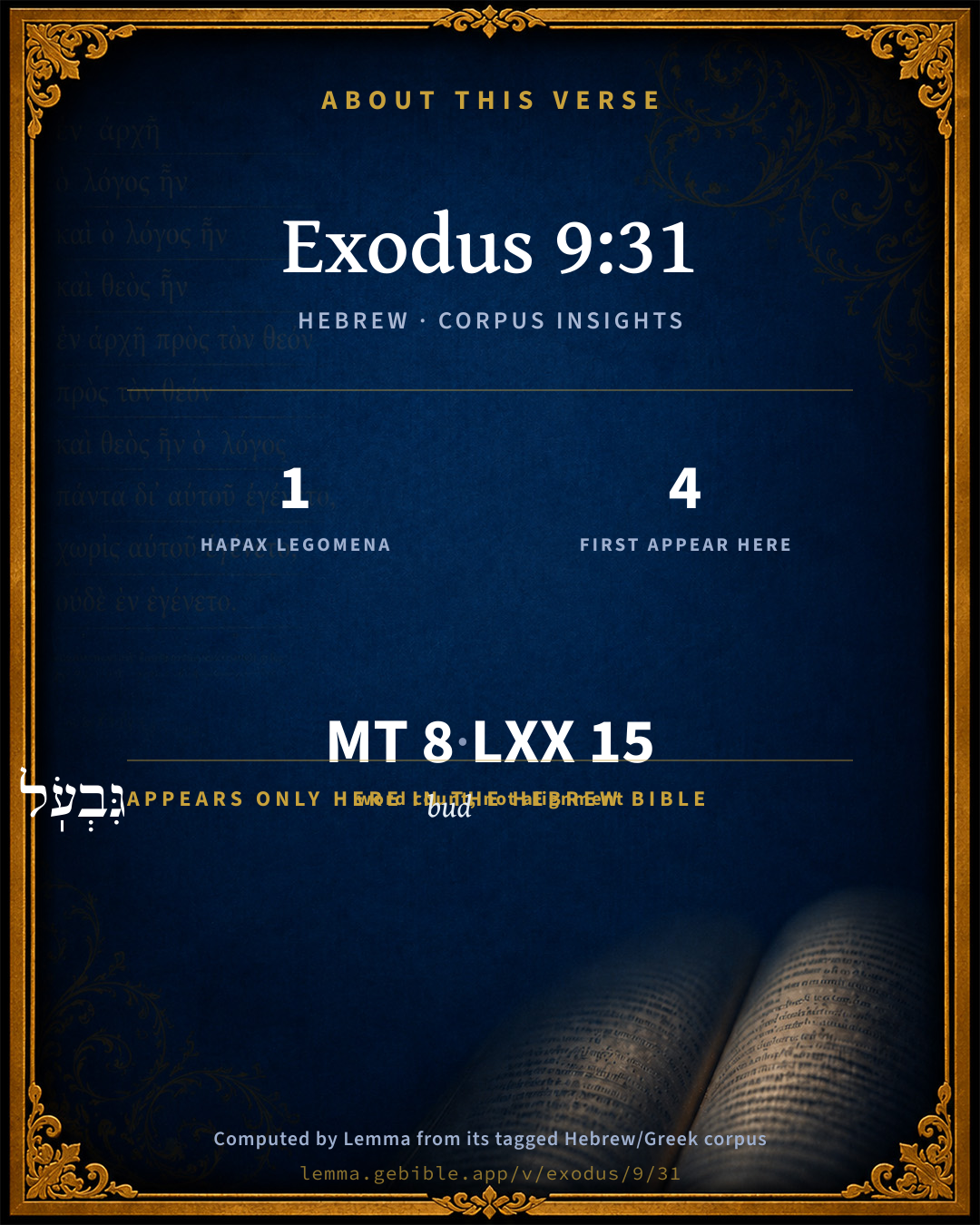
  • 1 hapax legomenon — only here in the Hebrew Bible
  • 4 first appearances in the Hebrew Bible
Full analysis ↓
Download a study sheet

One document with this verse’s original text, its word-by-word gloss line, the meaning frame, cross-references with their text, attributed commentary, and full source and license credits — printable, and it pastes into notes with its structure intact.

This verse Autodidact and up

Study sheet (.html) Plain text (.txt)

A passage Seminary Student

Up to 50 verses in one chapter. A passage sheet keeps up to 6 commentary sources and 12 cross-references per verse, in the order this page ranks them, and says so on the sheet whenever that leaves anything out. Ask for a single verse and you get the Autodidact verse sheet above.

Everything on this page stays free to read, with no account — the sheet is a download of what is already on screen, not access to it.

Want to remove ads? Support Godless Engineer
Compare translations 3

The same verse in 3 English versions, stacked beneath the original-language interlinear above. Click any original word for its lexicon entry.

Each is an independent rendering of the whole verse — the interlinear is not word-aligned to these translations.

Highlighted words mark where these versions differ — a whole-verse word diff, not a word-by-word alignment.

  • World English Bible Public Domain
    The flax and the barley were struck, for the barley was in the ear, and the flax was in bloom.
  • King James Version Public Domain
    And the flax and the barley was smitten: for the barley was in the ear, and the flax was bolled.
  • unfoldingWord Literal Text CC BY-SA 4.0
    (And the flax and the barley were struck down, for the barley was in ear, and the flax was in bloom.

unfoldingWord Literal Text — © unfoldingWord, licensed CC BY-SA 4.0. Word-aligned USFM3 via Door43 (git.door43.org/unfoldingWord/en_ult).

Versions to compare (up to 4)

3 of 4 selected

Show all 18 translations

Every available English version of this verse, each an independent rendering of the whole verse.

  • World English Bible Public Domain
    The flax and the barley were struck, for the barley was in the ear, and the flax was in bloom.
  • Berean Standard Bible Public Domain
    (Now the flax and barley were destroyed, since the barley was ripe and the flax was in bloom;
  • Majority Standard Bible Public Domain
    (Now the flax and barley were destroyed, since the barley was ripe and the flax was in bloom;
  • King James Version Public Domain
    And the flax and the barley was smitten: for the barley was in the ear, and the flax was bolled.
  • American Standard Version (1901) Public Domain
    And the flax and the barley were smitten: for the barley was in the ear, and the flax was in bloom.
  • Revised Version (1885) Public Domain
    And the flax and the barley were smitten: for the barley was in the ear, and the flax was bolled.
  • Geneva Bible (1599) Public Domain
    (And the flaxe, and the barley were smitten: for the barley was eared, and the flaxe was bolled.
  • Douay-Rheims (1899) Public Domain
    The flax therefore and the barley were hurt, because the barley was green, and the flax was now boiled:
  • Young's Literal Translation Public Domain
    And the flax and the barley have been smitten, for the barley `is' budding, and the flax forming flowers,
  • Literal Standard Version CC BY-SA 4.0
    And the flax and the barley have been struck, for the barley [is] budding, and the flax forming flowers,
  • Unlocked Literal Bible CC BY-SA 4.0
    Now the flax and the barley were ruined, for the barley was maturing in the ear, and the flax was in bloom.
  • unfoldingWord Literal Text CC BY-SA 4.0
    (And the flax and the barley were struck down, for the barley was in ear, and the flax was in bloom.
  • Darby Bible Public Domain
    And the flax and the barley were smitten; for the barley was in the ear, and the flax was bolled.
  • World Messianic Bible Public Domain
    The flax and the barley were struck, for the barley had ripened and the flax was blooming.
  • Webster's Bible Public Domain
    And the flax and the barley were smitten: for the barley was in the ear, and the flax was bolled.
  • Free Bible Version CC BY-SA 4.0
    (The flax and barley were destroyed, because the barley was ripe and the flax was flowering.
  • Bible in Basic English Public Domain
    And the flax and the barley were damaged, for the barley was almost ready to be cut and the flax was in flower.
  • JPS Tanakh (1917) Public Domain
    And the flax and the barley were smitten; for the barley was in the ear, and the flax was in bloom.

Literal Standard Version (2020), Covenant Press — licensed CC BY-SA 4.0. Text via the HelloAO Bible API (eBible.org). Unlocked Literal Bible (unfoldingWord) — licensed CC BY-SA 4.0. Text via the HelloAO Bible API (eBible.org). unfoldingWord Literal Text — © unfoldingWord, licensed CC BY-SA 4.0. Word-aligned USFM3 via Door43 (git.door43.org/unfoldingWord/en_ult). Free Bible Version, Dr. Jonathan Gallagher — licensed CC BY-SA 4.0. Text via the HelloAO Bible API (eBible.org).

Word by word

More ways to search: Search by grammar → Find every occurrence → Compare this word →

Practice this passage: Drill this verse → Learn its vocabulary →

About this verse

These counts appear in no published source. They are computed here, from the morphology-tagged text and Lemma’s own curated glosses. What Lemma adds →

8
words
6
distinct lemmas
Pentateuch
section

Notable vocabulary

1 hapax legomenon — a word that appears only here in the entire Hebrew Bible:

  • גִּבְעֹֽל bud H1392

First appearance in Scripture

These words make their first canonical appearance in the Hebrew Bible here:

  • וְהַפִּשְׁתָּ֥ה flax H6594
  • וְהַשְּׂעֹרָ֖ה barley H8184
  • אָבִ֔יב barley H24
  • גִּבְעֹֽל bud H1392

Shared distinctive vocabulary

וְהַפִּשְׁתָּ֥ה flax H6594 occurs in 3 verses of the Hebrew Bible. Also found in:

Grammatical profile

  • 1 verb
  • 6 nouns
  • 1 conjunction

Verb forms

  • נֻכָּ֑תָה Pual · Perfect

Repetition

Words recur within this verse — often emphatic in Hebrew:

  • וְהַפִּשְׁתָּ֥ה flax H6594 ×2
  • וְהַשְּׂעֹרָ֖ה barley H8184 ×2

Hebrew & Septuagint length

In English translation the verse runs 20 words from the Hebrew and 18 from the Septuagint (LXX English) — closely comparable.

A rough comparison of the two English renderings, which tokenize alike — not a word-level alignment.

Word counts can differ between the Hebrew and the Greek without any difference in meaning — e.g. the Hebrew direct-object marker אֵת has no separate Greek word, and Greek often adds the article ὁ.

In the original languages it is 8 Hebrew tokens and 15 Greek tokens — but the two are counted differently (Hebrew bundles its prefixes and suffixes into one token; the Greek is in lemma form), so that isn’t a like-for-like length.

Cross-references

4

Topical passages linked to Exodus 9:31 in the Treasury of Scripture Knowledge — connected by theme and wording, ordered by reader-vote popularity; previews shown in the World English Bible.

  • Ruth 1:22 So Naomi returned, and Ruth the Moabitess, her daughter-in-law, with her, who returned out of the country of Moab: and they came to Bethlehem in the beginning of barley harvest.
  • Ruth 2:23 So she kept fast by the maidens of Boaz, to glean to the end of barley harvest and of wheat harvest; and she lived with her mother-in-law.
  • Amos 4:9 I struck you with blight and mildew many times in your gardens and your vineyards; And your fig trees and your olive trees have the swarming locust devoured: Yet you haven't returned to me," says Yahweh.
  • Habakkuk 3:17 For though the fig tree doesn't flourish, Nor fruit be in the vines; The labor of the olive fails, The fields yield no food; The flocks are cut off from the fold, And there is no herd in the stalls:

Cross-references courtesy of OpenBible.info (CC BY 4.0).

Hebrew and Greek witnesses Masoretic Hebrew ↔ Greek Septuagint

The same verse in the two great witnesses to the Old Testament, shown verse-for-verse.

These are two independent witnesses, not word-aligned to each other, and the Septuagint is shown in lemma (dictionary) form.

Hebrew Exodus 9:31 Masoretic · Westminster Leningrad Codex

וְהַפִּשְׁתָּ֥ה וְהַשְּׂעֹרָ֖ה נֻכָּ֑תָה כִּ֤י הַשְּׂעֹרָה֙ אָבִ֔יב וְהַפִּשְׁתָּ֖ה גִּבְעֹֽל

The flax and the barley were struck, for the barley was in the ear, and the flax was in bloom.

World English Bible · Public Domain

Greek LXX Exodus 9:31 Septuagint · lemma form

ὁ δέ λίνον καί ὁ κριθή πλήσσω ὁ γάρ κριθή παραἵστημι ὁ δέ λίνον σπερματίζω

And the flax and the barley were struck, for the barley was advanced, and the flax was seeding.

LXX2012 (modern English Septuagint) · Public Domain

On this verse, Adam Clarke's Commentary discusses the Septuagint’s reading. Read the note in Commentary ↓

Hebrew: Westminster Leningrad Codex (CC BY 4.0). Greek: Septuagint (public domain); English from LXX2012 (modern English Septuagint) (Public Domain). How the Septuagint differs from the Hebrew →

Targum (Aramaic paraphrase)

2

The Targum is the ancient Jewish Aramaic paraphrase of the Hebrew Scriptures — an interpretive translation, not the Hebrew text itself. Onkelos (literal) and Pseudo-Jonathan (expansive) render the Torah, and Jonathan the Prophets. Coverage is partial: where no permissively-licensed English translation exists for a verse, only the Aramaic is shown. This is verse-level text, not a word-by-word alignment to the Hebrew.

  1. Targum Onkelos Torah (Genesis–Deuteronomy)
    וְכִתָּנָא וְסַעֲרֵי לְקוֹ אֲרֵי סַעְרַנְיָא אַבִּיבִין וְכִתָּנָא גַבְעוֹלִין:

    (no public-domain English translation for this verse)

    Targum Onkelos — Aramaic: “Onkelos Genesis” (public domain); “Onkelos Exodus” (public domain); “Onkelos Leviticus” (public domain); “Onkelos Numbers” (public domain); “Onkelos Deuteronomy” (public domain). English: “Sefaria Community Translation” (CC0 1.0 (public-domain dedication)); “J.W. Etheridge. The Targums of Onkelos and Jonathan Ben Uzziel on the Pentateuch. London: Longmans, Green, 1862” (public domain). Text via Sefaria.

  2. Targum Pseudo-Jonathan Torah (Genesis–Deuteronomy)
    וְכִתְּנָא וְסַרְתָּא לָקוּן אֲרוּם סַרְתָּא הֲוָות כְּסִירָא וְכִיתְנָא עָבַד פּוּקְלִין

    And the flax and the barley were beaten down, because the barley was in the ear, and the flax was making pods.

    Targum Pseudo-Jonathan — Aramaic: “Targum Jonathan on Genesis” (public domain); “Targum Jonathan on Exodus” (public domain); “Targum Jonathan on Leviticus” (public domain); “Targum Jonathan on Numbers” (public domain); “Targum Jonathan on Deuteronomy” (public domain). English: “The Targum of Jonathan ben Uzziel, trans. J. W. Etheridge, London, 1862” (public domain). Text via Sefaria.

Commentary

Notes on Exodus 9:31 from classic Christian and Jewish commentators (each source and its license shown beneath its notes). The classic Christian expositions comment on the surrounding passage and are grouped to its opening verse, so a note may address several verses; the Jewish commentaries on the Tanakh (Rashi and others) are per-verse, so they appear only where the commentator wrote on this verse.

Lemma curates 59 commentaries, every one of them public domain or Creative Commons licensed, each selected and text-cleaned for this edition rather than reprinted as found. About our sources →

Trapp's Complete Commentary

John Trapp

Exo 9:31 And the flax and the barley was smitten: for the barley [was] in the ear, and the flax [was] bolled.

Ver. 31, 32. And the flax and the barley.] We need not wonder that in Egypt their barley harvest was so long before their wheat harvest; since, from the overflow of the Nile, and the difference of the climate, it must, needs be otherwise with them than with other countries.

John Trapp, A Commentary or Exposition upon All the Books of the Old and New Testament (1647–1656) — public domain. Text from a community e-Sword module.

Joseph Benson's Commentary

Exo 9:31. The flax and barley were smitten — Which were not so necessary for human life as the wheat and rye. Thus God sends smaller judgments before the greater. The flax was bolled — Grown into a stalk.

Joseph Benson's Commentary on the Old and New Testaments (1811–1818) — public domain. Text from a community e-Sword module.

Keil & Delitzsch

C. F. Keil & F. Delitzsch

The account of the loss caused by the hail is introduced very appropriately in Exo 9:31 and Exo 9:32, to show how much had been lost, and how much there was still to lose through continued refusal. "The flax and the barley were smitten, for the barley was ear, and the flax was גּבעל (blossom); i.e., they were neither of them quite ripe, but they were already in ear and blossom, so that they were broken and destroyed by the hail. "The wheat," on the other hand, "and the spelt were not broken down, because they were tender, or late" (אפילת); i.e., they had no ears as yet, and therefore could not be broken by the hail. These accounts are in harmony with the natural history of Egypt. According to Pliny, the barley is reaped in the sixth month after the sowing-time, the wheat in the seventh. The barley is ripe about the end of February or beginning of March; the wheat, at the end of March or beginning of April. The flax is in flower at the end of January. In the neighbourhood of Alexandria, and therefore quite in the north of Egypt, the spelt is ripe at the end of April, and farther south it is probably somewhat earlier; for, according to other accounts, the wheat and spelt ripen at the same time (vid., Hengstenberg, p. 119). Consequently the plague of hail occurred at the end of January, or at the latest in the first half of February; so that there were at least eight weeks between the seventh and tenth plagues. The hail must have smitten the half, therefore, of the most important field-produce, viz., the barley, which was a valuable article of food both for men, especially the poorer classes, and for cattle, and the flax, which was also a very important part of the produce of Egypt; whereas the spelt, of which the Egyptians preferred to make their bread (Herod. 2, 36, 77), and the wheat were still spared.

Keil & Delitzsch — Biblical Commentary on the Old Testament (1861–1891) — public domain (CC PDM 1.0). Text via the HelloAO Bible API. (Old Testament only.)

Jamieson, Fausset & Brown

Robert Jamieson, A. R. Fausset & David Brown

the flax and the barley was smitten, &c.--The peculiarities that are mentioned in these cereal products arise from the climate and physical constitution of Egypt. In that country flax and barley are almost ripe when wheat and rye (spelt) are green. And hence the flax must have been "bolled"--that is, risen in stalk or podded in February, thus fixing the particular month when the event took place. Barley ripens about a month earlier than wheat. Flax and barley are generally ripe in March, wheat and rye (properly, spelt) in April.

Next: Exodus Chapter 10

Jamieson, Fausset & Brown — Commentary Critical and Explanatory on the Whole Bible (1871) — public domain (CC PDM 1.0). Text via the HelloAO Bible API.

Adam Clarke's Commentary

Verse 31. The flax and the barley was smitten] The word פשתה pishtah, flax, Mr. Parkhurst thinks, is derived from the root pashat, to strip, because the substance which we term flax is properly the bark or rind of the vegetable, pilled or stripped off the stalks. From time immemorial Egypt was celebrated for the production and manufacture of flax: hence the linen and fine linen of Egypt, so often spoken of in ancient authors.

Barley] שערה seorah, from שער saar, to stand on end, to be rough, bristly, c. hence שער sear, the hair of the head, and sair, a he-goat, because of its shaggy hair; and hence also barley, because of the rough and prickly beard with which the ears are covered and defended.

Dr. Pocock has observed that there is a double seed-time and harvest in Egypt: Rice, India wheat, and a grain called the corn of Damascus, and in Italian surgo rosso, are sown and reaped at a very different time from wheat, barley and flax. The first are sown in March, before the overflowing of the Nile, and reaped about October; whereas the wheat and barley are sown in November and December, as soon as the Nile is gone off, and are reaped before May.

Pliny observes, Hist. Nat., lib. xviii., cap. 10, that in Egypt the barley is ready for reaping in six months after it is sown, and wheat in seven. In AEgypto HORDEUM sexto a satu mense, FEUMENTA septimo metuntur.

The flax was bolled.] Meaning, I suppose, was grown up into a stalk: the original is גבעל gibol, podded or was in the pod.

The word well expresses that globous pod on the top of the stalk of flax which succeeds the flower and contains the seed, very properly expressed by the Septuagint, το δε λινον σπερματιζον, but the flax was in seed or was seeding.

Adam Clarke's Commentary on the Bible (1810–1826) — public domain. Text from a community e-Sword/MySword module.

Ellicott's Commentary for English Readers

(31) The flax and the barley was smitten.—Flax was grown largely in Egypt, since linen garments were very generally worn by the people, and were the necessary attire of the priests (Herod. ii. 37). Mummies also were swathed in linen bandages (Herod. ii. 86); and soldiers wore linen corselets (Herod. ii. 182, 3:47). Barley was grown as food for horses, as an element in the manufacture of beer, and as a material for an inferior kind of bread. The flax is “bolled”—i.e., forms its seed-vessel—towards the end of January or beginning of February, and the barley comes into ear about the same time. These facts fix the date of this plague, and help to fix the dates both of the earlier and the later ones.

A Bible Commentary for English Readers, edited by Charles John Ellicott (1878–1897) — public domain. Text from a community e-Sword module.

The Cambridge Bible for Schools and Colleges

gen. ed. J. J. S. Perowne

31, 32. A supplementary notice, which interrupts the connexion between vv. 29f. and 33, stating, more explicitly than v. 25b, what crops had suffered in the fields. On account of the information on Egyptian matters which it contains, the notice is referred by Di. and others to E. In Egypt, according to a farmer living in the Delta (cited by W. R. Smith, Journ. of Phil. xii. 300), flax blossoms and barley ripens in Jan.; but, he adds, the seasons vary, and so the travellers cited by Kn. mention mostly Feb.: wheat and spelt are ripe, in any case, about a month later. As the wheat and the spelt were not yet up, the hail will be represented as coming in Jan. (Kn.), if not earlier.

Flax was much cultivated in Egypt: for linen was worn constantly by men of rank, and exclusively by the priests (Hdt. ii. 37); wrappings for mummies were also made of it. There are many representations on the Egyptian monuments of the processes by which flax was converted into linen; and the linen itself was often of remarkable transparency and fineness (Erman, pp. 448, 449 f.; Wilk.-B. ii.157 f., 165 f.; cf. Gen_41:42; Eze_27:7; Hdt. ii. 81, 105).

was bolled] was in bud. The Heb. word occurs only here in the OT.; but, as Ges. shews, this is the meaning of gib‘ôl in the Mishna.

‘Bolled’ is a now obsolete expression meaning podded (lit. swollen, akin to bowl, bellows, billow, &c.) for seed. The old verb was bolnen, to swell. Aldis Wright mentions that the later of the Wycliffite versions has in Col_2:18 bolnyd for ‘puffed up,’ and that in Holland’s Pliny ‘bolled leekes’ is the rendering of ‘porrum capitatum.’ He adds that ‘bolled’ in the sense of podded is still in use in Ireland, as it is also in Lincolnshire (Jos. Wright, Dialect Dict. i. 332): cf. the remark on the word in the Preface to RV.

The Cambridge Bible for Schools and Colleges (gen. ed. J. J. S. Perowne; Cambridge University Press, 1878–1918) — public domain. Text from a community e-Sword module.

John Gill's Exposition

But the wheat and the rye were not smitten,.... Bruised, broken, beat down, and destroyed by hail: the word by us rendered "rye", and by other "fitches" or "spelt", is thought by Dr. Shaw (q) to be "rice", of which there were and still are plantations in Egypt; whereas rye is little, if at all known in those countries, and besides is of the quickest growth; and he observes that rice was the "olyra" of the ancient Egyptians, by which word the Septuagint render the Hebrew word here; and from Pliny (r) we learn, that "olyra", and "oryza", or rice, are the same, and which with the Greeks is "zea", by which some translate the word here:

for they were not grown up; and so their leaves, as the same traveller observes, were at that time of so soft and yielding a nature, that the hail by meeting with no resistance, as from the flax and barley, did them no harm; and so the Septuagint and Vulgate Latin versions render it: "they were late"; and so the Targum of Jonathan and Jarchi interpret it: for the wheat harvest with the Jews, and so with the Egyptians, was later than the barley harvest, there being about a month's difference between them: some render the word "dark or hidden" (s) because, as Aben Ezra says, they were now under ground; and if this was the case, indeed the reason is clear why they were not smitten; but this was not the case, for, according to Pliny (t), there was but one month's difference in Egypt between the barley and the wheat; but rather they are said to be so, because the ear was as yet hid, and was not come forth; it just began to spindle, or, as the above traveller explains it, they were of a dark green colour, as young corn generally is, as contradistinction to its being of a bright yellow or golden colour, when it is ripe; for, adds he, the context supposes the wheat and the rice not only to have been sown, but to have been likewise in some forwardness, as they well might be in the month of Abib, answering to our March.

(q) Travels, tom. 2. c. 2. sect. 5. p. 407. Ed. 2. (r) Nat. Hist. l. 18. c. 7. 9. (s) "caliginosa", Montanus, Vatablus; "latuerant", Tigurine version; "latentia", Junius & Tremellius, Piscator, Drusius. (t) Ut supra. (Nat. Hist. l. 18. c. 7. 9.)

John Gill's Exposition of the Whole Bible (1746–1763) — public domain (CC PDM 1.0). Text via the HelloAO Bible API.

Matthew Poole's English Annotations

The flax and the barley were not so necessary for human life as the wheat and rye. Thus God still sends smaller judgments to usher in the greater.

Matthew Poole's English Annotations on the Holy Bible (1683–1685) — public domain. Text from a community e-Sword/MySword module.

Whedon's Commentary on the Bible

Daniel D. Whedon

31, 32. And the flax and the barley was smitten — Flax was a most important crop in Egypt, as great quantities of linen were required for clothing and for the bandages of mummies, as well as for exportation. The barley was in the ear and the flax was bolled — These verses give us the first decisive indication of the time of the year when these events took place. The barley was in the ear and the flax was in the flower or blossom. In Egypt flax flowers at the end of January, and flax and barley are both ripe at the end of February or the first of March; but wheat and doora do not ripen till April. This plague, then, took place in the last of January or the first of February. From January to April is also the very time when cattle there are in pasture. The author thus shows a minute acquaintance with the agriculture and natural history of Egypt.

The wheat and the rye — Rather, wheat and spelt, a grain closely resembling wheat, the common food of the ancient Egyptians, and now well known and much used under the name of doora. All the processes of cultivating and gathering these grains, and the operations of watering the flax, beating the stalks when gathered, and of manufacturing them into twine and cloth, are fully represented in the paintings of the Egyptian tombs. Wilkinson states that the Egyptian linen was remarkably fine in texture, equal in quality to the best now made, and superior to the modern article in the evenness of its threads. Zoan or Tanis was famous for its flax fields. The storm that would destroy barley in the ear, and flax in the blossom, would be too early in the season to cut off the wheat and spelt, which were not yet high enough to be broken by the hail, and consequently escaped destruction.

Daniel D. Whedon (gen. ed.), Commentary on the Old and New Testaments (1874–1909) — public domain. Text from a community e-Sword module.

The Pulpit Commentary

Vers. 31, 32. These verses seem out of place, containing, as they do, an account of the damage done by the hail, and being thus exegetical of verse 25. They are a sort of afterthought, inserted parenthetically, and preparethe way for the understanding of the next plague; since, if the damage done by the hail had extended to all the crops, there would have been nothing left for the locusts to devour.

The flax and the barley was smitten. Flax was largely cultivated by the Egyptians, who preferred linen garments to any other (Heb 2:37), and allowed the priests to wear nothing but linen. Several kinds of flax are mentioned as grown in Egypt (Plin. H. N. 19:1); and the neighbourhood of Tanis is expressly said to have been one of the places where the flax was produced. The flax is boiled, i.e. blossoms towards the end of January or beginning of February, and the barley comes into ear about the same time, being commonly cut in March. Barley was employed largely as the food of horses, and was used also for the manufacture of beer, which was a common Egyptian beverage. A certain quantity was made by the poorer classes into bread.

The Pulpit Commentary (1880–1919), ed. H.D.M. Spence-Jones & Joseph S. Exell — public domain. Text from a community e-Sword module.

unfoldingWord translationNotes

Door43 World Missions Community

flax

This is a plant that produces fibers that can be made into linen cloth.

barley

This is a type of grain used for making bread; also used for cattle feed.

spelt

This is a kind of wheat.

spread out his hands to Yahweh

This symbolic gesture accompanies prayer. See how you translated a similar phrase in Exodus 9:29. AT: "lifted up his hands toward Yahweh and prayed" (See: Symbolic Action)

translationWords

ruin

wheat

Pharaoh

Yahweh

unfoldingWord translationNotes — © Distant Shores Media and the Door43 World Missions Community, licensed CC BY-SA 4.0. Source: git.door43.org/Door43/en_tn.

Rashi

Rabbi Shlomo Yitzchaki (Rashi)

והפשתה והשערה נכתה AND THE FLAX AND THE BARLEY נכתה — i. e. were broken; it has the same meaning as in, (2 Kings 23:29) “Pharaoh-Necho (נכה)”, which denotes Pharaoh the lame i. e. broken in so far as the power of his legs is concerned (cf. II Samuel 9:3); (Isaiah 16:7) “brocken (נכאים)”, and so too לא נכו (v. 32), “they were not broken”. It would not be correct to explain that it is connected in meaning with the word that signifies “smiting”, הכאה, for a נ cannot take the place of a ה that one may explain נֻכָּתָה as being equivalent to הֻכָּתָה, and נֻכּוּ to הֻכּוּ, but the נ is a root-letter in the verb, and the word נֻכּוּ is of the same grammatical form as the verb in, (Job. 33:21) “and all his bones are laid bare” שֻׁפּוּ (i. e. Pual of כי השערה אביב

כי השערה אביב FOR THE BARLEY WAS IN THE EAR — it had produced its first ears and it stood on its stalks; these were therefore broken and fell. So, too, the flax had already grown and had become hard enough to stand in its capsules.

השערה אביב means [THE BARLEY] STOOD IN RIPE STATE, similar in meaning to, (Song 6:11) “[to look at] the ripe plants (באבי] of the valley”.

Rashi on the Tanakh — English translations: “The Judaica Press complete Tanach with Rashi, translated by A. J. Rosenberg” (CC BY 4.0); “Pentateuch with Rashi's commentary by M. Rosenbaum and A.M. Silbermann, 1929-1934” (public domain); “The Metsudah Tanach series, Lakewood, N.J” (CC BY 4.0); and “The Book of Joshua, Metsudah Publications, 1997” (CC BY 4.0). Text via Sefaria.

Ramban (Nachmanides)

Rabbi Moshe ben Nachman (Ramban / Nachmanides)

AND THE FLAX AND THE BARLEY WERE SMITTEN, etc. Scripture narrates what happened, but I do not know why these two verses were entered in this place before the subject of Moses’ prayer and the removal of the hail was completed. In the name of Rav Saadia Gaon, that there is some proof indicating that Ramban may have seen the Gaon’s commentary in the original Arabic. the commentators have said that these [two verses are also part of] Moses’ words to Pharaoh. He said to him: “Before you had feared G-d and said, The Eternal is the righteous One, the flax and the barley were already smitten and these can no longer be saved. But the wheat and the spelt were not smitten yet, and henceforth you will no longer suffer damage.”I find no sense in this explanation. The hail smote every herb of the field and broke every tree, and the wheat and the spelt were saved only because they had not sprouted at all or because they were so tender that they were not destroyed completely by the hail since they could sprout again. That being the case, even if the hail had continued for days more to come down upon them, there would not be a loss. There was thus no need for Moses to inform Pharaoh of what he lost and what he did not lose, for when the hail will be removed, he will himself see!In my opinion, these are Moses’ words to Pharaoh. Moses said to him: “I know that before the plagues are removed, you fear G-d, and afterward you repeat your folly. Now the flax and the barley were smitten while the wheat and the spelt which are your livelihood were not smitten in this plague, but it is within G-d’s power to destroy them if you return and sin again before Him.” Thus Moses alluded to them that which G-d said later [of the locust], And they shall eat the residue of that which escaped. Bo

Ramban (Nachmanides) on the Tanakh — English translation: “Commentary on the Torah by Ramban (Nachmanides). Translated and annotated by Charles B. Chavel. New York, Shilo Pub. House, 1971-1976” (CC BY 4.0). Text via Sefaria.

Lesson kit

Teaching starters — assembled from the data on this page, not authored interpretation. Every prompt links to the verse data it draws on. Edit before teaching.

Exodus, in the Pentateuch, opens this verse with 8 words (6 distinct Hebrew lemmas). Its most distinctive word is gibʻôl (“bud”). A historical commentator’s framing appears above. Read the whole chapter for the surrounding context.

Discussion questions

  1. How does “bud” (gibʻôl) shape what this verse is saying?
  2. 1 word here appears nowhere else in the Hebrew Bible. Why might the author reach for such rare wording?
  3. 4 words make their first appearance in Scripture here. What does this debut establish?
  4. How does Isaiah 42:3, which shares the word «flax», read alongside this verse?
  5. What does the repetition of “flax” (2× in this one verse) do in this verse?
  6. These translations render this verse differently. What is at stake in choosing one wording over another?
  7. «נֻכָּ֑תָה» is a Pual Perfect verb. How does that grammatical form shape the action described?
  8. Compare how Trapp's Complete Commentary and Joseph Benson's Commentary read this verse. Where do they agree or differ?

Things to notice

  • 1 word in this verse appears nowhere else in the Hebrew Bible.
  • 4 words make their first canonical appearance in Scripture here.
  • This verse counts 8 Hebrew ↔ 15 Greek words.
  • These translations choose different wording for 5 words in this verse.
  • “flax” occurs 2× in this single verse.

Reading settings

Reading text

Shown beneath each verse's original-language words.

Old Testament
Old Testament edition

Read the OT as the Masoretic Hebrew (MT) or the Greek Septuagint (LXX).

English shown for the Greek Septuagint (in the Hebrew ↔ Greek comparison).

Comparing translations? Open the Compare panel on any verse page to stack up to four side by side.