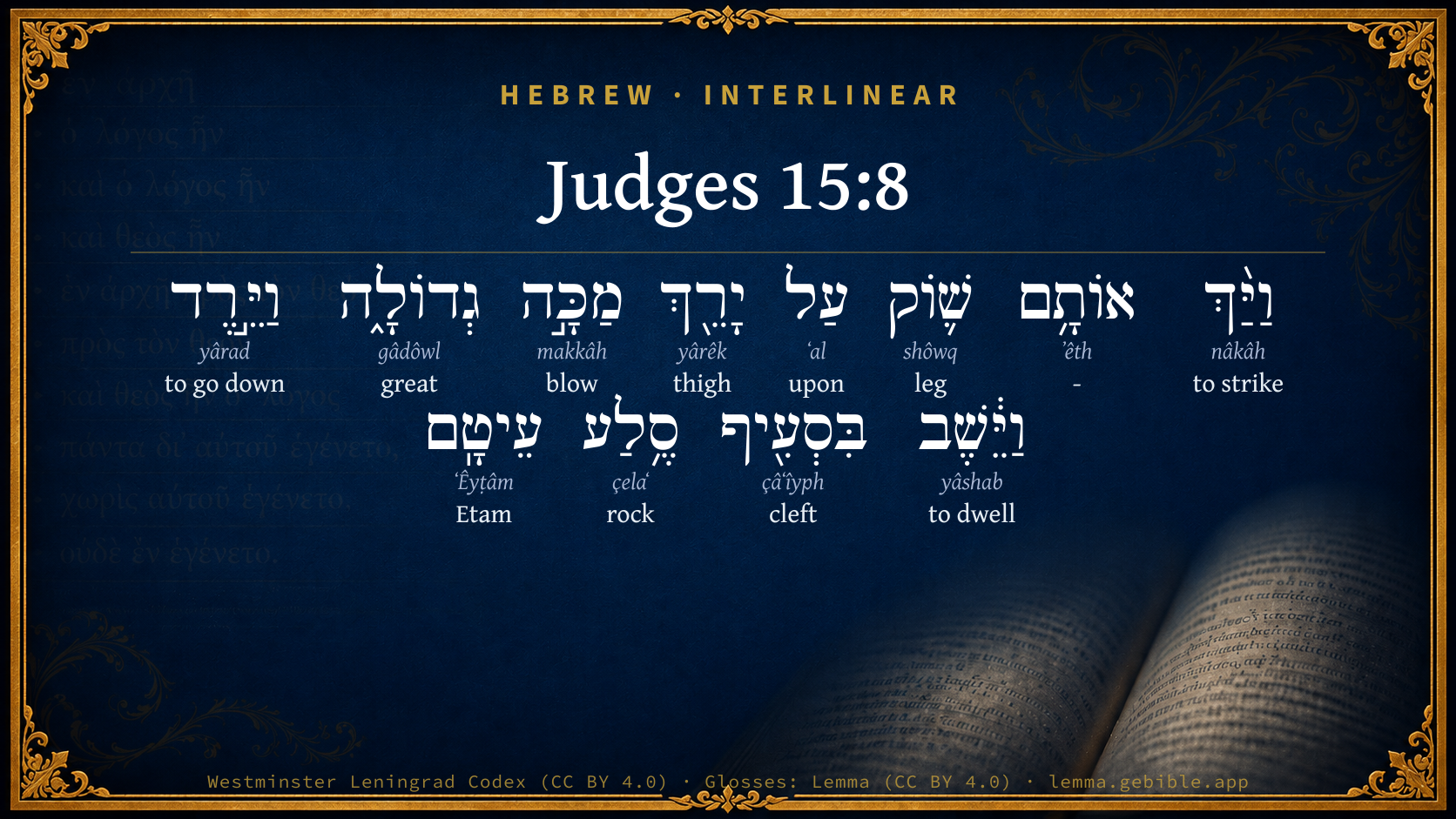
Judges 15:8

Hebrew (Westminster Leningrad Codex) Judges 15:8 appears in the Hebrew Old Testament. The text above is from the Westminster Leningrad Codex. Each word links to its Strong’s number, a concise gloss, and parsing drawn from the Open Scriptures Hebrew Bible morphology. Click any word for its full Brown-Driver-Briggs (BDB) entry.
Download image
Cite this verse

Judges 15:8 (World English Bible). Public Domain. Lemma interlinear Bible study tool, https://lemma.gebible.app/v/judges/15/8.

Show BibTeX & RIS
BibTeX
RIS
English Translation
He struck them hip and thigh with a great slaughter: and he went down and lived in the cleft of the rock of Etam.
World English Bible · Public Domain
Highlights
  • 2 first appearances in the Hebrew Bible
Full analysis ↓
Download a study sheet

One document with this verse’s original text, its word-by-word gloss line, the meaning frame, cross-references with their text, attributed commentary, and full source and license credits — printable, and it pastes into notes with its structure intact.

This verse Autodidact and up

Study sheet (.html) Plain text (.txt)

A passage Seminary Student

Up to 50 verses in one chapter. A passage sheet keeps up to 6 commentary sources and 12 cross-references per verse, in the order this page ranks them, and says so on the sheet whenever that leaves anything out. Ask for a single verse and you get the Autodidact verse sheet above.

Everything on this page stays free to read, with no account — the sheet is a download of what is already on screen, not access to it.

Want to remove ads? Support Godless Engineer
Compare translations 3

The same verse in 3 English versions, stacked beneath the original-language interlinear above. Click any original word for its lexicon entry.

Each is an independent rendering of the whole verse — the interlinear is not word-aligned to these translations.

Highlighted words mark where these versions differ — a whole-verse word diff, not a word-by-word alignment.

  • World English Bible Public Domain
    He struck them hip and thigh with a great slaughter: and he went down and lived in the cleft of the rock of Etam.
  • King James Version Public Domain
    And he smote them hip and thigh with a great slaughter: and he went down and dwelt in the top of the rock Etam.
  • unfoldingWord Literal Text CC BY-SA 4.0
    Then he struck them leg on thigh, a great striking. And he went down and stayed in the cleft of the rock of Etam.

unfoldingWord Literal Text — © unfoldingWord, licensed CC BY-SA 4.0. Word-aligned USFM3 via Door43 (git.door43.org/unfoldingWord/en_ult).

Versions to compare (up to 4)

3 of 4 selected

Show all 18 translations

Every available English version of this verse, each an independent rendering of the whole verse.

  • World English Bible Public Domain
    He struck them hip and thigh with a great slaughter: and he went down and lived in the cleft of the rock of Etam.
  • Berean Standard Bible Public Domain
    And he struck them ruthlessly with a great slaughter, and then went down and stayed in the cave at the rock of Etam.
  • Majority Standard Bible Public Domain
    And he struck them ruthlessly with a great slaughter, and then went down and stayed in the cave at the rock of Etam.
  • King James Version Public Domain
    And he smote them hip and thigh with a great slaughter: and he went down and dwelt in the top of the rock Etam.
  • American Standard Version (1901) Public Domain
    And he smote them hip and thigh with a great slaughter: and he went down and dwelt in the cleft of the rock of Etam.
  • Revised Version (1885) Public Domain
    And he smote them hip and thigh with a great slaughter: and he went down and dwelt in the cleft of the rock of Etam.
  • Geneva Bible (1599) Public Domain
    So hee smote them hippe and thigh with a mightie plague: then hee went and dwelt in the top of the rocke Etam.
  • Douay-Rheims (1899) Public Domain
    And he made a great slaughter of them, so that in astonishment they laid the calf of the leg upon the thigh. And going down he dwelt in a cavern of the rock Etam.
  • Young's Literal Translation Public Domain
    And he smiteth them hip and thigh -- a great smiting, and goeth down and dwelleth in the cleft of the rock Etam.
  • Literal Standard Version CC BY-SA 4.0
    And he strikes them hip and thigh [with] a great striking, and goes down and dwells in the cleft of the rock of Etam.
  • Unlocked Literal Bible CC BY-SA 4.0
    Then he cut them to pieces, hip and thigh, with a great slaughter. Then he went down and lived in a cave in the cliff of Etam.
  • unfoldingWord Literal Text CC BY-SA 4.0
    Then he struck them leg on thigh, a great striking. And he went down and stayed in the cleft of the rock of Etam.
  • Darby Bible Public Domain
    And he smote them hip and thigh with great slaughter; and he went down and stayed in the cleft of the rock of Etam.
  • World Messianic Bible Public Domain
    He struck them hip and thigh with a great slaughter; and he went down and lived in the cave in Etam’s rock.
  • Webster's Bible Public Domain
    And he smote them hip and thigh with a great slaughter. And he went down and dwelt in the top of the rock Etam.
  • Free Bible Version CC BY-SA 4.0
    He attacked them violently, killing them, and then left to go and live in a cave at the rock of Etam.
  • Bible in Basic English Public Domain
    And he made an attack on them, driving them in uncontrolled flight, and causing great destruction; then he went away to his safe place in the crack of the rock at Etam.
  • JPS Tanakh (1917) Public Domain
    And he smote them hip and thigh with a great slaughter; and he went down and dwelt in the cleft of the rock of Etam.

Literal Standard Version (2020), Covenant Press — licensed CC BY-SA 4.0. Text via the HelloAO Bible API (eBible.org). Unlocked Literal Bible (unfoldingWord) — licensed CC BY-SA 4.0. Text via the HelloAO Bible API (eBible.org). unfoldingWord Literal Text — © unfoldingWord, licensed CC BY-SA 4.0. Word-aligned USFM3 via Door43 (git.door43.org/unfoldingWord/en_ult). Free Bible Version, Dr. Jonathan Gallagher — licensed CC BY-SA 4.0. Text via the HelloAO Bible API (eBible.org).

Word by word

More ways to search: Search by grammar → Find every occurrence → Compare this word →

Practice this passage: Drill this verse → Learn its vocabulary →

עֵיטָֽם
ʻÊyṭâm
H5862
“Etam”
Noun, Proper
Part of Speech
Noun
Type
Proper
Full BDB Definition

Origin: from H5861

TWOT: None

Etam = "lair of wild beasts" - a village of the tribe of Simeon - a town in Judah fortified and garrisoned by king Rehoboam of Judah and located between Bethlehem and Tekoa - a cliff; site uncertain
  1. וַיַּ֨ךְ nâkâh H5221 “and · to strike” Conjunction + Verb, Hiphil, Sequential Imperfect, 3rd Person, Masculine, Singular
  2. אוֹתָ֥ם ʼêth H853 “- · them” Particle, Direct Object + Suffix, Personal, 3rd Person, Masculine, Plural
  3. שׁ֛וֹק shôwq H7785 “leg” Noun, Common, Feminine, Singular, Absolute
  4. עַל ʻal H5921 “upon” Preposition
  5. יָרֵ֖ךְ yârêk H3409 “thigh” Noun, Common, Feminine, Singular, Absolute
  6. מַכָּ֣ה makkâh H4347 “blow” Noun, Common, Feminine, Singular, Absolute
  7. גְדוֹלָ֑ה gâdôwl H1419 “great” Adjective, Adjective, Feminine, Singular, Absolute
  8. וַיֵּ֣רֶד yârad H3381 “and · to go down” Conjunction + Verb, Qal, Sequential Imperfect, 3rd Person, Masculine, Singular
  9. וַיֵּ֔שֶׁב yâshab H3427 “and · to dwell” Conjunction + Verb, Qal, Sequential Imperfect, 3rd Person, Masculine, Singular
  10. בִּסְעִ֖יף çâʻîyph H5585 “in/at · cleft of” Preposition + Noun, Common, Masculine, Singular, Construct
  11. סֶ֥לַע çelaʻ H5553 “rock of” Noun, Common, Masculine, Singular, Construct

About this verse

These counts appear in no published source. They are computed here, from the morphology-tagged text and Lemma’s own curated glosses. What Lemma adds →

12
words
12
distinct lemmas
Historical
section

Notable vocabulary

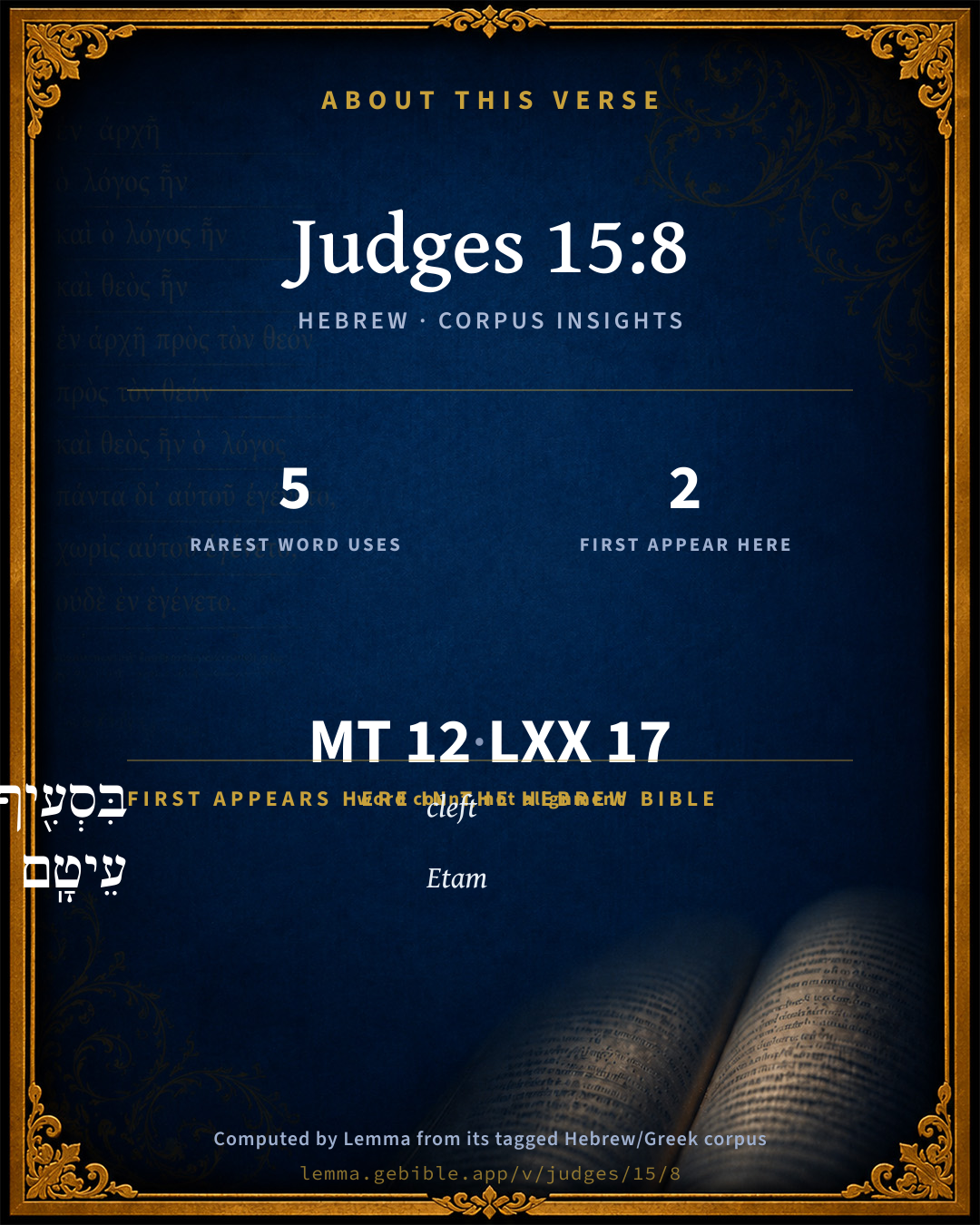
The rarest word here is עֵיטָֽם Etam H5862 — appearing just 5 times in the whole Hebrew Bible.

First appearance in Scripture

These words make their first canonical appearance in the Hebrew Bible here:

  • בִּסְעִ֖יף cleft H5585
  • עֵיטָֽם Etam H5862

Shared distinctive vocabulary

עֵיטָֽם Etam H5862 occurs in 5 verses of the Hebrew Bible. Also found in:

Grammatical profile

  • 3 verbs
  • 6 nouns
  • 1 adjective
  • 1 preposition
  • 1 particle

Verb forms

  • וַיַּ֨ךְ Hiphil · Sequential Imperfect
  • וַיֵּ֣רֶד Qal · Sequential Imperfect
  • וַיֵּ֔שֶׁב Qal · Sequential Imperfect

Hebrew & Septuagint length

In English translation the verse runs 24 words from the Hebrew and 23 from the Septuagint (LXX English) — closely comparable.

A rough comparison of the two English renderings, which tokenize alike — not a word-level alignment.

Word counts can differ between the Hebrew and the Greek without any difference in meaning — e.g. the Hebrew direct-object marker אֵת has no separate Greek word, and Greek often adds the article ὁ.

In the original languages it is 12 Hebrew tokens and 17 Greek tokens — but the two are counted differently (Hebrew bundles its prefixes and suffixes into one token; the Greek is in lemma form), so that isn’t a like-for-like length.

Cross-references

3

Topical passages linked to Judges 15:8 in the Treasury of Scripture Knowledge — connected by theme and wording, ordered by reader-vote popularity; previews shown in the World English Bible.

  • Isaiah 25:10 For in this mountain will the hand of Yahweh rest; and Moab shall be trodden down in his place, even as straw is trodden down in the water of the dung-hill.
  • Isaiah 63:3 I have trodden the winepress alone; and of the peoples there was no man with me: yes, I trod them in my anger, and trampled them in my wrath; and their lifeblood is sprinkled on my garments, and I have stained all my clothing.
  • Isaiah 63:6 I trod down the peoples in my anger, and made them drunk in my wrath, and I poured out their lifeblood on the earth.

Cross-references courtesy of OpenBible.info (CC BY 4.0).

Hebrew and Greek witnesses Masoretic Hebrew ↔ Greek Septuagint

The same verse in the two great witnesses to the Old Testament, shown verse-for-verse.

These are two independent witnesses, not word-aligned to each other, and the Septuagint is shown in lemma (dictionary) form.

Hebrew Judges 15:8 Masoretic · Westminster Leningrad Codex

וַיַּ֨ךְ אוֹתָ֥ם שׁ֛וֹק עַל יָרֵ֖ךְ מַכָּ֣ה גְדוֹלָ֑ה וַיֵּ֣רֶד וַיֵּ֔שֶׁב בִּסְעִ֖יף סֶ֥לַע עֵיטָֽם

He struck them hip and thigh with a great slaughter: and he went down and lived in the cleft of the rock of Etam.

World English Bible · Public Domain

Greek LXX Judges 15:8 Septuagint · lemma form

καί πατάσσω αὐτός κνήμη ἐπί μηρός πληγή μέγας καί καταβαίνω καί καταἵζω ἐν τρυμαλιά ὁ πέτρα ηταμ

And he struck them leg on thigh with a great overthrow; and went down and lived in a cave of the rock Etam.

LXX2012 (modern English Septuagint) · Public Domain

On this verse, Ellicott's Commentary for English Readers discusses the Septuagint’s reading. Read the note in Commentary ↓

Hebrew: Westminster Leningrad Codex (CC BY 4.0). Greek: Septuagint (public domain); English from LXX2012 (modern English Septuagint) (Public Domain). How the Septuagint differs from the Hebrew →

Targum (Aramaic paraphrase)

1

The Targum is the ancient Jewish Aramaic paraphrase of the Hebrew Scriptures — an interpretive translation, not the Hebrew text itself. Onkelos (literal) and Pseudo-Jonathan (expansive) render the Torah, and Jonathan the Prophets. Coverage is partial: where no permissively-licensed English translation exists for a verse, only the Aramaic is shown. This is verse-level text, not a word-by-word alignment to the Hebrew.

  1. Targum Jonathan Prophets (Joshua–Malachi)
    וּמְחָא יָתְהוֹן פָּרָשִׁין עִם רִגְלָאִין מְחָא סַגִיאָה וּנְחַת וִיתֵיב בִּשְׁקֵיף כֵּיף עֵיטָם:

    (no public-domain English translation for this verse)

    Targum Jonathan — Aramaic: “Mikraot Gedolot” (public domain). English: “Sefaria Community Translation” (CC0 1.0 (public-domain dedication)); “London "Chaldee Paraphrase," 1871” (public domain). Text via Sefaria.

Commentary

Notes on Judges 15:8 from classic Christian and Jewish commentators (each source and its license shown beneath its notes). The classic Christian expositions comment on the surrounding passage and are grouped to its opening verse, so a note may address several verses; the Jewish commentaries on the Tanakh (Rashi and others) are per-verse, so they appear only where the commentator wrote on this verse.

Lemma curates 59 commentaries, every one of them public domain or Creative Commons licensed, each selected and text-cleaned for this edition rather than reprinted as found. About our sources →

Trapp's Complete Commentary

John Trapp

Jdg 15:8 And he smote them hip and thigh with a great slaughter: and he went down and dwelt in the top of the rock Etam.

Ver. 8. And he smote them hip and thigh with a great slaughter,] i.e., Wherever he hit them, he gave them their passport, as we say: he beat them back and belly, as the French proverb hath it; he peppered them, and paid them to some tune, as ours. He hurled them to the ground with spurns and thrusts with his knees saith Diodat. Wherever his blows fell, they mauled them, and made them sure for stirring any more, saith another interpreter. Here we see that veriverbium of Solomon exemplified, "One sinner destroyeth much good." {Ecc 9:18} As also, what a deal of mischief and bloodshed many times followeth upon adulteries, rapes, or other violations of wedlock: the Trojan war, for instance, waged much about this time: according to that prophecy of Cassandra to her brother Paris.

“ Grain iuvenca venit quae te, patriamque domumque

Perdet; io prohibe; Graia iuvenca venit. ” - Ovid’s Epist.

The Scots paid dear for the dishonour they did to our Edward VI, whom they denied his espoused wife, their then Queen, and married her to the Dauphin of France. This occasioned that great loss they sustained at Musselburgh field. {a}

{a} Life of Edward VI.

John Trapp, A Commentary or Exposition upon All the Books of the Old and New Testament (1647–1656) — public domain. Text from a community e-Sword module.

Joseph Benson's Commentary

Jdg 15:8. He smote them hip and thigh — This seems to be merely a proverbial expression to denote a desperate attack and total overthrow. And he went down, or, rather, went and dwelt — For it is an idiom of the Hebrew language, to speak of going up, or going down, to a place without having any reference to the situation of it, whether it lay high or low. The place here spoken of, the top of the rock Etam, undoubtedly lay high, being, as Josephus informs us, a strong place in the tribe of Judah, to the summit of which only one man could ascend in front. Here Samson waited to see what steps the Philistines would take. It appears that Samson had no commission from God to raise an army and make open war, like Gideon, Jephthah, and others, for the deliverance of Israel from the yoke of the Philistines; but was only authorized to weaken them and keep them in awe, that their dread of him might cause them to lessen their cruelty.

Joseph Benson's Commentary on the Old and New Testaments (1811–1818) — public domain. Text from a community e-Sword module.

Geneva Bible (1599)

Geneva Bible translators

Or, horsemen and footmen.

Geneva Bible (1599) marginal notes — public domain. Text via Bolls.life.

Jamieson, Fausset & Brown

Robert Jamieson, A. R. Fausset & David Brown

smote them hip and thigh--a proverbial expression for a merciless slaughter.

he went down and dwelt in the top of the rock Etam--rather went down and dwelt in the cleft--that is, the cave or cavern of the cliff Etam.

Jamieson, Fausset & Brown — Commentary Critical and Explanatory on the Whole Bible (1871) — public domain (CC PDM 1.0). Text via the HelloAO Bible API.

Adam Clarke's Commentary

Verse 8. He smote them hip and thigh] This also is variously understood; but the general meaning seems plain; he appears to have had no kind of defensive weapon, therefore he was obliged to grapple with them, and, according to the custom of wrestlers, trip up their feet, and then bruise them to death. Some translate heaps upon heaps; others, he smote horsemen and footmen; others, he wounded them from their legs to their thighs, c., c. See the different versions. Some think in their running away from him he kicked them down, and then trod them to death: thus his leg or thigh was against their hip hence the expression.

The top of the rock Etam.] It is very likely that this is the same place as that mentioned 1Ch 4:32; it was in the tribe of Simeon, and on the borders of Dan, and probably a fortified place.

Adam Clarke's Commentary on the Bible (1810–1826) — public domain. Text from a community e-Sword/MySword module.

Ellicott's Commentary for English Readers

(8) Hip and thigh.—There is no doubt that the expression intensifies the words “with a great slaughter;” but the origin of the phrase is a matter of conjecture. It may be purely general, like the German expression “Arm und Bein,” or “er hieb den Feind in die Pfanne,” or “in Kochstücke” (“A blow strikes a fugitive on the hip, and that would be enough; another blow on the thigh ends him”). “Hence,” says Ewald, “it means thigh over and above”—i.e., besides the hip. It cannot possibly mean “cavalry and infantry,” as the Chaldee renders it, or be a reference to wrestling (Greek, huposkelizein); nor is it likely to have a sacrificial origin (“good and bad pieces”). It is hard to see what St. Jerome means by his gloss “ita ut slupentes suram femori imponerent.” Literally it is, thigh upon hip, or leg upon thigh (LXX., κνήμην ἐπὶ μηρὸν). May it not have had its origin in some such fierce custom as that known to the Greeks as akroteriasmos, or maschalismos, in which the extremities of a corpse were cut off and placed under the arm-pits? (Æsch. Cho. 439; Soph. El. 445.) Thus in Hesychius and Suidas maschalismata means “mutilated limbs,” and also “the flesh of the shoulders laid on the haunches at sacrifices.”

With a great slaughter.—It is not said, nor is it necessarily implied (any more than in the case of Shamgar), that Samson was absolutely alone in these raids. There is nothing either in the narrative or in the ordinary style of Hebrew prose which makes any such inference necessary, nor, indeed, is there any such inference drawn in many similar passages (e.g., Judgesi. 20, &c.).

In the top of the rock Etam.—It should undoubtedly be in a ravine (or cave) of the cliff Etam. For instance, in Jdg_15:11 the men of Judah could not go down to the top of a rock, and the same word is rendered “cleft” in Isa_57:5, and should be so rendered for “top” in Isa_3:21 (LXX., “in a hole of the rock,” and “in the cave of Etam;” Vulg., in spelunca petrae). This explains the expression “went down” in this verse, and “brought him up” in Jdg_15:13. Such cliff-caves are the natural refuge of oppressed peoples (Jdg_6:2; 1Sa_13:6; 1Ki_18:13). These caves, like the cave of Aduliam, are often supplied with water by natural springs, and one man may defend them against a multitude. The LXX. (Cod. A) add the words “by the torrent.” The site of Etam is uncertain; but it is in the tribe of Judah, which Samson only enters once, or, possibly (Jdg_16:3), twice, and then only as a fugitive.

A Bible Commentary for English Readers, edited by Charles John Ellicott (1878–1897) — public domain. Text from a community e-Sword module.

The Cambridge Bible for Schools and Colleges

gen. ed. J. J. S. Perowne

8. hip and thigh] lit. leg upon thigh, so that the limbs of the slain fall one upon another: such seems to be the force of the prep, upon, cf. Amo_3:15 ‘the winter house upon the summer house,’ i.e. so that the one falls upon the other, and Gen_32:11, Hos_10:14. At any rate it is a proverbial expression for with a great slaughter.

the rock of Etam] The Etam between Beth-lehem and Tekoa, 2Ch_11:6, is too high up and too far away. Schick, who finds the scenes of Samson’s exploits in the neighbourhood of ‘Artuf a little S.E. of Zorah, identifies Etam with ‘Araḳ Isma ‘în, near Marmita, remarkable for a perpendicular rock with a cave which can only be reached by going down to it (ZDPV. x. 143 ff.). Perhaps this was almost within the Danite territory; Jdg_15:9 ff. imply that the rock of Etam was in Judah.

The Cambridge Bible for Schools and Colleges (gen. ed. J. J. S. Perowne; Cambridge University Press, 1878–1918) — public domain. Text from a community e-Sword module.

John Gill's Exposition

And he smote them hip and thigh with a great slaughter,.... Either smote them on their hips and thighs with his hands (for it does not appear he had any weapon of war), so that they were sadly bruised, and maimed, and lamed, that they could not stir, and of which blows and bruises multitudes died: or he smote them with his legs on their thighs, kicked them about at pleasure, which kicks numbers of them never got over; or the meaning of the proverbial expression is, he laid on them at a great rate, and smote them here and there, and any where, which issued in the death of many of them: the Targum is,"he smote them horse and foot,''their cavalry and infantry, destroyed them both; but it does not appear that they came out in an hostile manner unto him, and much less in the form of a regular army:

and he went down and dwelt in the top of the rock Etam. Josephus says (e), that Samson having slain many in the fields of the Philistines, went and dwelt at Etam, a strong rock in the tribe of Judah; and which agrees with Ch2 11:6, where mention is made of the city Etam, along with Bethlehem and Tekoah, cities in that tribe, which had its name either from this rock, or the rock from that. The Septuagint and Vulgate Latin versions read,"in a cave of the rock of Etam;''and the Syriac and Arabic versions, in Sahaph, which is on the rock of Etam, as if Sahaph was the name of a city there; hither Samson went, not through fear, or for safety, but to wait for another opportunity of further avenging the injuries of Israel on the Philistines.

(e) Ibid. (Antiqu. l. 5. c. 8.) sect. 8.

John Gill's Exposition of the Whole Bible (1746–1763) — public domain (CC PDM 1.0). Text via the HelloAO Bible API.

Albert Barnes' Notes on the Bible

Hip and thigh - A proverbial expression of doubtful origin, meaning all the “great” and “mighty,” all the choice pieces like the thigh and shoulder.

In the top of the rock - Rather, “the cleft of the rock.” These clefts of the rock were the natural fortresses and hiding places of the land. (Isa 2:21; Isa 57:5. Compare 1Sa 13:6; 1Ki 18:13.)

Etam - Not the same as the place in the territory of Simeon 1Ch 4:32. Its situation is uncertain, but a site near Eleutheropolis (“Beth-jibrin”) is required; and there exist some extraordinary caverns in the soft limestone or chalky rock, fifteen or twenty feet deep, with perpendicular sides, opening into extensive excavations in the rock, about two hours from Eleutheropolis. (Conder conjectures it to be the same as Atab, a village 12 miles southwest of Jerusalem, in the ‛arkub or Ridge.)

Albert Barnes' Notes on the Bible (1834–1885) — public domain. Text from a community e-Sword/MySword module.

Haydock's Catholic Bible Commentary

Thigh. Striking this part is often mentioned as a mark of consternation, Jeremias xxxi. 19. (Menochius) --- Hebrew, "and he smote them thigh and leg, with a great slaughter." (Haydock) --- Vatable supposes this means an entire destruction. Chaldean, "he smote both horse and foot." He rendered them incapable of fleeing, or of making resistance, Nahum ii. 5. (Calmet) --- Cavern. Hebrew sahiph, signifies, "the top, branch, &c. The rock might be covered with wood, (Calmet) and was situated in the confines of the tribes of Simeon, Juda, and Dan, 1 Paralipomenon iv. 32. (Menochius)

George Leo Haydock (1774–1849), Haydock's Catholic Family Bible and Commentary, 1859 edition — public domain. Excludes Psalms (Douay-Rheims chapter numbering differs from Protestant) and Deuterocanonical books (Catholic canon only).

Matthew Poole's English Annotations

Hip and thigh; upon their hips and thighs, peradventure not designing to kill them, but to make them incapable of military employment, or of doing hurt to the Israelites. Or, He smote them with his leg upon their thigh, i.e. without any other weapon but his leg and foot he kicked them, and made them lame and useless for war.

With a great slaughter, Heb. with a great stroke; for so it was, even to them whom it did not kill.

He dwelt in the top of the rock Etam; partly because there he could better defend himself from his enemies; and partly because he would not involve his brethren in the same danger with himself, but, like a worthy magistrate, would secure them even with his own greater hazard.

Matthew Poole's English Annotations on the Holy Bible (1683–1685) — public domain. Text from a community e-Sword/MySword module.

Whedon's Commentary on the Bible

Daniel D. Whedon

8. Smote them hip and thigh — Rather, leg upon thigh. A proverbial expression that seems most naturally to denote a ferocious and indiscriminate slaughter, as when we say of slaughtered troops, “They were utterly cut to pieces.” Gesenius explains that he smote them so that the scattered limbs fell one upon another. It was a great slaughter, and convinced the Philistines, if they knew it not before, that Samson was their great national enemy.

Top of the rock — Better, cleft of the rock. Some deep and wild gorge or cleft, such as abound in the hill country of Judea.

Etam — This many have been inclined to identify with Etam of 2Ch_11:6, a city which Rehoboam fortified, and which Dr. Robinson and others have supposed to be the modern Urtas, about a mile south of Bethlehem. But to this place, which is located on high ground, Samson could hardly have been said to go down, and hence the Etam of the tribe of Simeon, mentioned 1Ch_4:32, is more probably intended here. Its exact location has not been certainly identified.

Daniel D. Whedon (gen. ed.), Commentary on the Old and New Testaments (1874–1909) — public domain. Text from a community e-Sword module.

The Pulpit Commentary

He smote them hip and thigh, etc. A proverbial expression, the origin of which is uncertain; it means, he smote them with a great and complete slaughter. It is reasonable to suppose that he had gathered a few Hebrews round him to help him. He went down, etc. This shows that Etam must have been situated lower than Tinmath, and seems to preclude its identification with Urtas, in the hill country of Judah, between Bethlehem and Tekoah, which apparently represents the Etam of 2Ch_11:6. But there is another Etam in the tribe of Simeon, (1Ch_4:32) which may possibly be the Etam of our text. In the top of the rock. Rather, the cleft or fissure of the rock some narrow and inaccessible ravine. The site has not been identified.

Vers. 8-16. Requiting evil for good, and good for evil.

It was truly unhandsome conduct on the part of the men of Judah. They had received aid and service from Samson, and their enemies had been put to shame; and now, when they are threatened with consequences for harbouring him from their foes, they are ready to betray him.

I THOSE WHO HAVE RECEIVED THE GREATEST BENEFITS OFTEN BETRAY THEIR BENEFACTORS. Wallace was betrayed by a Scotchman; Christ by Judas, and rejected by the Jews. This arises partly from failure to comprehend the work done by great men; partly from ignoble nature, that fails to attain the level of heroic action.

II A MAGNANIMOUS MIND WILL RATHER SURFER EVIL THAN BE THE OCCASION OF IT TO OTHERS.

III MEN INJURE THEMSELVES WHEN THEY EVADE DUTY IN COMPROMISE. These 3000 men of Judah might have driven the Philistines before them, and delivered their land, had they been inspired by a heroic spirit. They afterwards discover that the work is done in spite of them which might have been done by them, and thus lose the credit and blessing that might have been theirs. Samson is thus completely detached from the nation he was raised up to deliver. So Christ stalls alone as the Saviour of the world.

IV GOD MAY OVERRULE MEN"S MISDOINGS TO THEIR ULTIMATE ADVANTAGE. Grace can extract a blessing even from sin. But atonement has been made, and the spirit purged from its mean and unholy disposition. The crucifixion of Christ, the work of men, is the means of the salvation of men.

V EXTERNAL BONDS CANNOT EFFECTUALLY BIND THE SERVANT OF GOD. "Stone walls do not a prison make, Nor iron bars a cage.

Persecutions tend to further the influence of truth. God breaks the bands with which men confine his servants and his word. M.

The Pulpit Commentary (1880–1919), ed. H.D.M. Spence-Jones & Joseph S. Exell — public domain. Text from a community e-Sword module.

John Wesley's Explanatory Notes

Hip and thigh - It seems to be a phrase, to express a desperate attack, attended with the utmost hurry and confusion: and perhaps intimates, that they all fled before him. So he smote them in the hinder parts. Rock Etam - A natural fortress, where he waited to see what steps the Philistines would take.

John Wesley, Explanatory Notes Upon the Whole Bible (1754–1765) — public domain. Text via the GEBible commentary corpus.

Keil & Delitzsch

C. F. Keil & F. Delitzsch

"Then he smote them hip and thigh (lit. 'thigh upon hip;' על as in Gen 32:12), a great slaughter." שׁוק, thigh, strengthened by על־ירך, is a second accusative governed by the verb, and added to define the word אותם more minutely, in the sense of "on hip and thigh;" whilst the expression which follows, גדולה מכּה, is added as an adverbial accusative to strengthen the verb ויּך. Smiting hip and thigh is a proverbial expression for a cruel, unsparing slaughter, like the German "cutting arm and leg in two," or the Arabic "war in thigh fashion" (see Bertheau in loc.). After smiting the Philistines, Samson went down and dwelt in the cleft of the rock Etam. There is a town of Etam mentioned in Ch2 11:6, between Bethlehem and Tekoah, which was fortified by Rehoboam, and stood in all probability to the south of Jerusalem, upon the mountains of Judah. But this Etam, which Robinson (Pal. ii. 168) supposes to be the village of Urtas, a place still inhabited, though lying in ruins, is not to be thought of here, as the Philistines did not go up to the mountains of Judah (Jdg 15:9), as Bertheau imagines, but simply came forward and encamped in Judah. The Etam of this verse is mentioned in Ch1 4:32, along with Ain Rimmon and other Simeonitish towns, and is to be sought for on the border of the Negeb and of the mountains of Judah, in the neighbourhood of Khuweilifeh (see V. de Velde, Mem. p. 311). The expression "he went down" suits this place very well, but not the Etam on the mountains of Judah, to which he would have had to go up, and not down, from Timnath.

Keil & Delitzsch — Biblical Commentary on the Old Testament (1861–1891) — public domain (CC PDM 1.0). Text via the HelloAO Bible API. (Old Testament only.)

Rashi

Rabbi Shlomo Yitzchaki (Rashi)

Cavalry and infantry [lit. calf and thigh]. "Horsemen and foot soldiers." The horseman is not supported by the thigh, but by the calf of the foot inserted into the metal stirrup hanging from the saddle.

On the promontory of a crevice of the Eitam cliff. Similarly, "The promontories of the cliffs," "[He] shall remove its branches."

Rashi on the Tanakh — English translations: “The Judaica Press complete Tanach with Rashi, translated by A. J. Rosenberg” (CC BY 4.0); “Pentateuch with Rashi's commentary by M. Rosenbaum and A.M. Silbermann, 1929-1934” (public domain); “The Metsudah Tanach series, Lakewood, N.J” (CC BY 4.0); and “The Book of Joshua, Metsudah Publications, 1997” (CC BY 4.0). Text via Sefaria.

Lesson kit

Teaching starters — assembled from the data on this page, not authored interpretation. Every prompt links to the verse data it draws on. Edit before teaching.

Judges, in the Historical, opens this verse with 12 words (12 distinct Hebrew lemmas). Its most distinctive word is ʻÊyṭâm (“Etam”). A historical commentator’s framing appears above. Read the whole chapter for the surrounding context.

Discussion questions

  1. What does “Etam” (ʻÊyṭâm) contribute to the verse as a whole?
  2. 2 words here appear for the first time in Scripture. What is being introduced at this debut?
  3. Judges 15:11 shares the word «Etam» with this verse. How do the two illuminate each other?
  4. These translations render this verse differently. What is at stake in choosing one wording over another?
  5. The verb «וַיַּ֨ךְ» is Hiphil Sequential Imperfect. How does its form color the action?
  6. Reading how Trapp's Complete Commentary and Joseph Benson's Commentary read this verse, where do the two commentators agree and where do they part?

Things to notice

Reading settings

Reading text

Shown beneath each verse's original-language words.

Old Testament
Old Testament edition

Read the OT as the Masoretic Hebrew (MT) or the Greek Septuagint (LXX).

English shown for the Greek Septuagint (in the Hebrew ↔ Greek comparison).

Comparing translations? Open the Compare panel on any verse page to stack up to four side by side.