
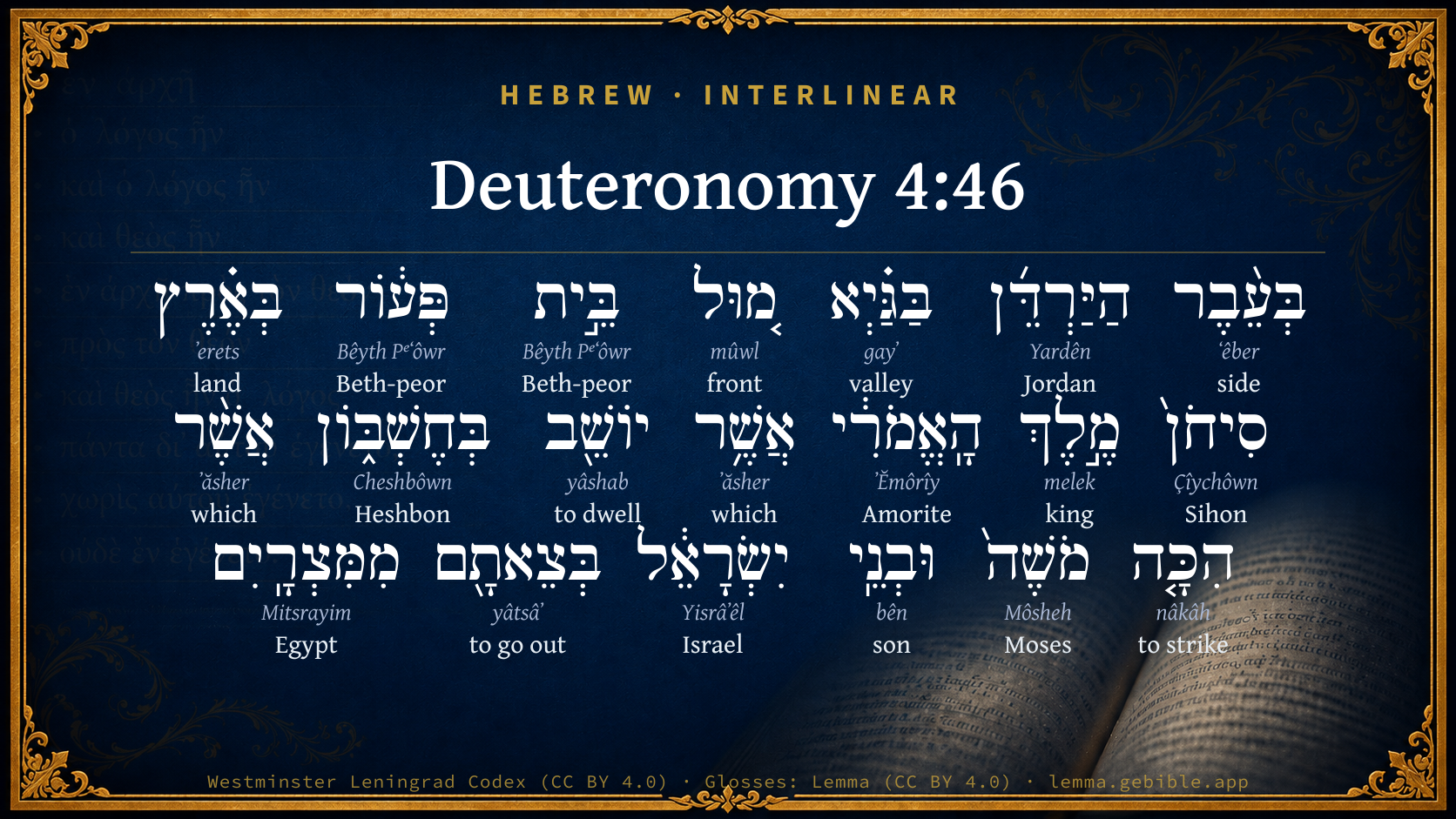
Deuteronomy 4:46

Hebrew (Westminster Leningrad Codex) Deuteronomy 4:46 appears in the Hebrew Old Testament. The text above is from the Westminster Leningrad Codex. Each word links to its Strong’s number, a concise gloss, and parsing drawn from the Open Scriptures Hebrew Bible morphology. Click any word for its full Brown-Driver-Briggs (BDB) entry.
Download image
Cite this verse

Deuteronomy 4:46 (World English Bible). Public Domain. Lemma interlinear Bible study tool, https://lemma.gebible.app/v/deuteronomy/4/46.

Show BibTeX & RIS
BibTeX
RIS
English Translation
beyond the Jordan, in the valley over against Beth Peor, in the land of Sihon king of the Amorites, who lived at Heshbon, whom Moses and the children of Israel struck, when they came forth out of Egypt.
World English Bible · Public Domain
Download a study sheet

One document with this verse’s original text, its word-by-word gloss line, the meaning frame, cross-references with their text, attributed commentary, and full source and license credits — printable, and it pastes into notes with its structure intact.

This verse Autodidact and up

Study sheet (.html) Plain text (.txt)

A passage Seminary Student

Up to 50 verses in one chapter. A passage sheet keeps up to 6 commentary sources and 12 cross-references per verse, in the order this page ranks them, and says so on the sheet whenever that leaves anything out. Ask for a single verse and you get the Autodidact verse sheet above.

Everything on this page stays free to read, with no account — the sheet is a download of what is already on screen, not access to it.

Want to remove ads? Support Godless Engineer
Compare translations 3

The same verse in 3 English versions, stacked beneath the original-language interlinear above. Click any original word for its lexicon entry.

Each is an independent rendering of the whole verse — the interlinear is not word-aligned to these translations.

Highlighted words mark where these versions differ — a whole-verse word diff, not a word-by-word alignment.

  • World English Bible Public Domain
    beyond the Jordan, in the valley over against Beth Peor, in the land of Sihon king of the Amorites, who lived at Heshbon, whom Moses and the children of Israel struck, when they came forth out of Egypt.
  • King James Version Public Domain
    On this side Jordan, in the valley over against Bethpeor, in the land of Sihon king of the Amorites, who dwelt at Heshbon, whom Moses and the children of Israel smote, after they were come forth out of Egypt:
  • unfoldingWord Literal Text CC BY-SA 4.0
    across the Jordan, in the valley opposite Beth Peor, in the land of Sihon, king of the Amorites, who lived at Heshbon, whom Moses and the sons of Israel had struck down when they came out from Egypt.

unfoldingWord Literal Text — © unfoldingWord, licensed CC BY-SA 4.0. Word-aligned USFM3 via Door43 (git.door43.org/unfoldingWord/en_ult).

Versions to compare (up to 4)

3 of 4 selected

Show all 18 translations

Every available English version of this verse, each an independent rendering of the whole verse.

  • World English Bible Public Domain
    beyond the Jordan, in the valley over against Beth Peor, in the land of Sihon king of the Amorites, who lived at Heshbon, whom Moses and the children of Israel struck, when they came forth out of Egypt.
  • Berean Standard Bible Public Domain
    while they were in the valley across the Jordan facing Beth-peor in the land of Sihon king of the Amorites, who lived in Heshbon and was defeated by Moses and the Israelites after they had come out of Egypt.
  • Majority Standard Bible Public Domain
    while they were in the valley across the Jordan facing Beth-peor in the land of Sihon king of the Amorites, who lived in Heshbon and was defeated by Moses and the Israelites after they had come out of Egypt.
  • King James Version Public Domain
    On this side Jordan, in the valley over against Bethpeor, in the land of Sihon king of the Amorites, who dwelt at Heshbon, whom Moses and the children of Israel smote, after they were come forth out of Egypt:
  • American Standard Version (1901) Public Domain
    beyond the Jordan, in the valley over against Beth-peor, in the land of Sihon king of the Amorites, who dwelt at Heshbon, whom Moses and the children of Israel smote, when they came forth out of Egypt.
  • Revised Version (1885) Public Domain
    beyond Jordan, in the valley over against Beth-peor, in the land of Sihon king of the Amorites, who dwelt at Heshbon, whom Moses and the children of Israel smote, when they came forth out of Egypt:
  • Geneva Bible (1599) Public Domain
    On this side Iorden, in the valley ouer against Beth-peor, in the land of Sihon King of the Amorites, which dwelt at Heshbon, whom Moses and the children of Israel smote, after they were come out of Egypt:
  • Douay-Rheims (1899) Public Domain
    Beyond the Jordan in the valley over against the temple of Phogor, in the land of Sehon king of the Amorrhites, that dwelt in Hesebon, whom Moses slew. And the children of Israel coming out of Egypt,
  • Young's Literal Translation Public Domain
    beyond the Jordan, in the valley over-against Beth-Peor, in the land of Sihon, king of the Amorite, who is dwelling in Heshbon, whom Moses and the sons of Israel have smitten, in their coming out of Egypt,
  • Literal Standard Version CC BY-SA 4.0
    beyond the Jordan, in the valley opposite Beth-Peor, in the land of Sihon, king of the Amorite, who is dwelling in Heshbon, whom Moses and the sons of Israel have struck in their coming out of Egypt;
  • Unlocked Literal Bible CC BY-SA 4.0
    when they were east of the Jordan, in the valley opposite Beth Peor, in the land of Sihon, king of the Amorites, who had lived at Heshbon, whom Moses and the people of Israel had defeated when they came out of Egypt.
  • unfoldingWord Literal Text CC BY-SA 4.0
    across the Jordan, in the valley opposite Beth Peor, in the land of Sihon, king of the Amorites, who lived at Heshbon, whom Moses and the sons of Israel had struck down when they came out from Egypt.
  • Darby Bible Public Domain
    on this side the Jordan, in the valley opposite to Beth-Peor, in the land of Sihon the king of the Amorites, who dwelt in Heshbon, whom Moses and the children of Israel smote when they came out of Egypt;
  • World Messianic Bible Public Domain
    beyond the Jordan, in the valley opposite Beth Peor, in the land of Sihon king of the Amorites, who lived at Heshbon, whom Moses and the children of Israel struck when they came out of Egypt.
  • Webster's Bible Public Domain
    On the east side of Jordan, in the valley over against Beth-Peor, in the land of Sihon king of the Amorites, who dwelt at Heshbon, whom Moses and the children of Israel smote, after they had come forth from Egypt:
  • Free Bible Version CC BY-SA 4.0
    This was when they were in the valley to the east of the Jordan near Beth-peor in the country of Sihon king of the Amorites. He had ruled from Heshbon and had been defeated by Moses and the Israelites after they had left Egypt.
  • Bible in Basic English Public Domain
    On the far side of Jordan, in the valley facing Beth-peor, in the land of Sihon, king of the Amorites, who was ruling in Heshbon, whom Moses and the children of Israel overcame after they had come out of Egypt:
  • JPS Tanakh (1917) Public Domain
    beyond the Jordan, in the valley over against Beth-peor, in the land of Sihon king of the Amorites, who dwelt at Heshbon, whom Moses and the children of Israel smote, when they came forth out of Egypt;

Literal Standard Version (2020), Covenant Press — licensed CC BY-SA 4.0. Text via the HelloAO Bible API (eBible.org). Unlocked Literal Bible (unfoldingWord) — licensed CC BY-SA 4.0. Text via the HelloAO Bible API (eBible.org). unfoldingWord Literal Text — © unfoldingWord, licensed CC BY-SA 4.0. Word-aligned USFM3 via Door43 (git.door43.org/unfoldingWord/en_ult). Free Bible Version, Dr. Jonathan Gallagher — licensed CC BY-SA 4.0. Text via the HelloAO Bible API (eBible.org).

Word by word

More ways to search: Search by grammar → Find every occurrence → Compare this word →

Practice this passage: Drill this verse → Learn its vocabulary →

בֵּ֣ית
Bêyth Pᵉʻôwr
H1047
“Beth-peor”
Noun, Proper
Part of Speech
Noun
Type
Proper
Full BDB Definition

Origin: from H1004 and H6465

TWOT: None

Beth-peor = "house of Peor" - a place east of the Jordan, in the land of the Amorites, allotted to the tribe of Reuben
  1. בְּעֵ֨בֶר ʻêber H5676 “in/at · side of” Preposition + Noun, Common, Masculine, Singular, Construct
  2. הַיַּרְדֵּ֜ן Yardên H3383 “the · Jordan” Particle, Definite Article + Noun, Proper
  3. בַּגַּ֗יְא gayʼ H1516 “in/at the · valley” Preposition, Determined + Noun, Common, Both, Singular, Absolute
  4. מ֚וּל mûwl H4136 “front” Preposition
  5. פְּע֔וֹר Bêyth Pᵉʻôwr H1047 “Beth-peor” Noun, Proper
  6. בְּאֶ֗רֶץ ʼerets H776 “in/at · land of” Preposition + Noun, Common, Both, Singular, Construct
  7. סִיחֹן֙ Çîychôwn H5511 “Sihon” Noun, Proper
  8. מֶ֣לֶךְ melek H4428 “king of” Noun, Common, Masculine, Singular, Construct
  9. הָֽאֱמֹרִ֔י ʼĔmôrîy H567 “the · Amorite” Particle, Definite Article + Noun, Gentilic, Masculine, Singular, Absolute
  10. אֲשֶׁ֥ר ʼăsher H834 “which” Particle, Relative
  11. יוֹשֵׁ֖ב yâshab H3427 “dwelling” Verb, Qal, Participle Active, Masculine, Singular, Absolute
  12. בְּחֶשְׁבּ֑וֹן Cheshbôwn H2809 “in/at · Heshbon” Preposition + Noun, Proper
  13. אֲשֶׁ֨ר ʼăsher H834 “which” Particle, Relative
  14. הִכָּ֤ה nâkâh H5221 “to strike” Verb, Hiphil, Perfect, 3rd Person, Masculine, Singular
  15. מֹשֶׁה֙ Môsheh H4872 “Moses” Noun, Proper
  16. וּבְנֵֽי bên H1121 “and · sons of” Conjunction + Noun, Common, Masculine, Plural, Construct
  17. יִשְׂרָאֵ֔ל Yisrâʼêl H3478 “Israel” Noun, Proper
  18. בְּצֵאתָ֖ם yâtsâʼ H3318 “in/at · to go out · them” Preposition + Verb, Qal, Infinitive Construct + Suffix, Personal, 3rd Person, Masculine, Plural
  19. מִמִּצְרָֽיִם Mitsrayim H4714 “from · Egypt” Preposition + Noun, Proper

About this verse

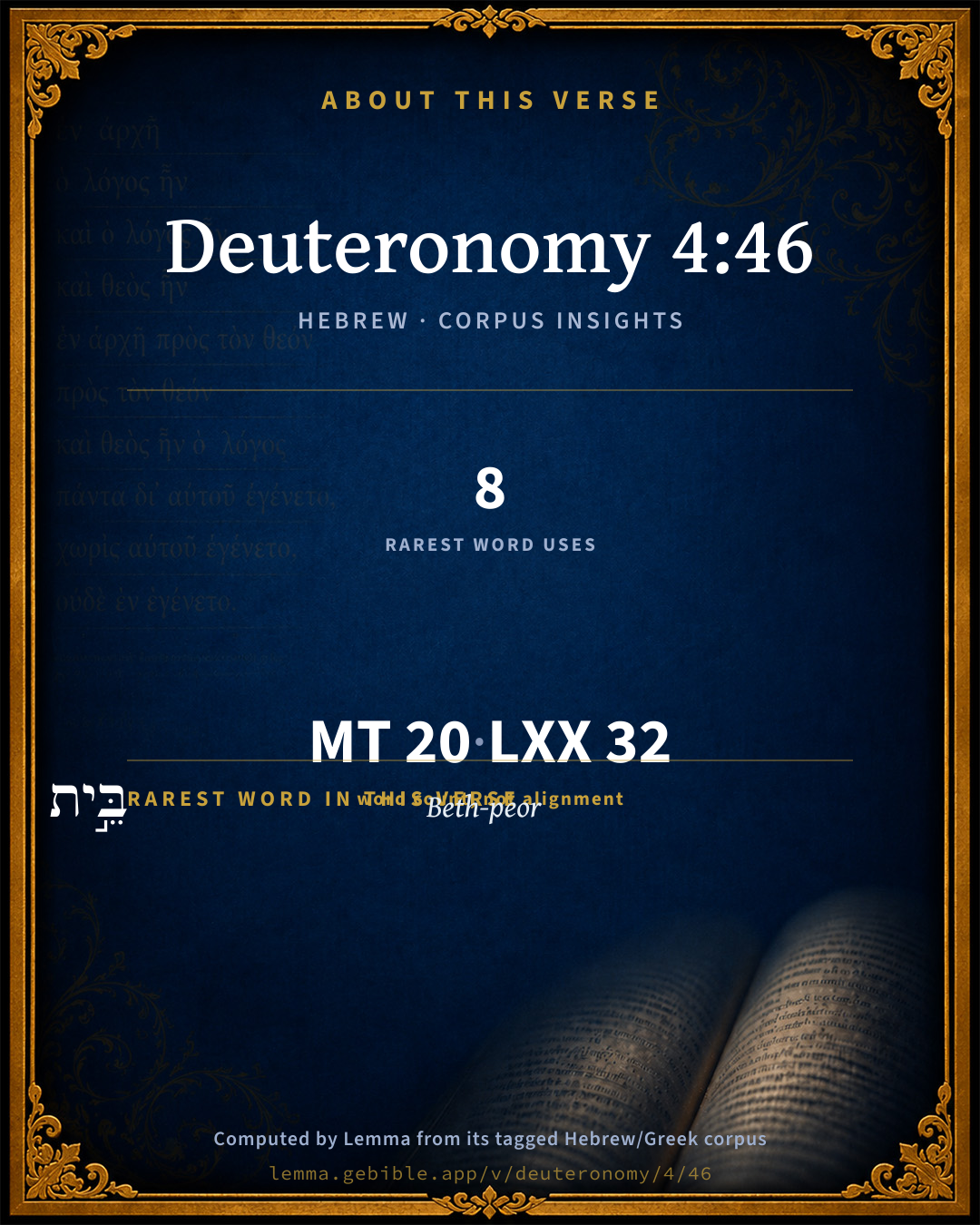
These counts appear in no published source. They are computed here, from the morphology-tagged text and Lemma’s own curated glosses. What Lemma adds →

20
words
18
distinct lemmas
Pentateuch
section

Notable vocabulary

The rarest word here is בֵּ֣ית Beth-peor H1047 — appearing just 8 times in the whole Hebrew Bible.

Shared distinctive vocabulary

בֵּ֣ית Beth-peor H1047 occurs in 4 verses of the Hebrew Bible. Also found in:

Grammatical profile

  • 3 verbs
  • 14 nouns
  • 1 preposition
  • 2 particles

Verb forms

  • יוֹשֵׁ֖ב Qal · Participle Active
  • הִכָּ֤ה Hiphil · Perfect
  • בְּצֵאתָ֖ם Qal · Infinitive Construct

Repetition

Words recur within this verse — often emphatic in Hebrew:

  • בֵּ֣ית Beth-peor H1047 ×2
  • אֲשֶׁ֥ר which H834 ×2

Hebrew & Septuagint length

In English translation the verse runs 38 words from the Hebrew and 44 from the Septuagint (LXX English) — closely comparable.

A rough comparison of the two English renderings, which tokenize alike — not a word-level alignment.

Word counts can differ between the Hebrew and the Greek without any difference in meaning — e.g. the Hebrew direct-object marker אֵת has no separate Greek word, and Greek often adds the article ὁ.

In the original languages it is 20 Hebrew tokens and 32 Greek tokens — but the two are counted differently (Hebrew bundles its prefixes and suffixes into one token; the Greek is in lemma form), so that isn’t a like-for-like length.

Cross-references

7

Topical passages linked to Deuteronomy 4:46 in the Treasury of Scripture Knowledge — connected by theme and wording, ordered by reader-vote popularity; previews shown in the World English Bible.

  • Deuteronomy 3:29 So we abode in the valley over against Beth Peor.
  • Numbers 21:21–32 Israel sent messengers to Sihon king of the Amorites, saying,
  • Numbers 32:19 For we will not inherit with them on the other side of the Jordan, and forward; because our inheritance is fallen to us on this side of the Jordan eastward.
  • Deuteronomy 1:4–5 after he had struck Sihon the king of the Amorites, who lived in Heshbon, and Og the king of Bashan, who lived in Ashtaroth, at Edrei.
  • Deuteronomy 2:30–36 But Sihon king of Heshbon would not let us pass by him; for Yahweh your God hardened his spirit, and made his heart obstinate, that he might deliver him into your hand, as at this day.
  • Deuteronomy 3:8 We took the land at that time out of the hand of the two kings of the Amorites who were beyond the Jordan, from the valley of the Arnon to Mount Hermon;
  • Deuteronomy 4:47 They took his land in possession, and the land of Og king of Bashan, the two kings of the Amorites, who were beyond the Jordan toward the sunrise;

Cross-references courtesy of OpenBible.info (CC BY 4.0).

Hebrew and Greek witnesses Masoretic Hebrew ↔ Greek Septuagint

The same verse in the two great witnesses to the Old Testament, shown verse-for-verse.

These are two independent witnesses, not word-aligned to each other, and the Septuagint is shown in lemma (dictionary) form.

Hebrew Deuteronomy 4:46 Masoretic · Westminster Leningrad Codex

בְּעֵ֨בֶר הַיַּרְדֵּ֜ן בַּגַּ֗יְא מ֚וּל בֵּ֣ית פְּע֔וֹר בְּאֶ֗רֶץ סִיחֹן֙ מֶ֣לֶךְ הָֽאֱמֹרִ֔י אֲשֶׁ֥ר יוֹשֵׁ֖ב בְּחֶשְׁבּ֑וֹן אֲשֶׁ֨ר הִכָּ֤ה מֹשֶׁה֙ וּבְנֵֽי יִשְׂרָאֵ֔ל בְּצֵאתָ֖ם מִמִּצְרָֽיִם

beyond the Jordan, in the valley over against Beth Peor, in the land of Sihon king of the Amorites, who lived at Heshbon, whom Moses and the children of Israel struck, when they came forth out of Egypt.

World English Bible · Public Domain

Greek LXX Deuteronomy 4:46 Septuagint · lemma form

ἐν ὁ πέραν ὁ ἰορδάνης ἐν φάραγξ ἐγγύς οἶκος φογωρ ἐν γῆ σηων βασιλεύς ὁ ἀμορραῖος ὅς καταοἰκέω ἐν εσεβων ὅς πατάσσω μωυσῆς καί ὁ υἱός ἰσραήλ ἐκἔρχομαι αὐτός ἐκ γῆ αἴγυπτος

on the other side of Jordan, in the valley near the house of Phogor, in the land of Seon king of the Amorites, who lived in Esebon, whom Moses and the sons of Israel struck when they came out of the land of Egypt.

LXX2012 (modern English Septuagint) · Public Domain

Hebrew: Westminster Leningrad Codex (CC BY 4.0). Greek: Septuagint (public domain); English from LXX2012 (modern English Septuagint) (Public Domain). How the Septuagint differs from the Hebrew →

Targum (Aramaic paraphrase)

2

The Targum is the ancient Jewish Aramaic paraphrase of the Hebrew Scriptures — an interpretive translation, not the Hebrew text itself. Onkelos (literal) and Pseudo-Jonathan (expansive) render the Torah, and Jonathan the Prophets. Coverage is partial: where no permissively-licensed English translation exists for a verse, only the Aramaic is shown. This is verse-level text, not a word-by-word alignment to the Hebrew.

  1. Targum Onkelos Torah (Genesis–Deuteronomy)
    בְּעִבְרָא דְיַרְדְנָא בְּחֵילָתָא לָקֳבֵל בֵּית פְּעוֹר בְּאַרְעָא דְסִיחֹן מַלְכָּא דֶאֱמֹרָאָה דִי יָתֵב בְּחֶשְׁבּוֹן דִי מְחָא מֹשֶׁה וּבְנֵי יִשְׂרָאֵל בְּמִפָּקְהוֹן מִמִצְרָיִם

    (no public-domain English translation for this verse)

    Targum Onkelos — Aramaic: “Onkelos Genesis” (public domain); “Onkelos Exodus” (public domain); “Onkelos Leviticus” (public domain); “Onkelos Numbers” (public domain); “Onkelos Deuteronomy” (public domain). English: “Sefaria Community Translation” (CC0 1.0 (public-domain dedication)); “J.W. Etheridge. The Targums of Onkelos and Jonathan Ben Uzziel on the Pentateuch. London: Longmans, Green, 1862” (public domain). Text via Sefaria.

  2. Targum Pseudo-Jonathan Torah (Genesis–Deuteronomy)
    וּתְנָנוּן משֶׁה בְּעִבְרָא דְיוֹרְדְּנָא בְּחֵילְתָא לְקָבֵיל בֵּית פְּעוֹר בְּאַרַע סִיחוֹן מַלְכָּא דֶאֱמוֹרָאֵי דְיָתֵיב בְּחוּשְׁבְּנָא דִמְחָא משֶׁה וּבְנֵי יִשְרָאֵל בְּמִפַּקְהוֹן מִמִּצְרָיִם

    And Mosheh delivered them beyond Jordan over against Beth Peor, in the land of Sihon king of the Amoraee, who dwelt in Heshbon, whom Mosheb and the sons of Israel smote when the had come out of Mizraim.

    Targum Pseudo-Jonathan — Aramaic: “Targum Jonathan on Genesis” (public domain); “Targum Jonathan on Exodus” (public domain); “Targum Jonathan on Leviticus” (public domain); “Targum Jonathan on Numbers” (public domain); “Targum Jonathan on Deuteronomy” (public domain). English: “The Targum of Jonathan ben Uzziel, trans. J. W. Etheridge, London, 1862” (public domain). Text via Sefaria.

Commentary

Notes on Deuteronomy 4:46 from classic Christian and Jewish commentators (each source and its license shown beneath its notes). The classic Christian expositions comment on the surrounding passage and are grouped to its opening verse, so a note may address several verses; the Jewish commentaries on the Tanakh (Rashi and others) are per-verse, so they appear only where the commentator wrote on this verse.

Lemma curates 59 commentaries, every one of them public domain or Creative Commons licensed, each selected and text-cleaned for this edition rather than reprinted as found. About our sources →

The Cambridge Bible for Schools and Colleges

gen. ed. J. J. S. Perowne

46. beyond Jordan] See Deu_1:1.

the valley over against Beth-peor] Deu_3:29.

whom Moses and the children of Israel smote, etc.] This part of Deu_4:46 and Deu_4:47 are, of course, superfluous after chs. 2 and 3. But their superfluity does not necessarily prove that they were placed here before Deu_1:6 to Deu_3:29 was prefixed to chs. 5 ff. For Deu_4:48 f. are based on ch. 3.

The Cambridge Bible for Schools and Colleges (gen. ed. J. J. S. Perowne; Cambridge University Press, 1878–1918) — public domain. Text from a community e-Sword module.

Jamieson, Fausset & Brown

Robert Jamieson, A. R. Fausset & David Brown

Beth-peor--that is, "house" or "temple of Peor." It is probable that a temple of this Moabite idol stood in full view of the Hebrew camp, while Moses was urging the exclusive claims of God to their worship, and this allusion would be very significant if it were the temple where so many of the Israelites had grievously offended.

Jamieson, Fausset & Brown — Commentary Critical and Explanatory on the Whole Bible (1871) — public domain (CC PDM 1.0). Text via the HelloAO Bible API.

John Gill's Exposition

And they possessed his land, and the land of Og king of Bashan,.... Seized upon them, and took them as their own, and divided them for an inheritance among two of their tribes and half another:

two kings of the Amorites; which is more than once observed, that it might be taken notice of that these were of the nations of the Canaanites Israel were to root out, and possess their land:

which were on this side Jordan, toward the sun rising; which lands and kingdoms lay to the east of Jordan, on that side of it on which were the plains of Moab, where Moses and Israel now were.

John Gill's Exposition of the Whole Bible (1746–1763) — public domain (CC PDM 1.0). Text via the HelloAO Bible API.

The Pulpit Commentary

In the valley (cf. Deu_3:29) In the land of Sihon; on ground already captured and possessed by Israel (cf. Deu_2:32-36 Deu_3:1-17; ver. 48; cf. Deu_3:9, Deu_3:12-17)

The Pulpit Commentary (1880–1919), ed. H.D.M. Spence-Jones & Joseph S. Exell — public domain. Text from a community e-Sword module.

Lesson kit

Teaching starters — assembled from the data on this page, not authored interpretation. Every prompt links to the verse data it draws on. Edit before teaching.

Deuteronomy, in the Pentateuch, opens this verse with 20 words (18 distinct Hebrew lemmas). Its most distinctive word is Bêyth Pᵉʻôwr (“Beth-peor”). A historical commentator’s framing appears above. Read the whole chapter for the surrounding context.

Discussion questions

  1. The word Bêyth Pᵉʻôwr carries the sense “Beth-peor.” How does it shape the verse?
  2. How does Deuteronomy 3:29, which shares the word «Beth-peor», read alongside this verse?
  3. What does the repetition of “Beth-peor” (2× in this one verse) do in this verse?
  4. The translations on this page render this verse differently — a whole-verse word diff, not a word-by-word alignment. What might account for the different wordings?
  5. «יוֹשֵׁ֖ב» is a Qal Participle Active verb. How does that grammatical form shape the action described?
  6. Compare how The Cambridge Bible for Schools and Colleges and Jamieson, Fausset & Brown read this verse. Where do they agree or differ?

Things to notice

Reading settings

Reading text

Shown beneath each verse's original-language words.

Old Testament
Old Testament edition

Read the OT as the Masoretic Hebrew (MT) or the Greek Septuagint (LXX).

English shown for the Greek Septuagint (in the Hebrew ↔ Greek comparison).

Comparing translations? Open the Compare panel on any verse page to stack up to four side by side.