2 Kings 8:28

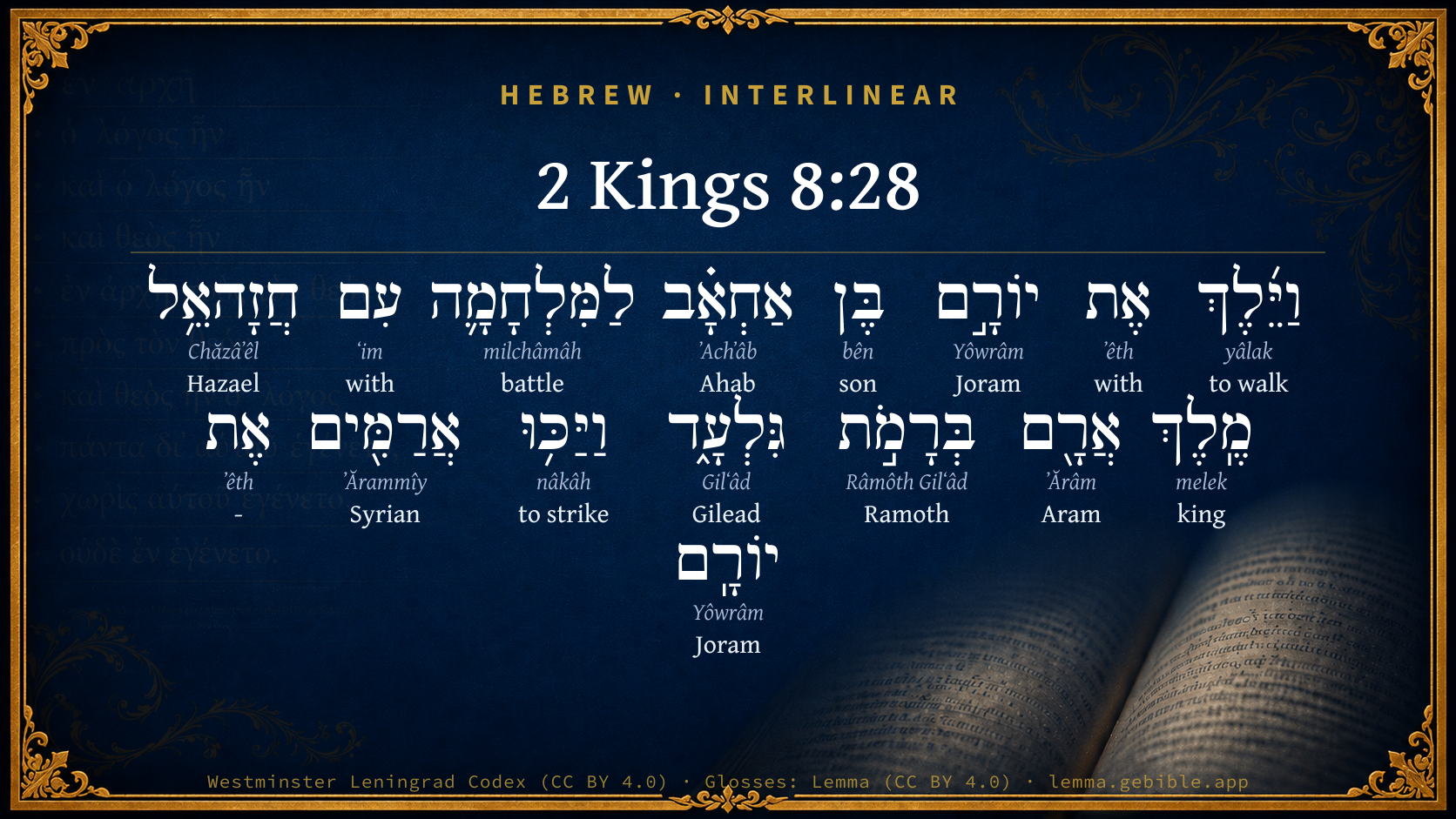
Hebrew (Westminster Leningrad Codex) 2 Kings 8:28 appears in the Hebrew Old Testament. The text above is from the Westminster Leningrad Codex. Each word links to its Strong’s number, a concise gloss, and parsing drawn from the Open Scriptures Hebrew Bible morphology. Click any word for its full Brown-Driver-Briggs (BDB) entry.
Download image
Cite this verse

2 Kings 8:28 (World English Bible). Public Domain. Lemma interlinear Bible study tool, https://lemma.gebible.app/v/2-kings/8/28.

Show BibTeX & RIS
BibTeX
RIS
English Translation
He went with Joram the son of Ahab to war against Hazael king of Syria at Ramoth-gilead: and the Syrians wounded Joram.
World English Bible · Public Domain
Download a study sheet

One document with this verse’s original text, its word-by-word gloss line, the meaning frame, cross-references with their text, attributed commentary, and full source and license credits — printable, and it pastes into notes with its structure intact.

This verse Autodidact and up

Study sheet (.html) Plain text (.txt)

A passage Seminary Student

Up to 50 verses in one chapter. A passage sheet keeps up to 6 commentary sources and 12 cross-references per verse, in the order this page ranks them, and says so on the sheet whenever that leaves anything out. Ask for a single verse and you get the Autodidact verse sheet above.

Everything on this page stays free to read, with no account — the sheet is a download of what is already on screen, not access to it.

Want to remove ads? Support Godless Engineer
Compare translations 3

The same verse in 3 English versions, stacked beneath the original-language interlinear above. Click any original word for its lexicon entry.

Each is an independent rendering of the whole verse — the interlinear is not word-aligned to these translations.

Highlighted words mark where these versions differ — a whole-verse word diff, not a word-by-word alignment.

  • World English Bible Public Domain
    He went with Joram the son of Ahab to war against Hazael king of Syria at Ramoth-gilead: and the Syrians wounded Joram.
  • King James Version Public Domain
    And he went with Joram the son of Ahab to the war against Hazael king of Syria in Ramothgilead; and the Syrians wounded Joram.
  • unfoldingWord Literal Text CC BY-SA 4.0
    And he went with Joram, the son of Ahab, to war with Hazael, the king of Aram, at Ramoth Gilead, but the Arameans struck Joram.

unfoldingWord Literal Text — © unfoldingWord, licensed CC BY-SA 4.0. Word-aligned USFM3 via Door43 (git.door43.org/unfoldingWord/en_ult).

Versions to compare (up to 4)

3 of 4 selected

Show all 18 translations

Every available English version of this verse, each an independent rendering of the whole verse.

  • World English Bible Public Domain
    He went with Joram the son of Ahab to war against Hazael king of Syria at Ramoth-gilead: and the Syrians wounded Joram.
  • Berean Standard Bible Public Domain
    Then Ahaziah went with Joram son of Ahab to fight against Hazael king of Aram at Ramoth-gilead, and the Arameans wounded Joram.
  • Majority Standard Bible Public Domain
    Then Ahaziah went with Joram son of Ahab to fight against Hazael king of Aram at Ramoth-gilead, and the Arameans wounded Joram.
  • King James Version Public Domain
    And he went with Joram the son of Ahab to the war against Hazael king of Syria in Ramothgilead; and the Syrians wounded Joram.
  • American Standard Version (1901) Public Domain
    And he went with Joram the son of Ahab to war against Hazael king of Syria at Ramoth-gilead: and the Syrians wounded Joram.
  • Revised Version (1885) Public Domain
    And he went with Joram the son of Ahab to war against Hazael king of Syria at Ramoth-gilead: and the Syrians wounded Joram.
  • Geneva Bible (1599) Public Domain
    And he went with Ioram the sonne of Ahab to warre against Hazael King of Aram in Ramoth Gilead, and the Aramites smote Ioram.
  • Douay-Rheims (1899) Public Domain
    He went also with Joram son of Achab, to fight against Hazael king of Syria in Ramoth Galaad, and the Syrians wounded Joram:
  • Young's Literal Translation Public Domain
    And he goeth with Joram son of Ahab to battle with Hazael king of Aram in Ramoth-Gilead, and the Aramaeans smite Joram,
  • Literal Standard Version CC BY-SA 4.0
    And he goes with Joram son of Ahab to battle with Hazael king of Aram in Ramoth-Gilead, and the Arameans strike Joram,
  • Unlocked Literal Bible CC BY-SA 4.0
    Ahaziah went with Joram son of Ahab, to fight against Hazael, king of Aram, at Ramoth Gilead. The Arameans wounded Joram.
  • unfoldingWord Literal Text CC BY-SA 4.0
    And he went with Joram, the son of Ahab, to war with Hazael, the king of Aram, at Ramoth Gilead, but the Arameans struck Joram.
  • Darby Bible Public Domain
    And he went with Joram the son of Ahab to the war against Hazael the king of Syria at Ramoth-Gilead; and the Syrians wounded Joram.
  • World Messianic Bible Public Domain
    He went with Joram the son of Ahab to war against Hazael king of Syria at Ramoth Gilead, and the Syrians wounded Joram.
  • Webster's Bible Public Domain
    And he went with Joram the son of Ahab to the war against Hazael king of Syria in Ramoth-gilead; and the Syrians wounded Joram.
  • Free Bible Version CC BY-SA 4.0
    Ahaziah went with Joram, son of Ahab, to fight against Hazael, king of Aram, at Ramoth-gilead. The Arameans wounded Joram,
  • Bible in Basic English Public Domain
    He went with Joram, the son of Ahab, to make war on Hazael, king of Aram, at Ramoth-gilead: and Joram was wounded by the Aramaeans.
  • JPS Tanakh (1917) Public Domain
    And he went with Joram the son of Ahab to war against Hazael king of Aram at Ramoth-gilead; and the Arameans wounded Joram.

Literal Standard Version (2020), Covenant Press — licensed CC BY-SA 4.0. Text via the HelloAO Bible API (eBible.org). Unlocked Literal Bible (unfoldingWord) — licensed CC BY-SA 4.0. Text via the HelloAO Bible API (eBible.org). unfoldingWord Literal Text — © unfoldingWord, licensed CC BY-SA 4.0. Word-aligned USFM3 via Door43 (git.door43.org/unfoldingWord/en_ult). Free Bible Version, Dr. Jonathan Gallagher — licensed CC BY-SA 4.0. Text via the HelloAO Bible API (eBible.org).

Word by word

More ways to search: Search by grammar → Find every occurrence → Compare this word →

Practice this passage: Drill this verse → Learn its vocabulary →

אֲרַמִּ֖ים
ʼĂrammîy
H761
“Syrians”
Noun, Gentilic, Masculine, Plural, Absolute
Part of Speech
Noun
Type
Gentilic
Gender
Masculine
Number
Plural
State
Absolute
Full BDB Definition

Origin: patrial from H758

TWOT: None

Syrian or Aramean = "exalted" - a thing or a person from Syria or Aram
  1. וַיֵּ֜לֶךְ yâlak H3212 “and · to walk” Conjunction + Verb, Qal, Sequential Imperfect, 3rd Person, Masculine, Singular
  2. אֶת ʼêth H854 “with” Preposition
  3. יוֹרָ֣ם Yôwrâm H3141 “Joram” Noun, Proper
  4. בֶּן bên H1121 “son of” Noun, Common, Masculine, Singular, Construct
  5. אַחְאָ֗ב ʼAchʼâb H256 “Ahab” Noun, Proper
  6. לַמִּלְחָמָ֛ה milchâmâh H4421 “to/for the · battle” Preposition, Determined + Noun, Common, Feminine, Singular, Absolute
  7. עִם ʻim H5973 “with” Preposition
  8. חֲזָהאֵ֥ל Chăzâʼêl H2371 “Hazael” Noun, Proper
  9. מֶֽלֶךְ melek H4428 “king of” Noun, Common, Masculine, Singular, Construct
  10. אֲרָ֖ם ʼĂrâm H758 “Aram” Noun, Proper
  11. בְּרָמֹ֣ת Râmôth Gilʻâd H7433 “in/at · Ramoth” Preposition + Noun, Proper
  12. גִּלְעָ֑ד Gilʻâd H1568 “Gilead” Noun, Proper
  13. וַיַּכּ֥וּ nâkâh H5221 “and · to strike” Conjunction + Verb, Hiphil, Sequential Imperfect, 3rd Person, Masculine, Plural
  14. אֶת ʼêth H853 “-” Particle, Direct Object
  15. יוֹרָֽם Yôwrâm H3141 “Joram” Noun, Proper

About this verse

These counts appear in no published source. They are computed here, from the morphology-tagged text and Lemma’s own curated glosses. What Lemma adds →

16
words
15
distinct lemmas
Historical
section

Notable vocabulary

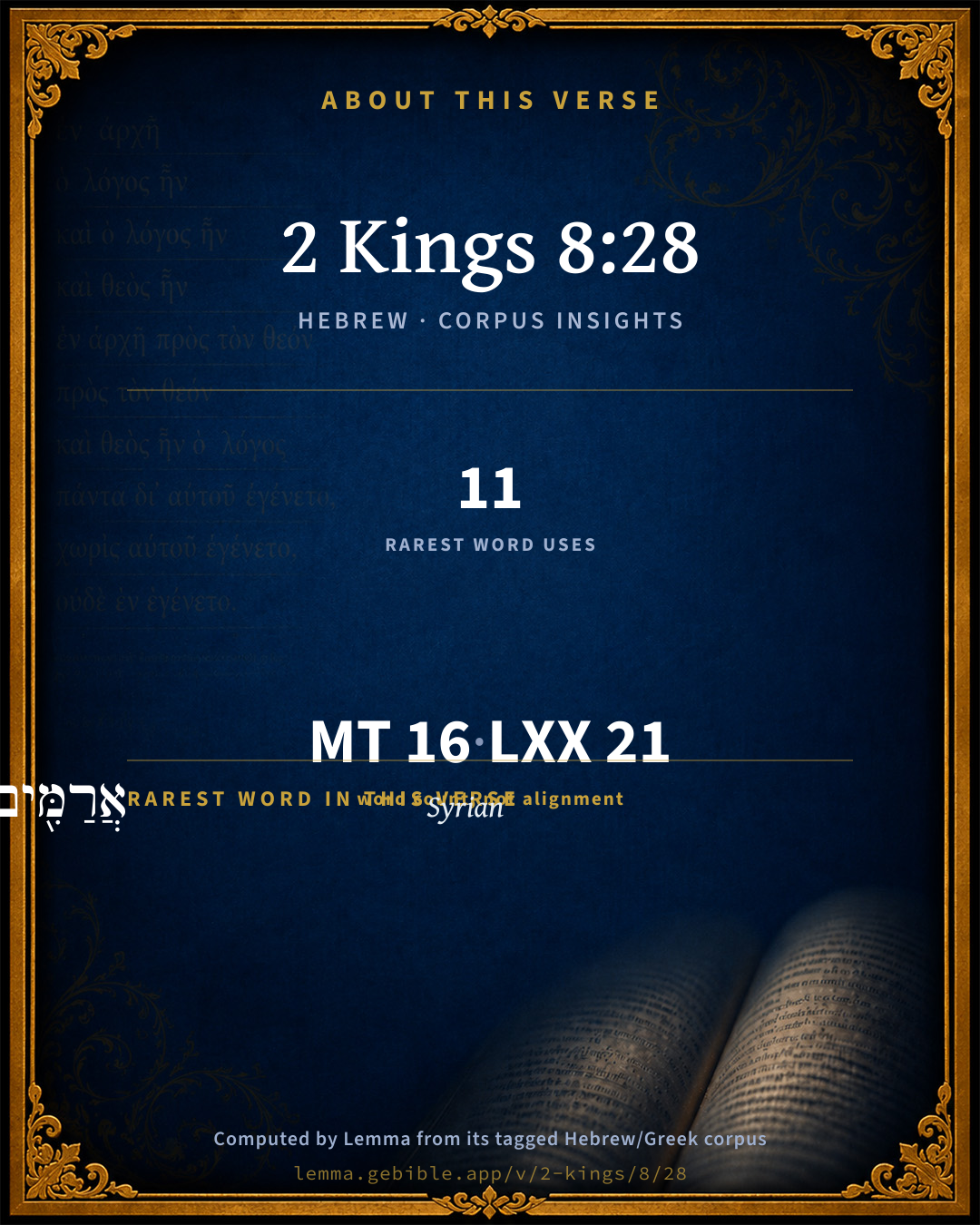
The rarest word here is אֲרַמִּ֖ים Syrian H761 — appearing just 11 times in the whole Hebrew Bible.

Shared distinctive vocabulary

אֲרַמִּ֖ים Syrian H761 occurs in 10 verses of the Hebrew Bible. Also found in:

Grammatical profile

  • 2 verbs
  • 11 nouns
  • 2 prepositions
  • 1 particle

Verb forms

  • וַיֵּ֜לֶךְ Qal · Sequential Imperfect
  • וַיַּכּ֥וּ Hiphil · Sequential Imperfect

Repetition

A word recurs within this verse — often emphatic in Hebrew:

  • יוֹרָ֣ם Joram H3141 ×2

Hebrew & Septuagint length

In English translation the verse runs 22 words from the Hebrew and 25 from the Septuagint (LXX English) — closely comparable.

A rough comparison of the two English renderings, which tokenize alike — not a word-level alignment.

Word counts can differ between the Hebrew and the Greek without any difference in meaning — e.g. the Hebrew direct-object marker אֵת has no separate Greek word, and Greek often adds the article ὁ.

In the original languages it is 16 Hebrew tokens and 21 Greek tokens — but the two are counted differently (Hebrew bundles its prefixes and suffixes into one token; the Greek is in lemma form), so that isn’t a like-for-like length.

Cross-references

13

Topical passages linked to 2 Kings 8:28 in the Treasury of Scripture Knowledge — connected by theme and wording, ordered by reader-vote popularity; previews shown in the World English Bible.

  • 2 Chronicles 22:5 He walked also after their counsel, and went with Jehoram the son of Ahab king of Israel to war against Hazael king of Syria at Ramoth-gilead: and the Syrians wounded Joram.
  • Joshua 21:38 Out of the tribe of Gad, Ramoth in Gilead with its suburbs, the city of refuge for the manslayer, and Mahanaim with its suburbs,
  • 1 Kings 4:13 Ben Geber, in Ramoth-gilead (to him [pertained] the towns of Jair the son of Manasseh, which are in Gilead; [even] to him [pertained] the region of Argob, which is in Bashan, sixty great cities with walls and brazen bars);
  • 1 Kings 19:17 It shall happen, that he who escapes from the sword of Hazael shall Jehu kill; and he who escapes from the sword of Jehu shall Elisha kill.
  • 1 Kings 22:3–4 The king of Israel said to his servants, "You know that Ramoth-gilead is ours, and we are still, and don't take it out of the hand of the king of Syria?"
  • 1 Kings 22:29 So the king of Israel and Jehoshaphat the king of Judah went up to Ramoth-gilead.
  • 2 Kings 3:7 He went and sent to Jehoshaphat the king of Judah, saying, The king of Moab has rebelled against me: will you go with me against Moab to battle? He said, I will go up: I am as you are, my people as your people, my horses as your horses.
  • 2 Kings 8:12–13 Hazael said, Why weeps my lord? He answered, Because I know the evil that you will do to the children of Israel: their strongholds will you set on fire, and their young men will you kill with the sword, and will dash in pieces their little ones, and rip up their women with child.
  • 2 Kings 8:15 It happened on the next day, that he took the coverlet, and dipped it in water, and spread it on his face, so that he died: and Hazael reigned in his place.
  • 2 Kings 9:15 but king Joram was returned to be healed in Jezreel of the wounds which the Syrians had given him, when he fought with Hazael king of Syria.) Jehu said, If this be your mind, then let none escape and go forth out of the city, to go to tell it in Jezreel.
  • 2 Chronicles 18:2–3 After certain years he went down to Ahab to Samaria. Ahab killed sheep and oxen for him in abundance, and for the people who were with him, and moved him to go up [with him] to Ramoth-gilead.
  • 2 Chronicles 18:31 It happened, when the captains of the chariots saw Jehoshaphat, that they said, It is the king of Israel. Therefore they turned about to fight against him: but Jehoshaphat cried out, and Yahweh helped him; and God moved them [to depart] from him.
  • 2 Chronicles 19:2 Jehu the son of Hanani the seer went out to meet him, and said to king Jehoshaphat, Should you help the wicked, and love those who hate Yahweh? for this thing wrath is on you from before Yahweh.

Cross-references courtesy of OpenBible.info (CC BY 4.0).

Hebrew and Greek witnesses Masoretic Hebrew ↔ Greek Septuagint

The same verse in the two great witnesses to the Old Testament, shown verse-for-verse.

These are two independent witnesses, not word-aligned to each other, and the Septuagint is shown in lemma (dictionary) form.

Hebrew 2 Kings 8:28 Masoretic · Westminster Leningrad Codex

וַיֵּ֜לֶךְ אֶת יוֹרָ֣ם בֶּן אַחְאָ֗ב לַמִּלְחָמָ֛ה עִם חֲזָהאֵ֥ל מֶֽלֶךְ אֲרָ֖ם בְּרָמֹ֣ת גִּלְעָ֑ד וַיַּכּ֥וּ אֲרַמִּ֖ים אֶת יוֹרָֽם

He went with Joram the son of Ahab to war against Hazael king of Syria at Ramoth-gilead: and the Syrians wounded Joram.

World English Bible · Public Domain

Greek LXX 2 Kings 8:28 Septuagint · lemma form

καί πορεύομαι μετά ιωραμ υἱός αχααβ εἰς πόλεμος μετά αζαηλ βασιλεύς ἀλλόφυλος ἐν ρεμμωθ γαλαάδ καί πατάσσω ὁ σύρος ὁ ιωραμ

And he went with Joram the son of Achaab to war against Azael king of the Syrians in Remmoth Galaad; and the Syrians wounded Joram.

LXX2012 (modern English Septuagint) · Public Domain

On this verse, The Pulpit Commentary discusses the Septuagint’s reading. Read the note in Commentary ↓

Hebrew: Westminster Leningrad Codex (CC BY 4.0). Greek: Septuagint (public domain); English from LXX2012 (modern English Septuagint) (Public Domain). How the Septuagint differs from the Hebrew →

Targum (Aramaic paraphrase)

1

The Targum is the ancient Jewish Aramaic paraphrase of the Hebrew Scriptures — an interpretive translation, not the Hebrew text itself. Onkelos (literal) and Pseudo-Jonathan (expansive) render the Torah, and Jonathan the Prophets. Coverage is partial: where no permissively-licensed English translation exists for a verse, only the Aramaic is shown. This is verse-level text, not a word-by-word alignment to the Hebrew.

  1. Targum Jonathan Prophets (Joshua–Malachi)
    וַאֲזַל עִם יוֹרָם בַּר אַחְאָב לְאַגָחָא קְרָבָא עִם חֲזָאֵל מַלְכָּא דַאֲרָם בְּרָמוֹת גִלְעָד וּמְחוֹ אֱנַשׁ אֲרָם יַת יוֹרָם:

    (no public-domain English translation for this verse)

    Targum Jonathan — Aramaic: “Mikraot Gedolot” (public domain). English: “Sefaria Community Translation” (CC0 1.0 (public-domain dedication)); “London "Chaldee Paraphrase," 1871” (public domain). Text via Sefaria.

Commentary

Notes on 2 Kings 8:28 from classic Christian and Jewish commentators (each source and its license shown beneath its notes). The classic Christian expositions comment on the surrounding passage and are grouped to its opening verse, so a note may address several verses; the Jewish commentaries on the Tanakh (Rashi and others) are per-verse, so they appear only where the commentator wrote on this verse.

Lemma curates 59 commentaries, every one of them public domain or Creative Commons licensed, each selected and text-cleaned for this edition rather than reprinted as found. About our sources →

Trapp's Complete Commentary

John Trapp

2Ki 8:28 And he went with Joram the son of Ahab to the war against Hazael king of Syria in Ramothgilead; and the Syrians wounded Joram.

Ver. 28. And the Syrians wounded Joram.] See on 2Ki 5:7.

John Trapp, A Commentary or Exposition upon All the Books of the Old and New Testament (1647–1656) — public domain. Text from a community e-Sword module.

Keil & Delitzsch

C. F. Keil & F. Delitzsch

Ahaziah went with Joram of Israel, his mother's brother, to the war with the Syrians at Ramoth. The contest for this city, which had already cost Ahab his life (1 Kings), was to furnish the occasion, according to the overruling providence of God, for the extermination of the whole of Omri's family. Being wounded in the battle with the Syrians, Joram king of Israel returned to Jezreel to be healed of his wounds. His nephew Ahaziah visited him there, and there he met with his death at the same time as Joram at the hands of Jehu, who had conspired against Joram (see Kg2 9:14. and Ch2 22:7-9). Whether the war with Hazael at Ramoth was for the recapture of this city, which had been taken by the Syrians, or simply for holding it against the Syrians, it is impossible to determine. All that we can gather from Kg2 9:14 is, that at that time Ramoth was in the possession of the Israelites, whether it had come into their possession again after the disgraceful rout of the Syrians before Samaria (2 Kings 7), or whether, perhaps, it was not recovered till this war. For ארמּים without the article see Ewald, 277, c.

Kg2 8:29

בּרמה = בּלעד בּרמת, Kg2 8:28; see at Kg1 22:4.

Keil & Delitzsch — Biblical Commentary on the Old Testament (1861–1891) — public domain (CC PDM 1.0). Text via the HelloAO Bible API. (Old Testament only.)

Tyndale Open Study Notes

Tyndale Open Resources

8:28-29 Once again, a king of Judah joined an Israelite king in battle against the Arameans at Ramoth-gilead (see 1 Kgs 22:1-40). • Jezreel served as a second capital for Israel during Ahab’s reign (1 Kgs 21:1); he retreated there after witnessing Elijah’s contest with the prophets of Baal on Mount Carmel (1 Kgs 18:46).

Tyndale Open Study Notes — © Tyndale Open Resources, licensed CC BY-SA 4.0. Text via the HelloAO Bible API.

Geneva Bible (1599)

Geneva Bible translators

Which was a city in the tribe of Gad beyond Jordan.

Geneva Bible (1599) marginal notes — public domain. Text via Bolls.life.

Adam Clarke's Commentary

Verse 28. The Syrians wounded Joram] Ahaziah went with Joram to endeavour to wrest Ramoth-gilead out of the hands of the Syrians, which belonged to Israel and Judah. Ahab had endeavoured to do this before, and was slain there; see 1Kg 22:3, &c., and the notes there.

Adam Clarke's Commentary on the Bible (1810–1826) — public domain. Text from a community e-Sword/MySword module.

Ellicott's Commentary for English Readers

(28) And he went with Joram.—By the persuasion of his mother and her family (2Ch_22:4). Ewald would omit the preposition with, on the assumption that Ahaziah took no part in the war at Ramoth, but only, as 2Ki_8:29 relates, visited Jehoram wheu lying ill of his wounds at Jezreel. But (1) all the MSS. and versions have the preposition; (2) if this verse related only to Joram king of Israel we should expect at the end of the verse, and the Syrians wounded him,” rather than “wounded Joram;” and in 2Ki_8:29, “and he went back,” rather than “and king Joram went back;” (3) the chronicler (2Ch_22:5) expressly states that Ahaziah accompanied Joram to Ramoth.

Against Hazael . . . in Ramoth-gilead.—Which strong fortress Ahab had vainly tried to wrest from Ben-hadad (1Ki_22:6 seqq.).

Wounded.—Literally, smote.

A Bible Commentary for English Readers, edited by Charles John Ellicott (1878–1897) — public domain. Text from a community e-Sword module.

The Cambridge Bible for Schools and Colleges

gen. ed. J. J. S. Perowne

28. to the war against Hazael] Hazael was already beginning to fulfil the forecast of Elisha. Ramoth-gilead belonged to Israel (1Ki_22:3) but now, as in Ahab’s reign, it was being seized by the Syrians. Joram, Ahab’s son, had ill-fortune like that of his father in the Syrian war, though as is evident from the next chapter he kept possession of Ramoth and left his officers there.

The Cambridge Bible for Schools and Colleges (gen. ed. J. J. S. Perowne; Cambridge University Press, 1878–1918) — public domain. Text from a community e-Sword module.

Albert Barnes' Notes on the Bible

This war of the two kings against Hazael seems to have had for its object the recovery of Ramoth-gilead, which Ahab and Jehoshaphat had vainly attempted fourteen years earlier 1 Kings 22:3-36. Joram probably thought that the accession of a new and usurping monarch presented a favorable opportunity for a renewal of the war. It may also have happened that Hazael was engaged at the time upon his northern frontier with repelling one of those Assyrian attacks which seem by the inscriptions to have fallen upon him in quick succession during his earlier years. At any rate, the war appears to have been successful. Ramoth-gilead was recovered 2Ki 9:14, and remained probably thenceforth in the hands of the Israelites.

The Syrians wounded Joram - According to Josephus, Joram was struck by an arrow in the course of the siege, but remained until the place was taken. He then withdrew to Jezreel 1Ki 18:45; 1Ki 21:1, leaving his army under Jehu within the walls of the town.

Albert Barnes' Notes on the Bible (1834–1885) — public domain. Text from a community e-Sword/MySword module.

Haydock's Catholic Bible Commentary

Galaad. The same city had proved fatal to Achab, 3 Kings xxii. Joram took it, but received (Calmet) many wounds; so that he left Jehu to attack the citadel. The latter was anointed king, and acknowledged by the army. He immediately proceeded to Jezrahel, and put his master to death. (Haydock)

George Leo Haydock (1774–1849), Haydock's Catholic Family Bible and Commentary, 1859 edition — public domain. Excludes Psalms (Douay-Rheims chapter numbering differs from Protestant) and Deuterocanonical books (Catholic canon only).

Whedon's Commentary on the Bible

Daniel D. Whedon

28. Went with Joram — His uncle.

To the war against Hazael — Here already we meet with that Hazael who treated with such contempt and apparent abhorrence the thought that he should commit sore evils against Israel, (2Ki_8:13,) engaged in war with that people. This battle was at Ramoth-gilead, the old spot so much contested between the kings of Israel and Syria. 1Ki_22:3. At this time it was retaken from the Syrians by Joram’s forces, and held in spite of all Hazael’s efforts to recover it. 2Ki_9:14.

The Syrians wounded Joram — While besieging Ramoth-gilead, according to Josephus, he was struck by an arrow from one of the Syrian archers.

Daniel D. Whedon (gen. ed.), Commentary on the Old and New Testaments (1874–1909) — public domain. Text from a community e-Sword module.

The Pulpit Commentary

And he went with Joram the son of Ahab to the war against Hazael King of Syria in Ramoth-Gilead. Some translate, and Joram himself went; but this is a very rare use of ta; and one which would be unnatural in this place for why "Joram himself," when "Joram" alone would have been quite sufficient? and still more unnatural in 2Ch_22:5, where the same phrase occurs. It is best, therefore, to follow our translators, who are in accord both with the Septuagint and with the Vulgate. Ahaziah followed the example of his grandfather Jehoshaphat, who had accompanied Ahab to Ramoth-Gilead, (1Ki_22:29) to fight against the Syrians in the time of Benhadad. That the city was still disputed shows the importance which it possessed in the eyes of both parties. And the Syrians wounded Joram. It appears that Hazael, soon after his accession, with the ardor of a young prince anxious to distinguish himself, made an expedition against Ramoth-Gilead, which had been recovered by the Israelites between the death of Ahab and the time of which the historian is now treating. Joram went to the relief of the town with a large force, and, being received within the walls, maintained a gallant defense, (2Ki_9:14) in the course of which he was wounded severely, though not fatally. Thereupon he and his brother king quitted the town and returned to their respective capitals, leaving a strong garrison in Ramoth-Gilead under Jehu and some other captains. Joram needed rest and careful nursing on account of his wounds, and Ahaziah would naturally withdraw with him; since he could not serve under a mere general.

The Pulpit Commentary (1880–1919), ed. H.D.M. Spence-Jones & Joseph S. Exell — public domain. Text from a community e-Sword module.

unfoldingWord translationNotes

Door43 World Missions Community

Ahaziah went with Joram son of Ahab, to fight against Hazael, king of Aram

The names of the three kings listed here are synecdoches and refer also to their armies that accompany them. AT: "Ahaziah's army joined the army of King Joram of Israel to fight against the army of King Hazael of Aram" (See: Synecdoche)

to be healed

This can be stated in active form. AT: "to heal" or "to recover" (See: Active or Passive)

against Hazael king of Aram

Here "Hazael" refers to himself and his army. AT: "the army of Hazael king of Aram" (See: Synecdoche)

Joram had been wounded

This can be stated in active form. AT: "the Arameans had wounded Joram" (See: Active or Passive)

translationWords

Ramoth

Gilead

cure

Jezreel

Ramah

unfoldingWord translationNotes — © Distant Shores Media and the Door43 World Missions Community, licensed CC BY-SA 4.0. Source: git.door43.org/Door43/en_tn.

Lesson kit

Teaching starters — assembled from the data on this page, not authored interpretation. Every prompt links to the verse data it draws on. Edit before teaching.

2 Kings, in the Historical, opens this verse with 16 words (15 distinct Hebrew lemmas). Its most distinctive word is ʼĂrammîy (“Syrian”). A historical commentator’s framing appears above. Read the whole chapter for the surrounding context.

Discussion questions

  1. The word ʼĂrammîy carries the sense “Syrian.” How does it shape the verse?
  2. Genesis 25:20 shares the word «Syrian» with this verse. How do the two illuminate each other?
  3. “Joram” occurs 2× in this one verse. What is the effect of the repetition?
  4. These translations render this verse differently. What is at stake in choosing one wording over another?
  5. The verb «וַיֵּ֜לֶךְ» is Qal Sequential Imperfect. How does its form color the action?
  6. Reading how Trapp's Complete Commentary and Keil & Delitzsch read this verse, where do the two commentators agree and where do they part?

Things to notice

Reading settings

Reading text

Shown beneath each verse's original-language words.

Old Testament
Old Testament edition

Read the OT as the Masoretic Hebrew (MT) or the Greek Septuagint (LXX).

English shown for the Greek Septuagint (in the Hebrew ↔ Greek comparison).

Comparing translations? Open the Compare panel on any verse page to stack up to four side by side.