
Isaiah 49:10

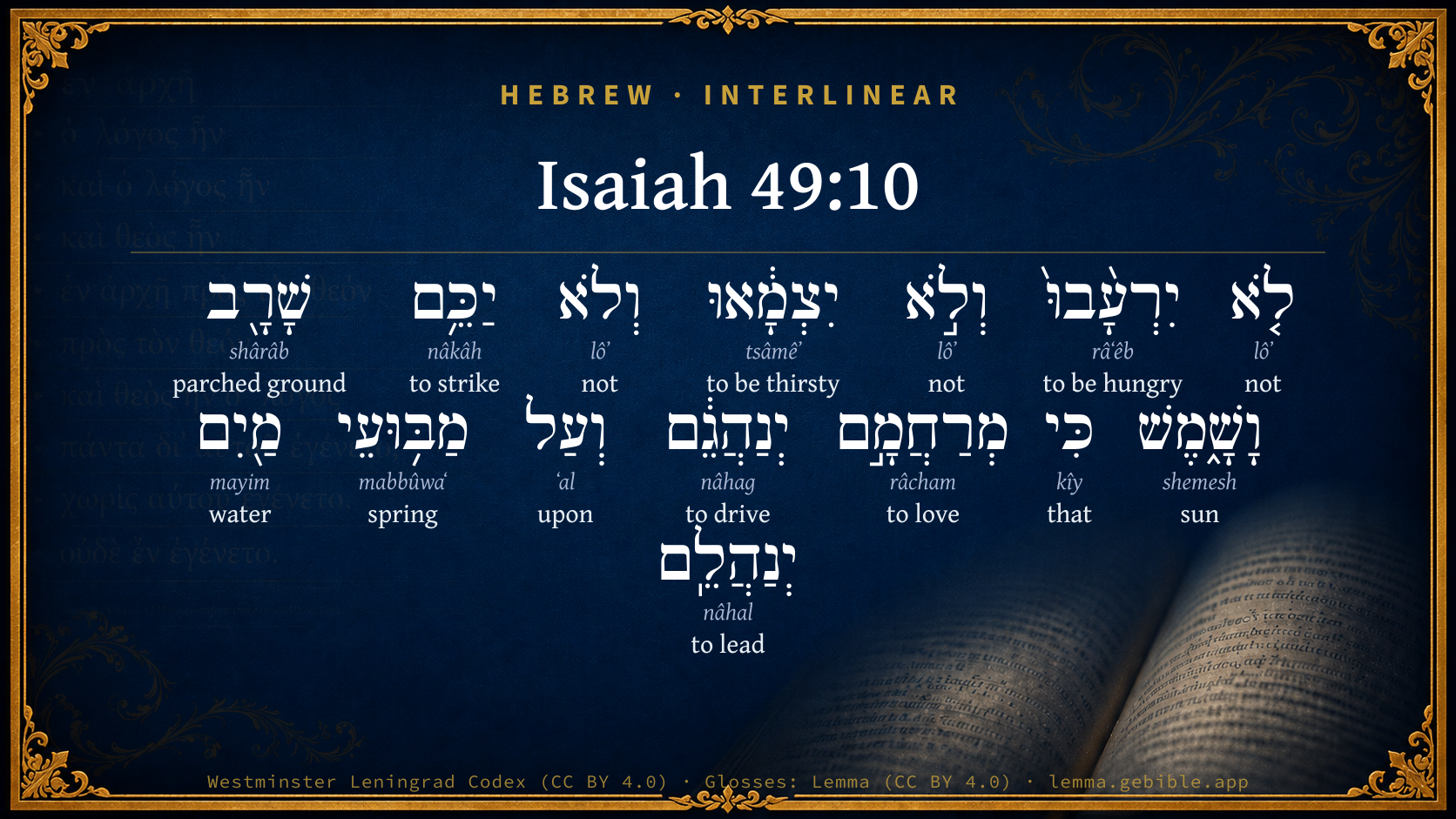
Hebrew (Westminster Leningrad Codex) Isaiah 49:10 appears in the Hebrew Old Testament. The text above is from the Westminster Leningrad Codex. Each word links to its Strong’s number, a concise gloss, and parsing drawn from the Open Scriptures Hebrew Bible morphology. Click any word for its full Brown-Driver-Briggs (BDB) entry.
Download image
Cite this verse

Isaiah 49:10 (World English Bible). Public Domain. Lemma interlinear Bible study tool, https://lemma.gebible.app/v/isaiah/49/10.

Show BibTeX & RIS
BibTeX
RIS
English Translation
They shall not hunger nor thirst; neither shall the heat nor sun strike them: for he who has mercy on them will lead them, even by springs of water will he guide them.
World English Bible · Public Domain
Download a study sheet

One document with this verse’s original text, its word-by-word gloss line, the meaning frame, cross-references with their text, attributed commentary, and full source and license credits — printable, and it pastes into notes with its structure intact.

This verse Autodidact and up

Study sheet (.html) Plain text (.txt)

A passage Seminary Student

Up to 50 verses in one chapter. A passage sheet keeps up to 6 commentary sources and 12 cross-references per verse, in the order this page ranks them, and says so on the sheet whenever that leaves anything out. Ask for a single verse and you get the Autodidact verse sheet above.

Everything on this page stays free to read, with no account — the sheet is a download of what is already on screen, not access to it.

Want to remove ads? Support Godless Engineer
Compare translations 3

The same verse in 3 English versions, stacked beneath the original-language interlinear above. Click any original word for its lexicon entry.

Each is an independent rendering of the whole verse — the interlinear is not word-aligned to these translations.

Highlighted words mark where these versions differ — a whole-verse word diff, not a word-by-word alignment.

  • World English Bible Public Domain
    They shall not hunger nor thirst; neither shall the heat nor sun strike them: for he who has mercy on them will lead them, even by springs of water will he guide them.
  • King James Version Public Domain
    They shall not hunger nor thirst; neither shall the heat nor sun smite them: for he that hath mercy on them shall lead them, even by the springs of water shall he guide them.
  • unfoldingWord Literal Text CC BY-SA 4.0
    They will not hunger, and they will not thirst, and the glaring heat and the sun will not strike them, for the one having compassion on them will lead them, and to springs of water he will guide them.

unfoldingWord Literal Text — © unfoldingWord, licensed CC BY-SA 4.0. Word-aligned USFM3 via Door43 (git.door43.org/unfoldingWord/en_ult).

Versions to compare (up to 4)

3 of 4 selected

Show all 18 translations

Every available English version of this verse, each an independent rendering of the whole verse.

  • World English Bible Public Domain
    They shall not hunger nor thirst; neither shall the heat nor sun strike them: for he who has mercy on them will lead them, even by springs of water will he guide them.
  • Berean Standard Bible Public Domain
    They will not hunger or thirst, nor will scorching heat or sun beat down on them. For He who has compassion on them will guide them and lead them beside springs of water.
  • Majority Standard Bible Public Domain
    They will not hunger or thirst, nor will scorching heat or sun beat down on them. For He who has compassion on them will guide them and lead them beside springs of water.
  • King James Version Public Domain
    They shall not hunger nor thirst; neither shall the heat nor sun smite them: for he that hath mercy on them shall lead them, even by the springs of water shall he guide them.
  • American Standard Version (1901) Public Domain
    They shall not hunger nor thirst; neither shall the heat nor sun smite them: for he that hath mercy on them will lead them, even by springs of water will he guide them.
  • Revised Version (1885) Public Domain
    They shall not hunger nor thirst; neither shall the heat nor sun smite them: for he that hath mercy on them shall lead them, even by the springs of water shall he guide them.
  • Geneva Bible (1599) Public Domain
    They shall not be hungrie, neither shall they be thirstie, neither shall the heat smite them, nor the sunne: for he that hath compassion on them, shall leade them: euen to the springs of waters shall he driue them.
  • Douay-Rheims (1899) Public Domain
    They shall not hunger, nor thirst, neither shall the heat nor the sun strike them: for he that is merciful to them, shall be their shepherd, and at the fountains of waters he shall give them drink.
  • Young's Literal Translation Public Domain
    They do not hunger, nor thirst, Nor smite them doth mirage and sun, For He who is pitying them doth lead them, And by fountains of waters doth tend them.
  • Literal Standard Version CC BY-SA 4.0
    They do not hunger, nor thirst, || Nor do mirage and sun strike them, || For He who is pitying them leads them, || And tends them by fountains of waters.
  • Unlocked Literal Bible CC BY-SA 4.0
    They will not be hungry or thirsty; nor will the heat or sun beat on them, for he who has mercy on them will lead them; he will guide them to springs of water.
  • unfoldingWord Literal Text CC BY-SA 4.0
    They will not hunger, and they will not thirst, and the glaring heat and the sun will not strike them, for the one having compassion on them will lead them, and to springs of water he will guide them.
  • Darby Bible Public Domain
    They shall not hunger nor thirst, neither shall the heat nor sun smite them; for he that hath mercy on them will lead them, and by the springs of water will he guide them.
  • World Messianic Bible Public Domain
    They shall not hunger nor thirst; neither shall the heat nor sun strike them, for he who has mercy on them will lead them. He will guide them by springs of water.
  • Webster's Bible Public Domain
    They shall not hunger nor thirst, neither shall the heat nor sun smite them: for he that hath mercy on them shall lead them, even by the springs of water shall he guide them.
  • Free Bible Version CC BY-SA 4.0
    They won't be hungry or thirsty, and they won't get hot in the sun, for the one who loves them will lead them to springs, and guide them to water.
  • Bible in Basic English Public Domain
    They will not be in need of food or drink, or be troubled by the heat or the sun: for he who has mercy on them will be their guide, taking them by the springs of water.
  • JPS Tanakh (1917) Public Domain
    They shall not hunger nor thirst, neither shall the heat nor sun smite them; for He that hath compassion on them will lead them, even by the springs of water will He guide them.

Literal Standard Version (2020), Covenant Press — licensed CC BY-SA 4.0. Text via the HelloAO Bible API (eBible.org). Unlocked Literal Bible (unfoldingWord) — licensed CC BY-SA 4.0. Text via the HelloAO Bible API (eBible.org). unfoldingWord Literal Text — © unfoldingWord, licensed CC BY-SA 4.0. Word-aligned USFM3 via Door43 (git.door43.org/unfoldingWord/en_ult). Free Bible Version, Dr. Jonathan Gallagher — licensed CC BY-SA 4.0. Text via the HelloAO Bible API (eBible.org).

Word by word

More ways to search: Search by grammar → Find every occurrence → Compare this word →

Practice this passage: Drill this verse → Learn its vocabulary →

שָׁרָ֖ב
shârâb
H8273
“parched ground”
Noun, Common, Masculine, Singular, Absolute
Part of Speech
Noun
Type
Common
Gender
Masculine
Number
Singular
State
Absolute
Full BDB Definition

Origin: from an unused root meaning to glare

TWOT: 2462a

burning or scorching heat, parched ground
  1. לֹ֤א lôʼ H3808 “not” Particle, Negative
  2. יִרְעָ֨בוּ֙ râʻêb H7456 “to be hungry” Verb, Qal, Imperfect, 3rd Person, Masculine, Plural
  3. וְלֹ֣א lôʼ H3808 “and · not” Conjunction + Particle, Negative
  4. יִצְמָ֔אוּ tsâmêʼ H6770 “to be thirsty” Verb, Qal, Imperfect, 3rd Person, Masculine, Plural
  5. וְלֹא lôʼ H3808 “and · not” Conjunction + Particle, Negative
  6. יַכֵּ֥ם nâkâh H5221 “to strike · them” Verb, Hiphil, Imperfect, 3rd Person, Masculine, Singular + Suffix, Personal, 3rd Person, Masculine, Plural
  7. וָשָׁ֑מֶשׁ shemesh H8121 “and · sun” Conjunction + Noun, Common, Both, Singular, Absolute
  8. כִּי kîy H3588 “that” Conjunction
  9. מְרַחֲמָ֣ם râcham H7355 “loving · them” Verb, Piel, Participle Active, Masculine, Singular, Construct + Suffix, Personal, 3rd Person, Masculine, Plural
  10. יְנַהֲגֵ֔ם nâhag H5090 “to drive · them” Verb, Piel, Imperfect, 3rd Person, Masculine, Singular + Suffix, Personal, 3rd Person, Masculine, Plural
  11. וְעַל ʻal H5921 “and · upon” Conjunction + Preposition
  12. מַבּ֥וּעֵי mabbûwaʻ H4002 “springs of” Noun, Common, Masculine, Plural, Construct
  13. מַ֖יִם mayim H4325 “water(s)” Noun, Common, Masculine, Plural, Absolute
  14. יְנַהֲלֵֽם nâhal H5095 “to lead · them” Verb, Piel, Imperfect, 3rd Person, Masculine, Singular + Suffix, Personal, 3rd Person, Masculine, Plural

About this verse

These counts appear in no published source. They are computed here, from the morphology-tagged text and Lemma’s own curated glosses. What Lemma adds →

15
words
13
distinct lemmas
Prophets
section

Notable vocabulary

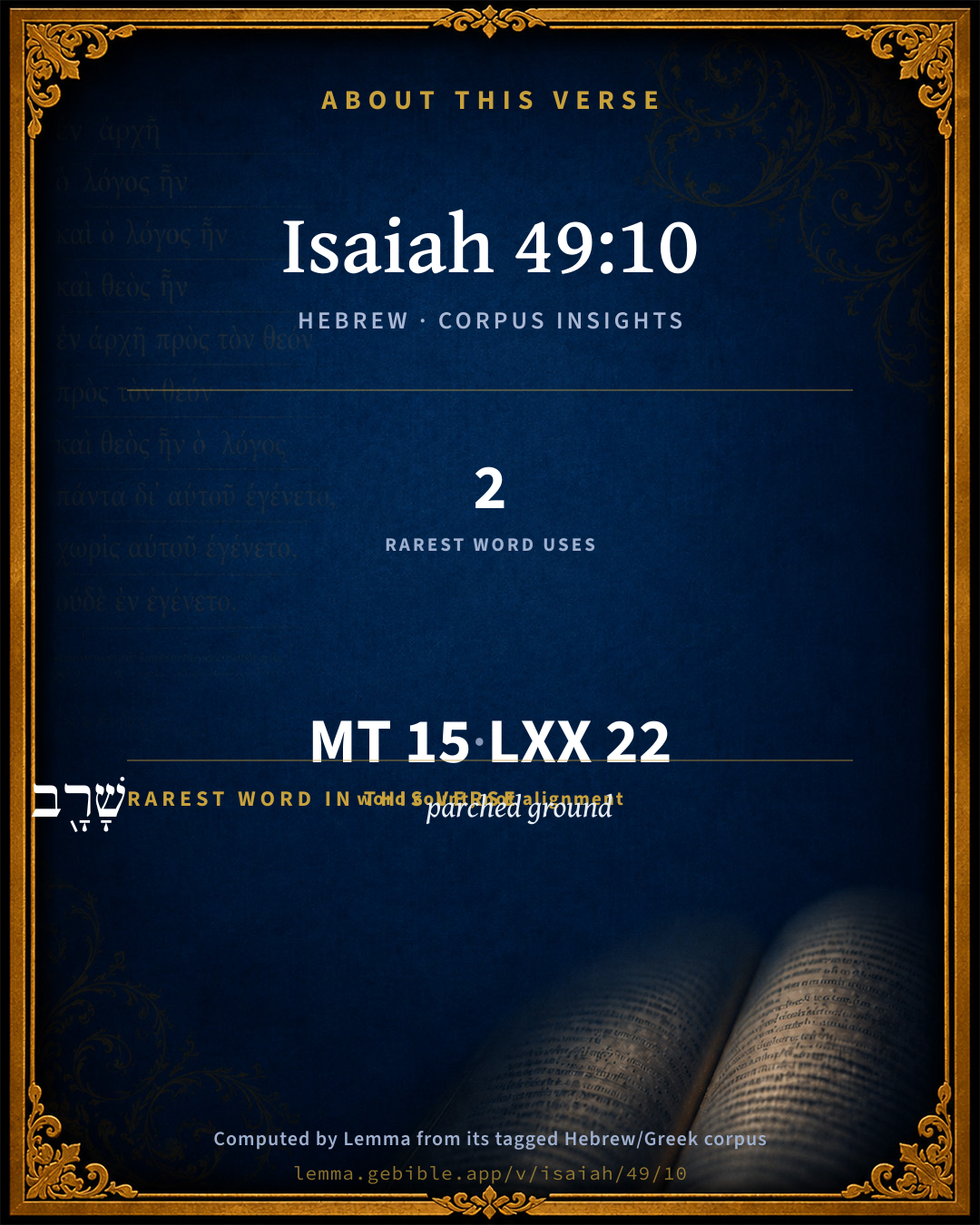
The rarest word here is שָׁרָ֖ב parched ground H8273 — appearing just 2 times in the whole Hebrew Bible.

Shared distinctive vocabulary

שָׁרָ֖ב parched ground H8273 occurs in 2 verses of the Hebrew Bible. Also found in:

Grammatical profile

  • 6 verbs
  • 4 nouns
  • 1 preposition
  • 1 conjunction
  • 3 particles

Verb forms

  • יִרְעָ֨בוּ֙ Qal · Imperfect
  • יִצְמָ֔אוּ Qal · Imperfect
  • יַכֵּ֥ם Hiphil · Imperfect
  • מְרַחֲמָ֣ם Piel · Participle Active
  • יְנַהֲגֵ֔ם Piel · Imperfect
  • יְנַהֲלֵֽם Piel · Imperfect

Repetition

A word recurs within this verse — often emphatic in Hebrew:

Hebrew & Septuagint length

In English translation the verse runs 33 words from the Hebrew and 36 from the Septuagint (LXX English) — closely comparable.

A rough comparison of the two English renderings, which tokenize alike — not a word-level alignment.

Word counts can differ between the Hebrew and the Greek without any difference in meaning — e.g. the Hebrew direct-object marker אֵת has no separate Greek word, and Greek often adds the article ὁ.

In the original languages it is 15 Hebrew tokens and 22 Greek tokens — but the two are counted differently (Hebrew bundles its prefixes and suffixes into one token; the Greek is in lemma form), so that isn’t a like-for-like length.

Cross-references

16

Topical passages linked to Isaiah 49:10 in the Treasury of Scripture Knowledge — connected by theme and wording, ordered by reader-vote popularity; previews shown in the World English Bible.

  • Revelation 7:16–17 They will never be hungry, neither thirsty any more; neither will the sun beat on them, nor any heat;
  • Matthew 5:6 Blessed are those who hunger and thirst after righteousness, For they shall be filled.
  • Ezekiel 34:23 I will set up one shepherd over them, and he shall feed them, even my servant David; he shall feed them, and he shall be their shepherd.
  • Isaiah 33:16 He shall dwell on high; his place of defense shall be the munitions of rocks; his bread shall be given [him]; his waters shall be sure.
  • Psalms 121:5–6 Yahweh is your keeper. Yahweh is your shade on your right hand.
  • Isaiah 40:11 He will feed his flock like a shepherd, he will gather the lambs in his arm, and carry them in his bosom, [and] will gently lead those who have their young.
  • Jeremiah 31:9 They shall come with weeping; and with petitions will I lead them: I will cause them to walk by rivers of waters, in a straight way in which they shall not stumble; for I am a father to Israel, and Ephraim is my firstborn.
  • John 10:3–4 The gatekeeper opens the gate for him, and the sheep listen to his voice. He calls his own sheep by name, and leads them out.
  • Isaiah 4:6 There will be a pavilion for a shade in the daytime from the heat, and for a refuge and for a shelter from storm and from rain.
  • Isaiah 25:4 For you have been a stronghold to the poor, a stronghold to the needy in his distress, a refuge from the storm, a shade from the heat, when the blast of the awesome ones is as a storm against the wall.
  • Isaiah 32:2 A man shall be as a hiding-place from the wind, and a covert from the tempest, as streams of water in a dry place, as the shade of a great rock in a weary land.
  • Isaiah 35:7 The glowing sand shall become a pool, and the thirsty ground springs of water: in the habitation of jackals, where they lay, shall be grass with reeds and rushes.
  • Psalms 23:2–4 He makes me lie down in green pastures. He leads me beside still waters.
  • Isaiah 54:10 For the mountains may depart, and the hills be removed; but my loving kindness shall not depart from you, neither shall my covenant of peace be removed, says Yahweh who has mercy on you.
  • Isaiah 14:1 For Yahweh will have compassion on Jacob, and will yet choose Israel, and set them in their own land: and the foreigner shall join himself with them, and they shall cleave to the house of Jacob.
  • John 6:35 Jesus said to them, "I am the bread of life. He who comes to me will not be hungry, and he who believes in me will never be thirsty.

Cross-references courtesy of OpenBible.info (CC BY 4.0).

Hebrew and Greek witnesses Masoretic Hebrew ↔ Greek Septuagint

The same verse in the two great witnesses to the Old Testament, shown verse-for-verse.

These are two independent witnesses, not word-aligned to each other, and the Septuagint is shown in lemma (dictionary) form.

Hebrew Isaiah 49:10 Masoretic · Westminster Leningrad Codex

לֹ֤א יִרְעָ֨בוּ֙ וְלֹ֣א יִצְמָ֔אוּ וְלֹא יַכֵּ֥ם שָׁרָ֖ב וָשָׁ֑מֶשׁ כִּי מְרַחֲמָ֣ם יְנַהֲגֵ֔ם וְעַל מַבּ֥וּעֵי מַ֖יִם יְנַהֲלֵֽם

They shall not hunger nor thirst; neither shall the heat nor sun strike them: for he who has mercy on them will lead them, even by springs of water will he guide them.

World English Bible · Public Domain

Greek LXX Isaiah 49:10 Septuagint · lemma form

οὐ πεινάω οὐδέ διψάω οὐδέ πατάσσω αὐτός καύσων οὐδέ ὁ ἥλιος ἀλλά ὁ ἔλεος αὐτός παρακαλέω καί διά πηγή ὕδωρ ἄγω αὐτός

They shall not hunger, neither shall they thirst; neither shall the heat nor the sun strike them; but he that has mercy on them shall comfort them, and by fountains of waters shall he lead them.

LXX2012 (modern English Septuagint) · Public Domain

On this verse, The Cambridge Bible for Schools and Colleges discusses the Septuagint’s reading. Read the note in Commentary ↓

Hebrew: Westminster Leningrad Codex (CC BY 4.0). Greek: Septuagint (public domain); English from LXX2012 (modern English Septuagint) (Public Domain). How the Septuagint differs from the Hebrew →

Targum (Aramaic paraphrase)

1

The Targum is the ancient Jewish Aramaic paraphrase of the Hebrew Scriptures — an interpretive translation, not the Hebrew text itself. Onkelos (literal) and Pseudo-Jonathan (expansive) render the Torah, and Jonathan the Prophets. Coverage is partial: where no permissively-licensed English translation exists for a verse, only the Aramaic is shown. This is verse-level text, not a word-by-word alignment to the Hebrew.

  1. Targum Jonathan Prophets (Joshua–Malachi)
    לָא יִכְפְנוּן וְלָא יִצְחוּן וְלָא יִלְקִינוּן שְׁרָבָא וְשִׁמְשָׁא אֲרֵי דַעֲתִיד לְרַחֲמָא עֲלֵיהוֹן יְדַבְּרִינוּן וְעַל מַבּוּעֵי מַיִין יַשְׁרִינוּן:

    They shall not hunger nor thirst, neither shall the heat nor the sun smite them: for He that shall have mercy on them shall guide them, and He shall cause them to dwell by the springs of water.

    Targum Jonathan — Aramaic: “Mikraot Gedolot” (public domain). English: “Sefaria Community Translation” (CC0 1.0 (public-domain dedication)); “London "Chaldee Paraphrase," 1871” (public domain). Text via Sefaria.

Commentary

Notes on Isaiah 49:10 from classic Christian and Jewish commentators (each source and its license shown beneath its notes). The classic Christian expositions comment on the surrounding passage and are grouped to its opening verse, so a note may address several verses; the Jewish commentaries on the Tanakh (Rashi and others) are per-verse, so they appear only where the commentator wrote on this verse.

Lemma curates 59 commentaries, every one of them public domain or Creative Commons licensed, each selected and text-cleaned for this edition rather than reprinted as found. About our sources →

Trapp's Complete Commentary

John Trapp

Isa 49:10 They shall not hunger nor thirst; neither shall the heat nor sun smite them: for he that hath mercy on them shall lead them, even by the springs of water shall he guide them.

Ver. 10. They shall not hunger nor thirst.] A sufficiency the saints have, even of outward comforts, if not a superfluity; and for inward, sunt nobis pascua, pocula, et panis coelestis, they "shall not want"; {Psa 23:1} yea, they shall "over exceedingly abound." {2Co 7:4} So little cause is there for the Jew to jeer us as poor and forlorn; spiritual alimony we are sure of, and bread and water with the gospel are good cheer. See Rev 7:16.

Neither shall the heat nor sun smite them.] As Psa 121:6. {See Trapp on "Psa 121:6"}

For he that hath mercy on them.] He saith not, Pastor, but Miserator, a sweeter title.

Even by the springs.] See Psa 23:3. {See Trapp on "Psa 23:3"}

John Trapp, A Commentary or Exposition upon All the Books of the Old and New Testament (1647–1656) — public domain. Text from a community e-Sword module.

The Biblical Illustrator

Joseph S. Exell

Isa_49:10-26

They shall not hunger nor thirst

Promise of Christ to His people

The people of God are represented as a flock of sheep travelling under the care of their good shepherd, in the heat of summer, through a barren and dry wilderness, towards a land of plenty, security, and everlasting rest.

Under such circumstances, what would this flock require? What might they expect from the hand of a faithful shepherd? There are doubtless three things which they would want and might look for--provision, protection, and refreshment. Such are the blessings promised by Christ in the text.

I. PROVISION. They shall not hunger nor thirst. Christ will furnish them with all things necessary both for life and godliness; that is, with a sufficiency of all temporal and spiritual blessings.

II. PROTECTION. Neither shall the heat nor the sun smite them. His people are exposed to the fire of persecution; but by His almighty power, by providential interpositions, He defeats the purposes, restrains the malice, and wards off the stroke of their persecutors. They are exposed, also, to the fiery darts of the wicked one; but here, again, the Lord protects His people.

III. REFRESHMENT. Even by the springs of water shall He guide them. Springs of water would be peculiarly refreshing in the sultry deserts, both as allaying the thirst of the flock, and as also furnishing on their banks fresh and verdant pasture, in which the sheep might repose and renew their wearied strength. Such and similar is the refreshment which Christ vouchsafes to His people. (E. Cooper.)

The love that will not let us go

This chapter is strewn with assurances to the chosen people on the eve of their return from Babylon. Jehovahs voice takes on a tone of unusual tenderness, and speaks as He only can. Let us heed His successive assurances of comfort and compassion.

I. HE WILL LEAD WITH A SHEPHERDS CARE.

II. HE WILL MAKE OBSTACLES SERVE HIS PURPOSE. I will make all My mountains a way (Isa_49:11). Mountains are prohibitory. The student of the geography of Palestine cannot fail to be impressed with the strong barricade of mountains with which God fenced in the Land of Promise on its southern frontier. Similarly, the mountains of Switzerland have sheltered liberty and those of Afghanistan have made conquest difficult to impossibility. There were great mountains between Israel and home, yet God does not say that He would remove them; but that they should form a pathway, as though contributing to the ease and speed of the return. I will make all My mountains a way. We all have mountains in our lives. There are people and things that threaten to bar our progress in the Divine life. Patience can only be acquired through just such trials as now seem unbearable. Submit thyself. Claim to be a par taker in the patience of Jesus. Meet thy trials in Him. Thus shall the mountains that stand between thee and thy promised land become thy way to it. Note the comprehensiveness of this promise. I will make all My mountains a way. The promise is in the future tense. When we come to the foot of the mountains we shall find the way.

III. GODS LOVE IS MORE THAN MOTHERHOOD (Isa_49:15). Many devout but misguided souls have placed the Virgin Mother on a level with God, and worship her, because they think that woman is more tender, more patient, more forgiving than man. The love of woman was Davids high-water-mark of love. And of womans love, none is so pure, so unselfish, so full of patient brooding pity, as a mothers. Such love is Gods. Indeed it is a ray from His heart. Ira mothers love is but the ray, what must His heart be! But there is sometimes a failure in motherhood. They may forget. But God can never so forget.

IV. GOD TREASURES THE THOUGHT OF HIS OWN (Isa_49:16). The Orientals had a custom of tattooing the name of beloved friends on the hand. That is the reference here. Thou art photographed where God must ever behold thee, on His hands, on His heart. Not on one hand only, but on both. Not tattooed or photographed, the marks of which might be obliterated and obscured; but graven. The graving tool was the spear, the nail, the cross. Glass will not give up its inscriptions, nor the onyx stone its seal, nor the cameo its profile; but sooner might they renounce their trust, than the hands of Christ. Not Zions ruins, but Zions walls were ever before Him. Our ideal self; what we are in Jesus; what we long to be in our best moments; what we will be when grace has perfected its work and we are comely in the comeliness He shall put upon us--this is the ineffaceable conception of us that is ever before God. What a contrast between Zions wail about being forsaken and forgotten, and Gods tender regard!

V. GODS LOVE IS STRONG ENOUGH TO CARRY OUT ITS PURPOSE (Isa_49:24). Such is the question of despondency, asked by Israel, from the heart of the mighty empire, in which she was a helpless captive But Jehovah had well calculated his resources (Isa_49:25).

VI. GODS LOVE WILL NOT PUT AWAY (Isa_50:1). (F. B.Meyer, B. A.)

The Biblical Illustrator, edited by Joseph S. Exell (c. 1880s–1900s) — public domain. Text from a community e-Sword module.

Tyndale Open Study Notes

Tyndale Open Resources

49:10-11 Like a shepherd, the Lord in his mercy will lead the returning exiles beside cool waters; he promised to comfort them and tend to their needs (see also 40:11; Ps 23:1). • level paths . . . highways: The Lord would open up the way of salvation.

Tyndale Open Study Notes — © Tyndale Open Resources, licensed CC BY-SA 4.0. Text via the HelloAO Bible API.

Geneva Bible (1599)

Geneva Bible translators

Meaning, that there should be nothing in their way from Babylon that should hinder or hurt them: but this is accomplished spiritually.

Geneva Bible (1599) marginal notes — public domain. Text via Bolls.life.

Jamieson, Fausset & Brown

Robert Jamieson, A. R. Fausset & David Brown

Messiah will abundantly satisfy all the wants, both of literal Israel on their way to Palestine, and of the spiritual on their way to heaven, as their Shepherd (Isa 65:13; Mat 5:6), also in heaven (Rev 7:16-17).

Jamieson, Fausset & Brown — Commentary Critical and Explanatory on the Whole Bible (1871) — public domain (CC PDM 1.0). Text via the HelloAO Bible API.

Ellicott's Commentary for English Readers

(10) Neither shall the heat . . .—The word is the same as the “parched ground” of Isa_35:7, and stands, as there, for the mirage of the scorching desert.

A Bible Commentary for English Readers, edited by Charles John Ellicott (1878–1897) — public domain. Text from a community e-Sword module.

The Cambridge Bible for Schools and Colleges

gen. ed. J. J. S. Perowne

10. neither shall the heat … smite them] The word for heat should probably be rendered the hot wind (Sirocco; LXX., καύσων). It is often taken to denote the mirage (see on ch. Isa_35:7), but that meaning is unsuitable here on account of the verb “smite.”

The Cambridge Bible for Schools and Colleges (gen. ed. J. J. S. Perowne; Cambridge University Press, 1878–1918) — public domain. Text from a community e-Sword module.

John Gill's Exposition

They shall not hunger nor thirst,.... Being fed in the ways and high places of Gospel ordinances with the love of God, with covenant mercies and precious promises, with Christ, the bread of life, and his grace the water of life, and with the doctrines of the Gospel; they do not desire carnal things, as formerly, but spiritual ones, which they have and are satisfied with, and desire no other food: it signifies that there shall be no famine of the word, nor want of spiritual provisions; it is applied to the New Jerusalem state, Rev 7:16 and so the following clause,

neither shall the heat nor sun smite them; not the sun of persecution, nor the heat of fiery trials and afflictions, particularly in the latter day; nor the heat of a fiery law and divine wrath, or of Satan's fiery darts; not however in the above mentioned state, or in the ultimate glory:

for he that hath mercy on them shall lead them; Christ, the great and good Shepherd of the sheep, who had mercy on them in eternity, and therefore undertook to feed them; and in time, and therefore laid down his life for them; and now in heaven, and sympathizes with him; and at the last day they shall find mercy with him: these he leads out of a state of nature, from the wilderness, where he finds them; out of their sinful ways, and from the pastures of their own righteousness; and he leads them in paths they had not known, in which they should go, in the way of truth, faith, and holiness; in right, though sometimes rough ways; he leads them to himself, his blood, righteousness, and fulness; into his Father's presence, and to his house and ordinances; into Gospel truths, and from one degree of grace to another, and at last to eternal glory; all which he does gradually, softly, gently, in proportion to their strength, and as they are able to bear:

even by the springs of water shall he guide them; or "fountains of water" (d); even of living water; which are no other than God himself, and the plenty of his grace and mercy; Christ, and the fulness of grace that is in him; the covenant of grace, and the blessings of it; the Gospel, and its ordinances; see Rev 7:17.

(d) , Sept. "fontes aquarum", V. L. rather flows of water which come from fountains, so Ben Melech; "scaturigines aquarum", Montanus; "scatebras aquarum", Vitringa.

John Gill's Exposition of the Whole Bible (1746–1763) — public domain (CC PDM 1.0). Text via the HelloAO Bible API.

Albert Barnes' Notes on the Bible

They shall not hunger nor thirst - All their needs shall be abundantly provided for, as a shepherd will provide for his flock. In the book of Revelation, this entire passage is applied Isa 7:16-17 to the happiness of the redeemed in heaven, and the use which is made of it there is not foreign to the sense in Isaiah. It means that the Messiah as a shepherd shall abundantly satisfy all the needs of his people; and it may with as much propriety be applied to the joys of heaven, as to the happiness which they will experience on earth. Their longing desires for holiness and salvation; their hungering and thirsting after righteousness Mat 5:6, shall be abundantly satisfied.

Neither shall the heat nor sun smite them - In Rev 7:16, this is, ‘Neither shall the sun light on them, nor any heat;’ that is, the burning heat of the sun shall not oppress them - an image of refreshment, protection, and joy, as when the traveler in burning sands finds the grateful shade of a rock or of a grove (see the notes at Isa 4:6; Isa 14:3; Isa 25:4; Isa 32:2). The word rendered here ‘heat’ (שׁרב shârâb), denotes properly heat, burning; and then the heated vapor which in burning deserts produces the phenomenon of the mirage (see it explained in the notes at Isa 35:7). It is equivalent here to intense heat; and means that they shall not be exposed to any suffering like that of the intense heat of the burning sun reflected from sandy wastes.

For he that hath mercy on them - That God and Saviour who shall have redeemed them shall be their shepherd and their guide, and they shall have nothing to fear.

Even by the springs of water - In Rev 7:17, ‘Shall lead them unto living fountains of waters’ (see the notes at Isa 35:6). The whole figure in this verse is taken from the character of a faithful shepherd who conducts his flock to places where they may feed in plenty; who guards them from the intense heat of a burning sun on sandy plains; and who leads them beside cooling and refreshing streams. It is a most beautiful image of the tender care of the Great Shepherd of his people in a world like this - a world in its main features, in regard to real comforts, not unaptly compared to barren hills, and pathless burning sands.

Albert Barnes' Notes on the Bible (1834–1885) — public domain. Text from a community e-Sword/MySword module.

Matthew Poole's English Annotations

They shall not hunger nor thirst, neither shall the heat nor sun smite them; they shall be supplied with all good and necessary things, and kept from all evil occurrents.

He that hath mercy on them shall lead them; God who hath magnified his mercy to them will conduct them with safety and comfort.

Matthew Poole's English Annotations on the Holy Bible (1683–1685) — public domain. Text from a community e-Sword/MySword module.

The Pulpit Commentary

They shall not hunger nor thirst.God"s (cf. Isa_35:7) To those who walk at noonday over the "glowing sand" of the desert, the heat which "smites them" seems to come as much from below as from above, the white ground reflecting the sun"s rays with a force almost equal to that wherewith the rays themselves beat down upon them from the sky. The Lord"s faithful ones, in their passage through the wilderness of life, shall be free Item these fearful trials. "The sun shall not smite them by day, neither the moon by night" (Psa_121:6) He that hath mercy on them; or, that hath compassion on them that sympathizes with their sufferings, and pities them in their trials (comp. vers. 13 and 15). Shall lead them. (Psa_23:2 Isa_40:11) The Oriental shepherd for the most part goes before his flock.

The ideal state.

The return journey of the exiles is here compared to that of a well-tended flock, which has no temptation to roam, for every need is supplied and every possible danger is averted from them. Prophetic figures can never be read aright unless we carefully distinguish between the pictured ideals of poets and prophets, and their realization in actual life. The actual never comes up to the ideal. The ideal is the best possible under the best of circumstances; the actual is the best possible under circumstances that come far short of the best possible. Ideals have their mission in keeping up our standards, and making us "aim high." Utopias are never found, but the world everywhere is the better because some of the human race have conceived Utopias, and presented their conceptions to their fellows. The absence of all elements of evil from the ideal state is figured by the removal of all sources of physical distress. This applies to the prophetic descriptions in the passage before us, and to the pictures of the heavenly given us in the Book of Revelation, "They shall hunger no more, neither thirst any more; neither shall the sun light on them, nor any heat." The points which may be profitably treated are these two.

I DISABILITIES ARE NEEDED WHILE MORAL CULTURE HAS TO BE CARRIED ON. If any proof were required of that fallen and deteriorated condition of man which is a matter of universal experience and conviction and really requires no proof, it would be found in the fact that man now will only learn his best moral lessons through suffering. We so readily think of suffering as arranged in the sovereign will of God; it is a sovereign necessity in meeting man"s fallen condition. Why will we not learn without these disabilities? It is clear that we do not, and we will not. It is evident that we are biassed towards wrong, towards self-willedness. Bodily pain, life-distresses, are necessary to the culture of moral creatures who have become enslaved to self-will., Sorrow is graciously linked with sin, lest sin should come to be loved.

II DISABILITIES MAY BE REMOVED WHEN MORAL CHARACTER IS ESTABLISHED. When men are all holy, then their surroundings may be all beautiful. There is no smiting heat, no chilling cold, no lack of food, no biting hunger, no raging thirst, no wearing pain, no blinding tears, no separating sea, no remorseless death, in heaven, because all who dwell there are established in goodness, and so there is no mission for disabilities to accomplish; their "occupation"s gone." And just so far as we win goodness on earth we rise above all our disabilities, heaven is begun below; as with everything, so with love, perfect love casteth out fear. R.T.

The Pulpit Commentary (1880–1919), ed. H.D.M. Spence-Jones & Joseph S. Exell — public domain. Text from a community e-Sword module.

J. A. Alexander on Isaiah

Joseph Addison Alexander

“They shall not hunger and they shall not thirst, and there shall not smite them mirage and sun; for He that hath mercy on them shall guide them, and by springs of water shall He lead them.” The image of a flock is still continued. (Compare Isa 40:10-11; Isa 41:18; Isa 43:19), as is the same word that is now universally explained in Isa 35:7 to mean the mirage, or delusive appearance of water in the desert. For the true sense of the verb ‘lead’, see above, on Isa 40:11.

Joseph Addison Alexander, The Prophecies of Isaiah (1846–1847; New York: Scribner, 1870–1878) — public domain. Text from a community e-Sword module.

unfoldingWord translationNotes

Door43 World Missions Community

General Information:

Yahweh continues speaking.

They will not

Here "they" refers to God's people.

nor will the heat or sun beat on them

Here the word "heat" describes the word "sun." The people suffering from the sun's heat is spoken of as if the heat struck them. AT: "nor will they suffer from the sun's heat" (See: Hendiadys and Metaphor)

for he who has mercy on them ... he will guide them

Yahweh speaks of himself in the third person. He speaks of protecting the people and caring for them as if he were their shepherd. AT: "I, the one who has mercy on them ... I will guide them" (See: First, Second, or Third Person and Metaphor)

I will make all my mountains into a road, and make my highways level

Yahweh speaks of guiding his people safely and removing obstacles from their path as if he turned mountains into roads and level highways. (See: Metaphor)

translationWords

mercy

unfoldingWord translationNotes — © Distant Shores Media and the Door43 World Missions Community, licensed CC BY-SA 4.0. Source: git.door43.org/Door43/en_tn.

Rashi

Rabbi Shlomo Yitzchaki (Rashi)

heat Heb. שָׁרָב, heat.

Rashi on the Tanakh — English translations: “The Judaica Press complete Tanach with Rashi, translated by A. J. Rosenberg” (CC BY 4.0); “Pentateuch with Rashi's commentary by M. Rosenbaum and A.M. Silbermann, 1929-1934” (public domain); “The Metsudah Tanach series, Lakewood, N.J” (CC BY 4.0); and “The Book of Joshua, Metsudah Publications, 1997” (CC BY 4.0). Text via Sefaria.

Ibn Ezra

Rabbi Abraham ibn Ezra

They will not, etc. When they return to Zion.

שרב Heat. Comp. 35:7. Nor the sun smite them. Comp. The sun shall not smite thee by day (Ps. 121:6)

Ibn Ezra on the Tanakh — English translations: “Sefaria Community Translation” (CC0 1.0 (public-domain dedication)); “Yalkut, Sifsei Chachomim Chumash, Metsudah Publications, 2009” (CC BY 4.0); and “Commentary of Ibn Ezra on Isaiah - trans. by M. Friedlander, 1873” (public domain). Text via Sefaria.

Lesson kit

Teaching starters — assembled from the data on this page, not authored interpretation. Every prompt links to the verse data it draws on. Edit before teaching.

Isaiah, in the Prophets, opens this verse with 15 words (13 distinct Hebrew lemmas). Its most distinctive word is shârâb (“parched ground”). A historical commentator’s framing appears above. Read the whole chapter for the surrounding context.

Discussion questions

  1. What does “parched ground” (shârâb) contribute to the verse as a whole?
  2. How does Isaiah 35:7, which shares the word «parched ground», read alongside this verse?
  3. What does the repetition of “not” (3× in this one verse) do in this verse?
  4. These translations render this verse differently. What is at stake in choosing one wording over another?
  5. «יִרְעָ֨בוּ֙» is a Qal Imperfect verb. How does that grammatical form shape the action described?
  6. Compare how Trapp's Complete Commentary and The Biblical Illustrator read this verse. Where do they agree or differ?

Things to notice

Reading settings

Reading text

Shown beneath each verse's original-language words.

Old Testament
Old Testament edition

Read the OT as the Masoretic Hebrew (MT) or the Greek Septuagint (LXX).

English shown for the Greek Septuagint (in the Hebrew ↔ Greek comparison).

Comparing translations? Open the Compare panel on any verse page to stack up to four side by side.